Tongdosa
Tongdosa, South Korea
Tongdosa is a working Korean mountain monastery whose main hall holds no Buddha statue, because the Buddha's relics are said to rest behind it.
The place
Tongdosa lies on the southern slope of Mount Chiseosan, just outside Yangsan in South Gyeongsang Province. Yangsan is a fast-growing commuter town for Busan, hemmed in by the Nakdong River on one side and ridges of low mountains on the others. The temple sits in the green fringe above all that, so the city and the monastery are close but feel like different worlds. The name is usually rendered as 'salvation of the world through mastery of truth'. Tongdosa is a head temple of the Jogye Order of Korean Buddhism, and it is counted among the Three Jewel Temples. Each of the three stands for one of the Buddhist jewels: Tongdosa for the Buddha, Haeinsa for the teachings, and Songgwangsa for the monastic community. What sets Tongdosa apart is the main hall. Visitors expect a gilded Buddha on an altar and instead find an empty platform and a window facing the relic shrine outside, because the relics are the presence the temple venerates. The grounds are not one compound but a string of courtyards laid out along a stream and up the slope, each with its own halls, pagodas and shrines. Walking from the outer gates to the innermost court takes a slow hour or more. It is also a living community: monks chant, study and run temple stays here, so the place is busy with practice rather than frozen as a museum. UNESCO lists it among the Buddhist mountain monasteries of Korea.
Its story
Tongdosa began in 646 with the monk Jajang, who had travelled to Tang China to study and came home during the reign of Queen Seondeok of Silla. Tradition says he carried back relics of the Buddha, among them a robe, an alms bowl and a piece of skull bone, and that the temple was founded to house them. That explains the odd emptiness of the main hall: the sacred object is not an image but the relics themselves. The temple flourished under Silla and again under Goryeo, when Buddhism was the state religion, and it stayed strong into the Joseon period. During its peak in the 1400s, the temple reportedly hosted thousands of monks and housed hundreds of buildings. The Japanese invasions of the late sixteenth century destroyed most of it. Only the main hall is recorded as surviving, and the rest was rebuilt afterwards, which is why the layout feels old but many roofs are younger than the founding date suggests. A legend is attached to the site. Nine evil dragons are said to have lived in a pond where the temple now stands. Jajang tried reciting scripture to move them on, and when they refused he wrote the character for fire on paper and tossed it into the air while stirring the water with his staff. The pond boiled, and three dragons fled, lost their bearings and died against a cliff now called Yonghyeolam, the dragon-blood rock.
What to see
- The approach gates — Temple entrance path
Tongdosa begins well before the main courtyards, with a sequence of gates along the entry path. The first is the One Pillar Gate, where the roof rests on a single row of columns, followed by the Guardian Gate and the Heavenly Kings Gate, whose painted guardians glare at visitors. Each gate marks a step from ordinary ground to sacred space.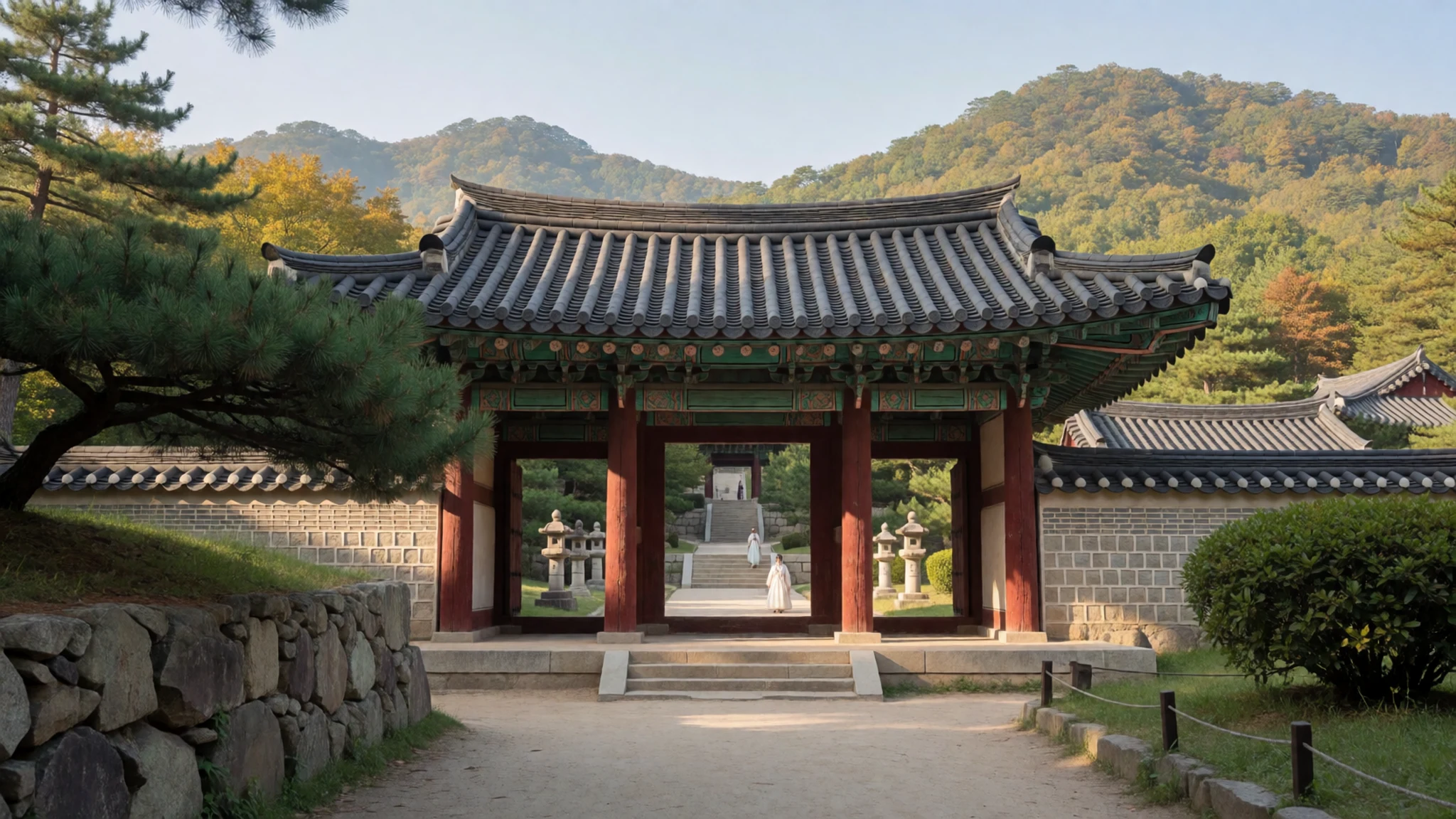
- Daeungjeon and the Diamond Altar — Inner courtyard
The main Dharma hall at Tongdosa is built so that worshippers face outwards, towards a raised stone platform called the Diamond Altar, rather than towards a statue. The relics are honoured there. Look at the painted beams and the carved ceiling inside, then walk round the altar slowly, as pilgrims do.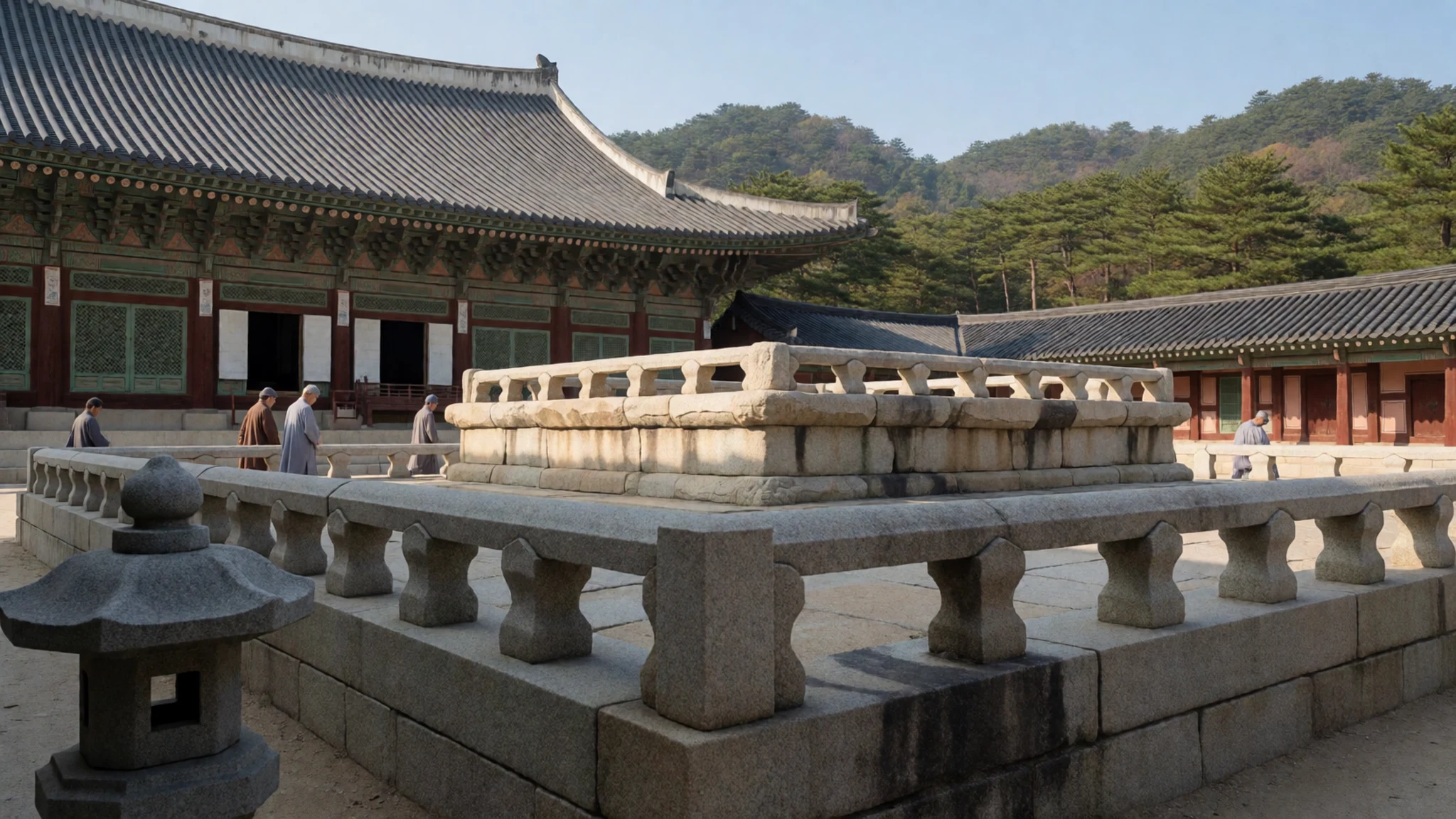
- The stone bridges — Stream through the temple grounds
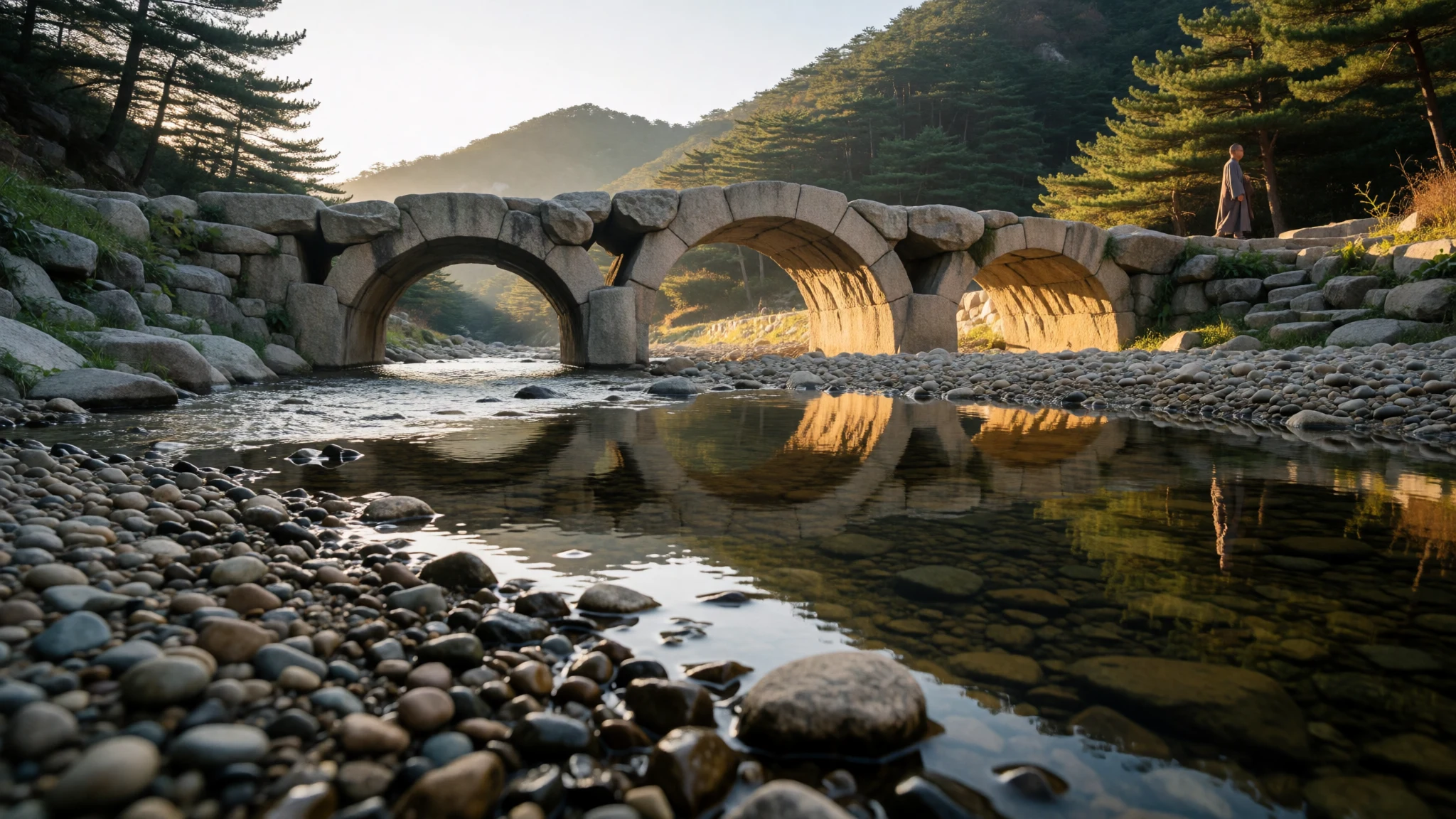
Stone bridges cross the stream within the temple grounds. One has three arches, and its name is usually explained as three stars and a half moon, which is also read as a symbol of the single mind. A plainer single-arch bridge is nearby. They are good places to stop and photograph the water and the pines.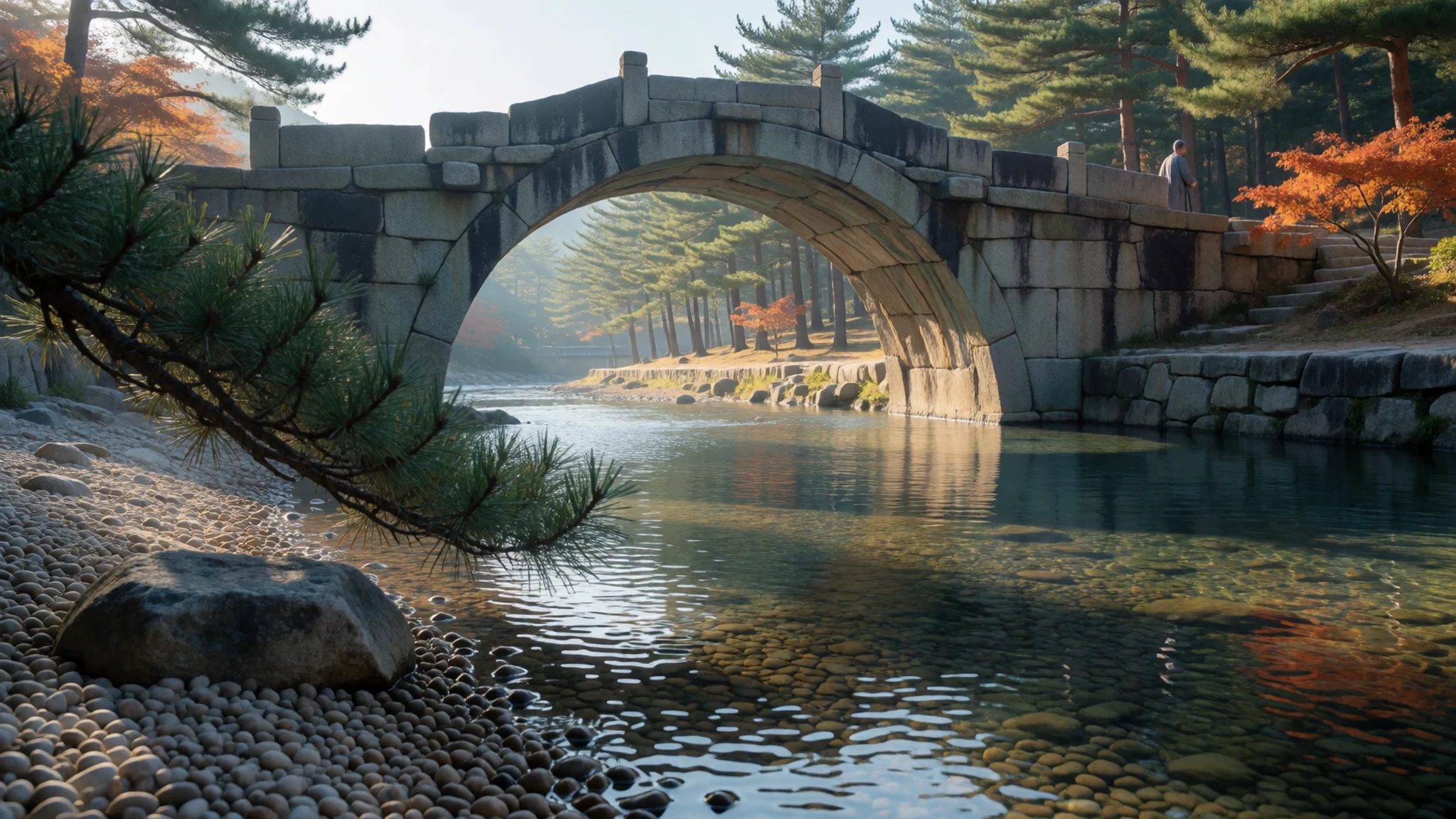
- Hongryong Falls — Wonhyosan Mountain, Yangsan
Hongryong Falls drops through a valley on Wonhyosan Mountain, a short drive from Tongdosa. A small temple, Hongryongsa, stands at its foot. It makes a pleasant side trip for walkers who want a shaded path and moving water after the stone and timber of the main monastery, and it is best after rain.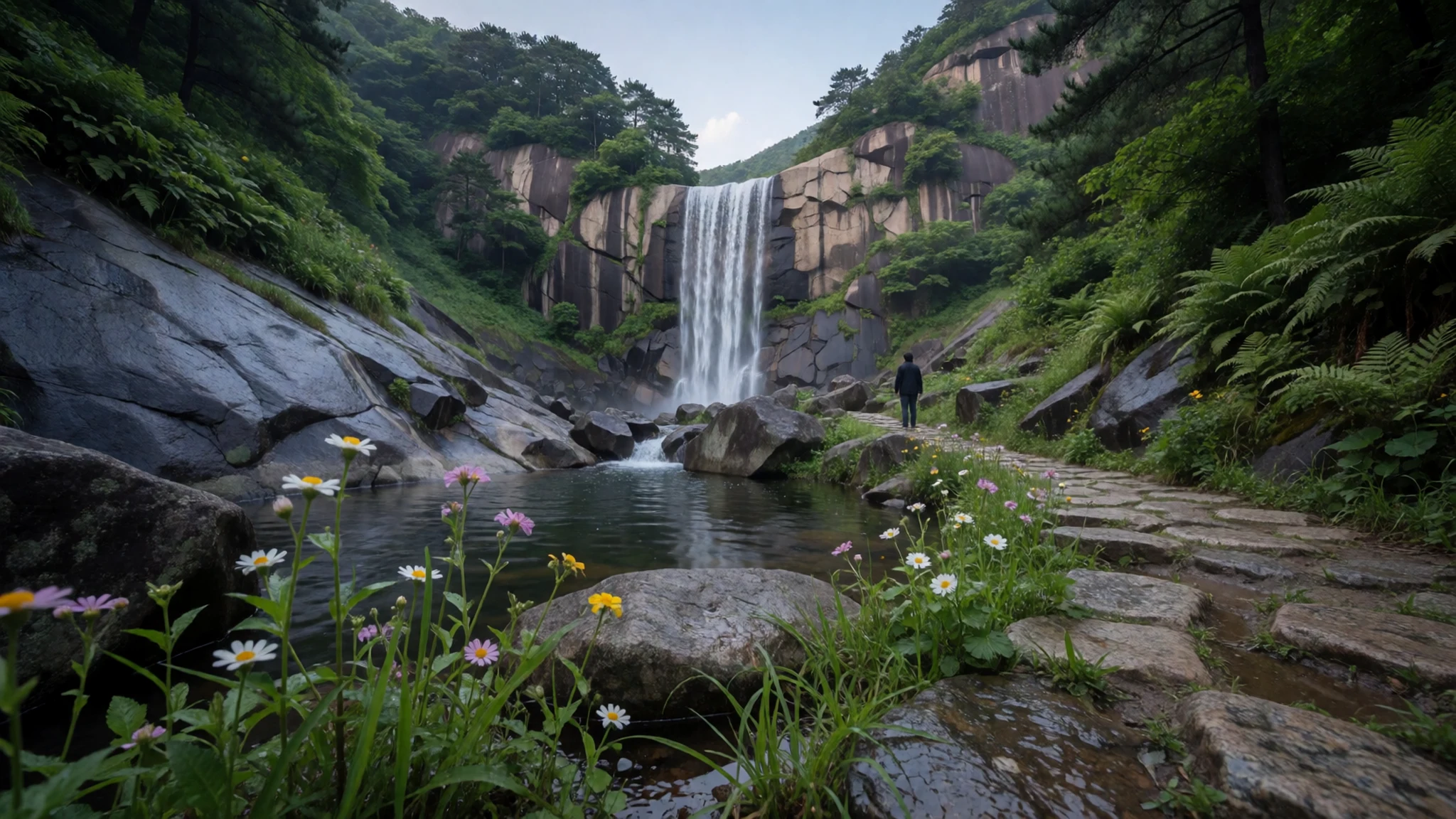
- Naewonsa Temple — Hills north-east of Yangsan
Naewonsa is a smaller mountain temple founded by the monk Wonhyo in the reign of Queen Seondeok. It has a quieter, more rural character than Tongdosa and fewer tour groups. Visitors who enjoy temple architecture without a crowd will find it a useful contrast, though the access road is narrow and local transport is thinner.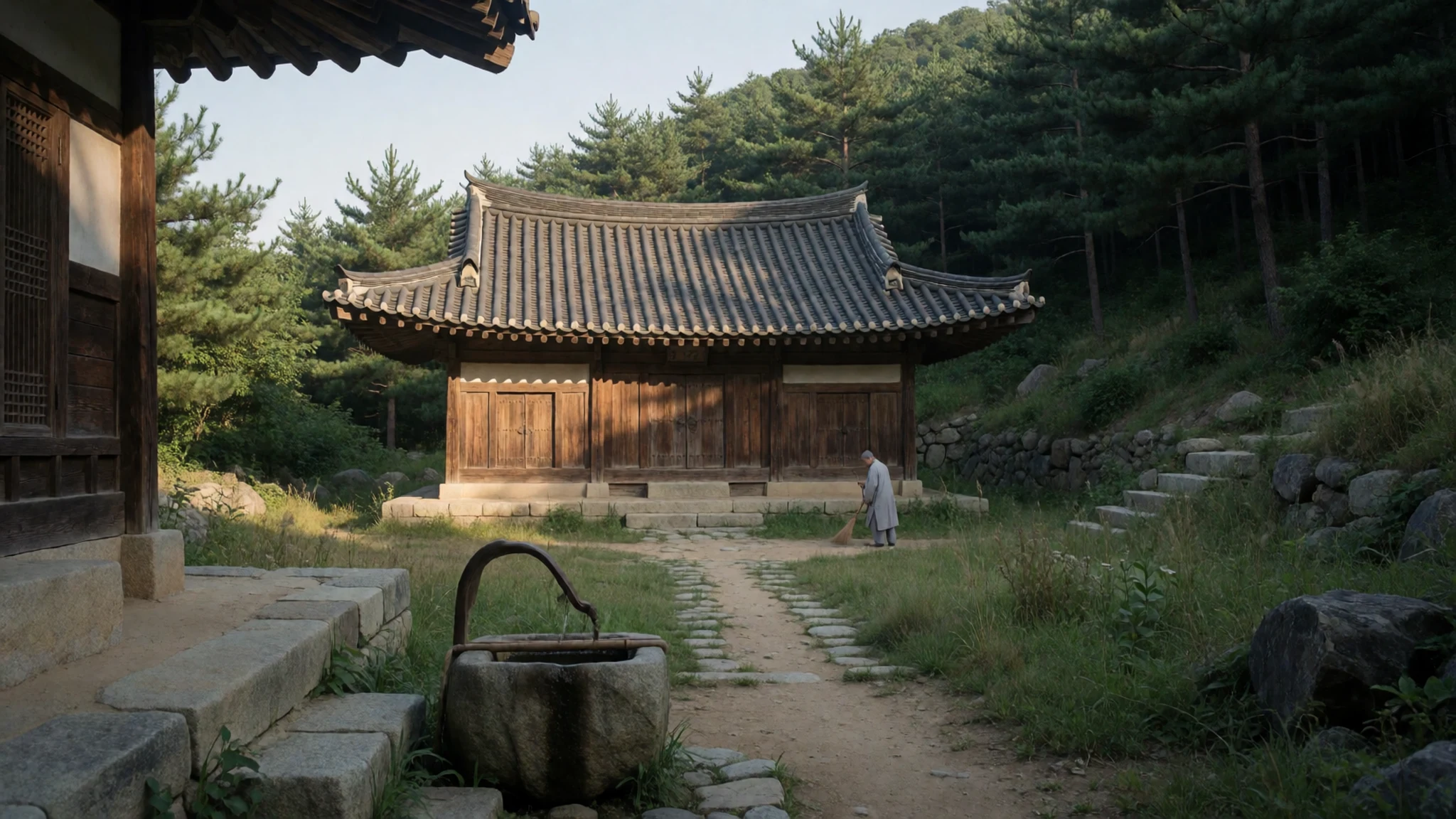
- Imgyeongdae Pavilion — Nakdong River bank, Yangsan
Imgyeongdae is a pavilion above the Nakdong River, counted among the Eight Scenic Views of Yangsan. It is also familiar to Korean film fans as a location in the romantic comedy My Sassy Girl. Go for the river outlook and an easy riverside walk rather than for anything large or elaborate.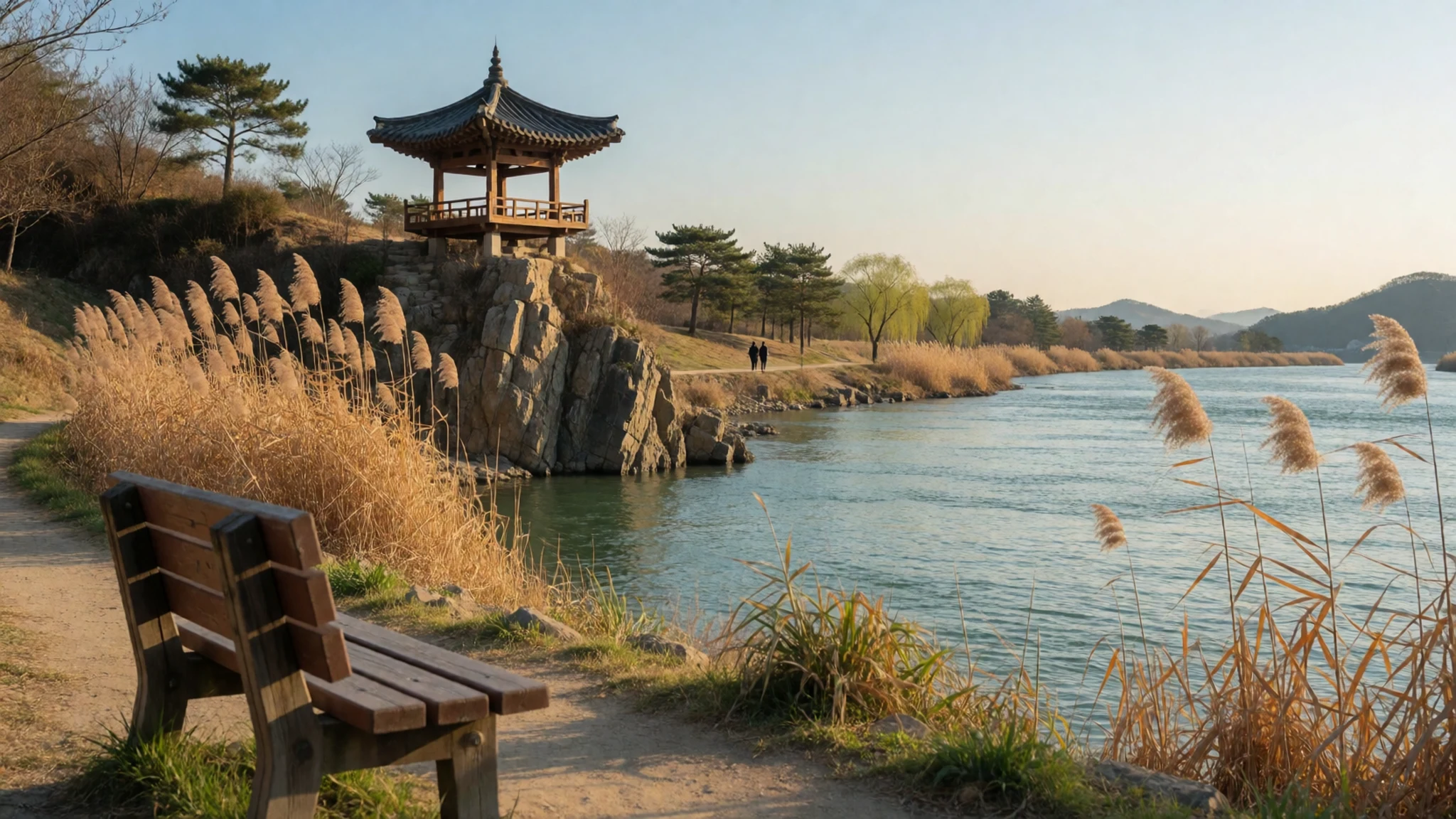
Culture
Tongdosa is first of all a place of practice, and its culture is the culture of Korean Seon Buddhism. Monks follow a daily round of chanting, meals and meditation, and lay worshippers come to bow, light candles and ask for blessings for their families. The Buddha's relics are the reason many Korean Buddhists make the journey, and the empty platform in the main hall puzzles first-time visitors until the logic is explained. Alongside prayer, the monastery keeps up a craft tradition visible in the painted eaves, the colourful patterns on beams and the guardian figures in the gates. These patterns, called dancheong, are repainted over the years rather than preserved as relics. Temple stays are offered here for visitors who want to spend a night, join early prayers and eat the monastic meal. These programmes let guests see how a large mountain monastery runs, and they are usually booked in advance through the temple, so check the official website for current details. Monastic cooking relies on vegetables and mountain greens, and the meal is eaten in near silence, with the bowls cleaned and drunk out at the end so that nothing is wasted. Festival days, above all the Buddha's birthday in spring, bring lantern displays and many more worshippers, and the temple is then much busier. Remove your shoes before entering any hall, keep your voice low, and do not photograph worshippers or monks at prayer without asking.
What to wear
Tongdosa shows two kinds of dress side by side: the clothes of the monastery and the clothes of everyday Korea. Traditional Korean dress is the hanbok, with a short jacket and wide skirt for women and jacket and trousers for men. It is made from silk for formal wear and from ramie or hemp for hot summers, and it is worn today mainly at weddings, New Year and festivals. Monks and nuns wear loose robes in grey and brown cloth, often layered in cold weather, and lay worshippers at some temples borrow plain vests and trousers for services. Most Koreans now dress casually and practically. Visitors to Tongdosa will see families in everyday clothes, older pilgrims in comfortable trousers and jackets, and walkers in outdoor gear. On festival days, a few people wear hanbok. For a visit, dress modestly: cover shoulders and knees, and avoid anything very tight, transparent or with slogans. Sleeves and long trousers also help in summer, when mosquitoes are common near the stream. The grounds involve a lot of walking on stone paths and uneven steps, so wear closed, comfortable shoes that slip off easily, since they come off at every hall. Bring layers: spring and autumn mornings can be cool in the shade, summers are hot and humid, and winters are cold. A light rain jacket is useful in the wet season, and a hat helps in the open courtyards.
What to eat
- Sanchae-bibimbap — Restaurants along the road to the temple entrance
Rice topped with mountain vegetables, mixed with chilli paste at the table. It is treated as a traditional local speciality around Yangsan. Light, earthy and often vegetarian, it suits a day of temple walking and is easy to find in restaurants near the temple approach.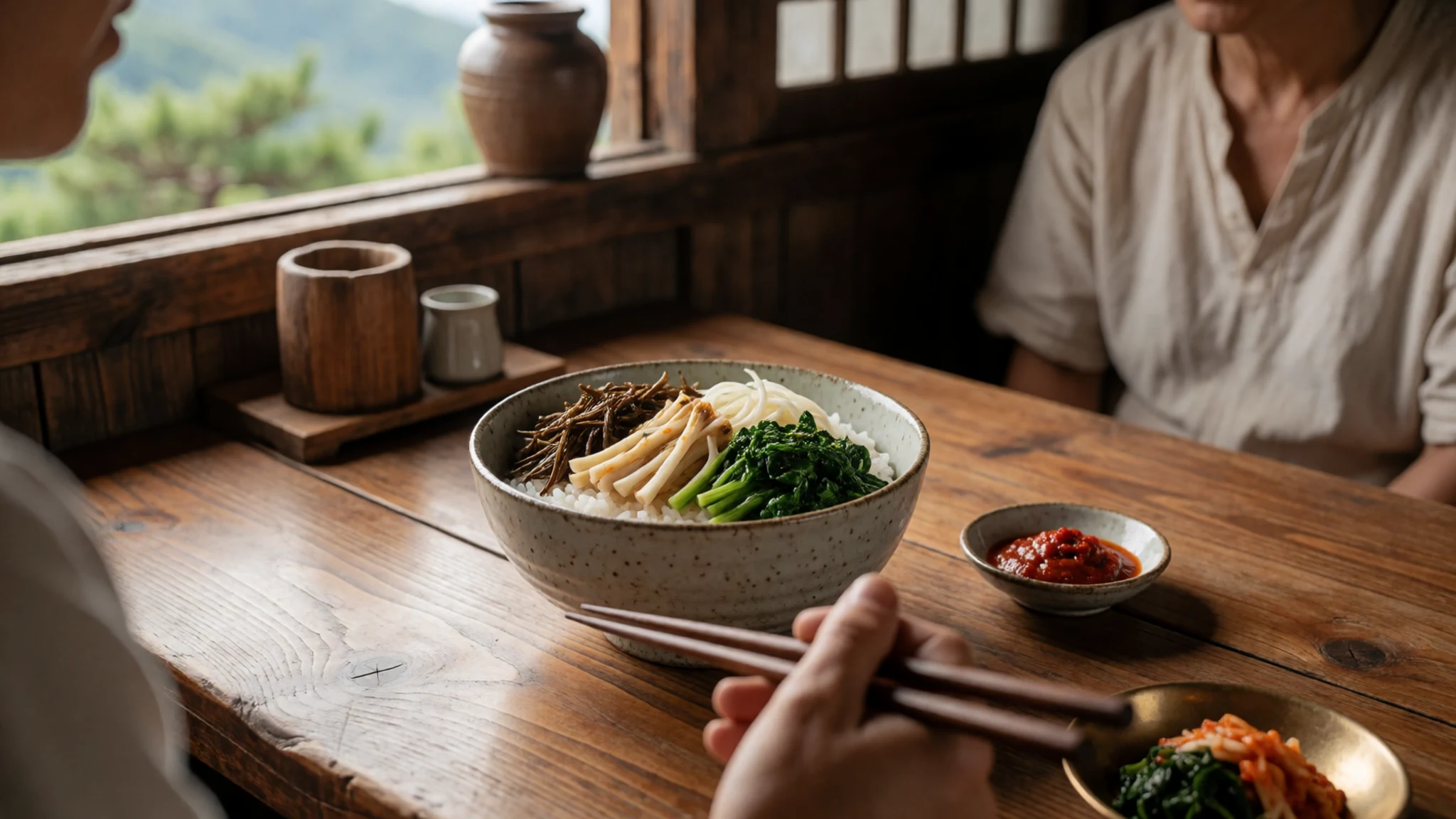
- Dwaeji gomtang — Pork-soup eateries in central Yangsan
A clear pork broth served with rice, slow-simmered until it is milky and mild. It is eaten with kimchi and salted shrimp on the side. Locals recommend it as a hearty meal before or after a long walk, and several well-regarded eateries in Yangsan town serve it.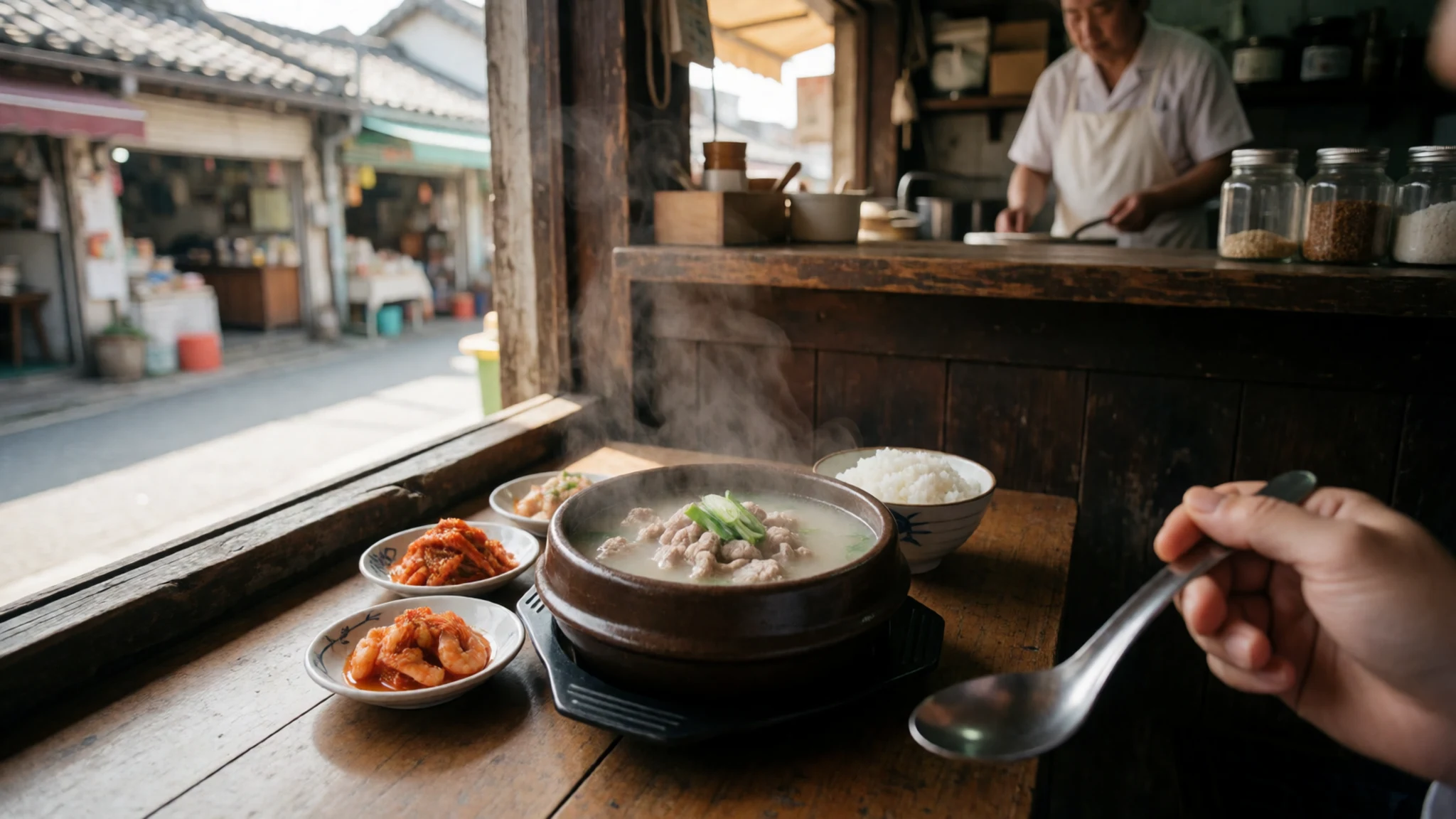
- Pork soup with udon noodles — Gukbap restaurants in Yangsan town centre
Yangsan is known for a local twist on pork soup, in which thick udon noodles replace or accompany the rice. The broth is rich but not heavy, and it is a regular lunch for workers in town. Ask for the noodle version when you order. - Maeuntang — Riverside restaurants along the Nakdong valley
A spicy freshwater fish stew cooked with vegetables and plenty of chilli. It is counted among Yangsan's traditional local dishes and is usually shared from a pot at the table. Expect heat, small bones and a lot of rice to cool it down. - Cafés by the Nakdong River — Riverside cafés in Wondong and Mulgeum areas
Yangsan has a growing café scene, with bakeries and coffee houses along the river and in the new residential districts. They are a good place to rest after the temple. Several face the water and are popular around sunset, particularly at weekends.
Plan it
Best time. March–April and October–November, when the mountain air is mild and the trees are in blossom or autumn colour. Summer is hot and humid with heavy rain, and winter is cold, though the temple is quieter then.
How long. 1–2
Getting there. Fly to Gimhae International Airport in Busan, or take the KTX high-speed train from Seoul to Busan or Ulsan. From Busan, intercity buses run to Tongdosa from the Nopo bus terminal, a short ride. Yangsan station is also the end of Busan metro line 2, with local transport onwards to the temple. Check the current routes before you travel.
Budget. low
Tips
- Arrive early in the morning, when the courtyards are quieter and the light is soft
- Check the official website at tongdosa.or.kr for temple stay bookings and any entry arrangements
- Wear shoes that slip off easily, as you will remove them often
- Carry some cash and a water bottle, as stalls near the temple are limited
- Weekends and festival days, especially the Buddha's birthday, are much busier, so pick a weekday if you can
Etiquette
- Remove shoes before entering any hall and keep your voice low
- Do not point your feet at the altar or sit with your back to it
- Ask before photographing monks or worshippers
Nearby
Sources
- Wikidata Q491454 (CC0)
- Wikipedia: Tongdosa (rev 1377456404) (CC BY-SA 4.0)
- Wikivoyage: Yangsan (rev 5433177) (CC BY-SA 4.0)
- Photo: Tongdosa grounds, Steve46814 (CC BY 3.0)
- Photo: Ceiling of a hall in Tongdosa, WolfgangMichel (CC0 1.0)
- Photo: Virūpākṣa in the Guardian Gate, Steve46814 (CC BY 3.0)
- Photo: Three Arch Bridge, Steve46814 (CC BY 3.0)
- Photo: Burimun Gate, Bernard Gagnon (CC0 1.0)
- Photo: Diamond Altar behind Daeungjeon, Steve46814 (CC BY 3.0)
- Photo: Single Arch Bridge, Steve46814 (CC BY 3.0)
- Photo: One Pillar Gate, Steve46814 (CC BY 3.0)


