Buseoksa
Buseoksa, South Korea
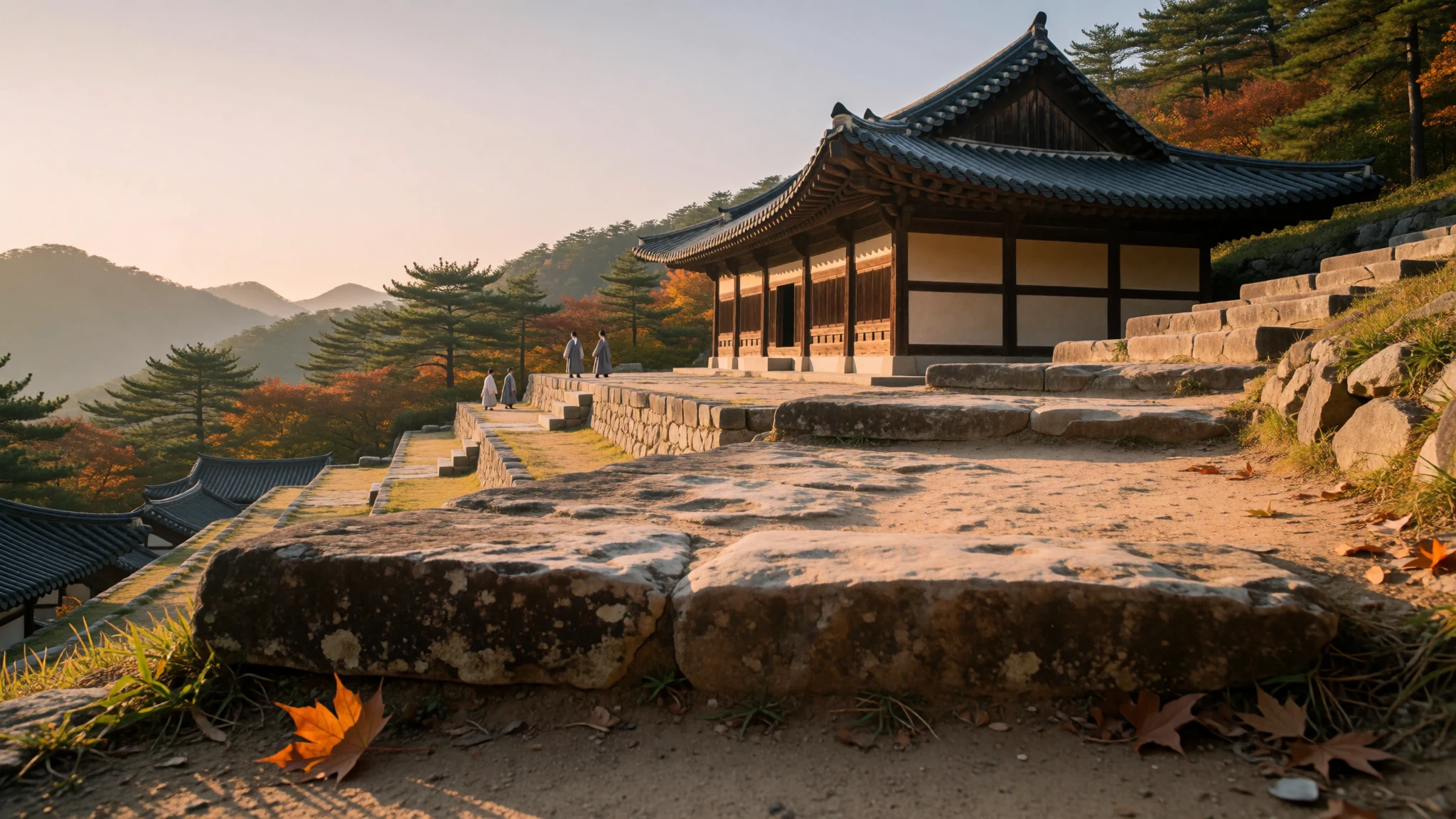
Buseoksa is a hillside Buddhist temple in Yeongju where an ancient timber hall waits at the top of a long, unhurried climb.
The place
Buseoksa sits on the slopes of Bonghwangsan in Buseok-myeon, a rural district of Yeongju in South Korea. The temple was founded in 676 by Uisang, a scholar-monk who taught the Huayan school of Buddhism here, and the school later took the temple's name for itself. The buildings are arranged in terraces up the hill, so a visit is mostly a steady walk through gates and beneath pavilions until the main hall comes into view at the top. That hall, Muryangsujeon, enshrines Amitabha, the Buddha of the Western Paradise, and is noted as being South Korea's second oldest wooden structure still standing. The temple carries a UNESCO listing, recorded in the facts as 1562-002, and its Korean name is written 부석사 (Hanja 浮石寺). The setting is farm country rather than a resort: Yeongju is a modest provincial town with a strong Confucian heritage, an older population and several festivals that honour traditional culture. Apples are the local pride, and eateries gather near the temple approach. Autumn is the busiest season, when the hillside colours up and the paths fill, especially at weekends. Spring and summer are calmer, though summer brings heat and humidity to the climb. The official temple website is http://www.pusoksa.org for anything time-sensitive.
Its story
Buseoksa began in the generation after Silla unified the Korean peninsula, a period of real strain. Years of war with Tang China had left the newly joined populations suspicious of one another, and the Silla court wanted shared spiritual centres that could calm the divisions. Uisang's Huayan teaching, which stresses harmony between apparently separate things, suited that purpose, and Huayan temples were established so that each region had one. Buseoksa, founded in 676, became the best known of them, and Uisang came to be honoured here as the great teacher of Buseok. Centuries later, in the Goryeo dynasty, the temple was also known by the names Seondal and Heunggyo. Fire damaged it in 1358, when enemy raiders set buildings alight. Rebuilding followed soon after: a monk named Won-eung oversaw the re-establishment of many annexes from 1372, with Muryangsujeon re-built in 1376 and the Josadang shrine to the founder following in 1377. Part of the story of the main hall was only recovered later. In 1916 a stained paper was found that indicated Muryangsujeon had first been built early in the Goryeo era, which suggests the present hall stands on older foundations. A few Goryeo-period buildings survive today, so the temple is one of the places where medieval Korean timber craft can still be seen in use rather than in a museum.
What to see
- Muryangsujeon — Upper terrace, Buseoksa
Muryangsujeon is the main hall at the highest level of Buseoksa, and the reason most people make the trip. It enshrines Amitabha and dates from the rebuilding of 1376. Look at the plain, balanced timber frame and the gently curved roof, then turn round for the view over the ridges.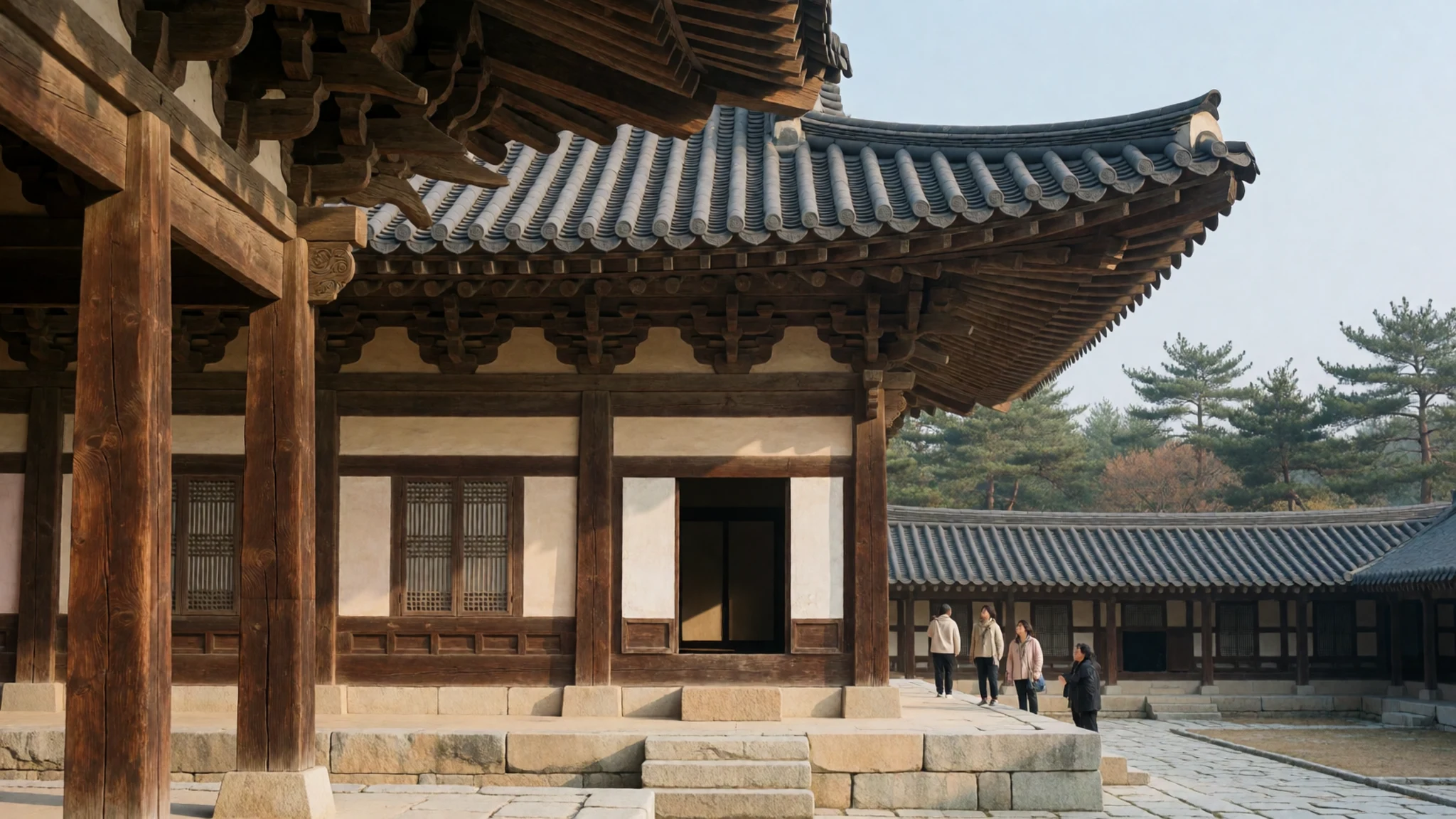
- Iljumun gate — Temple entrance, Buseoksa
The Iljumun, the one-pillar-line entrance gate, marks the point where the temple precinct begins. Pass through it slowly: it is the traditional threshold between the everyday world and sacred ground, and the approach beyond it sets the pace for the whole walk uphill.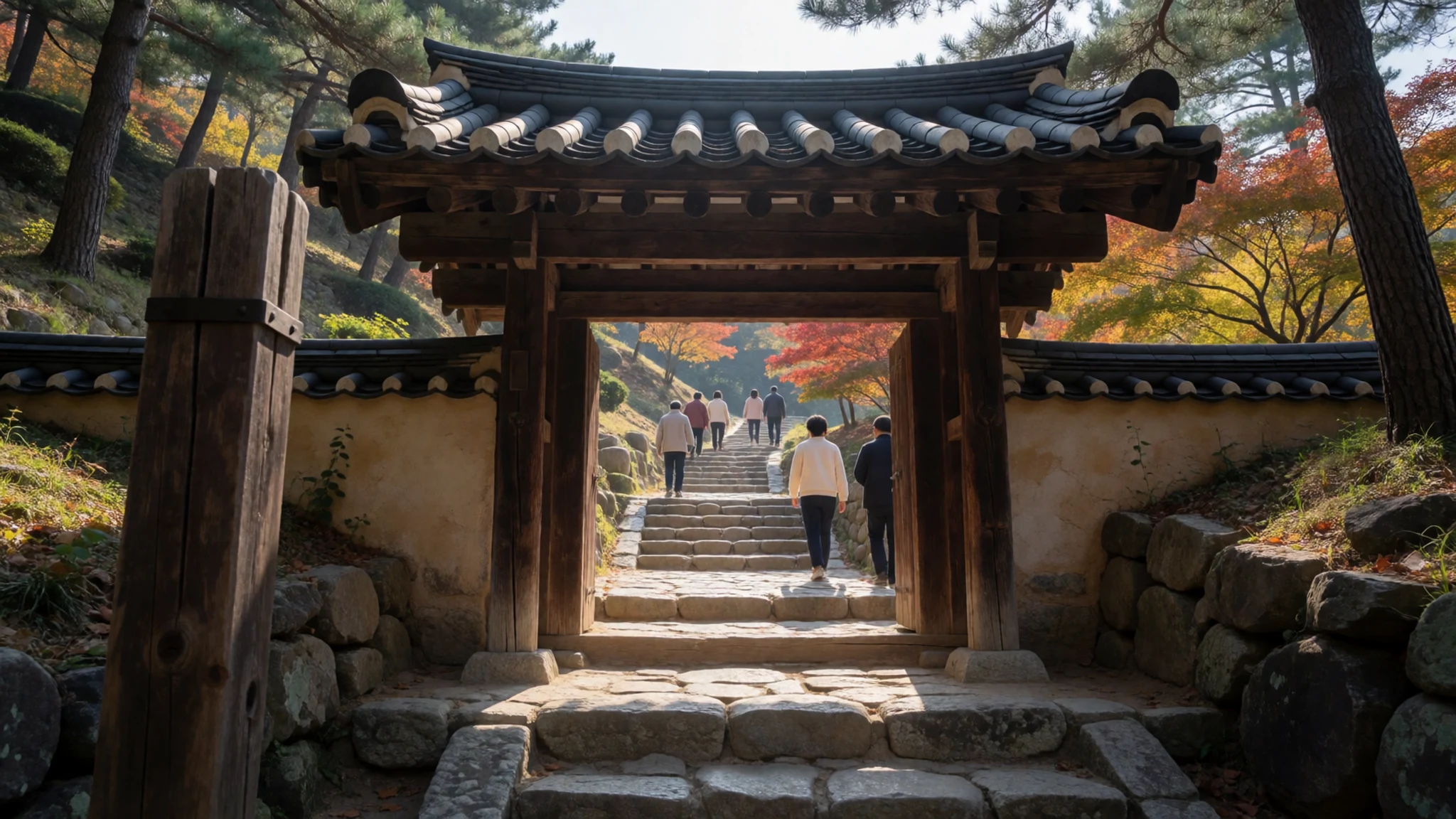
- Beomjongnu Pavilion — Mid terrace, Buseoksa
Beomjongnu is a pavilion on the climb where the temple's ritual instruments are kept. A two-storey timber structure with open sides, it frames the courtyard and the slope beyond. It is a good place to catch your breath and to notice how the buildings are fitted to the hill.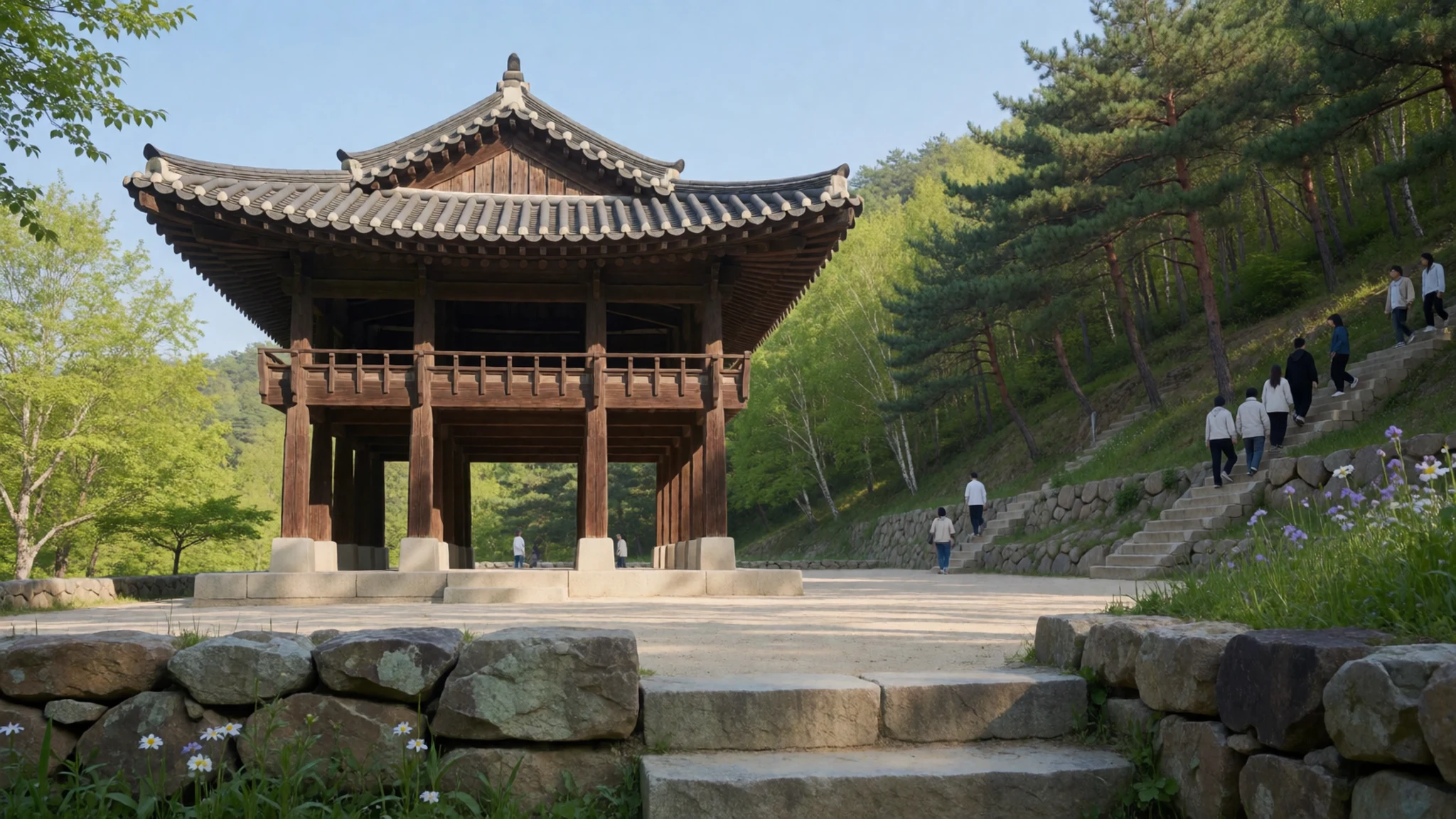
- Anyangnu Pavilion — Upper terrace, Buseoksa
Anyangnu stands close to the top of the temple and looks out across the valley and far ridgelines. Visitors tend to linger here, particularly in autumn, when the foliage below turns red and gold. It is also a calm spot for reading the layout of the whole terraced complex.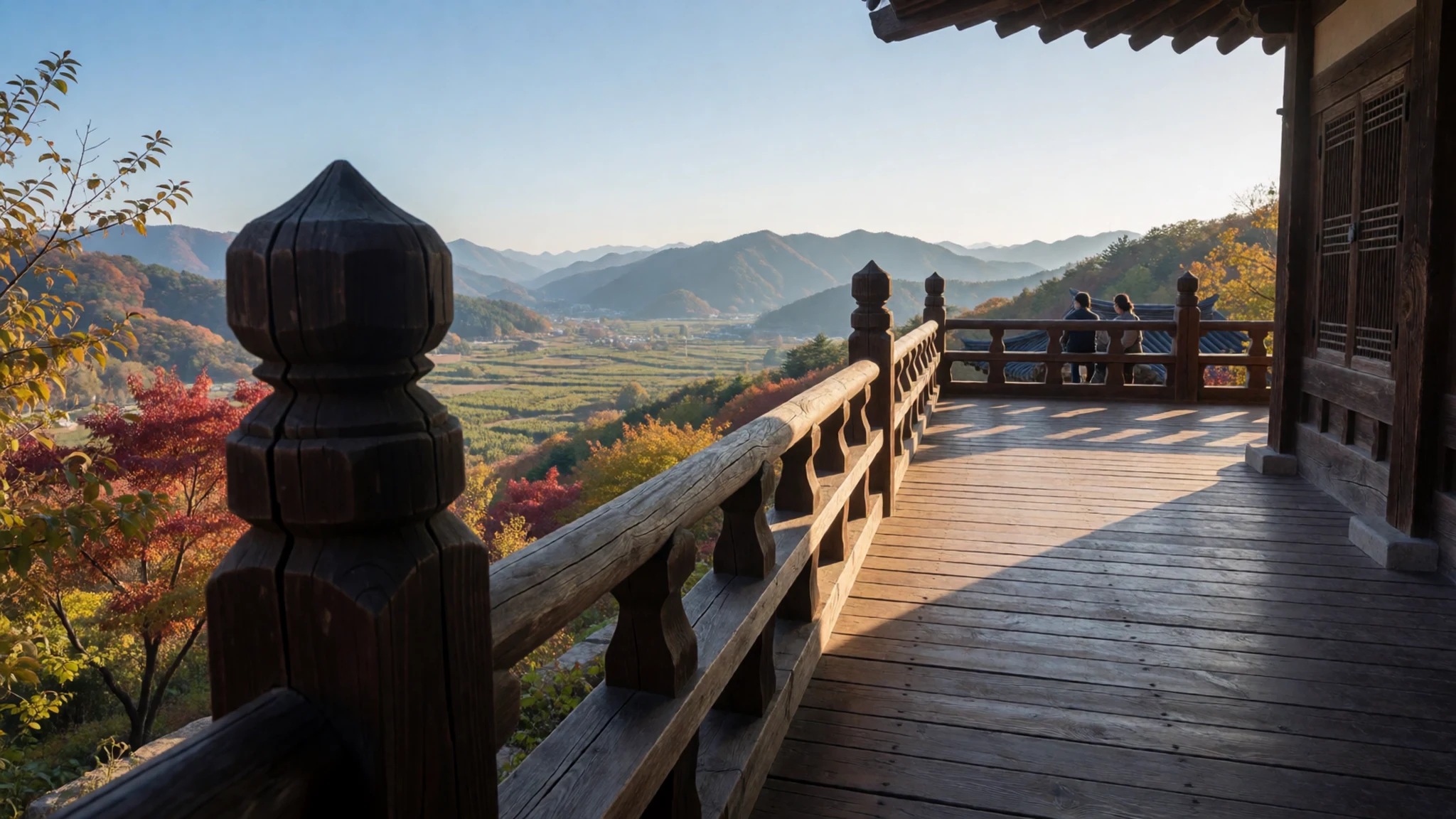
- Josadang Shrine — Upper terrace, Buseoksa
Josadang is the shrine to the temple's founder, built in 1377 soon after the main hall. It is small and easy to walk past, but it ties the place back to Uisang and his teaching. Take a moment to step in quietly and see how the temple honours its first master.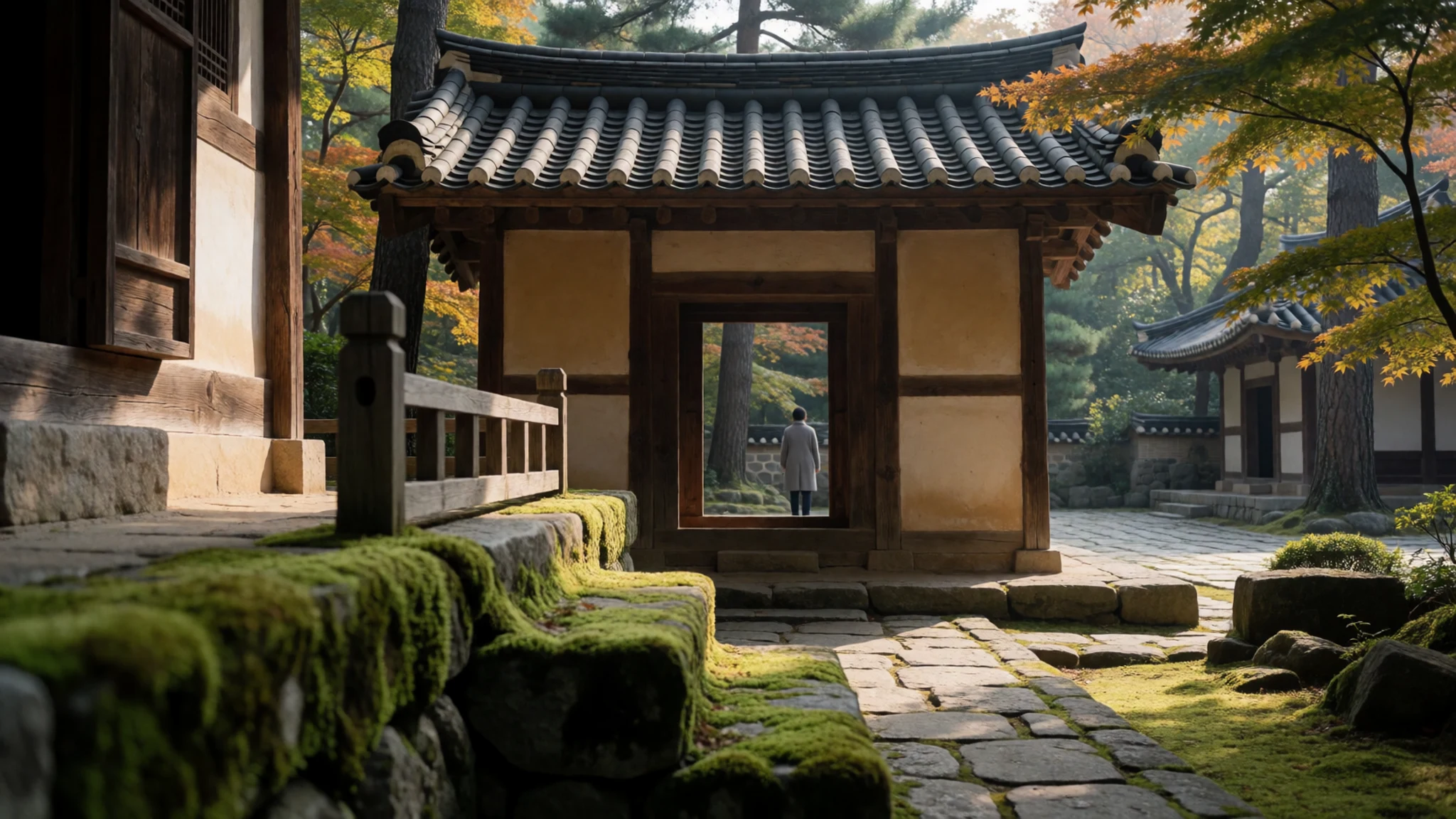
Culture
Buseoksa is a working Korean Buddhist temple, and its culture is shaped by the Huayan school that Uisang taught here. The school's central idea is that all things are interconnected, and that outlook runs through the temple's story of reconciling a divided kingdom. Today the monastic community keeps the daily rhythm of chanting and meditation, while visitors come as pilgrims, walkers, school groups and photographers. Temple buildings are named for their function, from gate to pavilion to shrine, and each is placed on a rising axis so that the visitor's walk becomes a gradual approach to Amitabha in the main hall. Around the temple, Yeongju presents itself as a keeper of Confucian history and traditional Korean life. The nearby Sosu Seowon academy and the living-museum village of Seonbichon preserve the world of the Joseon scholars, and the town hosts festivals such as the Punggi Ginseng Festival each October. The older population gives the district a settled, unhurried feel, set against newer ways of living. Seasonal visitors will notice that the temple and the town are at their most social in autumn and noticeably quieter outside it. Keep your voice low, dress modestly and take off your shoes before stepping into any hall where others have left theirs at the threshold.
What to wear
Buseoksa and Yeongju sit in a region with a long scholarly tradition, and the traditional dress is the hanbok. It has a short jacket (jeogori) worn over trousers (baji) for men, or a high-waisted wrap skirt (chima) for women. Textiles include silk for formal and festive wear, ramie (mosi) and hemp (sambe) for hot summers, and cotton for everyday and winter layers. Hanbok is worn today mainly at weddings, the Seollal and Chuseok holidays, and at cultural events, and some visitors hire one for photographs in heritage towns. Monks at the temple wear simple grey or brown robes, which are practical work clothes as much as religious dress. In daily life, people in Yeongju dress much as they do elsewhere in Korea: practical trousers, fleece or padded jackets in the cooler months, and sun hats and light layers in summer, with farmers in work gear during harvest. For a visit, the walk up through the terraces involves steps and slopes, so wear sturdy flat shoes with grip. Cover shoulders and knees out of respect for a working temple, and choose clothes that are easy to slip shoes on and off in. Autumn mornings on the hill can be cool, so bring a warm layer, and in summer bring a hat and water.
What to eat
- Yukhoe bibimbap — Family-run eateries in Yeongju and Punggi
Yukhoe bibimbap tops rice and vegetables with seasoned raw beef, mixed with chilli paste at the table. It appears on the Yeongju listings as a local favourite, and popular spots can involve a wait. Look for it at family-run eateries around Yeongju and Punggi.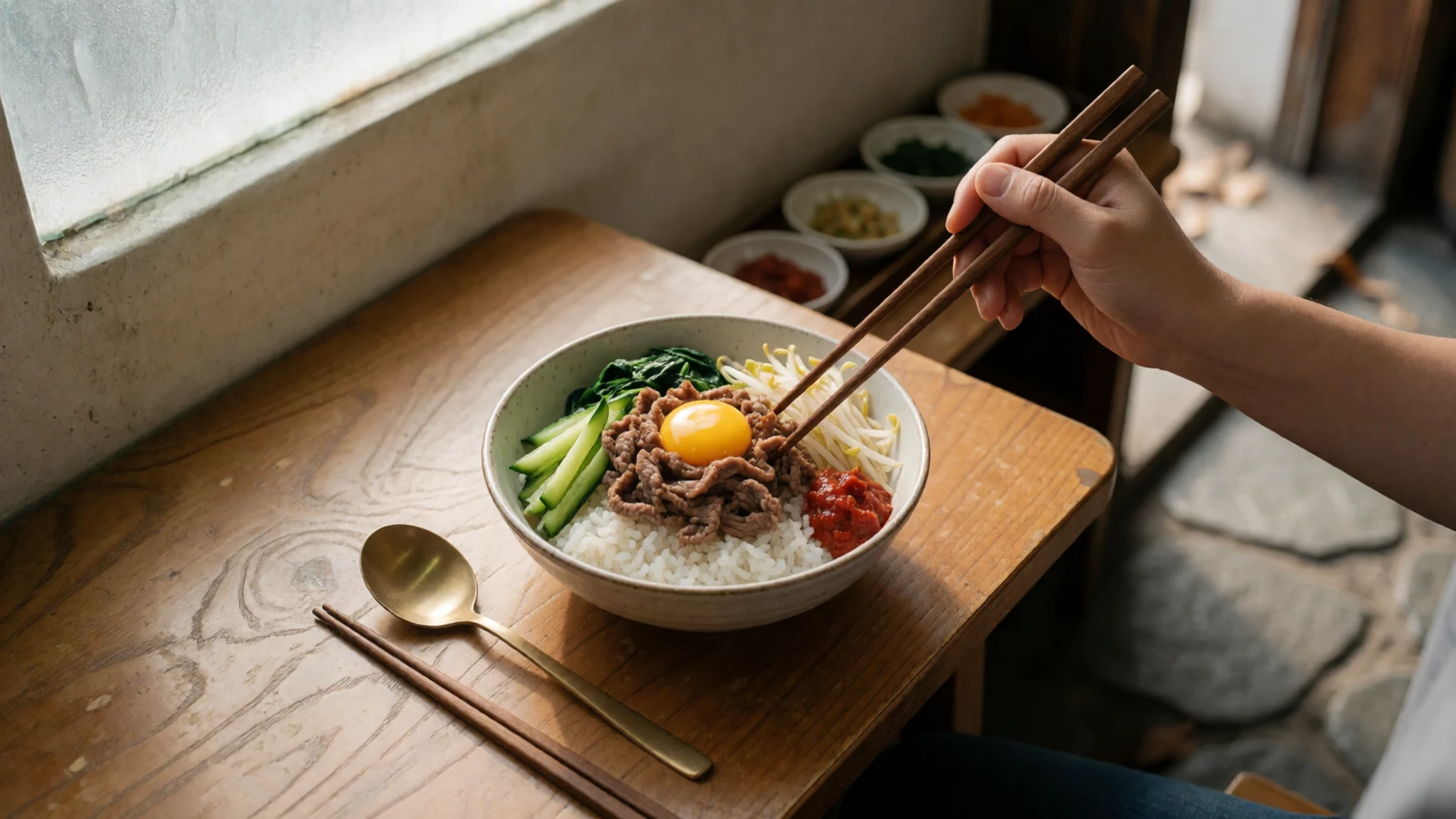
- Yeongju apples — Roadside stalls and the market near the temple approach
The area is known for its apples, and in season they are sold crisp and fresh from roadside stalls and in markets. They make an easy snack for the climb up to the temple. Buy a bag from a stall near the temple approach or in town.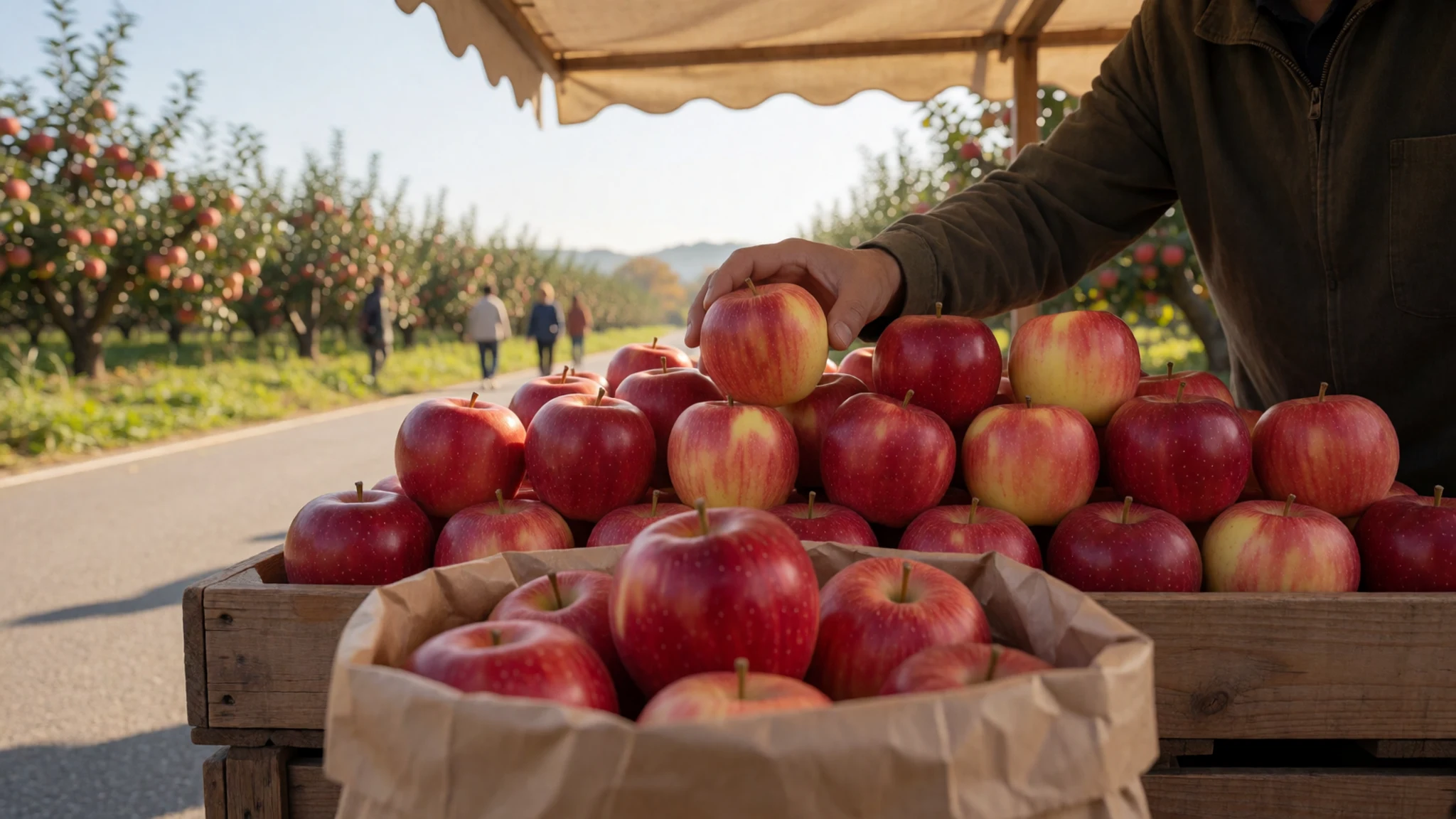
- Ginseng dishes — Punggi town and the festival grounds by Namwoncheon Stream
Punggi, in Yeongju, is known for ginseng, and during the early-October festival stalls sell fresh roots and prepared ginseng dishes. Outside festival time, ginseng appears in chicken soup and in teas. Ask at restaurants in Punggi town. - Injeolmi — Seonbichon Village and rice-cake shops in Yeongju
Injeolmi is a chewy rice cake dusted with roasted soybean powder, lightly sweet and easy to carry. Visitors can try making it at Seonbichon Village, which runs traditional activities, or buy it from rice-cake shops in town. - Temple-style vegetable meal — Vegetarian eateries in Yeongju, or by arrangement with a temple
Korean temple cooking is vegetarian, built around seasonal greens, mountain herbs, pickles, soy-based seasonings and rice. Some temples in the region offer meals to guests, though arrangements vary. Check the official temple site before relying on it.
Plan it
Best time. Late October to early November for autumn colour, and April to May for spring greenery and milder crowds. Summer is hot and humid on the uphill walk, and winter is cold, so dress warmly if you go then.
How long. 1–2
Getting there. The nearest practical rail stop is Yeongju Station, with several trains a day from Seoul. By bus, services run from Dong Seoul in about two and a half hours, from Dong Daegu in about an hour and a half, and from Andong in about forty minutes. From Yeongju, finish with a local bus or taxi to Buseok-myeon; check current timetables locally.
Budget. mid
Tips
- Go on a weekday in autumn, as weekends in leaf season are crowded
- Arrive early to walk up before tour groups and to catch softer light
- Wear grippy shoes, as the climb uses steps and slopes
- Carry water and a snack, and check the official site (http://www.pusoksa.org) for current opening arrangements
- Combine the visit with Sosu Seowon and Seonbichon Village for a fuller day in Yeongju
Etiquette
- Remove shoes before entering a hall where others have left theirs
- Keep your voice low and do not photograph worshippers praying
- Dress modestly, covering shoulders and knees
- Do not touch or lean on the timber structures or sit on altar steps
Nearby
Sources
- Wikidata Q3540839 (CC0)
- Wikipedia: Buseoksa (rev 1377452445) (CC BY-SA 4.0)
- Wikivoyage: Yeongju (rev 5422904) (CC BY-SA 4.0)
- Photo 01-muryangsujeon2.jpg (ko:Excretion) (CC BY-SA 2.0 kr)
- Photo 02-.jpg (최옥석) (CC BY-SA 4.0)
- Photo 03-iljumun-at-buseoksa.jpg (Bernard Gagnon) (CC0 1.0)
- Photo 04-beomjongnu-at-buseoksa-01.jpg (Bernard Gagnon) (CC0 1.0)
- Photo 05-anyangnu-at-buseoksa-01.jpg (Bernard Gagnon) (CC0 1.0)
- Photo 06-seonmyogak-at-buseoksa.jpg (Bernard Gagnon) (CC0 1.0)
- Photo 07-gwaneumjeon-hall-at-buseoksa-01.jpg (Bernard Gagnon) (CC0 1.0)
- Photo 08-josadang-at-buseoksa.jpg (Bernard Gagnon) (CC0 1.0)


