Bongeunsa Temple
Bongeunsa Temple, South Korea
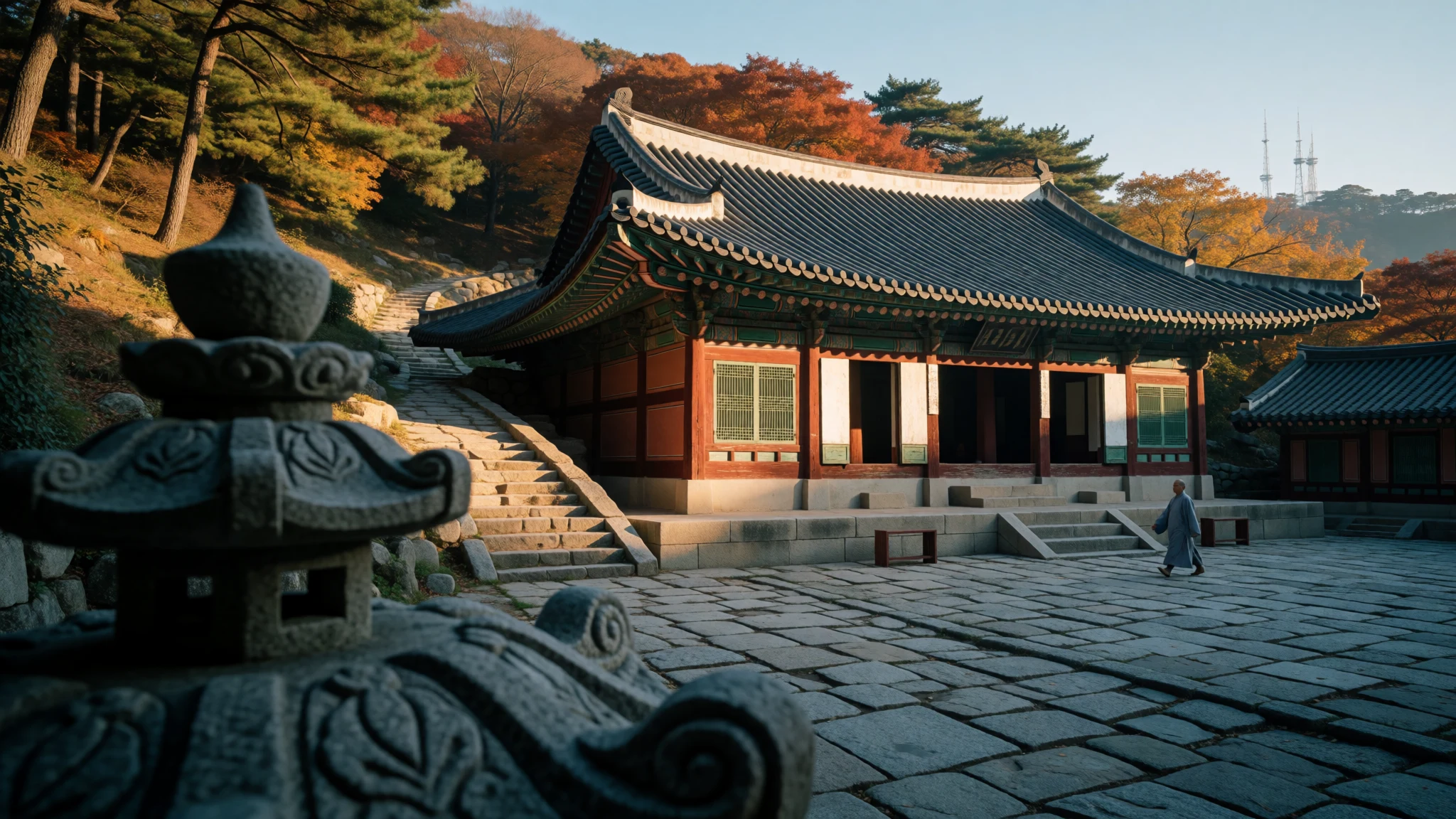
Bongeunsa Temple is a working Buddhist monastery of painted timber halls on a wooded slope, facing Gangnam's glass towers across the road.
The place
Bongeunsa Temple stands in Samseong-dong, in Seoul's Gangnam District, on the lower slope of Sudo Mountain. It belongs to the Jogye Order and is a working monastery rather than a preserved relic: monks keep up the daily chanting, local worshippers drop in on their way to work, and the courtyards fill with paper lanterns when festivals approach. The setting is what people remember. Across the road is COEX, a huge complex of underground shopping, offices, hotels and conference halls, and from the temple grounds its glass towers rise straight above the curved tiled roofs. Until Gangnam's rapid growth from the 1980s, the temple sat on the rural edge of the city, and it is now an island of old timber and pine in a district of luxury shopping. Gangnam is known for designer shops, polished cafés and late nightlife, especially around Apgujeong and Cheongdam beside the Han River. Bongeunsa keeps a different tempo, with gravel paths, incense smoke and the sound of chanting drifting between halls. The compound is modest in size, so a visit suits an hour or two rather than a full day. The main hall, Daewoongjeon, anchors the site, with deep eaves and painted beams in faded reds, greens and blues, and smaller halls and pavilions climb the slope behind it. Opening arrangements and any visitor programmes change, so check the official site, http://www.bongeunsa.org:90/, before setting out.
Its story
Bongeunsa Temple traces its beginnings to 794, when the monk Yeonhoe, then the senior-ranking monk of the Silla kingdom, founded it during the reign of King Wonseong. Its first name was Gyeonseongsa. The name used today dates from 1498, when Queen Jeonghyeon sponsored a rebuilding in the Joseon dynasty, an era when the court generally pushed Buddhism to the margins. Bongeunsa roughly means 'honouring the king', a reference to prayers for the long life of King Seongjong. The temple's fortunes rose again in the mid-sixteenth century under Queen Munjeong, who briefly revived Buddhist institutions. From 1551 until 1936 it served as the head temple of Korea's Seon tradition, the local branch of Chan, and between 1552 and 1564 it hosted the national examination for monks. Her appointed abbot, Bou, did not last long: he was killed within a few years, when the court turned against Buddhism again. In 1902 the temple was listed among fourteen principal temples of the Korean Empire. Under Japanese occupation it served as headquarters for 80 smaller temples around Seoul. Its head monk, Cheongho, pulled more than 700 people out of the Han River in 1922 and 1929, and a monument commemorates him. Once colonial rule ended, the temple came under the Jogye Order. Disaster followed: a fire in 1939 consumed most of the buildings, and the Korean War damaged more. The halls standing today are therefore rebuilt, which is worth remembering whenever the temple's age is quoted.
What to see
- Daewoongjeon, the main hall — Bongeunsa compound, Samseong-dong
The main hall, Daewoongjeon, is where Bongeunsa Temple's daily worship centres. Its wide, overhanging roof and painted beams are typical of Korean temple architecture, and the colours are deliberately worn rather than glossy. Step in quietly if a service is under way, and look at the Buddha images on the altar and the decoration overhead. Rebuilt after fire and war, it still feels settled.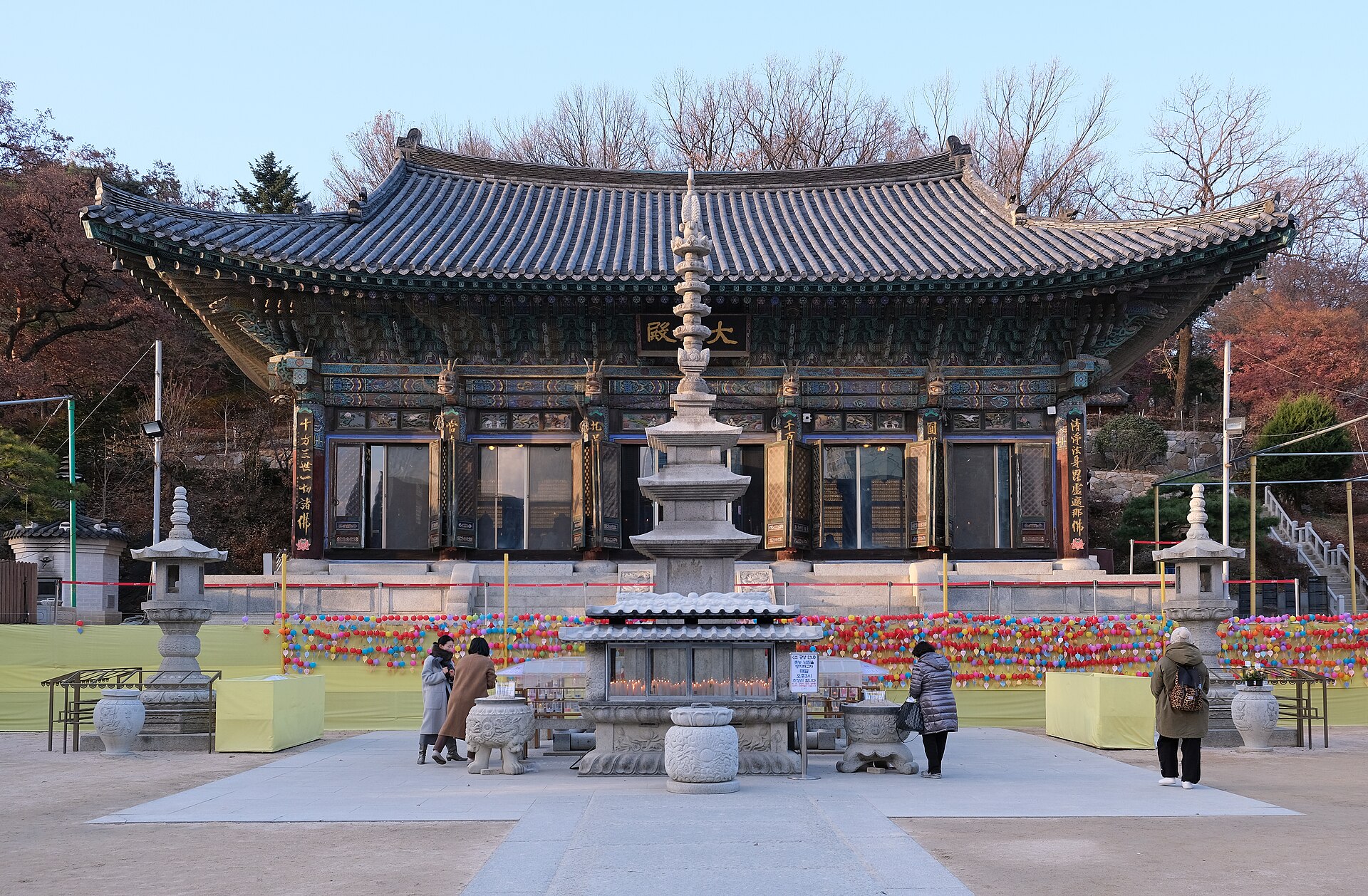
- The slope behind the halls — Bongeunsa compound, upper slope
Behind the main hall, paths rise through pines to smaller halls and pavilions on the Sudo Mountain slope. The climb is gentle and short, but it gives a clear sense of how the temple sits against its hillside, and the traffic noise fades noticeably. This is the quietest corner of the compound, good for a slow walk once the courtyards fill.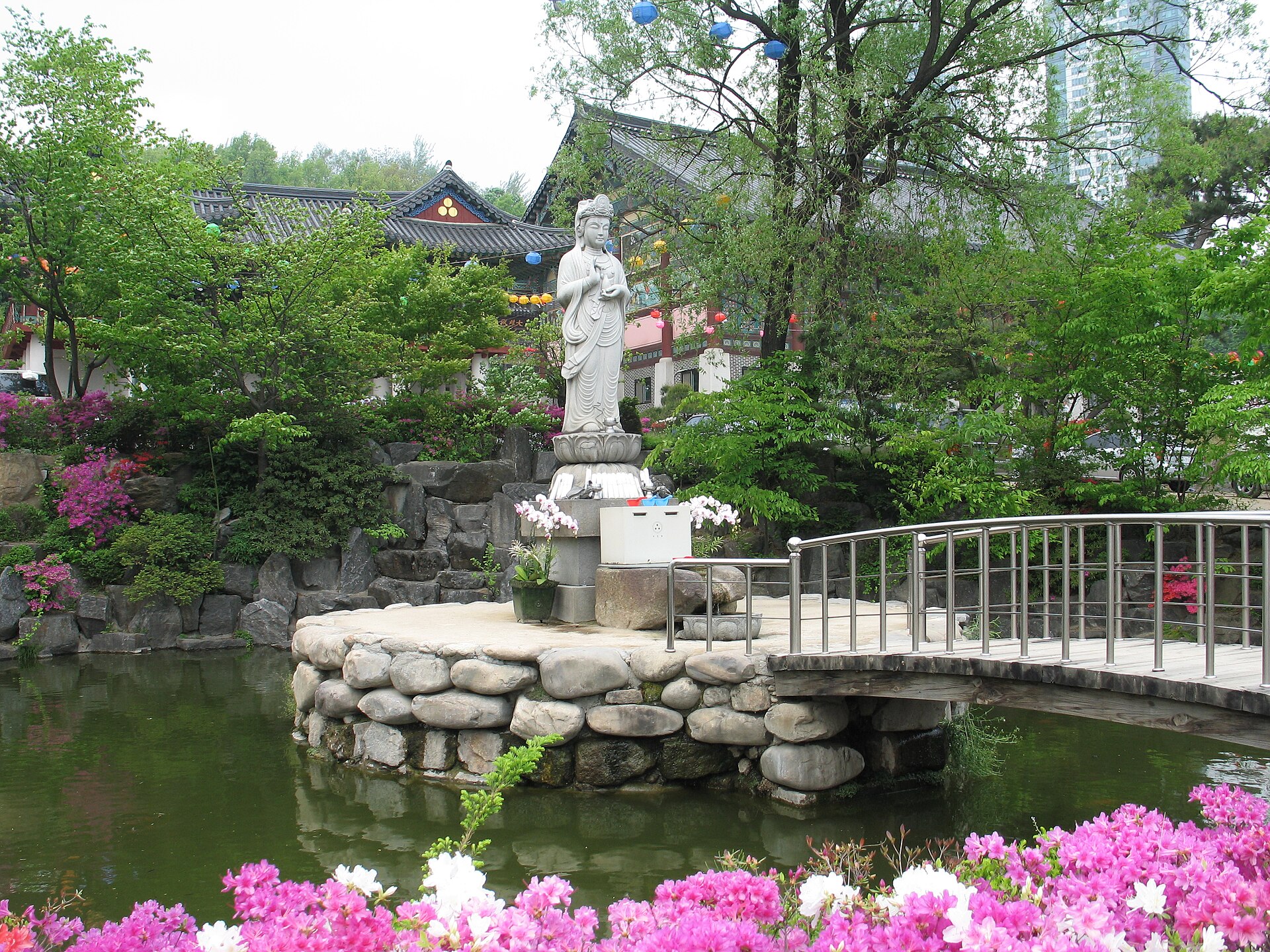
- COEX and the view across the road — Samseong-dong, across from the temple
From the temple's edge, COEX fills the view across the street, and the contrast of tiled roofs and glass is the photograph most visitors take. Walk over afterwards: the complex combines a large underground mall, offices, hotels and a convention centre, and it also holds the airport check-in bus terminal. It is handy for lunch or shelter from heat and rain.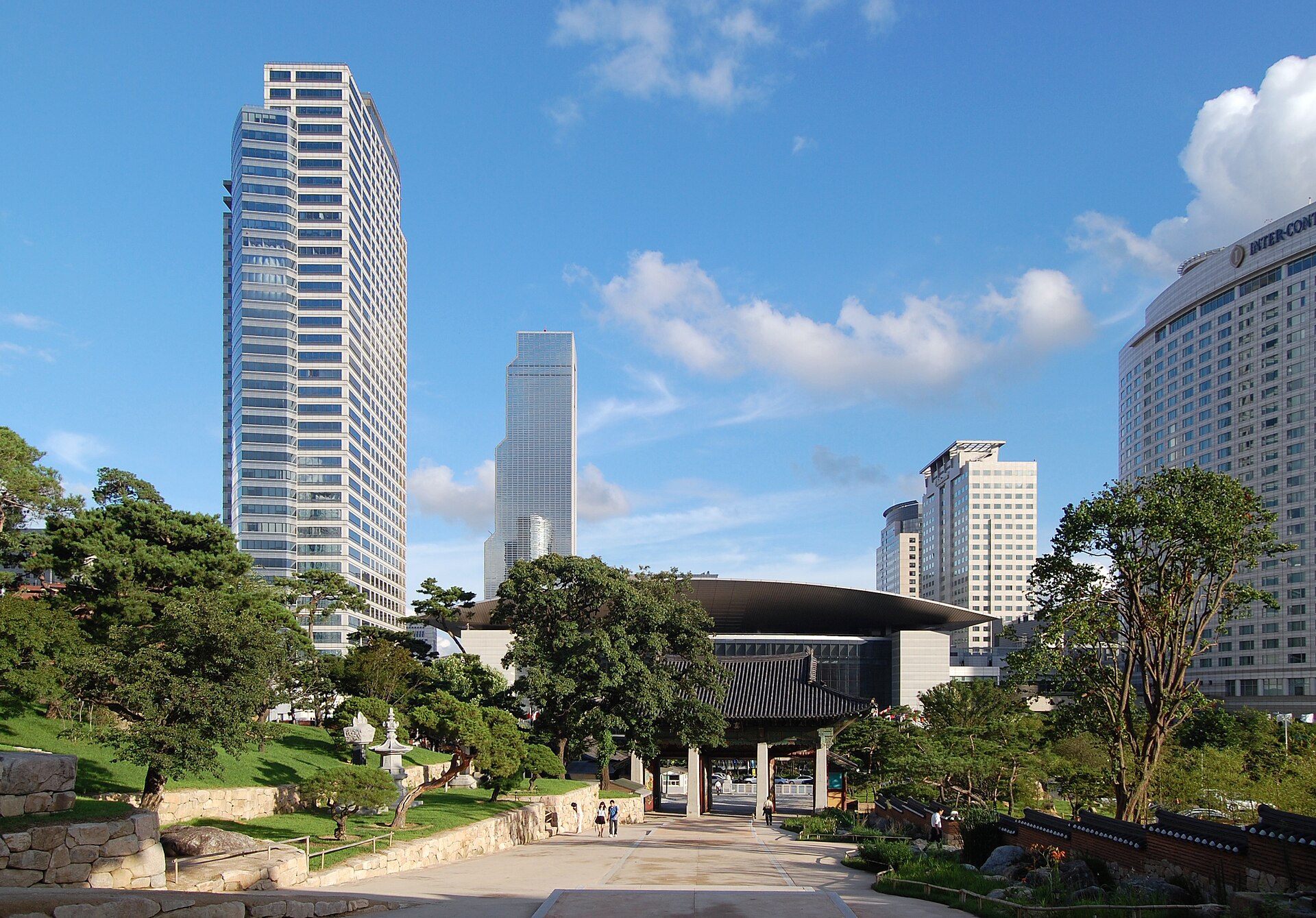
- Seonjeongneung Royal Tombs — Gangnam, near Seolleung
Seonjeongneung Royal Tombs is a quiet park a short distance from the temple, holding the burial mounds of two Joseon kings and a queen. It is a green, shaded space in the middle of Gangnam, and it pairs naturally with Bongeunsa for anyone wanting a half day of old Seoul in a modern district. Check official listings for current entry details. - Banpo Hangang Park — Banpo, on the Han River
Banpo Hangang Park is a stretch of the Han River park system near Banpo Bridge, a short ride west of the temple. It suits an evening after the temple: riverside paths, open sky and a view across to the far side of the city. Summer evenings draw crowds, while spring and autumn are calmer.
Culture
Bongeunsa Temple belongs to the Korean Seon tradition, the local branch of Chan or Zen, and today is administered by the Jogye Order. Seon puts weight on meditation and direct experience, which is why temple life here follows a quiet, steady routine of dawn chanting, sitting practice and simple communal meals. Visitors will notice habits worth recognising. Worshippers bow in full prostrations before the Buddha images, light candles and leave offerings of rice or fruit. Lotus-shaped paper lanterns hang across the courtyards in the weeks before the Buddha's birthday in spring, when the temple is at its most colourful. The buildings carry dancheong, the traditional painted patterns in greens, reds and blues that protect timber and mark a space as sacred. Because the temple sits in the middle of a major business district, it is more used to outsiders than many Korean temples, and it has run programmes introducing temple life to visitors; the official site lists what is currently offered. Even so, the community treats the compound as a place of practice rather than a sight, and local office workers use it for lunchtime calm alongside the foreign visitors. Take off your shoes where you see a raised floor and shoe racks outside a hall, keep your voice low, and ask before photographing monks or worshippers.
What to wear
At Bongeunsa Temple the clothes on show range from hanbok to monks' robes to Gangnam designer wear. The traditional dress is hanbok: a short jacket (jeogori) over a full wrapped skirt (chima) for women, and jacket with loose trousers (baji) for men. Fabrics include silk, ramie, hemp and cotton, with lighter weaves for summer, and hanbok is now worn mainly at weddings and the Seollal and Chuseok holidays. Many visitors hire one near the Seoul palaces for photographs. Monks wear loose grey or brown robes, and lay participants in temple programmes are usually lent simple loose clothing. Everyday dress in Gangnam is polished and fashion-aware: tailored office wear on weekdays, trend-led streetwear and sportswear at weekends, and plenty of designer labels around Apgujeong and Cheongdam. A visitor should dress for a place of worship rather than the shopping streets nearby. Cover shoulders and knees, and avoid anything very tight or sheer. Wear shoes that slip on and off easily, with socks, since shoes come off at hall doors. Soles should grip, as gravel paths and stone steps get slippery when wet. Seoul summers are hot, humid and rainy, so pack light fabrics and a compact umbrella; winters are cold and dry, and layers, a hat and gloves make the open courtyards comfortable.
What to eat
- Temple food (sachal eumsik) — Temple-food restaurants around Samseong-dong; check the temple's official site
Korean temple cuisine is vegetarian, built on seasonal vegetables, wild greens, tofu, grains and fermented seasonings, and traditionally avoids garlic and strong alliums. It is light and subtle rather than punchy. Ask whether the temple or a specialist temple-food restaurant nearby is serving it, as availability changes. - Korean grilled meat (galbi, samgyeopsal) — Grill restaurants across Gangnam, best at lunch
Marinated beef ribs or thick pork belly are cooked on a tabletop grill, then wrapped in lettuce or perilla leaves with garlic and chilli paste. Gangnam has many grill restaurants, and their lunch menus tend to be gentler on the budget than dinner. - Korean shabu-shabu — Upmarket restaurants in Gangnam and Seocho
Thin slices of beef and vegetables are swished through a simmering broth at the table, dipped in sauces, then followed by noodles or rice cooked in the leftover stock. Gangnam has several upmarket restaurants that specialise in this version. - Patbingsu — Cafés in Apgujeong and Cheongdam
Shaved ice topped with sweet red bean, rice cakes and fruit is the summer standby, and a good answer to a humid afternoon of walking. In Apgujeong and Cheongdam it turns up in stylish cafés with seasonal fruit or milk-based toppings. - Ramen and Korean fusion — Small ramen shops near Gangnam station; fusion eateries in the wider district
Gangnam's ramen shops serve Japanese-style bowls with rich, savoury broth, popular with office workers for a quick meal. The district also likes experiments such as kimchi burritos and galbi tacos, which show how Seoul blends Korean flavours with imports.
Plan it
Best time. April–May for mild weather and the lanterns before the Buddha's birthday; October–November for clear skies and autumn colour. June to August is hot, humid and rainy, and winter is cold and dry.
How long. 1
Getting there. Fly into Incheon or Gimpo airport. Limousine buses run from both to Gangnam, and the City Air Terminal at COEX offers check-in and a direct bus back to the airport. The last leg is a short walk from Bongeunsa or Samseong subway station; the temple is across the street from COEX.
Budget. mid
Tips
- Go early on a weekday for the quietest courtyards.
- Check the official site, http://www.bongeunsa.org:90/, for opening arrangements, visitor programmes and festival dates before you go.
- Combine the visit with COEX, which gives you shelter from summer heat and rain.
- Carry water in summer, as shade in the compound is patchy, and bring an umbrella for the rainy season.
Etiquette
- Remove your shoes where you see a raised floor or shoe racks at a hall door.
- Keep your voice low and do not walk in front of people who are praying.
- Ask before photographing monks or worshippers.
Nearby
Sources
- Wikidata Q135709 (CC0)
- Wikipedia: Bongeunsa (rev 1366944915) (CC BY-SA 4.0)
- Wikivoyage: Seoul/Gangnam-Seocho (rev 5433826) (CC BY-SA 4.0)
- Photo: Daewoongjeon at Bongeunsa, kallerna (CC BY-SA 4.0)
- Photo: Bongeunsa, Gaël Chardon (CC BY-SA 2.0)
- Photo: Bongeunsa, Gaël Chardon (CC BY-SA 2.0)
- Photo: Bongeunsa, Gaël Chardon (CC BY-SA 2.0)
- Photo: COEX as seen from Bongeunsa temple, Marcin Białek (CC BY-SA 4.0)
- Photo: Bongeunsa, jgmarcelino (CC BY 2.5)
- Photo: Bongeunsa, Gaël Chardon (CC BY-SA 2.0)
- Photo: Bongeunsa, kallerna (CC BY-SA 4.0)


