Taebaeksan
Taebaeksan, South Korea
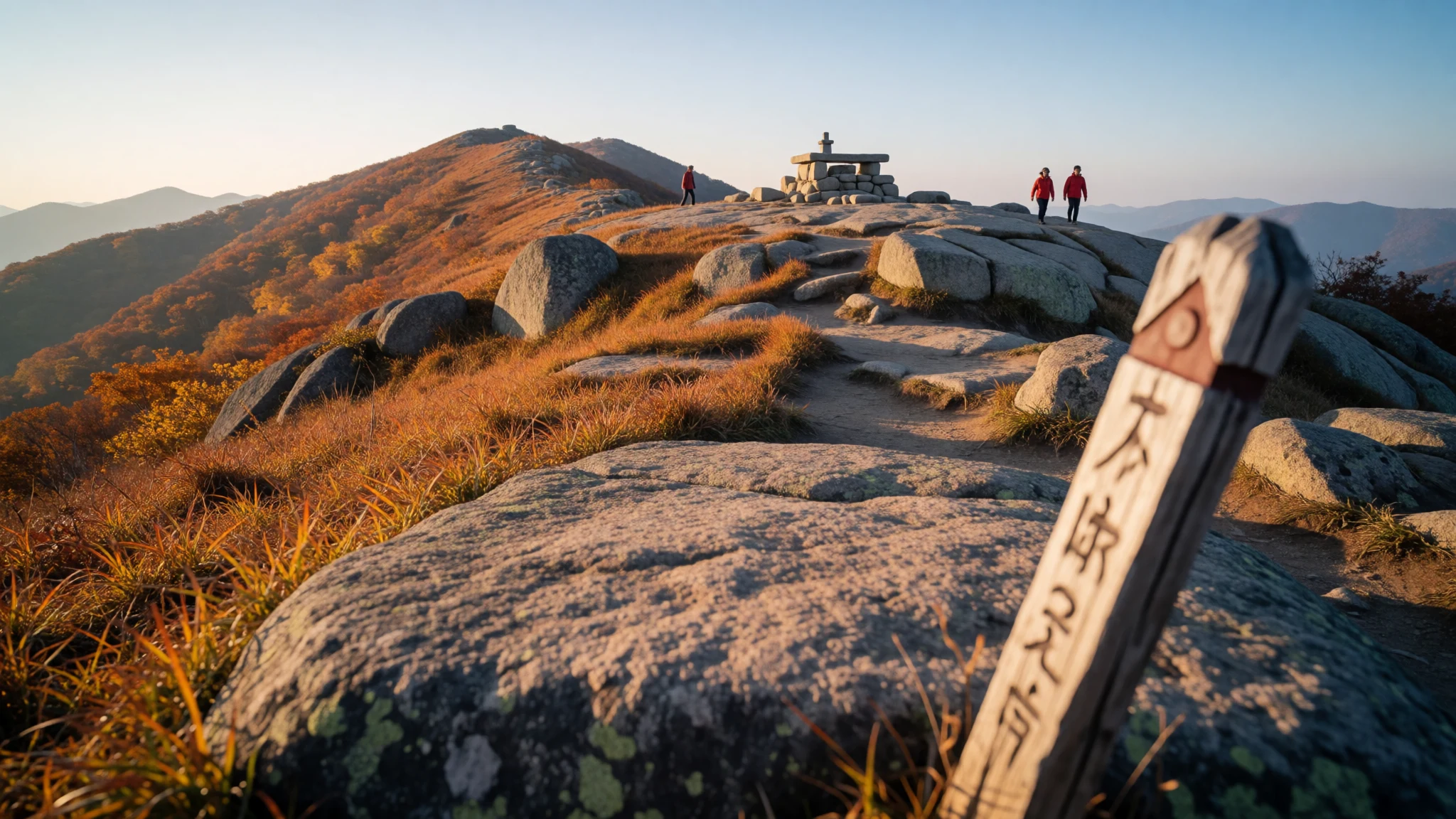
Taebaeksan is a broad, snowy mountain in South Korea's Gangwon-do, where winter hikers, old mountain worship and a boy-king legend meet on one windy summit.
The place
Taebaeksan rises to about 1,567 m in eastern South Korea, on the border between Gangwon-do and Gyeongsangbuk-do provinces. It sits on the Baekdu-daegan, the mountain spine that runs down the Korean peninsula, at the point where the ridge, after tracking the east coast for a long stretch, swings west. Trails climb from the Gangwon-do side near Taebaek town, while the far slopes belong to Bonghwa County in Gyeongsangbuk-do. The mountain holds national park status, a fairly recent designation, and many of the paths still feel more like old pilgrim routes than adventure trails.
The summit area is rounded rather than jagged. Several named peaks, Janggunbong and Munsubong among them, form a long crest that is gentler on the knees than Korea's craggier granite mountains. In winter that exposed top is scoured by wind and carries deep snow. Lower down the slopes are wooded, and in places broad fields of loose boulders spill down the hillside like grey rivers of stone.
The nearest bases are Taebaek and Yeongwol, both small working towns rather than resort centres, so evenings are quiet and options are simple. Crowds are real: autumn weekends and the snow season bring Korean hiking groups in large numbers, and the main trails can become a slow-moving line of bright jackets. Weekdays are far calmer. Summer is green but humid, and low cloud often hides the views from the top, so the walk itself has to be the reward on those days.
Its story
Taebaeksan's story mixes mountain worship with the memory of a boy king. Koreans have long treated high peaks as homes of spirits, and this one has been honoured for generations. A stone altar near the summit has been used for rites to the heavens, and ordinary families, shamans and hikers still climb to pray or simply to stand at the top, especially in winter.
Down in the valley, the town of Yeongwol keeps a different legend. Danjong, a young king of the Joseon dynasty, lost his throne to his uncle Sejo and was sent into exile in this remote corner of the country, where he was killed. Local memory says his body was left by the river, and that one loyal servant, defying the danger, buried it in secret. The grave was lost to view for a very long time. When it was finally found, it became the royal tomb now called Jangneung.
That tomb is unusual. Most Joseon royal tombs lie in and around Seoul, but this king rests far from the capital because he died here. The people of Yeongwol felt sympathy for him across the centuries and hold a festival in his memory. Some local shamans go further and say Danjong became a god who protects the district.
So the mountain and the valley share a quiet kind of guardianship. One is a place of sky-facing ritual, the other a place of grief and loyalty, and visitors often meet both in a single trip.
What to see
- Janggunbong summit — Taebaeksan National Park, summit area
Janggunbong is the main summit most walkers aim for, at the top of Taebaeksan's roughly 1,567 m crest. The top is broad and open, with a stone altar close by and wind that can be fierce. On clear days ridges roll away in layers; in cloud, the climb is the whole point.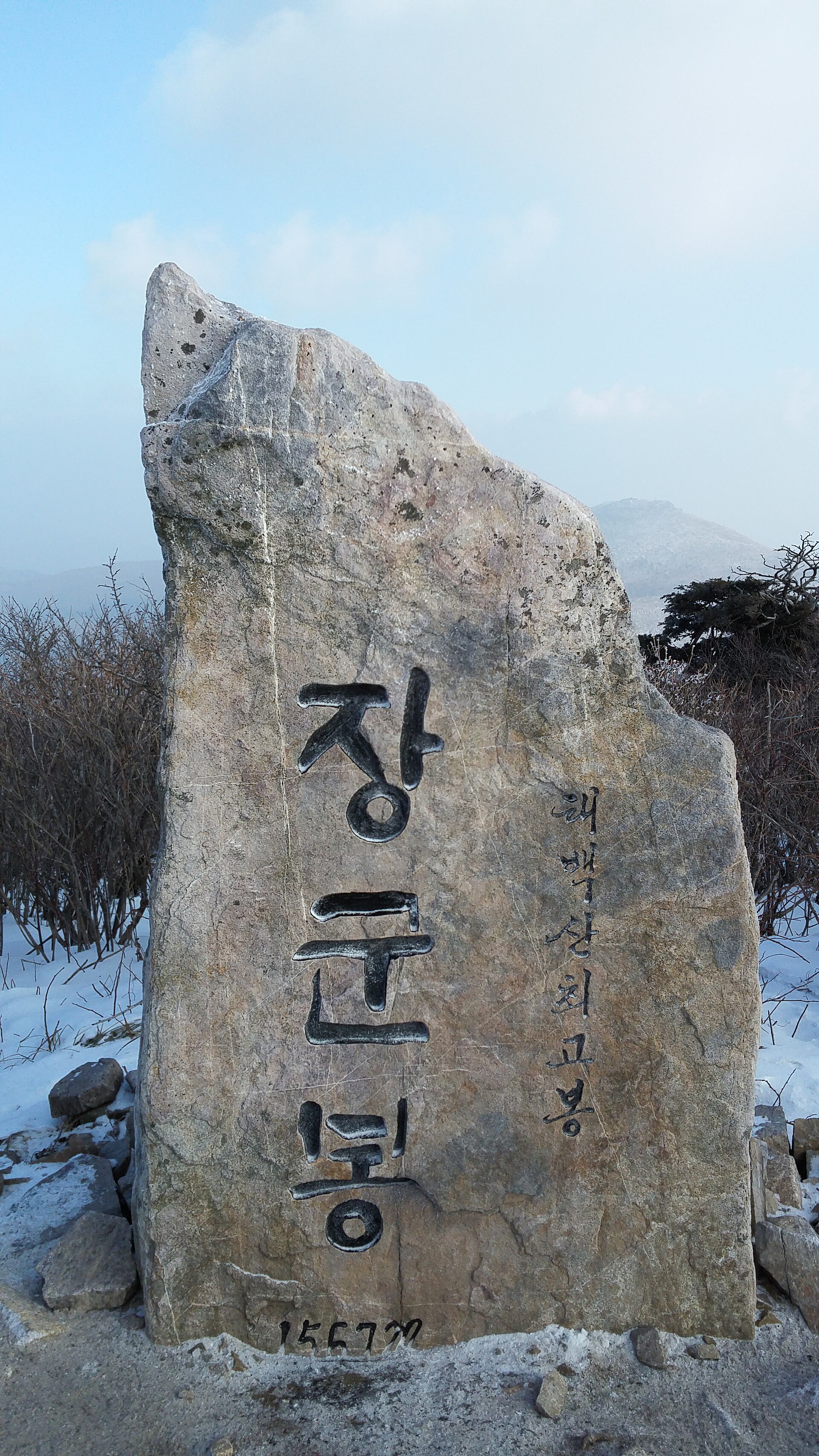
- Munsubong and the main-peak view — Taebaeksan ridge line
Munsubong is another peak on the same crest, and it is the place photographers use to frame the whole massif. From here the main summits show their true shape: a long, rounded ridge rather than a single spike. It rewards walkers who want a quieter outlook than the busiest viewpoint.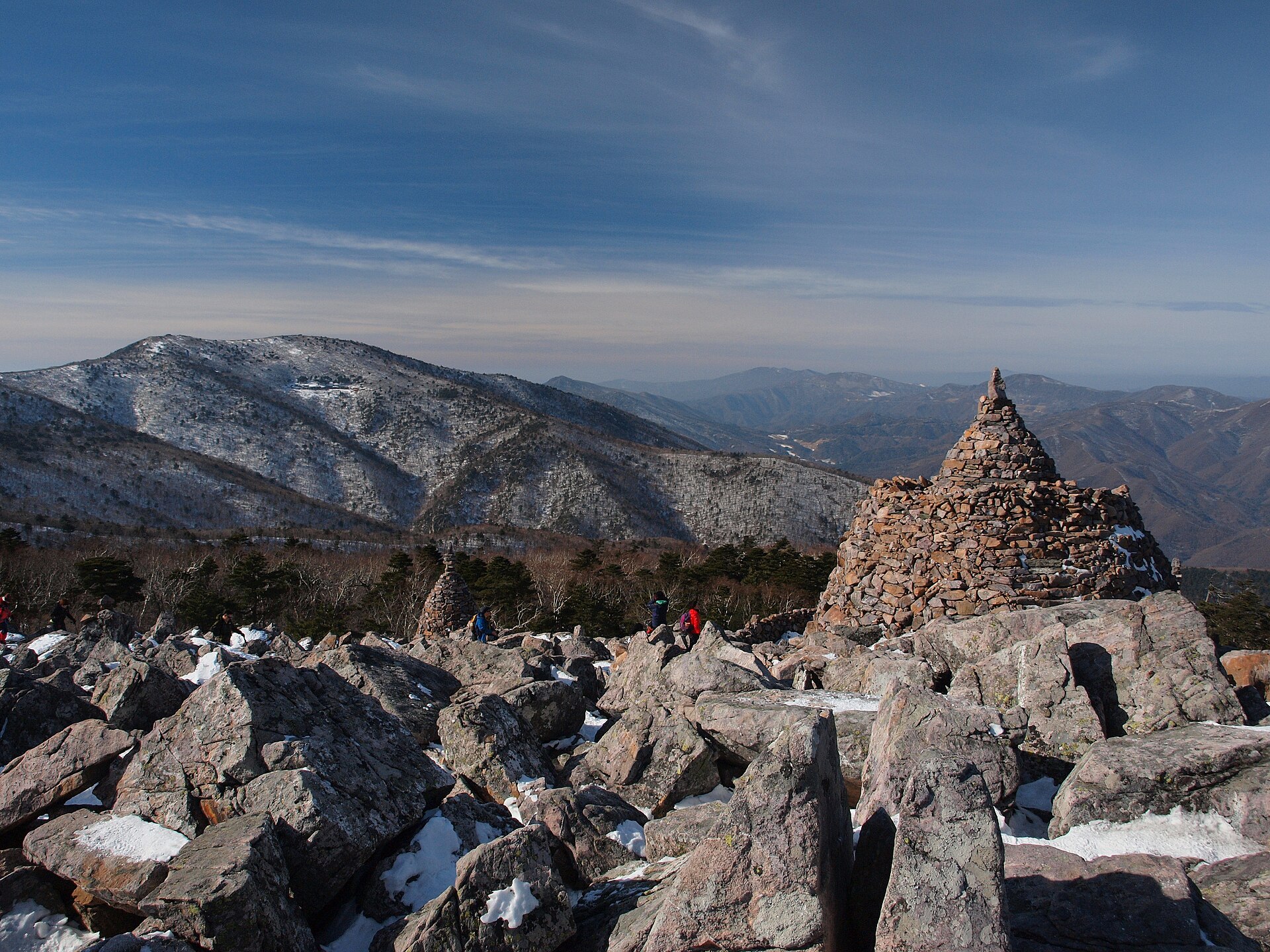
- Manggyeonsa temple — Just below Janggunbong
Manggyeonsa is a Buddhist temple set a little below Janggunbong, useful as a pause on the way up or down. In winter its roofs and the surrounding slopes sit under snow, and the view back across the forested valleys is among the calmest on the mountain.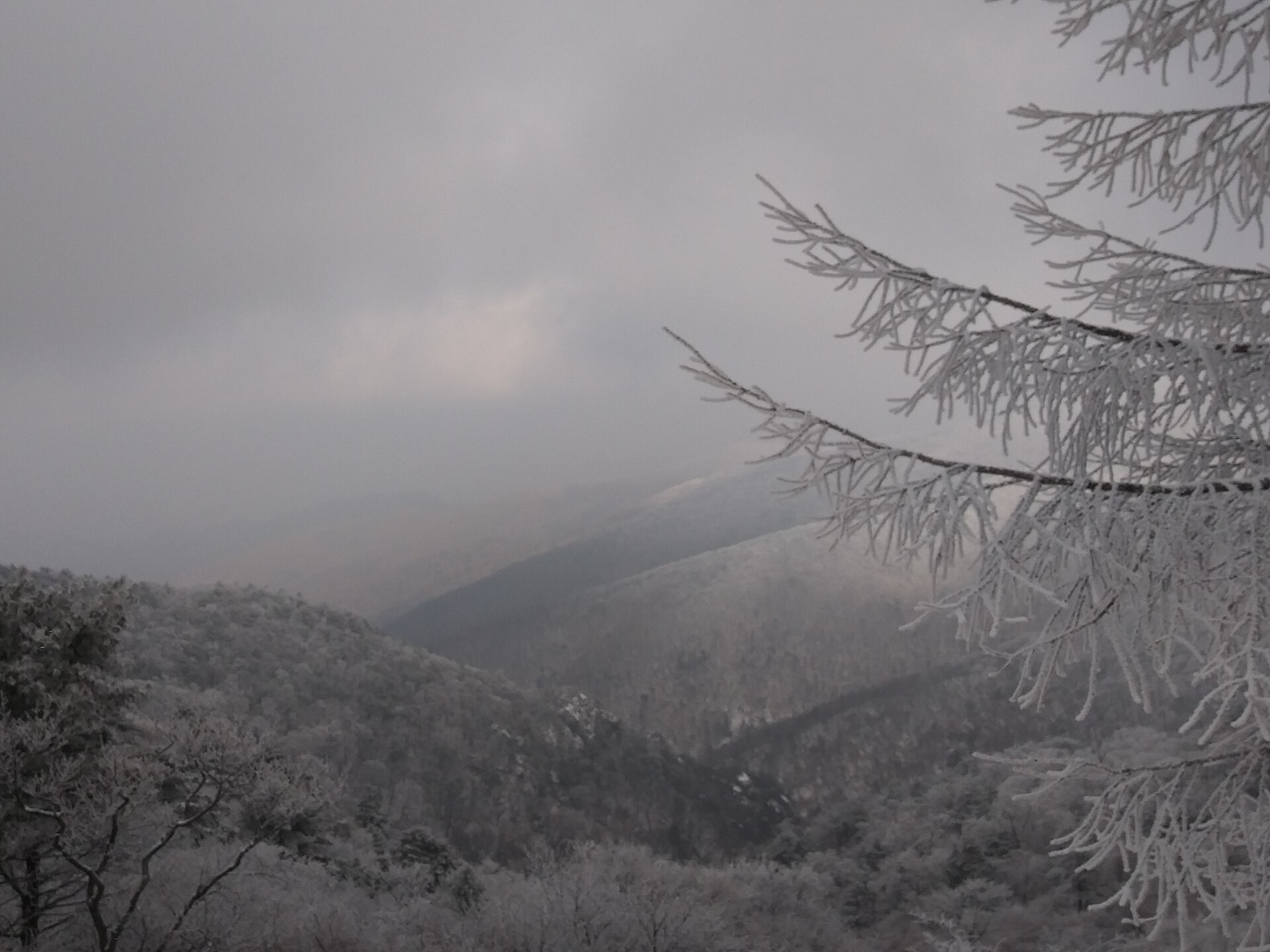
- The boulder fields — Taebaeksan National Park, lower slopes
On the slopes of Taebaeksan, streams of angular boulders run downhill between the trees, a feature Koreans call amgoeryu. They look like frozen rivers and make an odd contrast with the soft summit. The rocks are uneven and slippery when wet, so footing needs care and patience.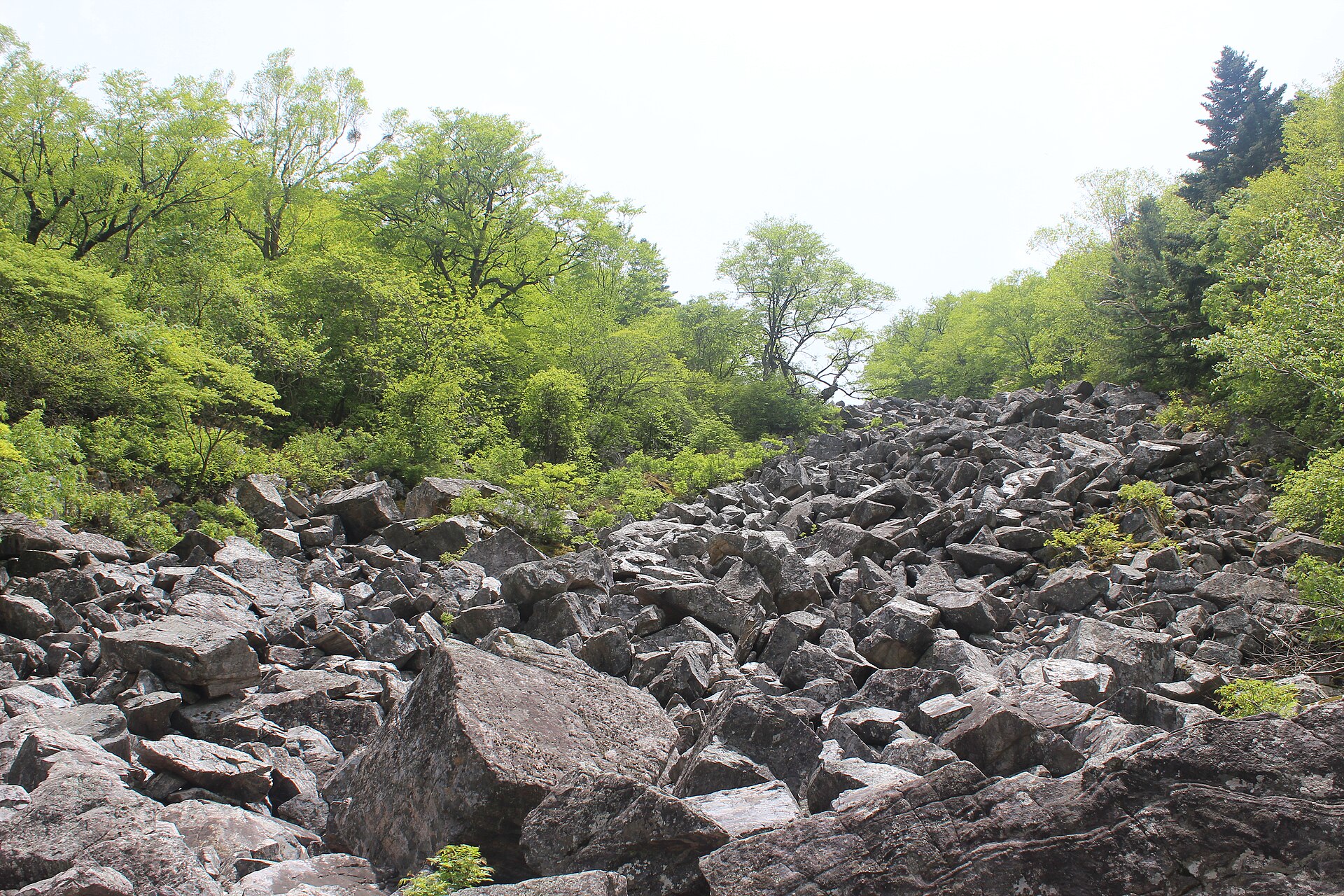
- Jangneung, tomb of King Danjong — Yeongwol
Jangneung is the royal tomb of the young king Danjong, set in the hills of Yeongwol rather than near Seoul. It is a calm, wooded site and a good way to understand why the district remembers him. Bodeoksa Temple and two small shrines lie close by in the same valley.
Culture
Taebaeksan sits at the meeting point of two old Korean habits: honouring mountains as living places, and walking up them together. Shamanic tradition regards peaks like this as the homes of spirits, and the stone altar near the top is a reminder that rites to the heavens were once held here. Many climbers still stop at the summit to bow, leave a small offering or say a short prayer, whatever their faith.
Buddhism sits quietly alongside it. Manggyeonsa temple on the upper slopes is a working place of worship, and the valley below, around Yeongwol, has further temples and shrines linked to the story of King Danjong. Local people commemorate him with a festival, and some regard him as a protective deity of the district.
Hiking itself is a social ritual in South Korea. Groups arrive in matching colours, share snacks and rice wine at the trailhead or summit, and greet passing walkers with a cheerful word. A winter snow festival is held on the mountain, so dates and crowds should be checked locally before planning around it. Cairns of small stones appear along the paths, built by walkers as wishes; they are part of the landscape and not rubbish.
At the temple, greet monks and other worshippers quietly, take off your shoes before stepping into any prayer hall, and never knock down or add to the stone cairns carelessly.
What to wear
Around Taebaeksan, traditional dress means hanbok: a short jacket (jeogori), a full wrap skirt (chima) for women, loose trousers (baji) for men, and an overcoat (durumagi) in colder months. Summer garments were made from breathable ramie and hemp, while silk marked ceremonial or festive wear, and padded cotton kept people warm through the mountain winters. Hanbok is now worn mainly at weddings, family holidays such as Seollal and Chuseok, and commemorative festivals, including events honouring King Danjong in Yeongwol.
Everyday dress in the towns is simple and casual. On the mountain itself, Korean hikers favour bright technical clothing: windproof jackets, fleece, hats, gloves, trekking poles and gaiters in snow. Even short day walks tend to be done in proper outdoor gear, and walkers often look better equipped than visitors might expect.
Visitors should dress for exposure, not fashion. In winter, wear thermal base layers, a windproof outer shell, a warm hat, gloves and a scarf; the summit is open and windy, and conditions can be much harsher than in the valley. Boots with a firm sole are best, with microspikes or crampons when snow and ice settle on the path. In summer, light quick-drying clothes and a waterproof jacket are better. Temple halls do not need special clothing, but covered shoulders and knees are polite when visiting Manggyeonsa.
What to eat
- Gondrebap — Small village restaurants in Yeongwol and Taebaek
Rice mixed with gondre, a fragrant mountain thistle, and served with soybean paste and side dishes. It is a plain, earthy meal that suits cold mountain air and is common across Gangwon-do's hill country. - Memil guksu — Local noodle shops and traditional markets in Yeongwol
Buckwheat noodles served in a cool broth in summer or a warm one in winter. Buckwheat grows well in highland Gangwon-do, giving the noodles a nutty taste and a slightly firm bite. - Gamja ongsimi — Family-run eateries near the main trailheads and in Taebaek town
Soft potato dumplings in a light broth, a Gangwon-do staple. The texture is chewy and gentle, and the dish reflects a region where potatoes were once a main crop on poor mountain soil. - Sanchae bibimbap — Restaurants close to temples and park entrances
Rice topped with seasoned wild mountain greens, vegetables and chilli paste, mixed at the table. It is a lighter, vegetable-heavy meal that tastes of the hills and suits a post-hike appetite. - Hanwoo beef grill — Beef restaurants in Taebaek town centre
Korean beef cooked over a table-top grill and wrapped in lettuce with garlic and paste. Taebaek's cold upland climate gave it a name for beef restaurants, and groups often finish a hiking weekend this way.
Plan it
Best time. Late October for autumn colour on the lower slopes, January and February for deep snow and the winter festival season, and May for fresh greenery. Summer is leafy but humid, with low cloud that often hides the views.
How long. 1–2
Getting there. Fly into Incheon International Airport near Seoul, then travel east by rail on the Taebaek line, which stops at Yeongwol and Ssangryong stations, or by intercity bus. The last leg to the trailheads is by local bus or taxi from Taebaek or Yeongwol; check Korail and local bus timetables before you travel.
Budget. mid
Tips
- Start early so you are off the exposed summit well before dark, especially in winter.
- Book rooms ahead for winter weekends and festival dates, when the towns fill with hiking groups.
- Carry water and snacks, plus some cash for small trailhead stalls and village eateries.
- Check weather and any trail closures on the national park's official site before you set out.
- Weekdays are far quieter than weekends in autumn and in the snow season.
Etiquette
- Take your shoes off before entering any temple prayer hall.
- Keep your voice low near temples and shrines, and leave stone cairns as you found them.
- Carry all your rubbish down the mountain with you.
Nearby
Sources
- Wikidata Q625254 (CC0)
- Wikipedia: Taebaeksan (rev 1355990774) (CC BY-SA 4.0)
- Wikivoyage: Yeongwol (rev 5430198) (CC BY-SA 4.0)
- Photo: Dcpeets, Main peaks of Taebaeksan from Munsubong (CC BY 3.0)
- Photo: Alif Arefur, Beauty of Silence (CC BY 3.0)
- Photo: Christian Bolz, Janggunbong at Taebaeksan (CC BY-SA 4.0)
- Photo: Franguiche, Parc National Taebaeksan en hiver (CC BY-SA 4.0)
- Photo: Jyuri08, Taebaeksan winter (CC BY 3.0)
- Photo: 최옥석, Taebaeksan boulder field (2) (CC BY-SA 4.0)
- Photo: 최옥석, Taebaeksan boulder field (3) (CC BY 3.0)
- Photo: 최옥석, Taebaeksan boulder field (4) (CC BY-SA 4.0)


