Mangystau
Mangystau, Kazakhstan
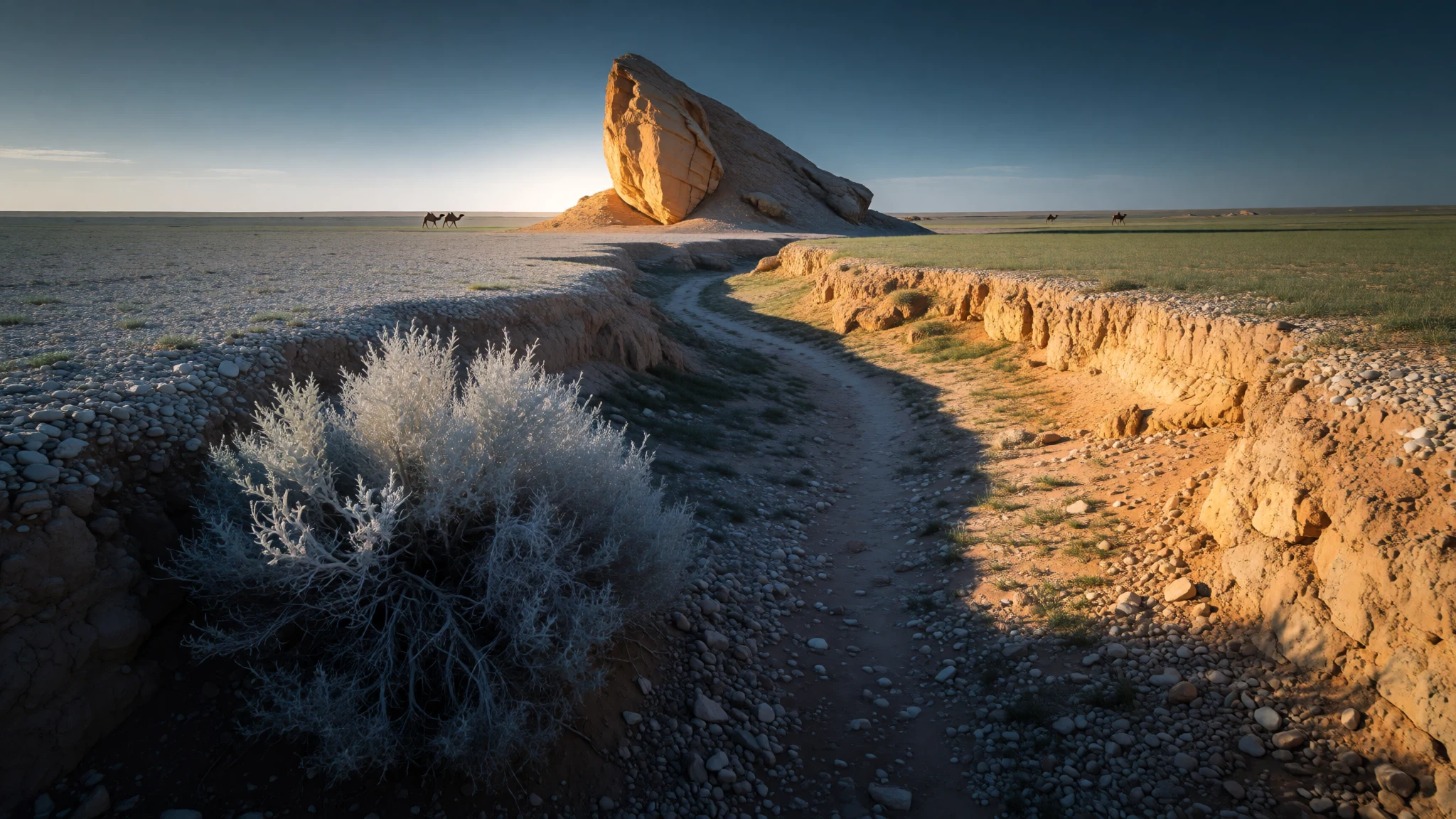
Mangystau is Kazakhstan's Caspian desert region, where striped clay canyons, lone rock towers and old burial grounds sit in near-total silence.
The place
Mangystau is a region in the south-west of Kazakhstan, on the Caspian shore, with the seaport of Aqtau as its capital. It covers the Mangyshlak Peninsula and shares borders with Turkmenistan and Uzbekistan, as well as with the Aktobe and Atyrau regions. About 735,000 people live there, spread thinly across roughly 165,600 square kilometres, so most of the land is empty.
The terrain is a patchwork of Caspian lowland, flat-topped plateaus such as Ustyurt, low mountain ranges, deep hollows and open desert. Colour is the main event. Layers of clay and loam show up green, yellow, pink and red, and wind and the occasional downpour have carved them into a maze of gullies, cliffs and odd shapes. The highest point, Otpan mountain, reaches 556 metres, so this is a region of wide horizons rather than peaks.
Oil shaped the modern region. Petroleum was found in Soviet times, drilling followed, and towns grew up around the industry; Mangystau has existed as an administrative region since 1973. That explains the contrast a traveller meets: a working industrial coast and port, then a few hours inland, canyons and chalk-white cliffs with hardly a soul about.
Distances are long, tracks between sights are often unsurfaced, and services thin out fast. The climate is continental, with cold winters, especially on the northern plateau, and warm, dry summers with very little rain. Mangystau suits people who like space, silence and slow, dusty drives more than those hoping for grand monuments.
Its story
Mangystau enters the written record in the 9th century, when Arabic geographers described a land with few people. By the tenth century, Turkic groups had settled where they could find springs and grazing, and later medieval writers mention a small principality and a town carrying the region's name. The peninsula sat on the edge of larger powers, among them the Khazars, the Khwarezmian state and the Seljuks, and changed hands more than once.
In 1221 the Mongols took it. After that the region passed in turn through the Golden Horde, the Nogai Horde, the Uzbek Khanate and the Kazakh Khanate. Its population shrank as the steppe gradually dried out, and raids by Kalmyk groups, beginning in 1620, added to the pressure. For long stretches this was a place of herders moving between wells and winter pastures, not of cities.
The rock tells an older story. Much of the landscape is made of sediments laid down under water, which is why cliffs here are banded like layer cakes and why round stone concretions and fossils weather out of the slopes.
The twentieth century brought the biggest change. Under Soviet rule, herding families were pushed into settled life, and the discovery of oil drew engineers, workers and a new port town to the coast. The area was called Mangyshlak from 1973 until 1988, when the present name came back. The old burial grounds scattered across the steppe are the clearest surviving trace of the centuries before.
What to see
- Sherqala — Desert plain inland from Aqtau
Sherqala is a lone, whale-backed rock of pale stone rising abruptly from flat desert, its steep clay flanks glowing orange at sunset. Visitors usually come on a long day trip from Aqtau and walk around the base. Go with a local driver, as tracks are unmarked and summer heat is fierce.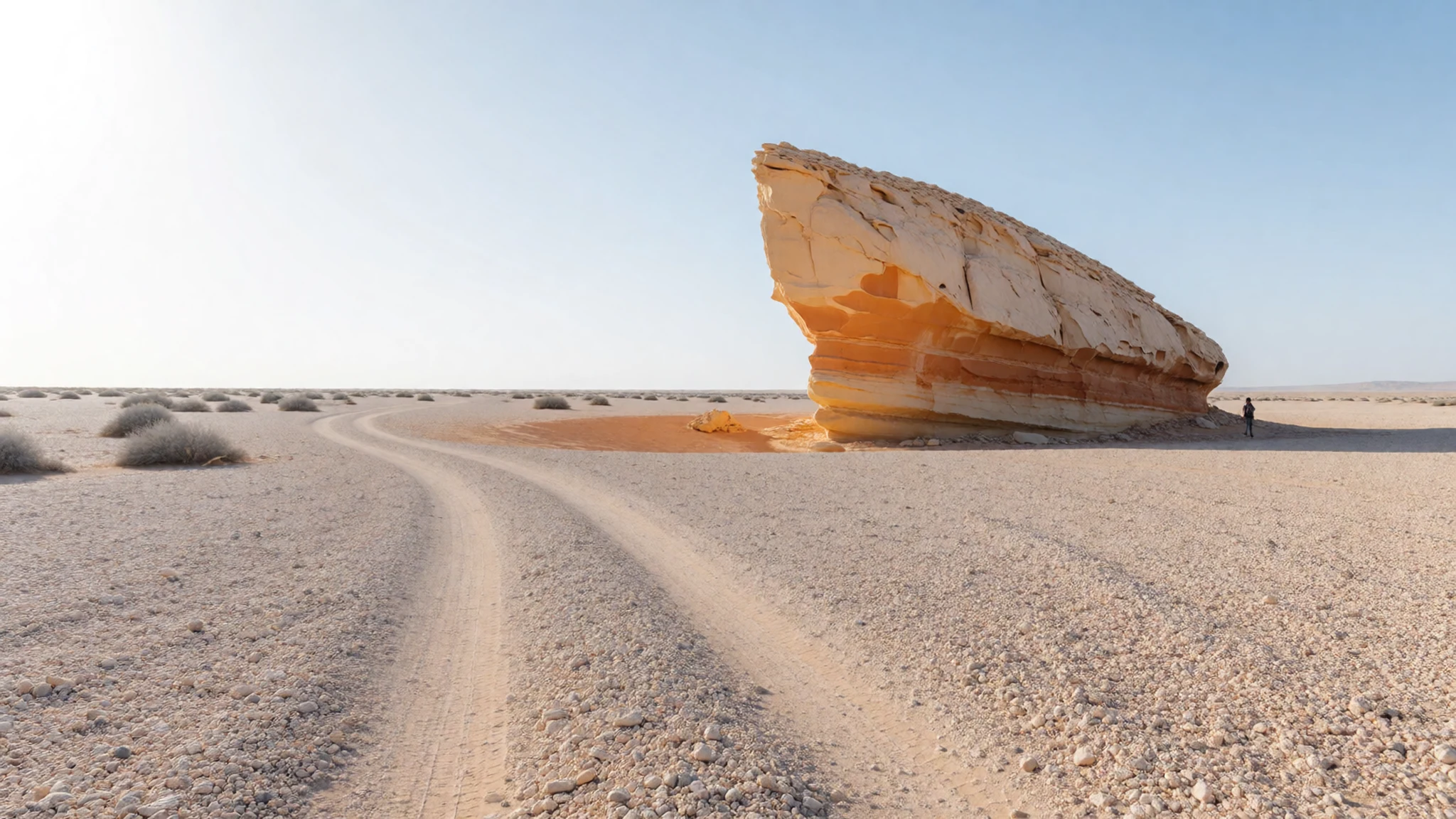
- Zhabaiushkan reserve — Desert interior of Mangystau
Zhabaiushkan is a protected local reserve of eroded hills, ravines and rock walls in the Mangystau desert. The scenery is best in low morning or evening light, when the layered colours deepen. Access is normally arranged through a local guide or tour operator, so ask about permits before setting out.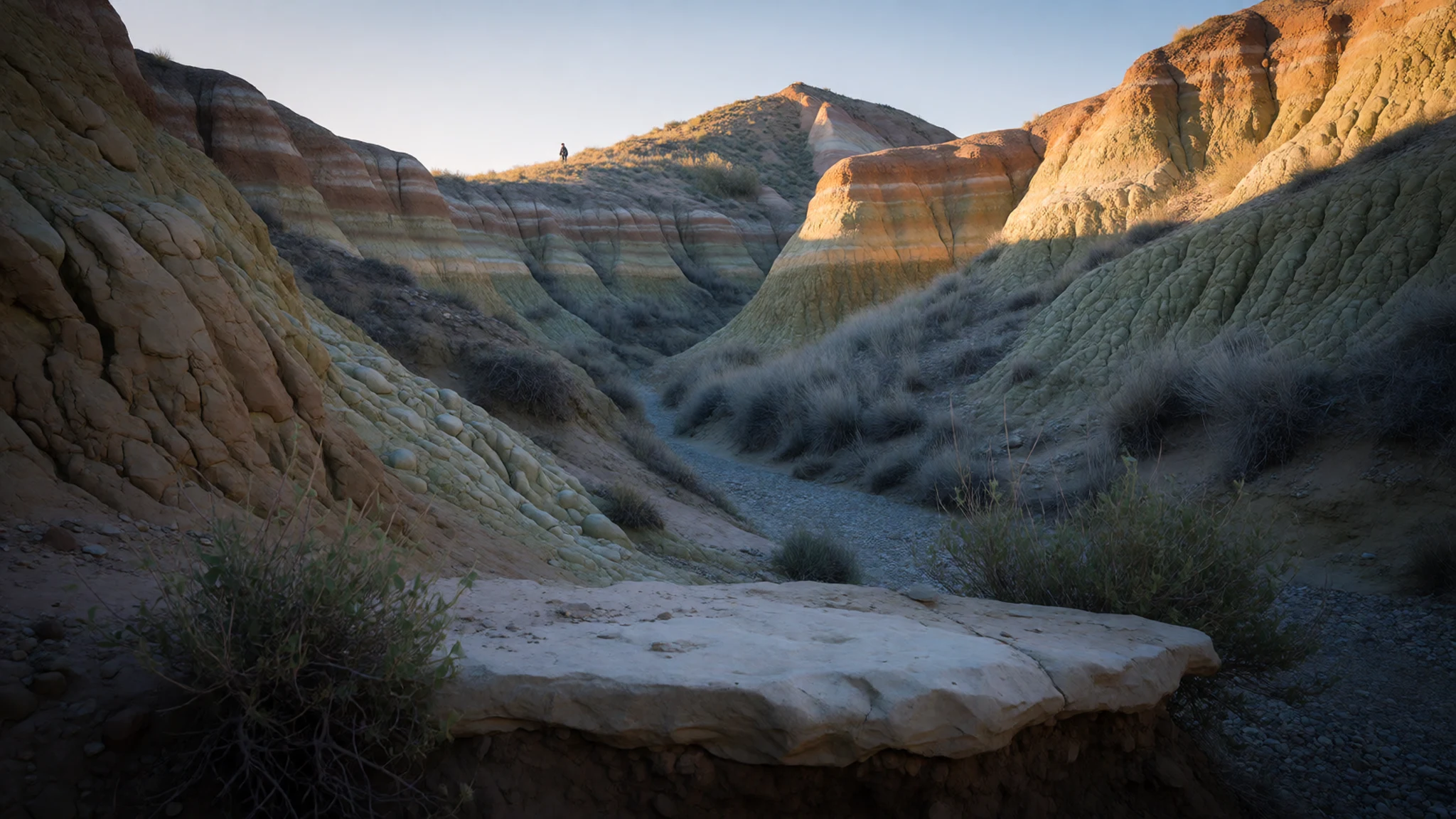
- Senek necropolis — Open steppe, Mangystau
Senek is a historic burial ground where carved stone markers stand in open steppe, far from any village. It is a quiet place and a reminder that Mangystau was long a land of herders and Muslim communities. Go in a respectful frame of mind, speak softly and ask before photographing anything.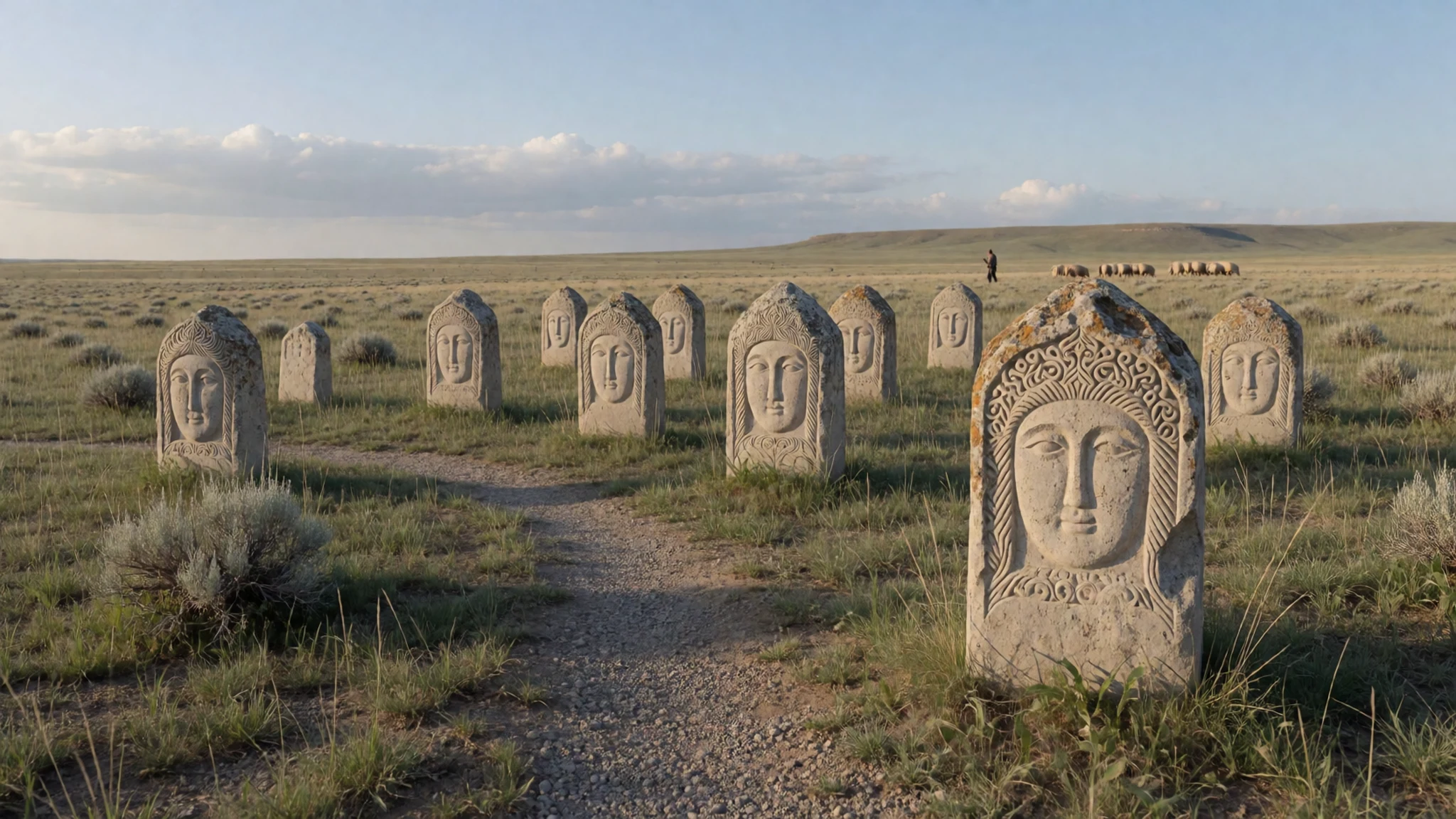
- Concretion fields — Clay valleys of western Kazakhstan
In several valleys across western Kazakhstan, rounded stone concretions lie scattered on clay slopes, some small enough to hold and others the size of boulders. They formed inside the soft rock and were freed as it eroded. Look, photograph, but leave them where they are.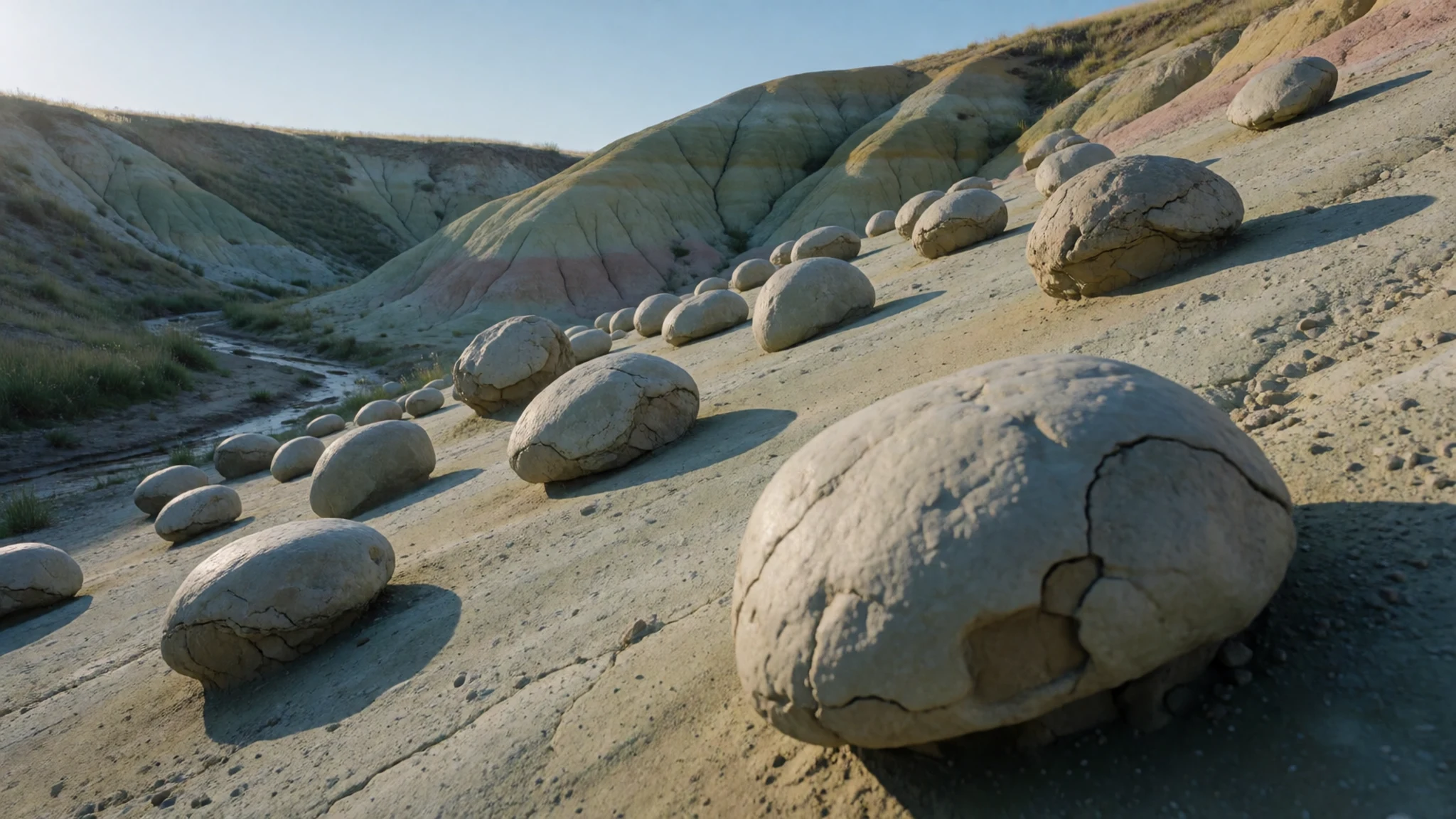
- Karyn-Zharyk hollow and Kenderli — Central desert of Mangystau
Karyn-Zharyk is a deep hollow in the desert, ringed by striped cliffs that catch the light well in the evening. Nearby, the pale Kenderli basin can hold water after rain and looks like a mirror when it does. Carry plenty of water; shade is scarce and there are no shops.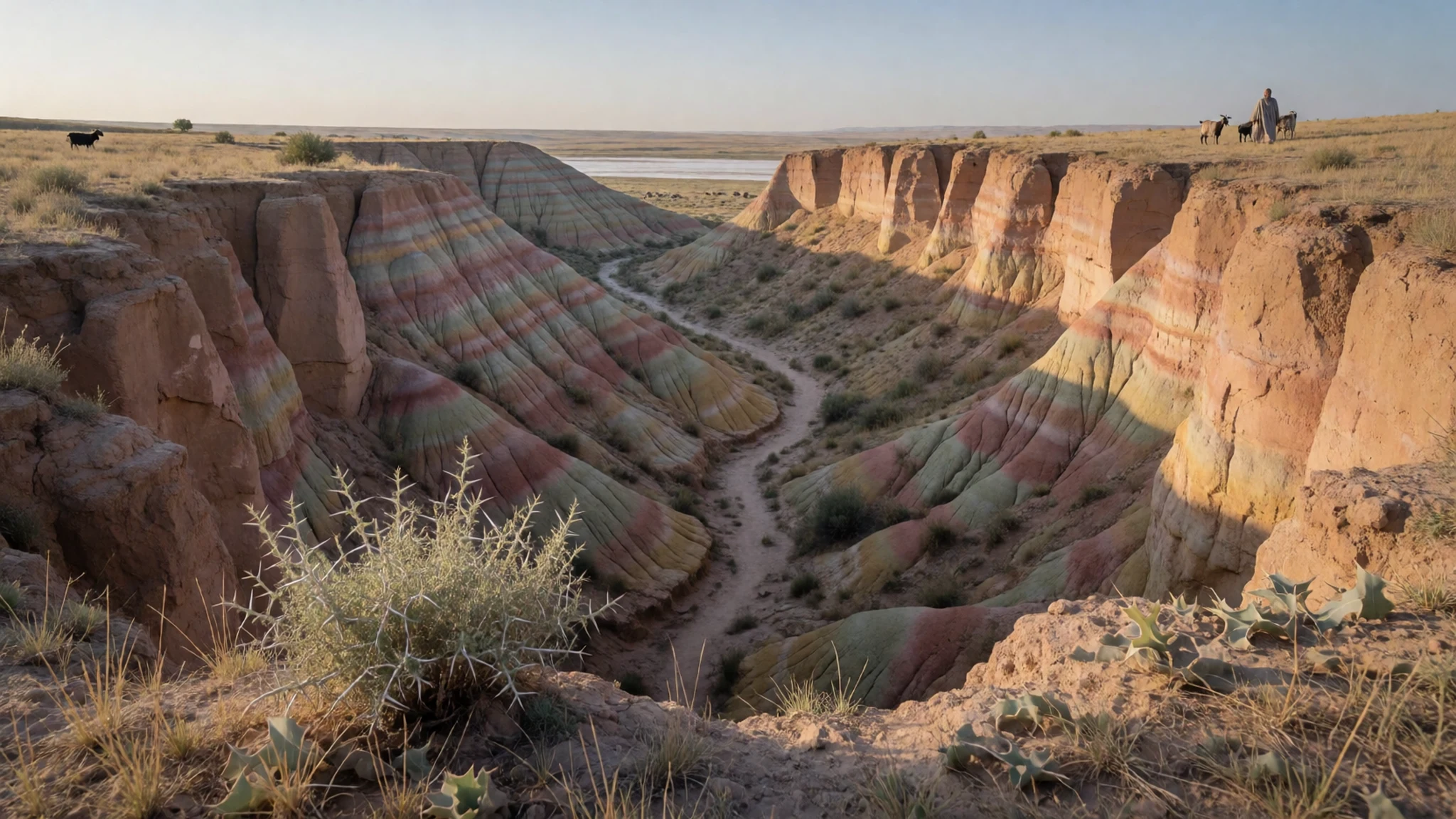
- Aqtau — Caspian coast
Aqtau is the regional capital and Caspian seaport, a planned town of apartment blocks, a seafront and a working harbour. It is not a sightseeing destination in itself, but it is where flights land, supplies are bought and driver-guides are found, so most trips into the desert begin and end here.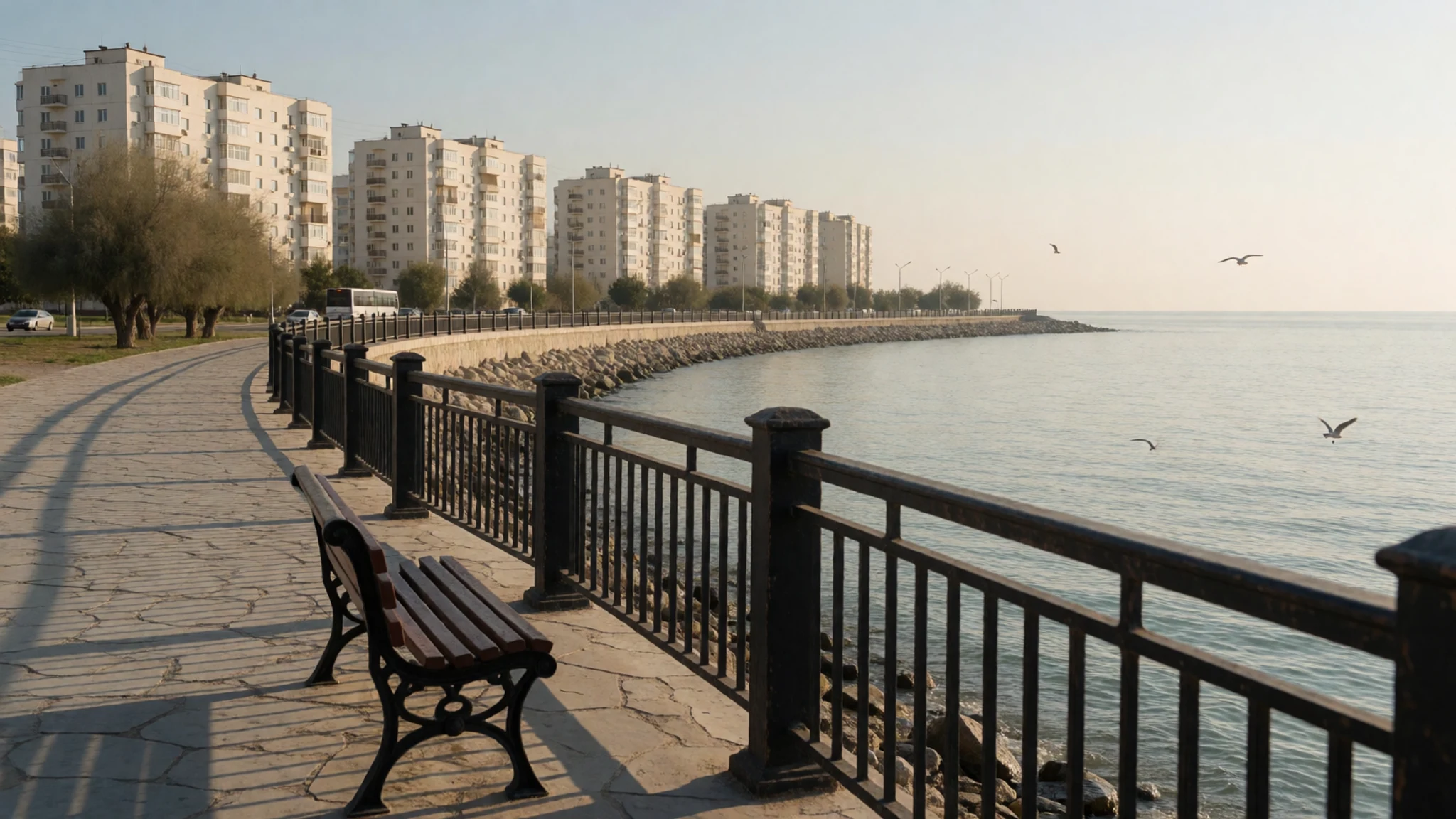
Culture
Mangystau is part of a Kazakh culture built on herding and horses. For centuries families moved with their animals across the steppe, and the horse remains a symbol of identity, seen in full at big traditional festivals and in the many horses that roam the winter pastures near Aqtau. Soviet policy forced herding families to settle, so a daily nomadic life is now rare. The yurts offered to tourists are mostly re-creations made for visitors, which is worth knowing before expecting a living tradition.
People in Kazakhstan are proud of their country and tend to be hospitable to guests. Tea, bread and sweets appear quickly when you sit down in someone's home or at a roadside stop, and refusing everything outright can seem cold. Conversation often turns to family, to where you come from and to what you make of the land. Criticism of Kazakhstan or its people, however light, can land badly, and jokes about the film Borat are tired and unwelcome.
Kazakhstan is a Muslim-majority country, though everyday practice varies and religion is held fairly lightly in towns. In the countryside, old graves, shrines and underground prayer sites are still visited by pilgrims and are treated with seriousness. Use a driver or guide when going far into the desert; they also serve as the interpreter for local etiquette.
At graves, shrines and mosques, dress modestly, lower your voice, remove your shoes where others do, and ask before photographing people or praying worshippers.
What to wear
Traditional Kazakh dress grew out of life on horseback. The chapan is a long, loose robe, quilted or lined for winter, worn over trousers and a shirt. Felt, sheepskin, camel wool, silk and velvet were the main materials, often with embroidery on cuffs and hems. Men wore skullcaps or fur-trimmed hats such as the borik, and women wore the kimeshek, a white head and shoulder covering. The saukele, a tall, ornate bridal headdress, is the best known piece, usually seen now at weddings and festivals.
In Aqtau and the oil towns, everyday clothing is plain and practical: jeans, trousers, shirts, jackets and trainers, with business dress in offices and a smarter look for evenings and family occasions. Traditional pieces appear at national holidays, on stage and at celebrations, rather than on the street. Women often dress more formally than visitors expect, even for a simple meal.
For visitors, the desert sets the rules. Wear light, long-sleeved, breathable layers against sun, wind and dust, a hat with a brim, sunglasses and a scarf or buff to cover the face on dusty tracks. Evenings turn cool, and winters are properly cold, so bring a warm jacket and gloves outside the warm months. Closed, sturdy shoes with good grip are better than sandals on loose clay and rock. At shrines, graves and mosques, cover shoulders and knees, and women should carry a scarf for the head.
What to eat
- Beshbarmak — Family-run restaurants and eateries in Aqtau, or at a home table
The best-known Kazakh dish: boiled meat, traditionally horse, beef or lamb, laid over flat squares of pasta with onion and potato, and served with a rich broth. It marks special occasions, and portions are large enough to share.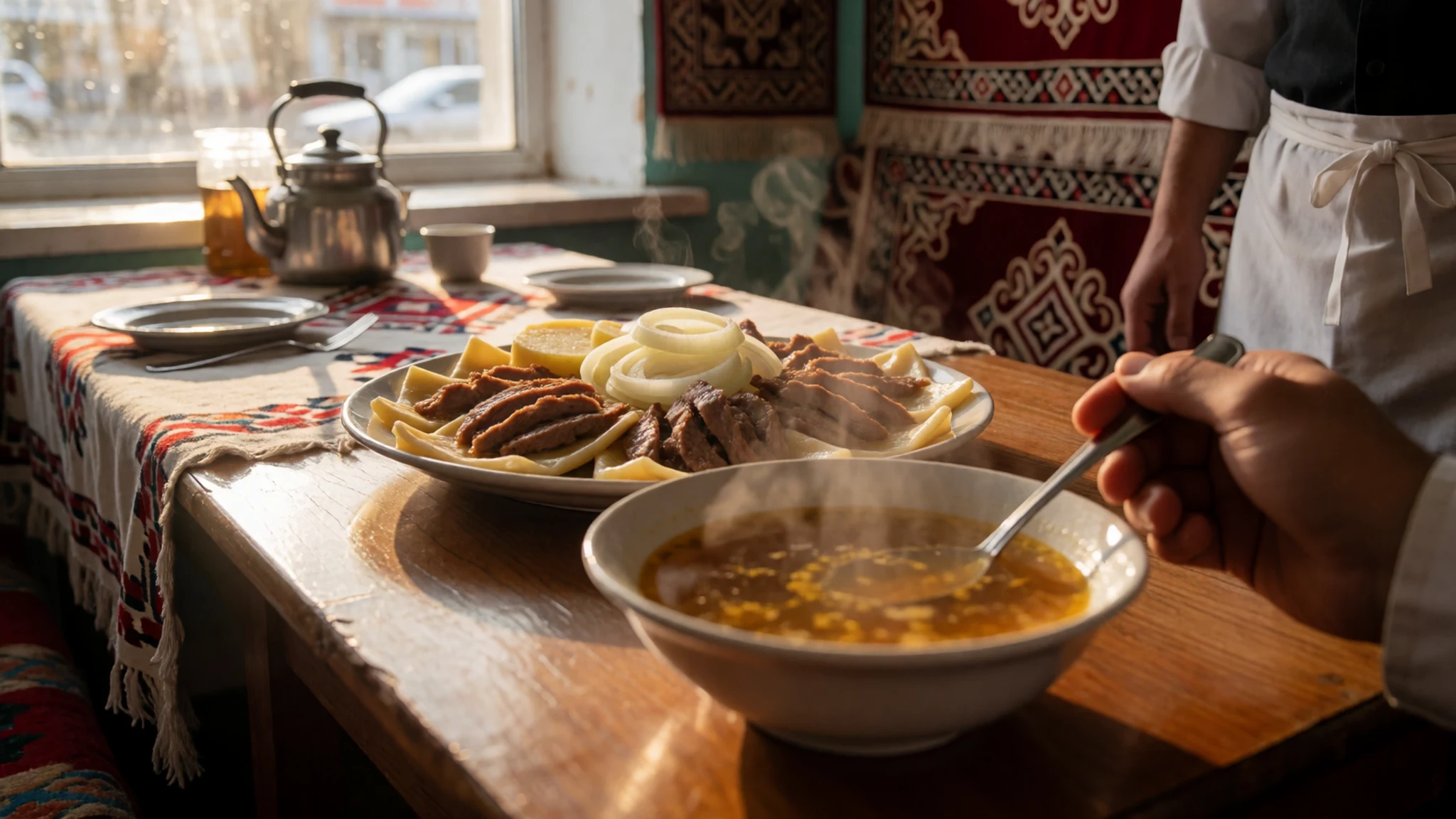
- Kazy — Larger restaurants in Aqtau, or the meat counters of the city's markets
Handmade horse-meat sausage, sliced and eaten cold as part of a spread of cured meats, or served alongside beshbarmak when ordered in advance. It is rich, salty and fatty, and best shared in small slices.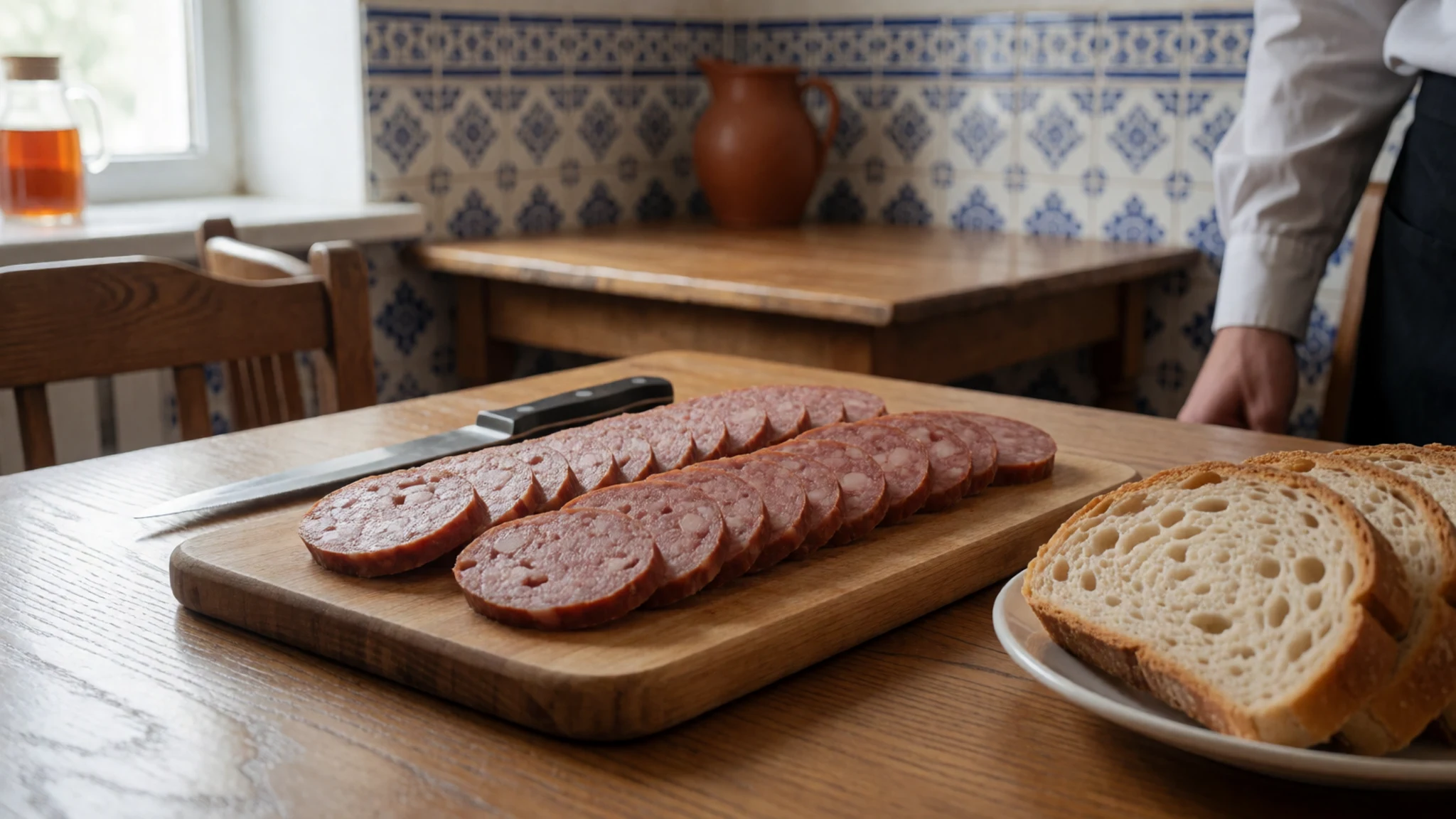
- Laghman — Casual eateries and canteen-style places across Aqtau
A thick-noodle dish with meat, carrot, onion and other vegetables, served either as a soup or with the sauce spooned over. It is filling, easy to order and one of the safer choices for a first meal. - Manty — Neighbourhood cafés and eateries in Aqtau
Large steamed dumplings filled with chopped meat and onion, sometimes with pumpkin. They arrive hot, usually with sour cream or a simple sauce, and are a staple of family meals and small cafés. - Shubat — Roadside stalls and village stops in the desert, and some city markets
Fermented camel milk, fizzy, sour and slightly salty, sold as a traditional drink in the Caspian steppe. It is an acquired taste, so start with a small cup, and take care if your stomach is sensitive.
Plan it
Best time. April–May and September–October are the most comfortable months, with mild days and cooler nights. Summer is warm, dry and sunny, with heat that makes long desert walks hard, while winters are cold, windy and bleak, especially on the northern plateau. Rainfall is scarce all year.
How long. 3–4
Getting there. Fly to Aqtau, usually with a connection through Almaty or Astana, though routes change, so check current schedules. From Aqtau, the sights lie along long unsurfaced tracks, so book a driver with a robust four-wheel-drive vehicle. Entry rules vary by passport, so check the latest on the official government websites before booking, and see the regional site at http://mangystau.gov.kz/.
Budget. mid
Tips
- Hire a local driver-guide; signs are scarce, tracks are rough and getting lost in the desert is a real risk.
- Carry more drinking water than you expect, plus snacks, sun cream and a hat, as shops are rare away from towns.
- Keep some cash for villages and roadside stops, as cards may not work outside Aqtau.
- Start early, because heat and wind build through the day, and the light is better in the morning and evening.
- Mobile signal is patchy in the desert, so tell someone your route and download offline maps.
Etiquette
- Dress modestly at graves, shrines and mosques, and remove your shoes where others do.
- Accept a cup of tea or a snack when offered, and say thank you warmly.
- Ask before photographing people, and avoid arguments about politics, religion or Borat.
Nearby
Sources
- Wikidata Q238931 (CC0)
- Wikipedia: Mangystau Region (rev 1386037295) (CC BY-SA 4.0)
- Wikivoyage: Kazakhstan (rev 5427114) (CC BY-SA 4.0)
- Sherqala, Ashina (CC BY 3.0)
- Zhabaiushkan reserve, Putnik13 (CC BY-SA 4.0)
- Senek necropolis, Yakov Fedorov (CC BY-SA 4.0)
- Concretions, Western Kazakhstan, Alexandr Babkin (CC BY-SA 4.0)
- Horses in Mangystau Province, Triante2009 (Public domain)
- Karyn-Zharyk Hollow, Kenderlik Lake, Максат79 (CC BY-SA 4.0)
- Zhabaiushkan sanctuary, Максат79 (CC BY-SA 4.0)
- Aktau panorama, Vita86 (CC BY 3.0)


