Karaganda
Karaganda, Kazakhstan
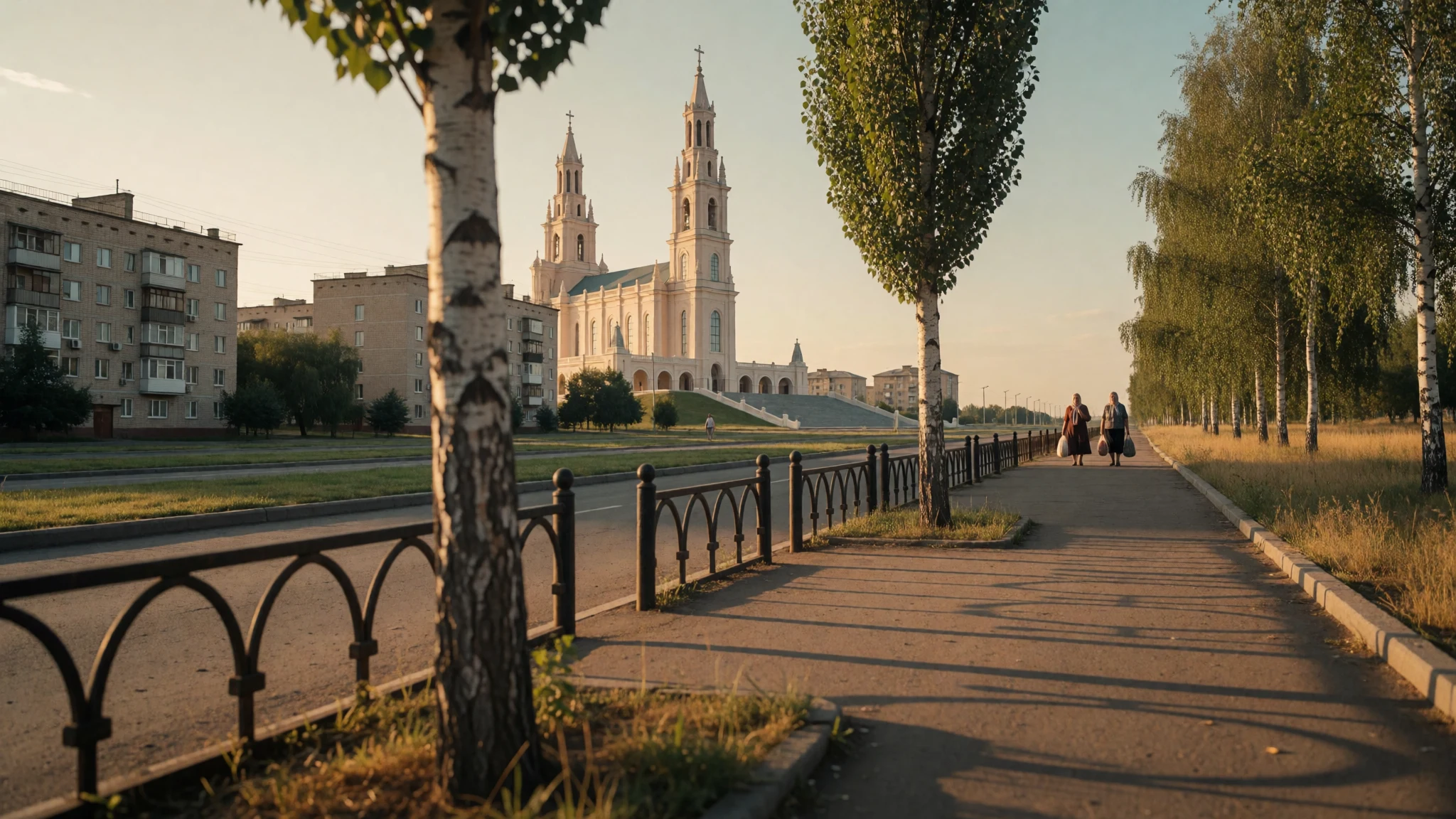
Karaganda is a Soviet coal city on the Kazakh steppe, worth a stop for its unusual cathedrals, mining-era museums and honest everyday atmosphere.
The place
Karaganda sits on open steppe in central Kazakhstan, about 553 m above sea level, and serves as the capital of its region. Roughly half a million people live here (the facts give 515,632), so it is a proper city rather than a mining camp, even though coal explains why it exists at all. The centre follows a Soviet plan: broad avenues, solid apartment blocks, long strips of park and a main boulevard, Buqar-Jyrau, where shops, eateries and a couple of small museums cluster. Walk ten minutes in almost any direction and the grassland starts to show between the buildings, while pit-heads and spoil heaps on the edges are a reminder of the trade that built the place.
This is not a city of monuments, and it rarely sees many foreign visitors. That means no queues and no souvenir crush, but also little English on signs and menus, so a translation app earns its place. Russian is the common language of daily life, with Kazakh widely heard too.
The climate is strongly continental. Summers are warm and mostly dry, winters are long and savagely cold, and the shoulder seasons are short and can be muddy or windy. Universities give the city a young, lively streak, visible in cafés, bars and karaoke places along Nurken Abdirov and nearby streets. Karaganda works best as a one- or two-night stop on the rail line between Astana and Almaty, or as a base for the national park to the east, rather than as a destination on its own.
The official city administration website is https://www.gov.kz/memleket/entities/akimat-karagandy for current information.
Its story
Karaganda's story begins with coal. Local tradition says a shepherd named Appak Baizhanov noticed the black seams in 1833, and the find drew labourers from surrounding villages, Russian traders and investors from as far away as France and England. That first boom faded and the workings were abandoned. Some city maps still mark the spot as the Old Town, though almost nothing stands there today.
The city people see now is a Soviet creation. In the late 1920s geologists surveyed the coalfield, and the authorities responded by setting up a state coal trust and drawing plans for about a dozen pits and a town to house the workforce. Digging resumed at the start of the next decade, and miners' families first lived in hastily built temporary shelters while permanent streets were still on paper. Karaganda counts 1931 as its founding year.
The workforce was gathered from across the Soviet Union, and not always by choice, which is why the city has long been home to Kazakhs, Russians, Germans, Poles and many other communities. That mix explains a detail that surprises visitors: a Catholic diocese is based here, and its cathedral is among the city's landmarks.
After independence the mines remained central to the economy, even as the city added universities, services and light industry. Coal still shapes everything from the skyline to local pride. Understanding Karaganda mostly means understanding that it was planned around a resource and filled with people who arrived to dig it, then stayed and made a home on the steppe.
What to see
- Cathedral of Our Lady of Fatima — City centre
Karaganda's Catholic cathedral is the most photographed building in town, a pale, soaring structure with tall slender towers that looks oddly at home against the flat steppe sky. It is the seat of the local diocese. Visit in daylight, step inside quietly if services are not under way, and look at it from a distance too.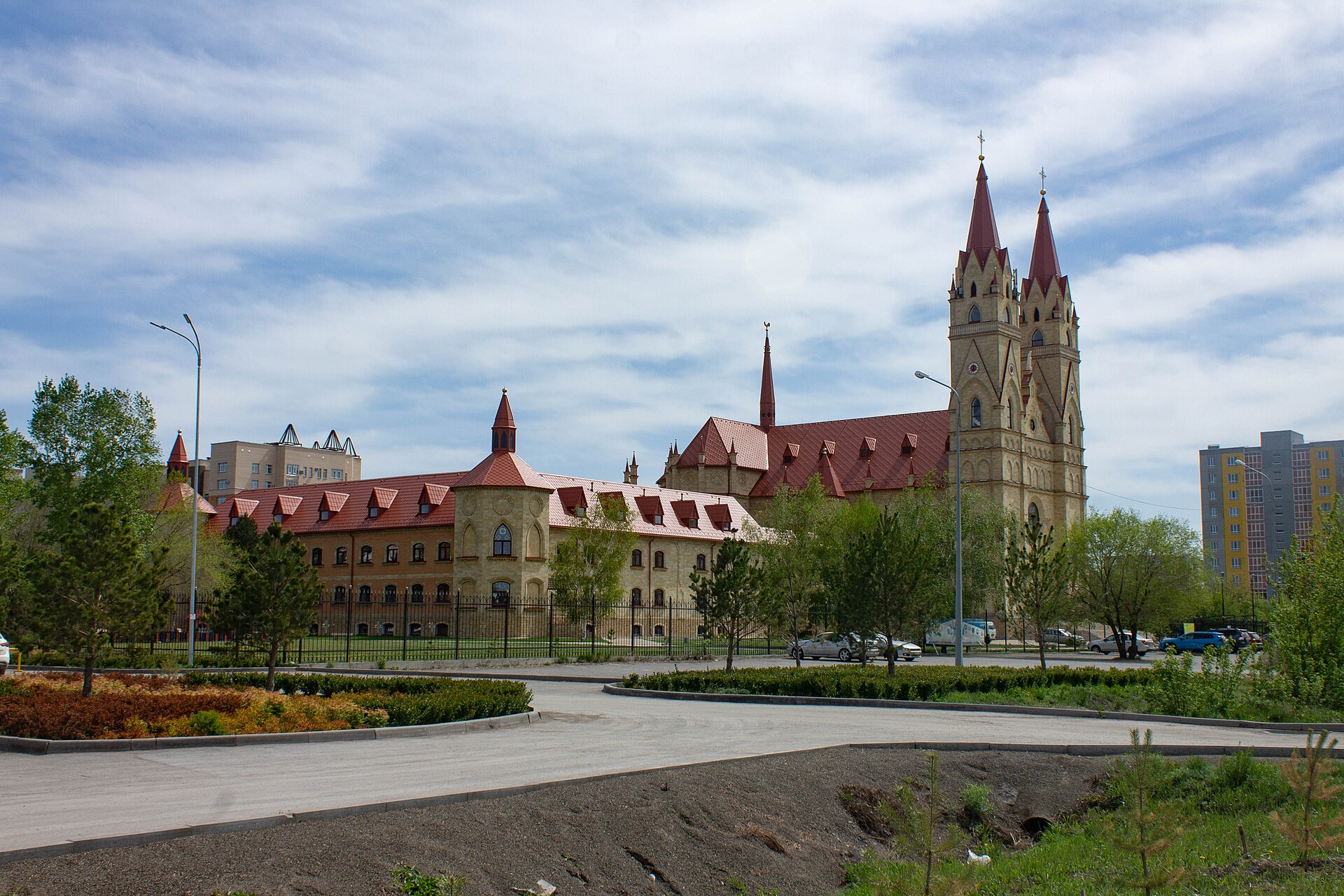
- Miners' Palace of Culture — Central Karaganda
A grand Soviet-era theatre and cultural hall that honours the men who dug the coal. Its columned front and large scale show how seriously the planners took mining as a source of civic pride. Check the programme for concerts and plays, or simply admire the exterior and the square around it.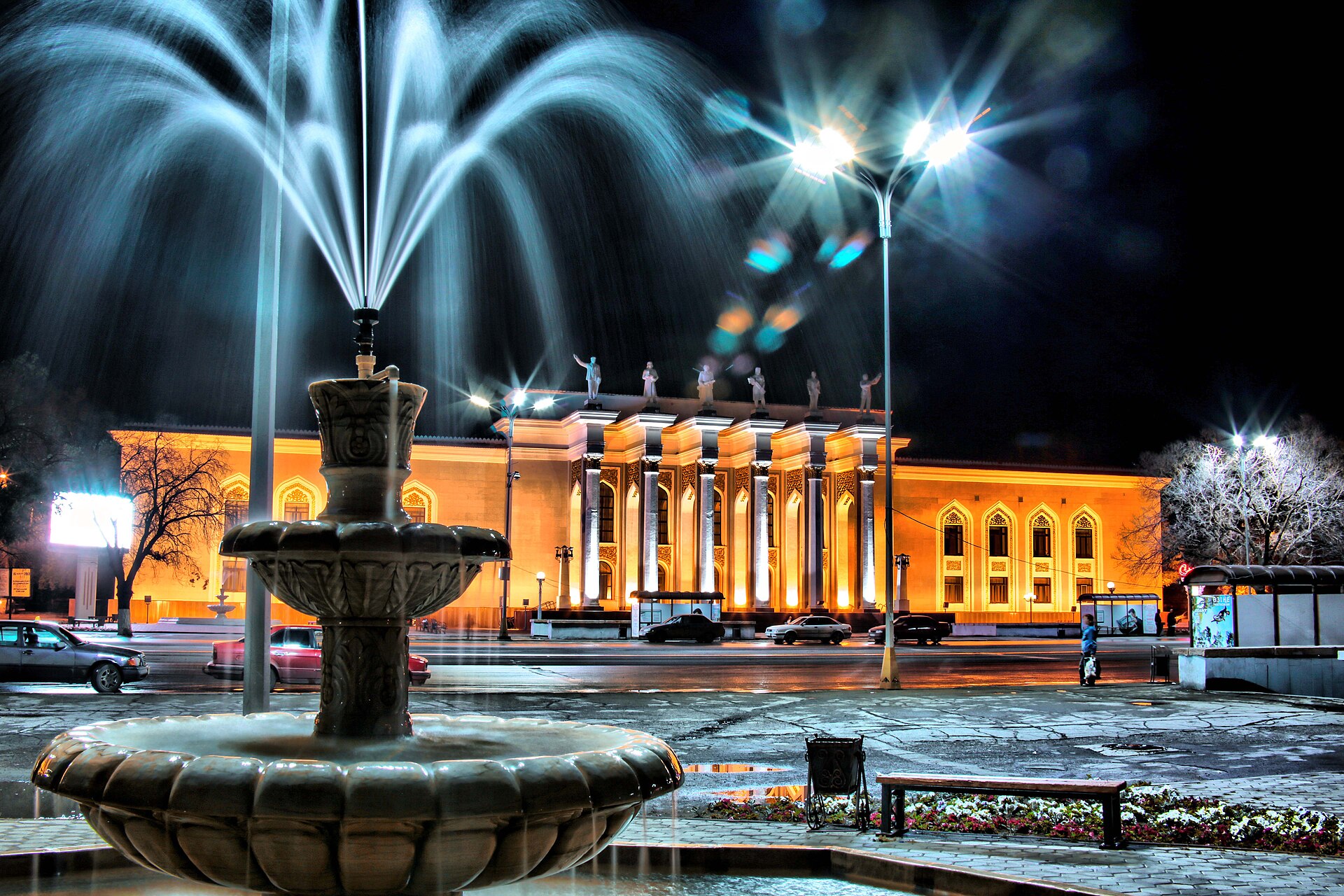
- Karaganda Regional Museum — Buqar-Jyrau and Yermekov corner
Tucked away behind a shopping centre near Buqar-Jyrau, this is now a small art gallery with changing shows. Its one surviving permanent exhibit is a huge cluster of creedite crystals, a surprisingly beautiful mineral specimen. Opening times change, so check locally before making a special trip. - Ecomuseum — Buqar-Jyrau
Housed on the main boulevard, the Ecomuseum covers the natural and industrial history of the region. Its displays cover how this region served the Soviet space programme, a link that rarely features in guidebooks. A good rainy-day or freezing-day stop that gives context for the city and the land around it. - St Joseph's Cathedral — Residential district
A second Catholic church that signals how varied the city's communities have been. Seen from the open ground nearby, its tall spires rise above surrounding houses and trees. It is a quieter, more local counterpart to the larger cathedral, and a good place to see how faith survived in a place built for industry.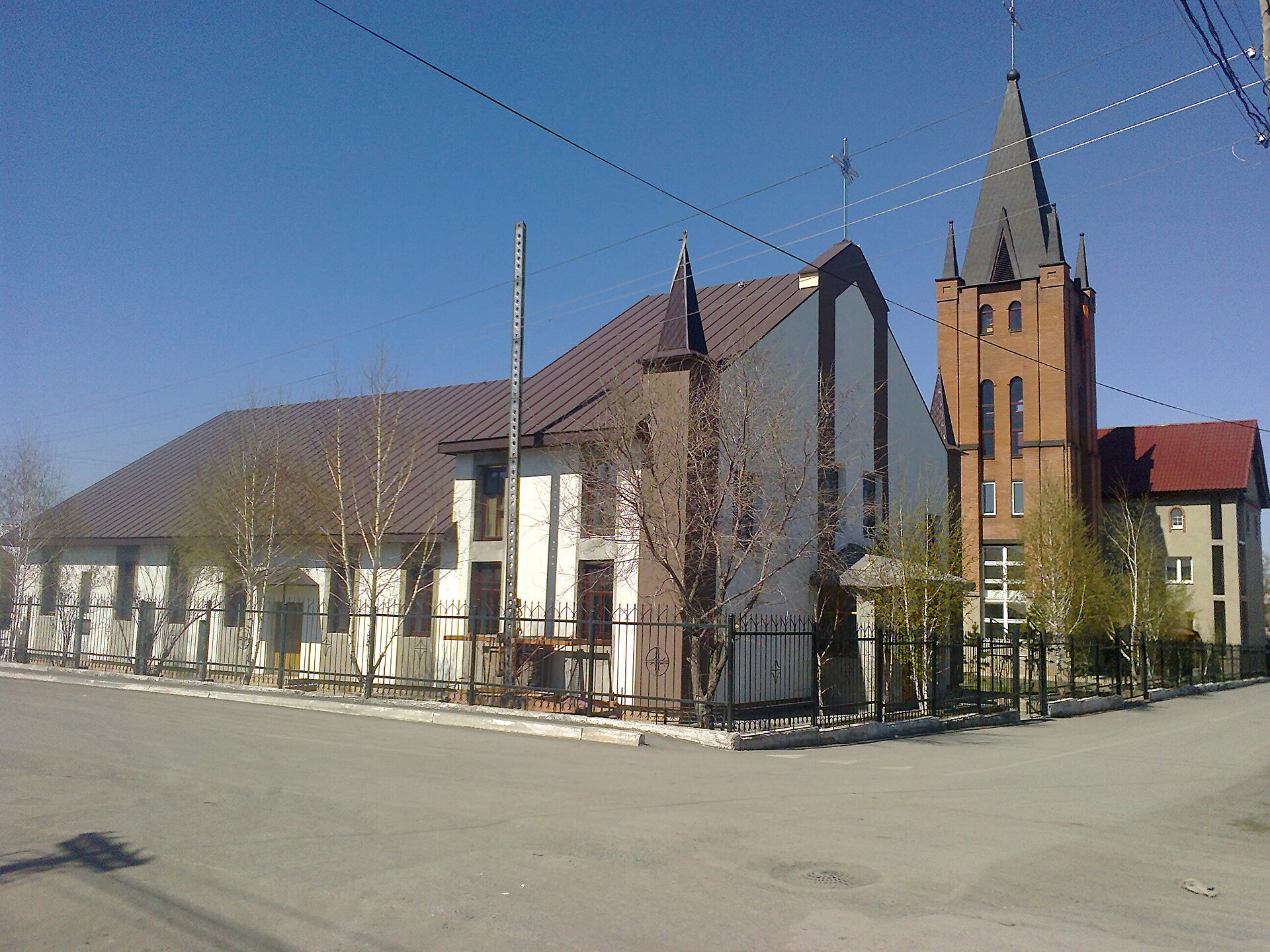
Culture
Karaganda is a meeting point of Kazakh, Russian and many other traditions, and daily life shows it. Russian is the common city language, Kazakh is widely spoken and increasingly visible on signs, and religious life is mixed: Muslim, Orthodox and Catholic communities all live here, which is why a Catholic diocese has its seat in the city. The cathedral opened in recent years and has become a symbol of that mix.
Mining remains the city's heart. The Miners' Palace of Culture is a large theatre built to honour the workforce, and the local football club, Shakhter Karagandy (the name means miner), carries the same identity. Matches at Shakhtyor Stadium draw loyal crowds, and locals still talk about the club's Champions League qualifying win over Celtic of Scotland.
Hospitality is the Kazakh habit that visitors notice first. A guest is offered tea, bread and sweets almost as soon as they sit down, and refusing everything outright can feel cold. Family ties matter, elders are treated with respect, and people often speak softly in public. Winter is long, so cafés, shopping centres and indoor entertainment carry much of social life, with parks and the boulevard filling up as soon as the weather turns warm.
People are generally curious about foreigners and happy to chat, usually through a mix of simple Russian, gestures and phone translation. When invited into a home, take off your shoes at the door, greet the eldest person first, and accept at least a cup of tea.
What to wear
Karaganda's traditional dress follows wider Kazakh custom. The chapan is a long robe, often quilted cotton or velvet, sometimes silk-lined and embroidered, worn over other clothes. Women's festive outfits feature velvet waistcoats and the saukele, a tall ornate bridal headdress decorated with beads, metal and stones. Felt is central to the steppe wardrobe: white felt kalpak hats for men, and fur-trimmed hats for winter. These garments appear at weddings, on Nauryz in spring and at folk performances, rather than on ordinary days.
What people wear now is practical and fairly urban. Young people favour jeans, trainers and branded jackets, while office workers dress neatly, and many women like to dress up for an evening out even in a mining city. Winter changes everything: padded coats, fur or knitted hats, scarves and thick boots are the normal uniform, and bare heads are a rare sight in the coldest months.
Visitors should dress for the weather first. In winter pack thermal layers, insulated waterproof boots with grip, gloves and a warm hat that covers the ears. In summer light cotton works, but evenings cool quickly and the steppe wind can bite, so carry a jacket. Sturdy shoes help on uneven pavements, and spring thaw can be muddy. Modesty norms are relaxed in the city, but when visiting a church or mosque, cover shoulders and knees, and keep a scarf handy for women entering religious buildings.
What to eat
- Beshbarmak — Traditional Kazakh eateries on and around Buqar-Jyrau
Karaganda shares Kazakhstan's national dish: boiled meat, traditionally horse or mutton, laid over broad flat noodles with onion and broth. It is a celebration meal, usually shared. Look for it at traditional Kazakh eateries, especially along the main boulevard and cross-streets. - Manty — Cafés and canteens in the city centre
Large steamed dumplings stuffed with spiced minced meat and onion, often served with sour cream or a simple sauce. They are filling, cheap by local standards and easy to order by pointing. Canteens and family cafés prepare them fresh. - Baursaki — Bakeries and market stalls
Golden puffs of fried dough, slightly crisp outside and soft within, eaten with tea, jam or honey, and set out on the table for guests. They suit a cold morning very well, and bakeries and market stalls sell them warm. - Kazy and other horse-meat sausage — Meat counters in covered markets
Cured horse-meat sausages, rich, salty and sliced thin, are a steppe speciality served cold as a starter or with bread. Stalls in covered markets sell them by weight, and staff will usually let you taste first. - Shubat — Dairy stalls in the city markets
A tangy, fizzy drink of fermented camel's milk, offered to guests in Kazakh homes and sold at markets. Its sourness is an acquired taste, so start with a small cup. It is considered refreshing in hot weather.
Plan it
Best time. June to August brings the warmest, longest days, while May and September are milder and quieter. Winter is very cold, with short days and icy pavements, so it suits only travellers who enjoy the challenge.
How long. 1–2
Getting there. Sary-Arka airport (KGF) lies southeast of the city and has flights from Almaty, Moscow and a few other cities; for Astana the train or bus is easier than flying. Trains between Astana and Almaty call at Karaganda several times a day, and the railway and bus stations stand side by side at the south end of the centre, a short taxi ride from most hotels.
Budget. low
Tips
- Check train and bus timetables on the official operator sites before you travel, as schedules change
- Carry some cash for markets and small cafés, though cards work in most larger places
- Pack real winter gear from late autumn to spring; the wind on the open steppe is sharp
- Download a translation app and offline maps, as little English is spoken
- Use the left-luggage office at the railway station if you arrive early or leave late
Etiquette
- Take off your shoes when entering a private home
- Dress modestly and speak quietly inside churches and mosques
- Ask before photographing people, especially older residents
Nearby
Sources
- Wikidata Q484706 (CC0)
- Wikipedia: Karaganda (rev 1384249656) (CC BY-SA 4.0)
- Wikivoyage: Karaganda (rev 5242279) (CC BY-SA 4.0)
- Photo 01-.jpg: Cathedral of Our Lady of Fatima, Karagandy (Nikolai Bulykin) (CC BY-SA 4.0)
- Photo 02-.jpg: Miners' Palace of Culture (Grin1372Go) (CC BY 3.0)
- Photo 03-.jpg: House of Culture of Metalworkers, Balkhash (Nikolai Bulykin) (CC BY-SA 4.0)
- Photo 04-.jpg: Friendship House (Droppank) (CC BY-SA 4.0)
- Photo 05-.jpg: Karaganda Railway station (Артем Цой) (CC0 1.0)
- Photo 06-1.jpg: Cathedral of Our Lady of Fatima from above (Nikolai Bulykin) (CC BY-SA 4.0)
- Photo 07-.jpg: Karagandagiproshakht (Talgautb) (CC BY-SA 4.0)
- Photo 08-.jpg: St Joseph's Cathedral (Kaiyr) (CC BY 3.0)


