Astana
Astana, Kazakhstan
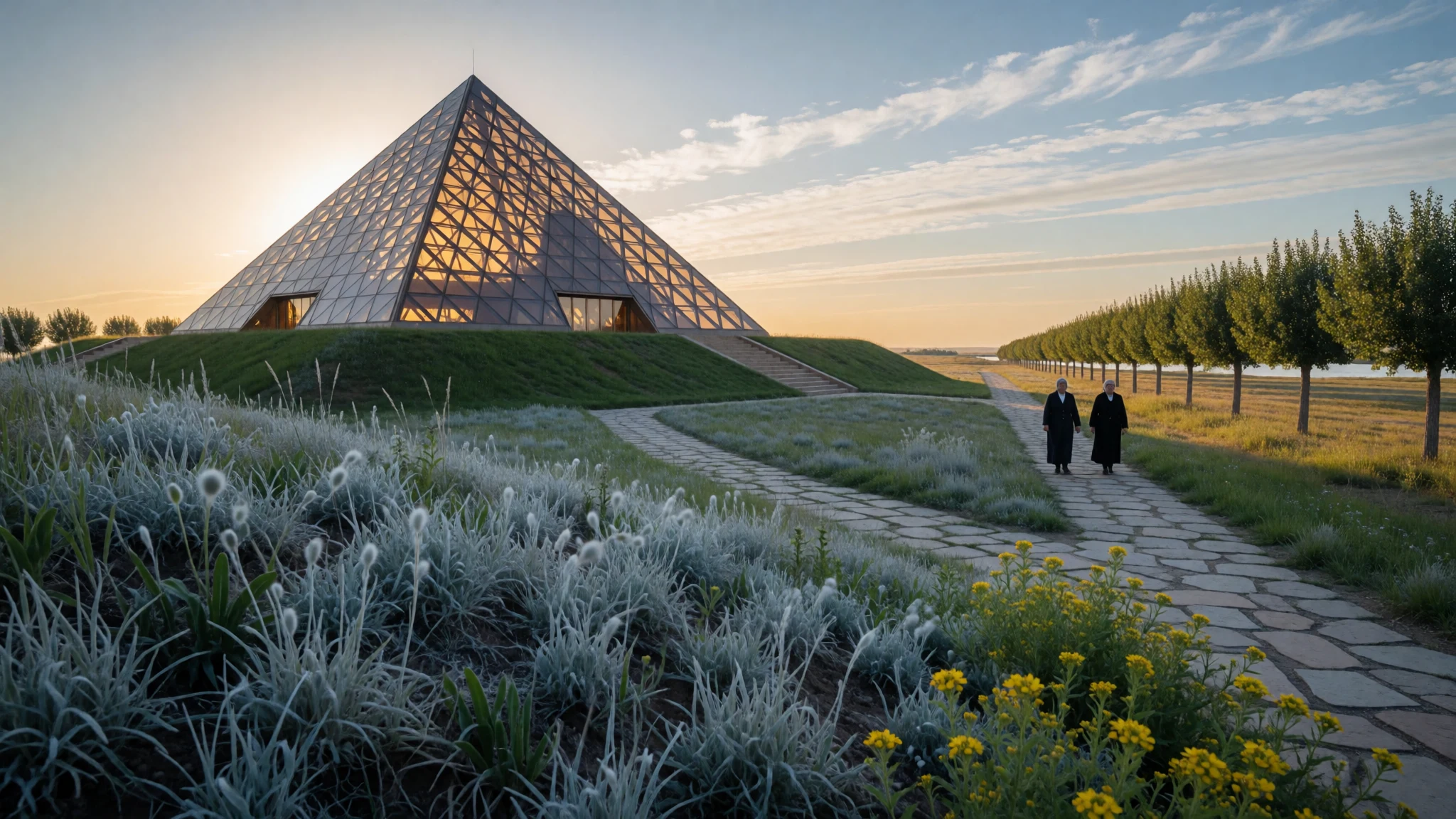
Astana is a young capital built on open steppe, where bold modern architecture, wide skies and Kazakh hospitality make for a few unusual days.
The place
Astana stands on the open steppe of northern Kazakhstan, beside the Ishim river, known locally as the Esil, at about 347 m above sea level. The land around it is flat, dry and almost treeless, so the weather shapes everything: a long, bitter winter, a short bright summer and wind in most seasons. About 1.2 million people live in the city, which has been the national capital since Almaty gave up the role in 1997. Almaty lies far to the south-east, and most travellers cover the gap by air.
The city is really two halves. The older part, with Soviet-era blocks, markets and the railway, lies on the northern bank. The newer government district spreads across the river to the south, laid out on wide axes with ministries, towers, parks and a long central boulevard. Planning was guided by the Japanese architect Kisho Kurokawa, and the result feels deliberate, sometimes theatrical, built for ceremony and for the camera as much as for strolling.
Honest expectations help. Distances are long, pavements are wide and empty in places, and walking between landmarks in midwinter is a test of stamina; buses, taxis and the new light rail do the heavy lifting. In summer the riverside promenades and parks fill with families, cyclists and couples, and the glass and steel look their best at dusk when lit. Shopping centres double as indoor public squares in the cold months. Astana is not a city of narrow old lanes. It suits people who enjoy ambitious modern architecture, big skies and a look at how a young capital presents itself, and who treat it as a base for two or three days rather than a long stay.
Its story
Astana's story starts well before the glass towers. A steppe fortress settlement called Bozok, tied to the Silk Road routes crossing the grassland, once stood on ground that the modern city is now spreading over. Its name points to open, unbroken grassland, which is a fair description of the setting even today.
The modern city dates from 1830, when a Russian officer, Fyodor Shubin, set up an outpost on the Ishim as the administrative seat of a district. It soon gained town status as Akmolinsk. Its position mattered: roads and military lines ran out from it across the steppe to forts and towns in several directions, tying the region into Russian administration. In 1838, during the uprising led by Kenesary Khan, the fortress was burned, then rebuilt once the revolt was put down. Later in the nineteenth century the town became the centre of a wider province, as Russian rule reshaped the Kazakh steppe and commissions drafted rules for governing it.
Names then changed with each political era. In Soviet times Akmolinsk became Tselinograd, a name linked to the farming campaigns on the northern steppe, and after independence it became Aqmola. In 1998 the city took the name Astana, which simply means 'capital' in Kazakh, once the seat of government had moved north. In 2019 it was renamed Nur-Sultan in honour of the former president Nursultan Nazarbayev, and in 2022 the name Astana returned. Older maps, signs and books may still show any of these earlier names, which is worth knowing when reading about the city.
What to see
- Palace of Peace and Reconciliation — Southern government district, east side
The Palace of Peace and Reconciliation in Astana is a glass-and-stone pyramid designed by the British architect Norman Foster and completed in 2006. The pyramid itself rises about 62 m above a grassy podium. It is mainly an events venue, so check the official site before planning to go inside. - Ak Orda presidential palace — Government district, south of the river
Ak Orda, opened in 2004, is the presidential residence and office in Astana's government district. It is a domed, columned building that looks most striking after dark, when it is lit. It is not a place for casual entry, so the best views are from the avenue outside the grounds. - Khan Shatyr — North-western edge of the government district
Khan Shatyr is a vast, transparent tent-shaped building holding shops, cafés and leisure space. Astana's winters make it useful as well as curious: families treat it as an indoor park when the streets are punishing. The structure alone justifies a look, even for visitors who dislike malls.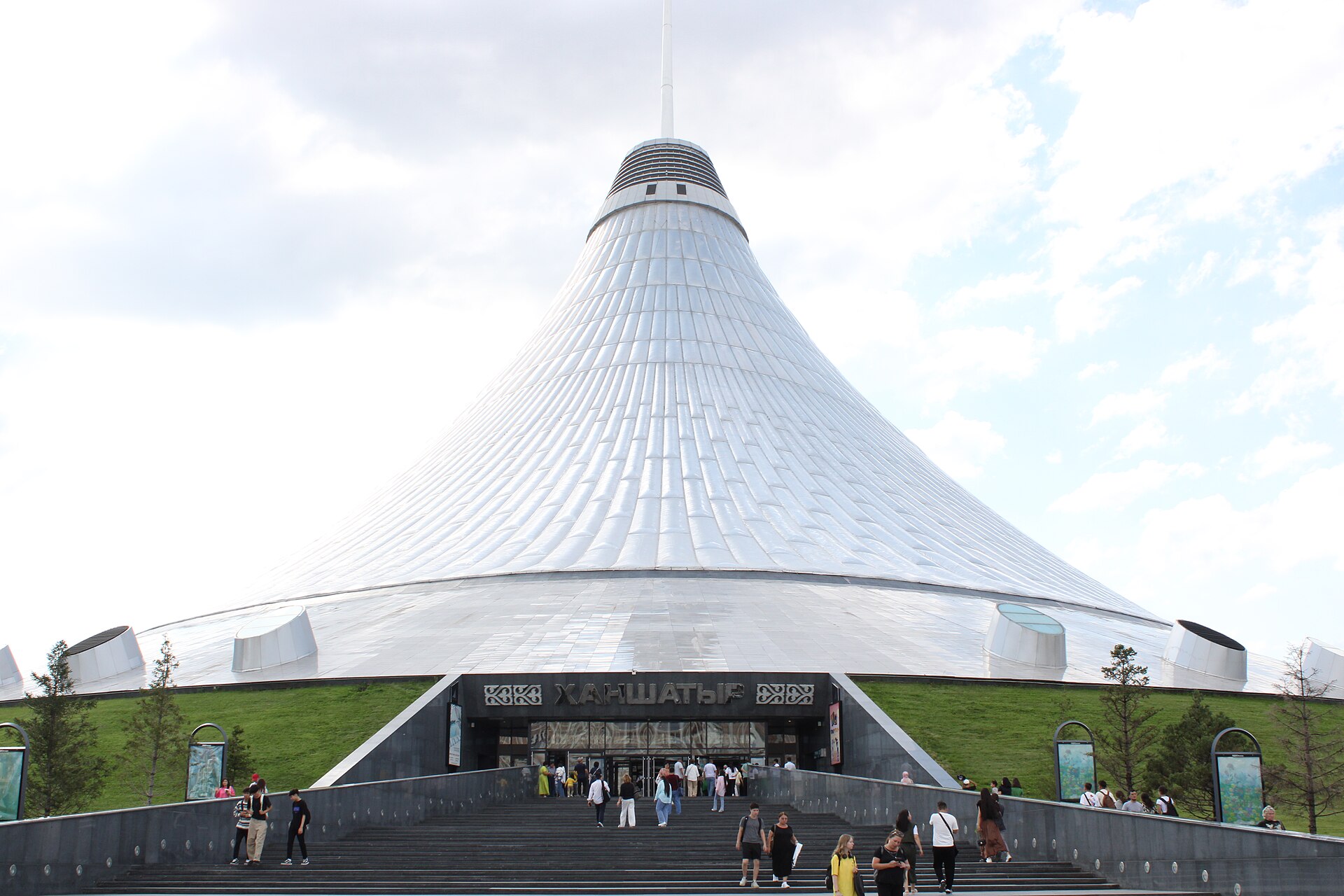
- Nurjol Boulevard — Central axis of the government district
Nurjol Boulevard is the landscaped central axis of the government district, a broad promenade of lawns, paths and water features with views along the avenue towards the Bayterek Tower. Summer evenings are the best time, when locals stroll and the buildings around it light up.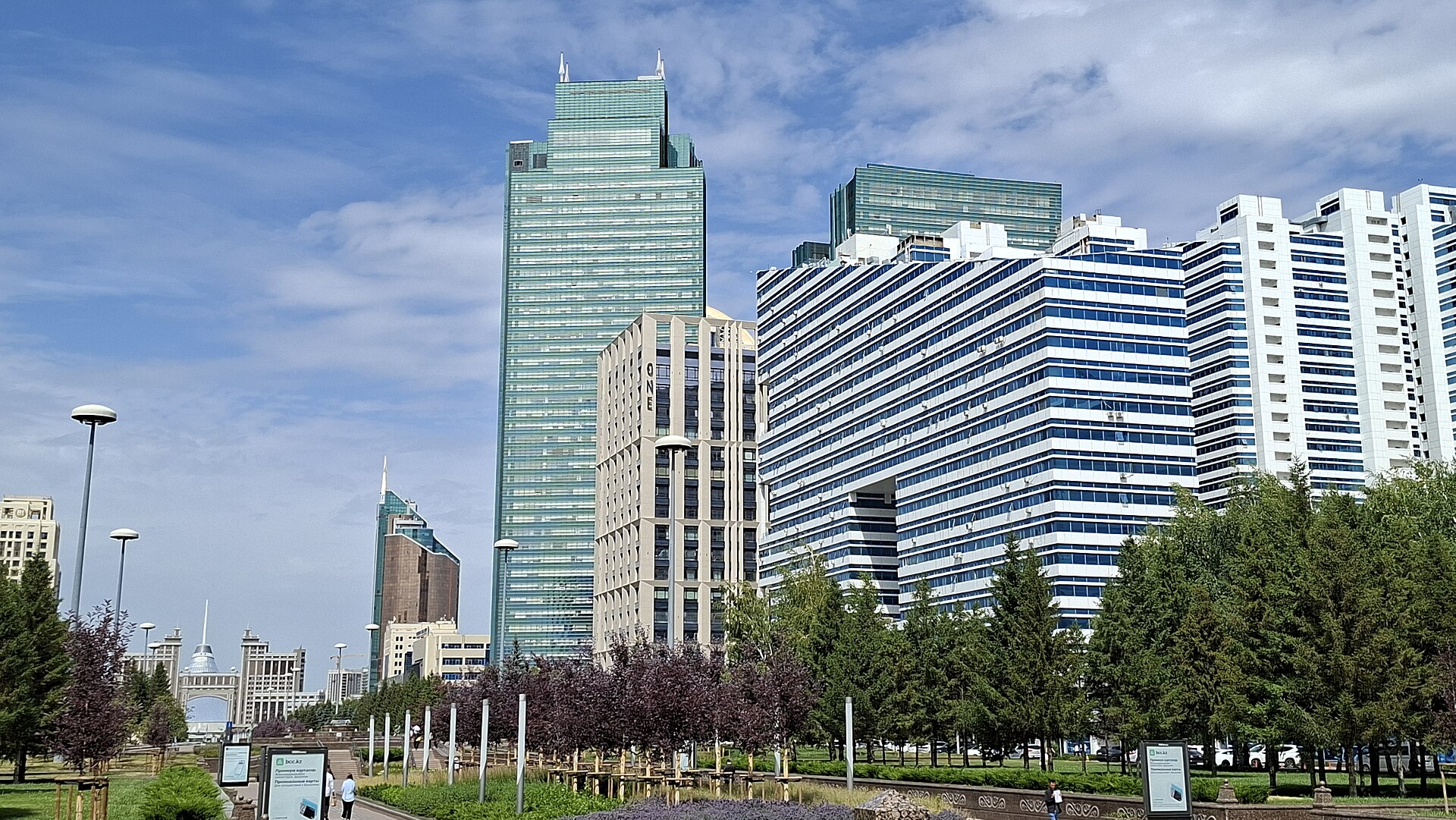
- Ai Alem museum — Southern Astana, former expo grounds
The Ai Alem museum is a large glass sphere on the southern side of Astana, built for an international expo and now used as a museum and exhibition space. Its round form stands out against the flat skyline. What is on display changes, so check current listings before going.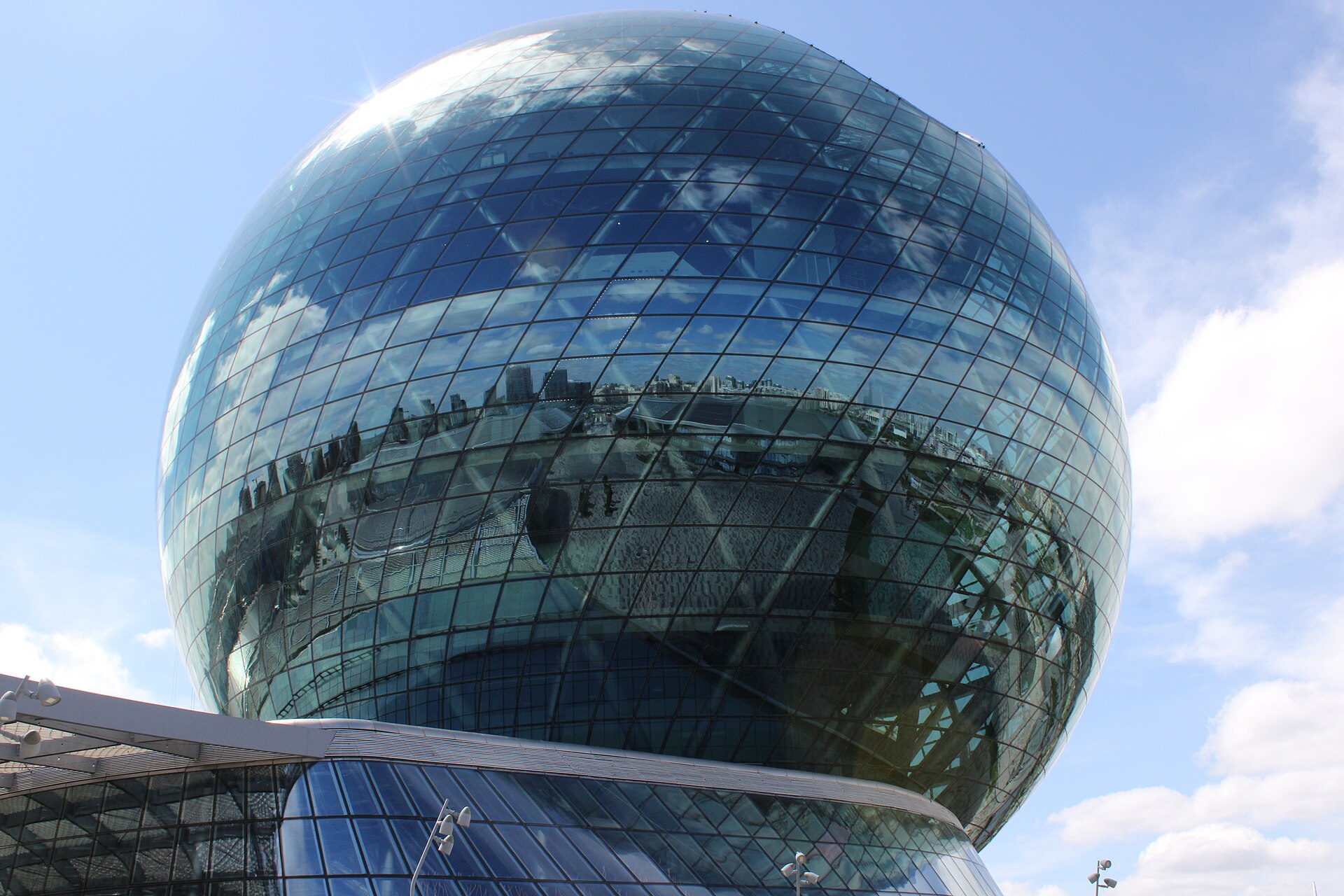
- Shabyt palace of arts — Southern government district, east side
Shabyt is a palace of arts shaped like a glass dish, standing near the Kazakh Eli monument in the government district. Its curved glass skin is easy to spot across the open ground and rewards a short architectural stop, especially paired with a walk to nearby landmarks on a clear day.
Culture
Astana is a capital where nomadic habits, Soviet inheritance and a newly confident national identity sit side by side. Kazakh is the state language and Russian is widely spoken, so signs and conversations move between the two. Hospitality is central to Kazakh life: guests are fed generously, tea is poured again and again, and a table loaded with bread, sweets, dried fruit and meat is a way of showing respect.
The old steppe tradition of horse herding still echoes in food, in song and in the two-stringed dombra, a lute played to accompany epic poems and folk tunes. In spring the festival of Nauryz brings music, yurts set up in parks and shared dishes to the city. Most people are Muslim by heritage, though daily practice varies, the atmosphere is relaxed and public life is largely secular. Mosques welcome respectful visitors.
Architecture is part of the culture here too. The capital was built to present a modern state, with national symbols worked into towers, domes and monuments, and the government district is treated with some formality, with security staff a common sight. Beyond the showpieces, the older northern bank gives a better sense of everyday life: markets, tea rooms and neighbourhood courtyards.
Remove your shoes when entering a home, and ask before photographing people or the guards outside government buildings.
What to wear
Astana's traditional Kazakh dress comes from a herding and horse-riding past. Men wore the chapan, a long quilted or velvet-trimmed coat, with a felt hat or an embroidered skullcap, and sheepskin or fur in winter. Women's festive dress used velvet, silk and brocade, with jewellery in silver and coral, and brides wore the saukele, a tall conical headdress. Felt, called kiiz in Kazakh, was used for rugs, hats and boots. Traditional clothes appear now at weddings, on stage, at Nauryz in spring and at national events.
Everyday dress in Astana is practical and urban. In winter people wear long down coats, fur or knitted hats, scarves and insulated boots, and indoors they change quickly into lighter layers. In summer the look is casual and often smart, with young people in fashionable, mainstream clothes, particularly around the malls and the riverside. Office dress tends to be tidy.
Visitors should plan around the climate. In winter, pack thermal layers, a windproof insulated coat, a hat, gloves and boots with good grip for ice. Summer calls for light cotton, a sun hat and an extra layer for breezy evenings. For mosques, cover shoulders and knees, women should carry a scarf for the head, and shoes come off at the entrance. Comfortable walking shoes matter because distances between sights are long.
What to eat
- Beshbarmak — Kazakh restaurants and family tables at celebrations
Boiled meat, traditionally horse or mutton, laid over wide sheets of noodle and covered in onions, served with a bowl of rich broth. It is the dish for celebrations and guests, so it often appears when a table is set for a gathering. - Baursak — Bakeries, market stalls and home tables
Golden fried dough puffs, light and a little chewy, served with tea, soup or jam. Warm ones from a stall are the best. They are the everyday bread of a Kazakh table and a common gift when visiting someone's home. - Kazy — Meat counters in the city's food markets and Kazakh restaurants
A cured horse-meat sausage made from rib meat, sliced thinly and eaten cold, rich and savoury. It is a taste of the steppe diet and is often part of festive platters. Visitors who are cautious can try a small portion first. - Kumis and shubat — Dairy stalls in markets and traditional-style restaurants
Kumis is fermented mare's milk, shubat the camel's-milk version. Both are tangy, a little fizzy and an acquired taste, but they are part of Kazakh tradition and are usually offered in small cups, especially in warmer months. - Chicken Kyiv and potato pancakes — Ukrainian-style restaurants, often with live music at night
A Ukrainian-style plate of breaded chicken with a buttery centre, often served with fried potato pancakes. It shows how Astana's food mixes Slavic and Central Asian influences, and the places serving it are comfortable, spacious and often busy in the evening. - Manti and laghman — Turkish and Central Asian cafés around the city
Steamed dumplings stuffed with spiced meat, and hand-pulled noodles in a savoury meat and vegetable sauce. Both are Central Asian staples that suit a cold day, and they are easy to order in cafés where the menu has pictures to point at.
Plan it
Best time. Late May to September is the comfortable season, with long warm days; July can be hot and brief thunderstorms are possible. Winters are very cold and windy, though indoor spaces are warm, which suits visitors who want snow, quiet streets and a very different mood.
How long. 2–3
Getting there. Astana's airport has connections from cities such as Istanbul, Dubai, Frankfurt, Beijing and Moscow. From the airport, city buses and the new light rail run into the centre; check current timetables and fares locally. Trains arrive at Nurly Zhol station or the older central station depending on the route, so confirm which one near the travel date.
Budget. mid
Tips
- Check entry rules for your passport before booking; many Western passport holders need no visa for short stays
- Pack for wind in every season, and for real cold from late autumn to early spring
- Use taxis, buses or the light rail between districts, as walking distances are long
- Carry a card but keep some cash for small cafés and markets
- Check the official city site, https://www.gov.kz/memleket/entities/astana, for current information and events
Etiquette
- Ask before photographing people, and be careful near government buildings and guards
- Remove shoes when entering a home
- Cover shoulders and knees in mosques
Nearby
Sources
- Wikidata Q1520 (CC0)
- Wikipedia: Astana (rev 1383088855) (CC BY-SA 4.0)
- Wikivoyage: Astana (rev 5393951) (CC BY-SA 4.0)
- Photo: Рабочая поездка Сергея Собянина в Астану, Денис Гришкин (CC BY 4.0)
- Photo: View on Left side of Astana from the Esil riverbank, Dauren Nabijan (CC0 1.0)
- Photo: Ai Alem museum, Dauren Nabijan (CC0 1.0)
- Photo: Khan-Shatyr shopping mall, Dauren Nabijan (CC0 1.0)
- Photo: Nurjol Boulevard in Astana, Dauren Nabijan (CC0 1.0)
- Photo: Astana city bus, KK70088 (CC BY-SA 2.0)
- Photo: Botanical triangles, Yersyn Yes (CC BY-SA 4.0)
- Photo: Astana satellite image, European Space Agency (CC BY-SA 3.0 igo)


