Kurama-dera
Kurama-dera, Japan
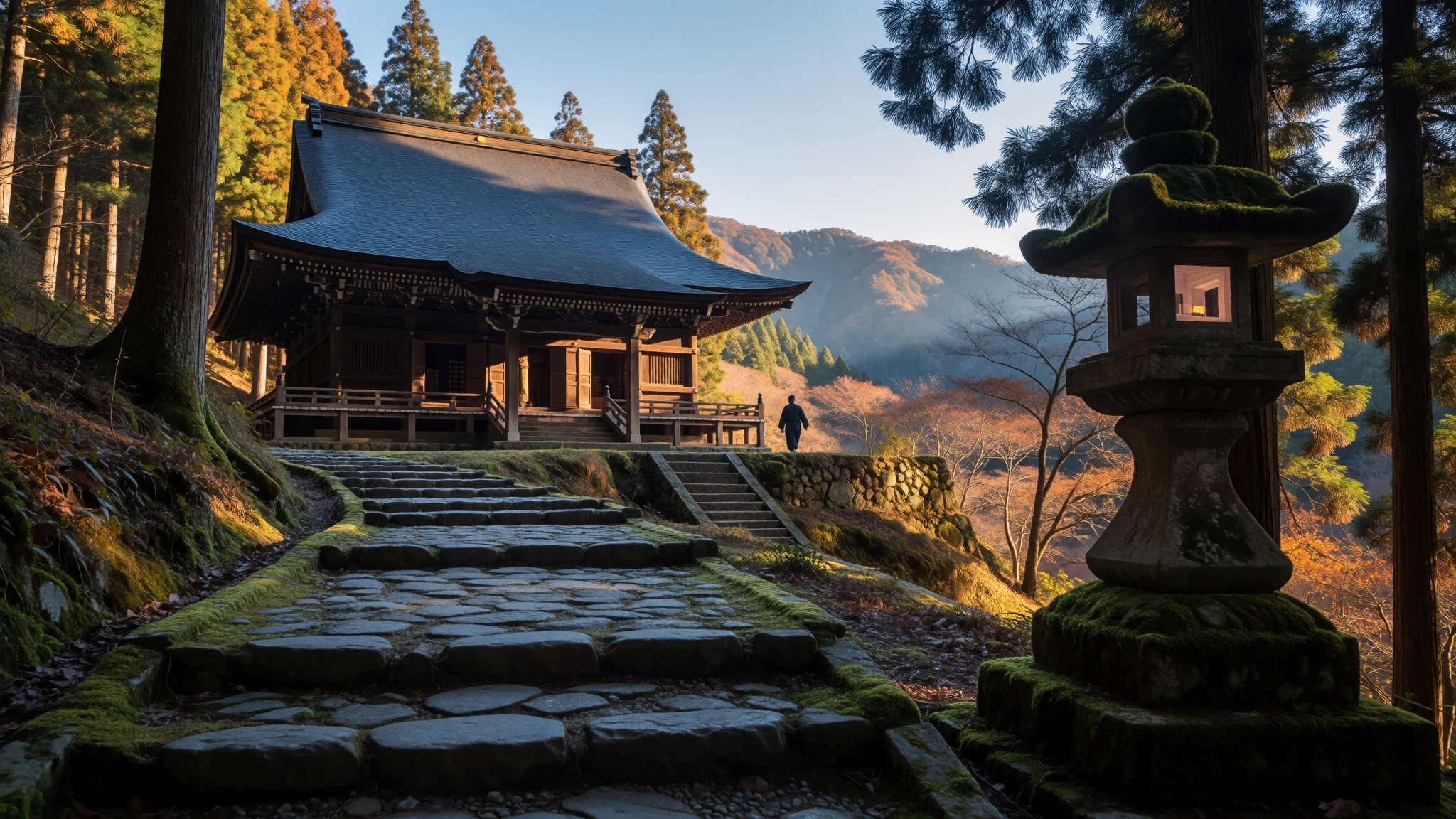
Kurama-dera is a mountain temple north of Kyoto where cedar forest, spirit legends and a ridge walk offer a change from the city's crowds.
The place
Kurama-dera sits in the far north of Kyoto, on the lower slopes of Mount Kurama, where the city's street grid gives way to steep cedar forest. The temple is reached from the small village of Kurama at the foot of the mountain, either on foot up a stepped forest path or by the temple's own short cable car. Its buildings are strung along the hillside rather than gathered around one courtyard, so a visit is as much a climb as a temple tour: gate, lanterns, small shrines, then a long wooded stretch before the main hall opens onto a ledge with views over the valleys.
The temple belongs to its own religious body, formed after the Second World War, and its central object of worship is esoteric and particular to Kurama. Several of its holdings are National Treasures of Japan, though they are kept in a small museum rather than set out in the open halls. Beyond the main hall a trail carries on over the ridge and drops into the neighbouring valley of Kibune, a favourite half-day walk. Cedar roots cross the path in places, and the ground turns slick after rain.
Kurama is a place for weather and light rather than for ticking off monuments. Autumn colour draws crowds at weekends, while winter brings snow on the stairs and very few visitors. Summer is green, shaded and humid, cooler than central Kyoto but far from cold. The village below has a hot-spring bath and a few eateries serving mountain vegetables, handy after the descent. Fees and opening hours change, so check the official site, https://www.kuramadera.or.jp/, before setting out.
Its story
Kurama-dera is recorded as founded in 796, though its early history is unclear. One account says a disciple of the Chinese monk Jianzhen dreamt in 772 that Mount Kurama held a spiritual force, and built an esoteric temple to gather and direct it. The two dates sit close together but do not agree, a reminder that temple chronicles record belief as much as fact.
Fire destroyed the buildings many times through the medieval centuries. Each time, monks carried the statues and treasures out in time, and those objects survive today as National Treasures. From the 12th century until 1949 the temple was subordinate to Shōren-in within the Tendai sect, and over the years it passed between three Buddhist schools. After the war, the abbot Kouun Shigaraki founded an independent religious body and took Kurama out of Buddhism altogether. The change let the temple reconcile with the yamabushi, the mountain ascetics, and with other esoteric followers of mountain worship who had long used these slopes.
Folklore is thick on the mountain. Tengu, the long-nosed spirits of the high forest, are still said to live here. They feature in the legend of the young warrior Minamoto no Yoshitsune, who is told to have learned swordcraft from them while a boy at Kurama. Few visitors treat the tales as history, but they are part of the place, and tengu masks and carvings turn up around the village and along the path.
What to see
- Sanmon gate and the cable car — Kurama village
Kurama-dera's entrance gate stands at the foot of the mountain and is the usual start of the climb. From here visitors choose between the stepped forest path and the temple's own cable car, which shortens the ascent. Walking takes longer but passes lanterns, small shrines and shaded stairs, and gives a truer sense of the mountain.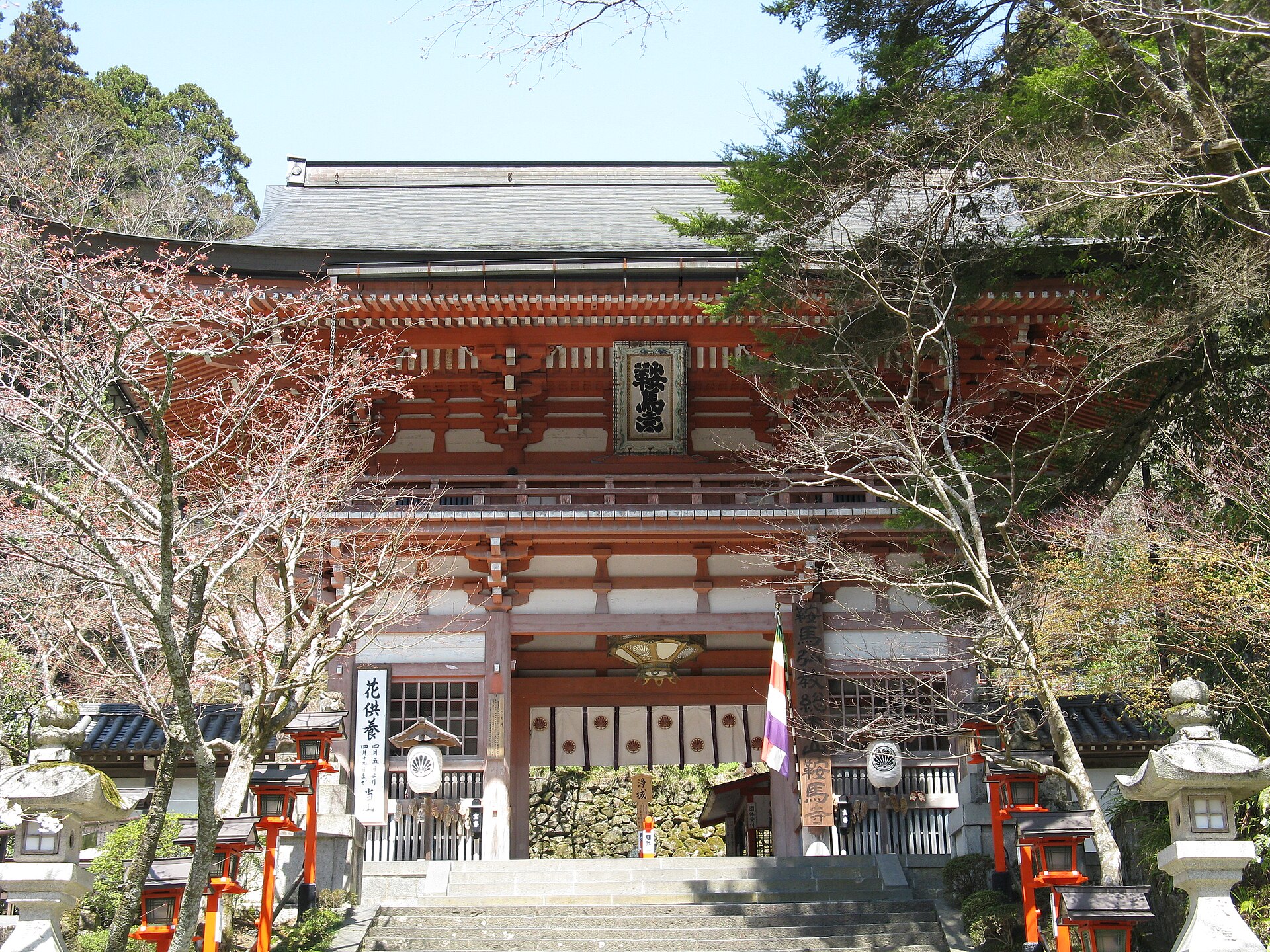
- Kondō main hall — Mount Kurama, upper temple
The Kondō, the temple's main hall, stands on a ledge high on the slope and looks out over forested valleys. The open forecourt in front of it is cooler than the village below. It is the focus of worship at Kurama-dera, and most visitors pause here to rest before deciding whether to continue over the ridge. - Treasure museum — Mount Kurama, upper temple
Kurama-dera keeps many of its National Treasures in a small museum on the mountain rather than in the open halls. The collection includes Buddhist statues and armour, such as a Kamakura-period helmet shown in the reference photographs. Check the official site for opening days before climbing, as exhibits and access can change.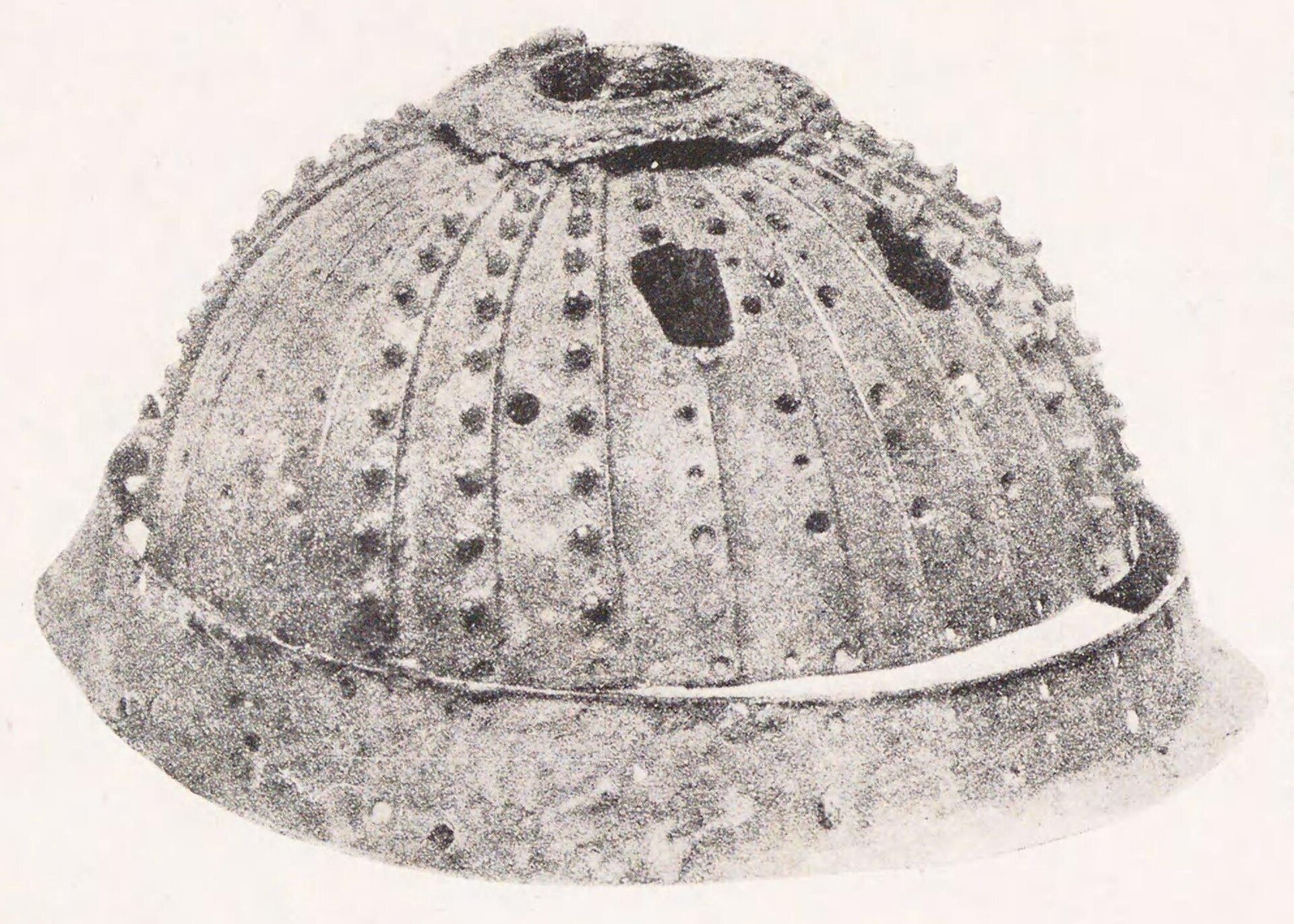
- The cedar-root path — Mount Kurama ridge
Past the main hall the trail climbs into old cedar forest, where thick roots cross the ground like steps. This stretch of the ridge walk is cooler and quieter than the temple core, and the footing is uneven. Good shoes matter, and wet days make the roots slippery enough to need real care. - Descent to Kibune — Kibune valley
The ridge trail from Kurama-dera drops into the neighbouring valley of Kibune, making a one-way walk of a few hours with public transport back toward Kyoto. A shrine and streamside eateries wait at the bottom. Walkers should start early in winter, when the forest darkens quickly and the stairs can hold snow.
Culture
Kurama-dera is a working temple on a mountain that local belief treats as inhabited, and its atmosphere comes from the mix of esoteric ritual and older mountain worship. The temple's independent religious body, set up after the war, still honours a central object of worship that belongs to Kurama alone. The yamabushi, mountain ascetics in a long tradition of training in the wilds, are welcome here, and visitors may meet pilgrims walking the ridge in practical dress.
Tengu are the local spirits of the forest, drawn with red faces and long noses, and their images are part of Kurama's identity much as foxes are at other shrines. Many people regard the mountain's trees, rocks and stairs as sacred in themselves, not just the buildings, which is why the climb is treated as part of the visit. The temple's holdings include National Treasures, and the museum is a quiet counterpoint to the forest outside.
In October the neighbouring village marks an autumn fire festival, a loud and crowded evening when streets fill with torches and roads are closed. Such events draw spectators from across Kyoto, so quieter days suit those who want the mountain to themselves. Offerings are modest: coins, incense and a bow at the hall are normal, and a short pause at each gate is a courtesy rather than a duty.
Keep voices low on the forest path and in front of the main hall, and do not photograph people at prayer or anywhere a sign forbids cameras.
What to wear
Kurama-dera's traditional dress belongs mostly to the temple and the mountain ascetics. Priests wear robes of plain cotton or silk in dark and muted shades, while the yamabushi dress in white jackets, pleated trousers, a small black cap on the forehead and a conch shell for signalling, worn when they train and on ritual days. Kyoto's wider textile heritage includes Nishijin brocade, woven in silk, and kimono and cotton yukata appear at festivals, especially in summer.
Day to day, people in Kurama village wear what suits the weather and the work: waterproof jackets, trainers or boots, and quick-drying layers. Weekend walkers from Kyoto dress much like hikers anywhere, in light trousers, caps and small rucksacks, with a few visitors wearing kimono for photographs in the village.
Visitors should plan for a mountain, not a city street. Sturdy shoes with good grip matter more than anything else, because the stairs and cedar roots are uneven and slippery after rain. Layers work best: the forest is cooler than the village, snow is possible in winter, and summer is humid enough to need a spare shirt. Shoulders and knees need not be covered with any strictness, but modest, practical clothing suits the temple halls, where shoes come off at some thresholds. A light rain jacket, a hat and a small towel earn their place in the bag in nearly every season.
What to eat
- Mountain-vegetable set meal — eateries in Kurama village
Kurama's eateries serve set meals built around seasonal mountain vegetables, rice, pickles and soup, often vegetarian in the temple tradition. They suit a walk, since they are light but filling. Look for small family-run places along the village street near the station. - Soba noodles — noodle shops near Kurama station
Buckwheat noodles served hot or cold are a common lunch in mountain villages across Kyoto prefecture. They arrive in a simple broth or with a dipping sauce, and can be eaten quickly before the walk back. Many places offer a vegetarian version on request. - Sansho pepper dishes — village shops and eateries
Sansho, the citrusy, numbing Japanese pepper, is used in the area's cooking, in sauces, simmered preserves and sprinkled over noodles. It is a pleasant surprise for visitors expecting chilli heat, and small jars make portable gifts. - Kyoto pickles (tsukemono) — set meals in village eateries
Tsukemono, the salted and fermented vegetables of Kyoto, come with most set meals in the village. Textures run from crisp to soft and flavours from sharp to mild. A small dish of them with rice is often the most honest taste of the region's home cooking. - Mochi and tea — tea stalls and small shops by the station or the temple approach
Soft rice cakes with a pot of green tea make a sensible rest after the climb. Fillings change with the season, from sweet bean paste to plain, and the tea cuts the sweetness neatly.
Plan it
Best time. April–May for fresh green and cooler walking, and late October–November for autumn colour, though weekends are crowded. Winter is cold with snow on the stairs, and summer is green but humid.
How long. 1
Getting there. Fly into Kansai International Airport, take the Haruka limited express to Kyoto (a little over an hour), then the Eizan railway from Demachiyanagi in northern Kyoto to Kurama, a short walk from the temple gate.
Budget. low
Tips
- Arrive early on weekends and in autumn, when the path and cable car queue
- Wear shoes with grip; the roots and stone stairs are slippery after rain
- Carry water and some cash, since small village eateries may not take cards
- Check the official site, https://www.kuramadera.or.jp/, for fees, opening times and any closures before going
- If walking on to Kibune, start by mid-morning so daylight is not a worry
Etiquette
- Remove shoes where there is a step up and slippers or a shoe rack waiting
- Keep voices low near halls and do not photograph people at prayer
- Stay on marked paths and take rubbish back down with you
Nearby
Sources
- Wikidata Q608668 (CC0)
- Wikipedia: Kurama-dera (rev 1366905990) (CC BY-SA 4.0)
- Wikivoyage: Kyoto (rev 5407786) (CC BY-SA 4.0)
- Photo: 鞍馬寺 山門 — KENPEI (CC BY 3.0)
- Photo: Kuramadera1.jpg (Public domain)
- Photo: Hoshi kabuto bachi, Kurama-dera (Public domain)
- Photo: Kurama (6911102120) — KimonBerlin (CC BY-SA 2.0)
- Photo: Kurama (7057164363) — KimonBerlin (CC BY-SA 2.0)
- Photo: Kurama-Dera hdsr S5 10 — Hyppolyte de Saint-Rambert (CC BY 4.0)
- Photo: Kurama-Dera hdsr S5 11 — Hyppolyte de Saint-Rambert (CC BY 4.0)
- Photo: Kurama-Dera hdsr S5 16 — Hyppolyte de Saint-Rambert (CC BY 4.0)


