Khor Al Adaid
Khor Al Adaid, Qatar
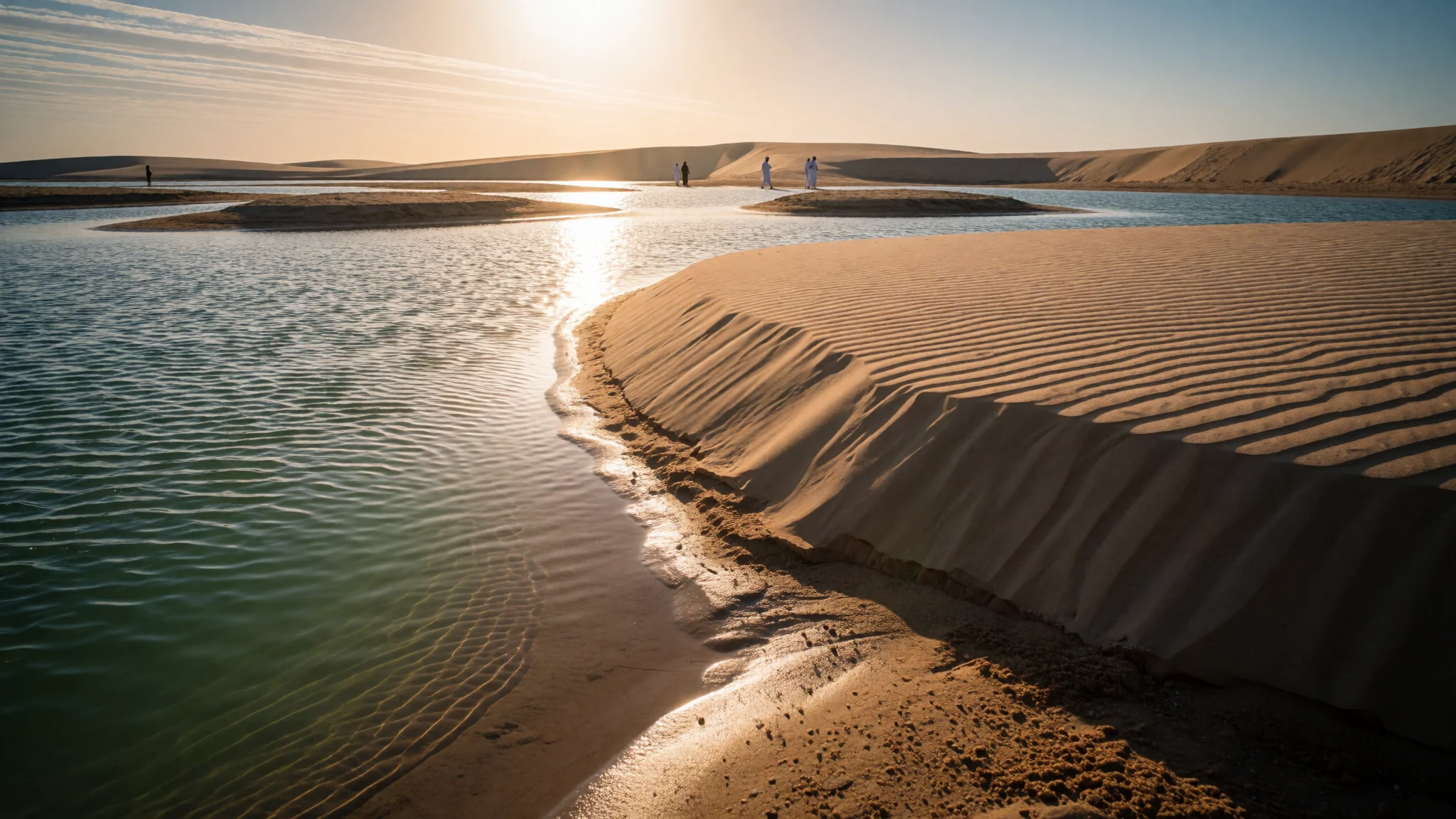
Khor Al Adaid is a tidal creek where Qatar's southern dunes run straight into a shallow inland sea.
The place
Khor Al Adaid sits at the south-eastern corner of Qatar, where a tidal creek of the Gulf pushes inland and then widens into a shallow basin the maps also call the Inland Sea. In Arabic it is خور العديد. Sand does not stop at a neat beach. High dunes lean over the water, and on a calm day their slopes run straight into pale green shallows, so the shore looks unfinished, as if the desert were still deciding where to end. The way in from the open Gulf is a bent channel; beyond it the basin spreads among bars and low islands of sand, the far side lost in glare. Around the water the ground changes character every few minutes: rippled dune, hard salt flat, and sabkha whose crust can look like a road and behave like wet plaster. There is almost no shade and almost no building. The sound is wind, the tick of cooling metal, and, on a winter Friday, engines. Light is the main event — white at noon, honey-coloured once the sun drops and every ridge throws a blue shadow across the creek. Fish move in the shallows, and wading birds use the flats when the tide has pulled back. At the southern rim the country does not thicken into a town; it thins toward the Saudi Arabian border, more dune and more glare, with Qatar ending in sand rather than in a skyline. It is beautiful in a bare way, and it is also exposed: heat, blown sand, and a long empty approach are part of the place, not a surprise at the end of the drive.
Its story
Khor Al Adaid has always been an awkward gift of geography: Gulf water held inland, salt on the lips, and a harbour no ship of size could use. Coastal people on the Qatar peninsula knew the southern creek as a landmark and a fishing ground, a place to read the tide rather than a place to found a port. The same families who worked the pearl banks farther north also knew this quieter water, where small boats could slip through the channel and the desert behind it offered grazing after rain and hard going in every other season. Bedouin routes treated the basin as an edge, not a centre. Wells and camel tracks mattered more than houses, and the shore was a meeting line between people of the sand and people of the boat. The English nickname Inland Sea came later, because the basin feels enclosed even though the tide still breathes in from the Gulf. In the late motor age the creek changed meaning again. Off-road tracks turned a remote border shore into a weekend journey from Doha, louder than the older round of nets and grazing. What remains is a place holding an older memory and a newer one: a working knowledge of tide, crust and wind, beside the habit of treating the dunes as a playground. The scratch of tyres on the sabkha is the visible argument between those memories. The southern shore also sits in border country, so the creek has been a political edge as well as a natural one, a line people navigated by memory long before it was a pin on a visitor's map.
What to see
- The inland shore — Inland shore of the basin
Khor Al Adaid's inland shore is a thin beach pressed against the basin, a pause in the dunes rather than a resort front. The water stays shallow far out, pale over sand and a harder blue in the channel. Visitors stand and look back at the ridges. Afternoon wind puts a chop on the surface, and the sand is fine enough to fill every shoe.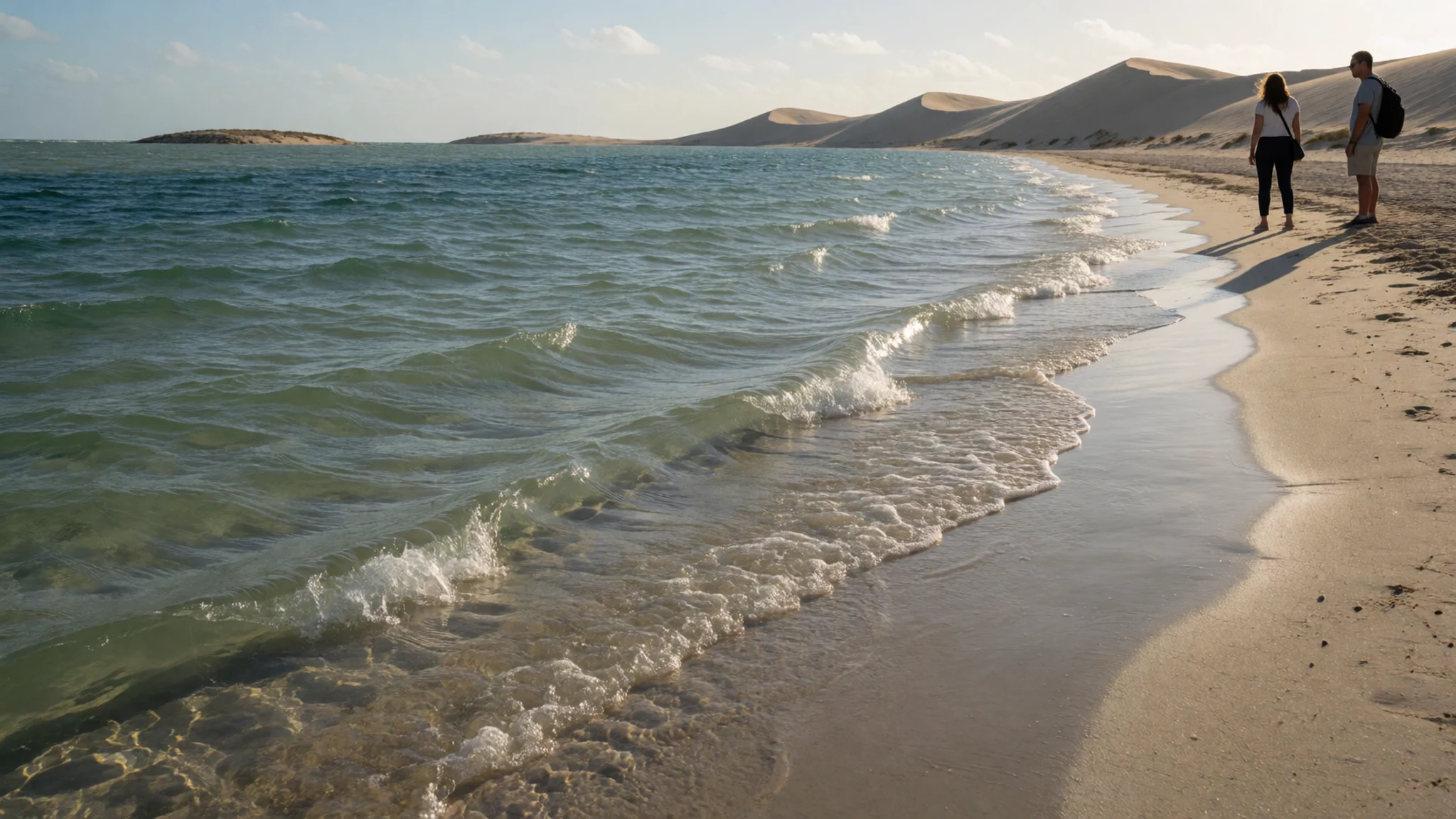
- Dunes at the cove — Coves where dunes meet the water
Khor Al Adaid shows its character where the dunes reach the cove and the slope does not bother to become a beach. From the crest the basin looks like a cloth laid in the sand; from the waterline the same ridge is a wall. Footprints do not last. A shamal, or even a lively afternoon breeze, rounds them off and sends a hiss of grains down the face.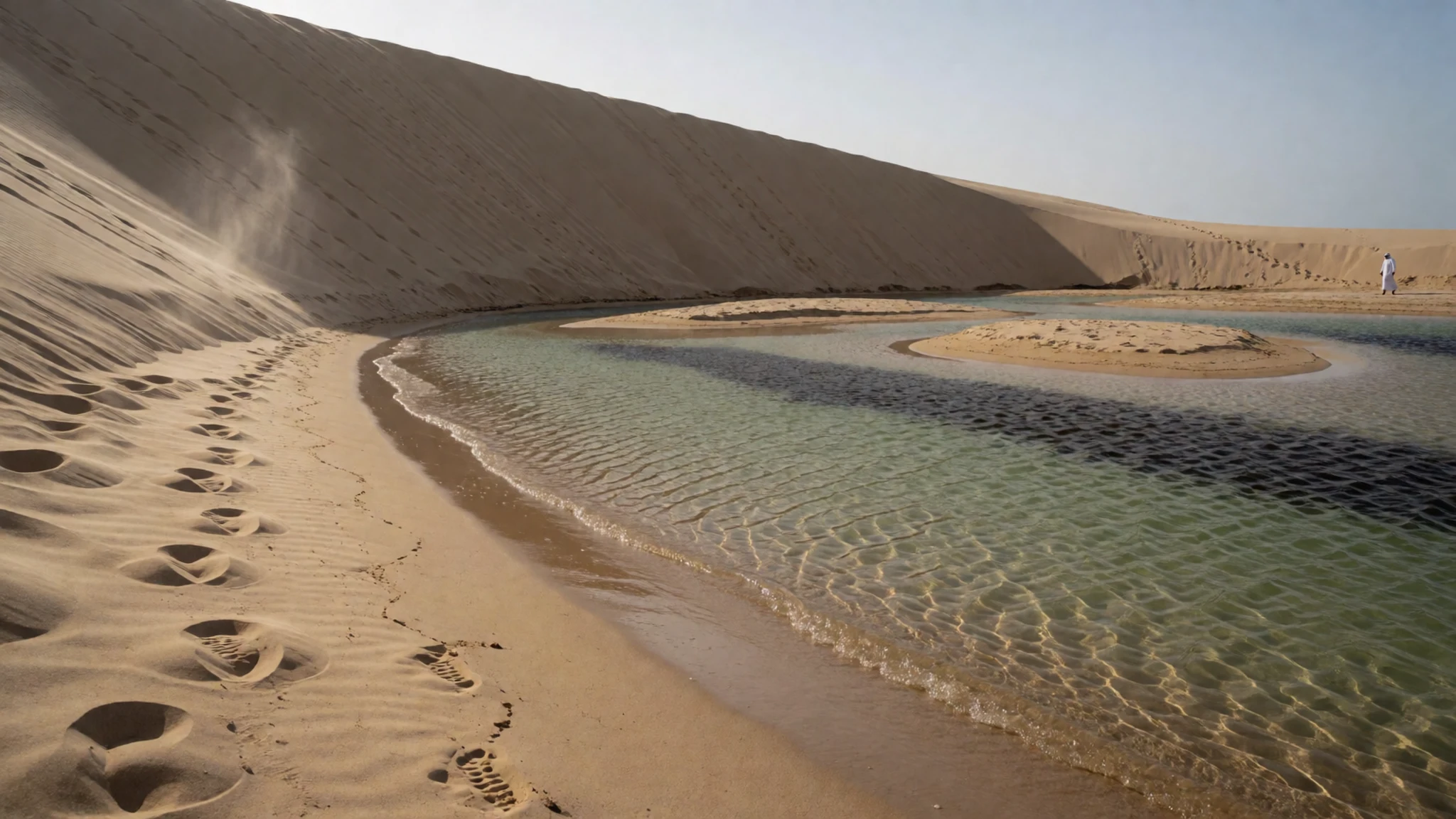
- The entrance channel — Entrance channel from the Gulf
Khor Al Adaid opens to the Gulf through a bent entrance rather than a wide mouth, and the old aerial view looking west-north-west still matches the feeling on the water: a slot of sea between low arms of sand. The channel is the basin's lung. Tide moves through it, and the colour of the water changes as the bottom rises and falls. Small boats pass where a ship could not.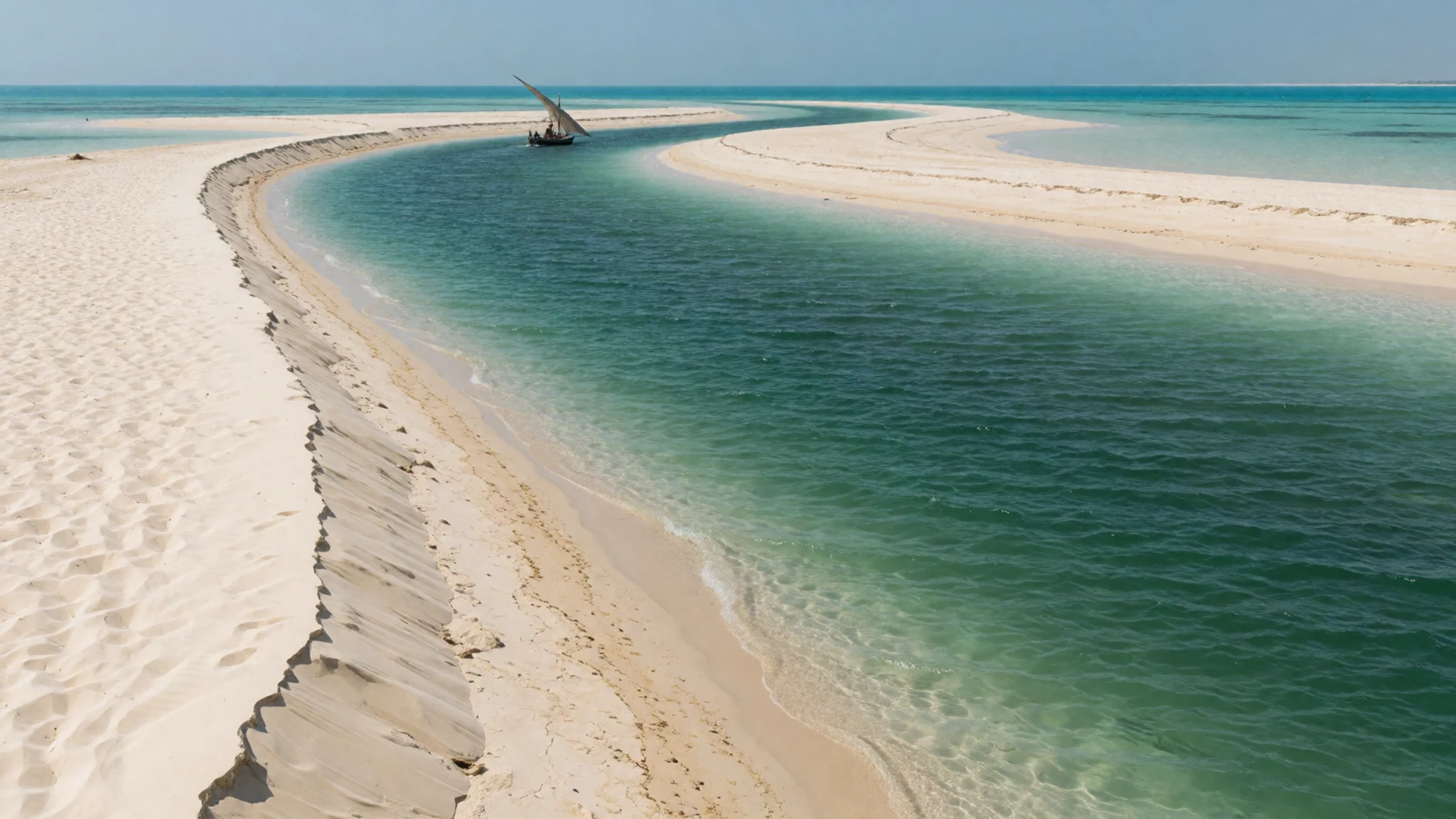
- Dune-driving country — Dune country on the southern approach
Khor Al Adaid's approach is a dune field where drivers drop and climb long before the creek appears. The rides are why many groups come: dusty, loud and physical, a crest then a thump then a view that lasts a moment. Off those tracks the surface is fragile. Salt crust and the odd plant tuft break under tyres and recover slowly, so the spectacle and the damage travel together.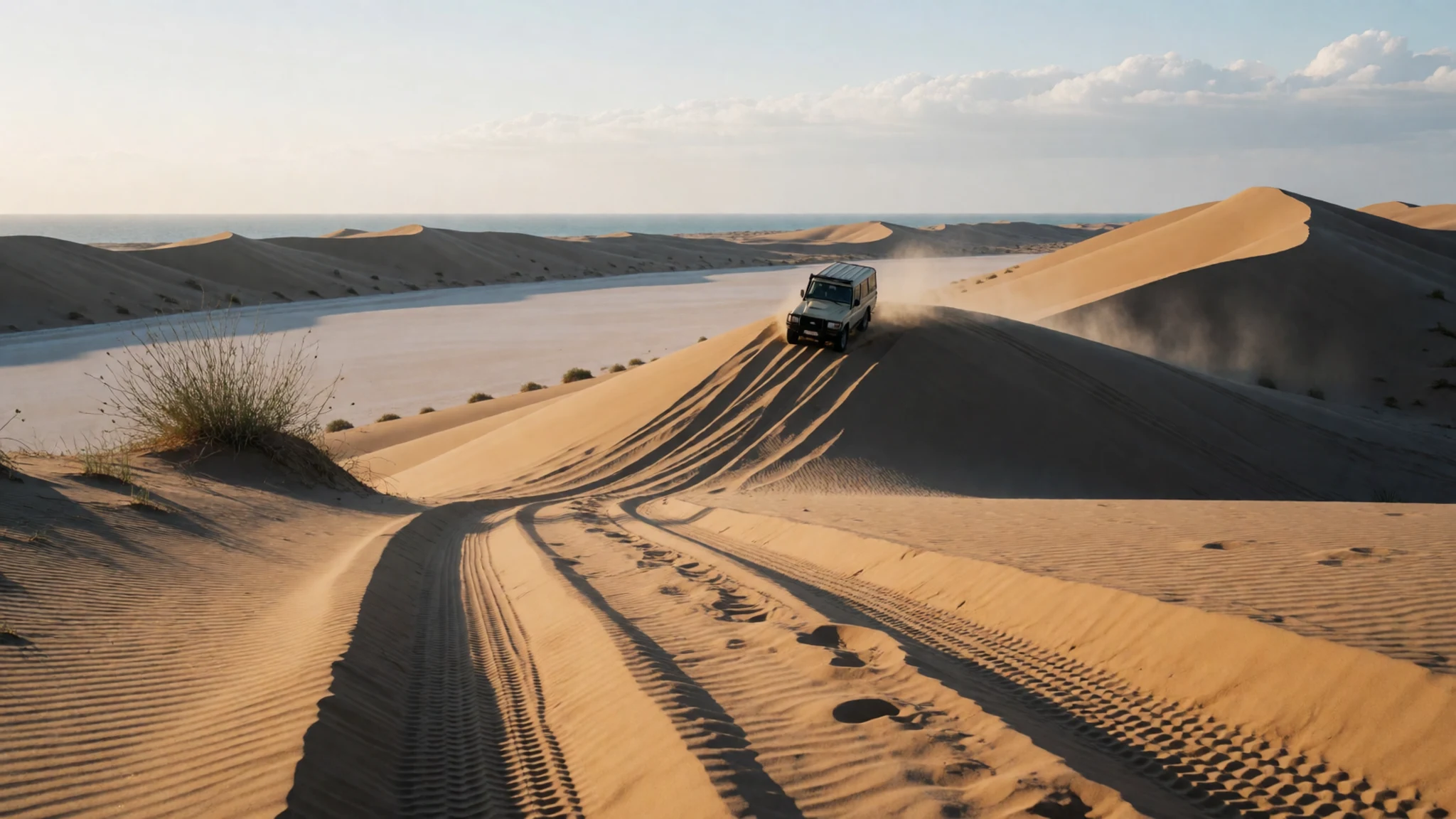
- The sabkha — Salt flats around the creek
Khor Al Adaid's sabkha is the pale flat between dune lines, tempting because it looks smooth and packed. It is a salt pan with a crust over softer ground, and a vehicle that leaves the known line can sink even when the surface appears dry. After rain the flats turn to paste; in a dry wind they glare and throw heat back at the sky.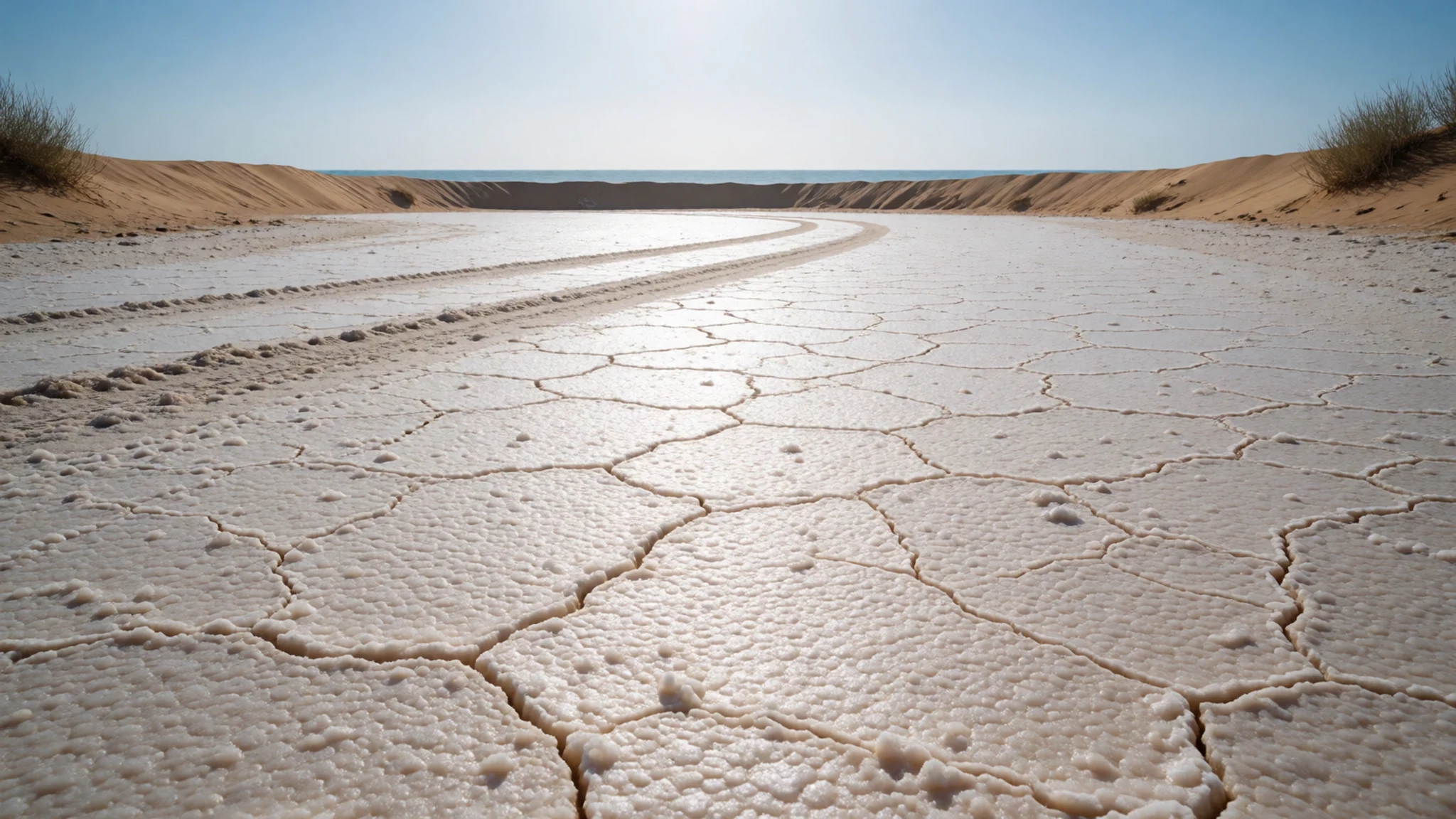
Culture
Khor Al Adaid sits inside a Qatari habit of treating the desert as a place for company, not only a view. Hospitality follows the majlis: gahwa scented with cardamom, poured a little at a time, and dates within reach. Taking the cup when it is poured, then tilting it to show one has finished, is the gracious rhythm; waving it away at once reads as a refusal of the welcome. On Fridays, families and friends leave Doha to camp, cook and watch the dunes change colour, and the gathering is the point of the journey. Prayer still structures the day this far from a mosque, and a quiet manner with strangers is ordinary courtesy rather than a special performance. National dress is common even on the sand, and visitors who match that covered, unfussy standard attract less attention than those who treat the basin as a private beach. The Saudi border makes wandering a serious matter: a track that drifts south is a mistake, not a longer scenic loop. Waste stays visible here for want of bins and of rain. Ask before photographing people, and leave the shore as you found it, carrying every bottle and scrap back to the city.
What to wear
Khor Al Adaid is usually reached in the national dress of Qatar or in practical desert clothes, and both belong in the picture. Men's formal and everyday traditional garment is the thobe, a long white cotton or cotton-blend robe, cool because it is loose and light. The ghutra, a square of cotton, often white or red-checked, covers the head and is held by the agal, a dark cord. For ceremonies a bisht, a cloak of wool or a lighter formal cloth with gold embroidery, goes over the thobe; nobody needs one for the dunes. Women commonly wear a black abaya over their clothes and a shayla or hijab, the fabrics ranging from plain crepe to something with a discreet sheen. In Doha, and in the vehicles heading south, many people now mix these garments with trainers, sunglasses and tailored jackets, while others wear ordinary shirts and trousers, especially among the large non-Qatari population. At the creek a visitor is best in loose, covering clothes: long sleeves, trousers or a long skirt, a scarf against sun and blown sand, and shoes that can be emptied of grit. Dark colours drink the heat; pale cotton is kinder. Swimwear is a poor match for an open, public shore in Qatar.
What to eat
- Machbous — Qatari eateries in Doha and desert-camp tables on the road south
Khor Al Adaid day-trippers often eat machbous before or after the sand: spiced rice with chicken, mutton or fish, coloured with dried lime, cardamom and clove. It is a Gulf table staple. Look for it in a Qatari eatery in Doha or on a desert-camp table on the road south.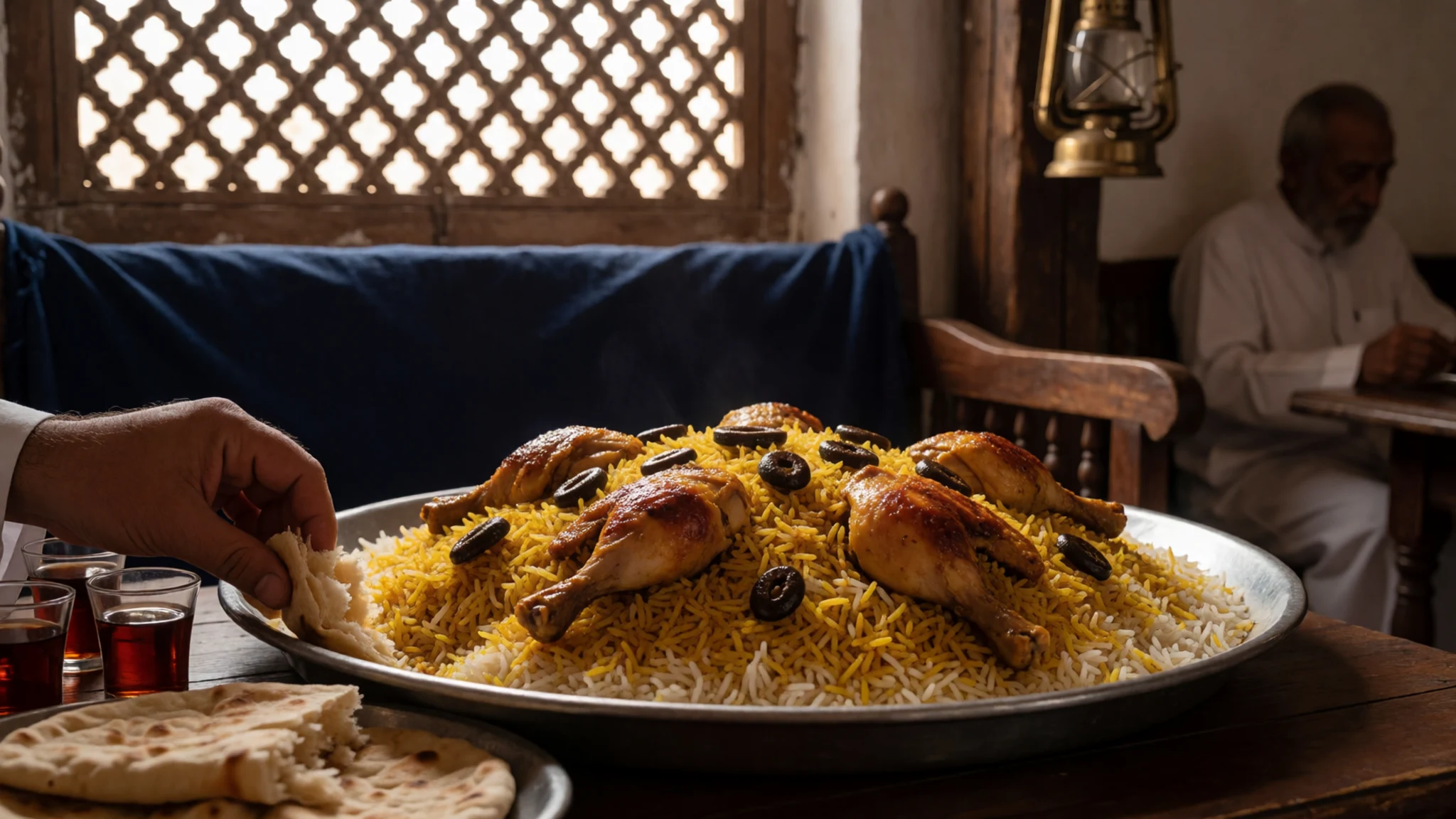
- Hammour — Seafood eateries and fish counters in Doha, and some desert-camp grills
Khor Al Adaid's water is the Gulf, so hammour, a firm local grouper, is the fish that tastes of the same coast. Grilled with lemon and rice, it turns up at fish counters and simple seafood eateries in Doha, and on some camp grills when the cook has brought ice.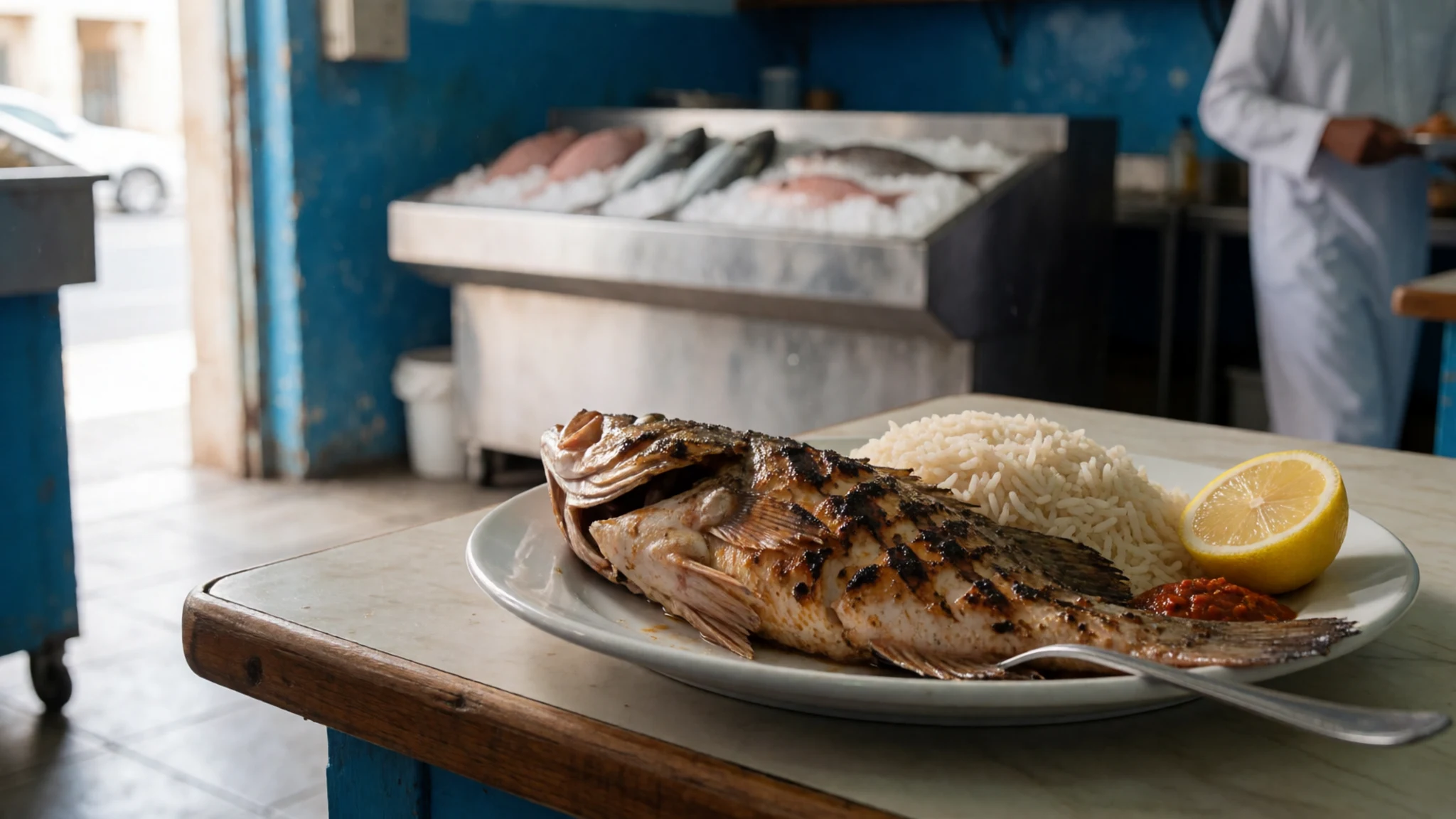
- Madrouba — Desert-camp kitchens and Qatari eateries in Doha
Khor Al Adaid nights, when a camp stays out, suit madrouba, rice cooked down with meat or chicken, spices and stock until it becomes a savoury porridge. It is warming when the desert loses its heat after dark. Desert-camp kitchens and Qatari eateries in Doha serve it, often beside pickles. - Balaleet — Cafeterias on the southern roads and breakfast counters in Doha
Khor Al Adaid departures are often early, which makes balaleet a sensible plate: sweet saffron vermicelli tangled with savoury egg, a Doha breakfast that travels well in a box. Cardamom and sugar set the perfume. Cafeterias on the southern roads and city breakfast counters sell it through the morning. - Luqaimat — Camp tea tables and dessert counters in Doha
Khor Al Adaid's sweet finish is often luqaimat, small fried dough balls, crisp outside and soaked in date syrup or honey. They belong to a camp tea table after dark, or to a dessert counter in Doha, rather than to a formal menu.
Plan it
Best time. October to April is the workable season at Khor Al Adaid, when a full day on the sand is realistic. May to September is harshly hot and humid. Winter weekends draw vehicle crowds; a weekday in the cooler months is calmer.
How long. 1–2
Getting there. Khor Al Adaid is reached via Hamad International Airport and Doha, then a long off-road journey south. No railway serves the creek. The last stretch is dune and sabkha, so come with a desert operator or a driver who knows the tracks.
Budget. mid
Tips
- Go with a desert operator or a driver who can tell firm sabkha crust from a crust that will swallow a wheel.
- Prefer a weekday in the cooler months; Friday convoys are louder and the dunes busier.
- Bring drinking water, a hat and a wind layer. The shore has neither a shop nor shade.
- Stay on existing tracks, and treat any line toward the Saudi border as closed.
- Read current official Qatar tourism advice before leaving Doha; sand access and camp rules change.
Etiquette
- Cover shoulders and knees; keep swimwear for a private camp, not the open shore.
- Ask before you photograph people.
- Carry every piece of rubbish out.
- If gahwa is offered, take a small cup and tilt it when you have finished.
Nearby
Sources
- Wikidata (CC0)
- Wikipedia: Khor Al Adaid (CC BY-SA 4.0)
- Wikivoyage: Qatar (CC BY-SA 4.0)