Al Jumail
Al Jumail, Qatar
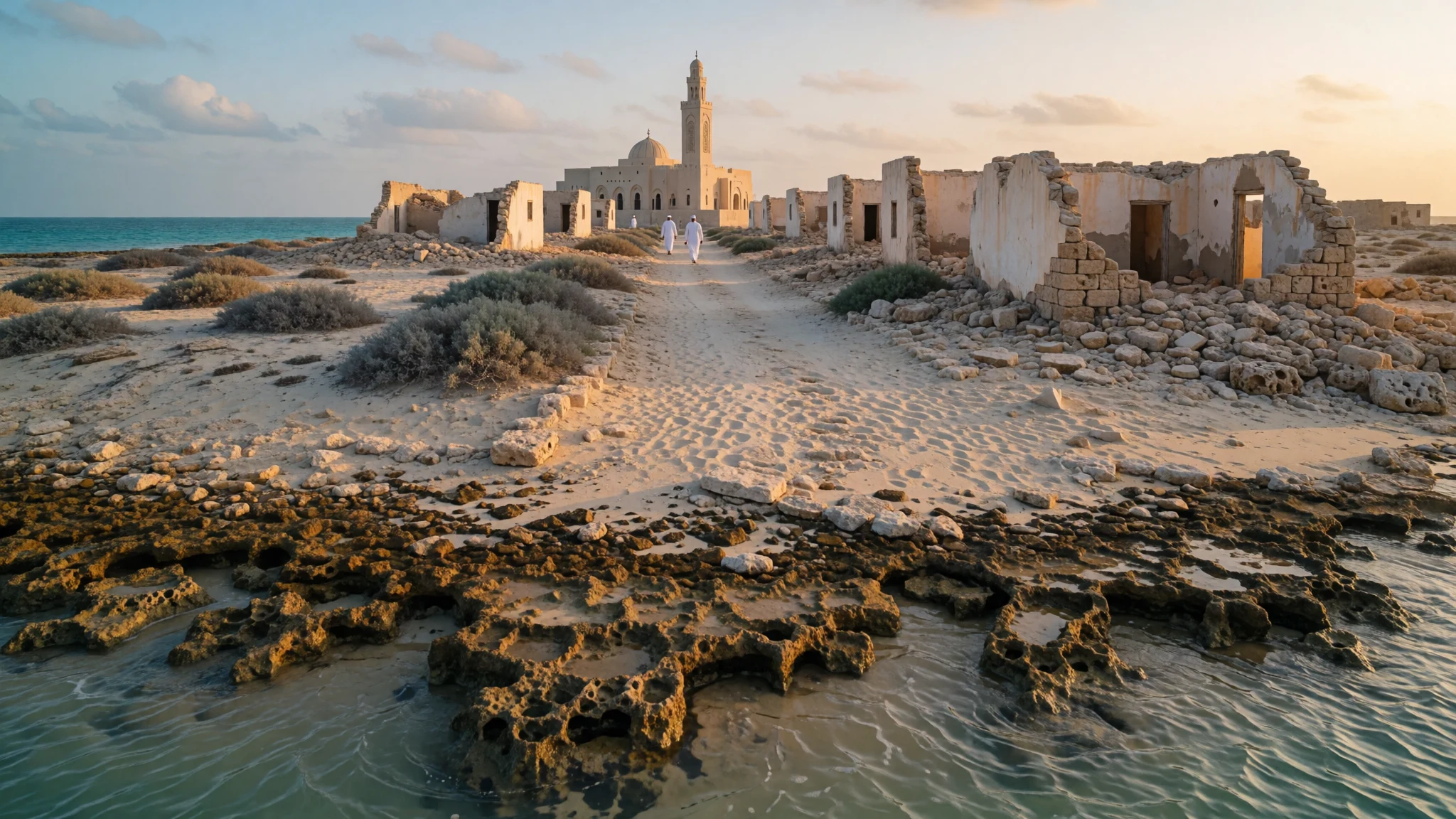
Al Jumail is an abandoned fishing village on Qatar's northeast coast, where ruined stone houses meet the Gulf.
The place
Al Jumail is a deserted fishing village on the northeast coast of Qatar, in the municipality of Al Shamal, facing the Arabian Gulf. Low ruined houses stand in loose rows a short walk from the water, their walls built of coral stone, limestone and mud plaster that the salt wind has worn thin. Doorways open onto small courtyards; roofs have fallen in; rooms are open to the sky. A mosque still marks the settlement, its simple mass rising above the rubble, and the shore itself is edged with beachrock, the cemented sand that forms where the sea meets this flat coast. There is no town life left here. No shops, no harbour traffic, no evening lights in the lanes. What remains is the plan of a working village: houses close enough for neighbours to call across a yard, paths leading toward the boats, and the mosque at the centre of daily prayer. Visitors usually come from Doha for the quiet and the photographs, especially when the light is low and the stone turns warm. In the middle of the day the site is exposed, with little shade and a strong glare off sand and water. Winter brings milder air and clearer walking; summer heat makes the ruins a brief stop rather than a long wander. The ground is uneven, with loose stones, collapsed masonry and soft sand, so the village asks for slow feet and a respect for walls that are already failing. Al Jumail is small. A person can cross it on foot and still have time to sit on the beachrock and watch the Gulf.
Its story
Al Jumail belonged to the coastal world of northern Qatar, where families lived by fishing and by the pearl banks that once organised the Gulf's year. Boats went out from this shore, and the village behind them was built for that work: thick-walled rooms against the heat, courtyards for cooking and mending, and a mosque for the prayers that structured the day. The houses were not monuments. They were family dwellings of stone and plaster, repaired after storms and left plain because the wealth, when it came, was in the pearls rather than in the walls. When the pearl trade collapsed, this kind of settlement lost its reason to stay. Divers and captains could no longer support a whole village from the banks, and later the oil economy pulled work, schools and markets toward Doha and the larger towns. Families moved. Al Jumail was not destroyed in a single event that the record names; it was left, and the climate finished the leaving. Rain, salt and sun opened the roofs, and without people to replaster the walls the rooms became shells. The mosque endured longer than the houses, as mosques often do, and it is the building visitors still read as the heart of the place. Today the village is a heritage site people visit rather than a home. Its value is the intact layout of a pre-oil fishing settlement, still sitting on its original coast, still scaled to foot and boat. Walking it is a lesson in how thin the margin was: households, a mosque, a beach, and a living that the wider Gulf outgrew. Al Jumail keeps that older scale in plain sight.
What to see
- Ruined houses — the lanes of the ruined village
Al Jumail's ruined houses form the body of the village: low shells of coral stone, limestone and plaster, many with fallen roofs and open courtyards. Doorways and small windows still show how tightly families lived. The masonry is fragile. Walls lean, plaster flakes, and loose blocks lie in the sand. The gaps between buildings are the sensible path, and every stone is better left where it sits.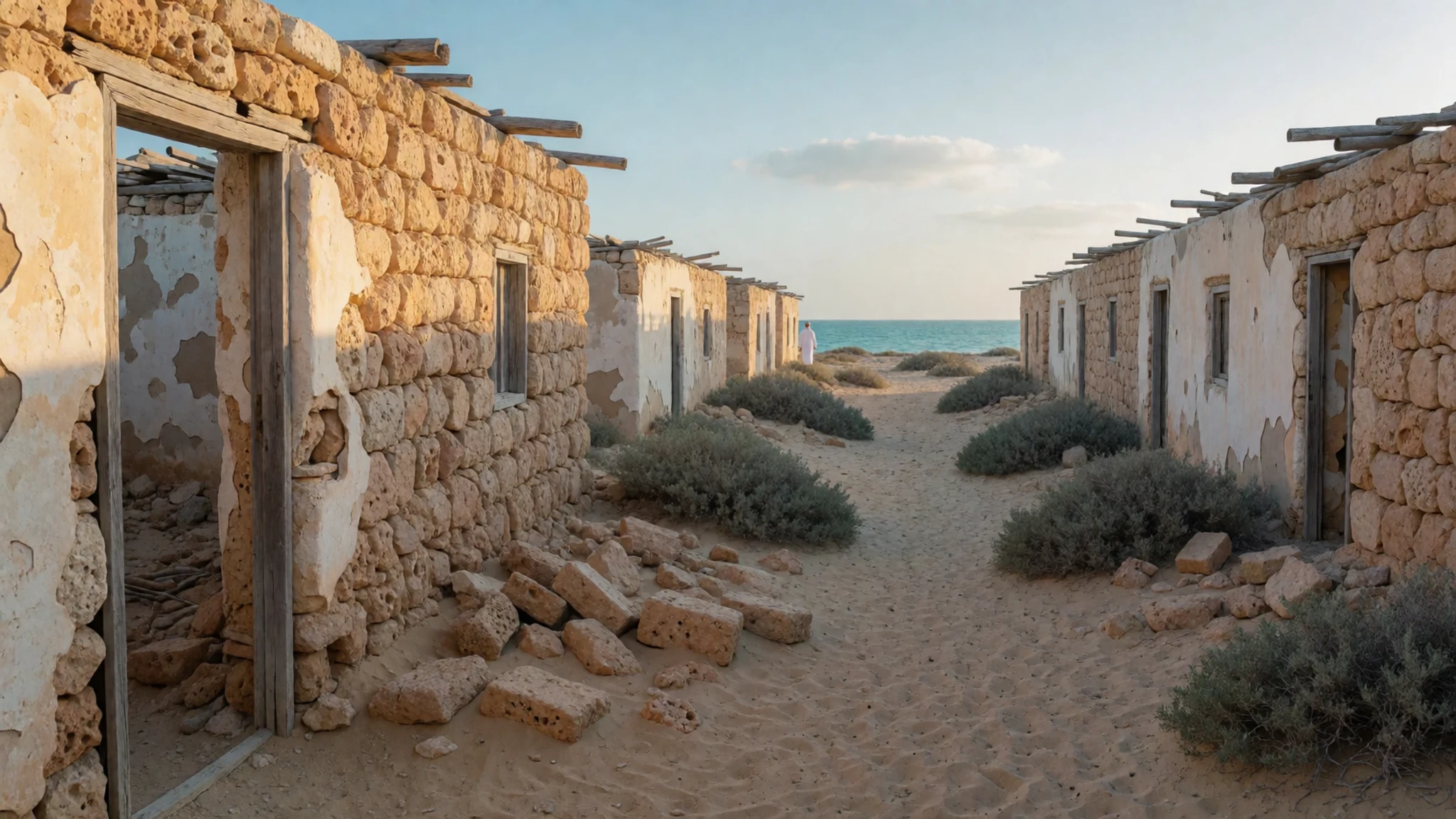
- Al Hussein Mosque — among the ruined houses
The remains of a fort and old houses in Al Jumail mark the village's former center. The plain building stands among ruined houses and marks the old centre of prayer in a fishing village without a congregation. Plaster has fallen, edges are broken, and the interior is open to wind and sand. Modest dress and a quiet step suit this historical monument.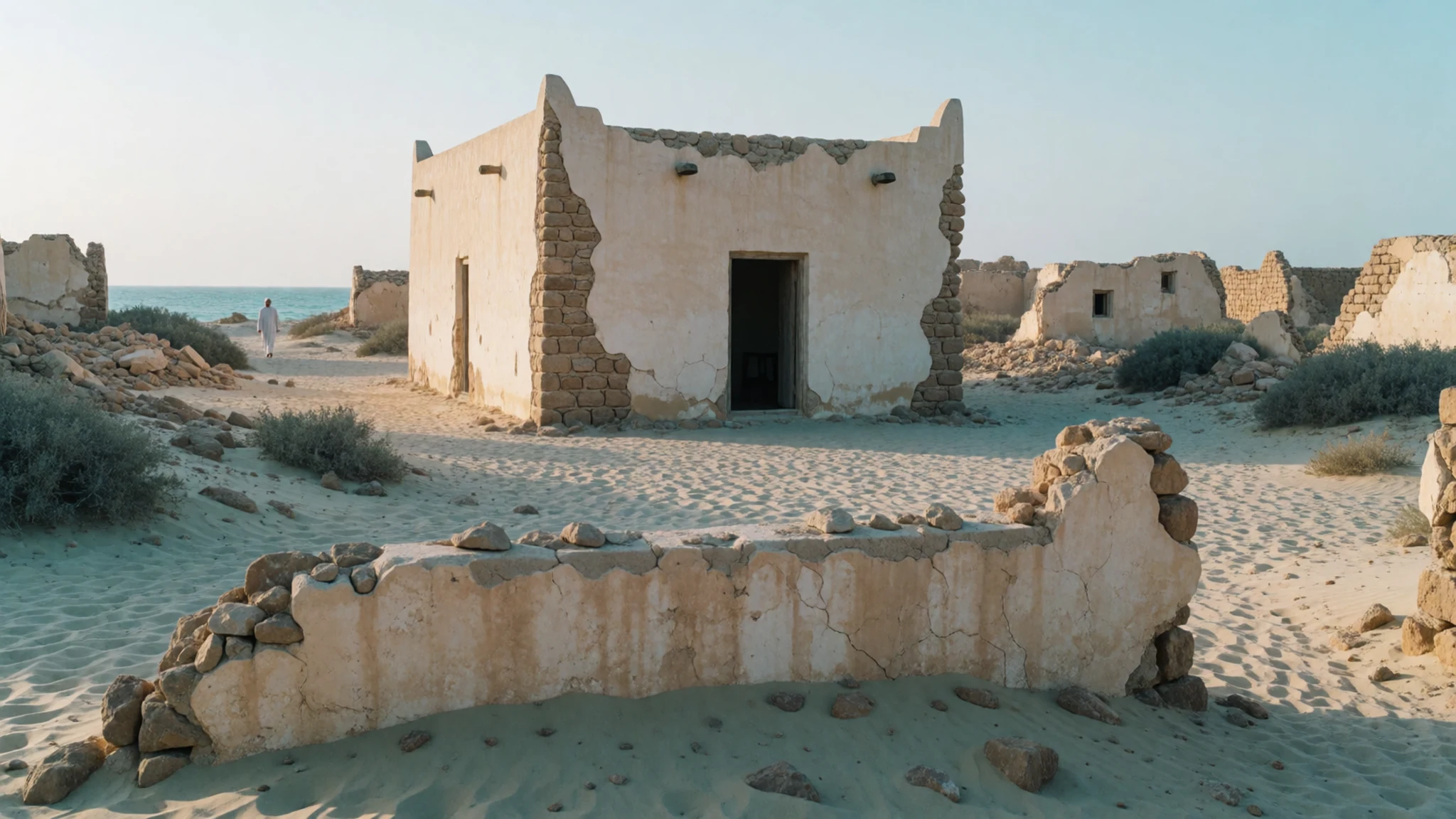
- Beachrock shore — the shore below the village
Beachrock at Al Jumail is the hard band of cemented sand along the waterline, where the Arabian Gulf meets the flat northern coast. It forms a rough pavement beside the ruined village, wet in places and sharp under thin soles. There is no promenade and no shade. The shore suits a short walk, and the footing changes quickly from hard slab to soft sand.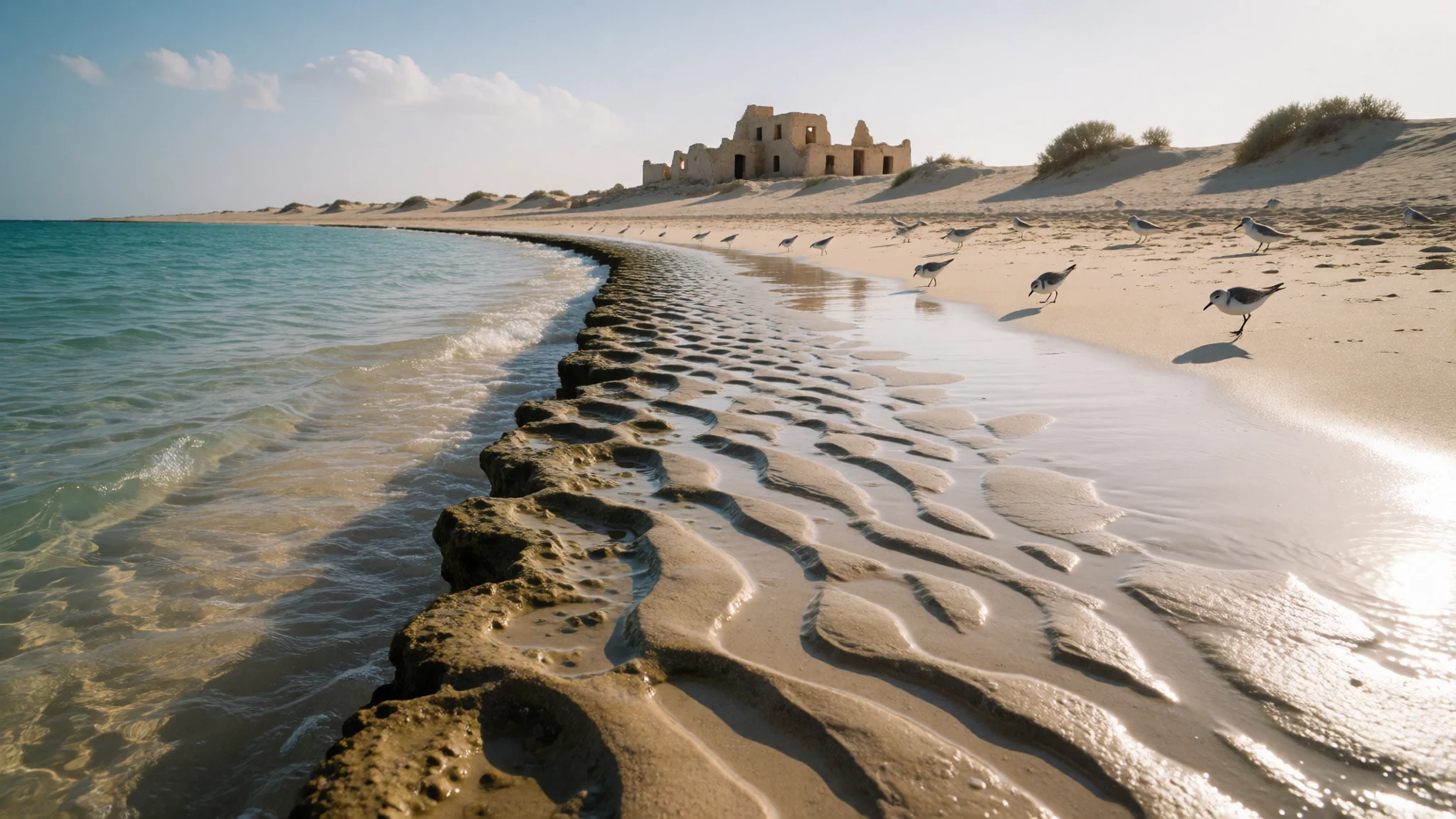
- The village from above — the settlement seen from above
From above, Al Jumail reads as a compact cluster of ruined rooms set just inland from the Gulf, with the mosque a solid shape among broken walls. The aerial view shows how small the settlement was and how directly it faced the water: houses, open yards, then beachrock and sea. Sunset light picks out collapsed roofs and the pale ground between them.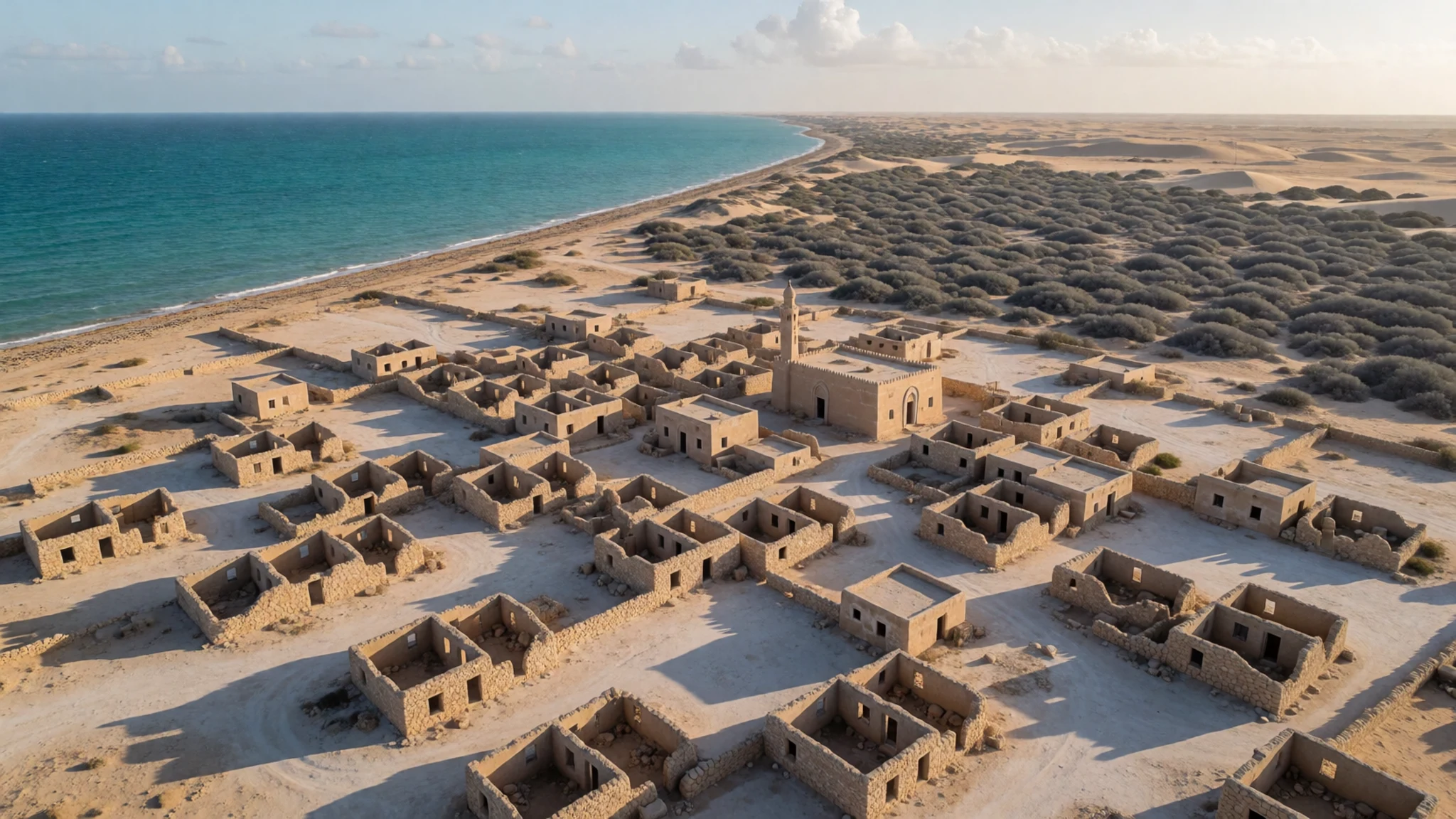
- Sunset over the ruins — the village and the shore
Al Jumail at sunset is the same ruined village with the light changed. The low sun warms the stone, lengthens the shadows inside roofless rooms, and turns the Gulf beside the beachrock into a bright band. The houses and the mosque separate cleanly from the pale ground. After the sun drops, the site goes dark quickly, with no street lighting and uneven rubble underfoot.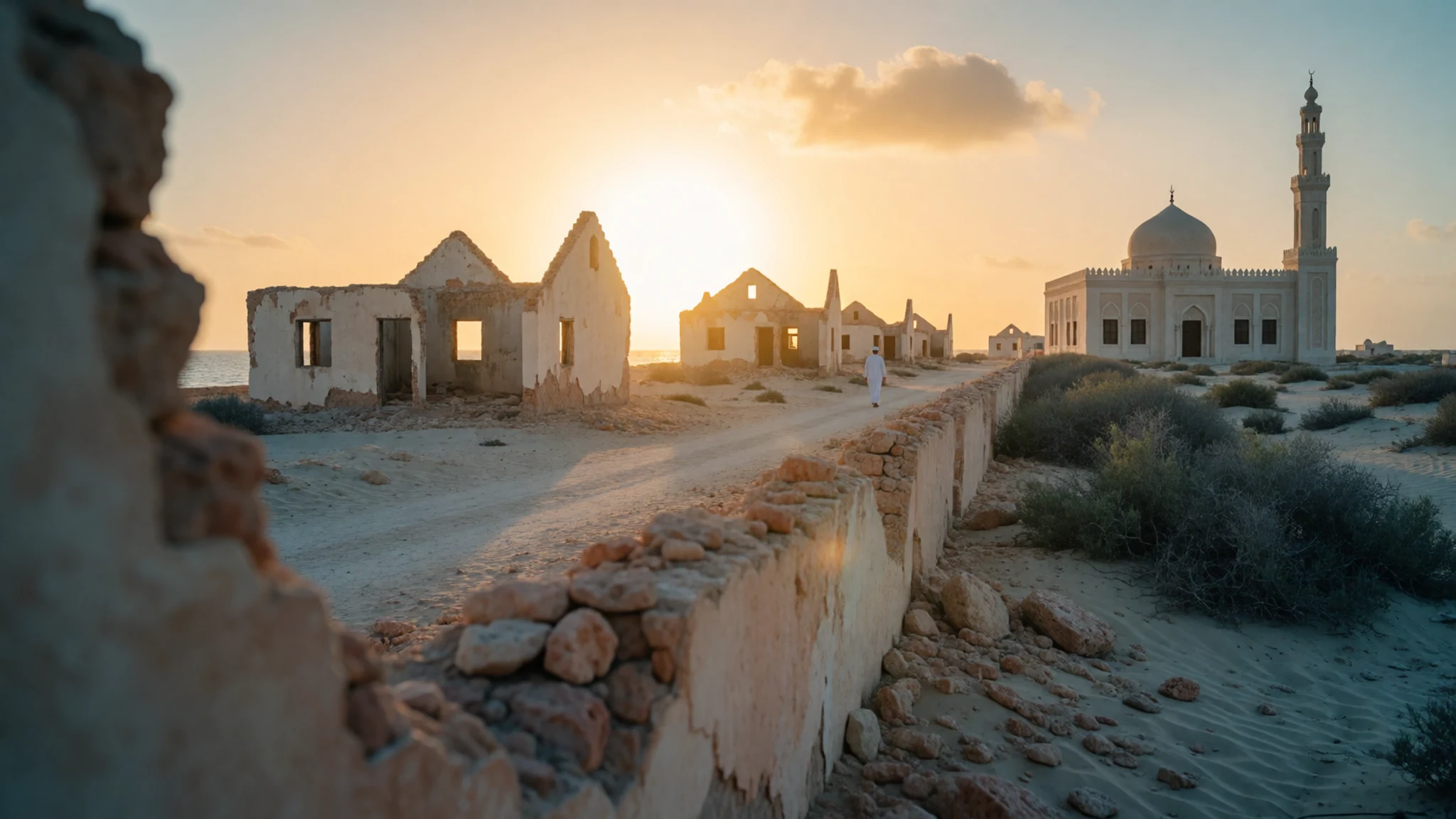
Culture
Al Jumail is an abandoned Muslim fishing village whose ruins still follow the old pattern of mosque, boats and courtyard. Daily life on this coast turned on prayer, on the fishing and pearling seasons, and on the household, where cooking, water and repair kept the settlement going between voyages. The people who did that work have gone, but the country around the village has not. In Qatar the weekend falls on Friday and Saturday, Ramadan slows the day and closes many kitchens from dawn until sunset, and a mosque remains a religious place even when its plaster is falling. Hospitality in the inhabited towns of Al Shamal is generous, with coffee and dates for a guest, yet Al Jumail has no resident host and no one to welcome a visitor inside. The empty rooms were family houses. They are not a quarry for coral souvenirs, a climbing frame, or a loud set for photographs. Dress as you would for a modest neighbourhood in Qatar, speak quietly in the mosque, and leave every stone where it lies.
What to wear
Al Jumail's fishermen and their families dressed for heat, wind and prayer, and that logic still governs clothes in northern Qatar. Men wore the thobe, a long white cotton robe that reflects the sun and lets air move, with a ghutra or shemagh on the head held by the agal, a dark cord. In cooler months a bisht, a cloak often of wool or a lighter formal cloth with gold thread, went over the thobe for mosque, guests and ceremonies. Women wore the abaya, a black outer cloak, with a shayla or hijab covering the hair; older everyday cloth was cotton, practical and washed often, while visiting dress could be more embroidered. People in Qatar still wear this national dress daily, especially outside offices, and it is the ordinary sight in Al Shamal. Younger residents also wear global casual clothes in the cities, but on the coast the white thobe remains common working dress. A visitor to Al Jumail should copy the modesty and the practicality, not the costume. Light, loose trousers or a long skirt, a shirt that covers the shoulders, and a scarf to hand if entering the mosque are enough. Closed shoes with a grip matter more than style: the ground is rubble, sand and beachrock. In summer a hat and a layer that can wet with sweat are wiser than bare arms. White and pale colours stay cooler. Smart shoes are better left in the car.
What to eat
- Machbous — eateries in Al Shamal, or fish restaurants on the road toward Doha
Near Al Jumail, machbous (also called majboos) is spiced rice with fish, onion, dried lime and a warm spice mix. The ruined village has nowhere to buy it. A simple eatery in Al Shamal, or a fish restaurant on the road toward Doha, serves it for lunch.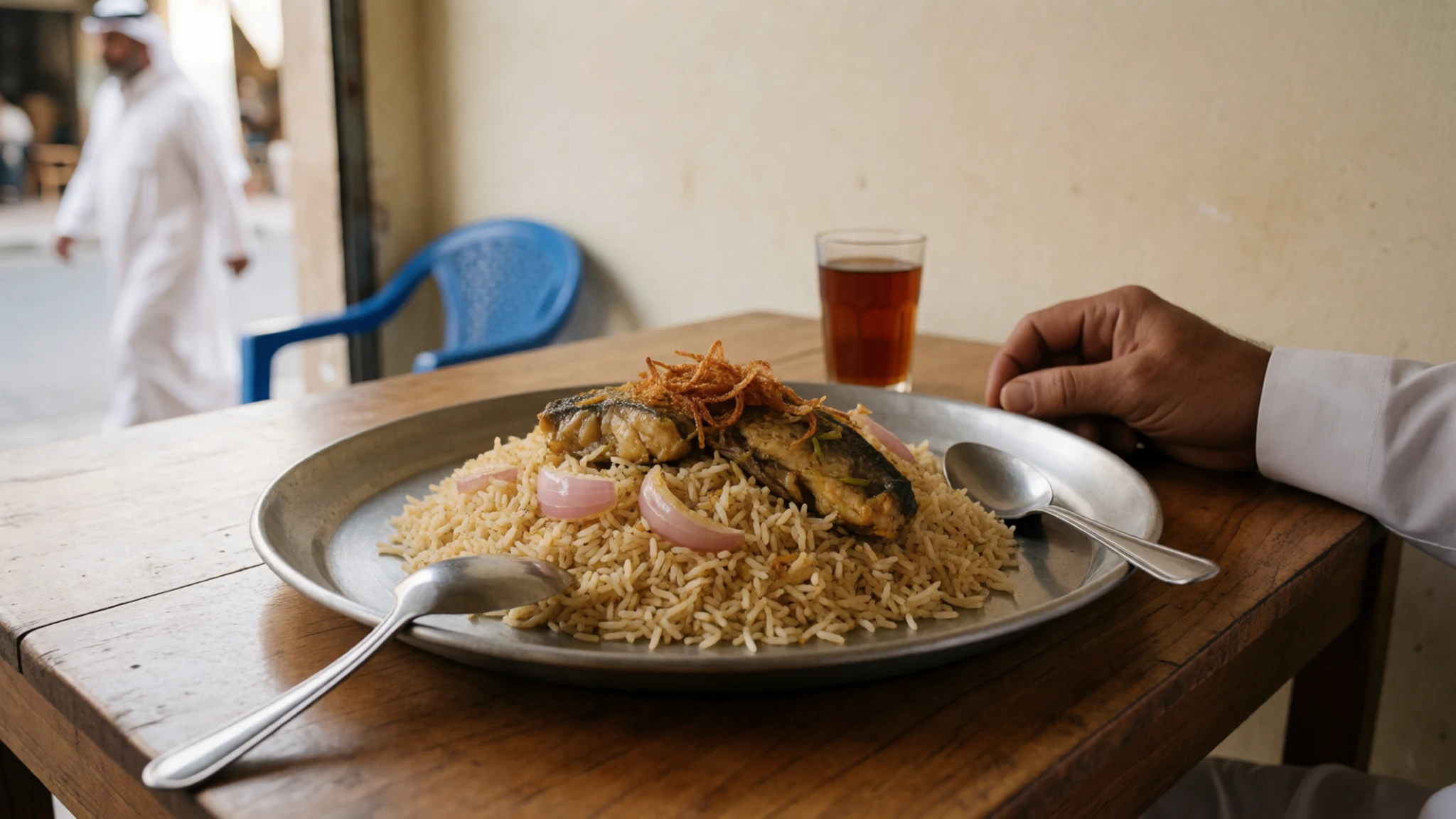
- Grilled hamour — Al Ruwais and other Al Shamal eateries
Grilled hamour, the local grouper, comes with rice or flatbread along the Qatari coast. It is the sort of catch Al Jumail's boats once lived by, though the village no longer has a market. Al Ruwais and other Al Shamal eateries serve it as an ordinary plate.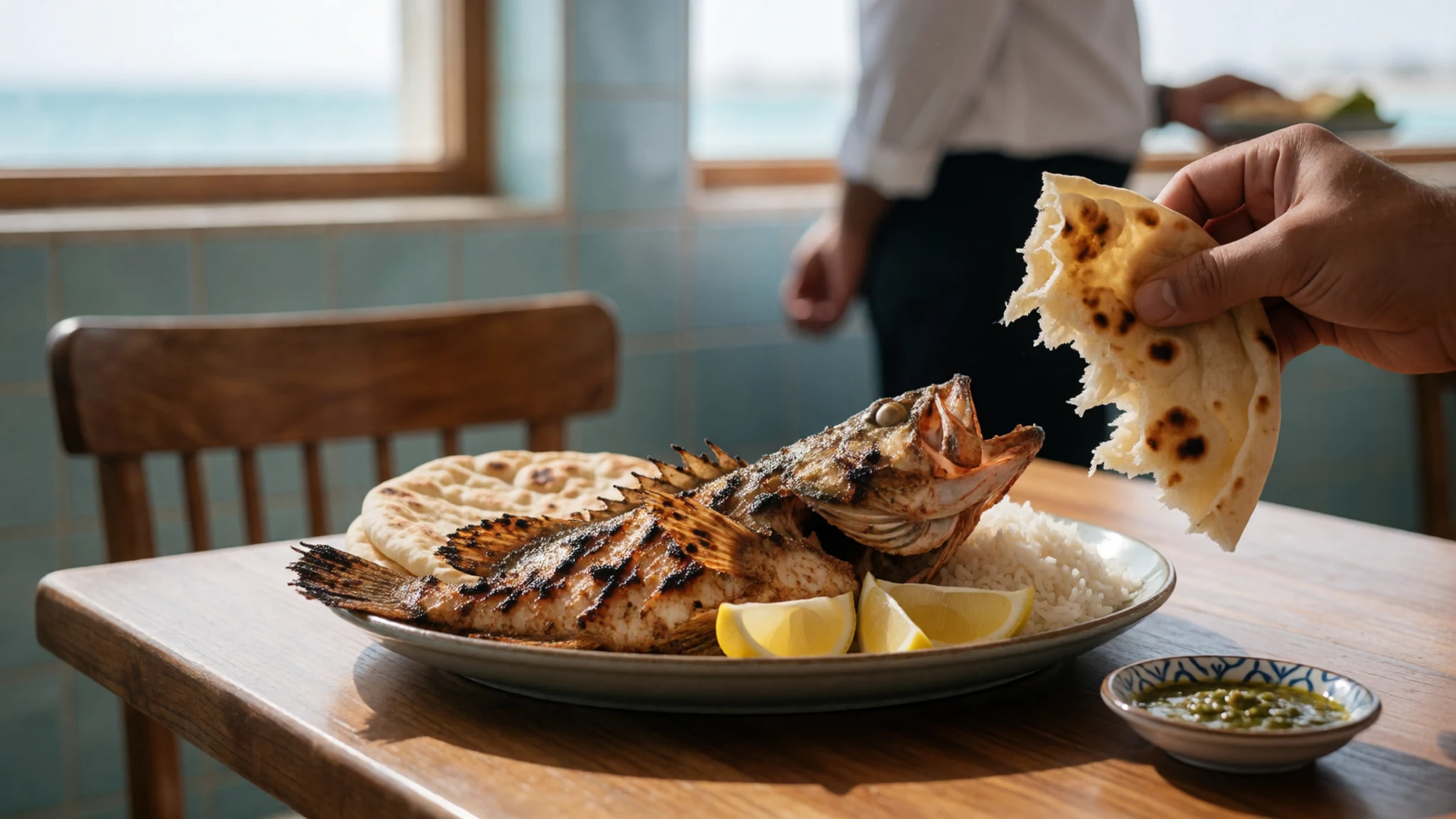
- Balaleet — Qatari eateries in Al Shamal or Doha
Balaleet is a sweet breakfast of thin vermicelli with sugar, saffron, cardamom and rose water, topped with an omelette. It is family food in Qatar, not a snack beside the ruins. Al Jumail has no stall. A Qatari eatery in Al Shamal or Doha serves it in the morning. - Harees — family eateries in Al Shamal
Harees is wheat and meat, chicken or lamb, pounded with salt and water into a thick savoury porridge. It is Friday and festival food in Qatar, especially in Ramadan and at Eid. Al Jumail has no kitchen. Family eateries in Al Shamal serve it on Fridays and during Ramadan. - Luqaimat — sweets counters in Al Shamal or Doha
Luqaimat are small fried dough balls with date syrup or honey, cardamom and saffron. They turn up at Ramadan nights, Eid and family gatherings in Qatar. Al Jumail has no stall. A sweets counter in Al Shamal or Doha is the place to buy them.
Plan it
Best time. December to February, when the days are mildest and walking the exposed ruins is comfortable; April and October are workable if you start early. June to August is extremely hot, with almost no shade among the houses.
How long. a day
Getting there. Fly into Hamad International Airport at Doha, then drive north by car through Al Shamal to the coast at Al Jumail. The village has no railway stop; the final stretch is by road to the edge of the ruins.
Budget. high
Tips
- Carry more water than a short walk suggests; Al Jumail has no shop and almost no shade.
- Go at opening light or in the late afternoon; midday glare off sand and stone is harsh, and after dark the rubble is a hazard.
- Wear shoes that can take coral stone, loose blocks and beachrock, and keep a scarf in the bag for the mosque.
- There is nothing to buy on site, so eat in Al Shamal or bring food from Doha, and take all rubbish away.
Etiquette
- Do not climb on walls or take coral, plaster or any fragment as a souvenir.
- Cover shoulders and knees at the mosque, keep voices low, and do not use it as a posing backdrop.
- If you meet residents on the road or in Al Shamal, ask before photographing people.
Nearby
Sources
- Wikidata (CC0)
- Wikipedia (CC BY-SA 4.0)
- Wikivoyage (CC BY-SA 4.0)