Kbal Spean
Kbal Spean, Cambodia
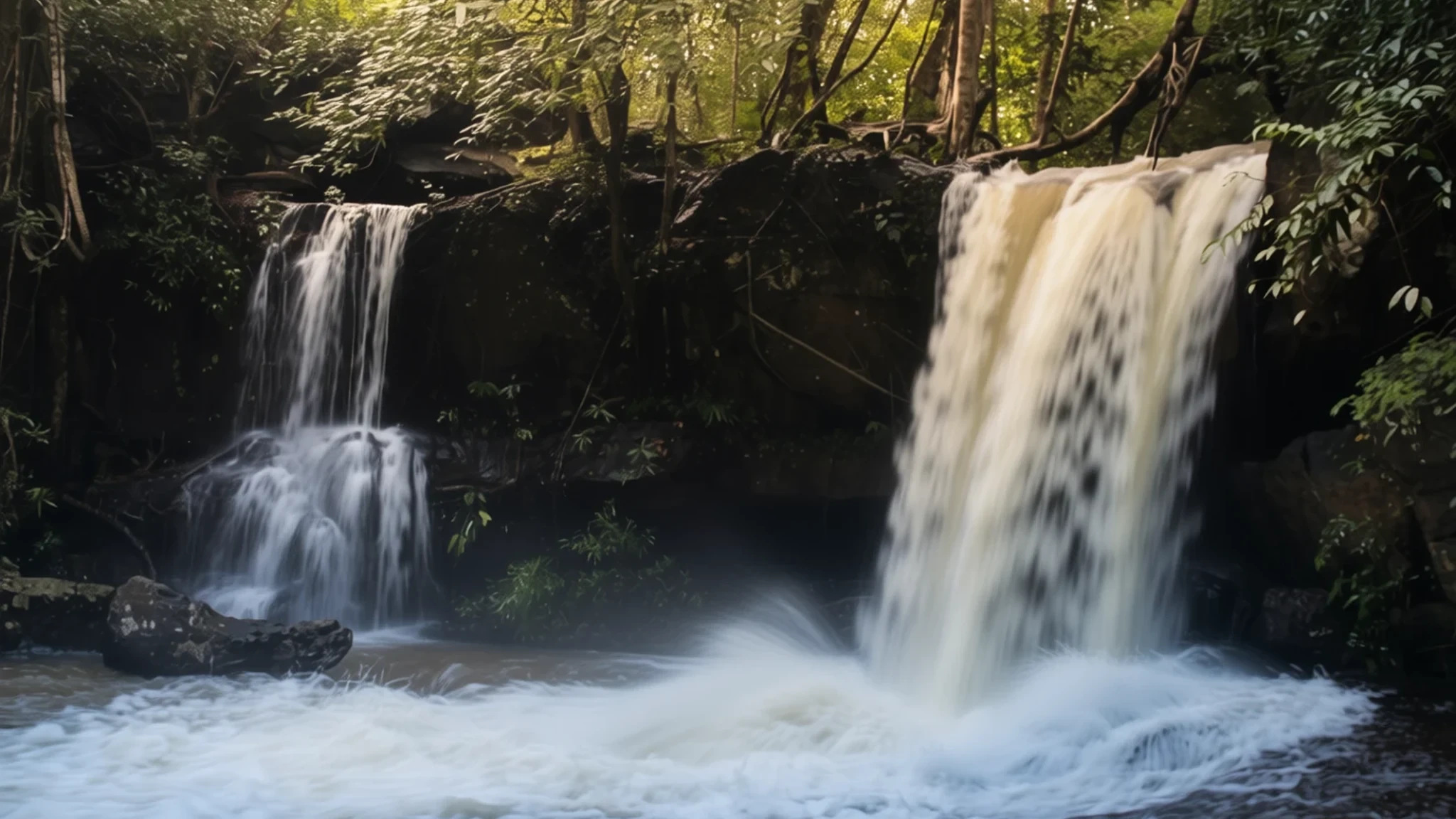
Kbal Spean is a forest walk to a river whose sandstone bed was carved with lingas and gods about nine centuries ago.
The place
Kbal Spean sits on the south-western slopes of the Kulen Hills, north-east of Angkor in Banteay Srei District, Siem Reap Province. The name is Khmer for 'bridge head', and it refers to a natural sandstone span over the Stung Kbal Spean, a small river that rises in the hills to the north. The site lies roughly 25 km (16 mi) from the main Angkor monuments, and the same water runs downstream towards them.
What makes it unusual is that the art is not in a building. The carvings run along about 150 m of river, cut into the bed and banks of the stream. Many are lingams, the upright form that represents the god Shiva, shown as neat rows of rounded bumps across the rock, or paired with a yoni base. That is why the place is called the Valley of a Thousand Lingas, or the River of a Thousand Lingas.
Among them are figures from Hindu myth: Shiva, Vishnu, Brahma, Lakshmi, Rama and Hanuman, along with cows and frogs. Some are crisp, others softened by centuries of flowing water, and when the river is low the patterns are easiest to read.
It is a working forest walk rather than a stroll between temples. Trees close in overhead, the air is damp, and the sound of water follows you for most of the climb. The reward is a quiet, shaded place where stone, river and belief are physically one thing, a different experience from the grand set pieces of Angkor itself.
Its story
The carving at Kbal Spean spans two reigns in the 11th and 12th centuries, beginning under King Suryavarman I and ending under Udayadityavarman II. The thousand lingas themselves, though not the other sculptures, are credited to a minister of Suryavarman I and were worked by hermits who lived in these hills. Inscriptions on site show that most of the carving was done under Udayadityavarman II, who is also recorded as consecrating a golden linga here in 1059.
The logic of the place is about water. Hindu belief held that a river flowing over sacred symbols was blessed by them, so the stream, running on towards Angkor and the fields around it, carried that blessing downhill to the capital. The carvings can be read as a kind of consecration of the water supply, placed upstream where the river begins its journey.
Then the forest took the site back. It was found by the ethnologist Jean Boulbet in 1969, but the Cambodian Civil War cut short any further exploration. Visiting became safe again only from 1989, and since then the site has slowly become an established stop for people exploring the area beyond the main Angkor temples.
The story is a reminder that Angkor was never only its famous towers. It was a landscape of hills, rivers and devotion, and this carved stream is one of the places where that wider world is still easy to see.
What to see
- The carved riverbed — Stung Kbal Spean, Kulen Hills
The main attraction is the stretch of river where lingas are cut in tidy grids across the sandstone. Look closely at the shallows, where water slides over the carving and makes the patterns shimmer. It is at its clearest when the flow is gentle, so the dry season is kinder to the details.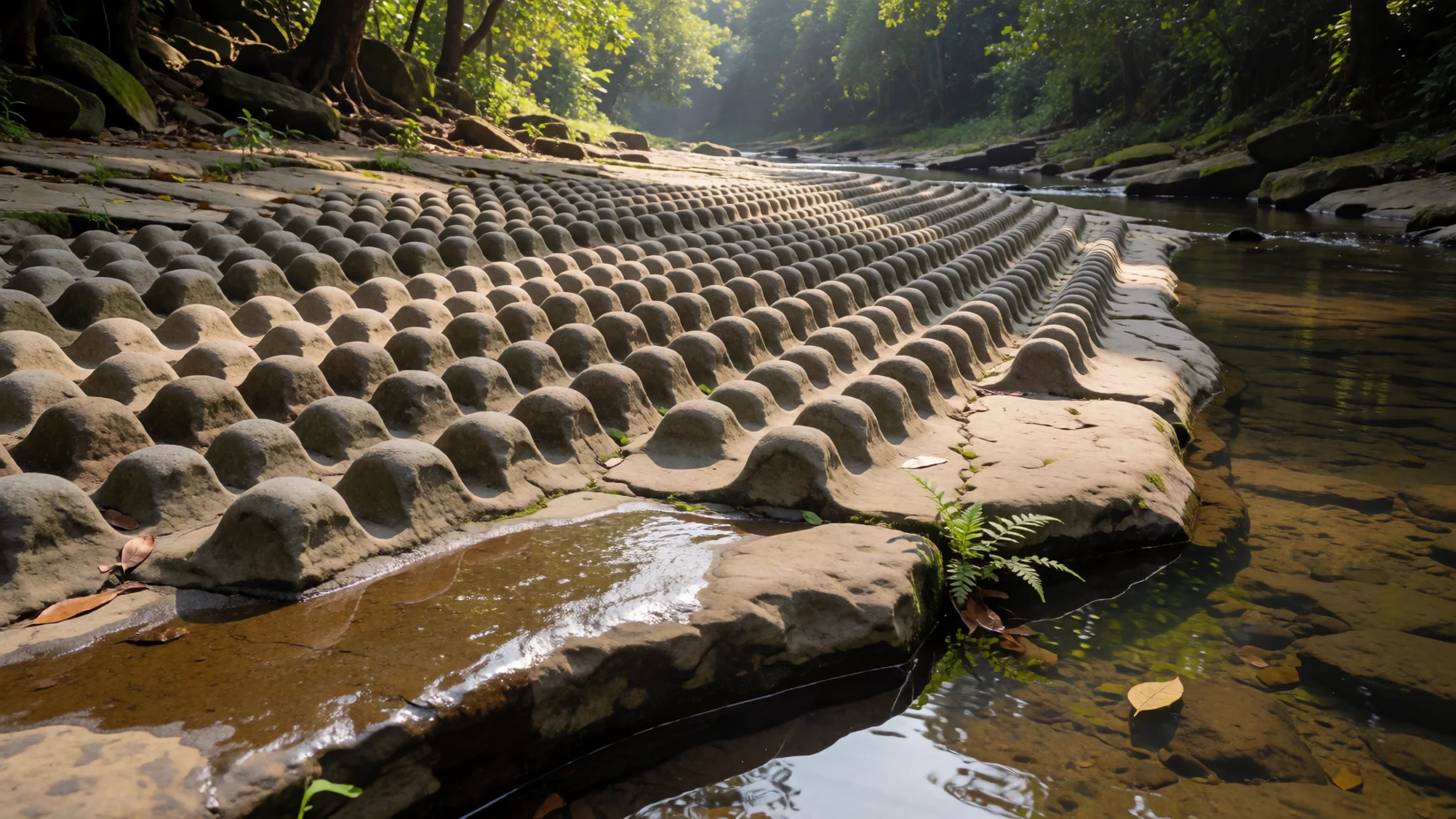
- Vishnu and Brahma reliefs — Along the river, Kbal Spean
Among the lingas are figures from the Hindu pantheon, including Brahma, carved in the rock with the calm, rounded features typical of Angkorian art. Some stand out clearly, others are faint. Spend time here, since the best figures are easy to walk past on the way to the waterfall.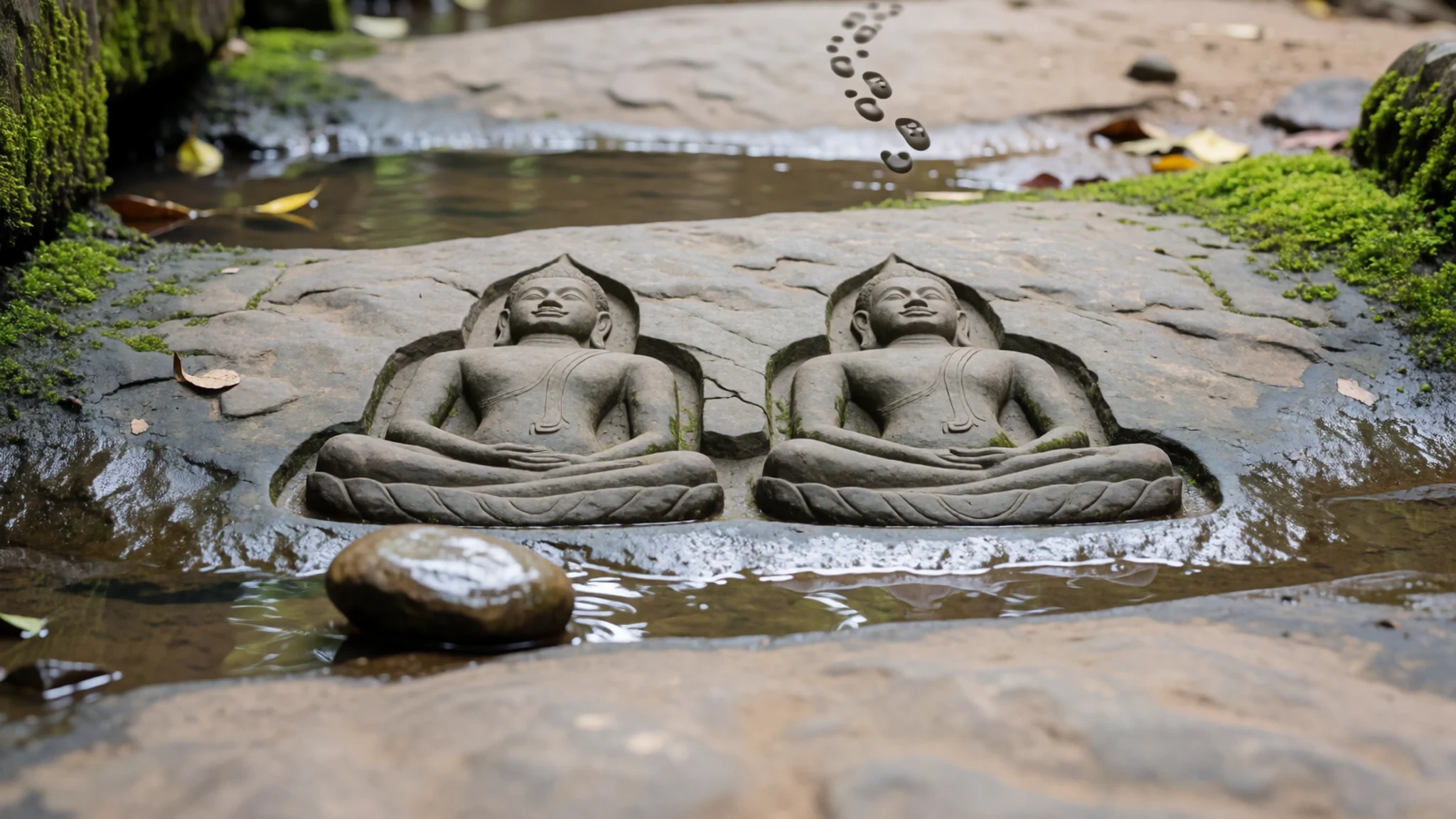
- Lingas in the living rock — Riverbed, Kbal Spean
Rows of small round lingas fill flat patches of bedrock, some paired with square yoni bases. Seen up close they look like regular bumps, almost like a dotted pattern. Photographs from above the water give the clearest sense of how orderly the carvers were, working directly into the stone of the stream.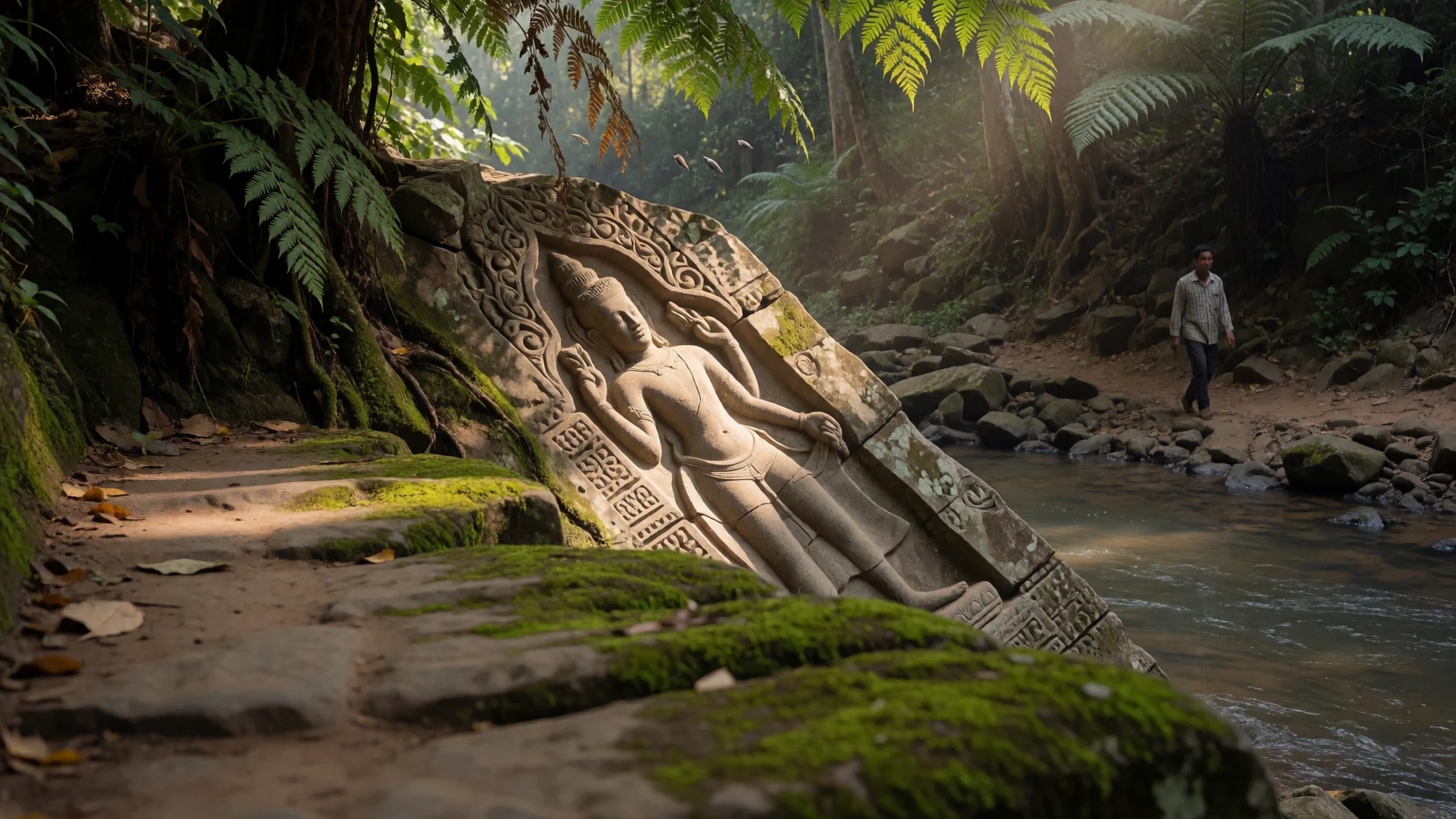
- The waterfall — Upper river, Kbal Spean
The river drops over a sandstone ledge near the carvings, and in the wetter months it is a lively little fall with lingas visible at its edge. In the dry season it can shrink to a trickle. It is a pleasant place to rest after the climb, in cool shade.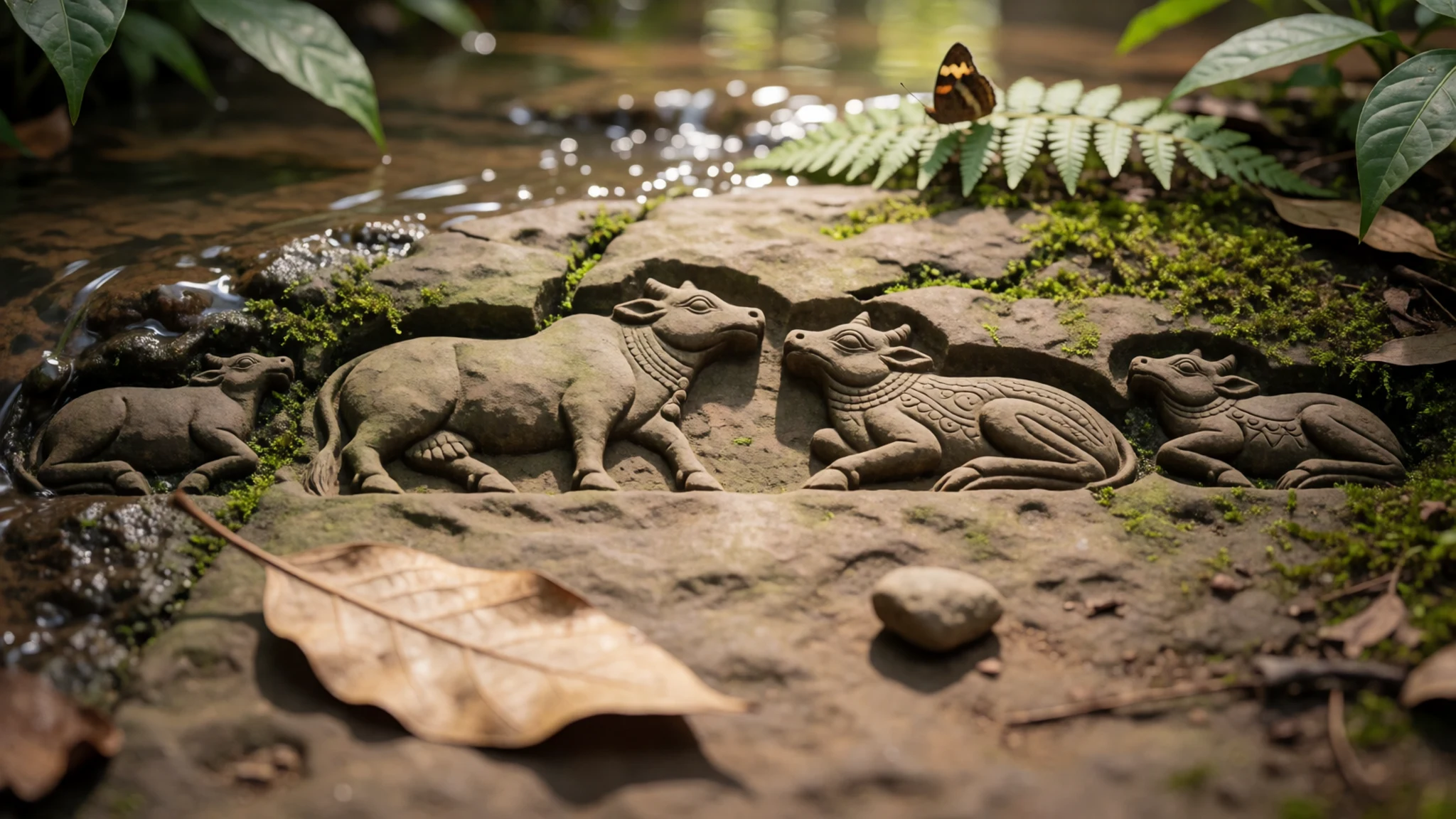
- The forest climb — Kulen Hills approach
The approach is itself part of the visit: a walk uphill through shaded woodland on a path of roots and rock before the river appears. Allow time, take water, and go slowly. The return downhill feels easier, and the quiet under the trees is a good contrast to busy Angkor.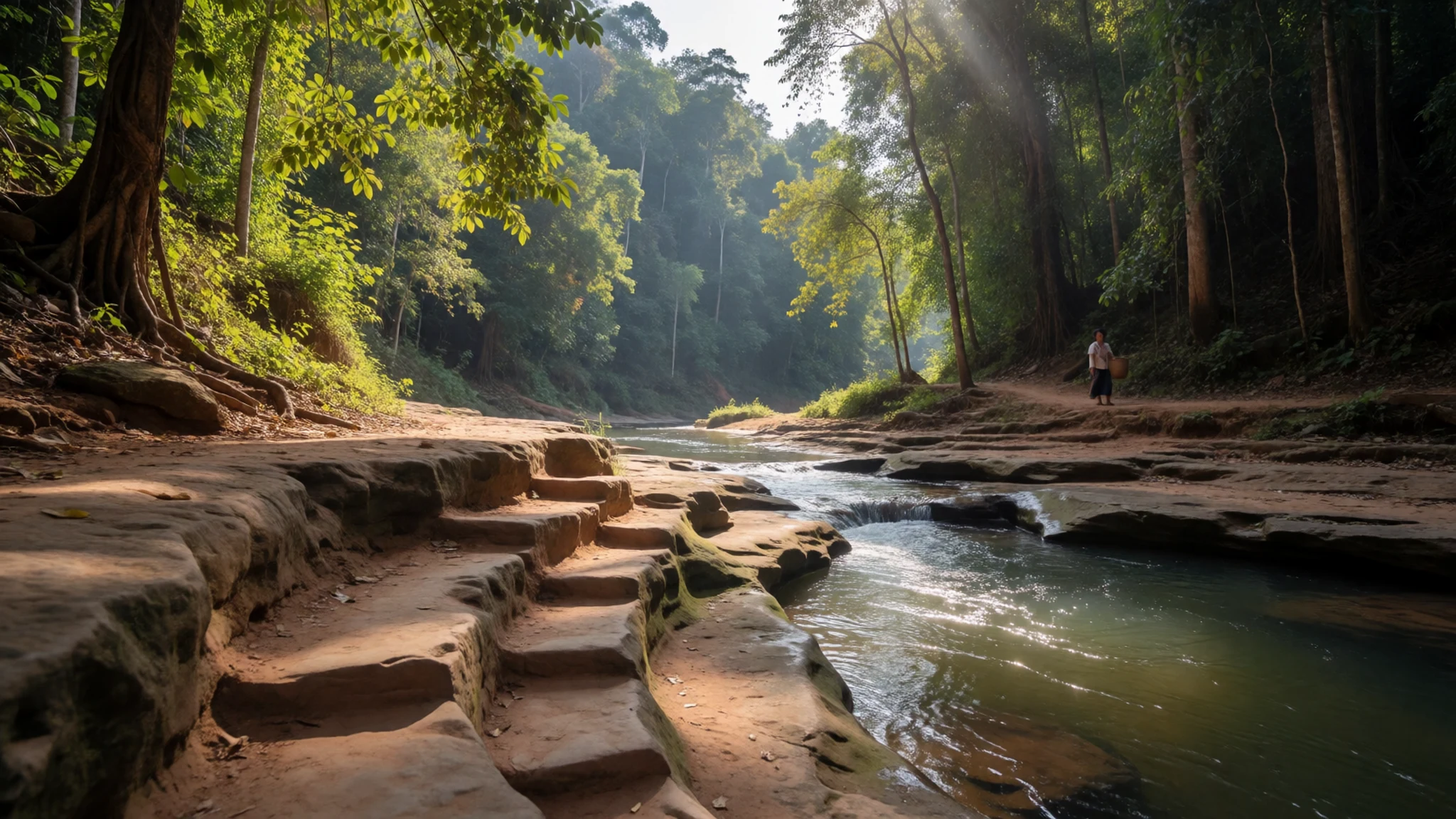
Culture
Kbal Spean is a Hindu site in a country that is now predominantly Buddhist, and that layering is part of Cambodian life. Angkorian kings often followed Shiva or Vishnu, and the lingas here come from that devotion. Today the forest around the river is treated with respect, and some visitors and local people still regard the stream as blessed by the stone it flows across.
Cambodia is in general a courteous, gentle country, and visitors who are polite and patient tend to be well received. Around Siem Reap, people are used to tourists, but the further you go from the towns, the less that is true. Always ask before photographing someone, as some people in more remote areas dislike it and a few in urban areas may ask for payment.
Dress is conservative, particularly for women, and covering shoulders and knees is the respectful default away from the main tourist streets. Many Cambodian women cover up in the daytime partly to avoid tanning, which is not considered attractive.
The lingas are sacred symbols rather than curiosities, so keep your voice low, do not climb on the carvings, and do not step on or touch the carved rock where the path allows you to avoid it.
What to wear
In Kbal Spean and the villages around Angkor, traditional dress centres on the sampot, a length of cloth wrapped around the waist and drawn between the legs or worn as a skirt. Silk sampot, often woven with patterns in the hol technique, is kept for weddings, ceremonies and festivals, while cotton versions are for everyday use. Men wear the krama, a checked cotton scarf, over the shoulders or around the head.
Day to day, most people near Kbal Spean wear modern clothes: loose shirts, trousers or long skirts, and light jackets on motorbikes. Farmers and forest workers favour practical long sleeves and the krama against sun and dust. Women in towns often cover their skin in the daytime, and brighter, more fashionable outfits appear in the evening.
For visitors, the walk to the river is a hot, humid forest climb on uneven ground. Wear light, breathable trousers or knee-length shorts, a shirt that covers the shoulders, and a hat. Shoes need real grip: trainers or light walking shoes, not sandals, since rocks and roots can be slippery. Carry a light rain layer in the wetter months and use insect repellent. If you plan to visit a temple on the same day, bring something to cover shoulders and knees.
What to eat
- Fish amok — Restaurants and eateries in Siem Reap town
Fish steamed in a banana-leaf cup with coconut milk and kroeung, a fragrant herb paste. It comes out soft, mild and slightly sweet, closer to a custard than a curry. A standard order for visitors in Siem Reap's restaurants.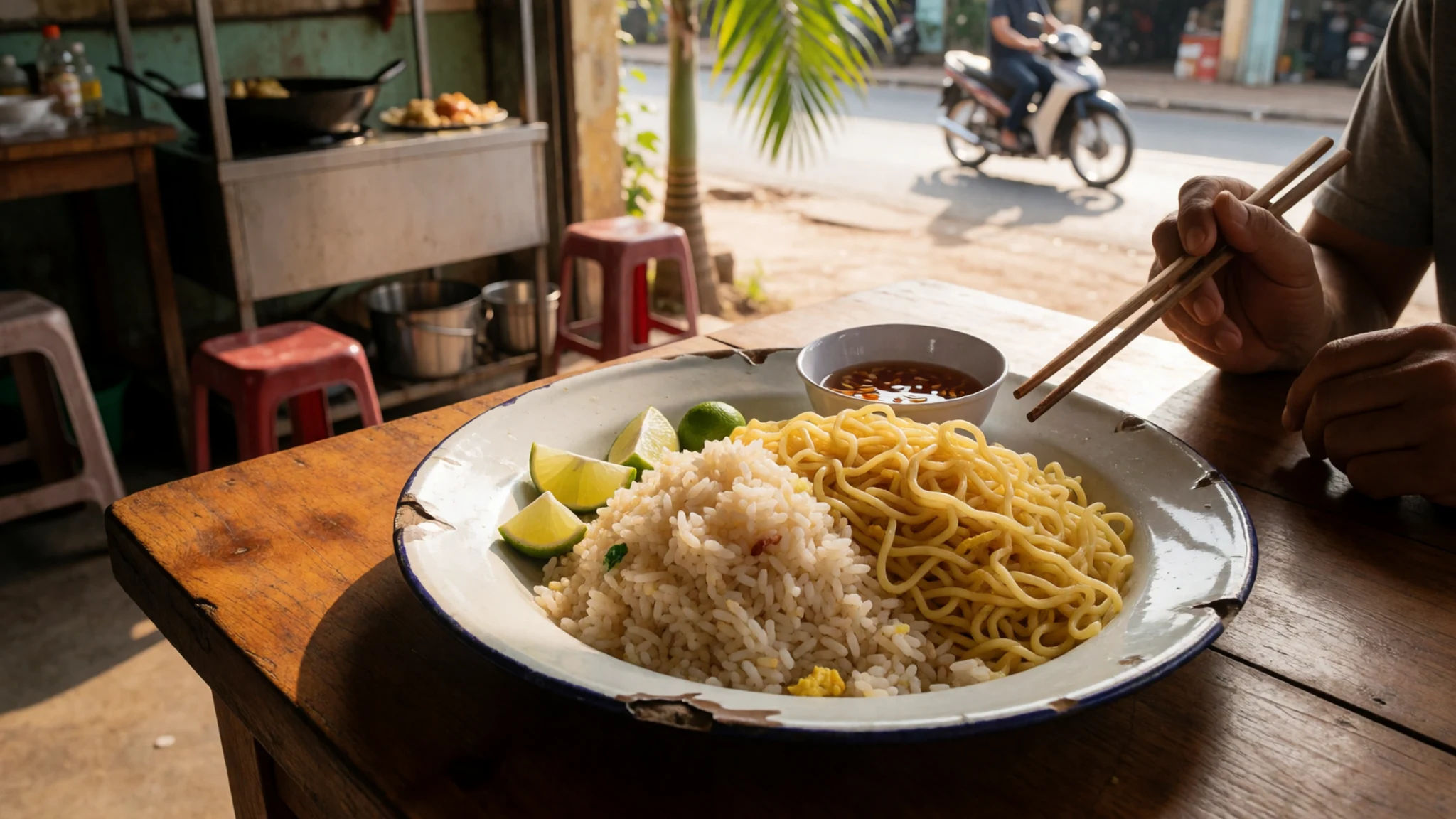
- Lok lak — Local eateries and night-market stalls in Siem Reap
Stir-fried beef in a peppery sauce, served on lettuce and tomato with a dipping mix of lime juice and black pepper. Cambodians favour pepper over chilli, so it is more savoury than fiery, and a safe first dish.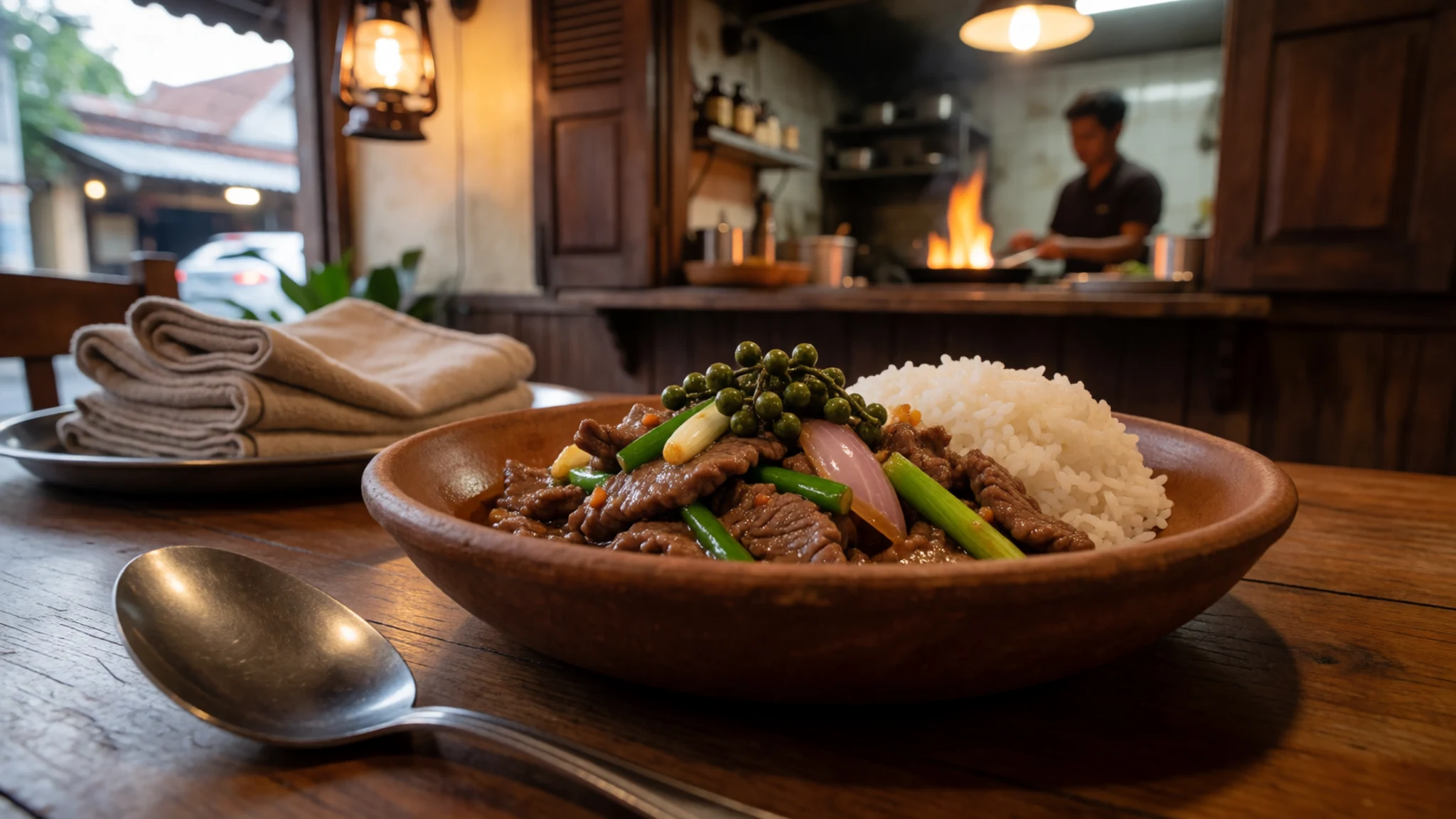
- Kuy teav — Morning market stalls and roadside noodle shops
A breakfast noodle soup of rice noodles in a clear pork or beef broth, topped with herbs, fried garlic and often sliced meat. Chillies and lime are added at the table, so you can adjust the taste to suit yourself. - Bai sach chrouk — Street stalls and morning markets in towns and villages
Grilled marinated pork served over broken rice with pickled vegetables and a little broth on the side. It is a classic, filling morning meal, cheap and quick, and often eaten at a simple roadside counter before the day gets hot. - Prahok dishes — Village eateries and market stalls around Siem Reap
Prahok is a fermented fish paste at the heart of Khmer cooking, giving depth and a strong smell to dips and soups. It may not suit every palate at first, but one small taste with fresh vegetables shows why it matters.
Plan it
Best time. November to February is the cooler, drier stretch and the most comfortable for the forest climb. March to May is very hot, and the rainy season brings muddy, slippery trails, though the river runs fuller.
How long. 1
Getting there. Fly to Siem Reap, then travel by taxi, tuk-tuk or hired driver towards Banteay Srei and on to the Kbal Spean car park, where a forest path leads up to the river. It is often combined with a day of temples.
Budget. mid
Tips
- Start early, as the climb is cooler and the site quieter in the morning
- Carry plenty of water and wear shoes with grip
- Check the official Angkor ticket rules and opening times before you go
- Bring cash for small purchases near the car park
- Use insect repellent and a hat in the forest
Etiquette
- Ask before photographing people
- Dress modestly, covering shoulders and knees
- Keep voices low and avoid walking on carvings
Nearby
Sources
- Wikidata Q1092603 (CC0)
- Wikipedia: Kbal Spean (rev 1367123993) (CC BY-SA 4.0)
- Wikivoyage: Cambodia (rev 5395048) (CC BY-SA 4.0)
- Photo: Prerit, KbalSpean.jpg (CC BY-SA 2.0)
- Photo: Pierre André, Kbal Spean (12) (CC BY-SA 1.0)
- Photo: BluesyPete, LingamCambodge1 (CC BY-SA 2.5)
- Photo: BluesyPete, LingamCambodge2 (CC BY 3.0)
- Photo: Jean-Pierre Dalbéra, La rivière aux mille Linga (CC BY 2.5)
- Photo: Photo Dharma, 020 Brahma (CC BY 2.5)
- Photo: Photo Dharma, 007 Lingas (CC BY 2.5)
- Photo: Photo Dharma, 016 Unidentified Face (CC BY 2.5)


