Kampot
Kampot, Cambodia
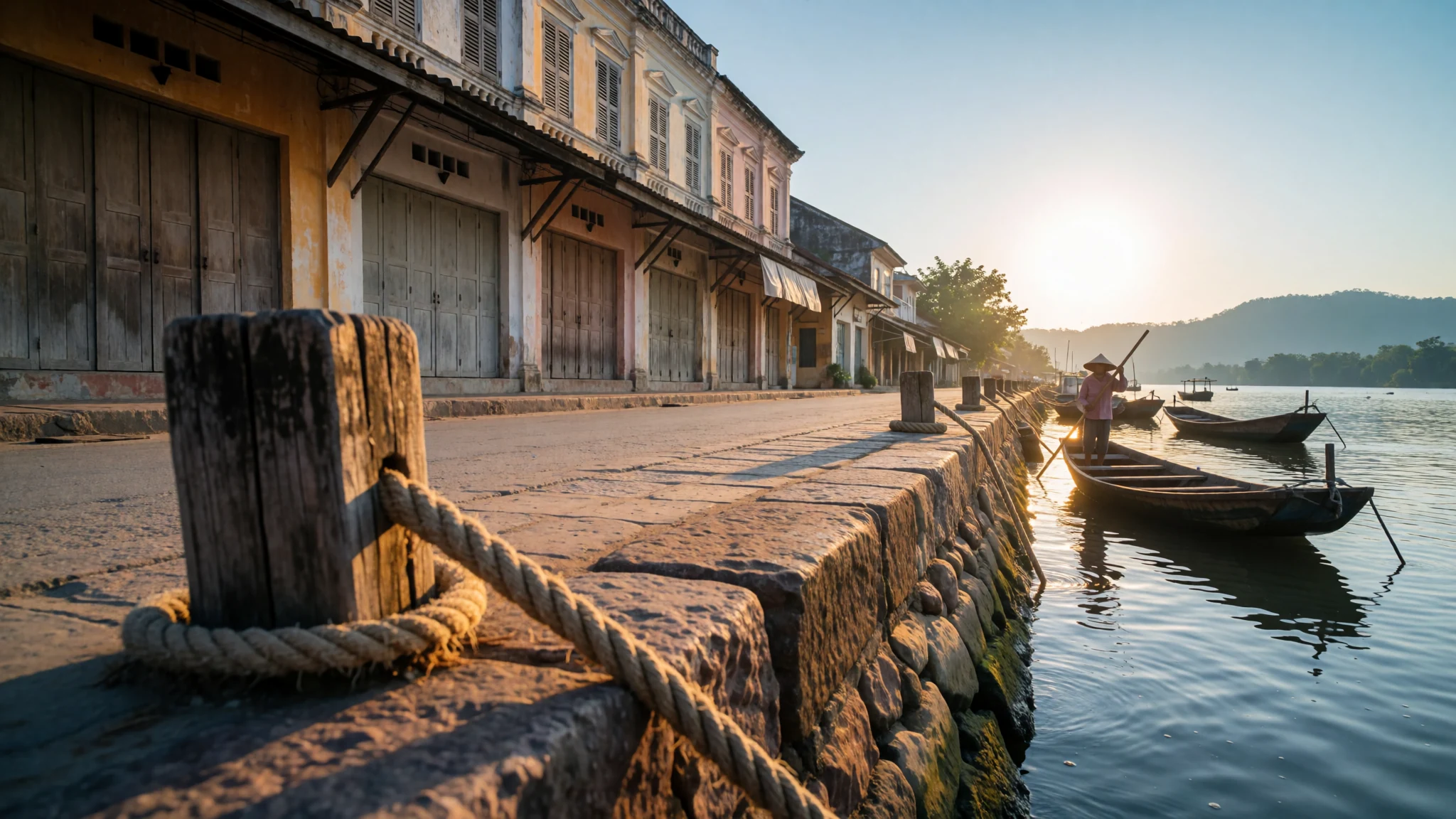
A riverside town of colonial-era façades, pepper farms and slow afternoons on the Kampot River, best enjoyed away from the rainy months.
The place
Kampot is a town in southern Cambodia and the capital of Kampot province. Kampot lies on the Praek Tuek Chhu River, roughly 5 kilometres (3 miles) inland from the Gulf of Thailand. Unlike most Cambodian provincial capitals, its centre still shows 19th-century French colonial architecture, with tall plain façades and shuttered shopfronts along the streets. The town has around 39,000 people, and most of them live a short walk back from the water.
The river is what draws most visitors. Guesthouses, cafés and tour operators cluster along the riverside promenade or a block or two behind it, and the pace stays unhurried even at midday. From the water, fishing boats, stilt houses and the hills of Bokor National Park rising inland make a calm backdrop. Several landmarks mark the riverfront: an old bridge pieced together from mismatched parts after it was damaged in the Khmer Rouge years, and an old market hall, a French-era structure that is undergoing repairs.
Back from the river, the town is organised around a roundabout with a large sculpture of a durian, the spiky fruit that locals love. The surrounding country is known for its pepper, grown on farms nearby and sold far beyond the province, along with sea salt and fish sauce. Kampot is not a place of big-ticket sights. It rewards slow mornings, a boat trip, a farm visit and a long lunch.
Its story
Kampot first appears in the Cambodian royal chronicles through events of 1771 to 1775. In 1771 King Taksin of Siam attacked Hà Tiên, on the Vietnamese coast, and then marched on the Cambodian capital at Oudong. The years that followed were a tangle of rival claims. The young prince who would become Ang Non II gathered Siamese soldiers at Kampot and used the town as a base until he took the throne in 1775.
In 1841 a Cambodian governor named Oknha Mau rejected a Vietnamese authority that had gradually tightened its hold over the town. Backed by Siam, he raised a force of about 3,000 men, and the Vietnamese withdrew to Hà Tiên. Kampot's commercial peak followed under King Ang Duong. After he came to the throne in 1840, he built a road from Oudong to the coast and made Kampot the country's only international seaport. Merchants from Singapore, many of them Anglo-Chinese traders, moved goods through the port so quickly that one neighbourhood became known as "Chinese Kampot". A French missionary founded the town's first Catholic church during these years, and the explorer Henri Mouhot visited.
The French era came next. Cambodia became a French protectorate in 1863, and Kampot served as the seat of a French residency. Its role as a port later declined as Sihanoukville developed, which is part of why the older streets still feel rooted in the colonial period. The Khmer Rouge years left their mark on the bridge and on much else, and the town's recovery since then has been shaped by pepper, salt and a slow growth in tourism.
What to see
- Bokor Mountain — the hills inland, reached by road and river
The French built a hill station on Bokor Mountain, and the shell of its church still stands in the upland forest. The surrounding Bokor National Park is under pressure from a large hotel development, so visitors should check current conditions and access before setting out. The eerie, quiet atmosphere is the main draw, and the forest air is cooler than the town below.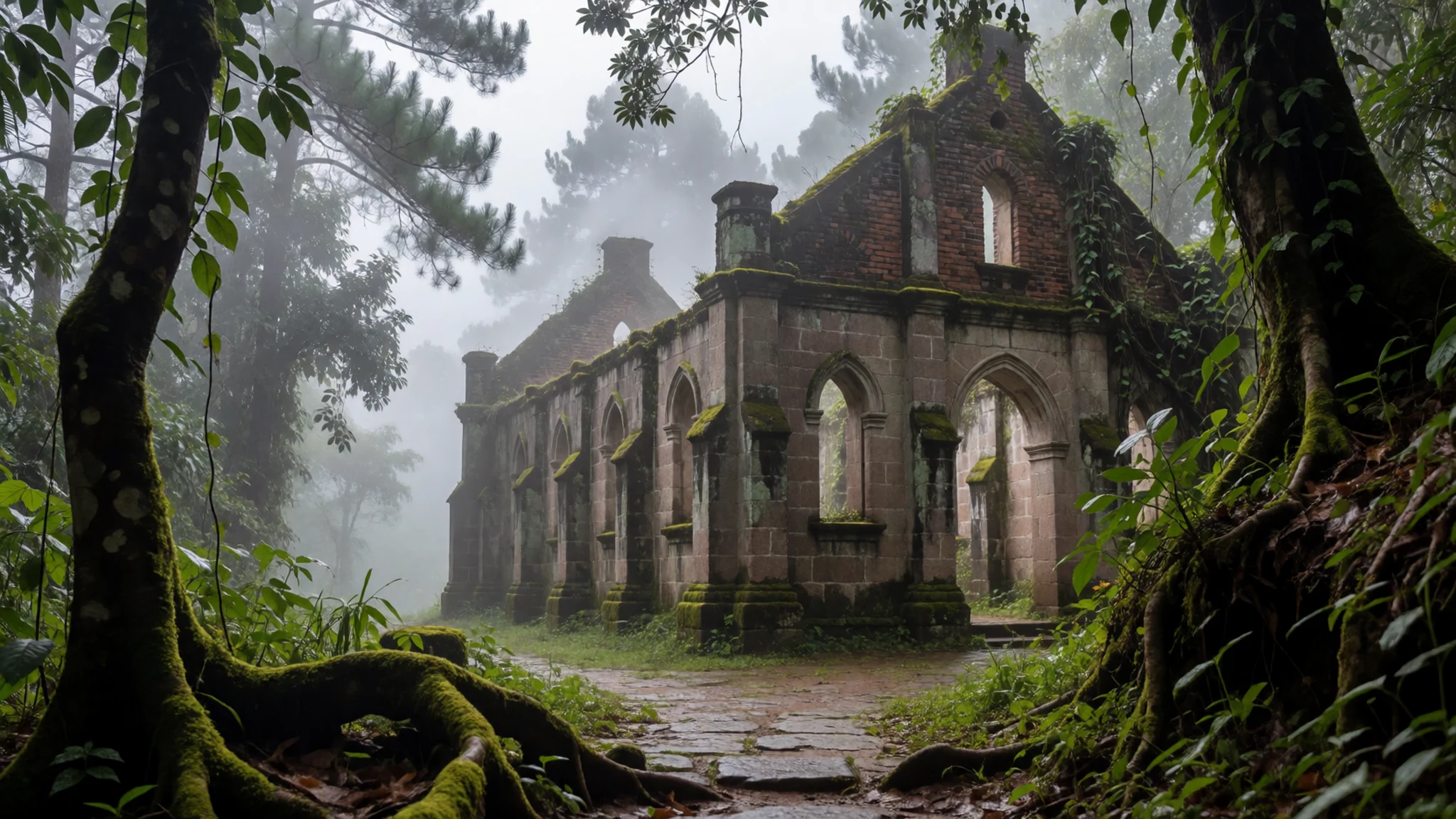
- Kampot River boat trips — the riverside promenade, where boats are hired
A traditional longtail boat carries visitors upriver through the mangroves, where plants, birds and village life sit close together. Morning and evening cruises are the usual choice, and kayaks and daily boat hire are also available. A guesthouse or tour office can arrange the trip and agree the route in advance, which keeps the afternoon relaxed.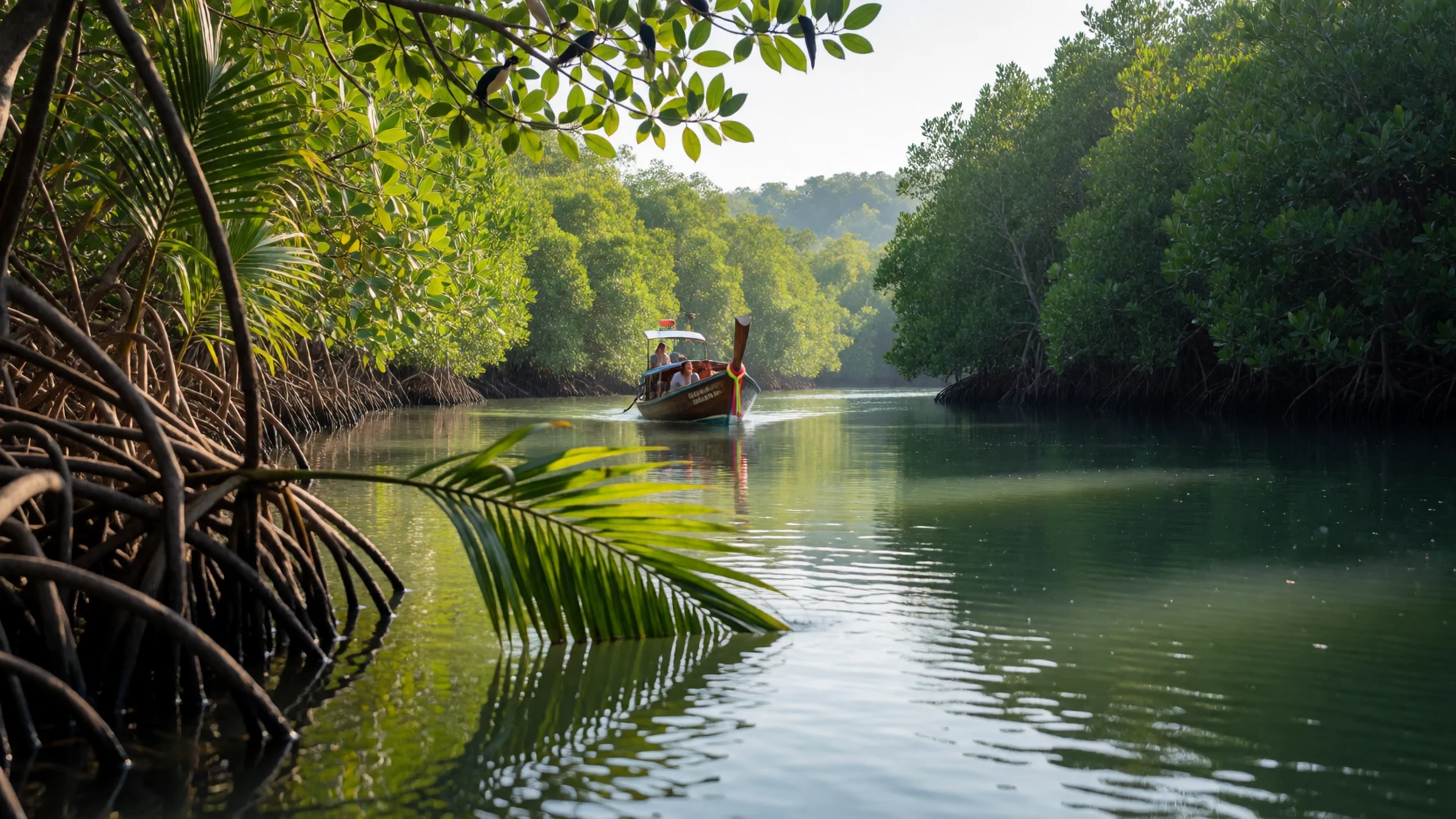
- Pepper farms — the countryside around the town
Pepper farms around Kampot can be visited on a guided tour, and town tour offices can arrange one. The Vine Retreat in Chamcar Bei village is one option, where visitors can see how the pepper is grown and processed. The harvest season changes how the plants look, so ask when you book what will be visible on the day.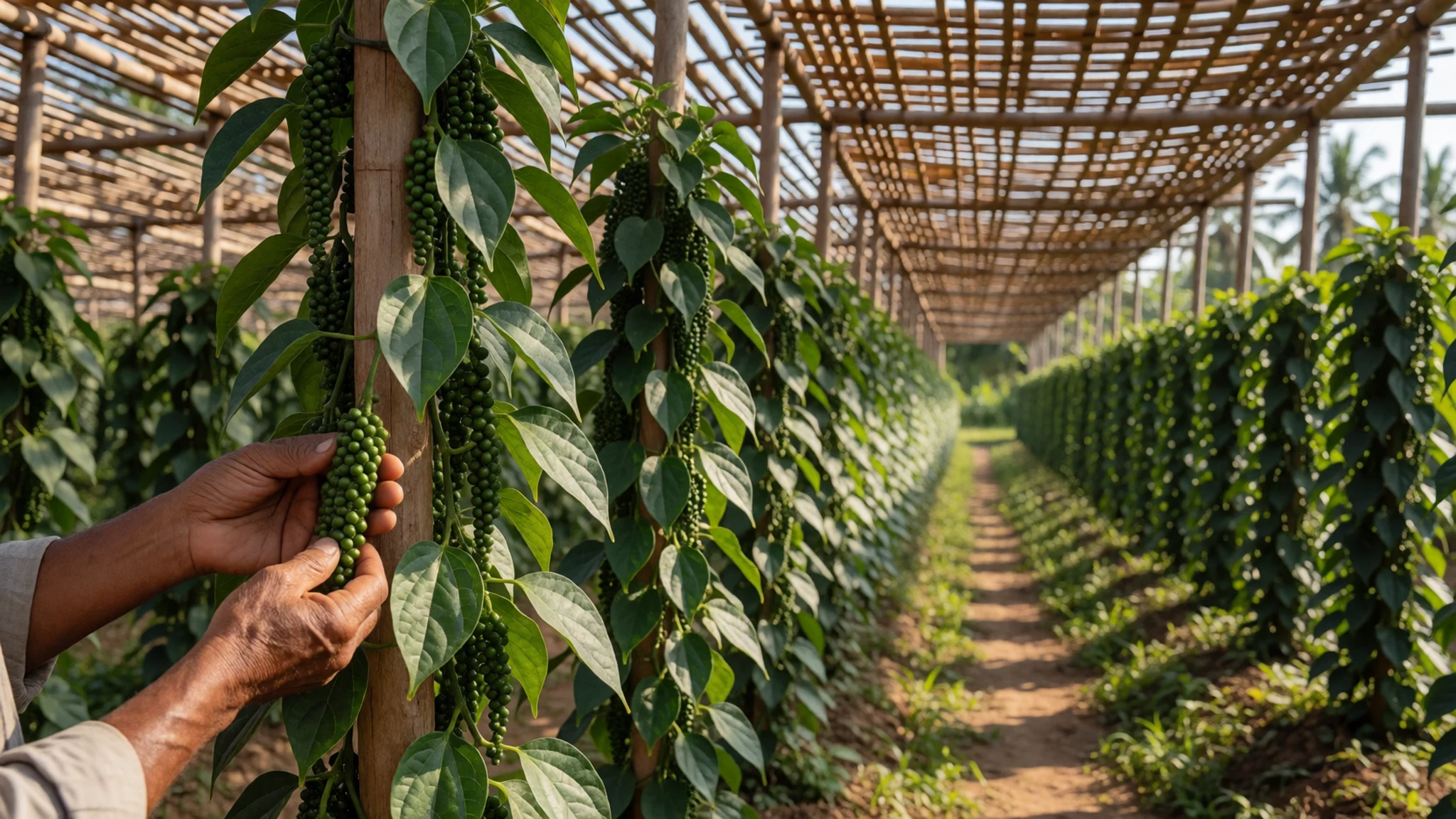
- Durian plantations — the road towards Teuk Chhou
Durian farms line the road to the Teuk Chhou Rapids. A tuk-tuk driver may not understand the request at first, so a tour office or travel agent is the easiest way to arrange a farm visit. The fruit is seasonal, and the trees look most rewarding when the roadside stalls are busy with fresh husks.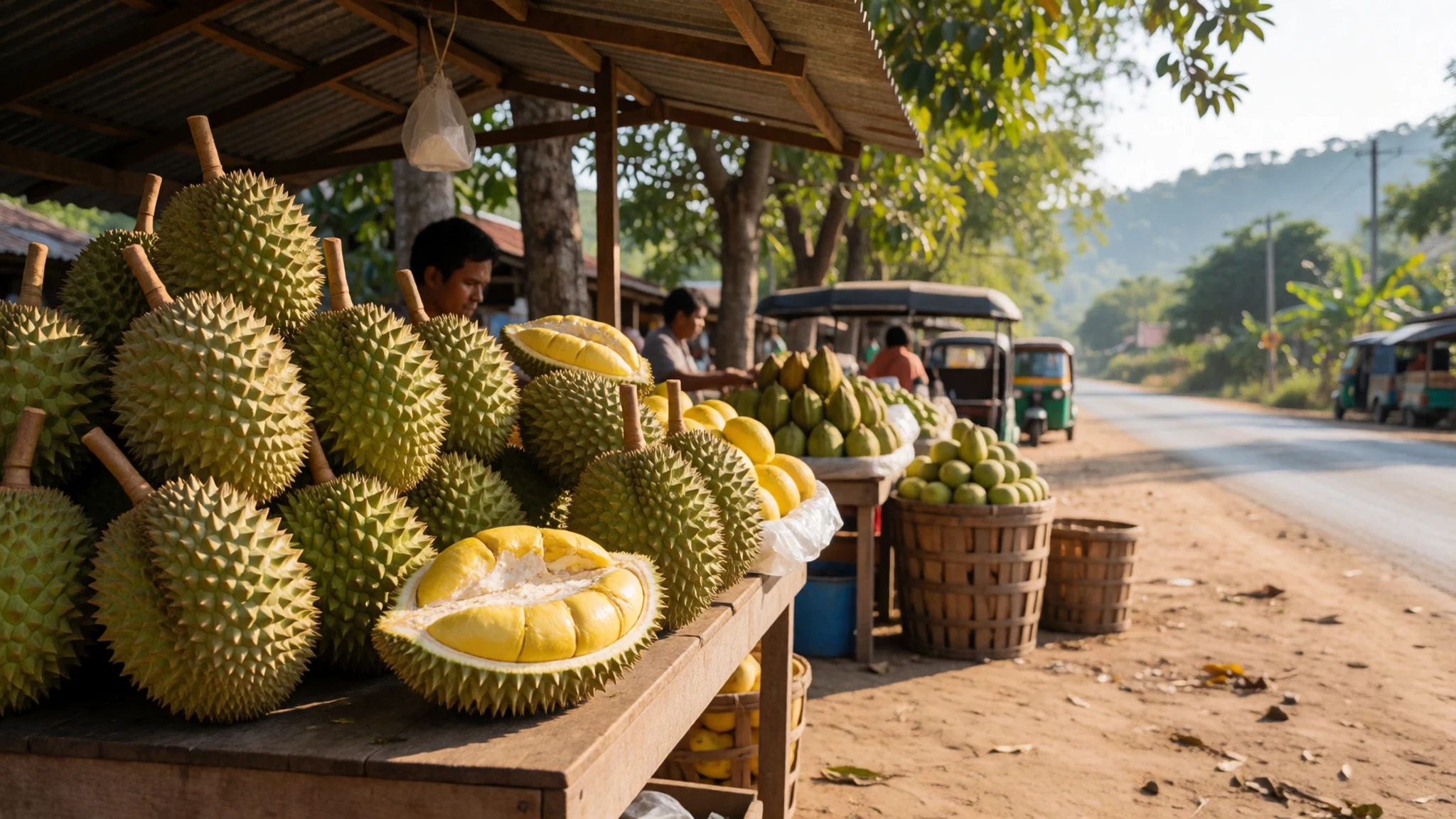
- Phnom Chhnork — the paddy fields to the north of town
A pleasant ride through paddy fields and village life leads to Phnom Chhnork, a set of caves with pre-Angkorian shrines from the Funan period. The caves are cool and dim, so a torch is useful. A half-day trip suits most visitors, and a local guide can explain the old religious sites and the stories people tell about them.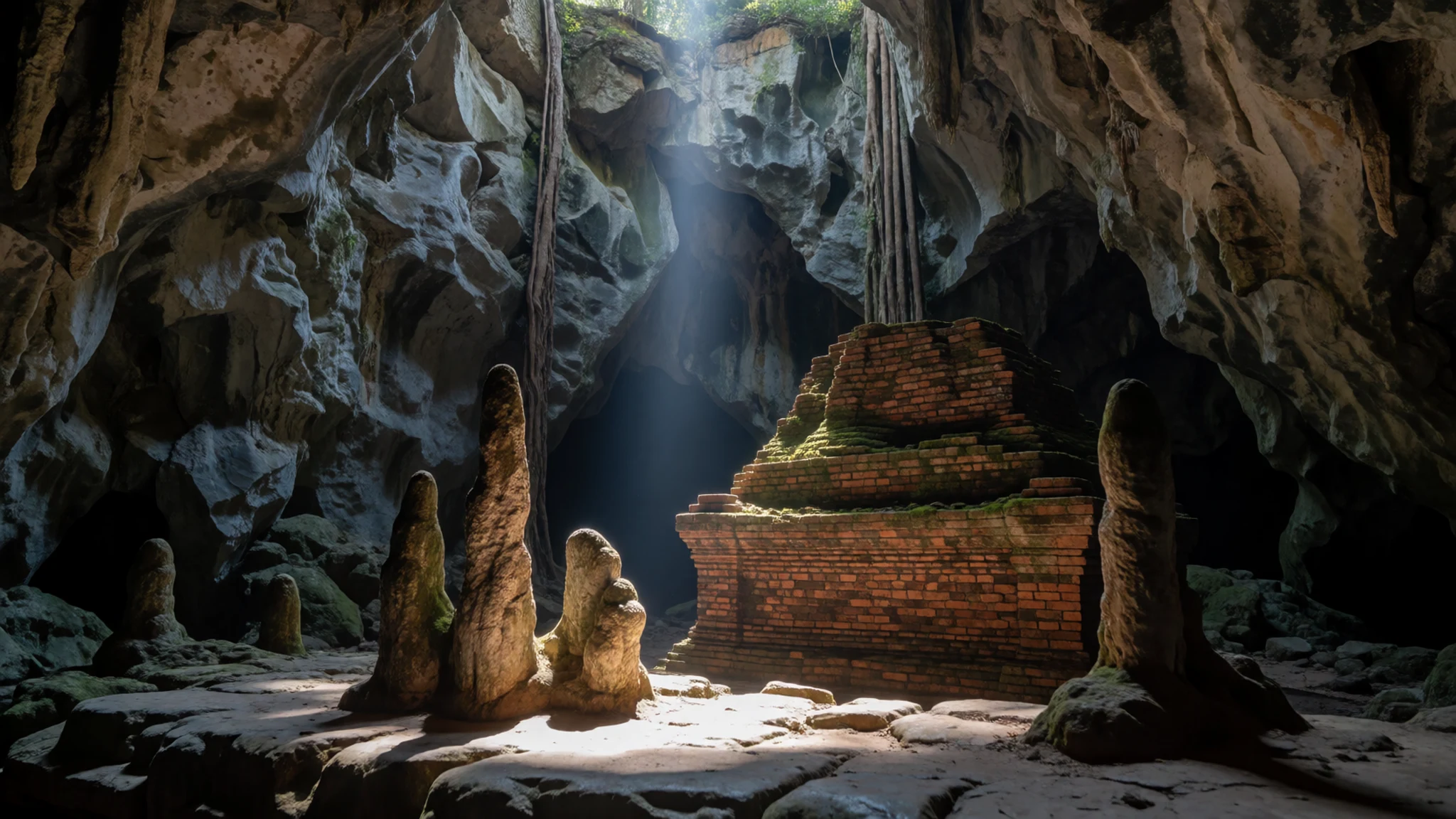
- Teuk Chhou rapids — upriver from the town, on the Praek Tuek Chhu
The rapids at Teuk Chhou have simple eateries, a small island and stretches of calm water for swimming and tubing. Vendors sell fruit, coffee and bottled water along the bank, so the place works well as a relaxed afternoon. Keep clear of the faster water, and take all rubbish away when leaving.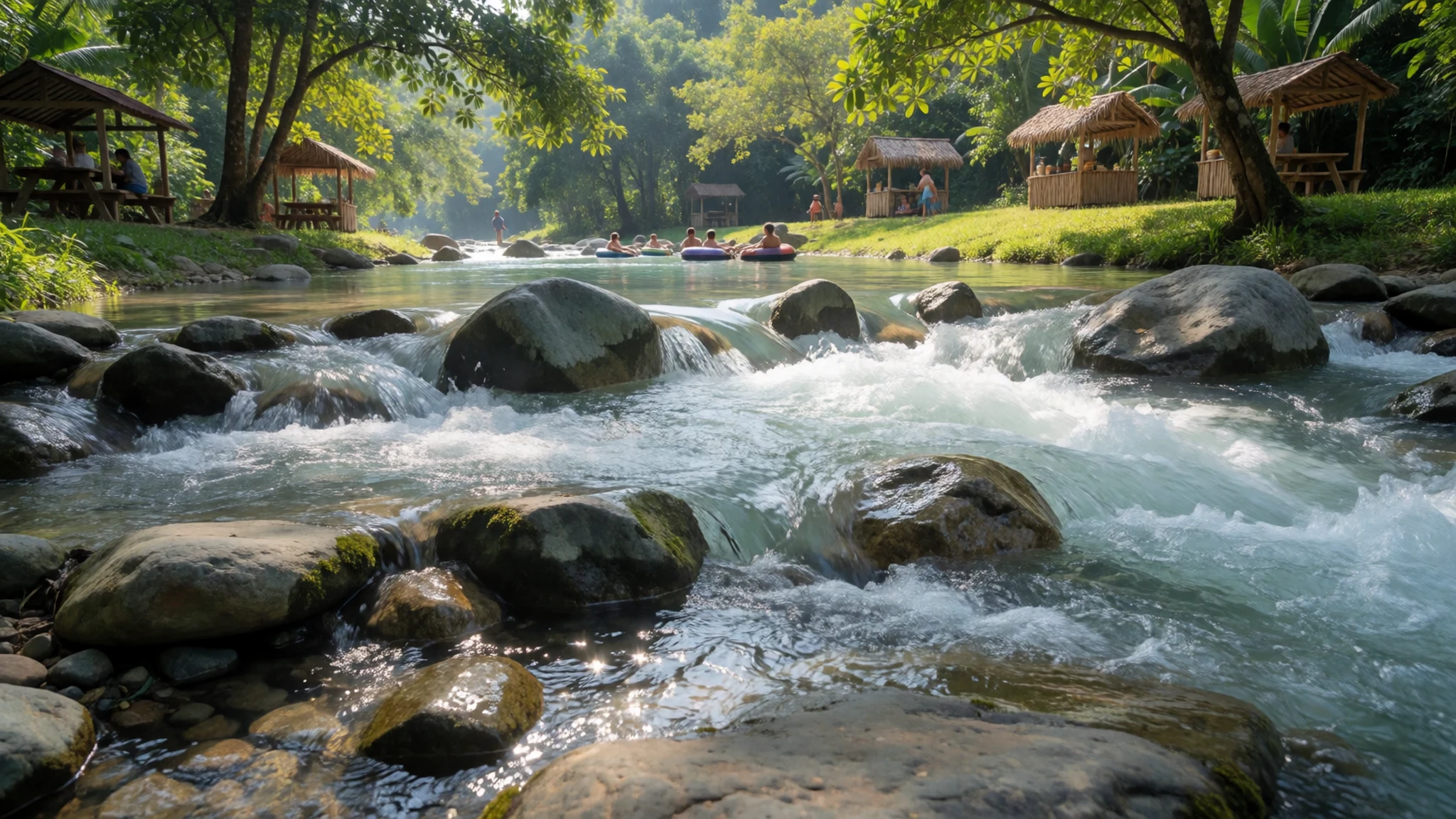
Culture
Kampot is a Buddhist town, and its pagodas and shrines are places of daily worship rather than backdrops for photographs. Locals greet monks and elders with a slight bow and a respectful tone, and voices are kept low inside temple compounds. Public affection is kept discreet, and modest dress is appreciated across town, especially away from the riverside bars. Photographing people is best done with a friendly gesture first, since many families would rather not appear in pictures without being asked. Bargaining is normal at markets and with tuk-tuk drivers, but it should stay good-humoured. Tipping is appreciated rather than expected, and a small amount for a guide or driver is welcome. Queues are informal, so stand close to the counter and bear with the pace of service in small eateries, where a single family often runs the kitchen. At pagodas, cover your shoulders and knees and take off your shoes before stepping onto a raised floor.
What to wear
Kampot's traditional dress is the sampot, a long wrap of woven cloth tied at the waist and worn by men and women across Cambodia, most often for ceremonies, temple days and weddings. Cambodian silk is traditionally woven on hand looms and patterned with fine stripes and checks, while the krama, a checked cotton scarf, serves as a headwrap, a sling and a sweat cloth. Everyday wear in town is far simpler: t-shirts, shorts, jeans and sarongs, with school uniforms for children and office clothes for those who work in the administrative centre. Motorbikes are common, so loose, comfortable clothing suits the heat and dust. For visitors, the climate calls for light cotton or linen, with a layer for air-conditioned buses and cooler evenings. Modest clothing is expected at pagodas and shrines, meaning covered shoulders and knees, and trousers or a skirt below the knee. Sturdy closed shoes suit the dusty roads and the Bokor hills, while sandals are fine on the riverside. A light waterproof helps in the wetter months.
What to eat
- Kampot pepper — pepper shops and seafood restaurants along the riverside
Pepper is the town's signature flavour. Fresh green peppercorns and the dried black and red types turn up in seafood dishes and sauces, and small shops sell it by the bag. Black, green and red varieties differ in heat and aroma, so a tasting at a farm or shop is worth the time.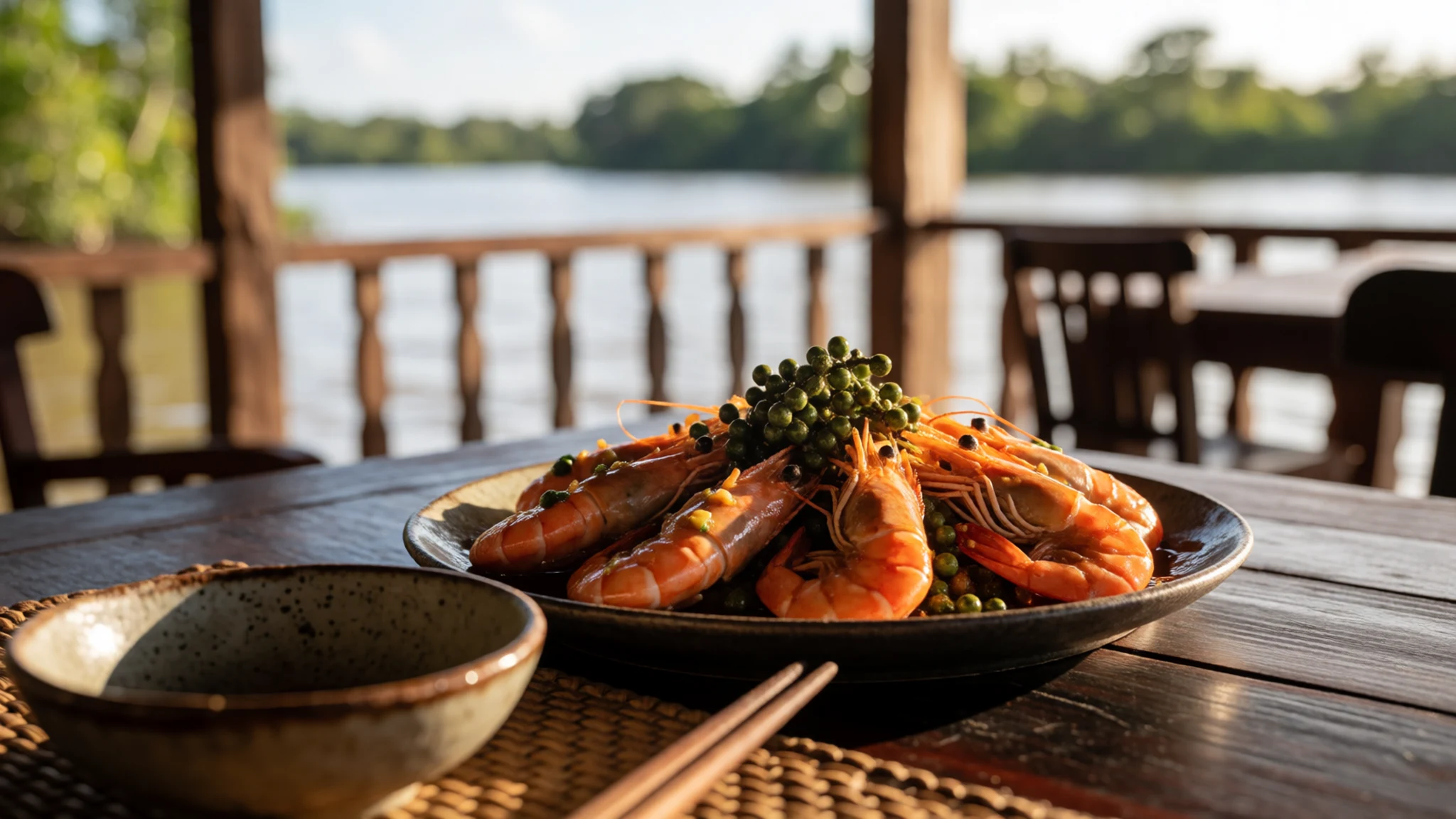
- Durian — roadside fruit stalls around the durian roundabout
Durian is the fruit the roundabout statue celebrates. In season, roadside stalls pile up the spiky fruit, and sellers will open a husk so buyers can judge the custard inside. Its smell is strong, so many guesthouses ask for it to be eaten outdoors.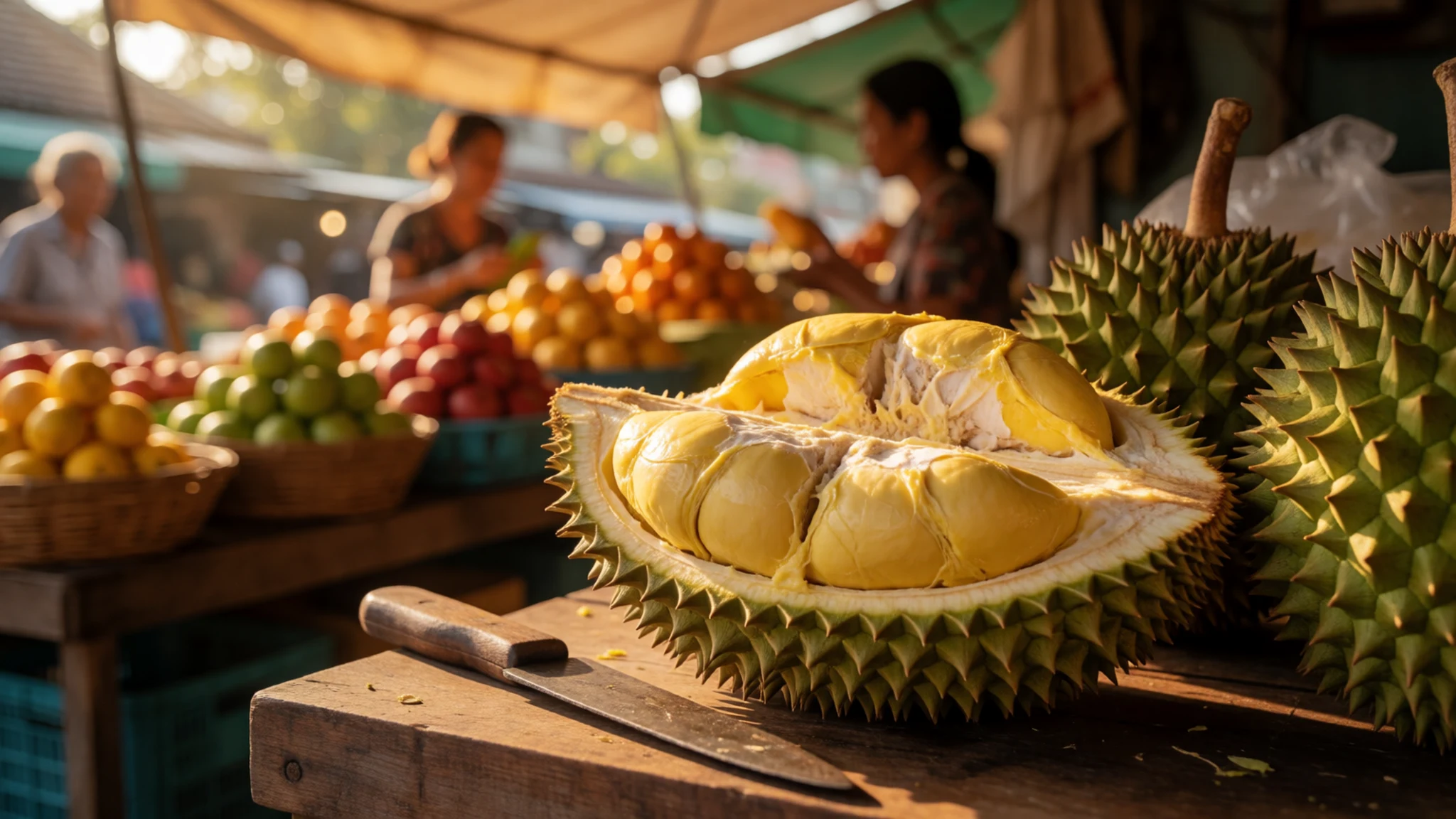
- Khmer riverside dishes — Samon's Village, a riverside garden restaurant
Samon's Village serves a wide range of Khmer dishes in a garden on the river. Expect meals built around rice, herbs, fish and a balance of sour, salty and sweet flavours. Fish sauce, sea salt and lime give many of the dishes their character, and the garden setting suits a long lunch. - Turkish kebabs — a casual eatery in town
Pita Pita is run by Turkish owners and serves good grilled kebabs, a welcome change after a few days of rice-based meals. The meat arrives with flatbread and salad, and portions are generous. It works well as a casual evening meal after a day on the water. - Pasta and pizza from a roadside stall — a roadside stall in town
Secret Italian is a small brick stall at the roadside, run by an Italian cook who makes pasta and pizza with care. The food is the main draw, and a simple dinner here pairs well with an evening walk along the river.
Plan it
Best time. December to February is the cool, dry stretch and the most comfortable time to visit, when rain is lightest. April and May are the hottest months, with highs near 37 C, and the wetter months from about May to October bring heavy showers and higher river levels, peaking in September.
How long. 2–3
Getting there. Buses from Phnom Penh, about 148 km away, take roughly 2½ to 5 hours depending on traffic and road conditions. Most operators end at the central Kampot bus station, a short walk from the guesthouse streets. From Ha Tien in Vietnam, minibuses cross the land border at Prek Chak, and the crossing involves on-foot transfers between vehicles.
Budget. low
Tips
- Check the operators' current timetables before travelling, because departure times change between seasons.
- Plan river and farm visits for early morning or late afternoon, when the light is good and the heat is lower.
- Carry cash for small eateries, markets and tuk-tuk drivers, as cards are less common outside larger businesses.
- Bring water and sun protection for the farms and rapids, where shade is limited.
- Book pepper farm tours and boat trips through a guesthouse or tour office, since guided visits are easy to arrange. The official website is kampot.gov.kh.
Etiquette
- Dress modestly when visiting pagodas, covering shoulders and knees.
- Ask before photographing people, especially at family homes or ceremonies.
- Take rubbish away from the rapids and the island at Teuk Chhou.
Nearby
Sources
- Wikidata Q876549 (CC0)
- Wikipedia, Kampot (rev 1381263845) (CC BY-SA 4.0)
- Wikivoyage, Kampot (rev 5406216) (CC BY-SA 4.0)
- Photo: Street in Kampot in Cambodia, Hans A. Rosbach (CC BY 3.0)
- Photo: Building with shops, Kampot, Cambodia, Marcin Konsek (CC BY-SA 4.0)
- Photo: Durian Roundabout, Kampot, Cambodia, Marcin Konsek (CC BY-SA 4.0)
- Photo: Governmental building in Kampot, Cambodia, Hans A. Rosbach (CC BY 3.0)
- Photo: Fishing boats on the Kampot River, Bolt9 (CC BY 3.0)
- Photo: Street in Kampot, Bùi Thụy Đào Nguyên (CC BY 3.0)
- Photo: View of Bokor Mountain from Khum Traeuy Kaoh, SovanDara (CC BY 3.0)
- Photo: Durian Roundabout sculpture, Rik Schuiling / TropCrop-TCS (CC BY-SA 4.0)


