Banteay Srei
Banteay Srei, Cambodia
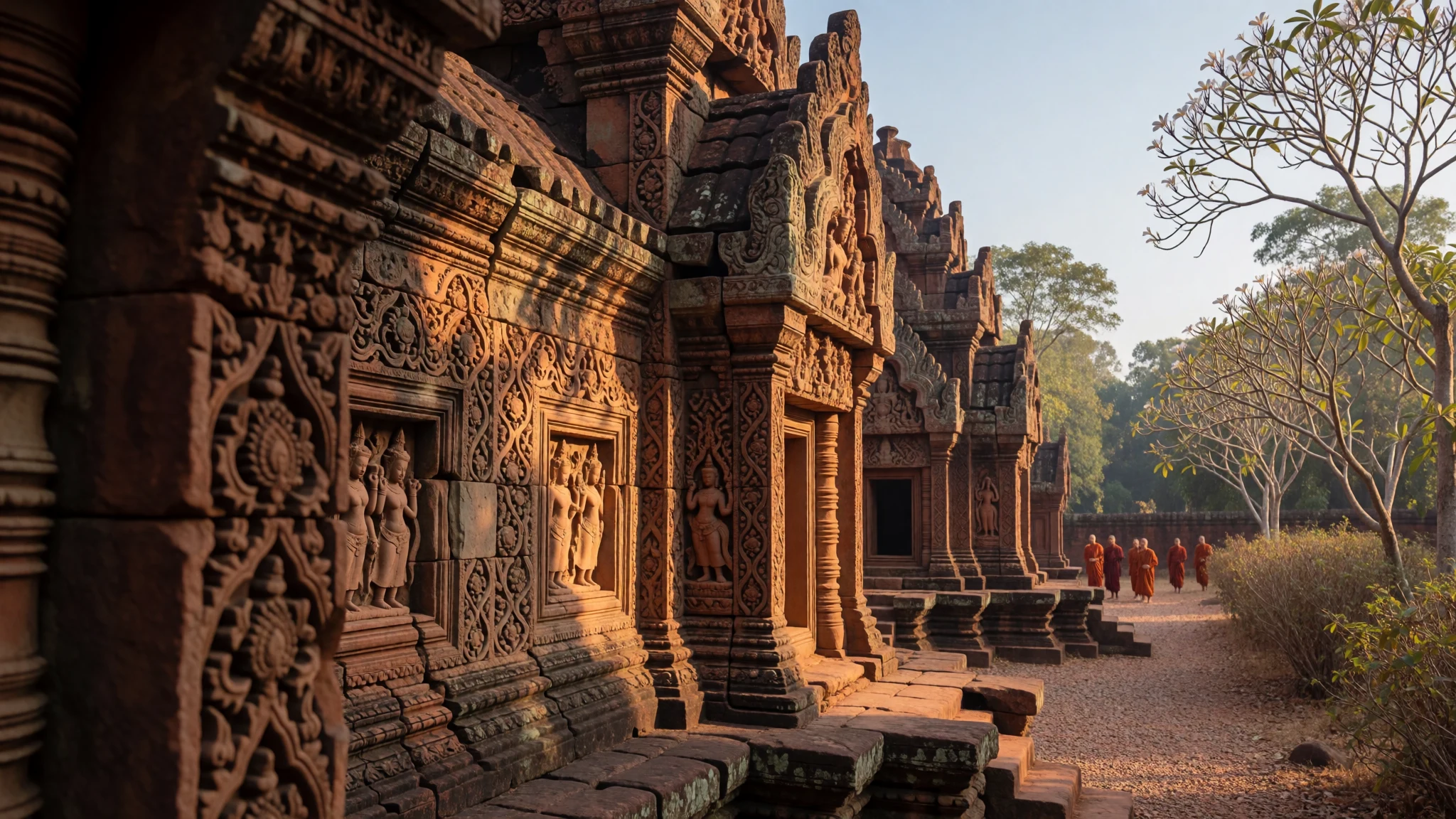
Visit Banteay Srei to admire the finest miniature red sandstone carvings of the ancient Khmer empire, tucked away north of the main Angkor ruins.
The place
Banteay Srei is an exquisite ancient temple located in Cambodia, dedicated to the Hindu deities Shiva and Parvati. Positioned near the hill of Phnom Dei, it sits away from the main cluster of monuments that once formed the medieval capitals of Yaśodharapura and Angkor Thom. What sets Banteay Srei apart from its grander neighbours is its unusual construction material: a fine-grained, intensely red sandstone that lends itself to exceptionally crisp, deep decorative wall carvings. When visitors approach the structures today, they immediately notice that everything is built on a remarkably small, almost miniature scale compared to the massive state temples of the region. Despite these modest dimensions, the quality of craftsmanship is astonishingly high, featuring layered floral motifs, mythical guardians, and divine figures that appear remarkably sharp after centuries of exposure. The surrounding area has evolved significantly, transitioning from quiet countryside tracks to a well-connected region anchored by the nearby tourist town of Siem Reap. Modern tarmac roads and paved walkways have replaced the old red dust paths, making the approach much smoother for travellers coming out from the town centre. Because of its unique aesthetic, the site has earned a reputation among travellers and scholars alike as a high point of Khmer artistic expression, drawing admirers from all over the world who make the journey north from the main archaeological park.
Its story
Banteay Srei holds a rare distinction in the Angkor region because it was not founded by a reigning monarch, but rather by senior courtiers and scholars. Consecrated in the year 967, its creation is credited to a scholar and philanthropist named Yajnavaraha, who served as a counsellor to King Rajendravarman II, alongside his co-founder Vishnukumara. According to historical stelae, Yajnavaraha was a respected intellectual who used his position to aid those suffering from poverty, illness, or injustice, and he later acted as a teacher to the future King Jayavarman V. At the time of its establishment, the temple was surrounded by a prosperous settlement known as Ishvarapura. Originally, the sanctuary was dedicated to the Hindu god Shiva and was given the Sanskrit name Tribhuvanamaheshvara, meaning the great lord of the threefold world, centered around a primary divine image. Architectural analysis shows a deliberate division across the central east-west axis, with shrines on the southern side devoted to Shiva and those on the northern side dedicated to Vishnu. Centuries later, during the eleventh century, the complex underwent further expansion and repair work under subsequent rulers. The modern name, Banteay Srei, translates from the local language as the citadel of women or the citadel of beauty, a moniker inspired by the delicacy of the miniature buildings and the abundance of graceful female devata figures carved into the rose-tinted stonework.
What to see
- Angkor National Museum — Siem Reap town centre
Angkor National Museum in Siem Reap provides a comprehensive introduction to the history, art, and religious architecture of the ancient Khmer Empire through extensive artifact galleries, multimedia presentations, and archaeological exhibits that help contextualise the temples visited in the wider archaeological park. - APOPO — Siem Reap outskirts
APOPO in Siem Reap runs an innovative visitor centre dedicated to humanitarian demining efforts, where travellers can learn about the specially trained African giant pouched rats used safely and efficiently to detect unexploded landmines left behind from Cambodia's turbulent past. - Angkor Botanical Garden — Near the royal gardens, Siem Reap
Angkor Botanical Garden in Siem Reap offers a tranquil green space featuring meticulously landscaped indigenous flora displays, shaded walking paths, a small family-friendly animal enclosure, and pleasant spots to rest alongside community recreational areas just outside the urban core. - Lotus Silk Farm — Puok district, Siem Reap
Lotus Silk Farm situated in Siem Reap province invites curious visitors on guided walkthroughs to observe the unique artisan process of extracting delicate fibres from lotus plant stems and spinning them into a rare, sustainable natural textile product. - Angkor Eye — National Road 6, Siem Reap
Angkor Eye in Siem Reap is a towering observation wheel that lifts passengers high above the surrounding countryside inside modern enclosed cabins, offering sweeping panoramic views across the urban canopy, nearby rural settlements, and distant horizon landmarks.
Culture
Banteay Srei and the surrounding Siem Reap region reflect a deeply traditional Cambodian society shaped by Theravada Buddhism and ancient Hindu heritage, where community life revolves around village festivals, temple ceremonies, and respectful interpersonal exchanges. Visitors will frequently encounter the traditional greeting known as the sampeah, where hands are pressed together near the chest in a gesture of polite respect. Local artisans preserve centuries-old techniques in weaving, stone carving, and silversmithing, passing these vocational skills down through families. Responsible tourism initiatives are active throughout the region, encouraging travellers to support ethical social enterprises and community-led conservation projects that directly benefit rural households. When exploring sacred spaces around Banteay Srei, visitors must dress respectfully by covering their shoulders and knees to honour local religious customs. Always remove your shoes before entering active monastery buildings or residential homes.
What to wear
Traditional Cambodian dress centres around the sampot, a versatile rectangle of cloth wrapped around the waist in various regional styles, often paired with patterned cotton or silk scarves known as kramas that serve multiple daily functions from sun protection to carrying goods. While traditional garments are reserved for formal celebrations, weddings, and religious ceremonies, everyday urban wear in nearby towns like Siem Reap is casual and practical due to the tropical climate, consisting of lightweight cotton shirts, breathable trousers, and sturdy sandals or walking shoes. Visitors heading to Banteay Srei and other archaeological sites should prioritise modesty and sun protection by wearing loose, lightweight clothing that covers both shoulders and knees to comply with cultural norms at sacred monuments. Bringing a wide-brimmed hat, sunglasses, and a light scarf will ensure comfort while navigating open-air temple courtyards under the strong sun.
What to eat
- Amok Trey — Local Khmer restaurants in Siem Reap
Amok Trey is Cambodia's signature dish featuring fresh river fish gently steamed in a banana leaf cup with a rich curry paste made from lemongrass, galangal, kaffir lime leaves, and rich coconut milk. Find it at traditional eateries across Siem Reap. - Bai Sach Chrouk — Morning food markets and roadside stalls in Siem Reap
Bai Sach Chrouk is a popular breakfast dish consisting of thinly sliced pork marinated in garlic and palm sugar, grilled over hot coals, and served over warm broken rice with pickled vegetables. Try it at morning street stalls around town. - Khmer Curry — Neighbourhood eateries in Siem Reap
Khmer Curry is a milder, more aromatic stew than its Thai counterparts, combining chicken, sweet potatoes, taro, and onions in a fragrant coconut broth flavoured with fresh herbs. Order this comforting dish at family-run cafes throughout the region. - Nom Banh Chok — Street vendors and local markets in Siem Reap
Nom Banh Chok features traditional fermented rice noodles topped with a greenish fish gravy made from pounded lemongrass and turmeric, garnished with fresh cucumber slices, edible flowers, and crisp water lily stems. Look for morning vendors serving bowls near local markets. - Cambodian Green Mango Salad — Cafes and local restaurants in Siem Reap
Cambodian Green Mango Salad combines crunchy unripe mango strips with crisp shallots, fresh herbs, roasted peanuts, dried shrimp, and a sharp lime-fish sauce dressing. Enjoy this refreshing plate at casual lunch spots across the town.
Plan it
Best time. December to February offers the most comfortable weather with lower humidity and minimal rainfall, making it ideal for exploring outdoor temples.
How long. 2–3
Getting there. Fly into Siem Reap, then take a tuk-tuk or private car north along paved roads for the 25 km journey out to Banteay Srei.
Budget. mid
Tips
- Set out early in the morning to beat the tour bus crowds and midday heat at the temple gates
- Wear breathable, modest clothing that covers your shoulders and knees for temple entry
- Carry small cash notes in local currency or US dollars for transport, drinks, and market stalls
- Hire an official licensed guide at the entrance to learn the intricate details of the stone carvings
Etiquette
- Always cover your shoulders and knees when visiting sacred temple structures
- Remove your shoes before entering any active shrine or residential home
Nearby
Sources
- Wikidata Q790099 (CC0)
- Wikipedia (rev 1376871306) (CC BY-SA 4.0)
- Wikivoyage (rev 5410537) (CC BY-SA 4.0)