Banteay Chhmar
Banteay Chhmar, Cambodia
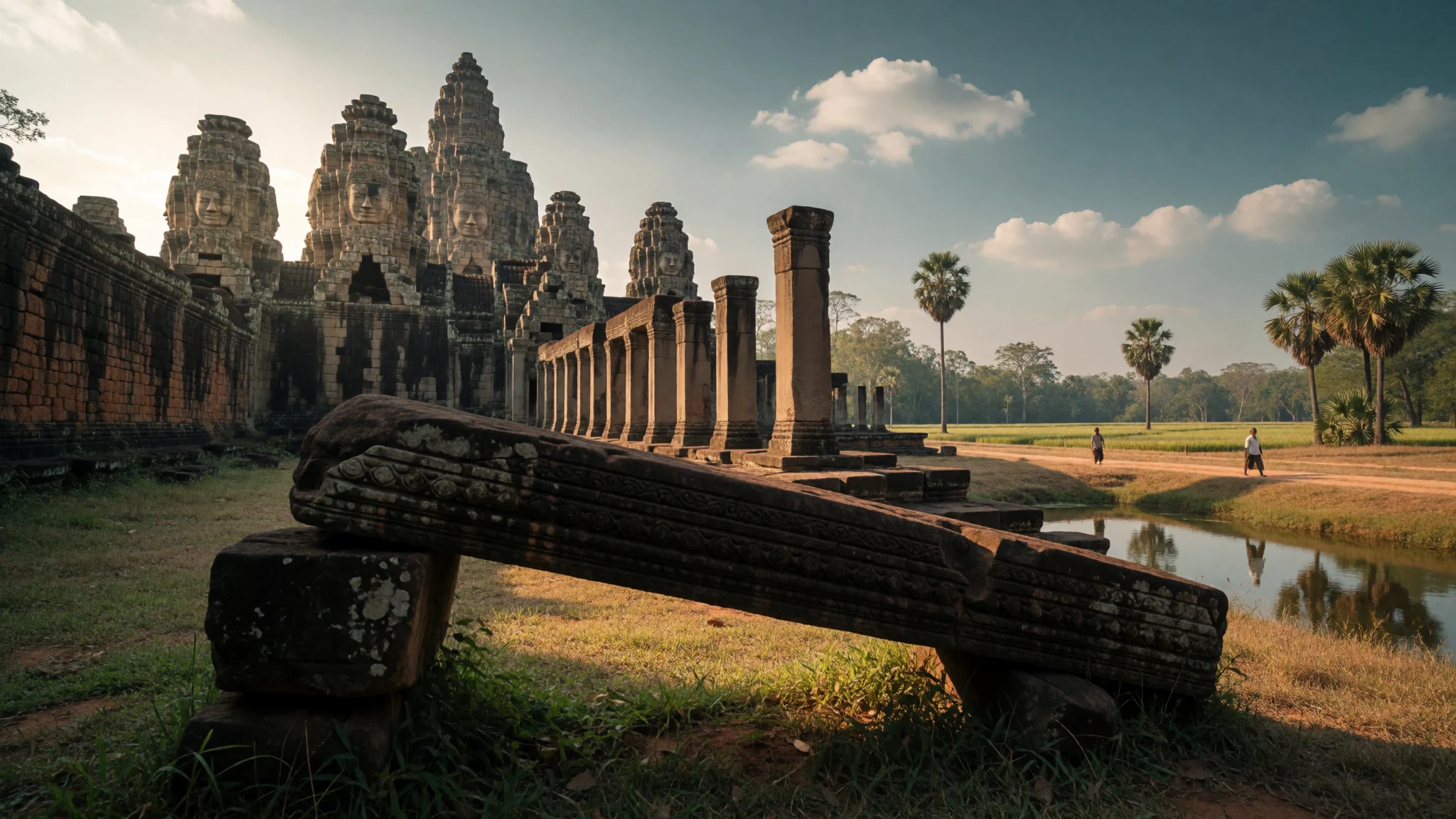
Banteay Chhmar holds face towers and long battle reliefs in a quiet corner of north-western Cambodia.
The place
Banteay Chhmar (បន្ទាយឆ្មារ) stands on the flat plain of north-western Cambodia, in Banteay Meanchey province, nearer the Thai border than the visitor circuits of Siem Reap. A living village presses against the old enclosure, so the ruins share a working landscape of houses, shade trees, rice fields and sugar palms. From outside, the complex reads as a low, wide citadel. A moat still traces much of the boundary. Laterite, the dark porous stone of this region, forms the long walls and galleries, while sandstone carries the faces, doorways and narrative reliefs. Many roofs have fallen, leaving corridors open to the sky and shaped blocks piled along the walls. Nested enclosures surround a central temple, with smaller shrines inside the circuit and satellite temples out in the fields. The artistic language is that of the Bayon: towers of calm faces turned toward the plain, and galleries cut as continuous picture-stories. Weathering, collapse and theft have broken those stories, yet enough remains to follow a narrative on foot. In the drier months the light is sharp and the paths are firm. In the hot months the stone throws heat by late morning, and through the rains the approach roads soften and the moat fills with weed and cloud. Birdsong carries farther than traffic, and the village goes about its day against the outer wall.
Its story
Banteay Chhmar belongs to the building programme of Jayavarman VII, the Khmer king whose temples turned toward Mahayana Buddhism. The ideas behind the Bayon at Angkor were carried to this north-western site: towers of faces, long reliefs of war and procession, and repeated images of Lokeshvara, the bodhisattva of compassion, with ranks of arms. The Khmer name is explained in more than one everyday way. Banteay means a fortress or citadel. Chhmar is heard either as the word for a cat, which local telling attaches to a legend, or as a word for something narrow. Neither reading is set out on a stone a visitor can check. The reliefs are the history the walls still hold. Soldiers, horses, elephants and boats move along the galleries in a campaign that scholars connect with war against Champa. Elsewhere the stone multiplies Lokeshvara, including a large figure whose arms fan around a calm face, the form the site photographs record as 32-armed. Isolation later made those walls easy to rob. Whole sections of relief were cut out and sold. Some pieces have come back; many gaps remain, so the battle reads as a sequence broken by missing blocks. Keeping what is left has been tied to the village: community guides walk the enclosures, and homestays lodge visitors in local houses, on the argument that a temple which employs its neighbours is harder to strip again. Banteay Chhmar is at once a Buddhist monument at the edge of the old kingdom and a test of whether a remote ruin can be kept by the people beside its moat.
What to see
- Face towers — Central temple, Banteay Chhmar
The face towers at Banteay Chhmar carry the calm, broad faces associated with the Bayon, set on the central temple and turned toward collapsed galleries. Sandstone features are worn soft, and several towers are broken at the shoulders, yet the expression stays readable: a half-smile, lowered lids, a level gaze. They tie this complex to the state art of Jayavarman VII.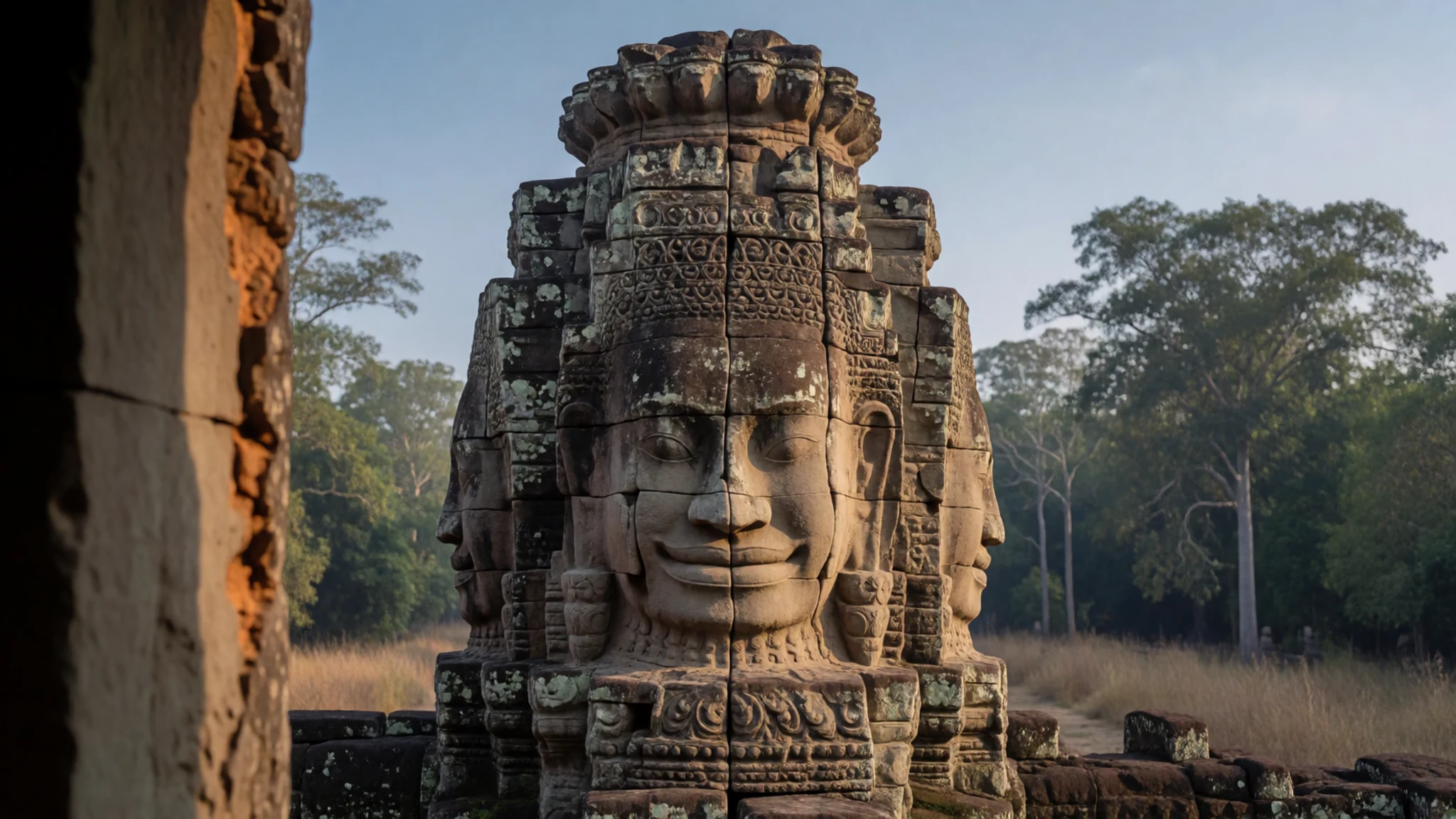
- Battle reliefs — Outer galleries, Banteay Chhmar
The outer galleries at Banteay Chhmar were carved as a continuous campaign: ranks of soldiers, horses, elephants and boats in a fight that scholars read as war with Champa. Much of the frieze is damaged, and some panels were cut away when the site was stripped for the art market. What remains is still a sequence, read by walking, with each missing block a hole in the plot.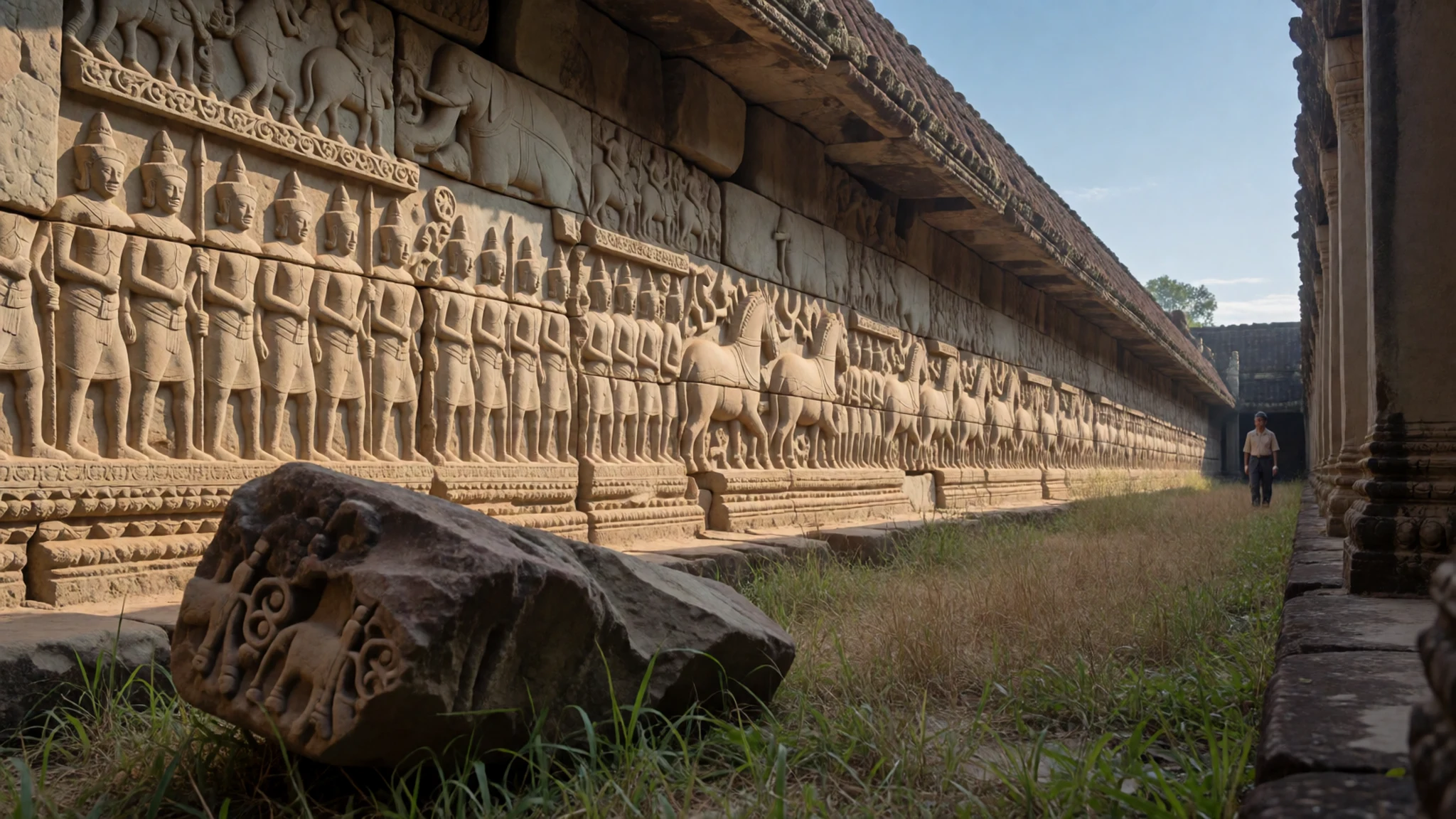
- Multi-armed Lokeshvara — Gallery walls, Banteay Chhmar
Lokeshvara, the bodhisattva of compassion, is repeated across the walls of Banteay Chhmar. One large figure spreads many arms around a still, frontal face, the form the site photographs record as 32-armed. Smaller attendants fill the field, so the panel reads as an ordered crowd rather than a lone portrait. Several of these reliefs are broken at the edges.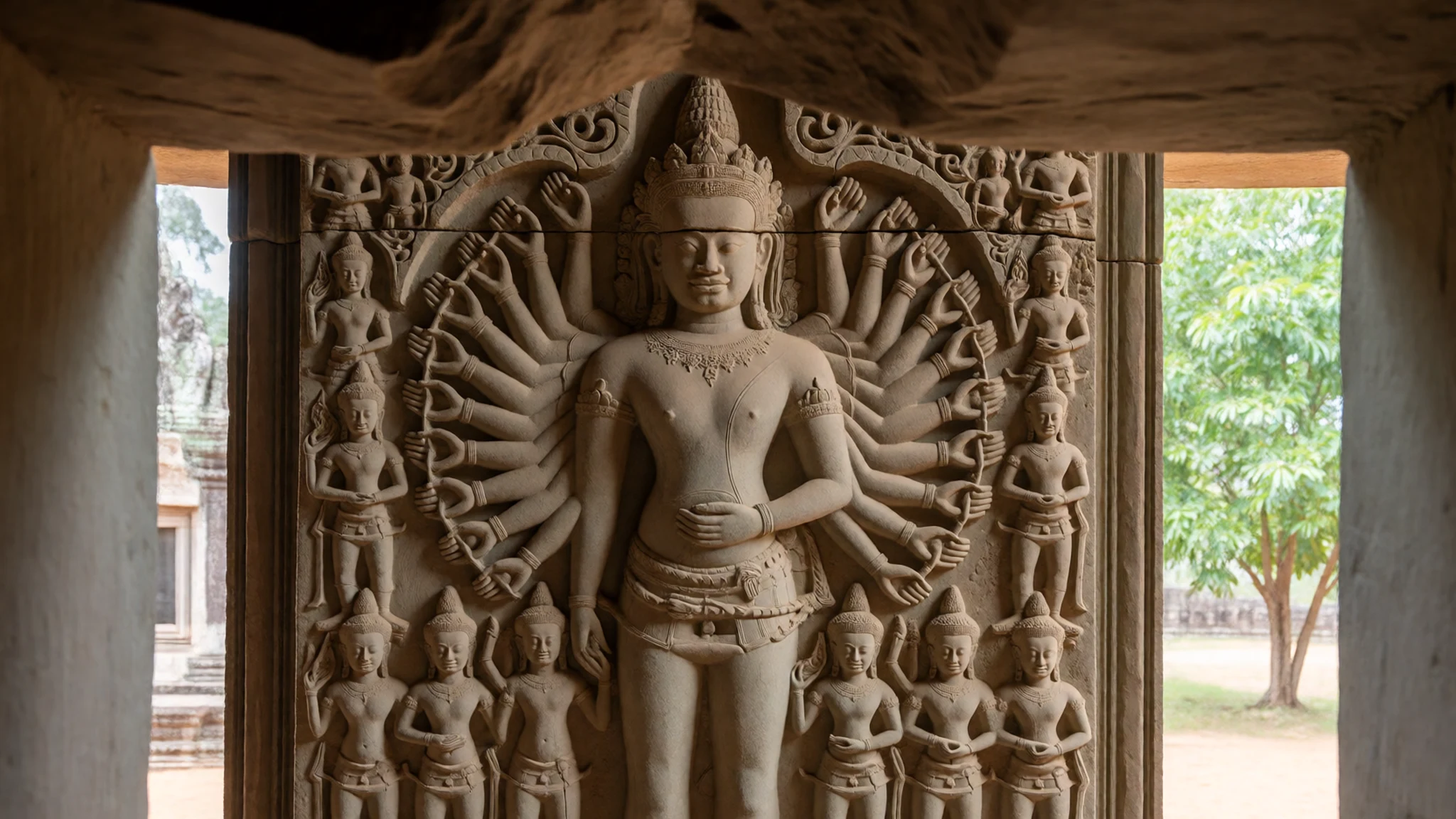
- Temple entrance — Main gate, Banteay Chhmar village
The entrance to Banteay Chhmar is a gap in a long laterite wall, more a gate than a triumphal arch, with the moat and the village immediately outside. Passage through it quiets the road and opens a wide interior of grass, fallen stone and gallery walls. There is no dense forest over the ruins, so the sky stays part of the architecture.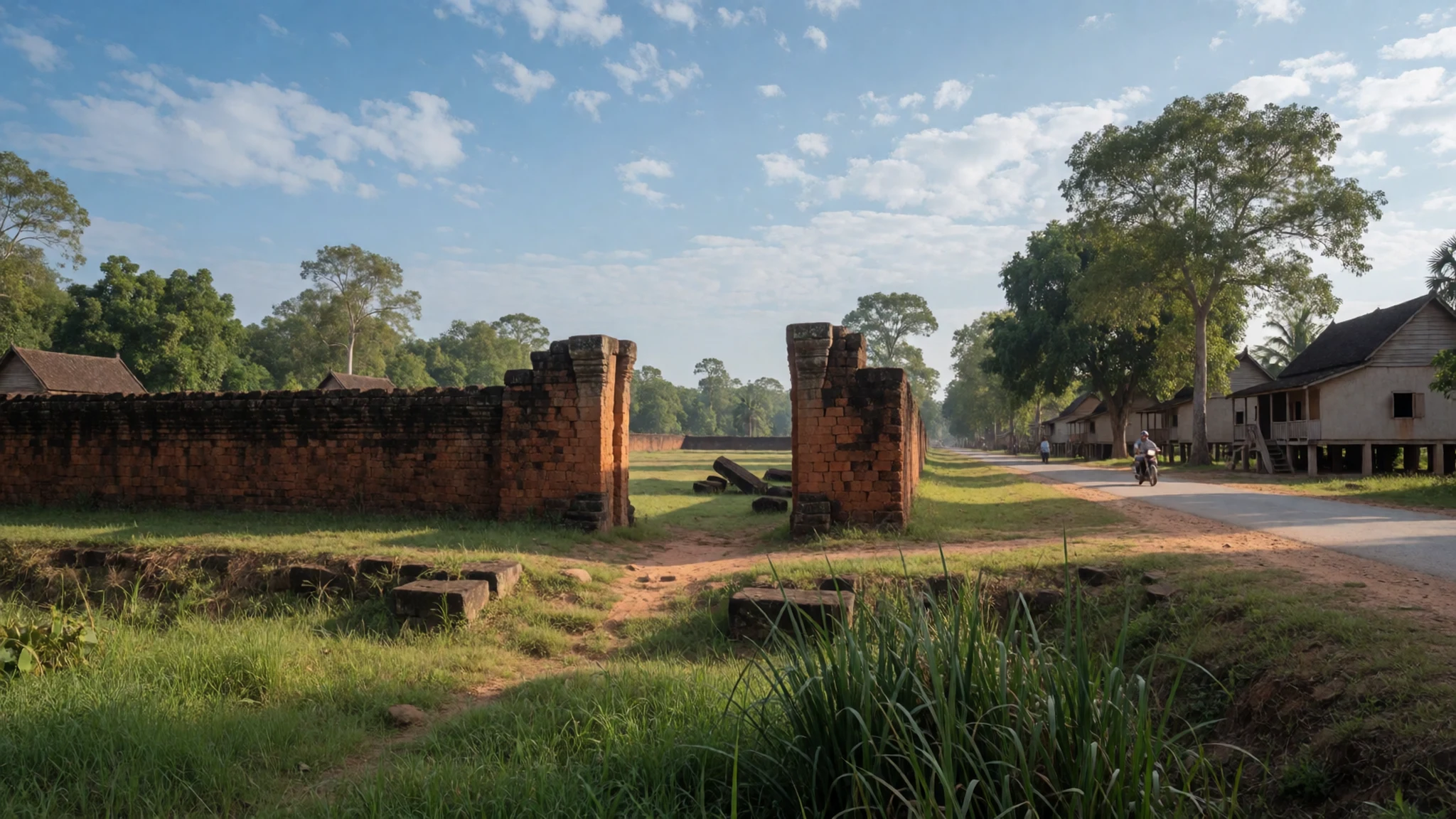
- Ta Prohm satellite temple — Fields beside the main enclosure
A satellite temple stands apart from the main enclosure of Banteay Chhmar, out among the fields. This one is known as Ta Prohm, a namesake of the temple at Angkor and not the same building. It is smaller and easier to grasp in a single circuit: a compact shrine in the same architectural language, with doorways, pediments and weathered sandstone. Fewer people walk out, and the path crosses cultivated land.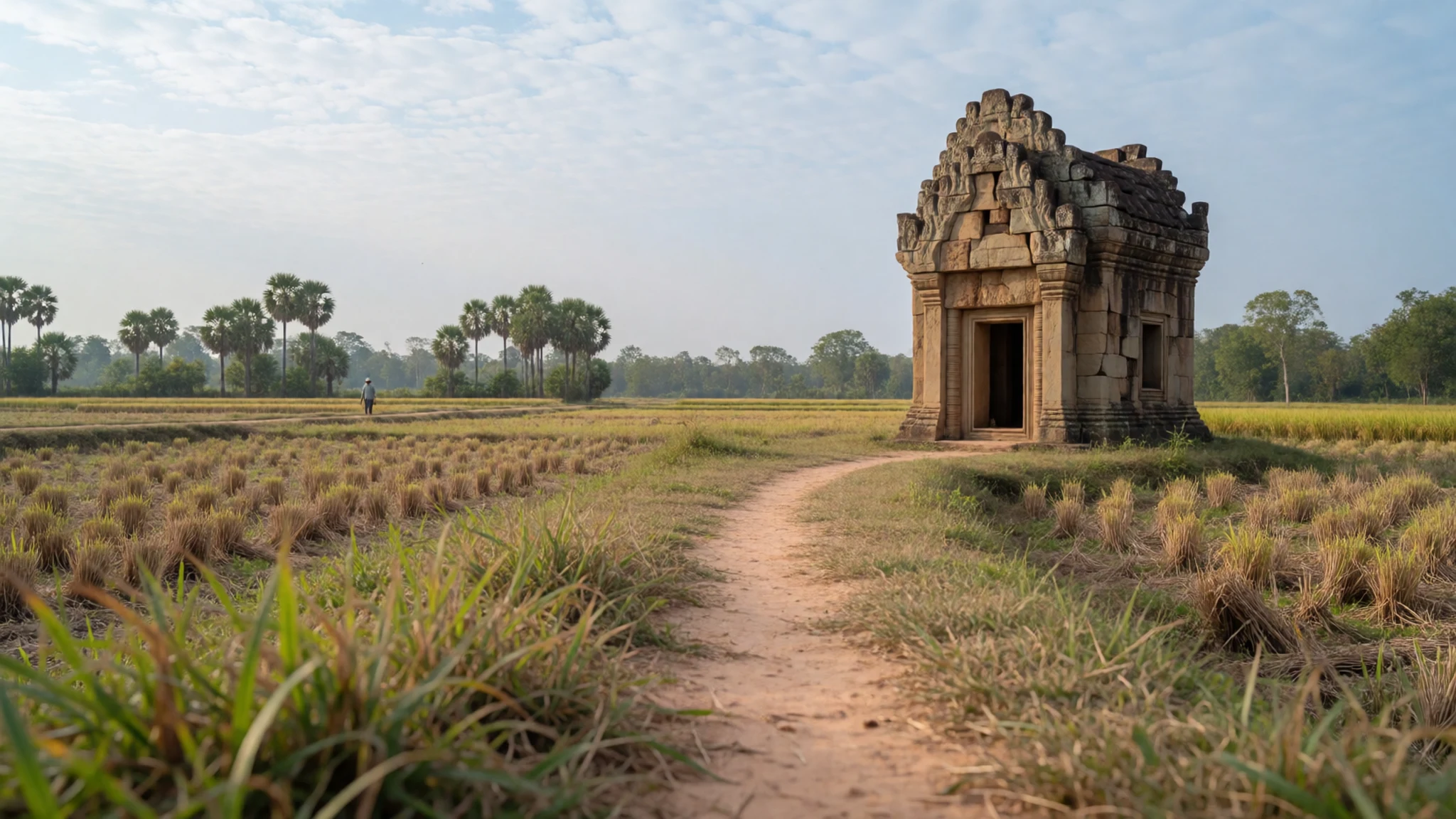
Culture
Banteay Chhmar is a Buddhist temple in a Khmer village that still treats the enclosure as part of ordinary life. Flowers, incense and fruit turn up at the feet of images, left by neighbours rather than by a scheduled congregation. The institution a visitor meets is the community tourism group: local guides, families who take overnight guests, and a small trade in textiles and cold drinks at the gate. A guide walks the battle relief as a sequence and names Lokeshvara as the bodhisattva of compassion, without inventing a story for every missing block. Khmer New Year is public and loud in the lanes, while Pchum Ben is quieter, a time of food set out for the dead; neither rite uses the ancient temple as its stage, yet both shape the calendar of the people who live against the moat. The cotton krama on heads and shoulders, and the silk sampot kept for ceremonies, are the cloth of that public life. Remove your shoes before you step onto a raised shrine or into the village pagoda, and ask before you photograph anyone who is praying or selling.
What to wear
Banteay Chhmar sits in a hot, open landscape, and cloth here answers to sun, dust and sacred thresholds. The older formal garment is the sampot, a length of cloth wrapped at the waist and, for ceremonies, cut from silk. Patterned hol silk — threads tied and dyed before weaving — still appears at weddings and at the pagoda, sometimes with a sbai, the sash over the shoulder. The textile people actually use every day is the krama, a checked cotton scarf on the head, at the neck or under a basket. In the lanes now, t-shirts, blouses, trousers and flip-flops are the norm, with a krama or a hat added for the fields. A visitor should dress for heat and for covered shoulders and knees on temple ground and inside a pagoda. Swimwear and very short shorts look careless beside people who are guiding or making offerings. Sandals come off quickly at a shrine step; a closed toe is kinder on fallen blocks. A cotton krama from a stall at the gate works as sun cover on the walls and as a dust cloth on the dry-season road.
What to eat
- Bai sach chrouk — Morning stalls in Banteay Chhmar village
Bai sach chrouk is the ordinary Cambodian breakfast at Banteay Chhmar: grilled pork with a little sweet marinade, served over rice with pickled vegetables and a small bowl of clear broth. It turns up on morning stalls in the village, eaten early before heat builds on the stone.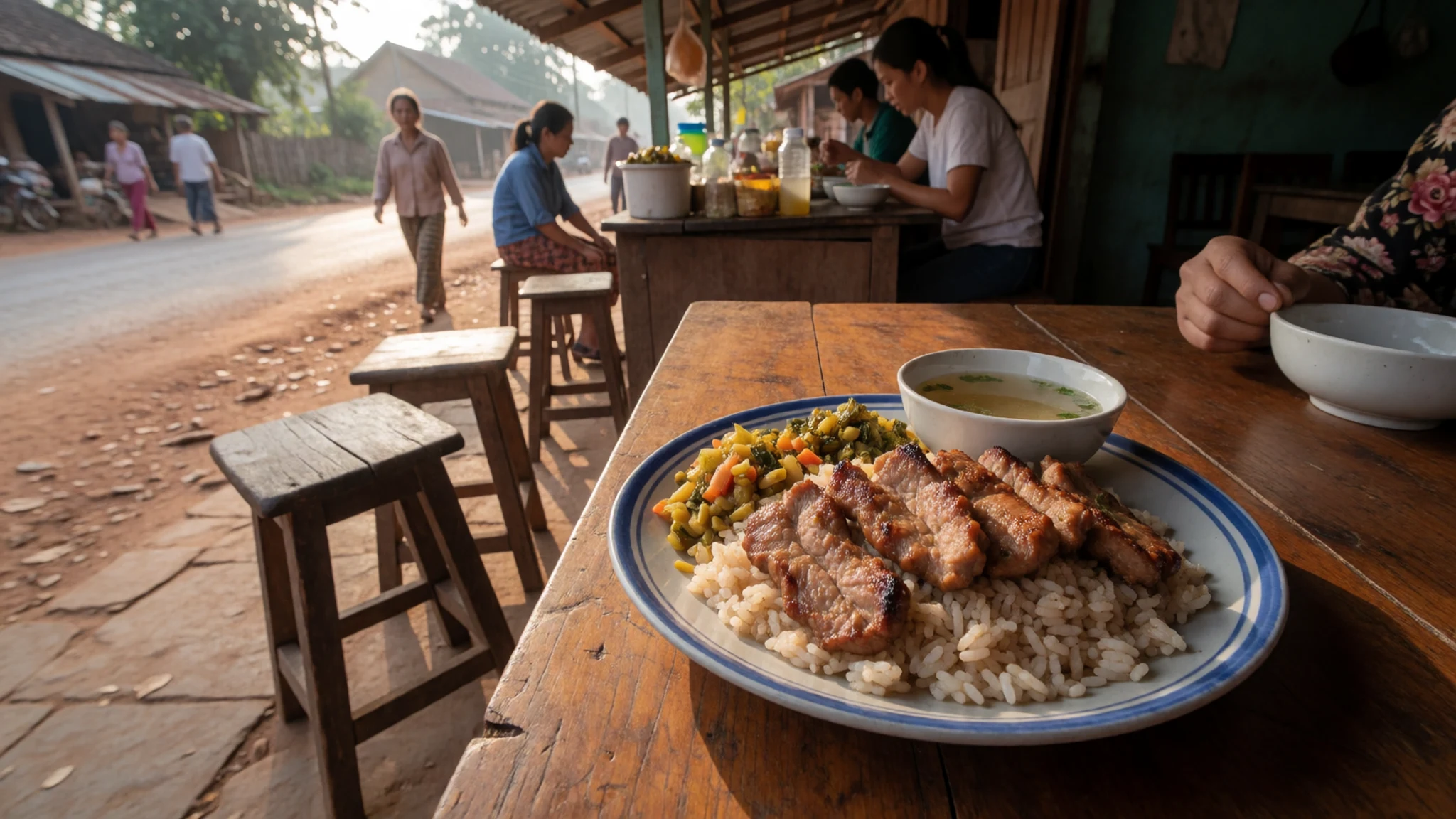
- Nom banh chok — Village morning market and roadside noodle stalls
At Banteay Chhmar, nom banh chok is a breakfast of soft rice noodles with a mild fish-and-herb gravy, cucumber, banana blossom and fresh herbs. Around the village the bowl is assembled from trays at a market stall, so the herbs are the substance of the dish.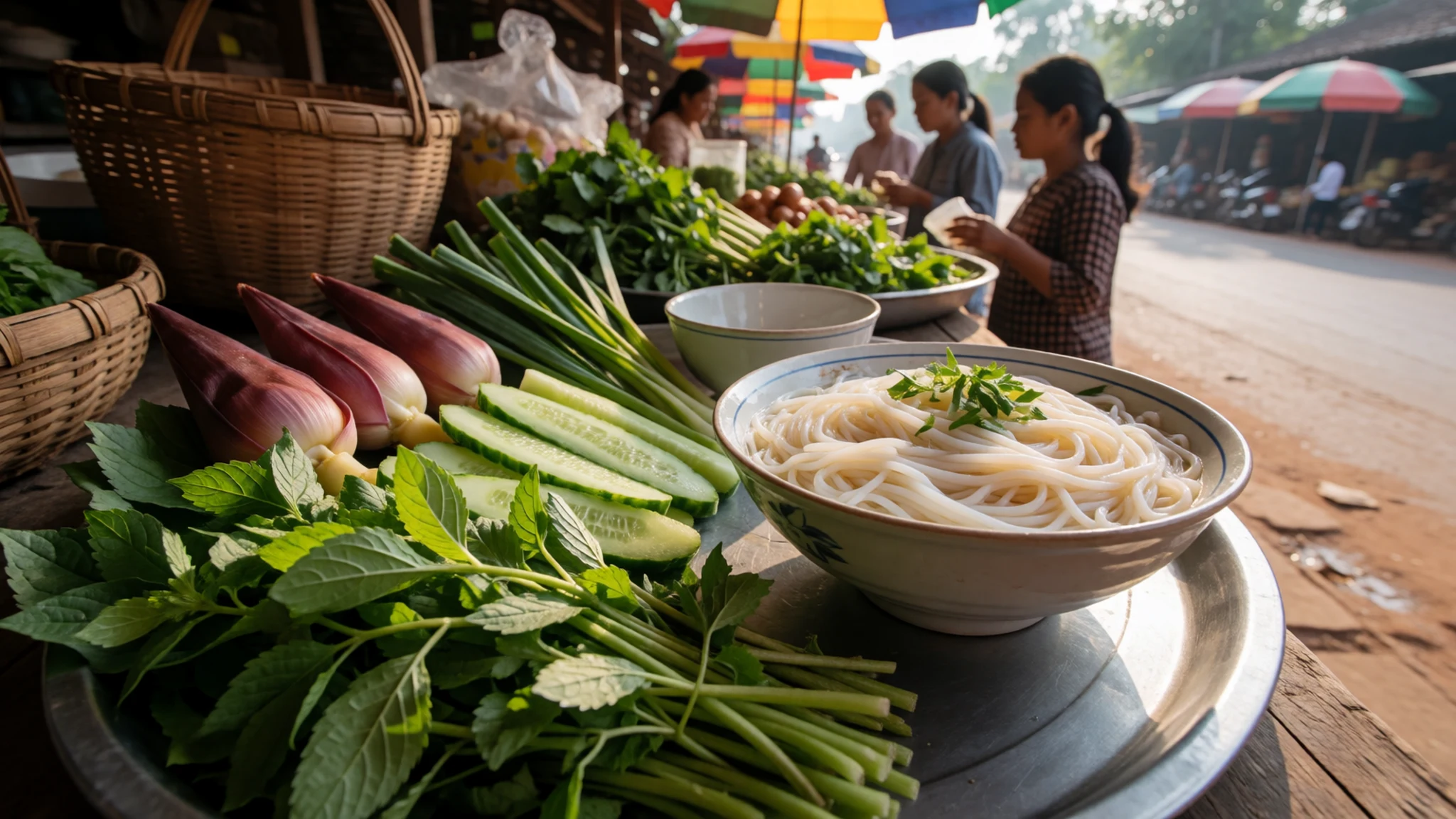
- Fish amok — Homestay kitchens and Khmer eateries in Sisophon
Fish amok, or amok trei, is fish folded into coconut curry with kroeung, the Khmer herb paste, and steamed until it just sets, often in a banana leaf. Near Banteay Chhmar it belongs in a homestay kitchen or a simple eatery in Sisophon, not on a roadside tray. - Samlor machu — Homestay kitchens and lunch stalls in the village
Samlor machu is the sour soup of the Cambodian table, a broth sharpened with tamarind or lime and finished with fish or pork. In a Banteay Chhmar homestay it comes as a shared lunch beside rice, herbs and a dish of prahok, the fermented fish paste. - Pleah sach ko — Homestay tables and Khmer eateries on the Sisophon road
Pleah sach ko is a lime-dressed salad of sliced beef with shallot, lemongrass, mint and a little prahok, the meat cured in the acid rather than stewed. It is a fuller plate than breakfast, the sort a homestay at Banteay Chhmar cooks when lunch is shared. - Num ansom — Village stalls and homes at ceremony time
Num ansom is a cylindrical cake of sticky rice and banana or pork, wrapped in banana leaf and boiled until the rice turns dense and gently sweet. Around Banteay Chhmar it shows up at stalls and in homes for a ceremony or a guest.
Plan it
Best time. November to February is dry but still hot, and November is the most comfortable time to walk open galleries. March and April are the hottest months and turn fiercely hot by late morning, while May is wet and September is wettest. From May into October, rain slows the rural roads and fills the moat.
How long. 2–3
Getting there. Banteay Chhmar has no airport of its own. Fly into Siem Reap and continue by road through Sisophon (Serei Saophoan), in Banteay Meanchey; the last leg is a rural road to the village. A car with a driver is the usual final stage. The community group at the temple can arrange a local guide. In the rains, check road conditions before you travel.
Budget. low
Tips
- Stay the night in a village homestay if you can; a there-and-back from Siem Reap spends most of the day on the road.
- Begin in the early morning, before heat builds in the open galleries.
- Carry cash. Card machines are not something to count on in the village.
- Bring drinking water and a hat or krama; shade along the outer walls is thin.
- Arrange a community guide through the village tourism group, which is how local conservation work is supported.
Etiquette
- Cover shoulders and knees in the enclosures and at the pagoda.
- Take shoes off before a raised shrine or the village pagoda.
- Ask before you photograph people, especially anyone praying or selling.
- Do not climb on carvings or touch the faces.
Nearby
Sources
- Wikidata (CC0)
- Wikipedia (CC BY-SA 4.0)
- Wikivoyage (CC BY-SA 4.0)