Haeinsa
Haeinsa, South Korea
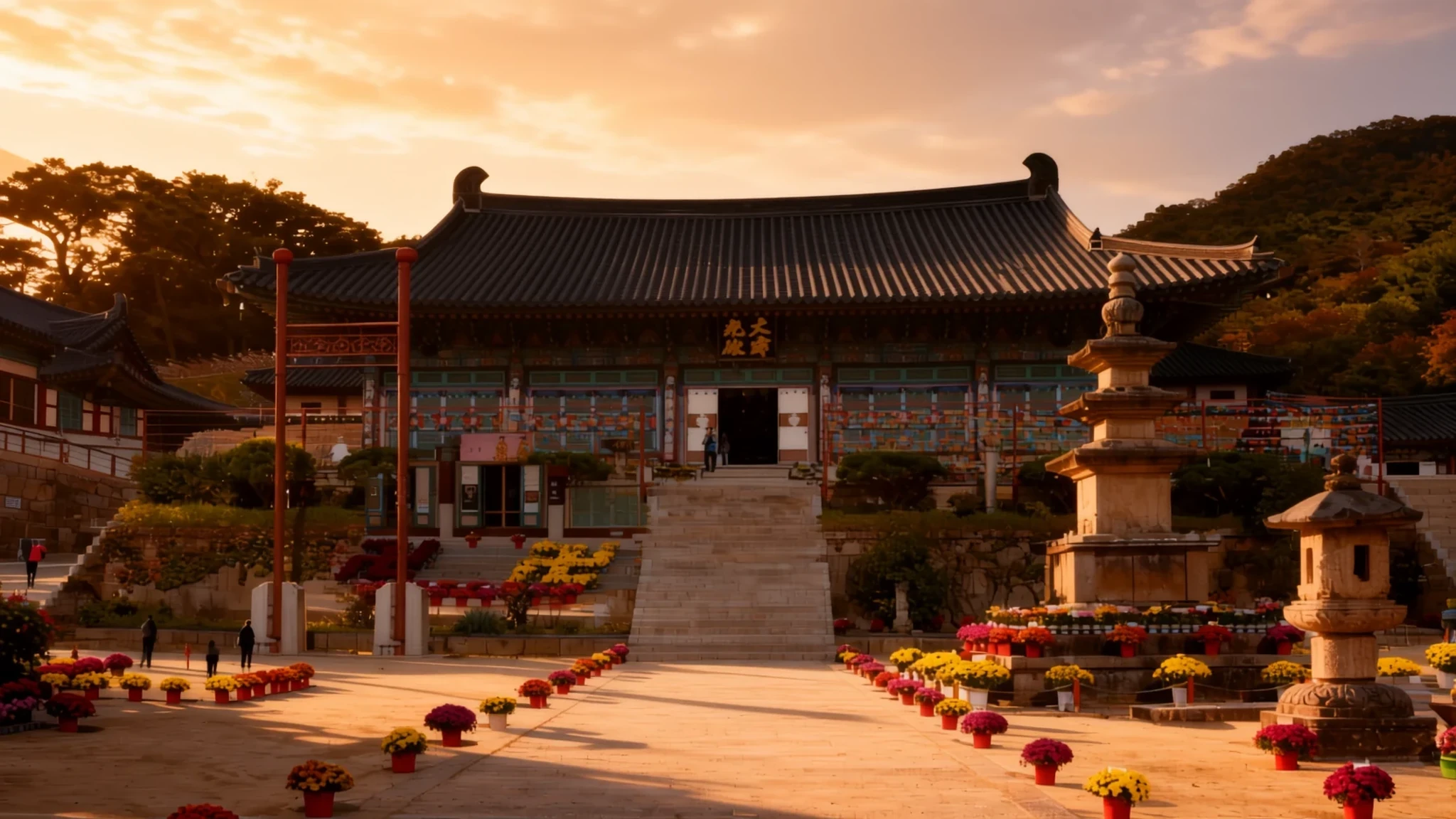
Haeinsa keeps Korea's carved Buddhist canon in a mountain monastery where the halls, the forest and the quiet are the point.
The place
Haeinsa stands on Gayasan in Hapcheon, South Gyeongsang, a working mountain monastery that also guards the wooden printing blocks of the Korean Buddhist canon. The name Haeinsa (해인사) comes from a Flower Garland image: a mind like water with no ripple, a sea lying smooth. The temple takes that picture as its own. The approach leaves the valley and climbs through forest, so tiled roofs and timber halls appear in stages. Worship buildings gather on the upper court. The scripture storehouses sit a little apart, where the wind can pass through the walls.
The monastery belongs to the Jogye Order of Seon Buddhism and still keeps a lived-in rhythm: a bell and a drum to mark the hours, quarters for the community, and courts that fill for ceremony and empty again by afternoon. Most travellers come for the Tripitaka Koreana, the canon carved in wood during the Goryeo kingdom and kept at Haeinsa in the Janggyeong Panjeon. Those depositories are long, low halls with slatted openings and a raised floor, arranged so the blocks stay dry. The visit is a look through the lattice. The stacks are not a corridor for wandering.
Gayasan gives Haeinsa its weather and its quiet. Spring brings new leaf, summer brings heavy rain and thick green, autumn brings maple colour, and winter is sharp. A day moves between the main Buddha hall, a stone pagoda, a rock-cut figure on the path, and the dark library of blocks. Hapcheon lies below, and leaving is a descent through the same woods.
Its story
Haeinsa began as a Silla monastery on Gayasan, founded by the monks Suneung and Ijeong. The tale kept at the temple says they aided the queen through an illness and that King Aejang then backed a new house of the Flower Garland school on this mountain. The name belongs to that school. An awakened mind is pictured as a sea without wind, clear enough to reflect the whole of things, which is the central image of the Avatamsaka, or Hwaeom, teaching. The cure may be legend.
The library was made later, under the Goryeo kingdom, while Mongol armies pressed the realm. An earlier carved canon had been lost in the fighting. Court and monastery responded by cutting a fresh set of blocks, scholarship and prayer in the same labour: the canon, carefully made, as a plea that the kingdom be protected. The work was carried out on Ganghwa, an island stronghold off the western coast, and the finished blocks have been kept at Haeinsa since 1398, in halls of uncertain date that Sejo expanded and renovated in 1457. Later fires and invasions destroyed other halls. The depositories and the blocks remained.
Haeinsa holds that Silla monastery and that Goryeo library in the same courtyards. The hermitage grew into a head temple of the Jogye Order of Korean Seon. The canon still rests in the Janggyeong Panjeon. A working copy of a block stands ready so an ink impression can be taken, while the historic stacks stay untouched behind the slats.
What to see
- Janggyeong Panjeon — Scripture halls beside the main court
Haeinsa keeps the Tripitaka Koreana in the Janggyeong Panjeon, a pair of long wooden depositories built to shelter the carved blocks. Slatted windows and a raised floor let the mountain air move through, which is why the wood has stayed sound. Visitors look in from outside the lattice rather than walking the stacks. The light inside stays low.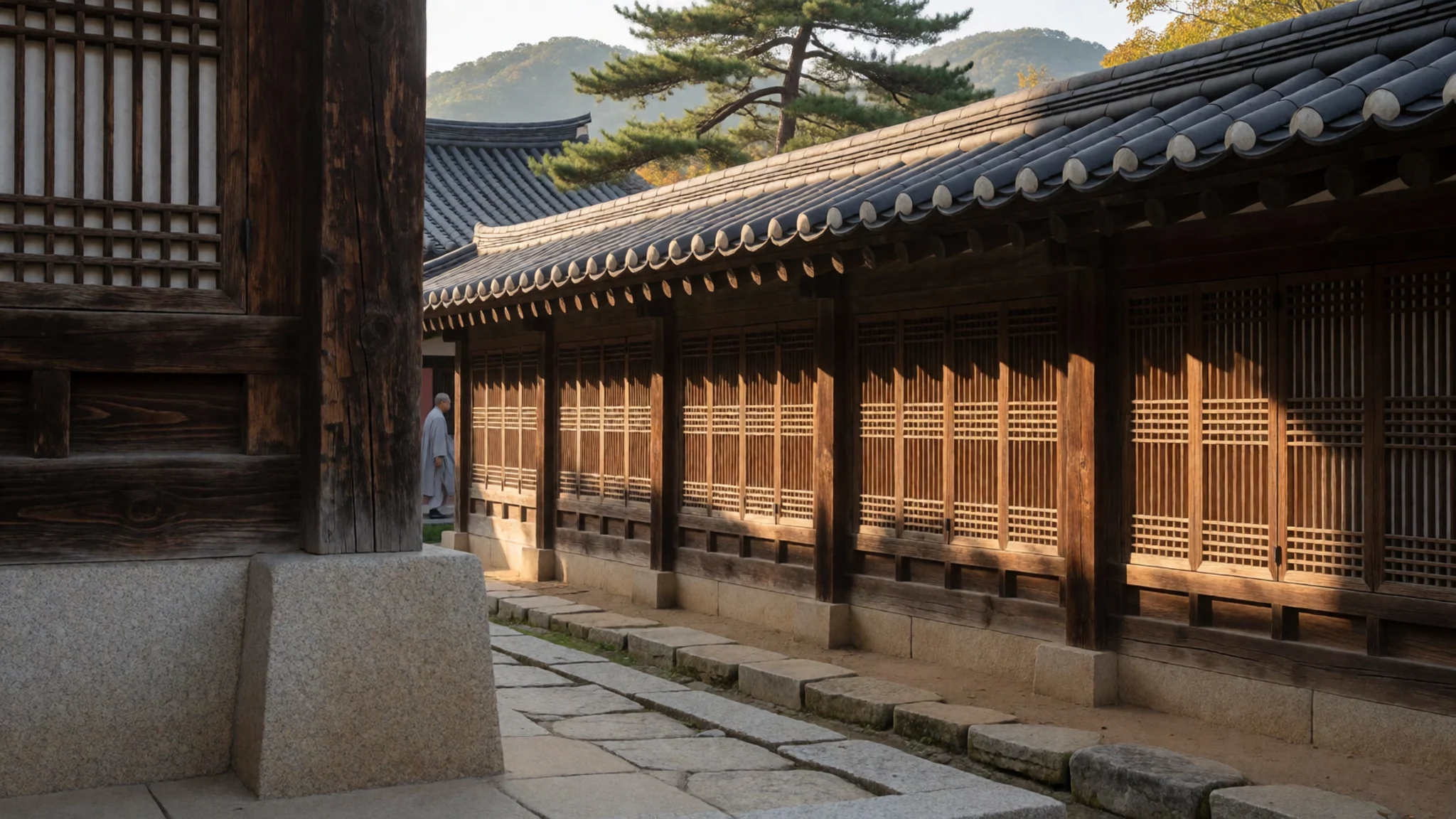
- Daejeokgwangjeon — Main worship court
Daejeokgwangjeon is the main Buddha hall of Haeinsa, where the community and visitors bow. Gilded figures sit on the altar beneath painted beams, in the dense colour of Korean temple sculpture. The doors open toward the courtyard, so the steps and offerings come before the statues. Services, drums and incense set the pace, and looking around fits between them.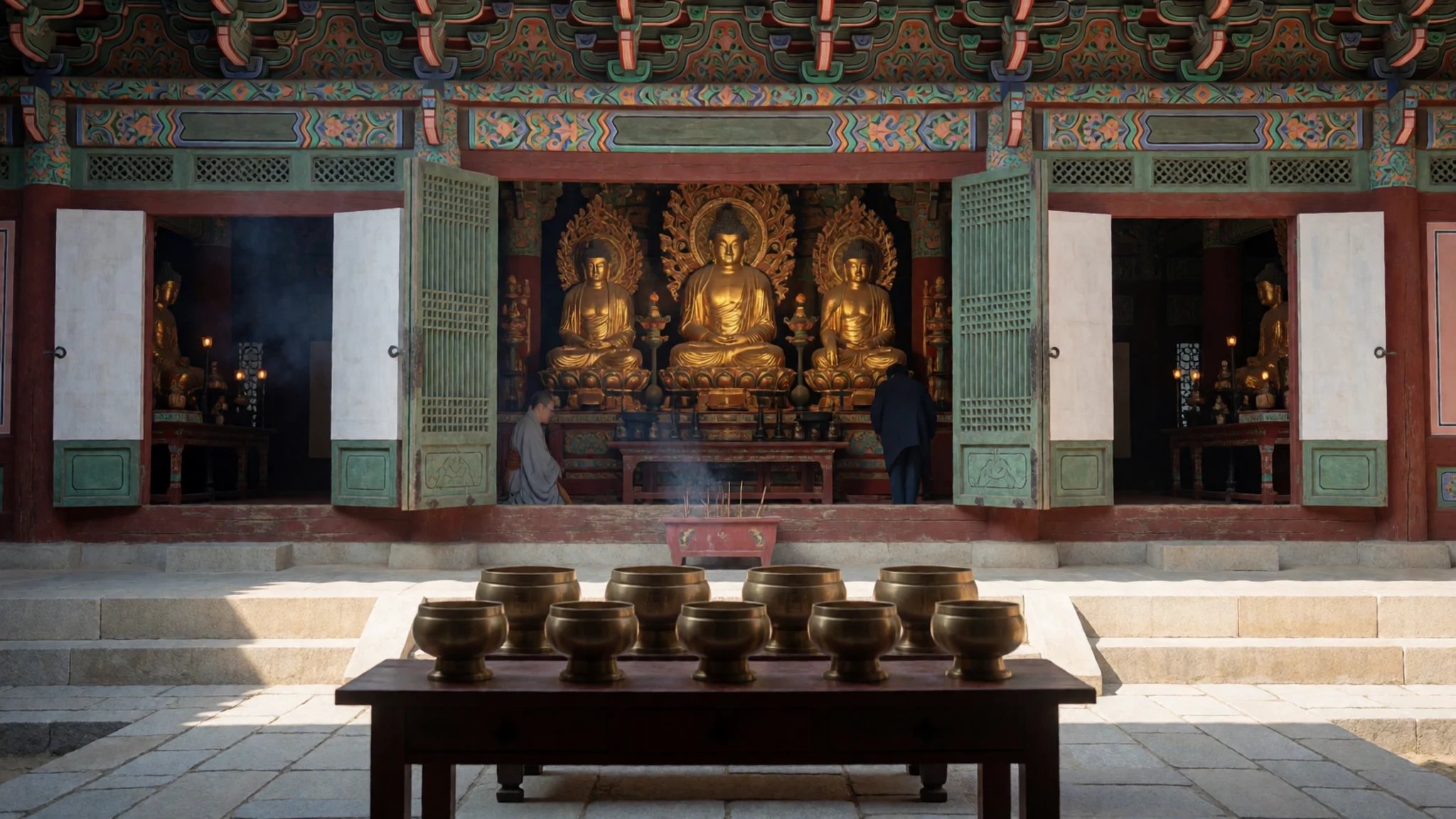
- Birotap — Temple courtyard
Birotap is the stone pagoda in the courtyard at Haeinsa, named for Vairocana, the cosmic Buddha of the Flower Garland school that shaped this monastery. It is a compact granite monument rather than a tall tower, the kind of pagoda that marks the centre of a Korean temple court. From the pagoda the main hall, the depositories and the ridge of Gayasan line up together.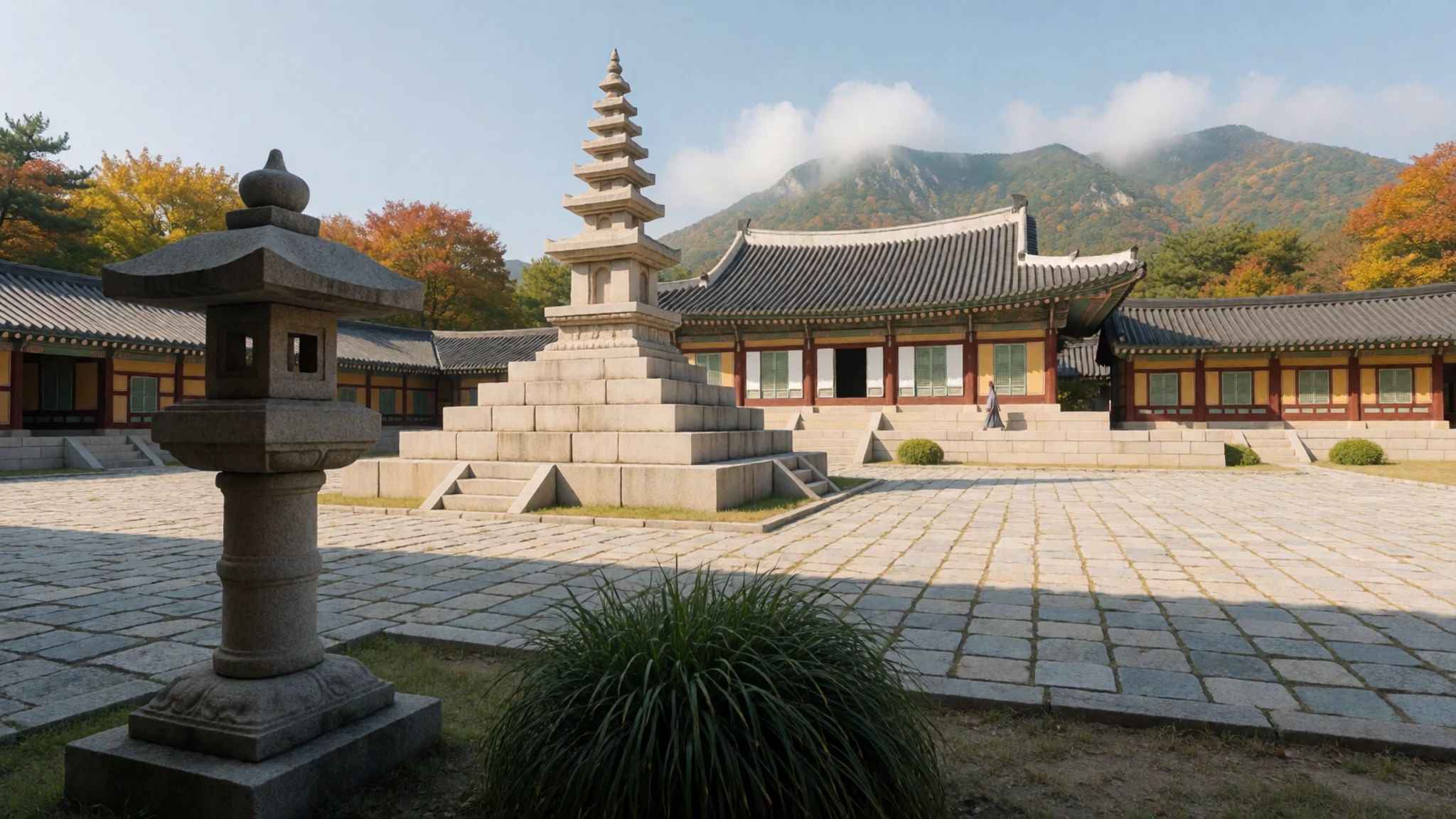
- Standing Buddha relief — Path between the temple and the Gayasan ridge
On the path between Haeinsa and the higher slopes of Gayasan, a stone relief of a standing Buddha is cut into the rock, outside any hall. The figure is frontal and plain, a mountain carving on a route used by monks and pilgrims. It is easy to miss if the walk stays in the courts. People still stop and bow, so it is a shrine as well as a photograph.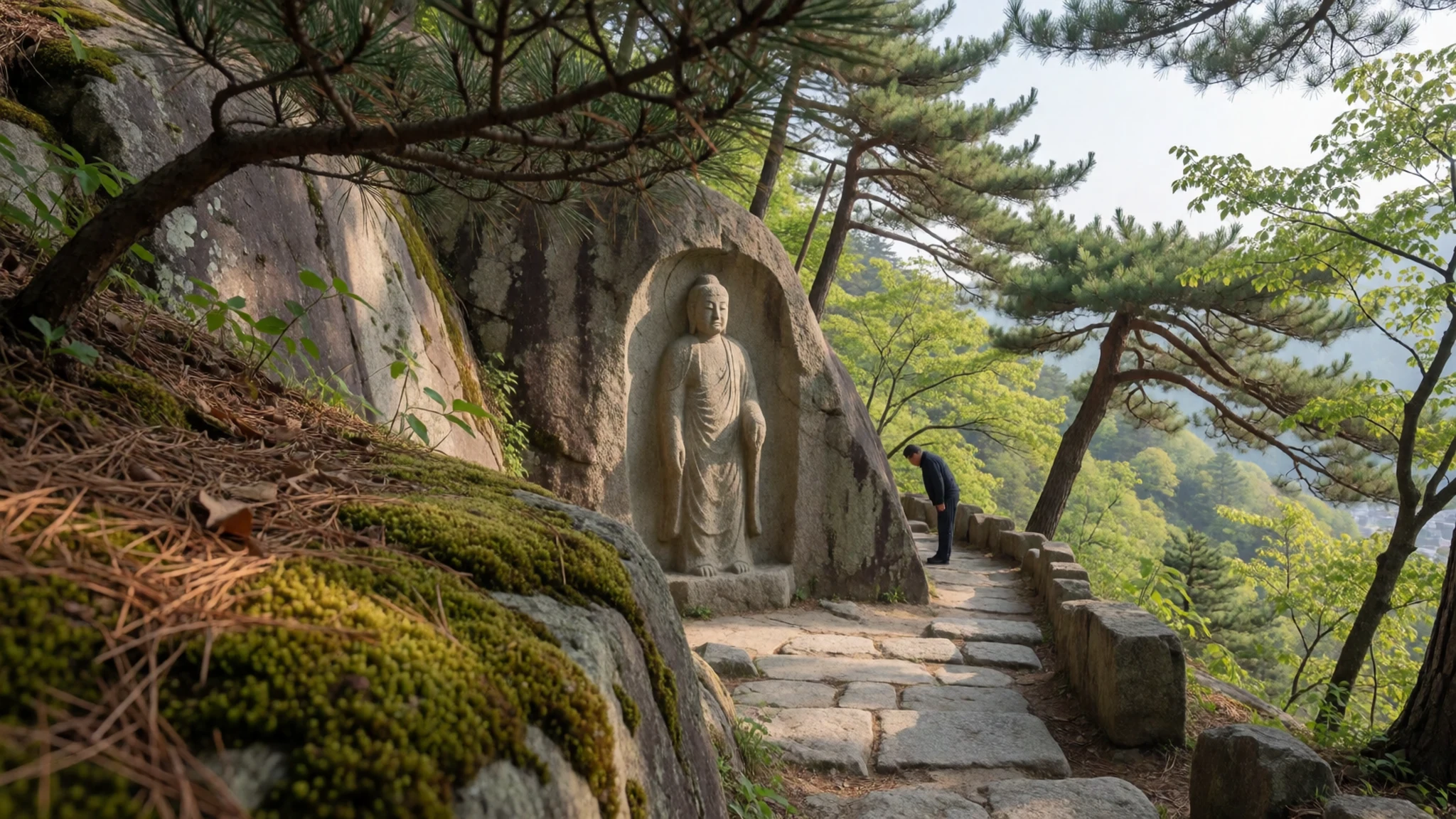
- Temple bell — Bell pavilion in the temple grounds
The bronze bell at Haeinsa hangs in its own pavilion and still belongs to the monastery's day, not only to photographs. With the drum and the wooden fish it marks the hours and calls the community. Visitors often come upon it between the main court and the side paths. When it is not being struck for a service, the striker stays untouched and the pavilion is for listening.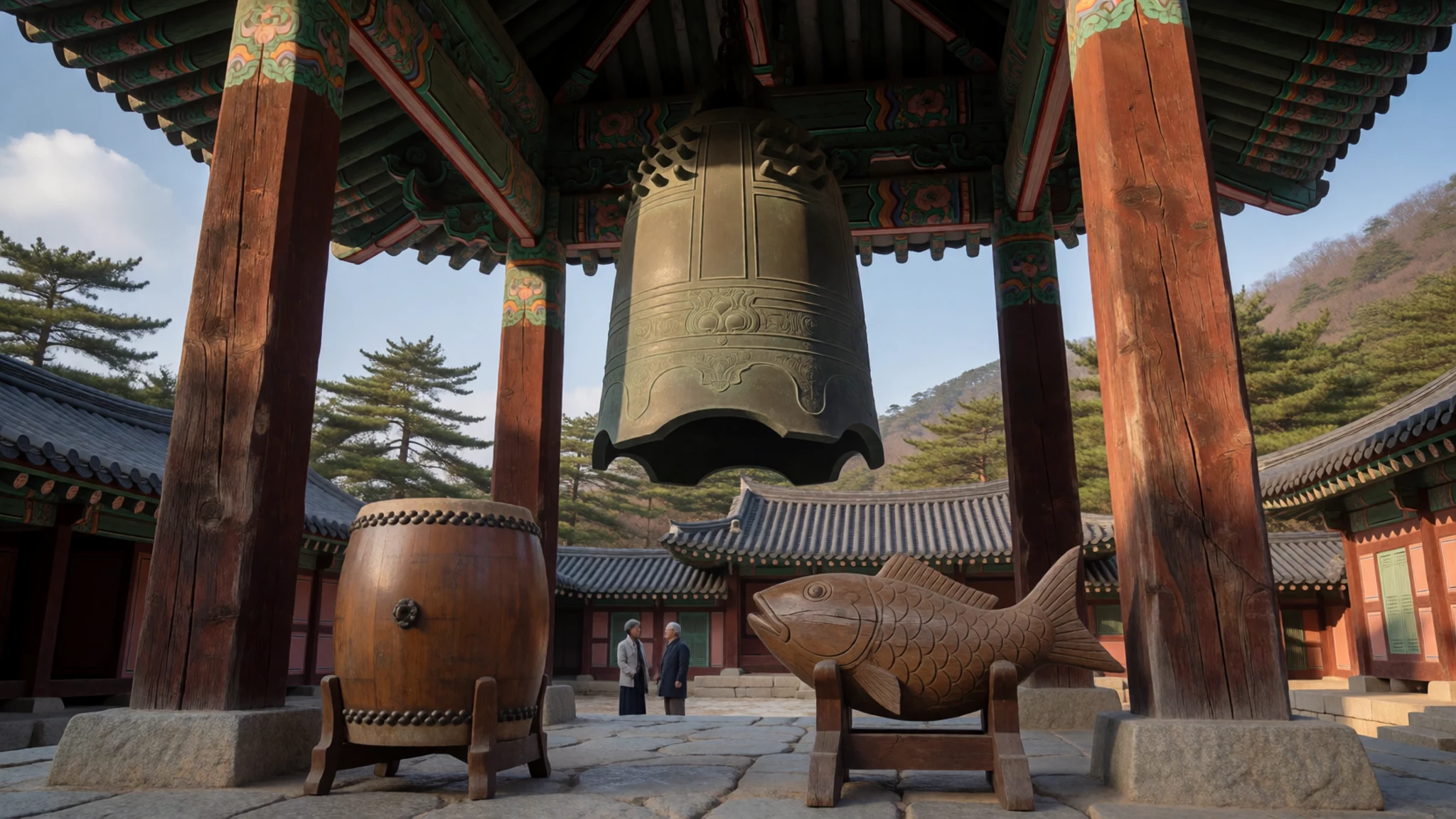
Culture
Haeinsa is a living Seon monastery of the Jogye Order, not a museum that happens to look like a temple. The day follows a monastic pattern: dawn and evening services, a meal taken in silence, work around the grounds, and study of the Flower Garland teaching that gave the place its name. Lay visitors are folded into that pattern rather than kept entirely outside it. Bowing toward the Buddha hall, lighting incense, and circling a courtyard are ordinary acts here, shared by pilgrims in hiking clothes and by people who have come only for the woodblocks.
The Tripitaka Koreana is treated as a sacred text before it is a historic object. That is why the blocks stay behind lattice, why a separate block is set out for inked prints, and why the depositories have the atmosphere of a shrine. On Buddha's birthday and at temple festivals the courts fill with lanterns and families; on an ordinary day the sound is shoes on stone, a bell, and the forest. Cover your shoulders and knees, keep your voice low in the worship courts, and step out of the way of anyone who is bowing or carrying offerings.
What to wear
The formal dress at Haeinsa is monastic. Monks wear a grey robe of plain cloth, with the gasa, a patched ceremonial mantle, for services, and shoes that come off at a threshold. Lay pilgrims who dress formally still choose hanbok: a jeogori jacket and a chima skirt or baji trousers, in silk for a rite and in ramie or cotton for a warm day. Those garments are now mostly for ceremonies, weddings and festivals, not for the bus up the mountain.
What people actually wear on an ordinary day is ordinary Korean city and hiking clothes. In Hapcheon and on the temple path that means trousers, a windproof layer, trainers or light boots, and a sun hat in the bright months. Gayasan is cooler than the valley, so a jacket is worth carrying.
For a visitor the practical rule is modest clothing that allows walking and bowing. Shoulders and knees should be covered for the Buddha hall, loud slogans are out of place in a worship court, and shoes should slip off easily because many inner floors are for stockinged feet. A stone path and a possible ridge walk reward a tread with grip, and a light raincoat belongs in the bag through the wet summer months.
What to eat
- Sanchae bibimbap — Vegetarian eateries and canteens on the road below the temple gate
Sanchae bibimbap is the meal tied to a day at Haeinsa: rice stirred with seasoned mountain vegetables such as fernbrake, bellflower root and mushrooms, and a little gochujang. Vegetarian eateries and canteens on the road below the gate serve it in the monastic style, without meat.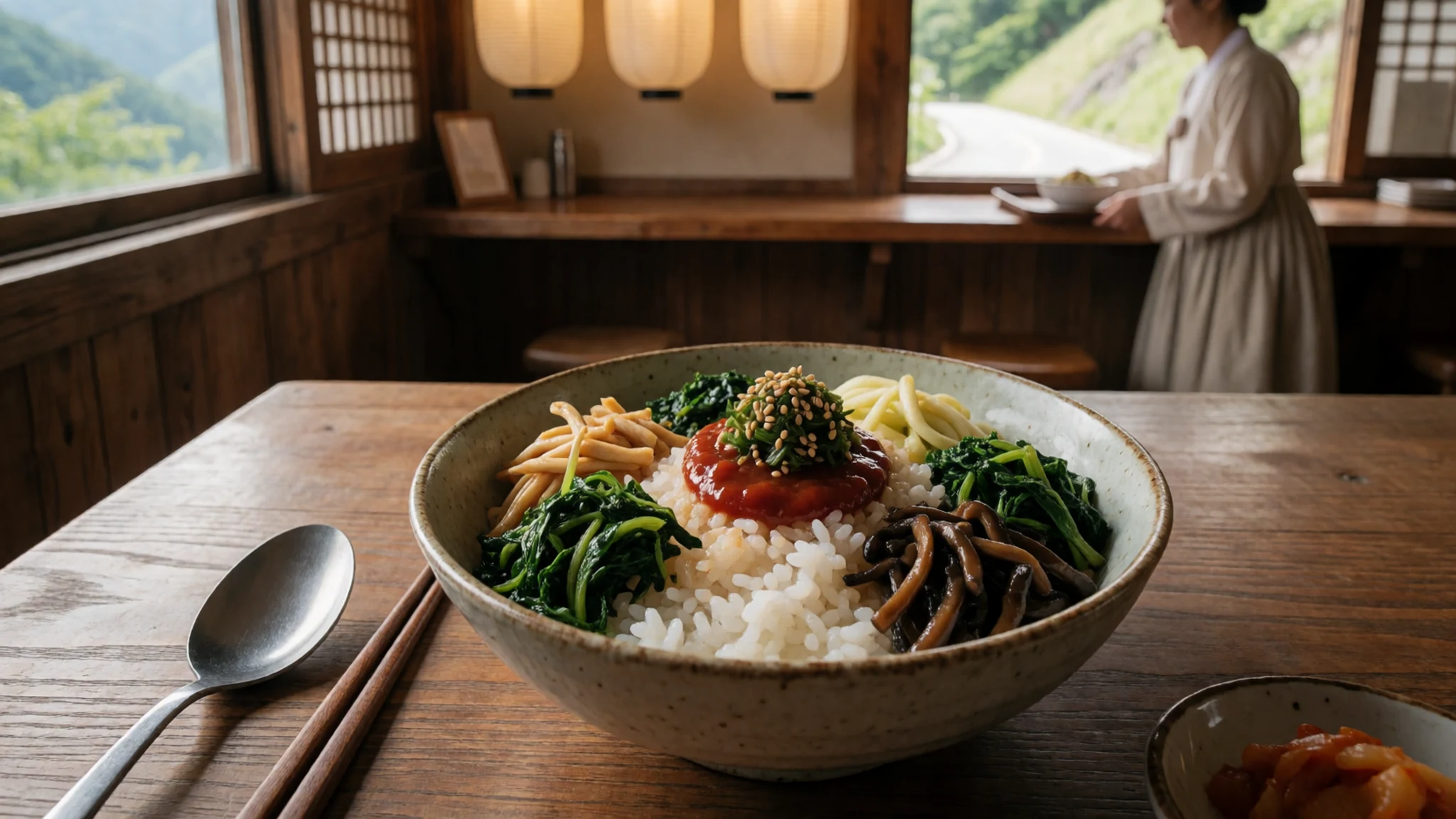
- Temple set meal — Temple canteen and temple-cuisine eateries on the mountain road
A temple meal near Haeinsa borrows from balwoo gongyang, the monastic custom of eating quietly from bowls. Visitors usually get a gentler set: many small plates, rice, soup and water kimchi, with little conversation. Ask at the temple canteen or at eateries on the mountain road that cook sachal eumsik.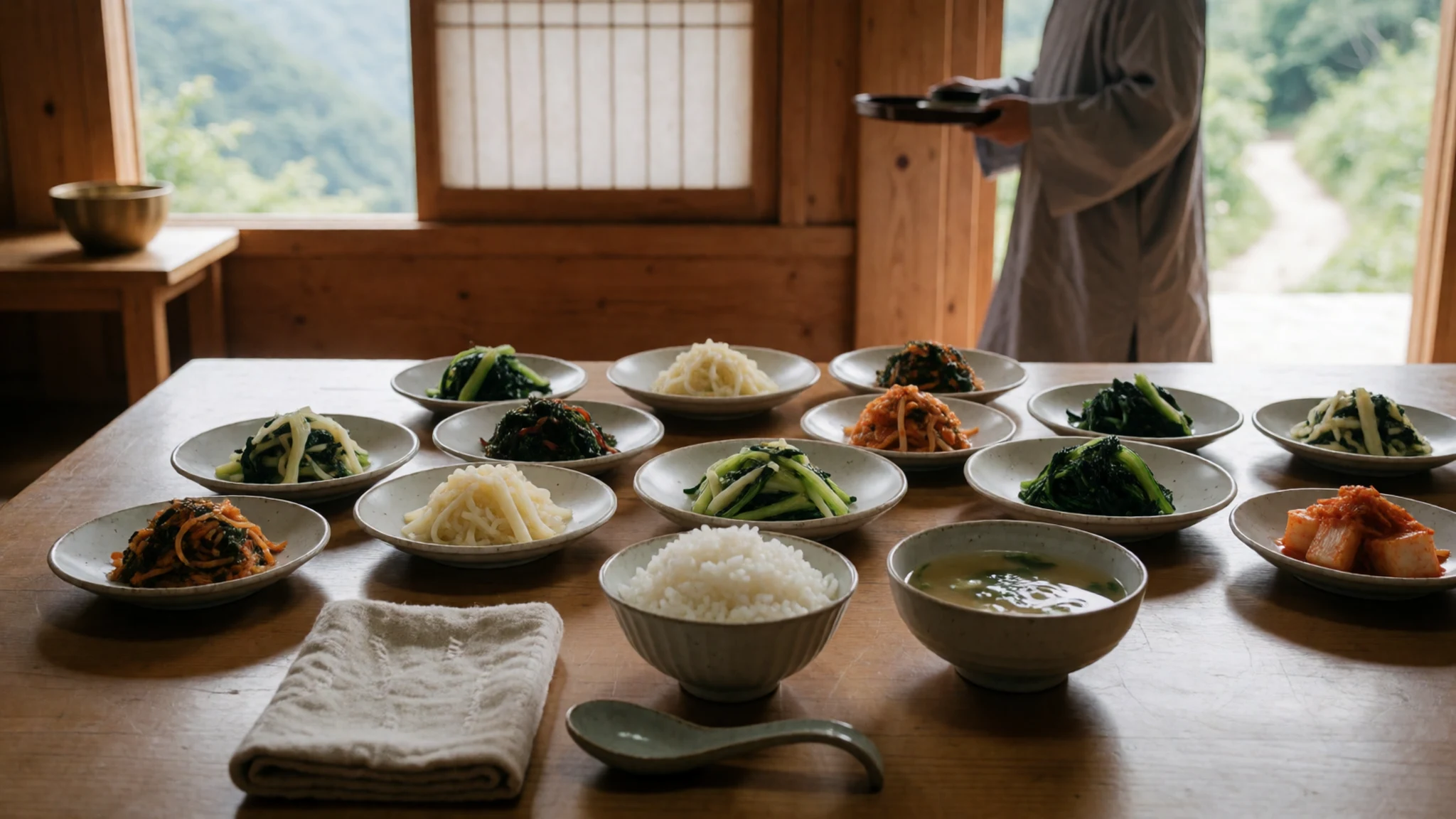
- Doenjang-jjigae — Simple restaurants in Hapcheon and temple-side eateries
Doenjang-jjigae, a stew of fermented soybean paste with tofu, courgette and greens, is everyday comfort food around Haeinsa and a natural partner to mountain-vegetable cooking. It turns up in simple restaurants in Hapcheon and in the same temple-side eateries that serve bibimbap, often beside a spread of banchan. - Namul — Stalls and small restaurants on the Hapcheon side of Gayasan
Namul, seasoned greens, are the local larder at Haeinsa. Gosari fernbrake, doraji bellflower root and mushrooms are blanched and dressed with sesame and garlic. Stalls and small restaurants on the Hapcheon side of the mountain sell them as side dishes and over rice in spring and autumn. - Hobakjuk — Cafés and small eateries near the bus stop below the temple
Hobakjuk, a soft pumpkin porridge, shows up at breakfast around Haeinsa, easy food before a climb. Cafés and small eateries near the bus stop at the foot of the temple serve it early, with barley tea. The monastic-leaning version is barely sweet.
Plan it
Best time. April and May suit a visit to Haeinsa: milder days and new leaf on Gayasan. September and October bring autumn colour, with clearer, drier air in October. July and August are hot, humid and busy, and winter on the mountain is cold, with ice on the steps a real risk.
How long. one or two
Getting there. The nearest large airports are Daegu and Busan (Gimhae). From either city, continue by intercity bus or car to Hapcheon, then take the mountain bus or a taxi up to the Haeinsa gate. There is no railway at the temple. Check the official site for current bus details.
Budget. low
Tips
- Start as early as the gates allow; the courts and the road are calmer in the morning.
- Look at the woodblocks through the lattice and use the demonstration block for prints; do not touch the historic set.
- Carry a layer; Gayasan is cooler and damper than Hapcheon town, and rain arrives quickly in summer.
- Cards work in town, but keep some cash for the temple bus, stalls and small offerings.
- Check the official site for ceremony days and any hall closures before you go.
Etiquette
- Speak quietly and bow if you enter a worship hall, and walk behind people who are praying rather than across them.
- Take off your shoes wherever the floor steps up or a row of slippers is waiting.
- Ask before photographing monks, worshippers, or a hall during a service.
Nearby
Sources
- Wikidata (CC0)
- Wikipedia — Haeinsa (CC BY-SA 4.0)
- Wikivoyage — Haeinsa (CC BY-SA 4.0)