Fort St. Catherine
Fort St. Catherine, United Kingdom
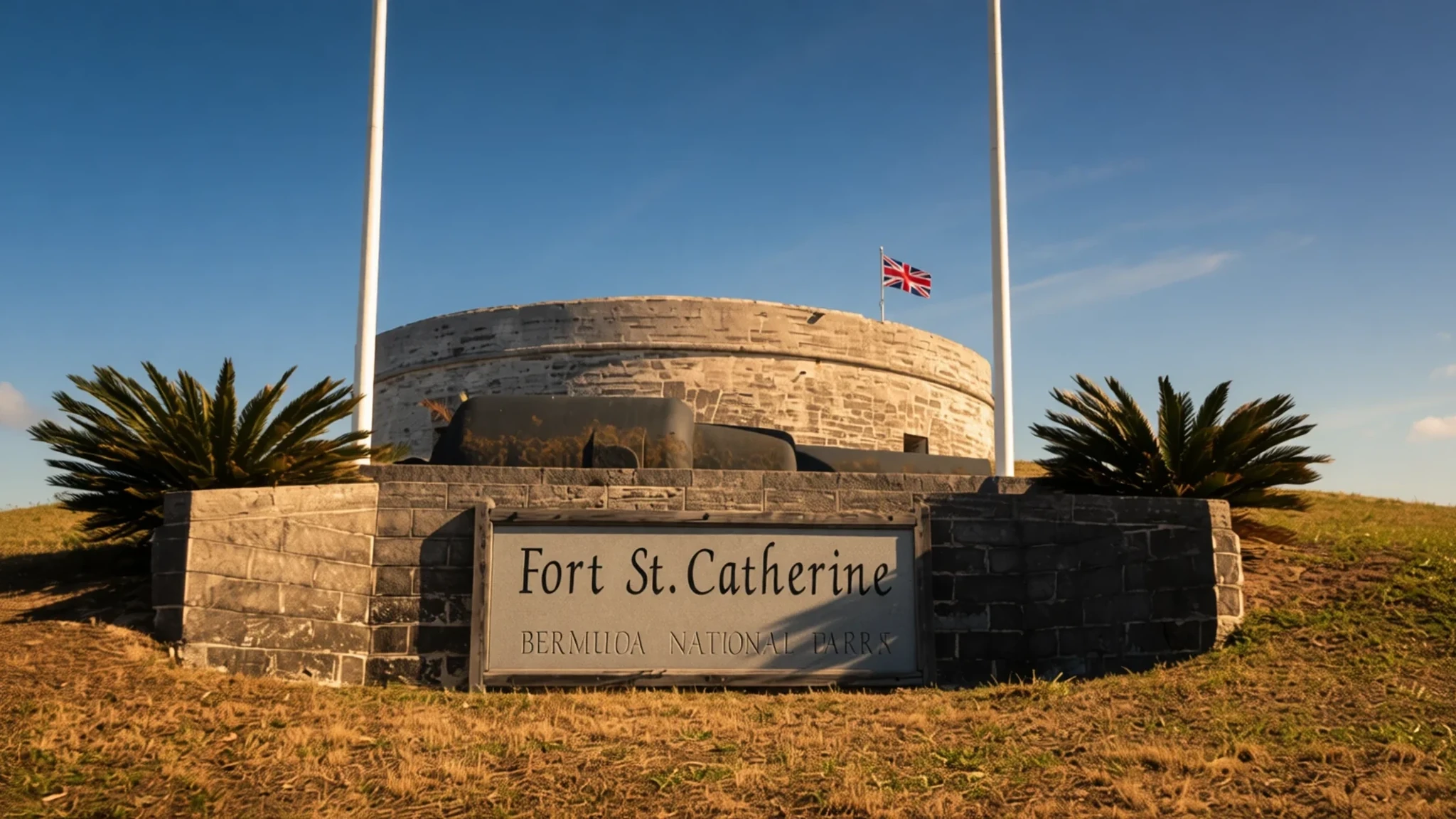
Fort St. Catherine was placed so a ship already through the reef could not round St. George's Island and sail west, with ramparts, heavy guns and stone passages open to visitors.
The place
Fort St. Catherine occupies the north-eastern headland of St. George's Island, where Bermuda's old harbour meets the open Atlantic. Ships already inside the reefs still pass under the fort's guns if they round the island and run west; on the other side the coast breaks into small coves, including the beach that shares the fort's name. The walls are low, thick and pale, built to sit in the wind rather than to tower over the town. From the landward path the place looks almost modest. From the water it reads as a lid of stone over the turn west around St. George's Island.
Inside, the fort is a compact maze rather than a parade ground. Ramps and narrow passages connect magazines, stores and the open gun floor on the roof. The passages were cut for barrels and shells, so they turn tightly and stay dim even at midday. On the roof, heavy guns point across the channel and out to sea, their barrels long enough that a visitor's first instinct is to follow the line of fire and find the reef line. The wind up there is constant. Shade is limited to the stair wells and the leeward side of the parapet.
The headland is part of the old town of St. George's, a short journey from the cruise pier and the square but quieter than either. Cruise mornings bring groups; late afternoon the stone cools and the passages empty. The fort is both a historic work of defence and a small museum, with a sign at the gate that treats the two as one visit. Nothing about the site is vast. Its interest is the fit between a dangerous shore, a narrow channel and a building shaped entirely by that problem.
Its story
Fort St. Catherine exists because St. George's has a front door and enemies knew where it was. English settlement on Bermuda followed a shipwreck: a Virginia-bound vessel broke on the reefs, the survivors got ashore, and the islands, long avoided as a haunted hazard, suddenly looked like a colony. The town that grew at the eastern end needed a gun on the channel. A wooden watch-post was not going to stop a privateer, so the headland was fortified, then fortified again whenever a war or a new kind of warship made the old work look thin.
What stands now is the mature version of that idea. Smooth stone replaced earth and timber. Magazines were buried in the body of the fort so that powder stayed dry and a spark on the gun floor would not end the garrison. Guns grew longer and heavier; the roof was strengthened to carry them, and the passages below were kept narrow on purpose, so a shell could be moved by hand without a wide, vulnerable corridor. The 10-inch muzzle-loaders in those rooms were never replaced; 9.2-inch breech-loaders at Fort Victoria made this fort and Fort Albert unnecessary. The job then passed to Fort Victoria. Here the old muzzle-loaders stayed.
The museum treats that long watch as the story, not a backdrop. Displays walk through the wreck that began English Bermuda, the life of a small garrison on a hot rock, and the oddity of an island that became a naval hinge between the Caribbean and the North Atlantic. Outside, the channel is still the channel. A modern ship does not fear the guns, but the reefs that made the guns necessary have not moved. Fort St. Catherine is the built answer to a coast that punishes a careless approach and rewards whoever holds the headland.
What to see
- The gun floor — Roof, eastern tip of St. George's Island
The open roof of Fort St. Catherine carries 10-inch guns brought from Fort Albert in the 1960s, set in the weather rather than under cover, this fort's own pieces having been pushed over the side in the 1940s. At the breech, the barrel points across the water the walls were built to deny to ships rounding west. Shelter is scarce. On a bright day the metal throws heat, and the view runs from the harbour mouth to open Atlantic.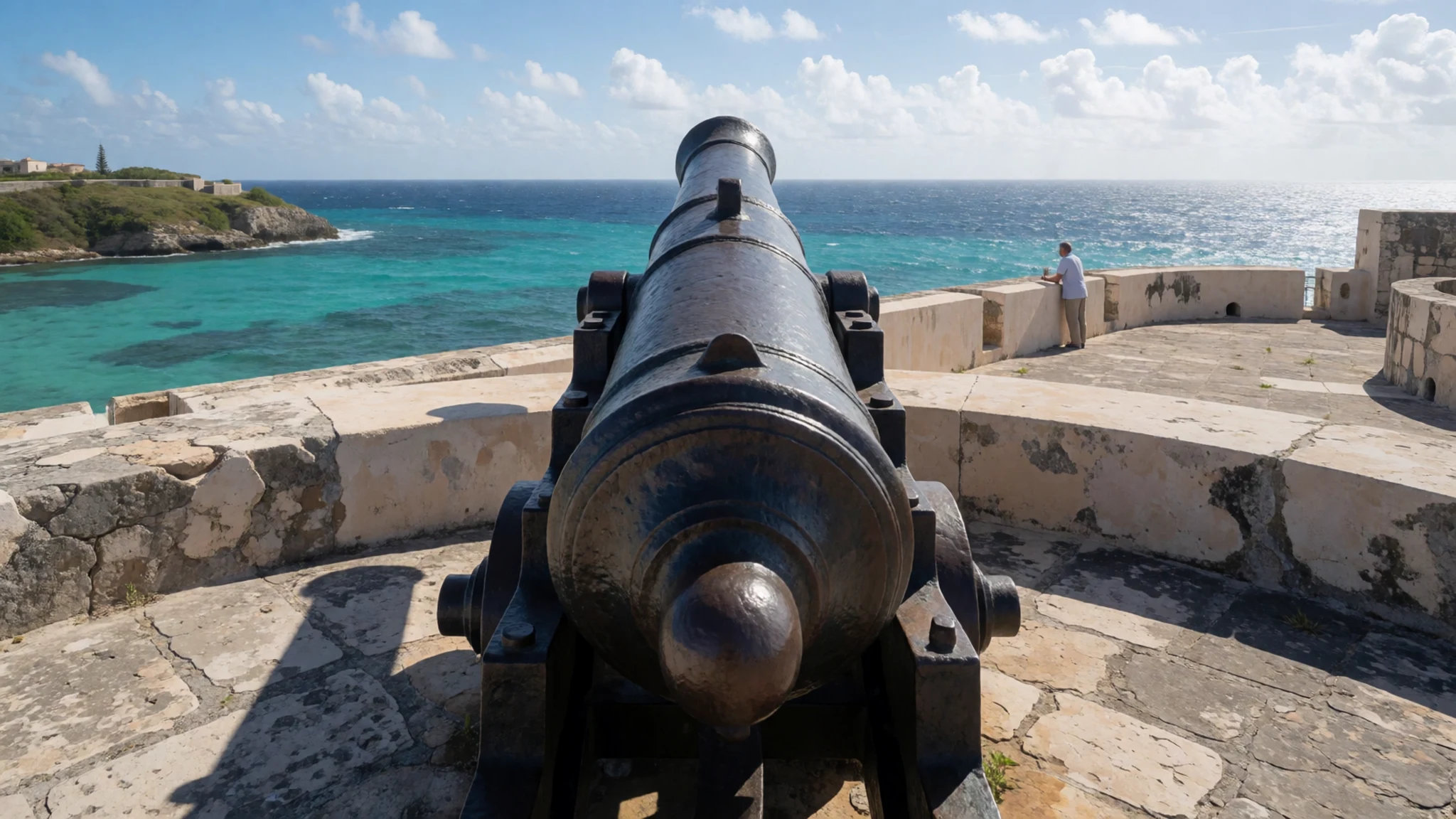
- The seaward walls — Landward approach, eastern tip of St. George's Island
Fort St. Catherine's outer walls are a long, low stone face, with a gun barrel breaking the skyline. The landward approach is gradual: grass, then masonry, then water on both sides of the headland. A passing boat sees pale stone close to the rocks, wet with spray in a stiff breeze. The outline is worth seeing before the interior; the passages make sense only once that shape is clear.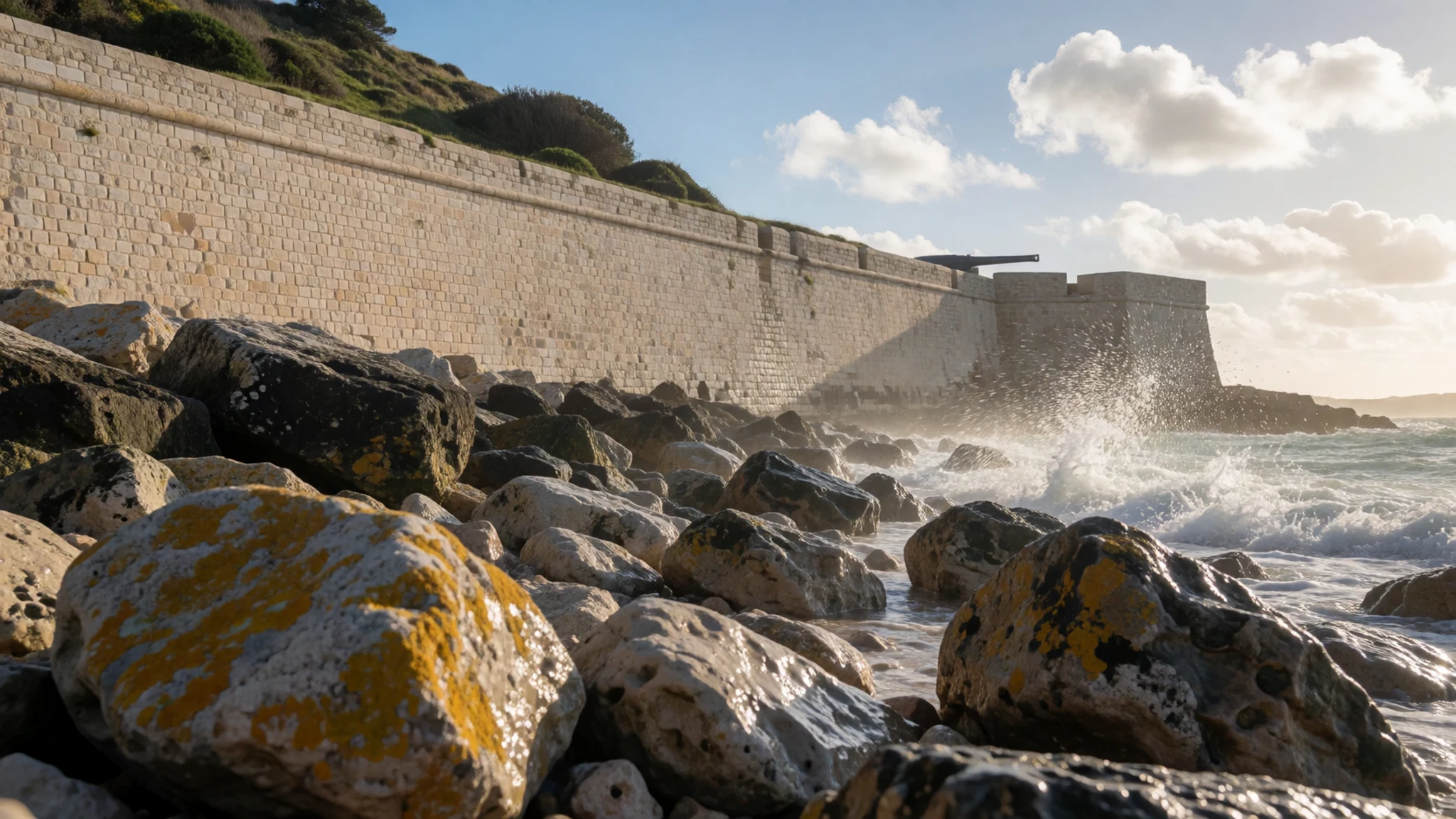
- The munitions passage — Interior, Fort St. Catherine
A narrow passage inside Fort St. Catherine carried shells and powder between the magazines and the guns. It is tight on the shoulders, and a tall visitor ducks. Light enters from the ends, so the middle stays dim, and the stone floor can be damp. There is no view and no ceremony, only the route ammunition took to avoid the open roof.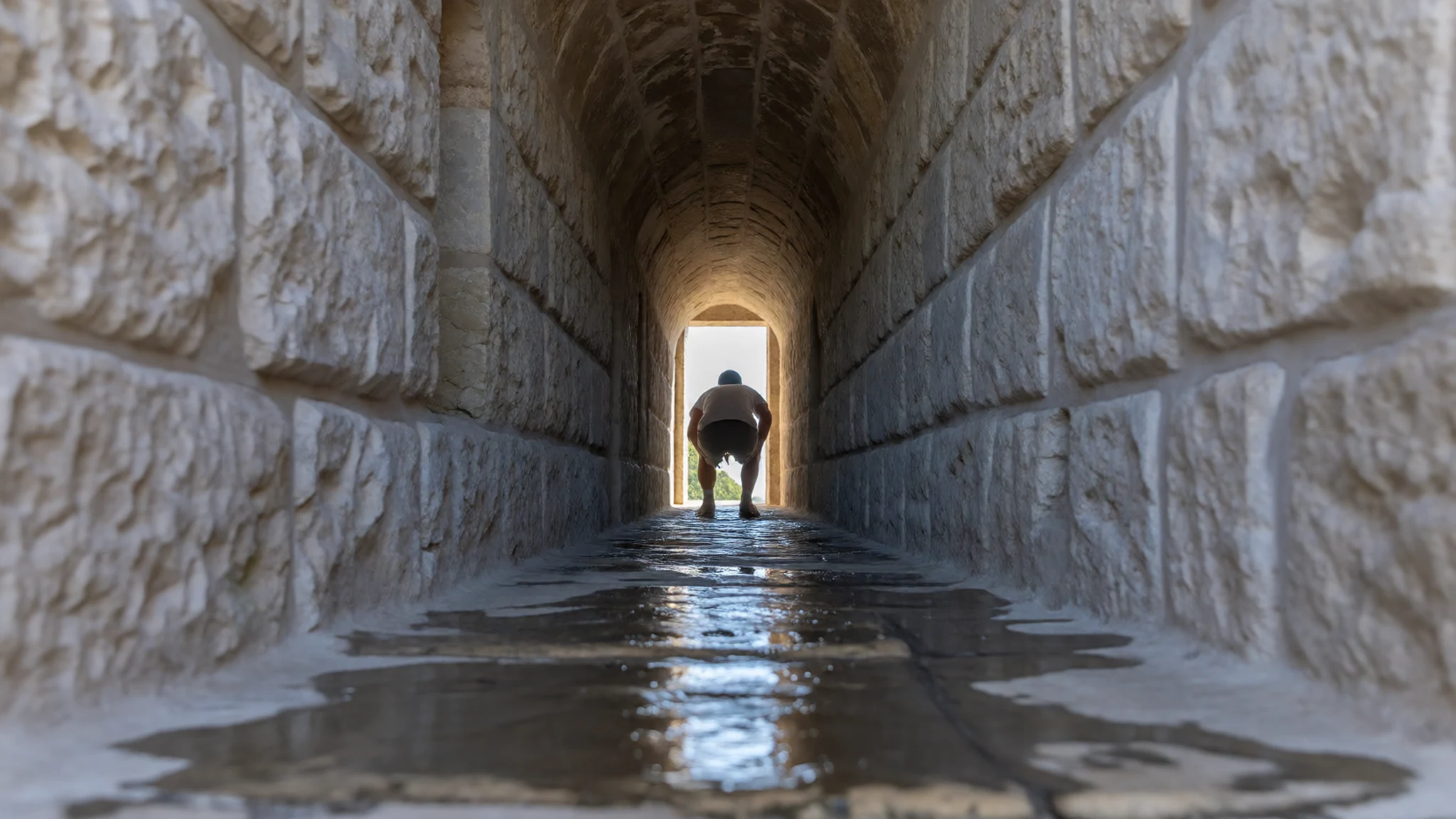
- Walls and pathways — Interior ramparts, Fort St. Catherine
The inner ways of Fort St. Catherine turn between high stone walls, with short steps and sudden openings onto the gun floor. They were garrison routes, not a promenade, so widths change and corners arrive without warning. Rain darkens the stone and slicks the steps; sun throws a hard white light off the walls. Each turn shows how storage, movement and firing positions fold into one small headland.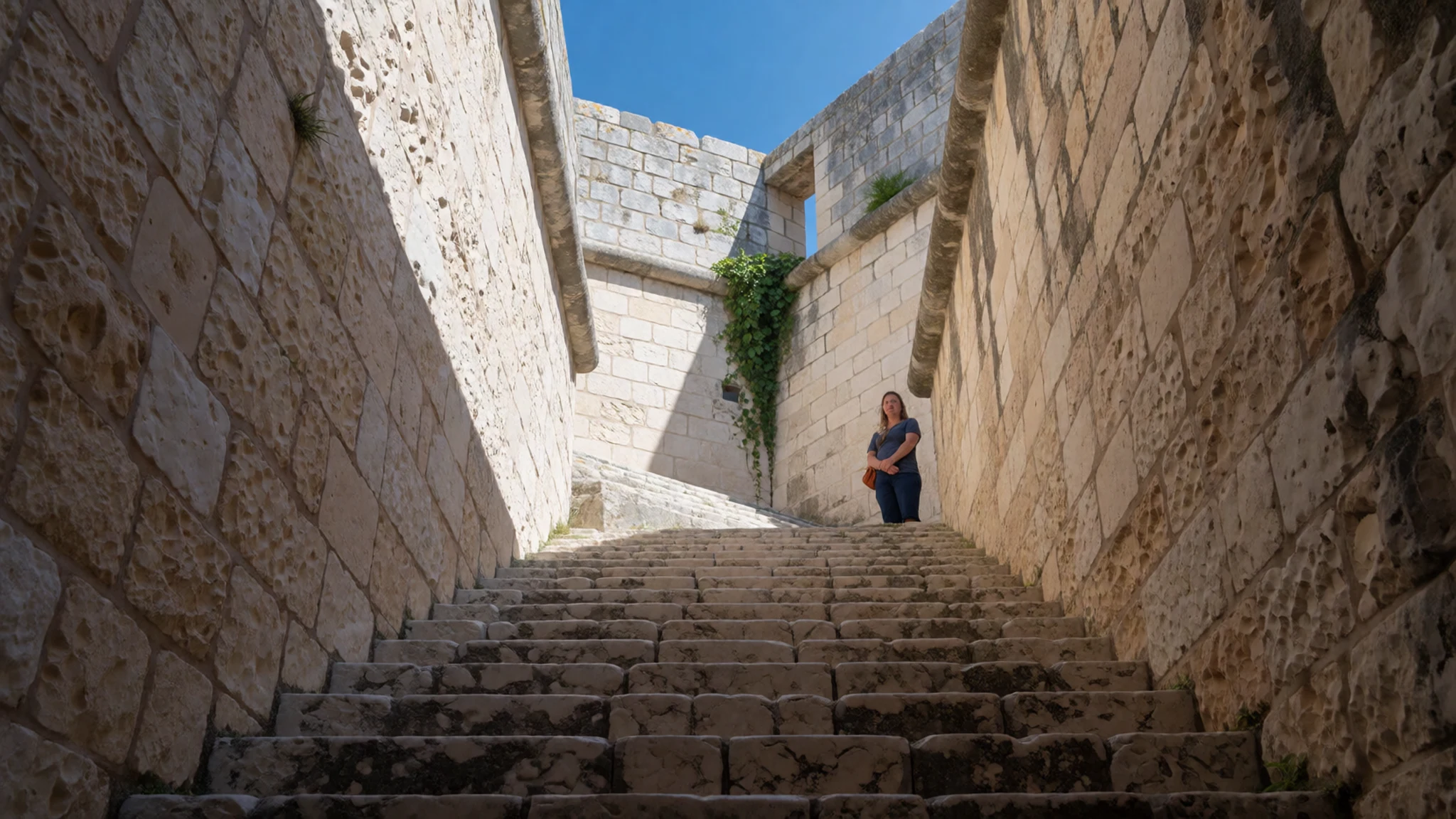
- The museum gate — Entrance, Fort St. Catherine
A sign at the entrance marks Fort St. Catherine as both fort and museum. The rooms off the passages hold the displays; the structure itself is the larger exhibit. Garrison life, the wreck that drew the English to Bermuda, and the fort's guns are told indoors, then set against the real walls outside. Leaving after only the roof misses why the passages exist.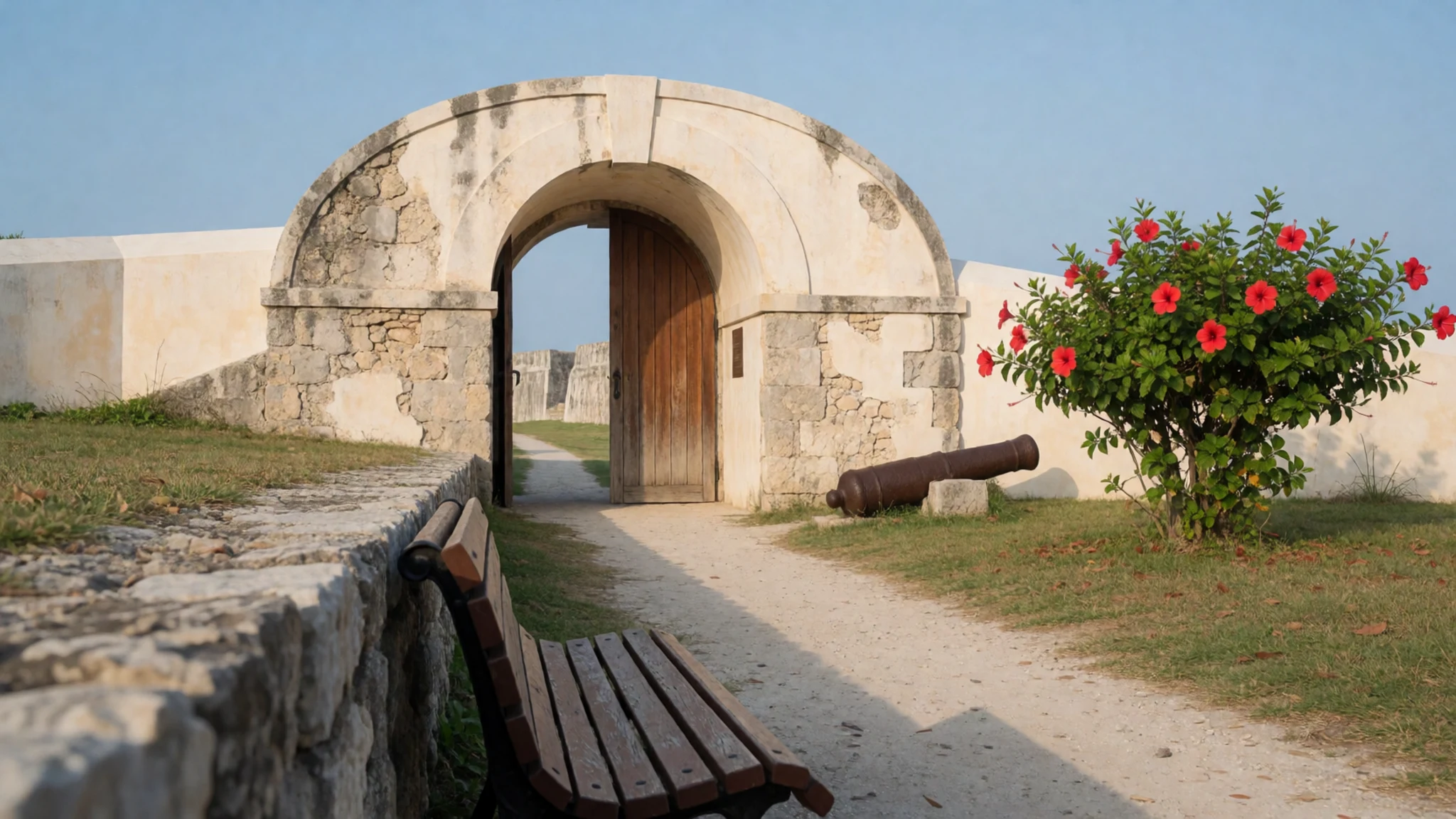
Culture
Life around Fort St. Catherine is St. George's life: a small, church-and-harbour town that still keeps British civic habits and a Bermudian calendar of its own. Sunday retains a quiet weight. Greetings are unhurried, and strangers get a nod on the paths outside the fort. Gombey troupes, in capes, masks and drums, appear at festivals rather than as a daily street performance; they are a living tradition with roots in African and Caribbean dance, not a backdrop hired for the ramparts. Cricket, sailing and the regimented pleasure of a well-kept town square matter more here than nightlife.
The fort sits inside that tone. It is a place of work that became a place of looking, and residents treat it as local heritage rather than a backdrop for stunts. Voices carry in the passages. The gun floor is a workplace people are proud of, which makes clowning on the barrels feel off even when no sign is watching. Visitor etiquette at Fort St. Catherine is simple: stay off the guns and the parapet edges, keep to the marked passages, and ask before photographing people in the tunnels.
What to wear
Fort St. Catherine stands on an island whose familiar day dress is a tailored short, often mistaken for something the garrison wore. Men wear knee-length shorts in cotton or a wool blend, cut like truncated trousers, with knee socks, loafers and, for business or a formal day, a blazer and tie. The cloth is meant to look pressed, not beach-faded. Women in town lean to linen, cotton shirt-dresses and clean pastels. That is day dress for Hamilton offices and for St. George's when there is a ceremony, not a costume issued at the fort gate.
On an ordinary day the island dresses for heat and water. Swimwear, rash guards and loose shirts fill the beaches; collared shirts and sundresses appear in town. The fort is the awkward middle. Its gun floor is fully exposed, its passages are dim and sometimes damp, and the beach sits close enough that people arrive in sand. A visitor does better in light trousers or a longer short, a shirt with sleeves, a hat, and shoes that grip wet stone. Flip-flops twist on the steps. Bare chests and dripping swimwear read as beach clothes brought indoors. A light layer helps: the Atlantic wind on the roof is cooler than the cove below, even when the town feels airless.
What to eat
- Bermuda fish chowder — Harbour eateries in St. George's
Bermuda fish chowder is a dark, tomato-tinted soup, finished at the table with sherry peppers and black rum. Harbour eateries in St. George's serve it year-round, leaving the pepper sauce within reach so the heat stays adjustable. It works as lunch after the fort.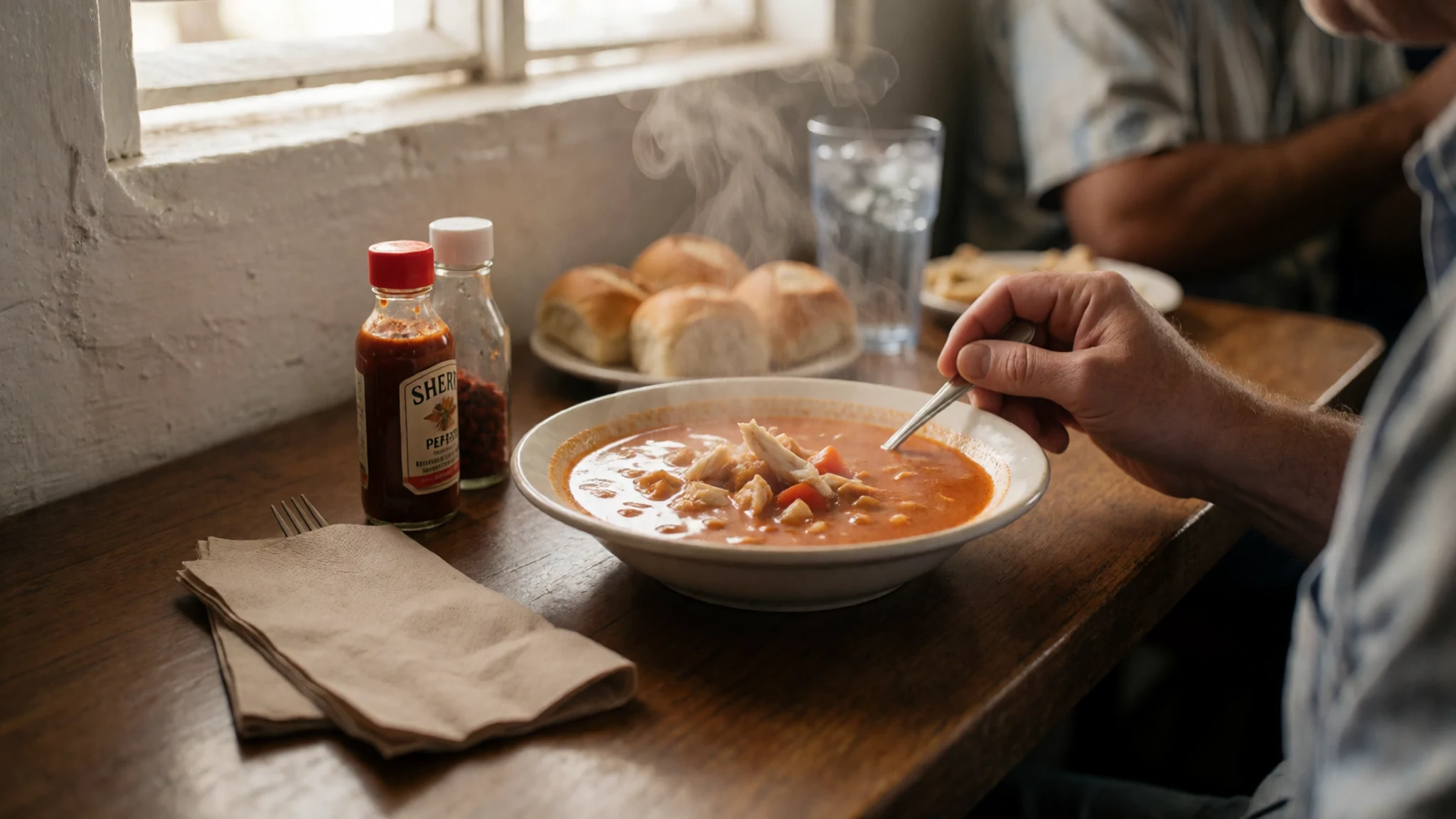
- Fried fish sandwich — Takeaways around St. George's
A Bermudian fish sandwich is fried fish on raisin bread, with tartar sauce and sometimes cheese. The sweet bread is the part newcomers notice. Takeaways around St. George's wrap it for the bench between town and the fort road, a practical lunch after a morning on the gun floor.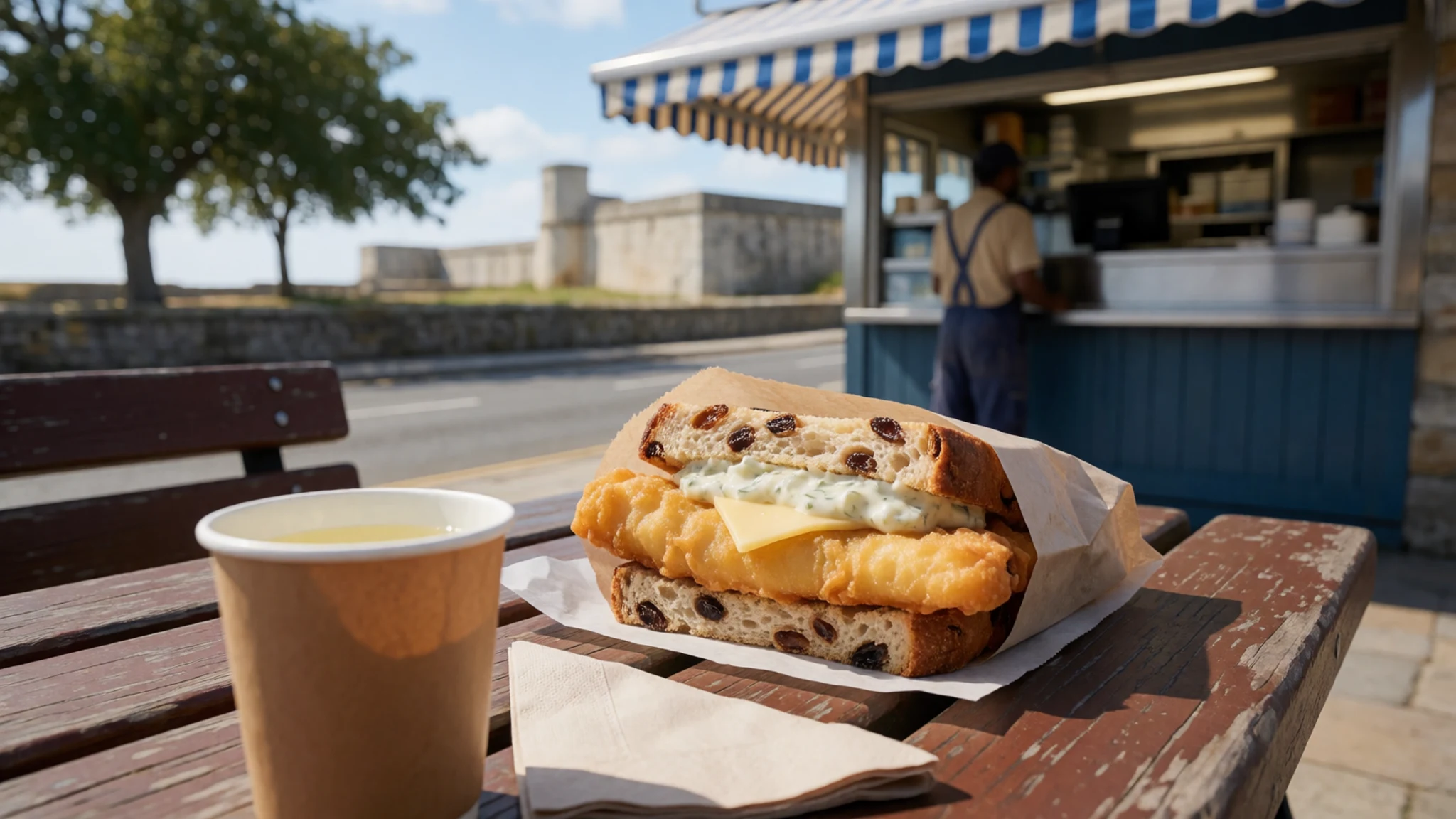
- Codfish and potatoes — Weekend breakfast tables in St. George's
Salt cod with boiled potatoes, banana and avocado is the old weekend breakfast, built for a morning on the water. Eateries in St. George's still serve it as a proper plate. It is heavy, and better before a walk to Fort St. Catherine than after sun on the ramparts. - Cassava pie — Bakeries in St. George's
Cassava pie is a dense, slightly sweet cassava bake, traditionally made with chicken or pork at Christmas and now found more often year-round in St. George's bakeries. The texture sits between cake and savoury pudding. A slice is no longer a winter privilege, since the bakeries keep it through the year. - Rum swizzle — Harbour terraces in St. George's
The rum swizzle is Bermuda's stirred long drink: dark and light rum, fruit juice and bitters, mixed until it froths. Harbour terraces in St. George's treat it as the usual cooler. It is stronger than it tastes, so it belongs after Fort St. Catherine, not before the steps.
Plan it
Best time. April and May suit Fort St. Catherine, April the driest and most comfortable, May warm before the humid months; August is both the hottest and the wettest. October and November are milder than August but still inside the June-to-November hurricane season, with fewer cruise-ship mornings. Summer is hot, close and inside the hurricane season, so the passages feel airless. Winter is much cooler than the Caribbean, gales are common, and the roof is windy and the sea rough.
How long. 1–2
Getting there. Fly into L.F. Wade International Airport, then cross the island to St. George's by bus, taxi or ferry. Fort St. Catherine sits on the eastern headland, a short last leg from the old town by bus, taxi or the shore road. Check the official site for opening days before setting out.
Budget. high
Tips
- Start when the gate opens on days when cruise ships are in St. George's; the passages crowd by late morning.
- Wear shoes that grip. The munitions passage and the steps are stone and often damp.
- Carry water. The gun floor has almost no shade, and the wind is a poor substitute for a drink.
- Keep a little cash as well as a card. Small stalls around St. George's do not all take the same payment.
- Pair the fort with the old town rather than rushing back across the island. The two share a single outing.
Etiquette
- Do not climb on the guns or sit on the parapet edge.
- Keep voices low in the passages, where sound carries.
- Ask before photographing people in the tunnels or on the beach.
- Change out of wet swimwear before going inside from the shore.
Nearby
Sources
- Wikidata (CC0)
- Wikipedia (CC BY-SA 4.0)
- Wikivoyage (CC BY-SA 4.0)