Amarbayasgalant
Amarbayasgalant, Mongolia
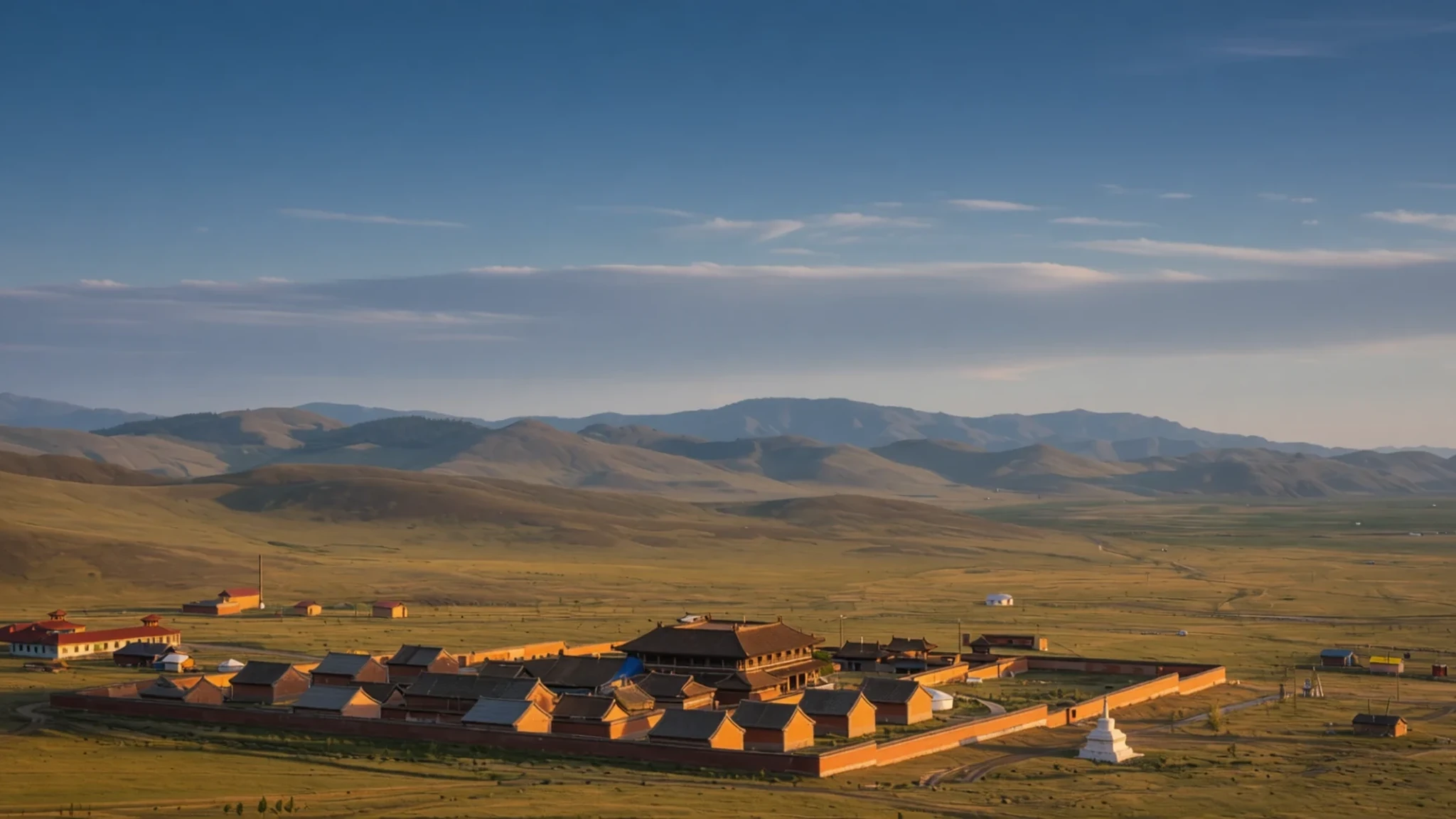
Amarbayasgalant is a restored Gelug monastery in a quiet Selenge valley, worth the long road for its halls, stupas and living prayer.
The place
Amarbayasgalant sits in a wide valley in Selenge aimag, northern Mongolia, where grassland runs up to forested ridges and a Buddhist monastery holds the middle distance. The Mongolian name, Амарбаясгалант, is usually rendered as a place of calm joy. From the approach the complex reads as a single composition: whitewashed walls, red timber, and grey tiled roofs with upturned eaves, set on a level terrace with hills closing the view behind. The plan is axial and formal, closer to a Qing-era Chinese monastic layout than to a scattered nomadic camp, with gateways, courtyards and shrine halls aligned so that a walker moves from the outer world toward the main assembly space. Inside, the tradition is Gelug, the Tibetan Buddhist school long established across Mongolia, and the visual language mixes that inheritance with Manchu and Chinese building craft: painted beams, thangkas, butter lamps, and statues of the Buddha and the bodhisattvas. A small community of monks keeps the daily rhythm of chanting and offerings. Around the built core the valley stays open. Herders' animals, larch-covered slopes and a huge quiet are part of the place, not a backdrop added for visitors. Reaching Amarbayasgalant means a long road north from Ulaanbaatar through Selenge's farmland and steppe, then a last stretch into the valley; there is no city at the gate, and services thin out well before the walls. Wind, dust and a sharp change of temperature between noon and evening are ordinary. The reward is the scale of the architecture against the emptiness around it, and the sense that worship here is a restored habit rather than a performance staged for the road.
Its story
Amarbayasgalant was raised as a monument to Zanabazar, the Jebtsundamba Khutuktu whom Mongolians remember as Öndör Gegeen, a monk-ruler, sculptor and scholar who shaped the country's Buddhist culture and devised the Soyombo script still used as a national emblem. After his death the Qing court ordered a monastery worthy of that memory, and builders laid out a formal complex in this valley rather than in a city. The halls were made to house his cult and the Gelug teaching he had anchored in Khalkha Mongolia: an assembly temple and shrines set behind successive gates. For generations the place functioned as a seat of monastic learning and pilgrimage, linked to the wider Tibetan world by lineage even while its roofs and brackets followed Chinese court architecture. When Mongolia's revolutionary state turned against the monasteries, communities were broken up, images and books were lost, and Amarbayasgalant, like so many other foundations, was left damaged and largely empty. What survived was the bones of the plan: walls, platforms and some of the principal halls standing in a valley that had gone quiet. Later decades brought repair. Roofs were retiled, painting was renewed, and monks returned to light lamps and chant in rooms that had stood unused. The story a visitor meets now is therefore a double one. Amarbayasgalant is both a Qing-era memorial to Zanabazar and a place pulled back into use after a long interruption, its Soyombo-marked prayer wheels and hillside shrines carrying a tradition that had to be reassembled piece by piece.
What to see
- Assembly hall — Central terrace
The principal hall at Amarbayasgalant stands on the central axis, a red-and-white building under a heavy tiled roof. Painted columns, thangkas and figures of the Buddha surround the space where monks gather to chant. Butter lamps and incense thicken the air. People at prayer take precedence over anyone passing through, and a camera stays down until a monk or caretaker has agreed.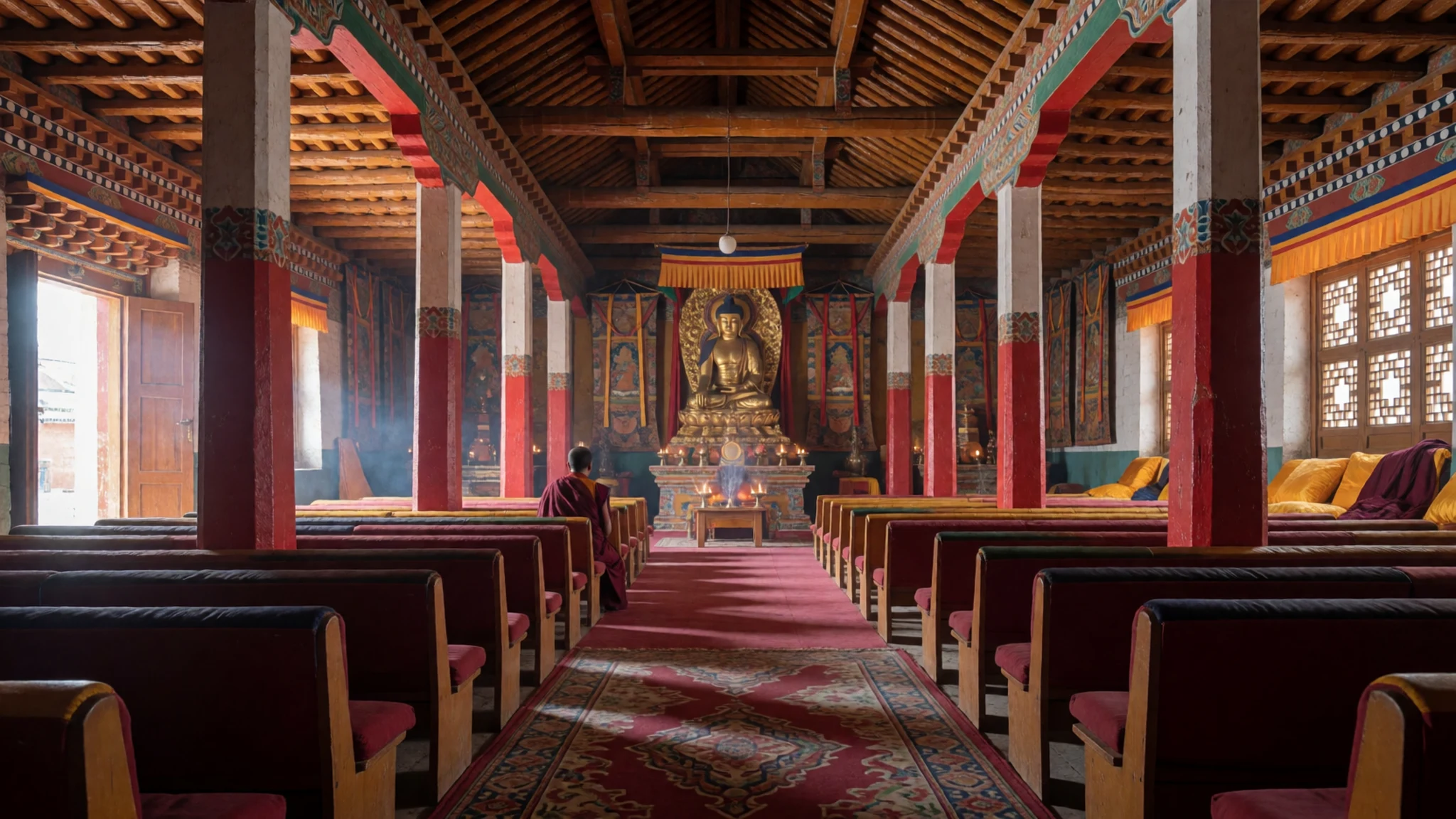
- Courtyards and roofs — Monastery axis
Amarbayasgalant's outer view is a run of gates, side halls and grey roofs along a gentle axis toward the mountains. The carpentry follows a Chinese outline, with bracketed eaves, glazed tiles and symmetrical wings, while the rooms serve Mongolian Gelug worship. The courtyards show both the formal plan and the repairs that brought it back into use. Gravel paths and little shade make a hat and closed shoes sensible.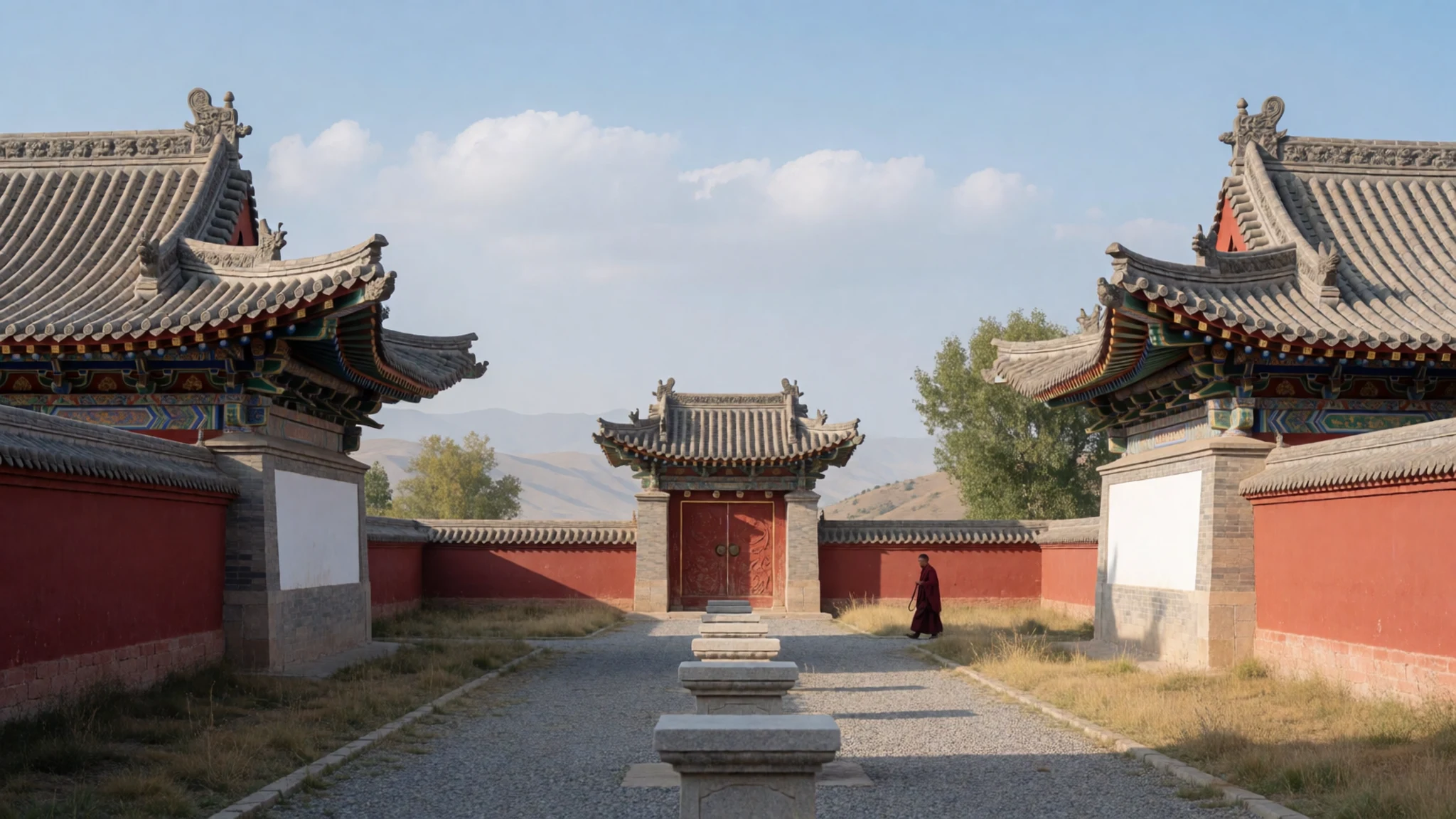
- Hillside stupa and Buddha — Hillside above the halls
Above the roofs at Amarbayasgalant a path climbs to a white stupa and a seated Buddha looking over the valley. The walk is short but exposed, with loose ground and wind once the trees thin. From the statue the monastery reads as a whole: walls, courts and the dark ridge behind. Circumambulation, where people do it, goes clockwise.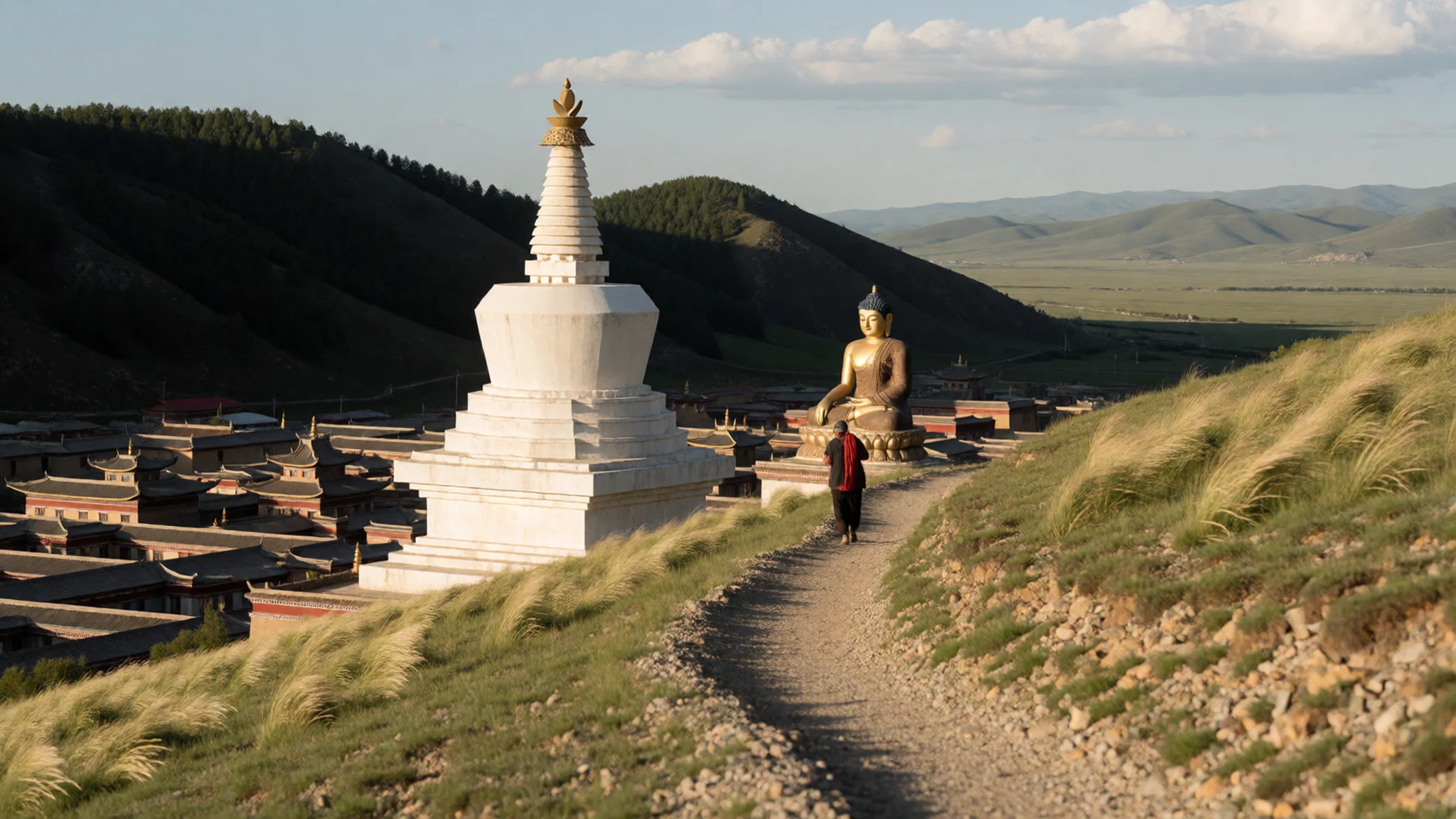
- Soyombo prayer wheels — Courtyard edges
Brass prayer wheels at Amarbayasgalant carry the Soyombo, the script emblem Zanabazar devised, raised on the metal in clear relief. Turning a wheel is a form of prayer in itself, done with the right hand and in a clockwise direction as one walks. The rows sit where a person can use them without entering a shrine, so they are a straightforward object to turn with respect.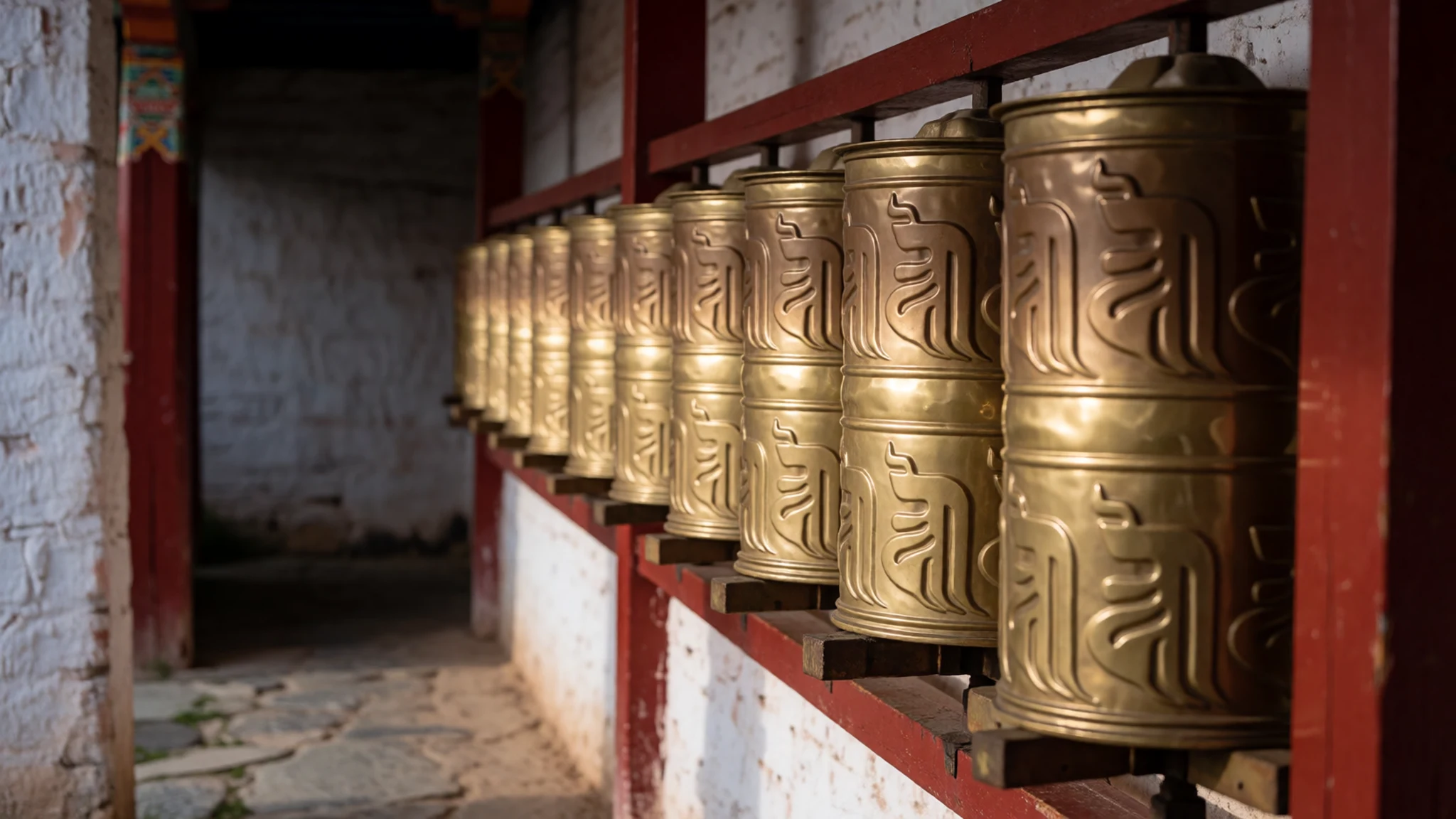
- The valley — Iven valley, Selenge
The wider sight at Amarbayasgalant is the valley itself: open grass, scattered trees, and forested slopes of Mount Büren-Khaan behind the roofs. Nothing in the view is arranged as a garden. Herds, weather and the long dirt approach are what hold the monastery in its setting. Late light picks out the white walls against darker hills. Wind and uneven ground come with any walk away from the courts.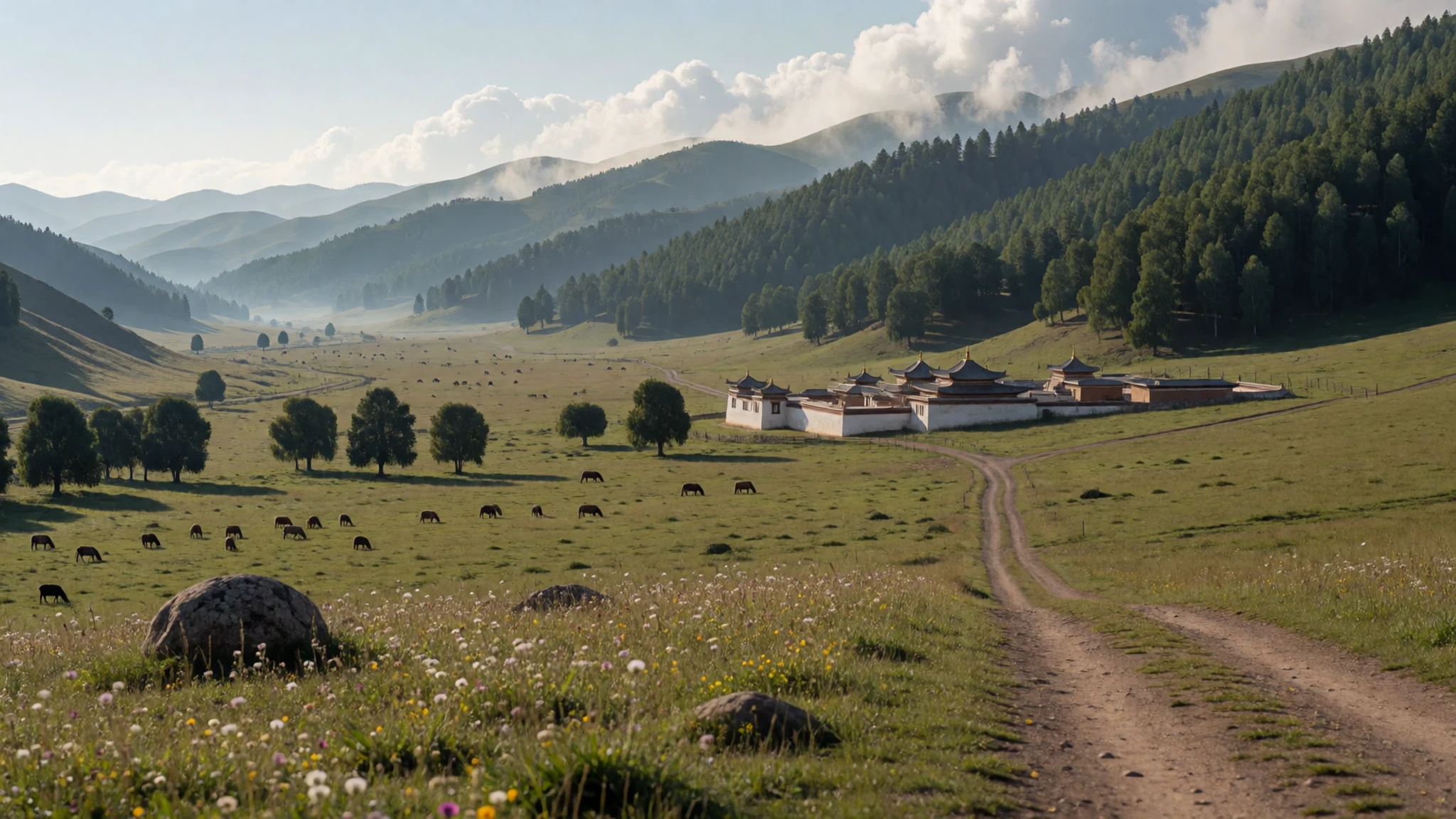
Culture
Amarbayasgalant keeps a living Gelug routine: chanting, butter-lamp offerings and the slow use of prayer wheels by monks and by lay people who have come a long way. The faith practised here is the Tibetan Buddhism that Zanabazar established among the Khalkha, with a particular memory of him as Öndör Gegeen, scholar, sculptor and inventor of the Soyombo script. That emblem, cast on the brass wheels, links devotion to a symbol Mongolians also meet on flags and official seals. The architecture may look Chinese, but the gestures are those of a Mongolian monastery: clockwise movement, reverence for teachers, and a preference for quiet over explanation. There is no timetable of ceremonies arranged for outsiders. A puja happens because it is the monastic day, and visitors who coincide with it are expected to stand aside. Families bring offerings and ask for prayers; herders from the valley treat the place as their own temple. The restoration matters culturally because so much of Mongolia's monastic life was broken in the revolutionary years, and a working community here is a recovered thread, not a reconstruction for show. At Amarbayasgalant, remove your hat and shoes where the threshold indicates, walk prayer wheels clockwise, and ask before you photograph any monk.
What to wear
At Amarbayasgalant the traditional garment still seen on festival days and at blessings is the deel, a long wrap-over robe cut in silk, brocade, cotton or wool according to season and means. A wide sash closes it at the waist, and the cuffs and collar often carry a contrasting cloth. Felt and sheepskin versions belong to winter; lighter cotton and silk belong to warm months and to formal visits. Monks do not wear the deel for liturgy. Their robes are the maroon and saffron cloths of the Gelug order, layered and practical for kneeling on a cold floor. Most people who come on an ordinary day now dress in contemporary clothes: jeans, quilted jackets, trainers or boots, a sun hat in summer and a heavy coat once the wind rises. Herders may mix a deel with modern layers. A visitor does well to copy the modest end of that range. Shoulders and knees covered please the shrine rooms, loose trousers beat shorts, and a scarf is useful both for dust and for covering the head if asked. Shoes should come off easily at thresholds and still cope with gravel, mud and the hillside path. Bright costume is unnecessary; clean, quiet clothing that can take a temperature drop between the sunny court and the dim hall is the right packing.
What to eat
- Buuz — Roadside canteens and ger kitchens on the Selenge drive
Buuz are steamed dumplings of mutton and onion, pleated closed at the top. Around Amarbayasgalant they turn up in roadside canteens and ger kitchens on the Selenge drive. They are the reliable hot meal when the monastery itself has no dining room.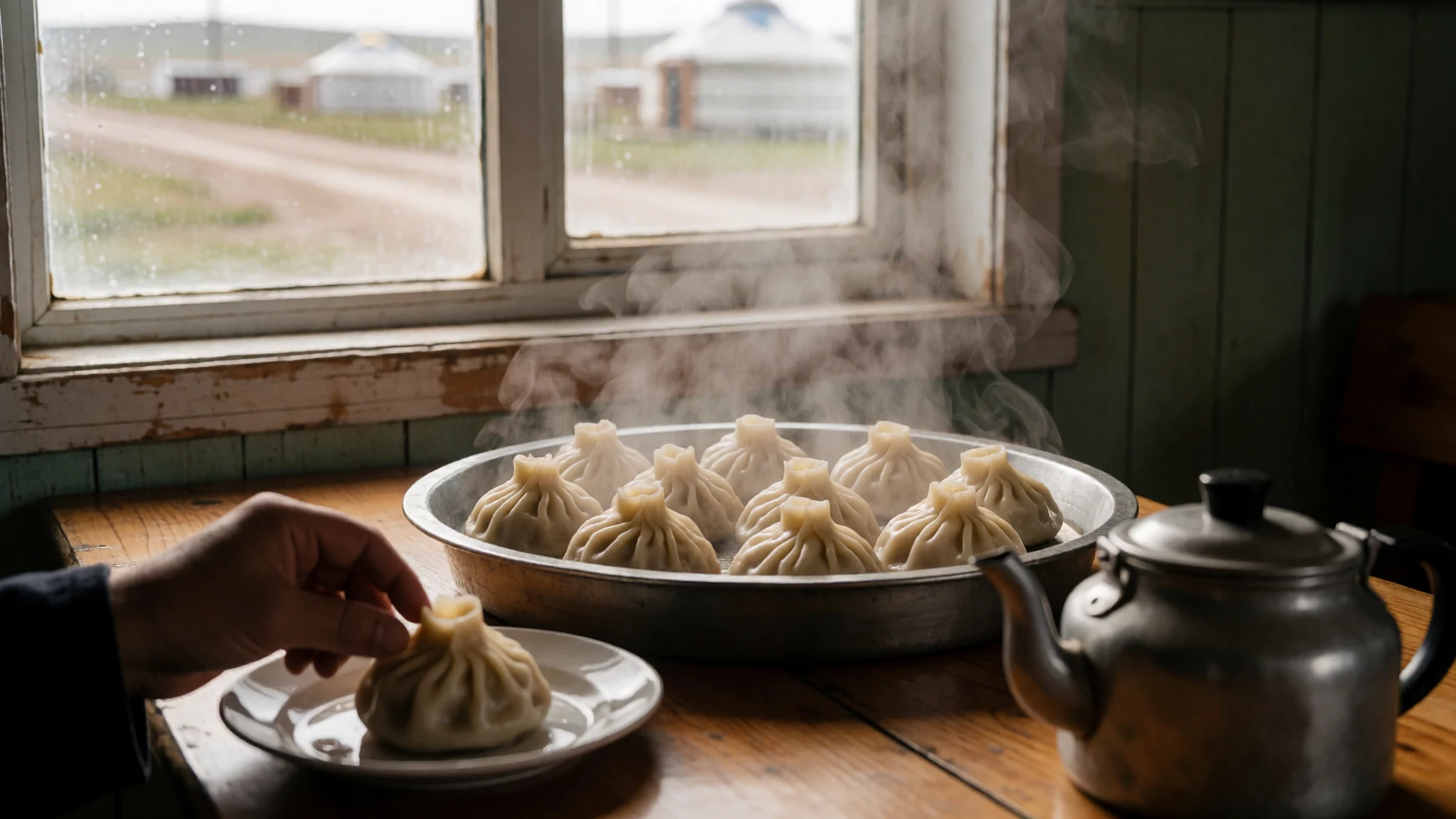
- Khuushuur — Canteen windows and gers on the roads toward the monastery
Khuushuur are flat, fried pastries stuffed with seasoned mutton, crisp at the edge and soft in the middle. On the roads toward Amarbayasgalant they are sold from canteen windows and from gers that cook for passing drivers. They are the usual lunch eaten beside the car.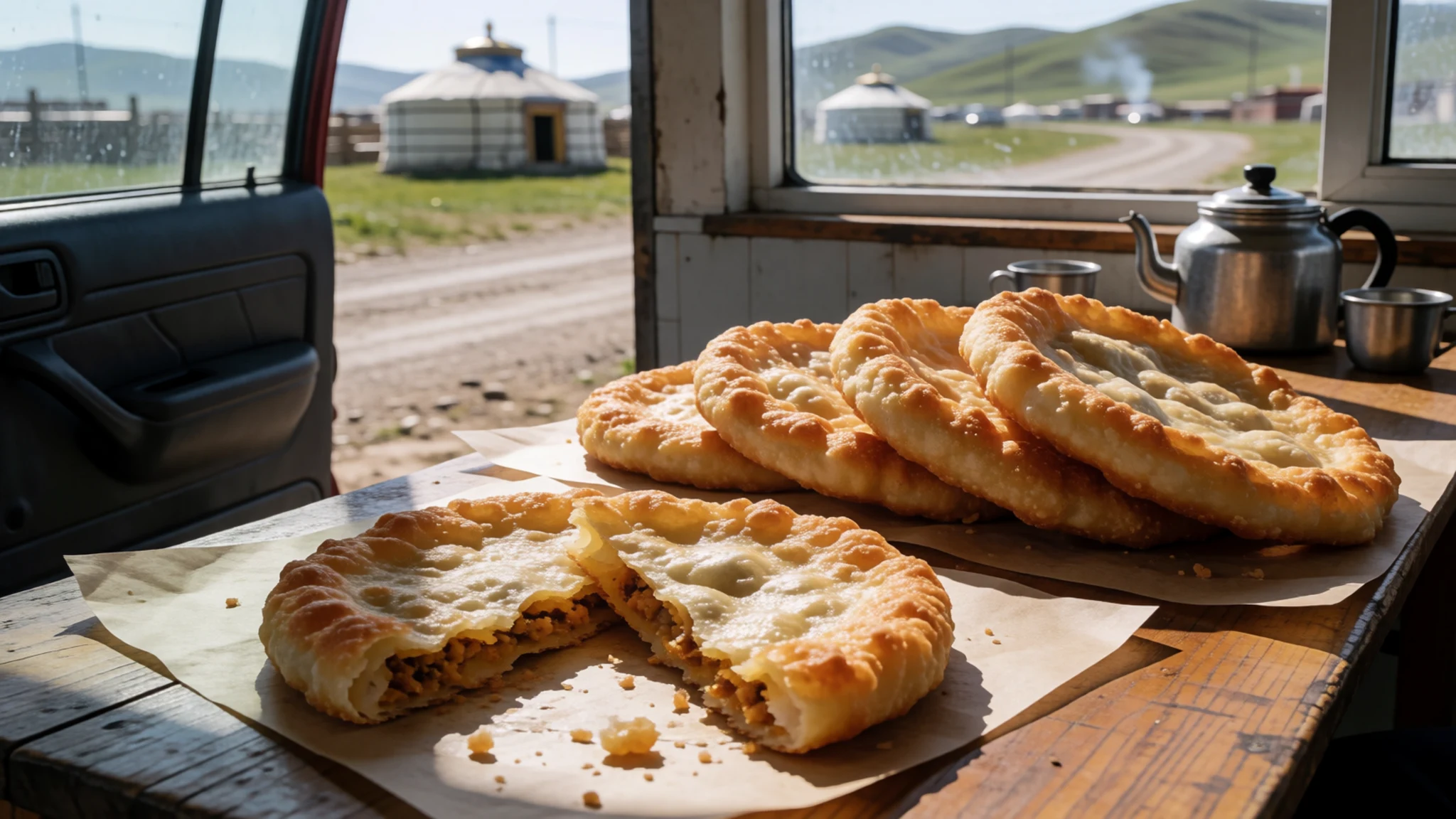
- Suutei tsai — Gers and a monastery household
Suutei tsai is Mongolian milk tea, brick tea boiled with milk and a pinch of salt. At Amarbayasgalant it is the drink of welcome in a ger or a monastery household, offered in small bowls. It tastes savoury rather than sweet. - Tsuivan — Eateries in Selenge sum centres
Tsuivan is a stir-fry of hand-cut noodles, mutton and simple vegetables such as carrot, cabbage and onion. Eateries in Selenge's sum centres serve it on the way to Amarbayasgalant. The dough is rolled, cut and cooked in the same pan as the meat. - Aaruul — Small shops in the sum centre and herding families near the valley
Aaruul is dried milk curd, hard and sour-sweet, carried as a pocket snack. Around Amarbayasgalant it is sold in small shops in the sum centre and sometimes offered by herding families near the valley. It keeps without refrigeration on a day when the next meal is uncertain. - Boortsog — Gers and family kitchens along the valley road
Boortsog are small pieces of fried dough, plain or faintly sweet, eaten with tea. Near Amarbayasgalant they appear beside milk tea in gers and family kitchens along the valley road. They fill a gap when the drive runs long and a proper meal is still ahead.
Plan it
Best time. The practical season for Amarbayasgalant runs from June to September, when the Selenge valley is green; July is hottest, August wettest and September most comfortable. Winter snow and hard cold make the valley difficult to reach, and the spring thaw turns the tracks to mud. Early autumn can be clear and quiet before the freeze.
How long. 2–3
Getting there. Chinggis Khaan International Airport in Ulaanbaatar is the usual air gateway. From the city the journey to Amarbayasgalant is by road north through Selenge, with a long unpaved last leg into the valley. Public transport does not reliably end at the monastery, so most people arrange a driver and confirm the turn-off before leaving. Check the road after rain.
Budget. mid
Tips
- Arrange a driver who knows the valley turn-off rather than hoping for a lift on the day.
- Carry cash, because card payments are not something to count on once you leave Ulaanbaatar.
- Bring drinking water and a packed lunch; Amarbayasgalant has no town services at the gate.
- Set out early so you are not on the unpaved stretch after dark.
- Wear layers: sunny courtyards heat up, while the halls and the wind stay cool.
Etiquette
- Take off your shoes and hat wherever a step, a mat or a row of slippers marks the interior.
- Walk clockwise around stupas and prayer wheels, and do not touch statues or scriptures.
- Ask before photographing monks or anyone praying, and stay quiet while chanting is under way.
Nearby
Sources
- Wikidata (CC0)
- Wikipedia — Amarbayasgalant Monastery (CC BY-SA 4.0)
- Wikivoyage — Mongolia (CC BY-SA 4.0)