Yuanyang Rice Terraces
Yuanyang Rice Terraces, People's Republic of China
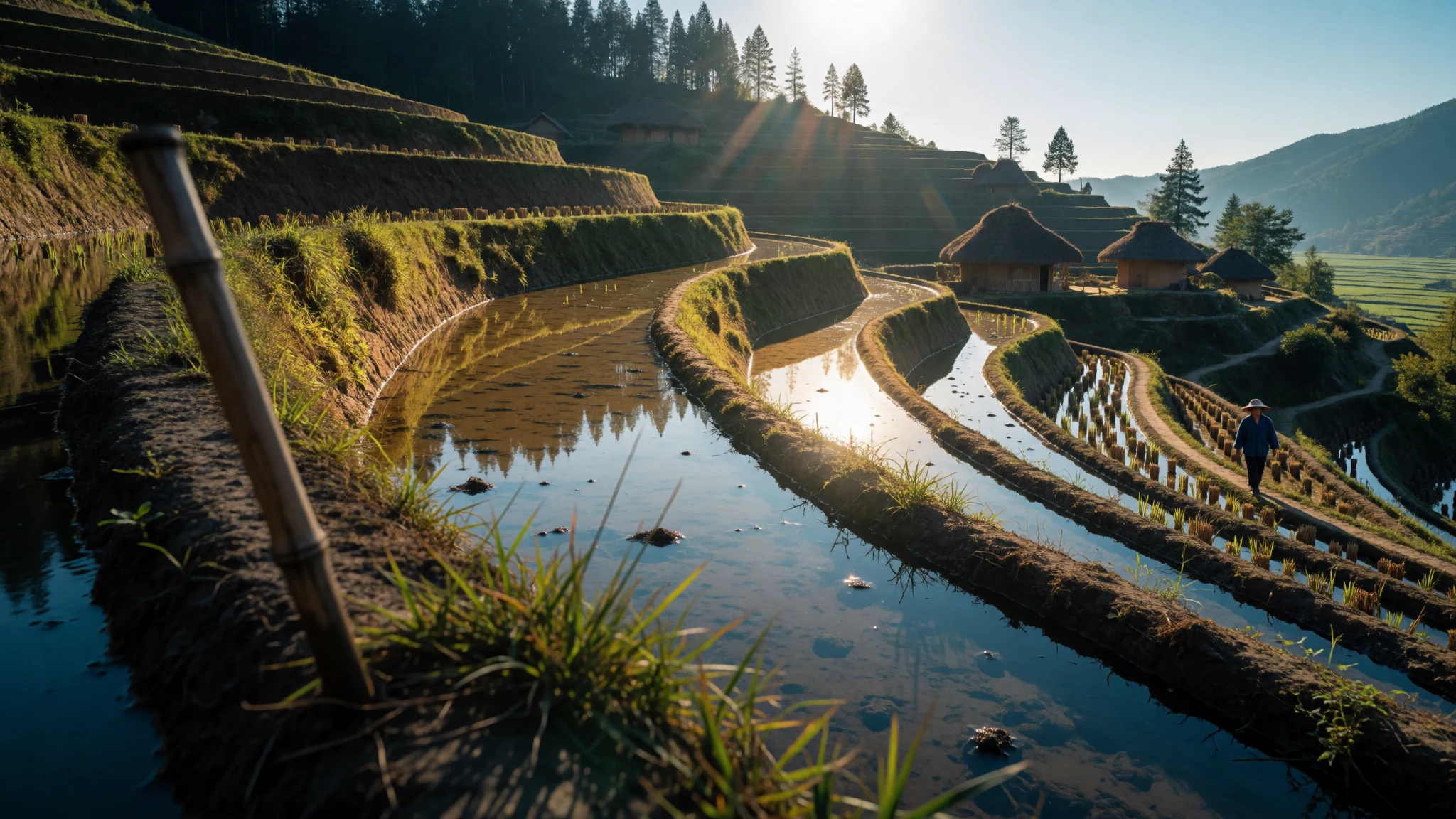
The Yuanyang Rice Terraces turn steep Yunnan slopes into flooded steps, where Hani villages and morning cloud share the view.
The place
The Yuanyang Rice Terraces cover the steep southern slopes of the Ailao Mountains in Yuanyang County, in Yunnan's Honghe Hani and Yi Autonomous Prefecture. From a ridge the hillside looks like a single pattern of steps, bunds and water, but it is a working farm, with hamlets set where the grade eases. The Hani people cut these terraces and still flood, plant and harvest them. Forested crests above the fields catch mist and feed the channels that run down through the paddies. Lower down, the land falls towards warmer valleys and the county's valley towns. In the weeks after harvest the paddies hold still water, so sky and cloud repeat in each step and the soil of the walls shows red. When the rice is tall the same hills turn a deep green and the geometry softens. Mornings often start inside cloud. A viewpoint can offer nothing but white, then open, ridge by ridge, onto houses and water. Afternoons are brighter, and the walk between hamlets feels longer once the sun is on the slope. Xinjie, a hill town, is the usual base for the viewing areas; Nansha, the county seat, sits much lower in the valley, warmer and farther from the ridges. Roads join the named overlooks, yet the last stretch is on foot, on narrow paths between houses and fields. This is a lived-in watershed: frogs at dusk, mud after rain, and quiet again once the sunrise crowds leave.
Its story
The Yuanyang Rice Terraces are a Hani landscape before they are a viewpoint. Families settled these Ailao slopes and cut the hillside into level steps so that rice could grow where the land itself runs downhill. The order of the slope is the story. Forest stays on the crests, holding soil and soaking up mist. Springs and carved channels carry that water past the village, through the paddies, and onward to the next hamlet down the hill. Houses sit in the middle band, above the fields they tend and below the trees that keep the water coming. Rice, and often fish in the same flooded plots, occupies the steps. Nothing in that arrangement is ornamental. A broken channel is a broken crop; a cleared forest spring is a dry terrace later in the year. The work is seasonal and shared. After the grain is cut, walls are scraped clean and patched before water is led back in. Planting follows, then the long green months, then harvest again. Festivals mark the turns of that year, with food set out for a whole village along a street, and with respect paid to the forest and the water rather than to the view. Outsiders arrived later, with cameras and guesthouses, and the sunrise ridges are now part of the local economy. The older plot still holds: people live among the terraces, farm them, and repair them. A morning of cloud and red water is a side-effect of that labour, not the reason the hills were cut.
What to see
- Duoyishu — Duoyishu
Duoyishu is a village people use for sunrise over the Yuanyang Rice Terraces. Paddies drop from a cluster of houses into a wide bowl, and flooded steps take the first colour while the valley is still cold. Cloud often fills that bowl and lifts late. Paths behind the houses change the angle quickly, so it is worth walking past the first platform.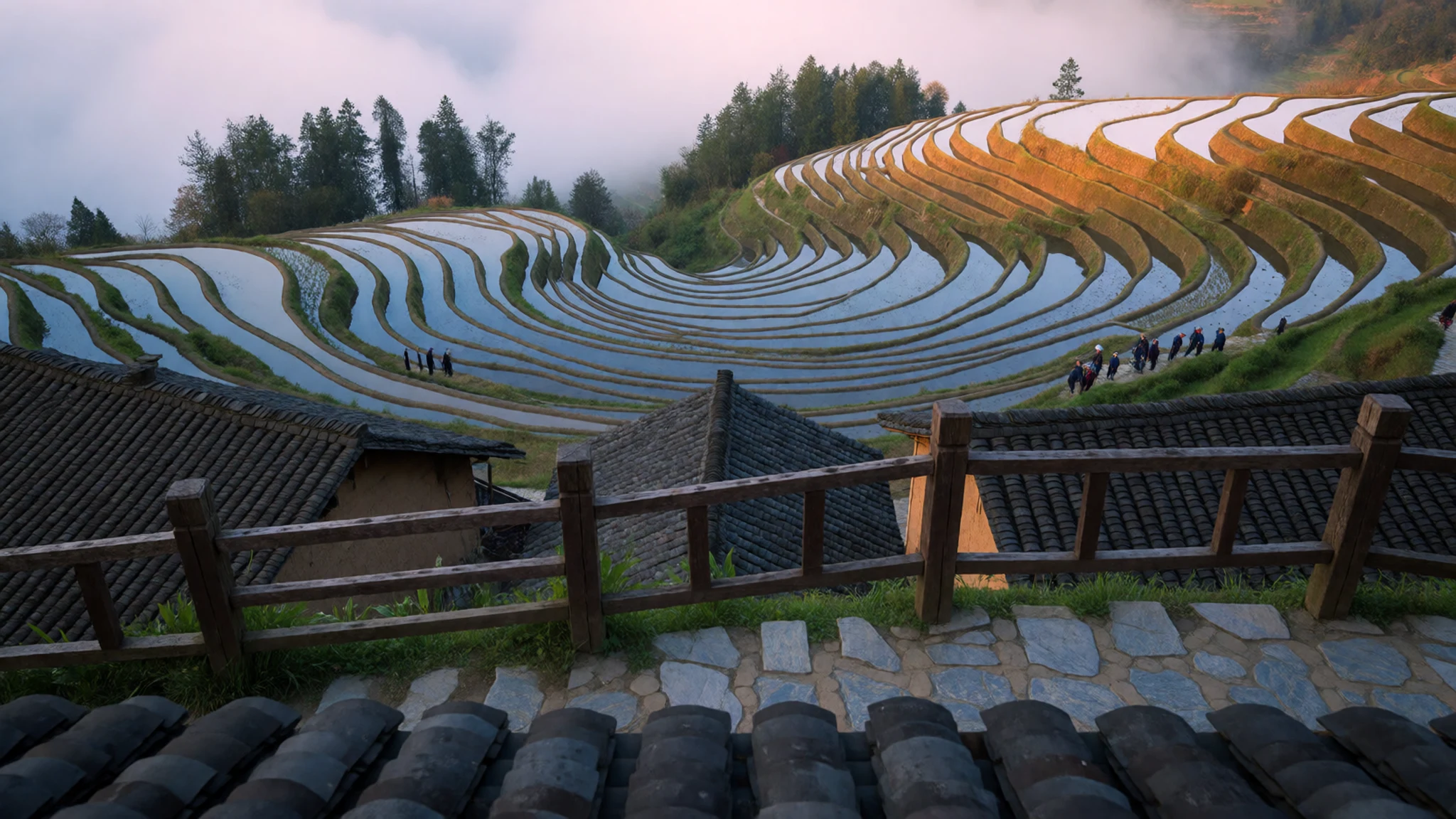
- Bada — Bada
Bada looks across a long run of the Yuanyang Rice Terraces towards a village on the far slope, and it is a good place to watch cloud pour through the valleys. The view is wide rather than intimate: many small paddies, dark tree lines, and hamlets that read as roofs among the steps. Morning is the usual time, though a late day can be fine if the haze stays high.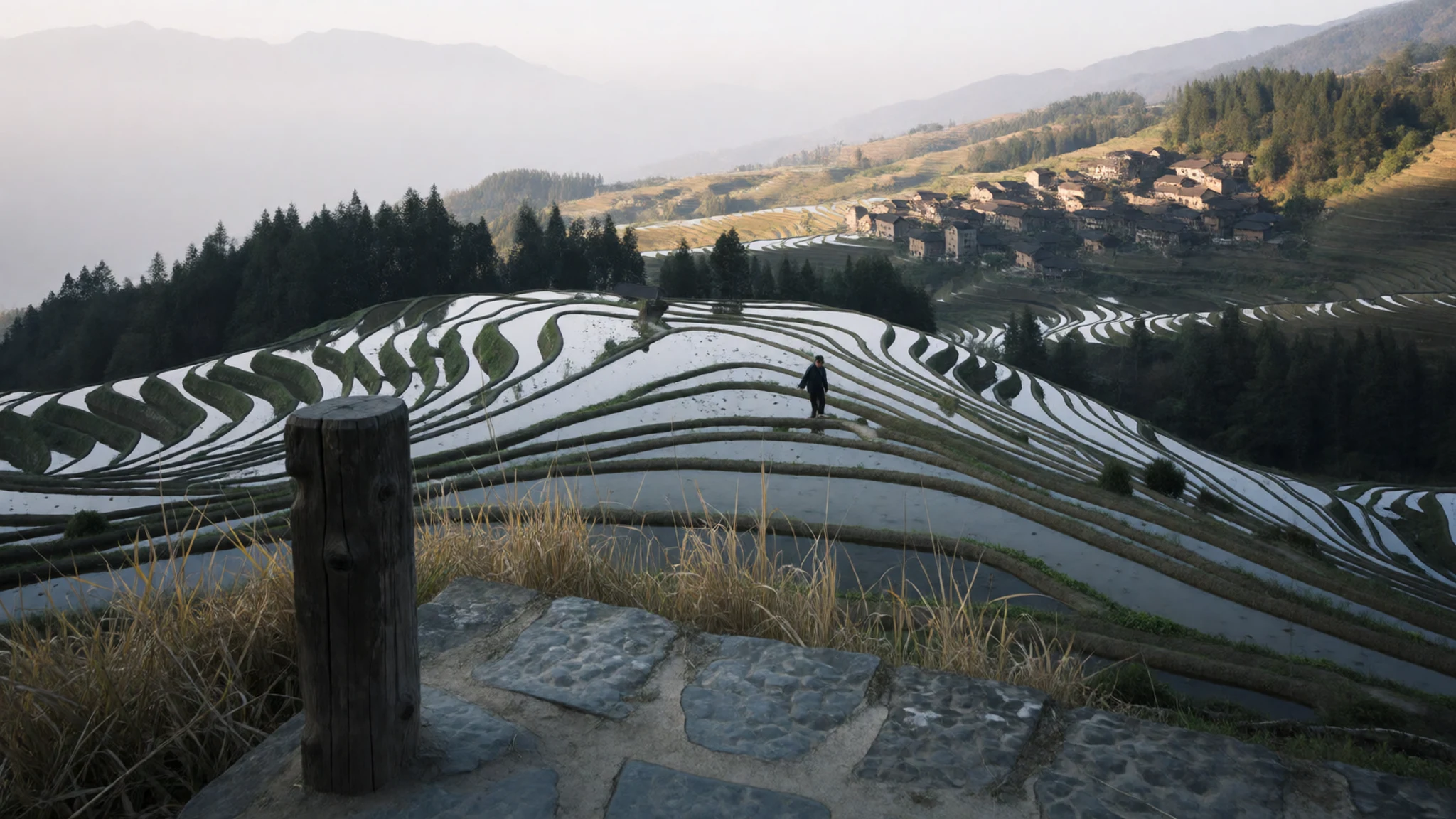
- Laohuzui — Laohuzui
Laohuzui (老虎嘴), often called Tiger's Mouth, is a sharp bend in the Yuanyang Rice Terraces where the hillside drops away around a narrow spine. The shape is the point: a thin viewing ridge, paddies packed below, and a long view into the next valley. Sunrise draws a crowd onto that ridge and the colour goes quickly. The path, not the terrace walls, is the place to stand.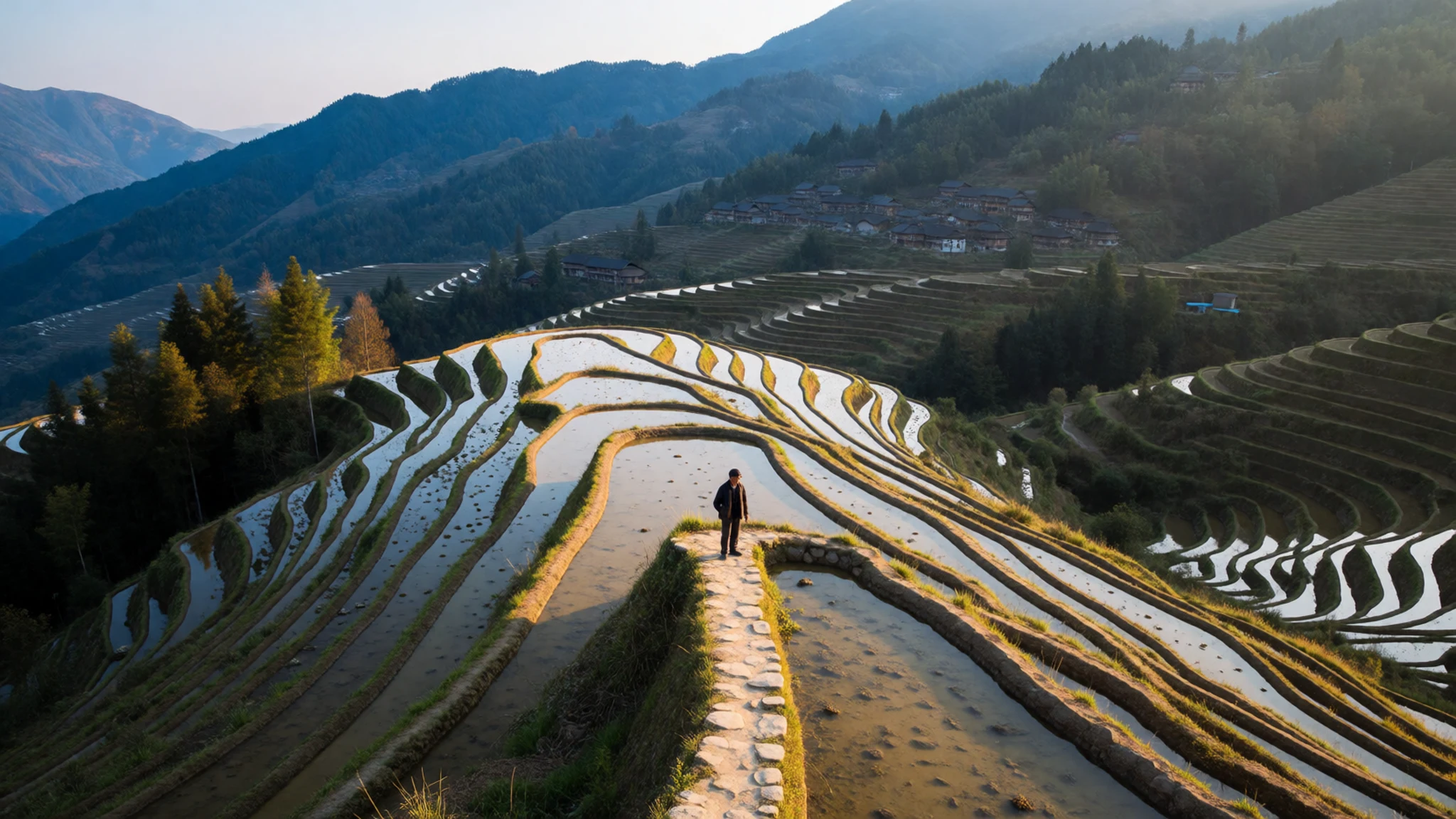
- Paozhuzhai — Paozhuzhai
Paozhuzhai sits high among the Yuanyang Rice Terraces, and cloud often fills the valley in the morning, leaving ridges and the tops of paddies in sight. Roofs, trees and the first water channels are part of the view before the slope breaks into steps. Thick cloud can hide all of it, so waiting is the visit. When the cloud breaks, the terraces appear in pieces.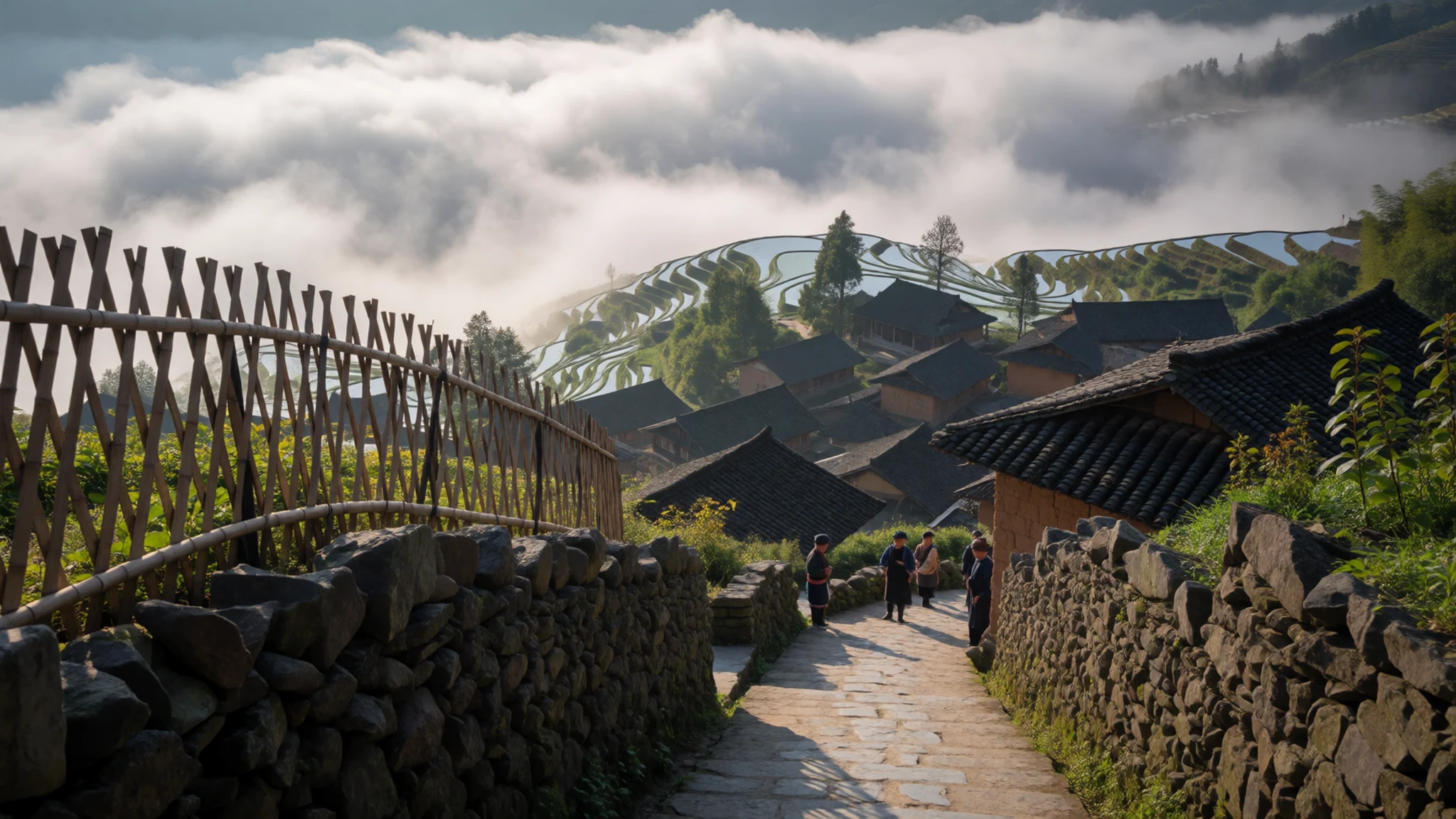
- Qingkou — Qingkou
Qingkou is a Hani village inside the Yuanyang Rice Terraces, visited less for a panorama than for forest, houses, channels and paddies on one hillside. Mushroom-shaped roofs, earth walls and the short walk from the houses towards the fields make the farming system visible at close range. Later morning suits it, once the sunrise ridges have emptied and the lanes are ordinary again.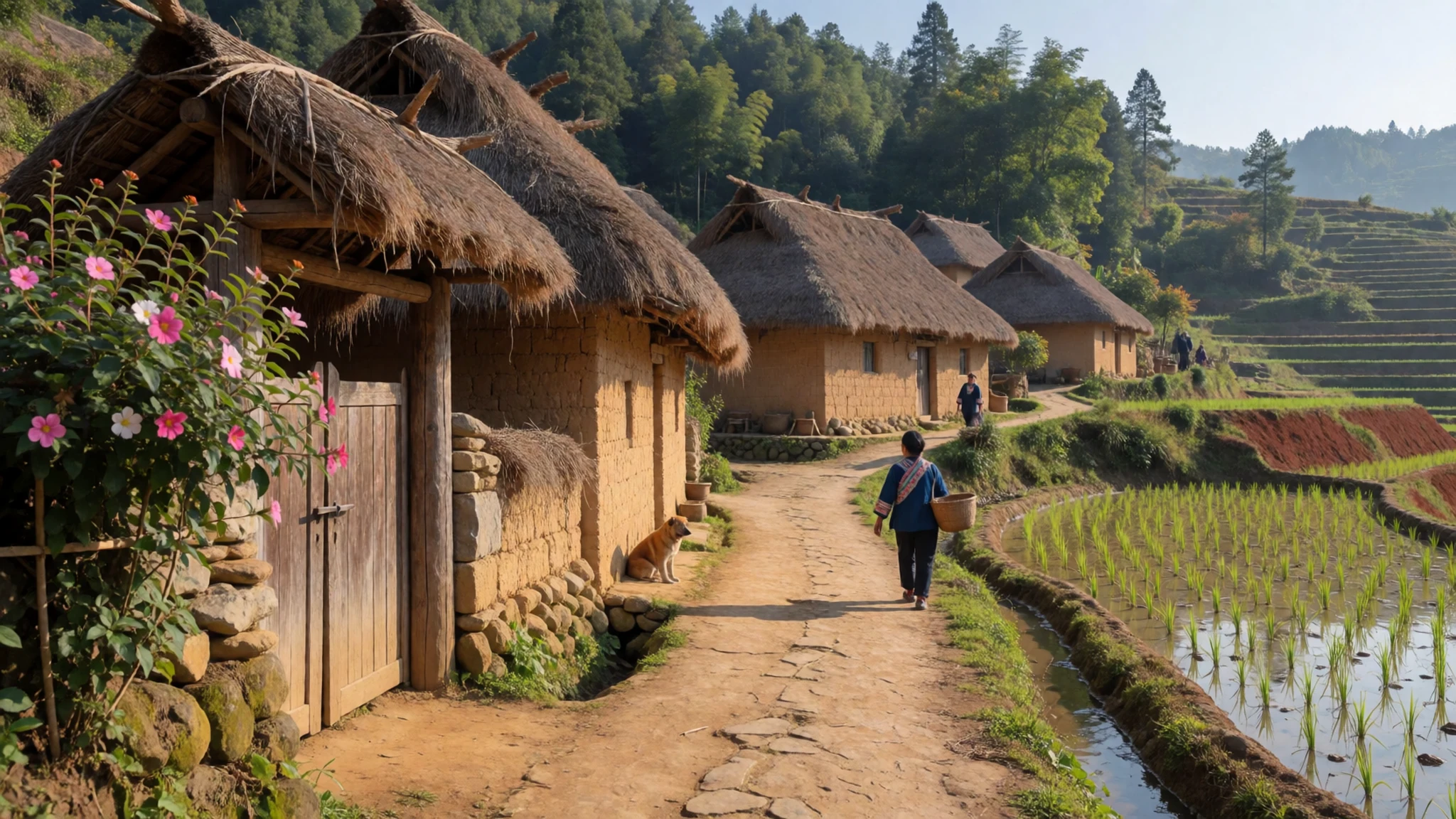
Culture
The Yuanyang Rice Terraces are Hani country, and the culture lives in the slope as much as in costume or festival. A village is placed on purpose: forest above it, fields below, water led through the middle. People speak of that order with pride, because the forest is what keeps the ditches running. Houses of earth, timber and thatch, sometimes called mushroom houses for their broad roofs, turn their backs to the weather and their fronts to the lane. Kinship still organises labour. Repairing a bund, cleaning a channel or setting out a feast is rarely one household's job alone. The long-street feast, when a village cooks and eats together along the lane, is a gathering visitors often hear about; it marks gratitude for the harvest and for the water, not a show staged for the ridge. Silver ornaments and indigo cloth still come out for those days, and for weddings, while ordinary mornings look like farm work anywhere in rural Yunnan: boots, tools, a hat against the sun. Hosts are often generous with tea and a seat, and a guest who has been invited in is a guest, not an audience. Ask before you photograph people, and do not step onto the narrow terrace walls that hold the crop.
What to wear
At the Yuanyang Rice Terraces, Hani dress is still a language of cloth, indigo and silver, even if most days on the paths look modern. Women's festival costume uses dark, often indigo-dyed cotton: embroidered jackets, bands at the cuffs, and trousers or leggings under a short panel. Headdresses differ by age and by community — wrapped cloth, or a taller frame with silver coins, chains and beads. Necklaces, ear ornaments and chest pieces come out for weddings and the long-street feast, not for a morning in the mud. Men's older dress is a dark jacket, trousers and a headcloth, worn when the occasion asks. Ordinary days in Xinjie and in the lanes of Duoyishu look like the rest of rural Yunnan: padded jackets in the cool season, T-shirts and sun hats in the glare, sandals or trainers in the mud. A visitor does best in layers. Dawn on a ridge is cold and damp; the walk back up can be hot. Long trousers shed scrub and mud, and shoes need grip on steep, wet paths. Covered shoulders and knees are the sensible default in a village, with a light waterproof in the wetter months. Festival silver belongs to the people wearing it for a reason; there is no need to dress up.
What to eat
- Hani red rice — village kitchens and plain eateries in Xinjie
Hani red rice is the grain of the Yuanyang Rice Terraces, darker and nuttier than polished white rice, and it is steamed as the centre of an ordinary meal. Village kitchens serve it, and so do plain eateries in Xinjie, often with pickled greens and little else on the table.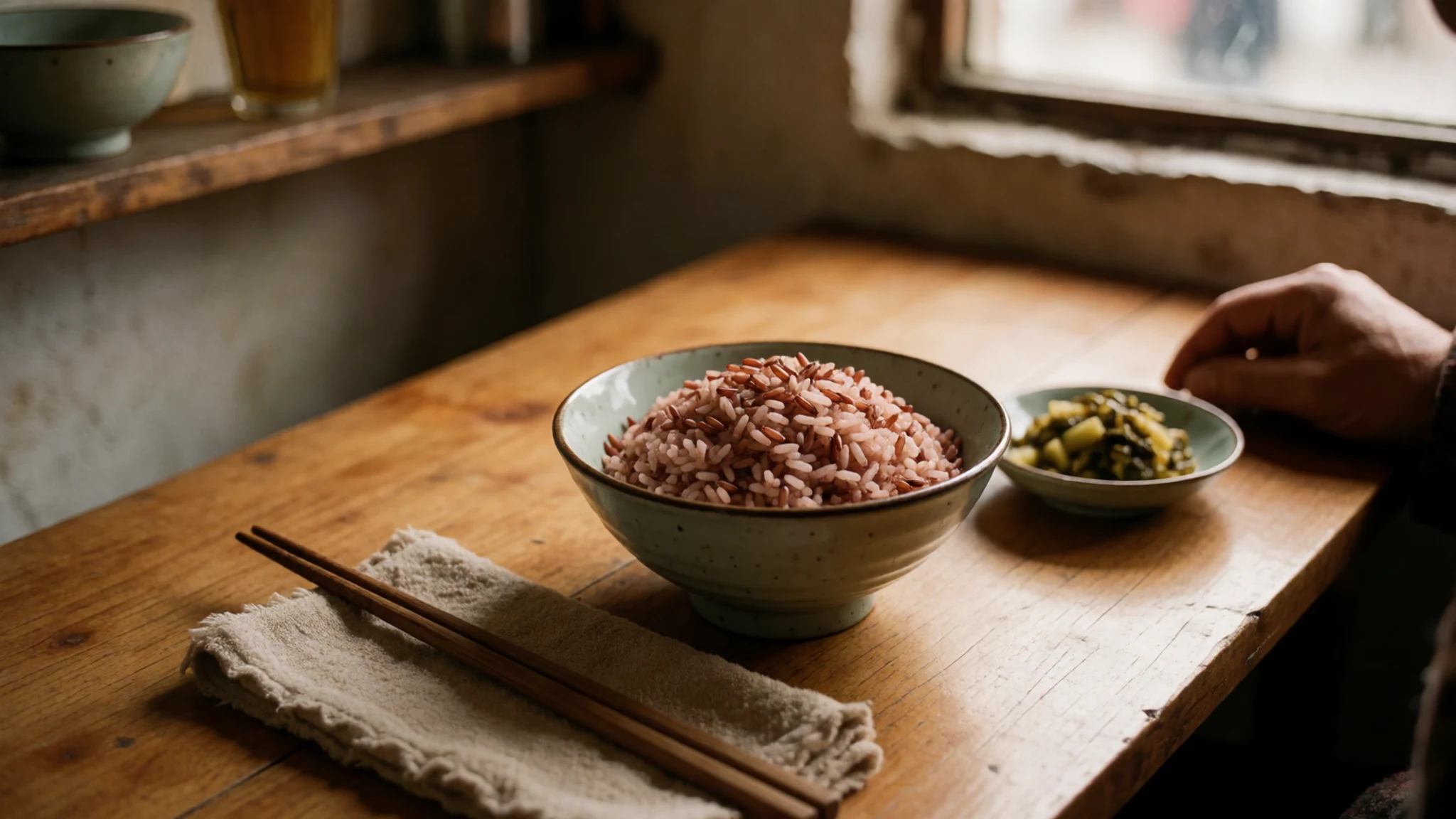
- Rice-field fish — family kitchens and casual eateries in terrace villages
Small fish raised in the flooded paddies are a natural second crop of the Yuanyang Rice Terraces. Fried or stewed with tomato, chilli and herbs, they turn up in family kitchens and in the casual eateries around Duoyishu and other terrace villages, especially when the fields are full of water.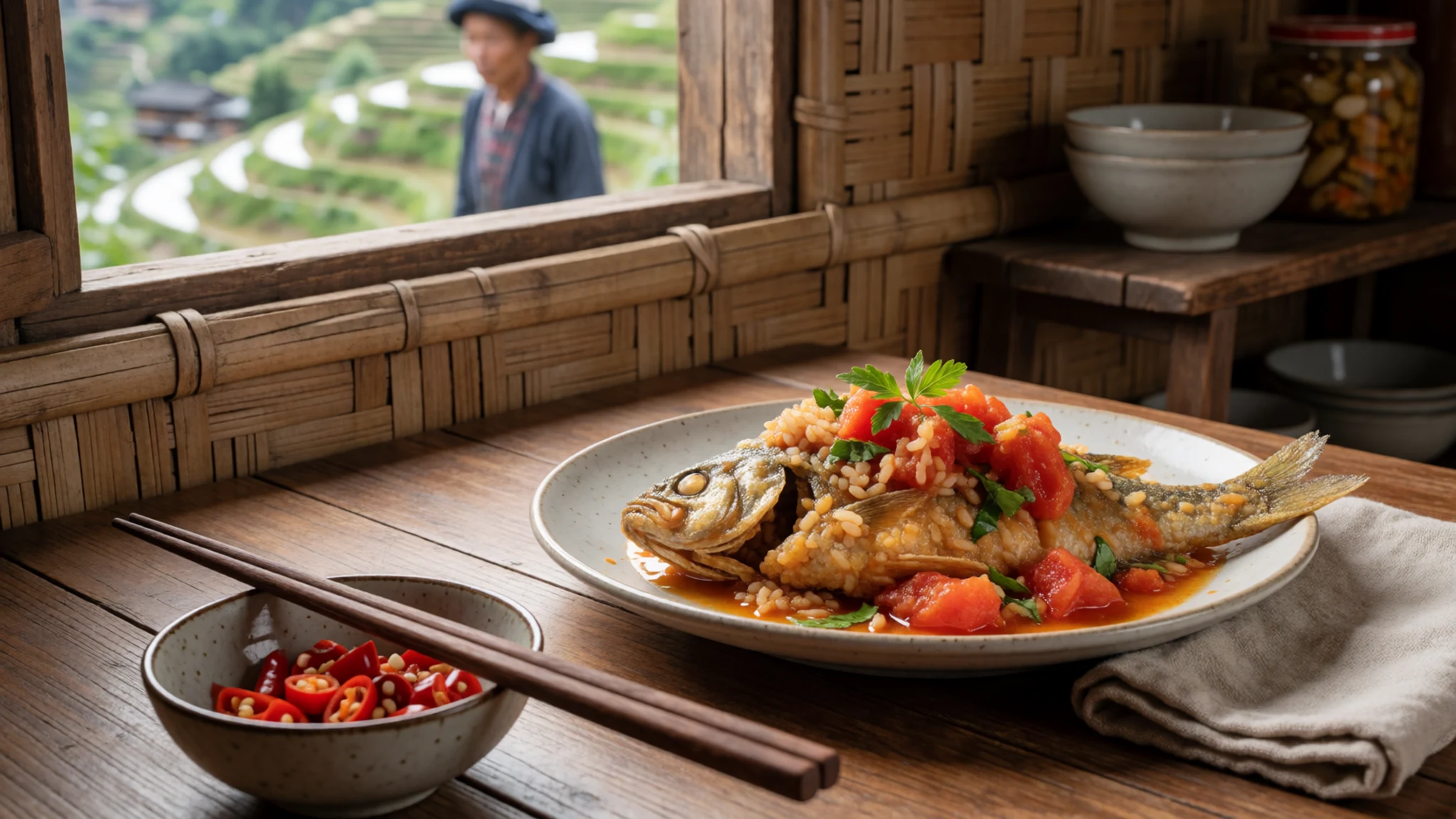
- Wild greens — morning markets in Xinjie and Nansha
The slopes around the Yuanyang Rice Terraces still supply wild and semi-wild greens — fern tips, bitter flowers, and herbs gathered above the paddies. Markets in Xinjie and Nansha sell them in the morning, and home-style eateries stir-fry them simply with garlic. The taste is sharper than farmed cabbage. - Crossing-the-bridge rice noodles — noodle shops in Xinjie and Nansha
Crossing-the-bridge rice noodles are a Honghe dish more than a terrace dish: a bowl of hot broth, a sheet of raw rice noodles, and thin meat and herbs added at the table. Noodle shops in Xinjie and down in Nansha serve them throughout the day. - Steam-pot chicken — eateries in Nansha and dining rooms in Xinjie
Steam-pot chicken, cooked in a clay pot with a chimney so the broth stays clear, is widely eaten in Honghe when people come down from the Yuanyang Rice Terraces. Herb-scented versions show up in eateries in Nansha and in the larger dining rooms in Xinjie.
Plan it
Best time. The cooler, drier months are the time for the Yuanyang Rice Terraces: after harvest the paddies are flooded and hold the sky, and people come for dawn. The warmer, wetter part of the year turns the hills green, with more mist and rain. Cloud can erase a morning in any season.
How long. 2–3
Getting there. Fly into Kunming and continue by road through Honghe to Xinjie, the hill town used as a base for the Yuanyang Rice Terraces. Local buses and hire cars cover the last leg up to the ridge villages. There is no train to the viewpoints.
Budget. mid
Tips
- Be at a sunrise ridge before first light; the colour is short and the platforms fill.
- If cloud is down, wait or try a second viewpoint rather than assuming the day is lost.
- Wear shoes with grip; paths are steep, muddy and narrow.
- Carry cash. Small shops and village eateries may not take cards.
- Book a room in Xinjie or a terrace village ahead for the popular cooler weeks.
Etiquette
- Ask before photographing people, including children and anyone in festival dress.
- Do not walk on the terrace bunds; they are the walls of someone's crop.
- Remove your shoes if you are invited into a home.
- Keep voices low near houses at dawn; people sleep close to the viewpoint.
Nearby
Sources
- Wikidata (CC0)
- Wikipedia (CC BY-SA 4.0)
- Wikivoyage (CC BY-SA 4.0)