Badain Jaran Desert
Badain Jaran Desert, People's Republic of China
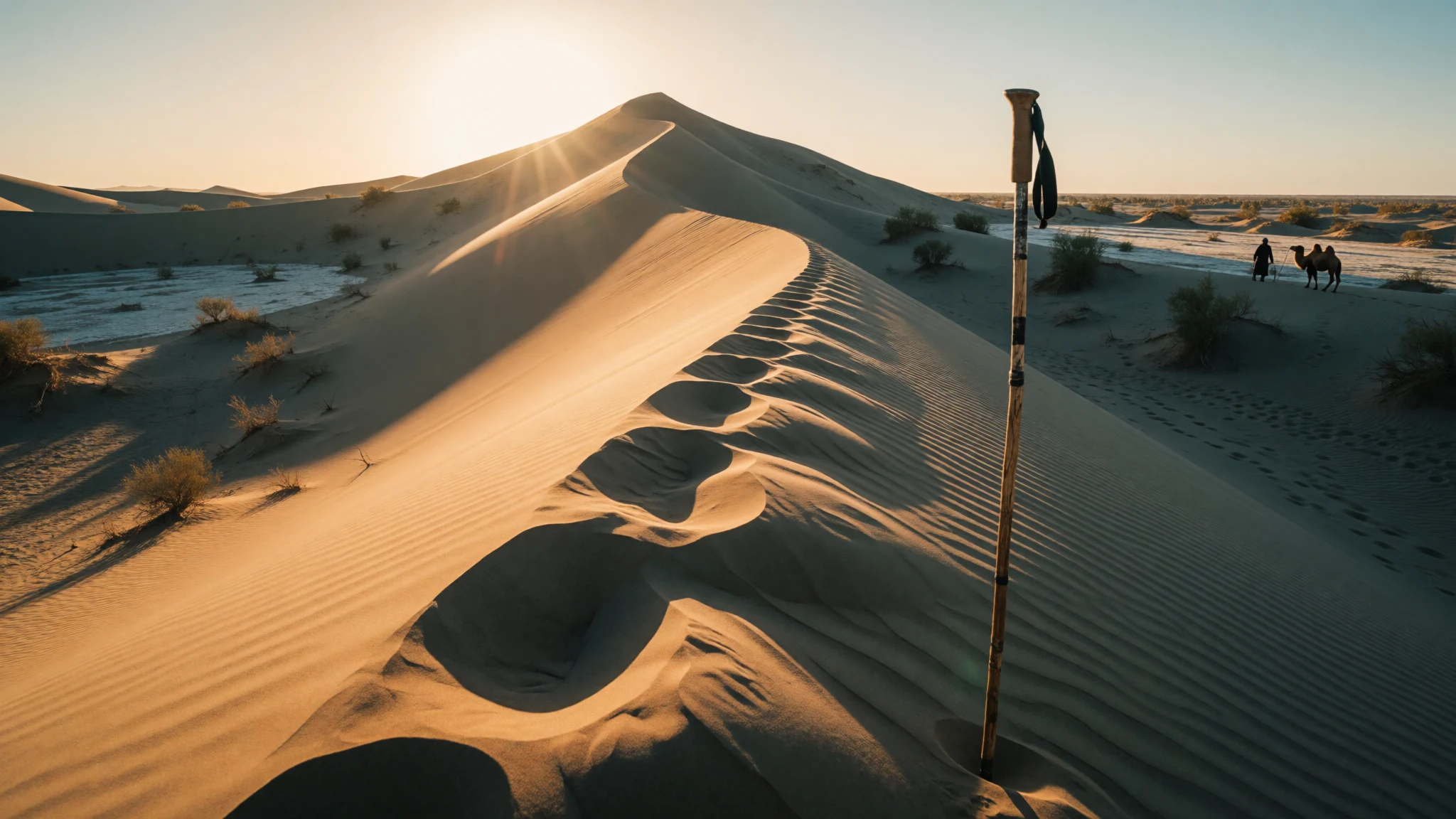
Badain Jaran Desert pairs towering, rock-hard dunes with spring-fed lakes in a remote, rarely visited stretch of north-west China.
The place
Badain Jaran Desert (巴丹吉林沙漠, Bādānjílín Shāmò) sits on the Alxa Plateau, mostly in the Alxa League of Inner Mongolia, with a northern edge of Gansu reaching into it. It spreads over about 49,000 square kilometres at roughly 1,200 metres above sea level, and geographers treat it as a sub-region of the Gobi. The Gobi lies to its north, while Mount Lang separates it on the east from the neighbouring Ulan Buh Desert.
What sets it apart is the scale of the sand. Most dunes average around 200 metres, and a few climb past 500 metres, which puts them among the tallest stationary dunes anywhere, according to published measurements. They stay put because only the thin surface layer moves. Deeper down, the sand has been compacted for more than 20,000 years into something close to sandstone, and moisture held inside the dunes helps lock them in place.
Between the ridges lie more than 100 spring-fed lakes. Some are fresh and others intensely salty, and the Mongolian name of the desert is usually translated as 'mysterious lakes'. Scientists have not studied them fully, and the strongly alkaline ones support unusual animal communities. A single river, the Ruo Shui ('weak water'), crosses the desert and has built an alluvial plain.
The climate is severe. Rain amounts to only a few centimetres a year and falls mostly between June and August, yet evaporation is many times greater than rainfall. Winter and spring bring strong north-westerly winds that can reach force 8. Few people live here, and the desert suits self-sufficient, well-planned travel rather than casual stops.
Its story
Badain Jaran Desert has a story told more in water and sand than in dates. Its Mongolian name points to the oddity that made it known: lakes, sometimes startlingly blue, sitting in the lee of some of the tallest dunes on Earth, in a region that receives almost no rain. A traveller arriving from the dry plateau could be forgiven for suspecting a mirage.
The explanation is still being worked out. The lakes are fed by springs rather than rainfall, and the research so far is incomplete. Many lakes have never been properly surveyed, and the strongly alkaline ones shelter animal communities that interest biologists precisely because so little is known about them.
The dunes carry their own history. Sand packed down over more than 20,000 years has hardened in the cores of the biggest ridges, so these hills behave more like landforms than drifts, and only the surface travels with the wind. Around them, the Ruo Shui, whose name means 'weak water', crosses the desert and spreads into a plain, a modest river with a name that sounds like a verdict on its size.
People have traditionally skirted this desert rather than crossed it. The Gansu corridor to the south and west carried Silk Road traffic, while Alxa to the north and east is Mongolian herding country, where livestock move between sparse pastures. The pattern largely holds today: few roads, few outside visitors, and a place that still feels more like a scientific puzzle than a settled destination.
What to see
- Bilutu Peak and the giant dunes — Central desert
Bilutu Peak is recorded as the highest point of Badain Jaran Desert, and it stands among giant dunes that rise past 500 metres from base to crest. Climbing the sand is slow work, with each step sliding back, but the ridge-lines give a long view over dune after dune and, on clear days, glints of lake water.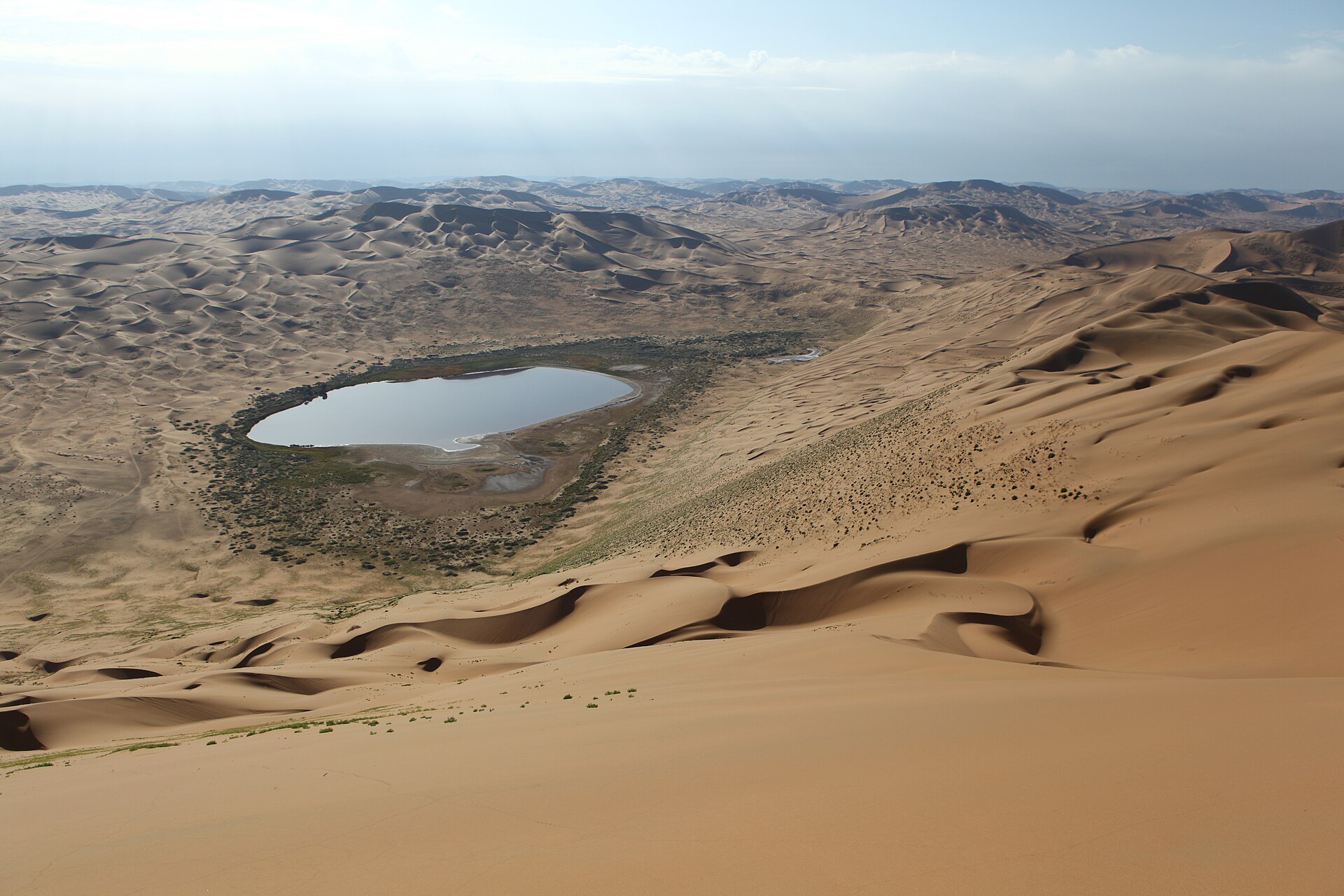
- Badain Jaran Temple and its lake — Lakeside, inside the desert
A temple stands on the shore of one of the desert's lakes, and its reflection in still water is the image most often used to show the place. Calm air is more likely early or late in the day. Check locally before travelling, since access to the shore depends on current rules and on the condition of desert tracks.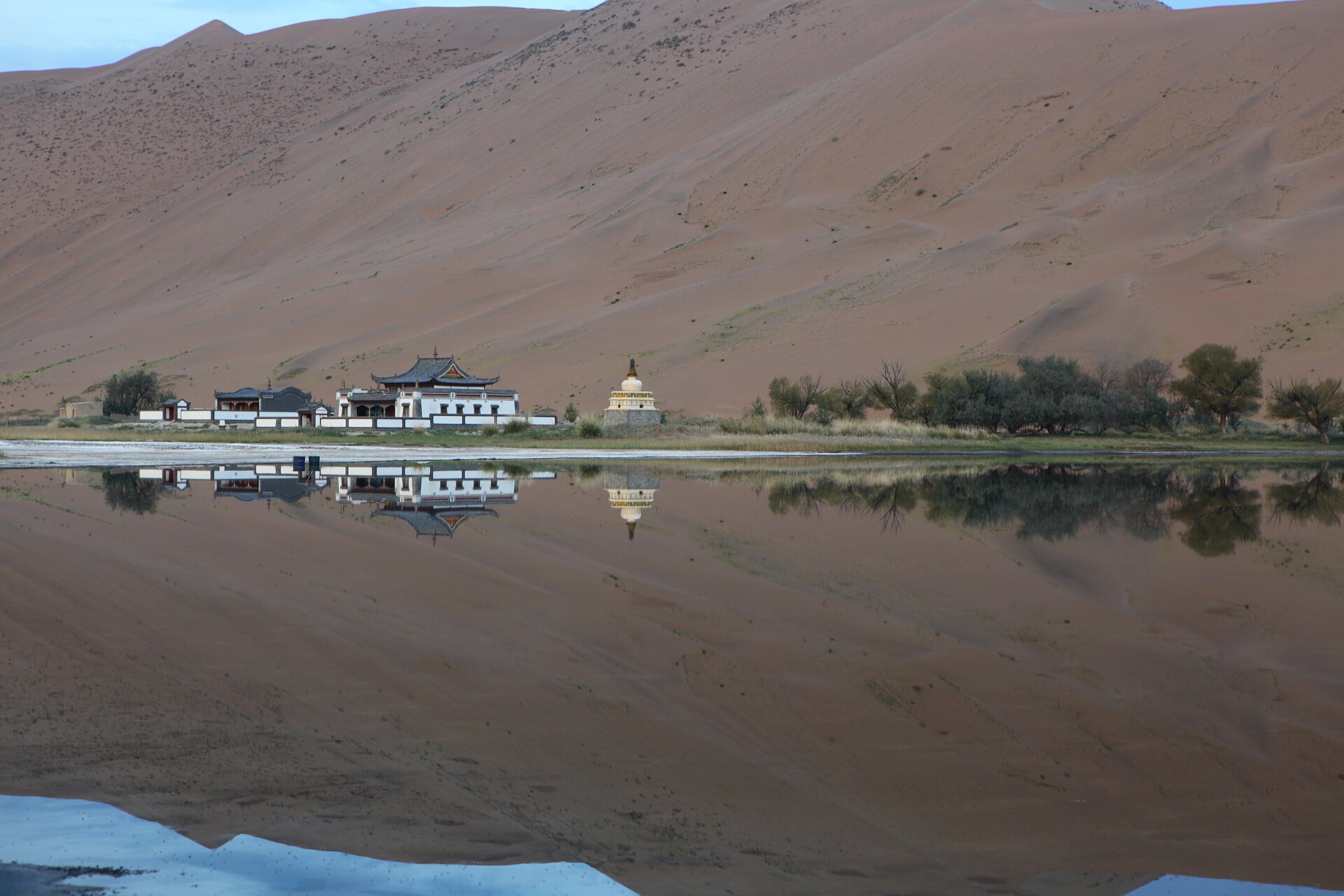
- Lakes between the dunes — Between the dune ridges
More than 100 spring-fed lakes lie in the hollows between the ridges. Some are fresh, others very salty, so water that looks inviting is often undrinkable. Reed edges and pale salt crusts mark many shores. Quiet walking and photography are the main pleasures; swimming is best left to those with a local guide. - Smaller dunes on foot — Desert margins
Not every dune demands an expedition. The smaller ridges near the desert's edge are easier to climb and good for a first feel of the sand, the wind patterns and the colour shifts at sunrise and sunset. Go in good shoes, carry water, and keep within sight of your vehicle.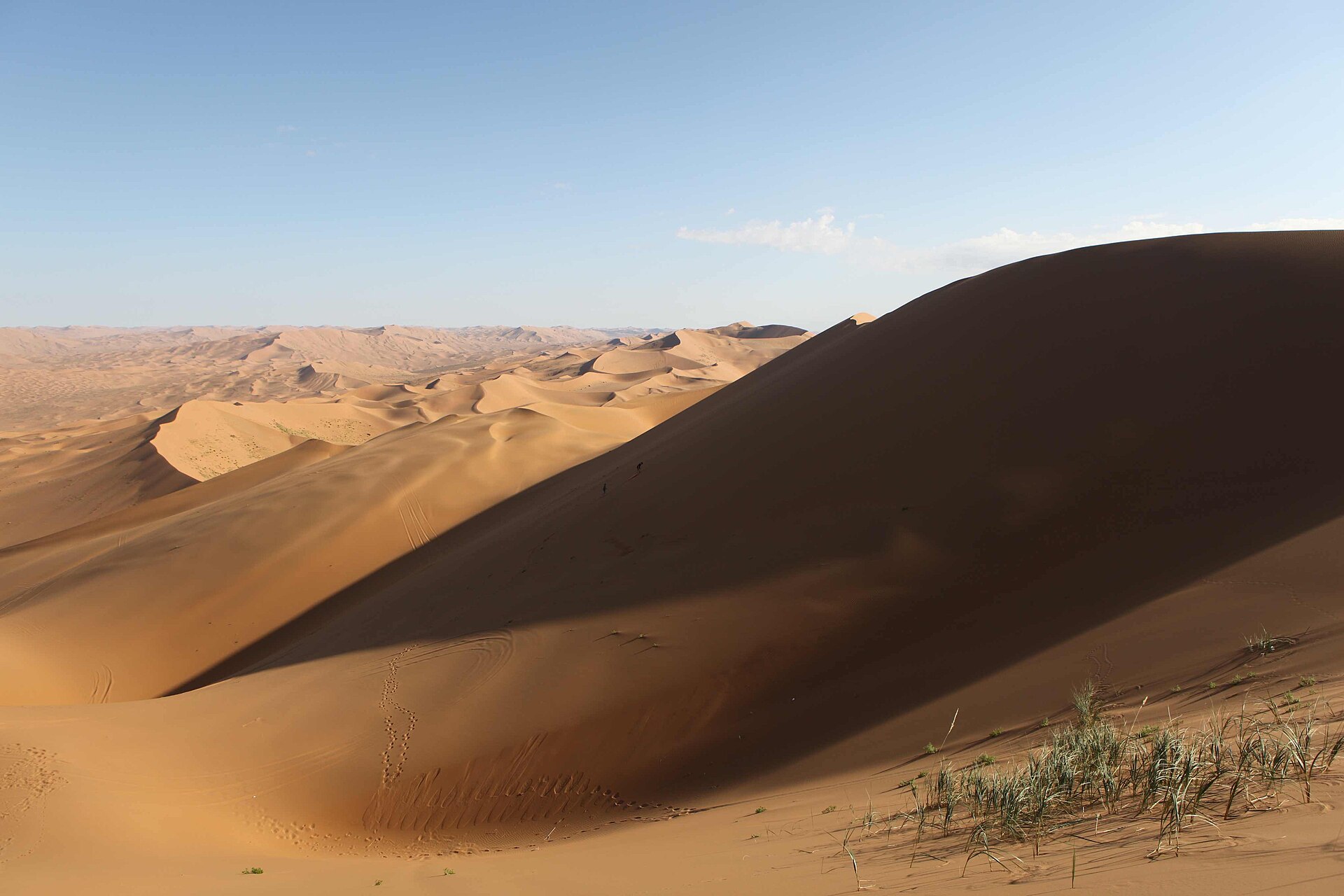
- Water Curtain Thousand Buddha Caves — Luomen, Gansu
The Water Curtain Thousand Buddha Caves at Luomen in Gansu are a cave temple, with a Sakyamuni Buddha 30 metres high carved into the cliffside. A regional travel guide lists them alongside the desert, but they are a separate stop; check the distance and opening arrangements before building them into a plan.
Culture
Badain Jaran Desert lies in Mongolian-speaking country, and its Mongolian name, 'mysterious lakes', hints at how local people have long regarded the water here: as something out of the ordinary. The Alxa League belongs to the Inner Mongolia Autonomous Region, and its culture blends Mongolian herding traditions with Buddhist practice. A temple stands on one lake shore, and cave temples farther into Gansu show how deeply Buddhism runs through this part of China.
Gansu itself sits on the old Silk Road, where Han, Hui, Tibetan and Mongolian communities have traded and settled alongside one another for centuries. Hospitality in the region tends to be generous and food-led: tea, milk products and meat appear quickly when guests arrive. Herding families set the rhythm of life outside the towns, and desert guides are often the best source of local knowledge about springs, tracks and seasons.
Life in a place this dry is organised around water and weather. Strong spring winds, scant rain and long distances mean that visitors depend on local drivers and guides, and that goodwill is returned. A few words of Mandarin, or of Mongolian if you can manage them, and the willingness to accept a bowl of tea, go a long way.
Ask before photographing herders, families or monks, and behave quietly at the lakeside temple as you would at any working place of worship.
What to wear
Badain Jaran Desert sits in Mongolian-speaking Alxa and on the edge of Gansu, so traditional dress here follows Mongolian and Silk Road habits. The classic Mongolian garment is the deel, a long wrap-over robe fastened at the side and tied with a bright sash. It is made of cotton or silk for warmer months and lined or padded with wool or sheepskin for winter, and worn with boots and a hat. Herders still wear it for festivals, weddings and cold days. In Gansu towns, Hui men in white caps are a common sight, and Tibetan chuba robes appear in the mountain pastures.
Day to day, most people wear practical modern clothes shaped by wind, sun and distance: work trousers or jeans, fleeces and padded jackets, caps, and scarves pulled over the face when sand blows. Younger people in the towns dress much as they would in any Chinese city.
Visitors should dress for exposure. Pack layers, because desert mornings and nights turn cold even after warm days. Bring long sleeves, a wide-brimmed hat or scarf, sunglasses or goggles, and closed shoes with a good grip, since sand fills sandals. Light gaiters help on the dunes. At the lakeside temple and the cave temples, cover shoulders and knees. Winter and spring call for a windproof shell and proper gloves.
What to eat
- Lanzhou lamian (兰州拉面) — Noodle shops in Gansu towns such as Zhangye
Hand-pulled wheat noodles in a clear, savoury beef broth, famous across China and eaten daily throughout Gansu. Order at a small noodle shop in any Gansu town, where the noodles are pulled to order and thickness is often your choice. - Shou-zhua lamb (羊肉, yángròu) — Lamb restaurants in Gansu and Alxa towns
Plain boiled lamb, served in large pieces with a dip on the side. Local lamb is said to be mild and tender because the animals graze on dry, saline pastures. Eating it plain is the best way to taste the meat itself. - Yak yoghurt, butter and milk — Markets and tea houses in the Tibetan pasture areas of southern Gansu
In southern Gansu, yak milk products are staples: thick yoghurt, butter for tea and cooking, and fresh milk. Texture is richer and tangier than cow's milk. Try them at breakfast, or wherever herding families sell directly. - Scrambled eggs with tomato — Simple restaurants near transport stops and visitor areas
A simple, mild dish that most restaurants catering to travellers can make, and a reliable fallback after a long day on the road when a menu in Chinese is hard to read. Usually served with rice. - Local spirits — Shared meals, and shops in Zhangye
Zhangye and the wider region produce strong local spirits, including rice whisky, which should be treated with care. Sip them slowly with food, and let your host set the pace at any meal where they are offered.
Plan it
Best time. September–October, when the summer rains of June to August are over and the strong north-westerly winds of winter and spring have not yet arrived. Spring and winter are windy, and summer brings what little rain the desert gets.
How long. 3–4
Getting there. Fly to Zhangye Ganzhou (YZY) or Jiayuguan (JGN); Lanzhou (LHW) and Dunhuang (DNH) are further options. The last leg is by road across desert tracks, so arrange a local driver with a vehicle suited to sand in advance.
Budget. mid
Tips
- Book a local guide and a desert-capable vehicle before you arrive, as independent driving on sand is risky
- Carry far more water and food than seems necessary, and do not drink lake water
- Go for sunrise and late afternoon, when light is soft and wind is usually lower
- Carry cash as a backup, and expect patchy mobile signal inside the desert
- Protect cameras and phones from fine sand with sealed bags
Etiquette
- Ask before photographing herders, families and monks
- Take all rubbish out with you and keep to established tracks to protect the fragile lake shores
- Behave quietly at the lakeside temple and follow any local guidance on footwear
Nearby
Sources
- Wikidata Q939033 (CC0)
- Wikipedia: Badain Jaran Desert (rev 1381988295) (CC BY-SA 4.0)
- Wikivoyage: Gansu (rev 5362885) (CC BY-SA 4.0)
- Small Dunes of Badain Jaran Desert, Sjoerd van Oort (CC BY 3.0)
- Badain Jaran Desert Location Map, Sjoerd van Oort (CC BY 3.0)
- Map of Northern China, Christycheungkayan (CC BY-SA 4.0)
- Badain Jaran Temple Reflection, Sjoerd van Oort (CC BY 3.0)
- Bilutu Peak, Sjoerd van Oort (CC BY 3.0)
- Badain Jaran Desert (MODIS 2020-02-07), NASA GSFC (Public domain)
- Badain Jaran Desert Visible & Near IR, Jesse Allen (Public domain)
- Badain Jaran Desert, Landsat 8 2014, NASA Earth Observatory (Public domain)


