Basum Tso
Basum Tso, People's Republic of China
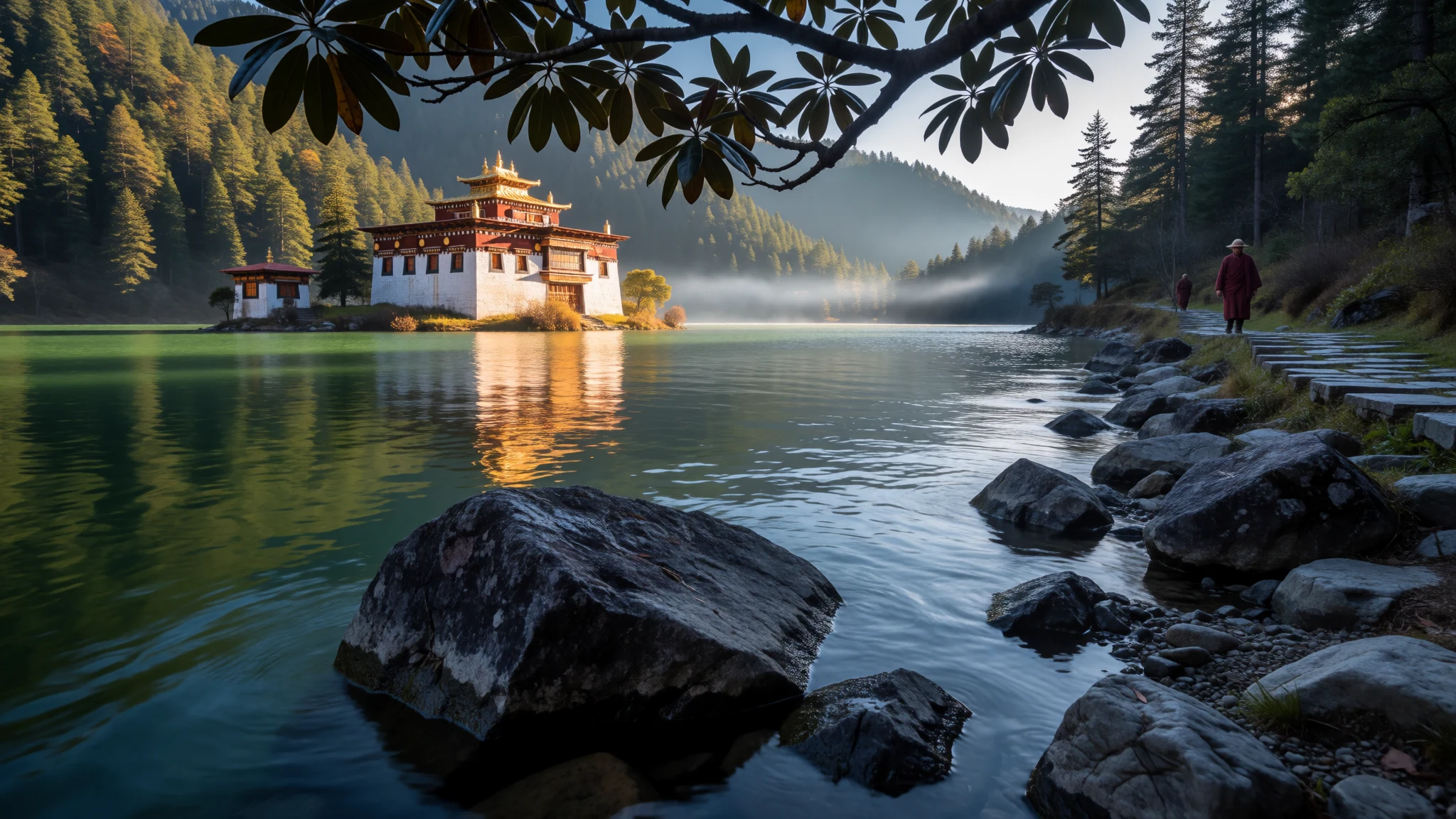
Basum Tso is a green, forest-ringed lake in Nyingchi, Tibet, with an island monastery, pilgrim paths and mountain views.
The place
Basum Tso sits at 3,700 metres over sea level in Gongbo'gyamda County, part of Nyingchi Prefecture in the Tibet Autonomous Region. Chinese signs call it Basong Cuo (八松错), and it also appears as Pagsum Lake or Draksum Tso; the Tibetan name is usually explained as 'three rocks'. The lake is long and narrow, running between steep, wooded slopes, and its colour shifts from jade to deep green with the light and the sky. Fir, spruce and rhododendron come right down to the shoreline, so the place feels closer to a Himalayan valley than to the dry, open plateau that many people picture when they think of Tibet. The surrounding prefecture lies in the lower reaches of the Yarlung Zangbo river, and the whole district is greener, wetter and more wooded than the country around Lhasa. The water is clear and low in nutrients, and it supports native fish such as naked carp, alongside a long list of animal species recorded by researchers. A small island in the middle of the lake carries the Tsozong monastery, and it is the focal point of most photographs. On the north-western shore stands a large boulder with a hole through its centre, treated as sacred. Most visitors come as a long day trip or an overnight stop from Bayi, the main town of Nyingchi, and the lake fits easily with the meadows of Lulang and the views of Namjagbarwa on the same journey.
Its story
The story of Basum Tso is told in two layers, the Buddhist and the heroic. The Buddhist layer centres on the island monastery, Tsozong, a Nyingma-school temple dedicated to Padmasambhava, the teacher who is credited with bringing Buddhism firmly into Tibet. Inside, old carvings show Hayagriva, a horse-headed protective deity. The island is known in Chinese as Zhaxi (Tashi) Island, and for local people it is a place of prayer long before it is a place for photographs. The heroic layer belongs to King Gesar, the warrior of Tibetan epic. Along the shore, marks in the rock are said to be where his arrows struck and where his warhorse left hoofprints, and pilgrims trace these spots as they walk. Each year, on the 15th day of the fourth Tibetan month, worshippers circle the lake in a festival circuit, an occasion that gathers families from across the Kongpo region, the area's own Tibetan subgroup. The lake was later named a top-rated national scenic area, and that status brought roads, boats and organised tourism to what had been a pilgrim's destination. The present mix is easy to read on a visit: coaches and camera lenses on one side, butter lamps, prayer flags and quiet circling on the other. The two do not always sit comfortably together, but the sacred reading of the landscape has not been displaced.
What to see
- Tsozong monastery on Tashi Island — Centre of the lake
The small Nyingma monastery on the island in the middle of Basum Tso is the heart of the lake. Ancient carvings of Hayagriva are inside, and pilgrims arrive with prayer flags and butter. Visit early, before group tours, when the island is quiet and mist often hangs on the water.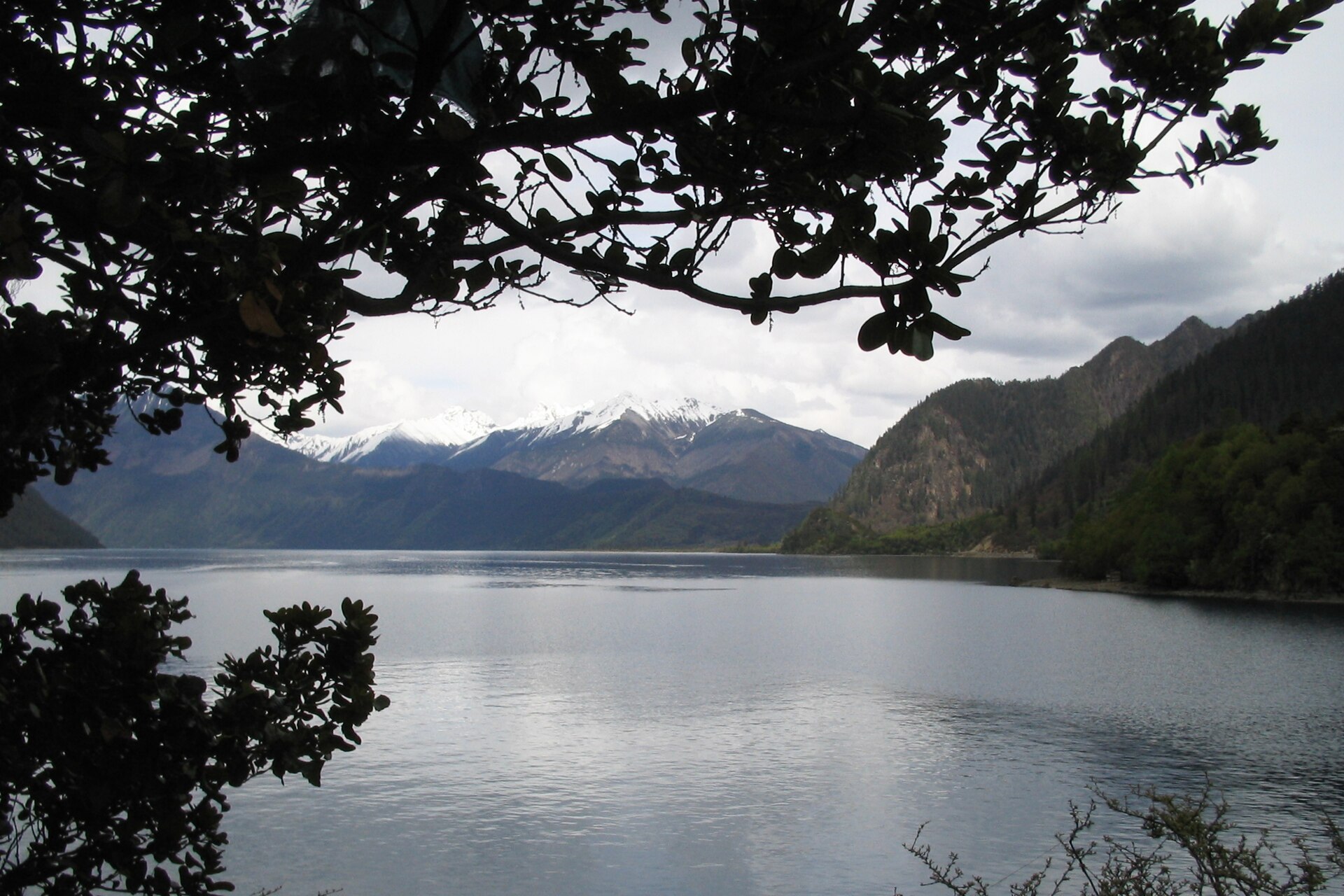
- The lakeshore forest and sacred boulder — Basum Tso shore
Paths on the shore of Basum Tso run through fir, spruce and rhododendron, with the water glimpsed through the trunks. On the north-western side is the boulder with a hole through it, which pilgrims pass through for blessing. Go slowly; the altitude makes even gentle walking tiring.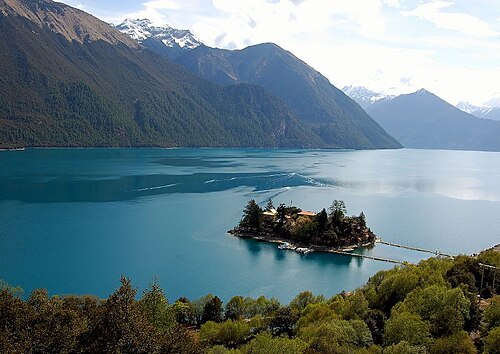
- Namjagbarwa viewpoints — Yarlung Zangbo valley, Nyingchi
Namjagbarwa is the great peak at the eastern end of the Himalaya, and it is often hidden in cloud. Viewpoints along the Yarlung Zangbo valley and the Sejila pass give the best chance of a clear look. Early morning and the season after the rains tend to be most promising. - Lulang alpine meadows — Lulang, east of Bayi
Lulang is a high area of conifer forest, grassland and wildflowers, and visitors often compare it to the Alps. It is a natural pairing with Basum Tso for anyone driving the valley. The village is also known for its stone-pot chicken, a local speciality. - Peach Blossom Valley — South of Bayi
Peach Blossom Valley, south of the Nyingchi urban area, fills with blossom in spring, usually in March and April. It is a pleasant half-day for anyone timing a visit for the early season. Expect domestic tour groups at weekends and holidays, and go on a weekday if you can.
Culture
Basum Tso belongs to the Kongpo people, a Tibetan subgroup whose traditions differ in small but real ways from those of central Tibet. Tibetan Buddhism shapes daily life here: prayer flags are strung along the shore, mani stones are stacked beside paths, and the island monastery receives worshippers all year. The Nyingma school, the oldest of the main Tibetan Buddhist traditions, is strongly associated with this lake and with Padmasambhava. The festival circuit on the 15th day of the fourth Tibetan month draws the largest crowds of pilgrims, and it is worth knowing about when planning, since the shoreline gets busy and some accommodation fills early. Losar, the Tibetan New Year, is the other big occasion in the region's calendar, with family visits, offerings and village celebrations. The nearby town of Miling and the traditional villages around Nyingchi are the places where music, dance and festival customs are easiest to meet, though it is courteous to treat them as living communities, not as shows. Some of the spiritual significance here is tied to particular rocks, boulders and viewpoints, and not all of these are marked clearly for outsiders. A local guide or a patient look at what others are doing will usually explain it. Walk clockwise around the monastery, prayer-flag poles and sacred boulder, and ask before photographing monks or worshippers.
What to wear
Around Basum Tso, traditional Tibetan dress is the chuba, a long wrap-over robe traditionally made of wool or sheepskin and tied at the waist, worn over a shirt. Married women in many Tibetan areas wear a striped woollen apron, and Kongpo dress is noted for its silver ornaments, often worn on festival days alongside coral and turquoise jewellery. The finest chuba and jewellery come out for Losar, pilgrimage days and weddings, and the older generation still wears the robe daily. Day to day, most local people now wear practical modern clothes: fleece or padded jackets, trousers, trainers or boots, and often a wool hat. Many in the younger generation dress much as people do in any Chinese town, saving traditional dress for celebrations. A visitor should dress for cool, changeable weather above 3,500 m. Layers are essential: a warm fleece or down jacket, a waterproof shell, a hat and gloves for mornings, and a sun hat and sunglasses for the thin air. Wear sturdy shoes with a good grip for forest paths that can be wet or muddy. At the monastery, cover shoulders and knees, and take off hats and sunglasses before going inside.
What to eat
- Ghee tea (butter tea) — Any Tibetan eatery or village home in the Nyingchi area
Ghee tea is a daily drink across Tibet, made of strong tea, ghee and salt. It is savoury and warming, and many first-time drinkers find it odd but get used to it after a cup or two, especially in the cold. - Tsampa and barley rice cake — Tibetan restaurants and morning stalls in Bayi
Tsampa is a staple food of Tibetans, made from green barley that is stir-fried and ground into flour. It is eaten mixed into tea, or shaped into a glutinous cake. It is filling and good fuel for a day at altitude. - Roast Tibetan pork — Tibetan restaurants in Bayi, the main town of Nyingchi
Roasted local pork is a classic of Tibetan cooking in this region. It is served in chunks, simply seasoned, and usually shared at a table with tea or barley beer. Check that the restaurant uses local pork if that matters to you. - Stone-pot chicken — Eateries in and around Lulang village
Stone-pot chicken is the dish most associated with the Nyingchi area, and Lulang is its home ground. The chicken is slow-cooked with local herbs and mushrooms in a stone pot, and it is a warming meal after a day in the cold.
Plan it
Best time. April–May for spring blossom and fresh forest, and late September–October for autumn colour and generally clearer views. Summer is cool and often rainy, with sudden weather changes at altitude, and winter brings cold.
How long. 1–2
Getting there. Fly or take the Sichuan–Tibet railway to Nyingchi; the train from Lhasa takes about 3.5 hours. The last leg to Basum Tso is by road from Bayi, usually in a hired car, taxi or tour vehicle. Foreign visitors need the right permits for Tibet, so check current rules with official sources and a licensed operator before booking.
Budget. mid
Tips
- Allow a day or two to acclimatise before long walks, and watch for dizziness, breathlessness and fatigue; for anything serious, go to the nearest hospital in Linzhi.
- Carry warm layers, a raincoat and sturdy shoes even in summer, because the weather changes fast.
- Start early to see the lake and island before the tour groups arrive.
- Carry some cash as well as cards, and bring water and snacks for the shore paths.
- Check transport and permit rules before you travel, since they change.
Etiquette
- Walk clockwise around monasteries, prayer flags and sacred stones.
- Ask before photographing monks, pilgrims or people in traditional dress.
- Dress modestly and remove hats and sunglasses inside the monastery.
Nearby
Sources
- Wikidata Q2011572 (CC0)
- Wikipedia: Pagsum Lake (rev 1385218365) (CC BY-SA 4.0)
- Wikivoyage: Nyingchi (rev 5244154) (CC BY-SA 4.0)
- Photo: Basum Lake 01 (Gao) (CC BY 2.5)
- Photo: BasumTso-wiki (Kosi Gramatikoff) (Public domain)
- Photo: 201107 Basong Tso (MNXANL) (CC BY-SA 4.0)
- Photo: Basom Tso, Tibet (cattan2011) (CC BY 2.5)
- Photo: Basomtso Lake (Michael Mooney) (CC BY 2.5)
- Photo: Basong Tso 9 (钉钉) (CC BY-SA 4.0)
- Photo: Basong Tso1 (钉钉) (CC BY-SA 4.0)
- Photo: Basong Tso12 (钉钉) (CC BY-SA 4.0)


Wildlife
- Naked carp (animal)
The naked carp is a fish that feeds on tiny drifting life, a bit like a swimmer sipping a very thin soup. In Basum Tso it is one of the native fish living in the clear water, which holds few nutrients. Across its range, the main group swims from the lake up into rivers to breed. Watch from the bank, keep quiet, and go with a local guide who knows the water. Never feed it or fish for it, because the species is endangered after overfishing and habitat loss.