Yamadera
Yamadera, Japan
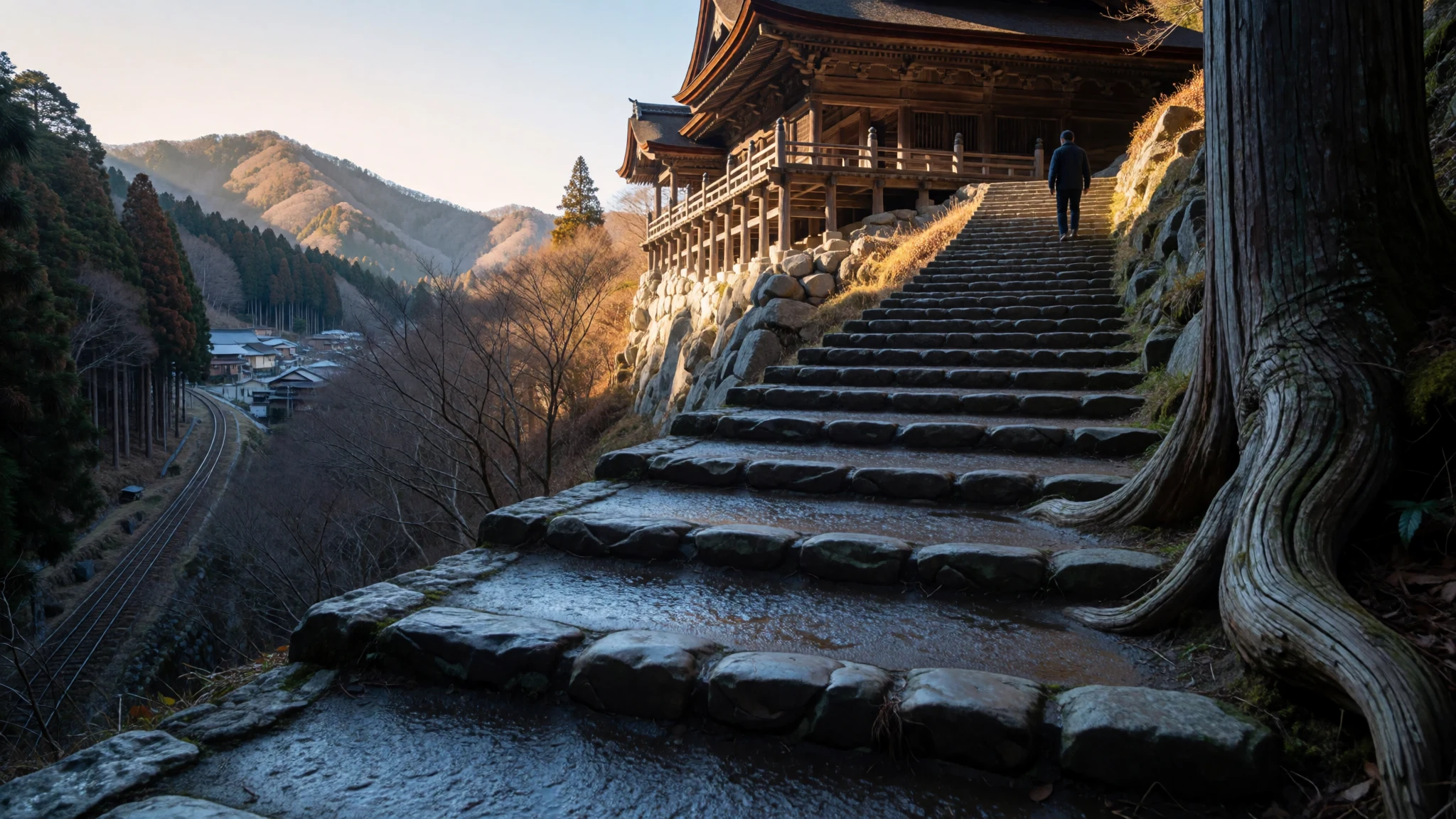
Yamadera is a mountain temple of stone steps, old cedars and cliff-edge halls, where Bashō once listened to the cicadas.
The place
Yamadera (山寺, "Mountain Temple") is the everyday name for Risshaku-ji, a Buddhist temple complex northeast of the city of Yamagata, in Yamagata Prefecture, northern Honshu. The name describes it well: small halls and shrines sit on ledges, in hollows and against bare rock, all linked by stone steps under tall trees. Its principal image is a hibutsu, a statue kept hidden from public view, of Yakushi Nyorai, the Buddha of healing. The grounds lie within Zaō Quasi-National Park and carry two national designations, as a Place of Scenic Beauty and as a Historic Site. As an administrative unit, Yamadera was a municipality created in 1889 and since dissolved, so the name now belongs mainly to the temple and the small settlement at its foot. That village is quiet, with a railway station, a handful of eateries, shops selling local sweets and souvenirs, and a stream running through the valley. Yamagata Prefecture is often described as a hidden side of Japan. It sits away from the usual Tokyo, Kyoto and Osaka circuit, which means thinner crowds but also slower, less frequent transport. What it offers instead is orchards, farmland, mountain hot springs, skiing, summer festivals and sturdy regional cooking. Yamadera works as a half-day or full-day outing from Yamagata city, and it pairs well with a night in a hot-spring town. Weather shapes the visit heavily: summer is green and humid, autumn turns the slopes red and gold, and winter lays snow over the roofs and steps, making the climb slippery and the silence deeper.
Its story
Yamadera's founding story begins with Ennin, a Tendai priest who came back from study in Tang China in 847 and later led the sect from Enryaku-ji on Mount Hiei, near Kyoto. Temple tradition credits him, under the posthumous name Jikaku Daishi, with establishing Risshaku-ji here in 860 on imperial instruction, as an outpost of the Hiei mother house. A flame carried from Enryaku-ji is said to have burned in the main hall ever since. Historians are more cautious: the exact date is unknown, though the oldest surviving wooden statues place the temple no later than the early Heian period. A cave in the grounds is traditionally held to be Ennin's burial place, even though he died on Mount Hiei. In 1948 excavators opened it and found a gold-leaf casket holding the remains of several people, along with pieces of a Heian-era statue of the priest. By then Yamadera had long been a regional centre of Buddhism for old Dewa Province. Fortunes rose and fell. After a medieval fire the temple turned to Zen; in 1356 Shiba Kaneyori, lord of Yamagata Castle, rebuilt the main hall, the Konpon-chūdō, and returned the temple to Tendai. The painter Sesshū Tōyō visited in 1482 and sketched the precincts. Warfare in the Sengoku period brought another burning, and the Date and Mogami families paid for restoration. In 1689 the poet Matsuo Bashō stopped here and wrote his cicada haiku, the verse that still draws many visitors. In 1996 the Ministry of the Environment listed the cicadas of Yamadera among Japan's soundscapes worth protecting.
What to see
- Konpon-chūdō (main hall) — Yamadera temple grounds
The Konpon-chūdō at Yamadera is the temple's central hall, rebuilt in the mid-fourteenth century and still holding the ritual flame said to come from Mount Hiei. It sits lower on the slope than the cliff-top halls, so it makes a calm first stop before the long climb begins. - Kaizandō and the founder's cave — Yamadera temple grounds, upper slope
Kaizandō is the small hall associated with Ennin, the priest credited with founding Yamadera. Nearby, tradition places his burial in a cave, where a casket was found in 1948. Visitors see the hall and rock face from outside, and the setting feels more intimate than grand. - Godaidō viewing hall — Yamadera, summit area
Godaidō is an open hall projecting from the rock near the top of the climb, with a veranda looking over the valley, the village roofs and the rail line below. It gets busy on clear autumn days, so a weekday morning is calmer, and the steps beside it can be slippery after rain. - Yamadera Basho Memorial Museum — Yamadera village, across the valley
The Yamadera Basho Memorial Museum stands a short walk uphill on the opposite side of the valley from the temple. It gathers the poet's writings, paintings and related art. It is worth pairing with the temple for anyone who wants the cicada haiku in its literary context. - Snow monsters of Zaō — Zaō Quasi-National Park, Yamagata
In winter, the trees on Mount Zaō near Yamagata freeze under snow into heavy, rounded shapes locals call snow monsters. The park also contains Yamadera. A day trip combining the two suits cold-season visitors, though mountain weather is changeable and warm layers are essential.
Culture
Yamadera is a working Buddhist site, and its culture blends Tendai practice, mountain faith and a strong literary legacy. Tendai teaching reached northern Japan from Mount Hiei, and the old Dewa region around Yamagata also holds Shugendo, the mountain ascetic tradition centred on the Three Mountains of Dewa. Pilgrims have climbed here for centuries, and the sense of effort, of earning the view, is part of the experience. Poetry is the other thread. Matsuo Bashō's cicada haiku turned the valley into a literary destination, and the sound of cicadas in summer is now treated as a heritage of its own. Elsewhere in Yamagata, culture is communal and seasonal. The Hanagasa festival in early August sends dancers through Yamagata city in flower-decked hats, and the imoni gatherings on the riverbank in September turn a taro and beef stew into a neighbourhood occasion. Sake brewing, rice farming and orchard work shape the calendar of the surrounding villages, and local pride in produce is strong. Yamagata is also known for sokushinbutsu, the mummified ascetics preserved in several temples across the prefecture, a reminder of how intense mountain devotion once was. At Yamadera, keep your voice low on the steps and at the halls, step aside for people stopping to pray, and do not touch carvings or cross any rope or barrier.
What to wear
Yamadera and the wider Yamagata region have a clothing tradition tied to festivals, fabric and weather. Traditional dress here means kimono and the lighter cotton yukata, worn mainly at summer festivals and special occasions. At the Hanagasa parade, dancers wear happi coats and the flower-decorated hats that give the event its name. Yamagata is also linked with safflower (beni) dye, and the Yonezawa area is known for woven silk called Yonezawa-ori, though visitors are more likely to meet these as craft goods than as everyday wear. What people wear now is practical and outdoorsy: jackets, trousers, walking shoes and caps in warm months, and thick coats, boots and scarves through the snowy season. Temple volunteers, monks and priests may be in robes, but most visitors and locals wear ordinary casual clothes. A visitor should dress for the climb rather than for ceremony. Choose shoes with a good grip, since the steps are stone and can be wet, mossy or icy. Wear layers: summer is humid and the climb is sweaty, while spring and autumn mornings can be cool, and winter needs proper cold-weather gear. Carry a light rain shell and a hat. Modesty rules are relaxed, but covered shoulders and knees feel respectful at the halls, and clean socks help where shoes come off at a threshold.
What to eat
- Imoni — riverbank gatherings in Yamagata city in September; regional eateries in autumn
Imoni is a stew of taro, beef, konnyaku and sugar, seasoned with soy sauce or miso. It is an autumn dish across Tohoku. Yamagata city holds a large imoni gathering on the riverbank each September, and eateries in the region serve it in the cooler months. - Soba — soba eateries near Yamadera station and around Yamagata city
Buckwheat noodles are a staple in Yamagata, served cold with a dipping sauce or in hot broth. Each shop has its own style, from thicker, rustic noodles to finer ones. A bowl makes a sensible meal before or after the climb at Yamadera. - Cherries — roadside fruit stalls and orchards around Yamagata in season
Yamagata is a major cherry-growing prefecture, and the Satonishiki variety is the best known, red and sweet. Fruit is sold fresh in season at roadside stalls and farm shops, and many orchards sell boxed fruit as gifts. Other local fruit includes grapes, apples, peaches and pears. - Ramen — ramen shops in Yamagata city and towns across the prefecture
Yamagata people spend a lot on ramen, and the prefecture has several regional styles, with Yamagata city, Sakata, Yonezawa and Akayu each known for their own broth. A bowl is an easy, warming lunch, especially after a cold morning on the temple steps. - Yonezawa beef — restaurants in Yonezawa city
Yonezawa beef comes from the city of Yonezawa in southern Yamagata and is among the best-known beef brands in Japan. It appears as steak, sukiyaki or grilled slices. Treat it as a splurge, and compare menus before booking. - Nihonshu (sake) — sake shops and eateries in Yamagata city
Rice farming and clean Mogami River water support a strong sake tradition in Yamagata. Local shops stock many small-brewery labels, and eateries often offer tasting sets so that different styles can be compared side by side. It also makes a portable gift.
Plan it
Best time. Late October to November for autumn colour on the slopes, and May for fresh green and comfortable walking. Summer is hot, humid and loud with cicadas; winter brings snow and icy steps, beautiful but demanding.
How long. 1
Getting there. Fly to Yamagata Airport (GAJ) or, more usually, take the Shinkansen from Tokyo to Yamagata city, about 3 hours. From Yamagata station a local train on the Senzan Line runs to Yamadera station; check the operator's timetable, as services are not frequent. From Yamadera station the temple entrance is a short walk through the village. Express buses from Sendai also reach Yamagata city.
Budget. mid
Tips
- Start early: morning light is softer, the steps are cooler and tour buses arrive later.
- Wear shoes with good grip and carry water, as the climb is on stone steps with few places to buy drinks.
- Carry some cash for small shops, stalls and entry fees, and check the temple's official information for opening times and admission.
- Check rail timetables before you go and plan the return train in advance.
- In winter, allow extra time and check conditions on the steps.
Etiquette
- Keep your voice low on the steps and at the halls, and step aside for people praying.
- Do not touch carvings or enter roped-off areas.
- Ask before photographing monks or other visitors up close.
Nearby
Sources
- Wikidata Q11467770 (CC0)
- Wikipedia: Yamadera (CC BY-SA 4.0)
- Wikivoyage: Yamagata (prefecture) (CC BY-SA 4.0)