Woljeongsa Temple
Woljeongsa Temple, South Korea
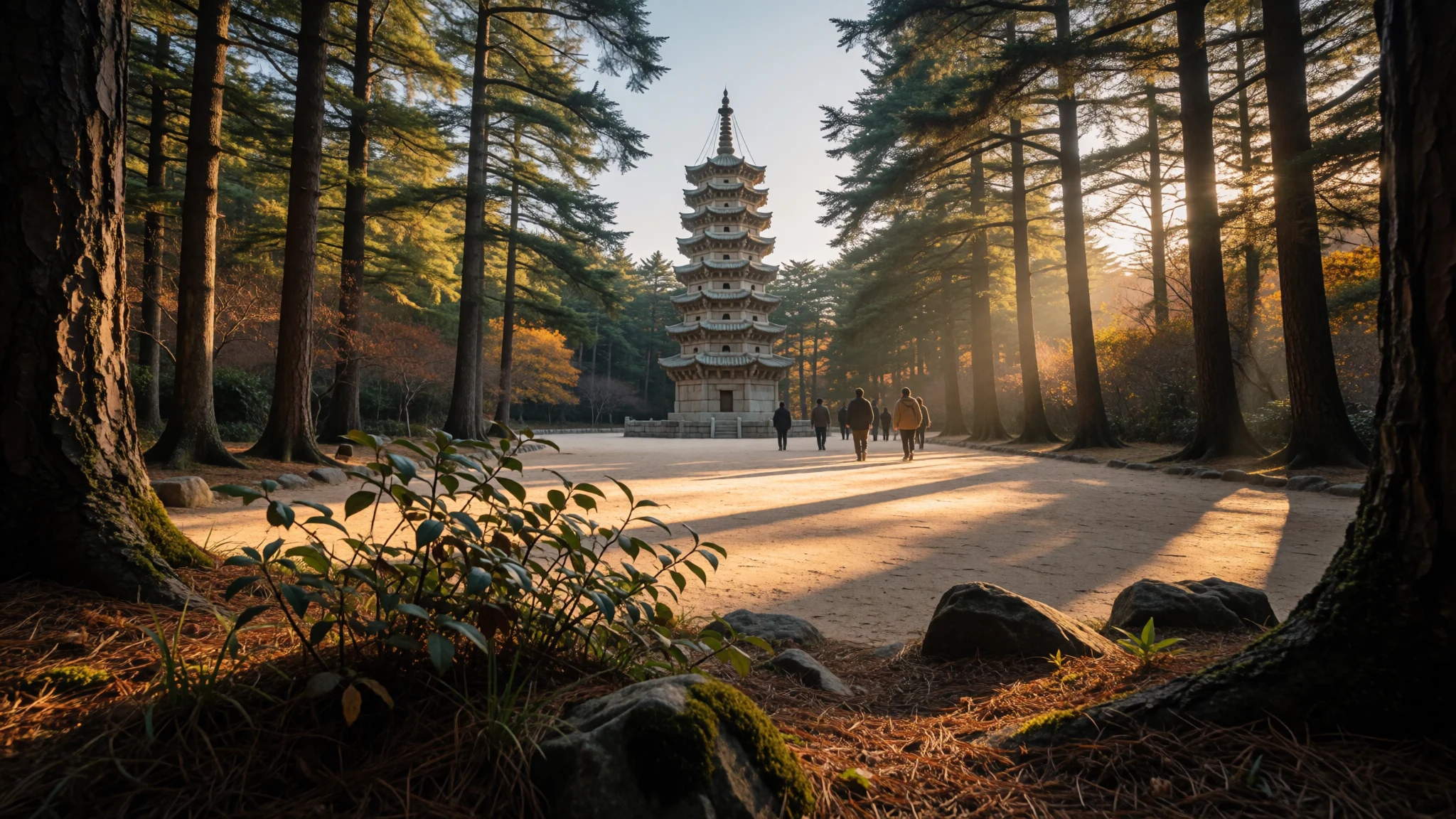
Experience deep mountain stillness and ancient Buddhist art amidst a magnificent forest of fir trees in Pyeongchang.
The place
Woljeongsa is a Buddhist temple situated on the eastern slopes of Odaesan mountain in Pyeongchang County. The site is defined by its integration with the natural landscape, where the temple complex sits nestled within the Odaesan National Park. Visitors often first encounter the place through a long, peaceful walk beneath a canopy of towering fir trees, which creates a natural cathedral leading to the main grounds. The air here is typically cooler and crisper than in the cities, though the mountain humidity can be heavy in summer.
As a head temple of the Jogye Order, Woljeongsa serves as a significant spiritual centre for Manjushri, the Bodhisattva of wisdom. The architecture consists of several rebuilt halls and halls that house national treasures, including an octagonal nine-story stone pagoda. While the temple is popular with tourists, especially during the autumn foliage, it retains a genuine atmosphere of monastic discipline. The surrounding park is a biodiversity hotspot, home to thousands of animal species and a wide variety of native plants. The terrain is mostly granite and gneiss, leading to a landscape of flat-topped summits and thick soil deposits that support the lush, green forests. It is a place where the boundary between the built environment and the wild mountain forest feels almost non-existent.
Its story
Woljeongsa was established in 643 by the Silla monk Jajang. The name of the temple translates to 'Moon Spirit,' chosen because the full moon appearing over Dongdaesan Mountain was remarkably bright. Jajang’s original vision for the site was tied to his travels in China, where he encountered Manjushri. Upon returning to Silla with sarira, he sought to establish a place of wisdom, though early attempts to meet the manifestation of Manjushri were thwarted by several days of severe weather.
Over the centuries, the temple has faced a cycle of destruction and rebirth. It was burnt to the ground in 1307 and again in 1833, each time being meticulously rebuilt by devoted monks. During the Joseon dynasty, the temple took on a civic role, protecting the National History Archives. However, the most devastating blow came during the Korean War, when military orders led to the temple being burnt down for strategic reasons. The reconstruction began in the 1960s, restoring the spiritual heart of the mountain.
Beyond the physical buildings, Woljeongsa has been a site of cultural reclamation. In the early twentieth century, royal protocols known as Uigwe were taken to Japan. After a lengthy legal battle initiated by the temple, these precious documents were repatriated to South Korea in 2011 and finally returned to their original home at Odaesan in 2023.
What to see
- Woljeongsa Main Complex — the main temple grounds
The central hub of the site features the octagonal nine-story stone pagoda and several prayer halls. It is a place of quiet contemplation where the scent of incense mixes with the mountain air. Visitors can observe monks in daily ritual and view the Stone Seated Bodhisattva, a significant piece of Buddhist art. - Sangwonsa Temple — the upper slopes of Odaesan
Located further up the mountain, this temple was built in 742. It is famous for its association with King Sejo of the Joseon dynasty and houses an ancient copper bell, which is noted as the oldest of its kind in South Korea. The climb to reach it offers stunning views of the peaks. - Virobong Course — Odaesan National Park
This hiking trail is considered one of the more accessible paths for those wanting to reach the heights of Odaesan. It leads from Sangwonsa through Jeokmyeulbogung to Virobong, providing a balanced mix of forest walking and rewarding vistas of the surrounding granite peaks. - Sogeumgang Course — Odaesan National Park
Renowned for its natural beauty, this route showcases the Sogeumgang river, often cited as one of the most beautiful rivers in the country. The path winds through dramatic rock formations and clear streams, making it a favourite for those focusing on the landscape rather than the shrines. - Dongdaesan Course — Odaesan National Park
A shorter hiking loop that is particularly striking during the spring and summer months when wild flowers bloom along the way. The trail connects Jingogae to Dongpigol, offering a gentle introduction to the mountain's biodiversity and the thick, weathered soil of the region.
Culture
Woljeongsa is a living centre of the Jogye Order, the largest sect of Korean Buddhism. The culture here is defined by 'Seon' (Zen) meditation and a commitment to mindfulness. This is evident in the way the monks maintain the grounds and the rhythmic nature of the morning and evening chants. The temple's role as a protector of the royal Uigwe archives also highlights the deep link between Korean Buddhism and the preservation of national history. Visitors will find that the atmosphere is one of disciplined peace, where silence is valued and the natural environment is seen as an extension of the dharma. The interaction between the monastic community and the lay public is polite and reserved, reflecting a traditional social hierarchy based on spiritual practice. The temple often hosts programs for those wishing to experience the monastic lifestyle first-hand. Please remember to keep your voice low and avoid walking directly in front of monks during their prayers.
What to wear
Traditional dress at Woljeongsa is centered on the hanbok, with monks wearing the grey or brown 'seungbok' made from breathable cotton or linen for summer and heavier quilted fabrics for the harsh Pyeongchang winters. Laypeople visiting for special ceremonies may wear a formal hanbok, characterised by the 'jeogori' jacket and 'chima' skirt or 'baji' trousers, often made from silk or ramie. In modern times, most visitors wear practical outdoor gear. You will see a lot of technical hiking trousers, moisture-wicking shirts, and sturdy walking boots, as the temple is a gateway to extensive mountain trails. For visitors, modesty is important; avoid overly revealing clothing such as short skirts or sleeveless tops to respect the religious nature of the site. Because the mountain climate can shift rapidly, layering is essential. Even in autumn, a windbreaker or light jacket is necessary, and comfortable, closed-toe footwear is a requirement for the forest paths and temple courtyards.
What to eat
- Temple Cuisine (Baru Gongyang) — temple dining halls
A ritualistic meal based on vegan principles, using only natural ingredients and no pungent herbs like garlic or onions. It focuses on mindfulness and zero waste. - Wild Mushroom Hotpot — restaurants near the temple entrance
A hearty, warming broth filled with various forest mushrooms gathered from the Odaesan slopes, served with fresh mountain greens and tofu. - Sanchae Bibimbap — eateries in the temple village
A bowl of rice topped with a variety of seasoned wild mountain vegetables, gochujang paste, and sesame oil, reflecting the local flora. - Buckwheat Pancakes — local markets in Jinbu
Savoury, thin pancakes made from local buckwheat flour, often mixed with wild chives and pan-fried until crisp on the edges. - Roasted Chestnuts — street stalls near the parking area
Simple, sweet roasted chestnuts sold in paper bags, providing a warm and energy-dense snack for hikers returning from the trails.
Plan it
Best time. March–April for blossoms and May for greenery; October–November for the vivid autumn maple colours. Winters are very cold with heavy snow.
How long. 1–2
Getting there. Take an intercity bus from Seoul (Dong-seoul terminal) to Jinbu Intercity Bus Station, then a short trip via Jinbu city bus to the temple.
Budget. mid
Tips
- Arrive early in the morning to enjoy the fir forest path without the crowds
- Carry a light jacket even in summer as mountain temperatures drop
- Wear sturdy walking shoes for the trails to Sangwonsa
- Bring cash for small snacks and local crafts
- Check the official website for temple stay availability
Etiquette
- Remove your shoes before entering any temple hall
- Avoid loud talking or shouting within the temple complex
- Dress modestly, covering shoulders and knees
Nearby
Sources
- Wikidata Q484158 (CC0)
- Wikipedia (CC BY-SA 4.0)
- Wikivoyage (CC BY-SA 4.0)