Upper Svaneti
Upper Svaneti, Georgia
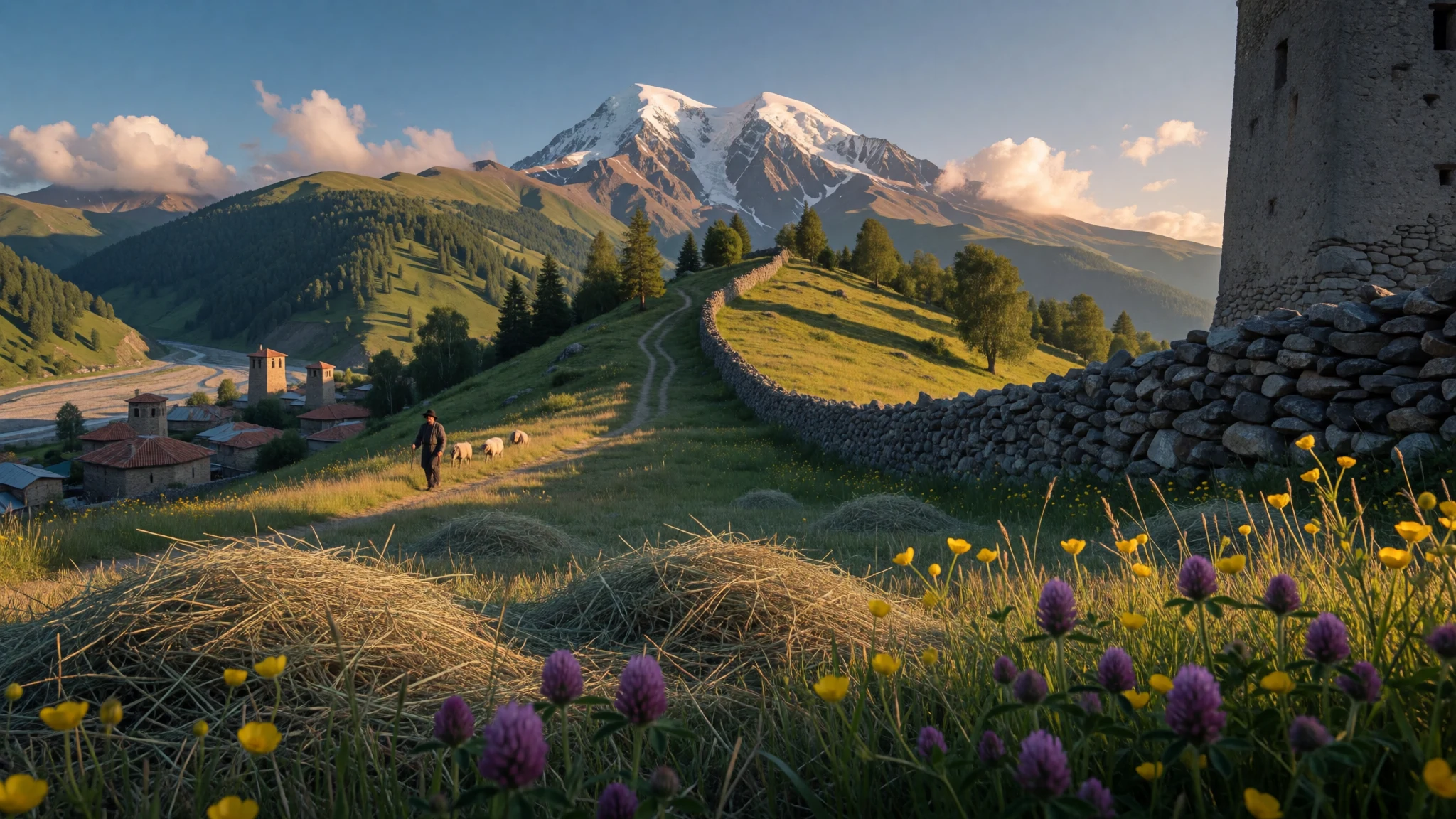
Upper Svaneti pairs medieval stone tower villages with Caucasus glaciers, polyphonic song and homestay hospitality, all at the end of a long mountain road.
The place
Upper Svaneti is the western half of the historic province of Svaneti, in north-western Georgia. It follows the upper valley of the Inguri river along the southern flank of the Greater Caucasus, and its administrative home is the region of Samegrelo-Zemo Svaneti. Mestia is the main town. A second valley, Lower Svaneti, lies over a separate range to the south-east, centred on Lentekhi and reached by a different route.
The landscape is vertical. Villages sit on terraces and shelves above the river, ringed by ridges and glaciated summits that belong to the Caucasus watershed. Shkhara, the highest mountain in Georgia, stands in the province, and Ushba, a twin-headed peak, is the one most often photographed from the valley. Tetnuldi and Ailama are also named on local walking maps. Meadows are cut for hay in summer, cattle and sheep move to higher pasture, and the lanes between stone houses are usually muddy or dusty according to the week.
The people are Svans, a subgroup of Georgians who speak Svan alongside Georgian. Their language is spoken in the home and differs enough from Georgian that visitors will hear a different rhythm in the villages than in Tbilisi.
Two things shape any visit. The first is distance: this is a long drive or a short flight from the rest of the country. The second is weather. Snow closes or slows roads for much of the cold season, so most walkers and drivers come in summer and early autumn, when trails are open and homestays are running at full capacity.
Its story
Upper Svaneti appears in Greek writing through Strabo, whose Soanes are usually taken to be the ancestors of today's Svans. For centuries the area sat in the orbit of Colchis and then of Lazica, the Black Sea kingdom also called Egrisi. In the sixth century the Svans used the confusion of the Lazic War to break from Lazica and side with Persia. The Byzantines wanted the passes to be in friendly hands, because whoever held them could block Persian raiders heading for the coast. When the war ended, Svaneti was folded back into Lazica.
Later the province joined the Abkhazian kingdom, and that realm was absorbed into the Kingdom of Georgia early in the eleventh century. Svaneti became a duchy governed by a duke, known in Georgian as an eristavi. Church art, manuscripts and painted icons from this period survive in village chapels, kept in part by the isolation of the valleys.
The high point in local memory is the reign of Queen Tamar, at the turn of the twelfth and thirteenth centuries. Svans revered her to an extent that the sources compare to worship of a goddess, and a local tradition says she visited the duchy every year. Whether or not the visits happened, the story shows how Svaneti saw itself: loyal to the crown, yet apart.
That apartness became a reputation. Invaders struggled to hold these valleys, and the tower houses, built so families could defend themselves, are the physical record of it. Even the Soviet state, the old brief says, never fully tamed the mountain communities. The reputation survives as friendly teasing from lowland Georgians.
What to see
- Ushguli — Head of the Inguri valley
Ushguli is a cluster of villages at the head of the Inguri valley, with tower houses packed close and Shkhara filling the skyline on clear days. It is the end of the road for most travellers. Walk the lanes early, before day-trip vehicles arrive, and expect cattle, chickens and mud underfoot.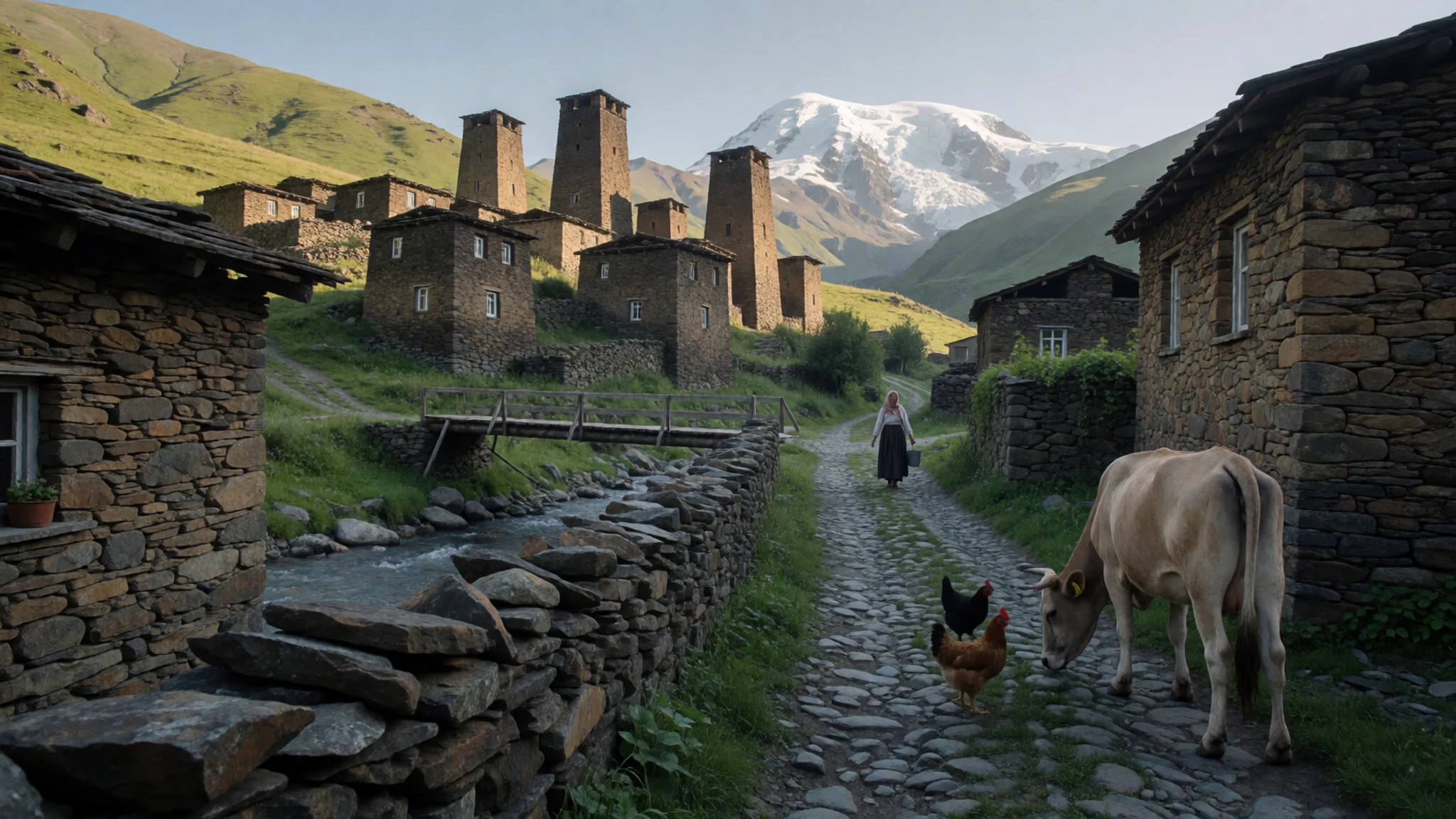
- Mestia and its towers — Mestia
Mestia is the main town of Upper Svaneti and the usual base. Stone watchtowers rise above ordinary houses, shops and guesthouses, so the medieval and the practical sit side by side. Visit the local museum and chapels, then climb a lane to see how the towers were built.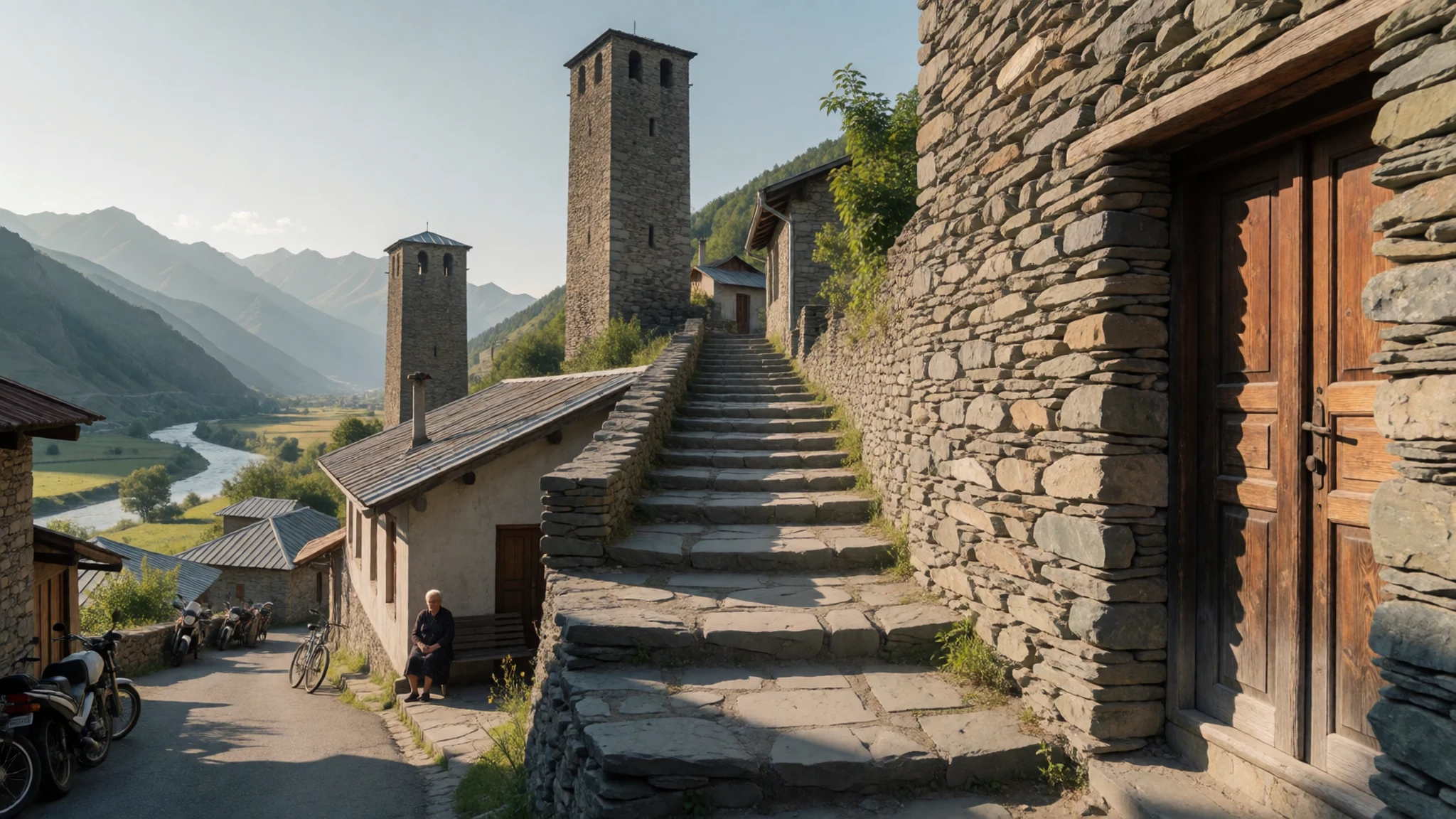
- The Tower of Love — Between Mestia and Ushguli
The Tower of Love stands on the road between Mestia and Ushguli and is a Svan tower with a particular story attached to it. It is a quick roadside stop rather than a destination, but it pairs well with a slow drive and a photograph of the valley behind it.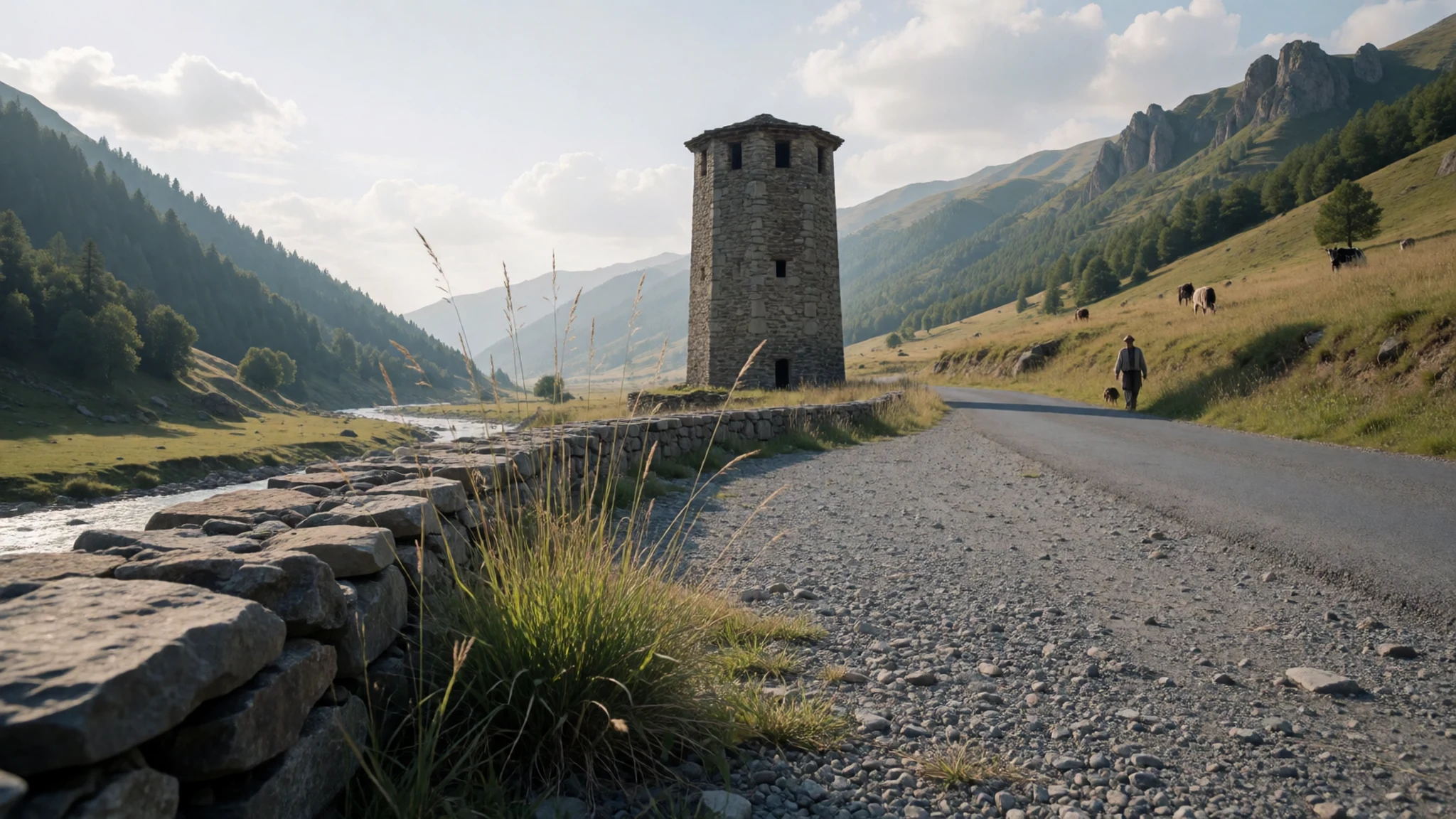
- Enguri Canyon near Totani — Near Totani, north of Jvari
The Enguri Canyon lies on the approach road near Totani, north of Jvari. The cliffs close in on both sides of the village, and the river runs in a narrow channel. It is worth pulling over when the dam upstream has released little water. Take care on the road edge, which has little room.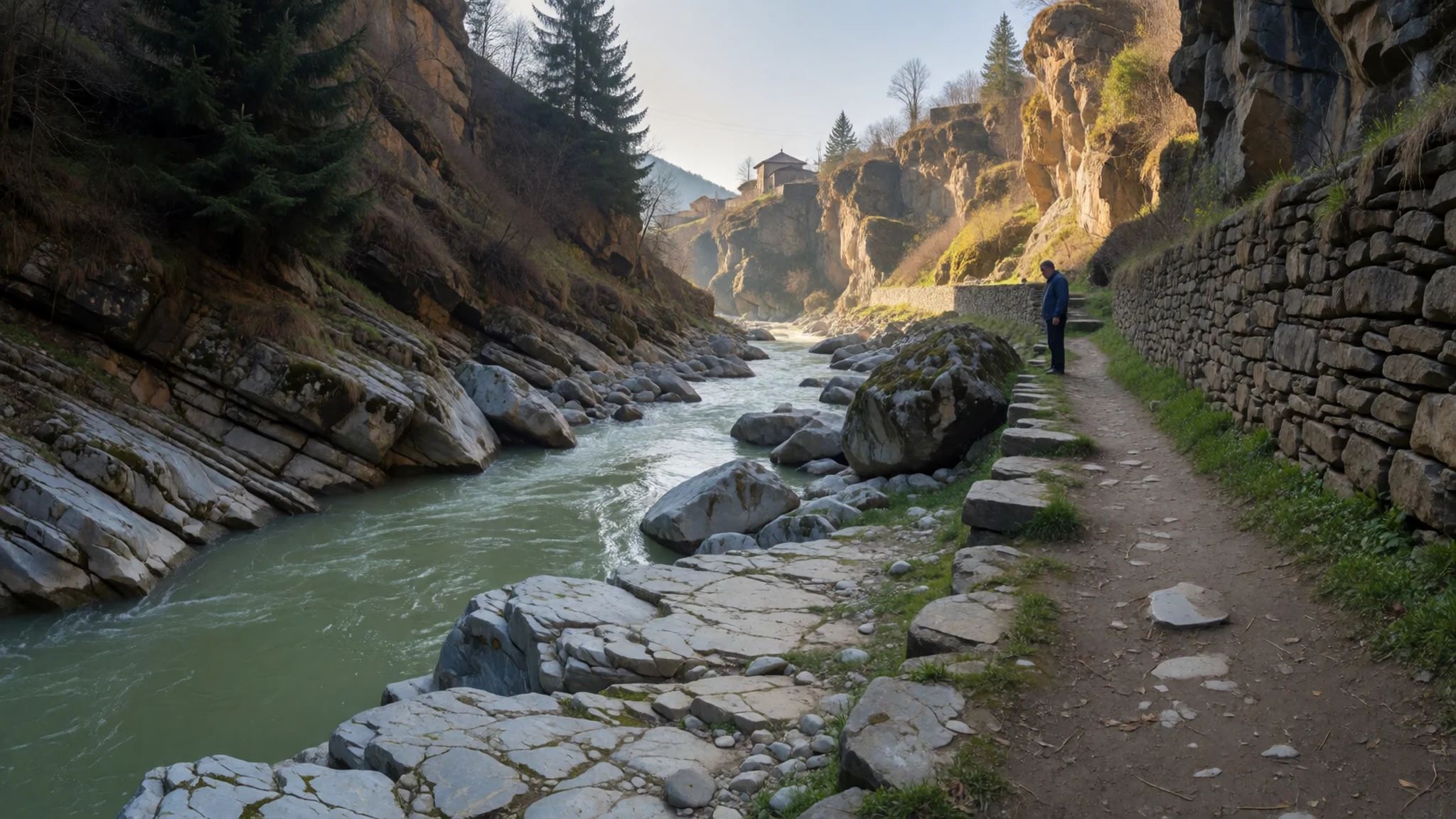
- Viewpoints for Ushba and Shkhara — Ridges above Mestia, and Ushguli
Ushba and Shkhara are the two summits visitors most often hope to see. Ushba shows best from meadows and ridges above Mestia, while Shkhara dominates the view from Ushguli. Cloud can hide both for days, so allow a spare day and walk up to a ridge rather than waiting at a car park.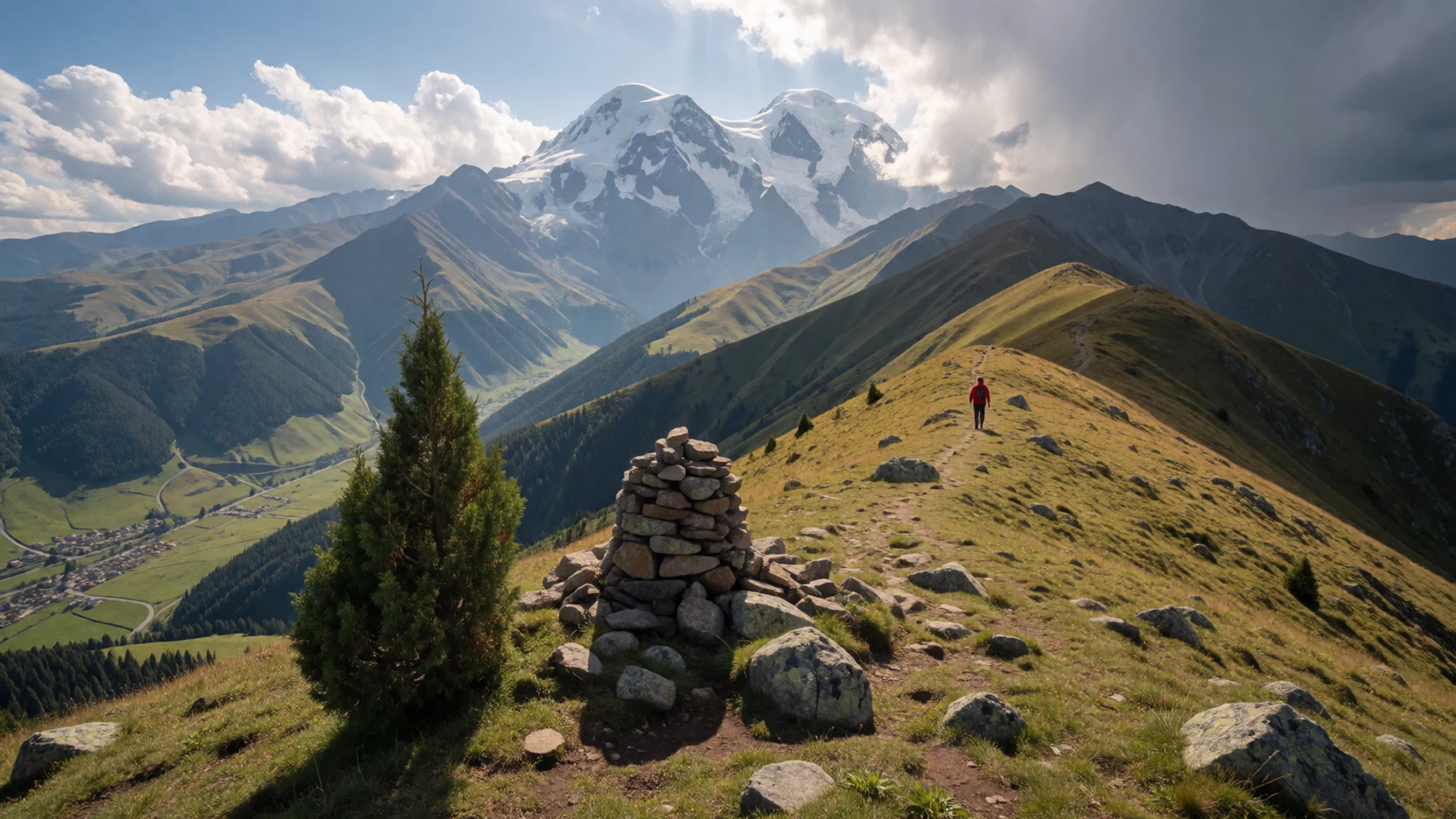
Culture
Upper Svaneti is best known for its tower houses, built mainly between the ninth and twelfth centuries. Each family tower was both a lookout and a refuge, and the stone shafts still stand over the villages, many with homes built against their base. The towers are not museum pieces. People live and farm around them, which is why a walk through a village feels closer to ordinary life than to a heritage site.
Singing is the other pillar. Svan music is polyphonic, with three parts moving against each other, and it is often tied to round dances. Songs are sung loudly and include dissonant chords that sound unfamiliar to ears used to western harmony. Researchers often describe the tradition as very archaic. Hearing it in a home, with the family joining in, is quite different from watching a staged show.
Faith is Orthodox Christian, with small village churches and chapels holding painted icons and church treasures. Families keep ties to particular chapels, and feast days bring relatives back from the cities. Hospitality is a point of pride: a guest is fed first and generously, and refusing food outright can seem rude, so accept a little of everything.
The Svan reputation for fierce independence is real in conversation, and it comes with humour. Respect for elders and for family land matters more here than in town.
When entering a village chapel, cover your shoulders and knees, remove any hat, and ask a local before photographing a person, a family's house interior or an icon.
What to wear
Upper Svaneti has a traditional mountain wardrobe built around wool and felt, the materials the valleys could produce from their own sheep. Felted caps and cloaks suited the cold, and an old photograph from Mestia shows a man in a long coat with a dagger at his belt, a reminder that dress here once carried weapons as well as warmth. Embroidery and woven belts appeared on festive clothing. Today these garments are mostly worn at festivals, weddings, performances and for photographs, and local museums display older pieces.
Everyday dress is practical and rural. Residents wear jeans, fleeces, knitted jumpers, boots and waterproofs, with headscarves common among older women. In summer, farm work calls for old shirts and rubber boots, and in the cold season people layer heavily. Younger Svans dress much as young people do in Tbilisi, and guesthouse hosts often wear a fleece over an apron.
Visitors should dress for changeable mountain weather first. Even in summer, evenings are cool and rain or hail can arrive in the afternoon, so pack a warm layer and a waterproof shell. Boots with grip matter more than style, because trails and village lanes are rough and muddy. Sun hats, sunglasses and high-factor sunscreen are needed at altitude. For chapels and churches, bring a lightweight scarf or shawl and trousers or a long skirt. Shorts are fine on trails, but cover up when entering a church or sitting down to a family meal.
What to eat
- Kubdari — Guesthouses and small eateries in Mestia
Kubdari is the Svan answer to khachapuri: a round bread pie stuffed with spiced minced meat. It is served hot and eaten by the wedge. Order it at a village guesthouse or a small eatery in Mestia, and expect it to arrive greasy, filling and well seasoned.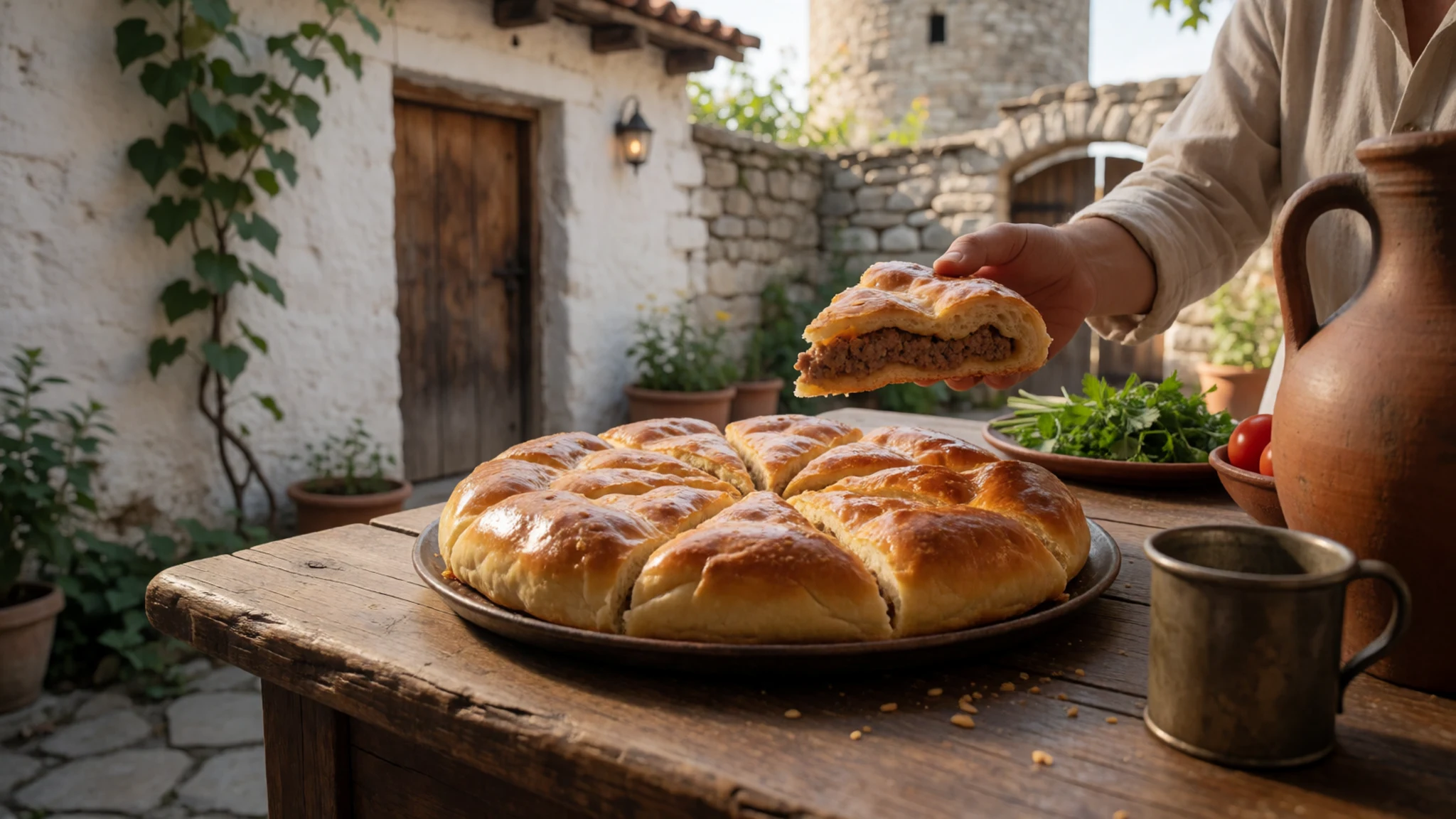
- Svan salt — Village stalls and homestay kitchens
Svan salt is a coarse seasoning ground with local spices and dried herbs, and it is the most portable souvenir of the cuisine. Hosts put it on the table for bread, boiled potatoes and meat. Ask for a small packet from a village stall or a family kitchen.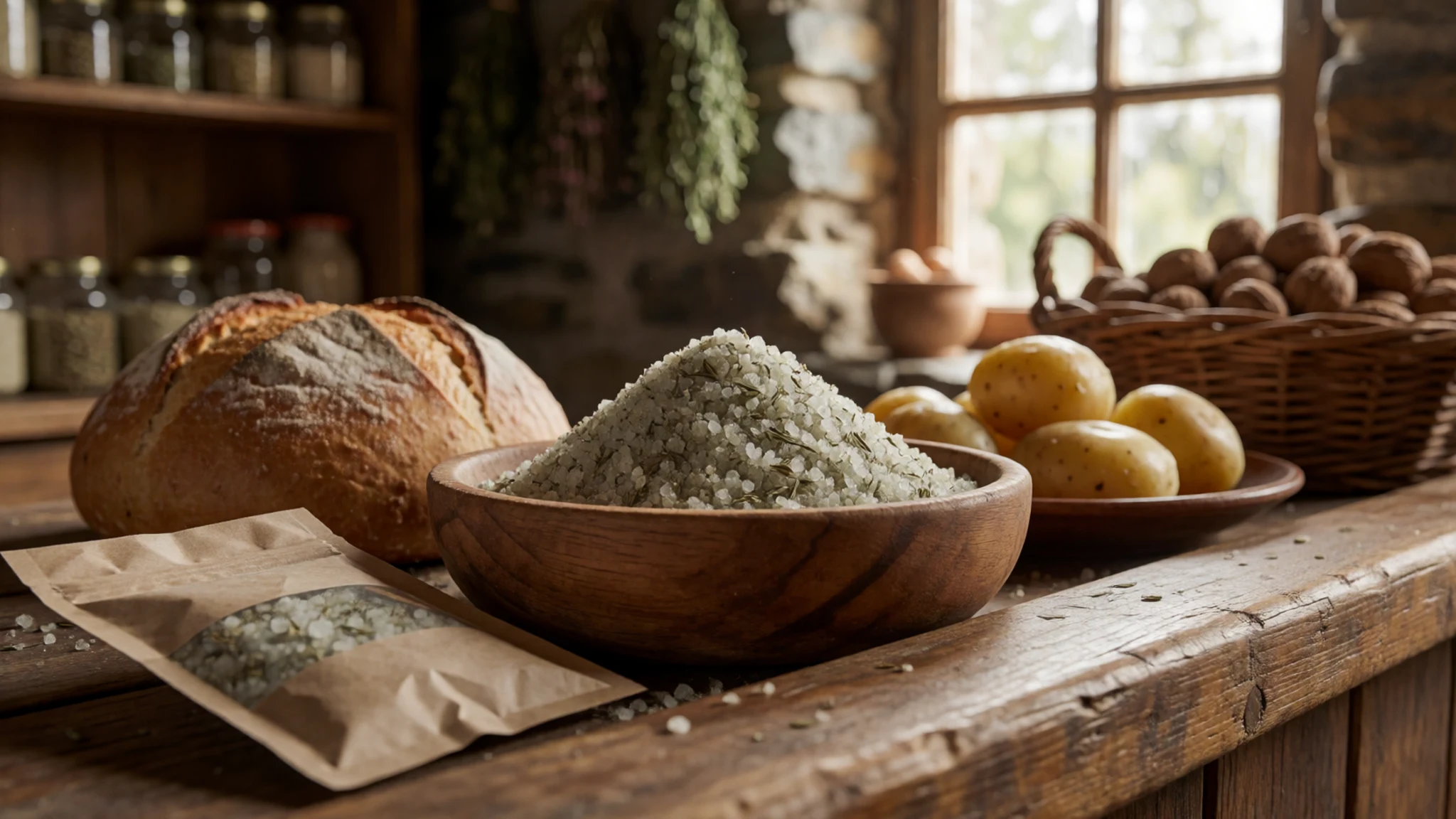
- Tashmijabi — Homestay dinners across the valley
Tashmijabi is mashed potato mixed with local cheese until stretchy, usually served as a side dish or a light meal. It suits cold days after a walk. Most homestays make it, and the quality depends on the cheese, which is often made by the family. - Khvanchkara and Barakoni wine — Homestay tables and shops in Mestia
Khvanchkara and Barakoni are red wines regarded as the best local drinks, though the grapes come from the Racha region rather than the Svan valleys. A bottle at dinner is normal in a guesthouse, and hosts often propose toasts. Drink slowly at altitude. - Mingrelian dishes — Eateries in Zugdidi and along the approach road
Mingrelian cooking, from the lowlands around Zugdidi, is spicier than most Georgian food and appears on menus on the way into Svaneti. Look for dishes with walnut sauce, chilli and fresh herbs. Try them at a roadside eatery in Zugdidi before the climb.
Plan it
Best time. June to September for open trails, green meadows and working guesthouses. Winter brings heavy snow, closed passes and fewer services, though some travellers come for skiing around Mestia.
How long. 3–5
Getting there. Fly to Tbilisi or Kutaisi, then take a marshrutka (shared minibus) or hired car to Mestia. An overnight train runs between Tbilisi and Zugdidi, with early morning marshrutkas on to Mestia for the last stretch of a few hours. Queen Tamar Airport at Mestia has flights operated by Serviceair; check the operator for the current schedule.
Budget. low
Tips
- Book the overnight train from Tbilisi to Zugdidi ahead of travel, because seats can sell out
- Stay in homestays, which usually include dinner and breakfast, and ask in Mestia's tourist information office for families in the villages between Mestia and Ushguli
- Carry cash in lari for villages, because cards are rarely accepted outside Mestia
- Allow spare days in the plan, because cloud and rain can hide the peaks and slow roads
- Take warm layers and sun protection, because altitude makes both cold and sun stronger
Etiquette
- Accept food and toasts from hosts, and ask before photographing people
- Cover shoulders and knees in chapels and churches
- Keep to paths through hay meadows and close gates behind you
Nearby
Sources
- Wikidata Q19044 (CC0)
- Wikipedia: Svaneti (CC BY-SA 4.0)
- Wikivoyage: Svaneti (CC BY-SA 4.0)
- Svanetiskt torn.jpg, Unknown author (CC BY 3.0)
- Ushguli community, Svaneti, Georgia, Florian Pinel (CC BY 3.0)
- West Asia non political with water system, DEMIS Mapserver, पाटलिपुत्र (CC BY 3.0)
- Svaneti region, Georgian Republic, T.Dept (Public domain)
- VittfarneGeorgien 155.jpg, Unknown author (CC BY 3.0)
- Sunrise in Mestia, Svaneti, Georgia (1889), Vittorio Sella (Public domain)
- Old peasant with dagger and long smoking pipe, Mestia, Svanetia, Georgia (Republic), restored by Adam Cuerden (Public domain)
- A view from mount Zuruldi, Svaneti, June, 2018, Alexey Komarov (CC BY-SA 4.0)


