Gergeti Trinity Church
Gergeti Trinity Church, Georgia
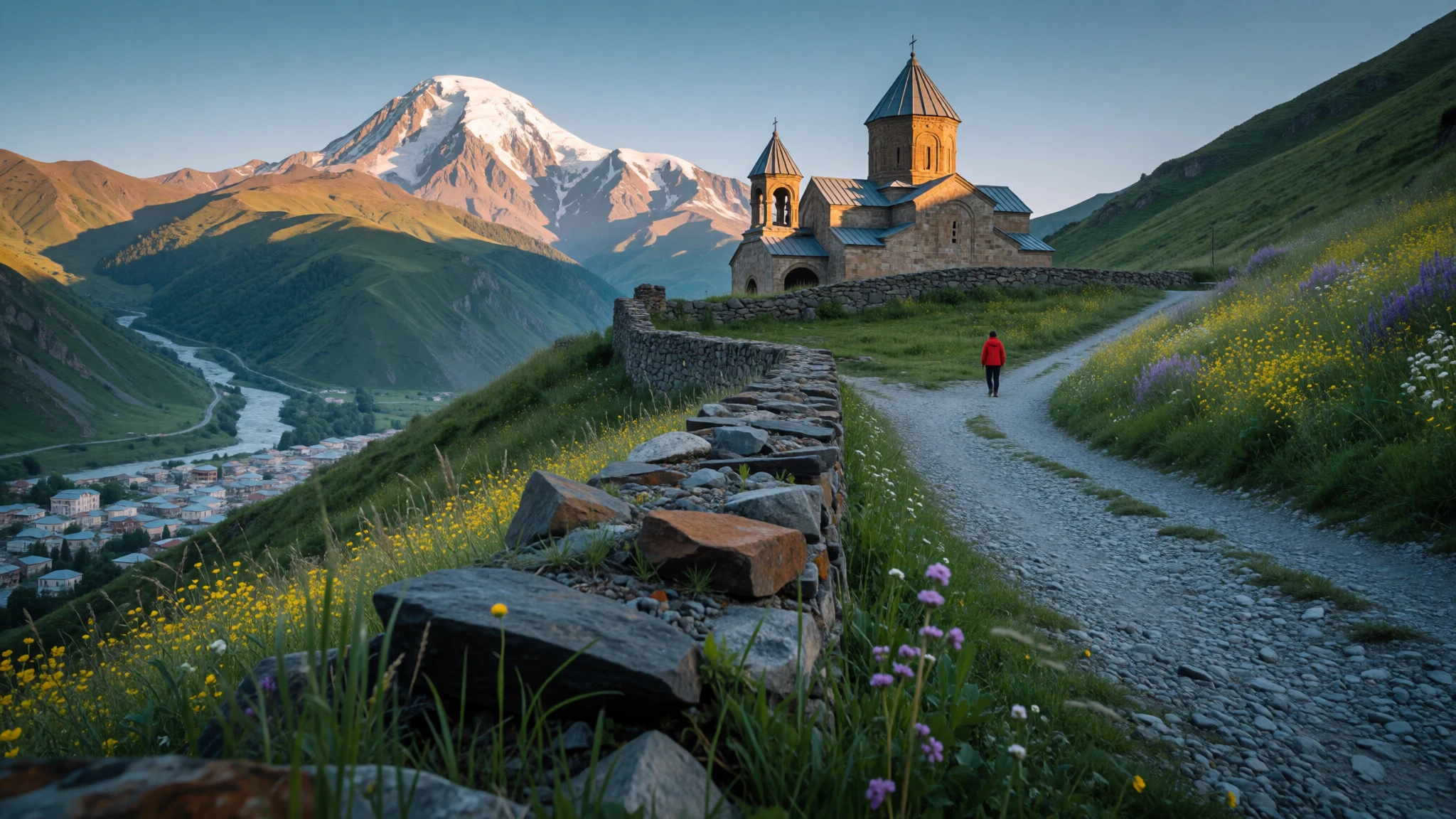
Gergeti Trinity Church stands alone on a ridge beneath Mount Kazbek, a small stone church whose setting does most of the talking.
The place
Gergeti Trinity Church stands at 2,170 metres on a grassy ridge above Stepantsminda, a small town in the Mtskheta-Mtianeti region of northern Georgia. Its Georgian name is Gergetis Samebis Eklesia (გერგეტის სამების ეკლესია), and people often simply call it Tsminda Sameba, the Holy Trinity. The Chkheri river runs in the valley below, and the mountain behind is Kazbek, a snow-streaked bulk that fills the skyline whenever the cloud lifts. The church itself is modest: a compact stone building with a domed roof, a short bell tower beside it and a low wall around the yard. Its power comes from position. There is no village up here, no market, only wind, grass and the crunch of boots on gravel. That isolation is also what makes it busy, since nearly every visitor to Stepantsminda wants the same photograph. Minibuses and four-wheel-drive taxis queue on the track from town, and by mid-morning the yard can feel more like a viewpoint than a place of worship. Early mornings and late afternoons are calmer. Cloud is a real risk, because Kazbek can vanish for days and leave the church floating in white. The slope is exposed, so the weather changes fast even in summer. Stepantsminda, down in the valley, has guesthouses, bakeries and trailheads, and it is the practical base for the visit.
Its story
Gergeti Trinity Church dates from around 1400, and in the centuries since it has marked a high, exposed corner of Georgia that empires wanted to cross or control. The country's history is a long list of pressure from Rome, Byzantium, the Mongols, Persia, the Ottomans and Russia, and its highland churches carry that history in their thick walls and defensible sites. A church at this height was never only a place of prayer. Local tradition says that valuables and sacred objects from elsewhere in Georgia were carried up to this ridge for safekeeping when danger threatened, though the details come from oral accounts and are better treated as tradition than as record. What is clearer is the church's later fame beyond Georgia. Painters and illustrators who travelled the Caucasus found the lone building under Kazbek an easy and irresistible subject, and their views helped fix its image as an emblem of the region. Like many Georgian churches, it lived through a long stretch when religious life was restricted under Soviet rule, and it now functions as a church again, with services and the occasional pilgrim. In recent decades it has also become a symbol of Georgian tourism, appearing on posters and in endless social media feeds. That popularity has brought crowds, a busy track and a fair debate about how many visitors a small mountain church can absorb. The building has changed little in that time; its surroundings have.
What to see
- The church and its yard — The ridge above Stepantsminda
The church is small enough to take in within minutes: weathered stone, a domed roof, a bell tower and a modest enclosure. Inside is dim, candlelit and simple. Spend more time outside, where the building and Kazbek line up in a single frame. Midday groups crowd the gate, so early or late is better.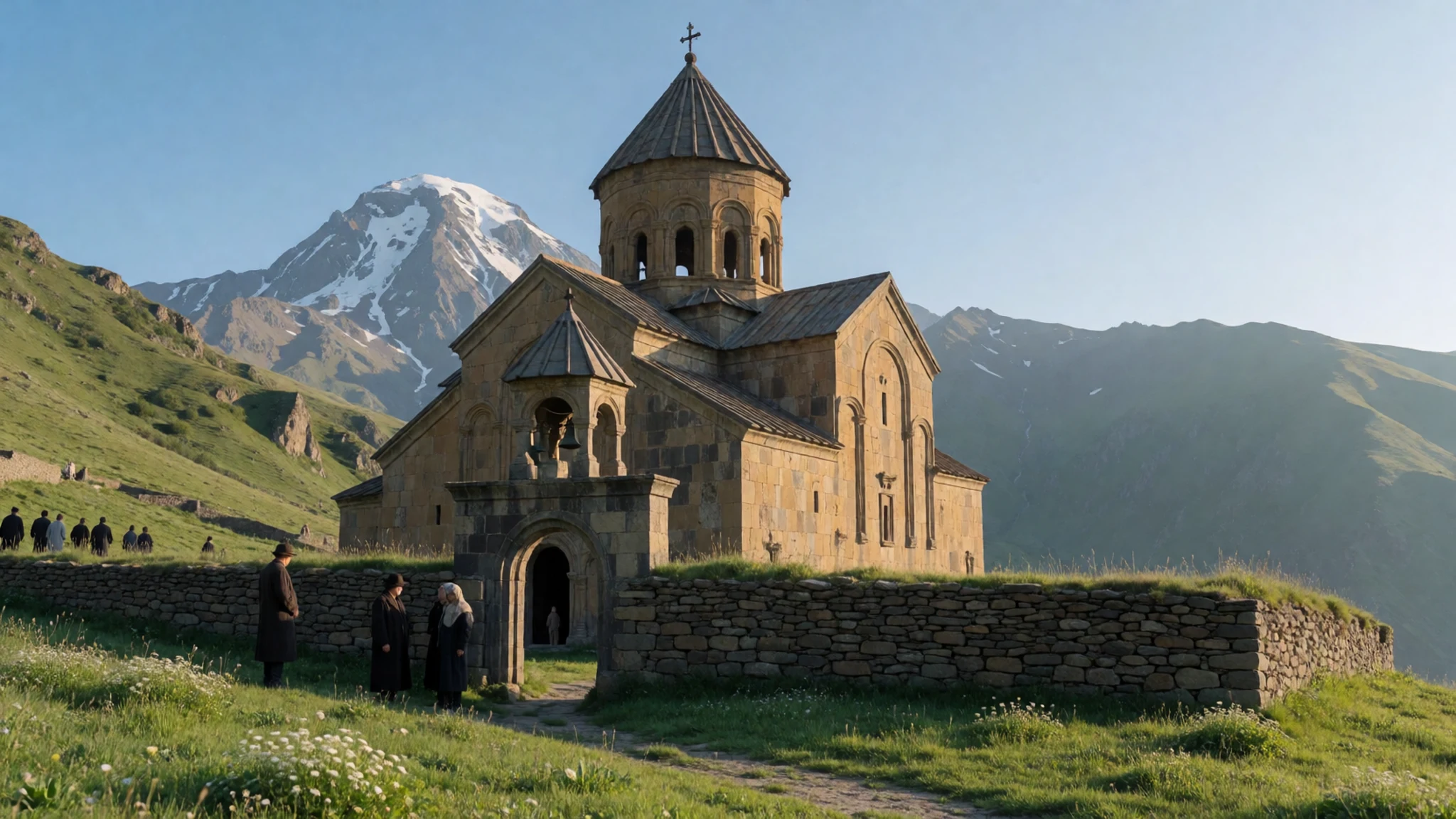
- The walk up from town — Stepantsminda to the ridge
Many visitors walk rather than ride, climbing through woodland and open slope from Stepantsminda to the church. It is a steady uphill on a rough track, and the church keeps appearing and disappearing through the trees. Walkers share the way with taxis, so expect dust in dry weather and mud after rain.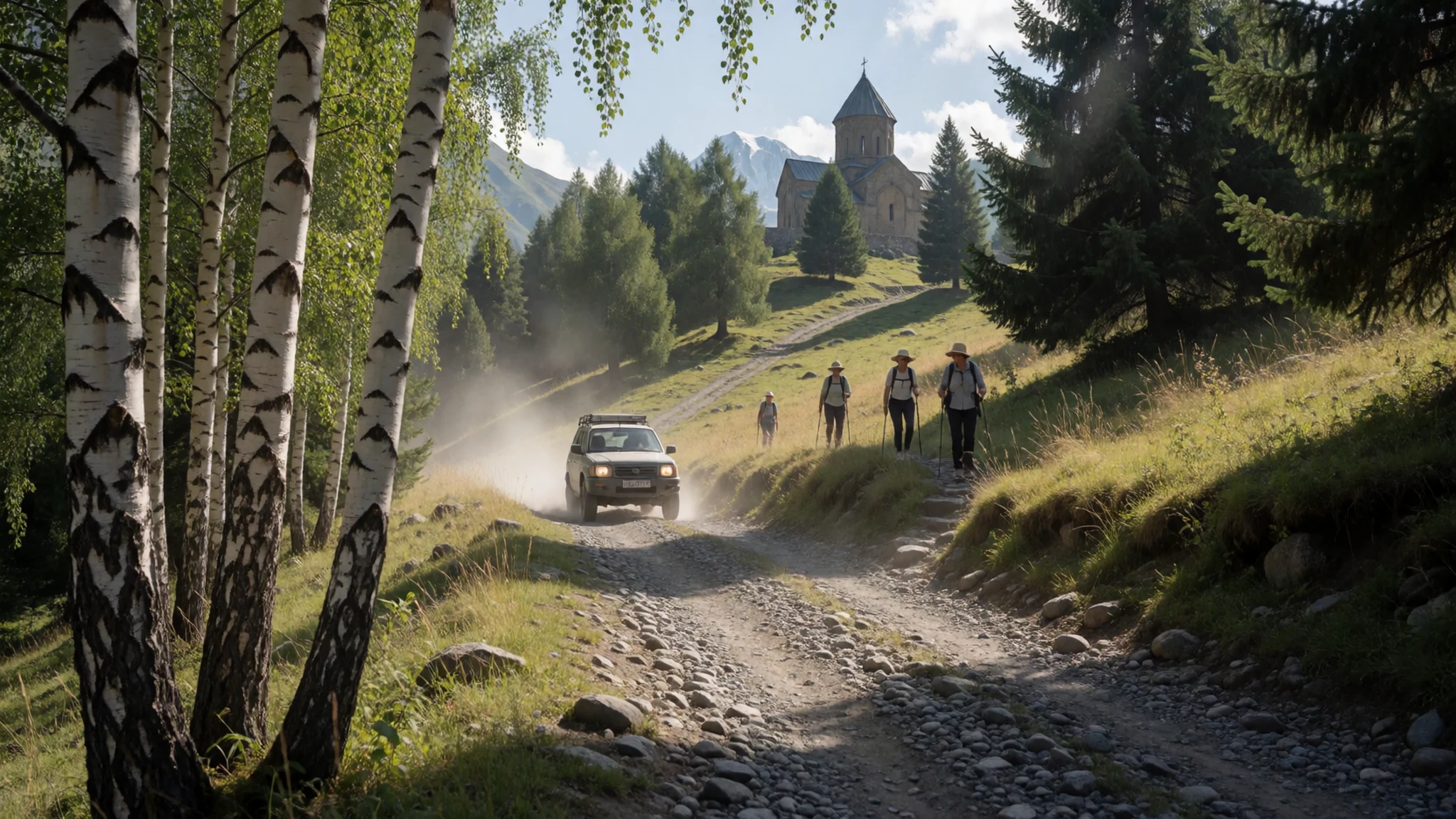
- Kazbek from the ridge — Viewpoints around the church
The mountain is the reason for the church's fame, and the ridge gives a clear view of its white summit above the green slopes. Cloud decides everything. Some mornings the peak stands sharp, other days it never shows. If the weather allows, staying a second night in town improves the odds.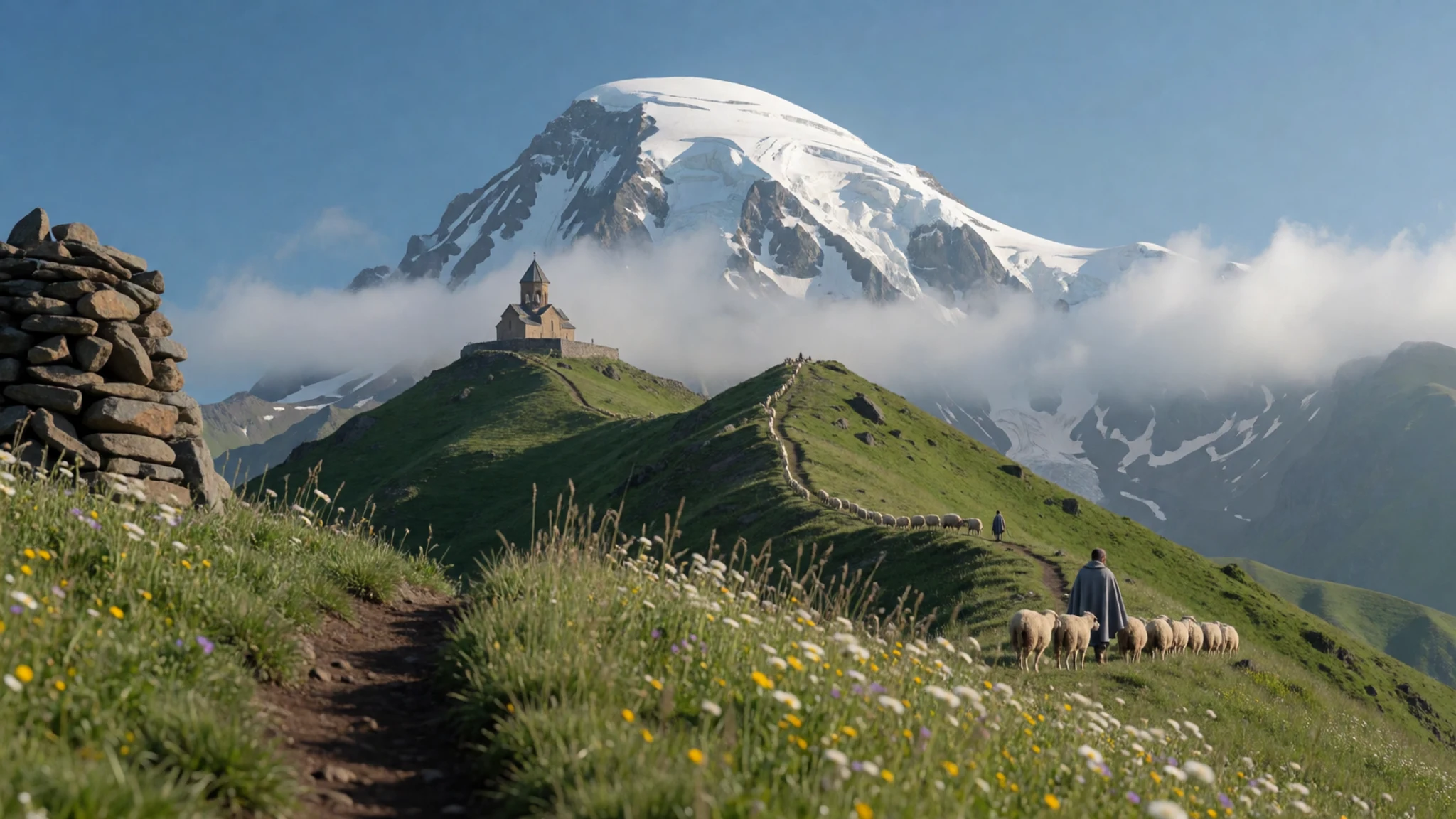
- Stepantsminda — Chkheri valley
Stepantsminda is the working base for the church, a mountain town of guesthouses, small shops, bakeries and trailheads. It is worth an evening for the food and the valley light, and a short wander along its main street shows how local life continues alongside the trekking trade.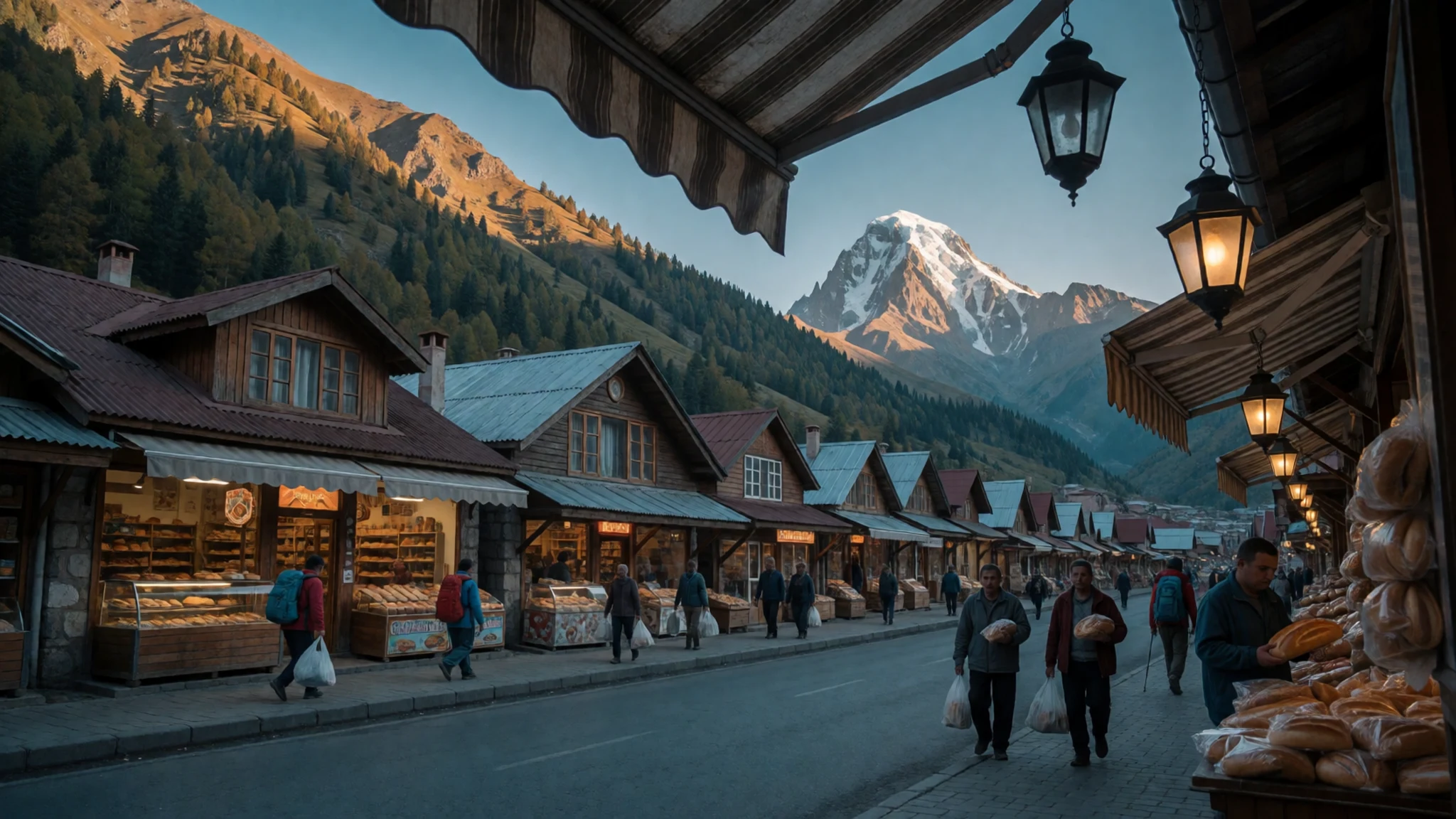
- The valley edge below the church — Chkheri river slope
A short drop from the church yard, the slope above the Chkheri gives a wider view of the valley, the town far below and the church small against the mountain. It is quieter than the gate and works well for photographs showing the true scale of the place.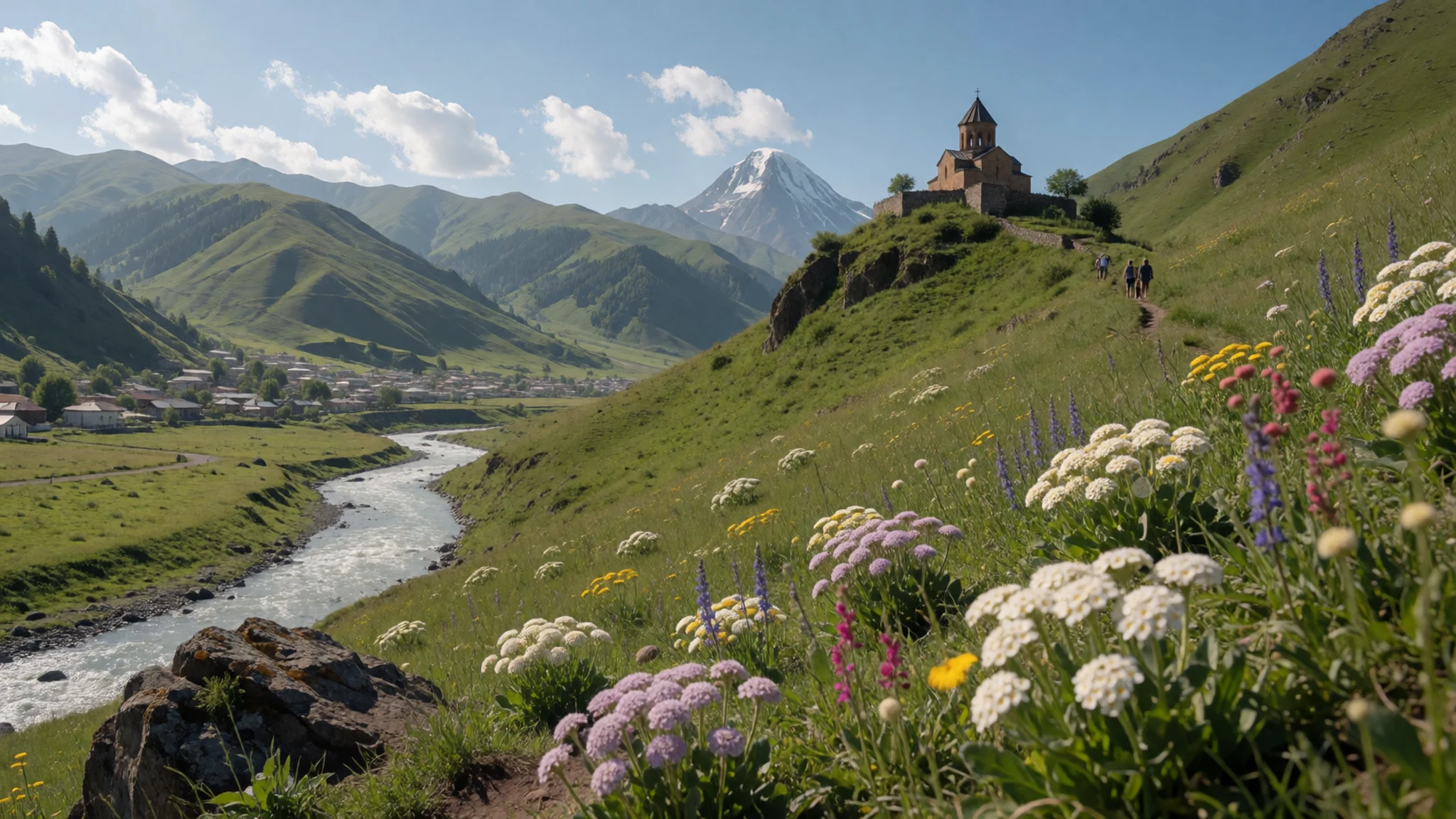
Culture
Gergeti Trinity Church is an active Georgian Orthodox place of worship, and the customs around it are those of a deeply religious country that is also known for hospitality. Georgians tend to be warm, direct and expressive. Loud, animated conversation is usually enthusiasm rather than anger, and personal questions about family or work are a way of getting to know someone, not a rudeness. Hosts often insist on paying, and arguing over the bill can embarrass them, so a gracious thank-you works better than reaching for a wallet, and a return gesture later, such as a toast, goes down well. Meals can turn into long, toast-filled feasts called supra, led by a toastmaster known as the tamada. In the mountains the welcome is just as strong, and guesthouse owners often feed their guests generously. Women are treated with old-fashioned courtesy, and manners lean towards the traditional end of the European range. Faith is part of daily life: people cross themselves when passing churches, and the yard here is a working religious site as well as a viewpoint. Candles are lit inside, and a service may be under way when tour groups arrive, so the mood shifts between reverent and crowded within the hour. Cover shoulders and knees before entering the church, with women also wearing a headscarf, and keep voices low and cameras away from worshippers and any service in progress.
What to wear
Around Gergeti Trinity Church, traditional dress belongs mostly to festivals, weddings, folk dance and church celebrations. The classic men's garment is the chokha, a long woollen coat with rows of cartridge pockets across the chest, worn with soft boots and often a sheepskin hat, the papakha. Mountain shepherds also wore heavy felt cloaks against wind and rain. Women's traditional dress is a long fitted gown with a belt and a fine head covering, usually in velvet, silk or wool depending on the occasion. In daily life in Stepantsminda, people wear what suits a cold, windy highland town: fleeces, padded jackets, jeans, wool hats and sturdy boots, with darker, plainer clothing common among older residents and at church. Visitors should dress for the weather first. Bring layers, a windproof jacket and a warm hat even in summer, since the ridge is exposed and temperatures drop fast when the cloud comes in. Wear hiking shoes or boots with a good grip for the gravel track, and bring sun protection for clear days. For the church itself, pack a scarf for women and clothing that covers shoulders and knees for everyone. Shorts and sleeveless tops are fine on the trail but need a layer over them at the door.
What to eat
- Khinkali — Family-run eateries along Stepantsminda's main street
Twisted dumplings of spiced meat, or sometimes cheese or mushroom, filled with hot broth. They are eaten by hand, holding the knot, with the top left on the plate. Mountain regions are closely associated with them, so they suit a cold evening after the climb.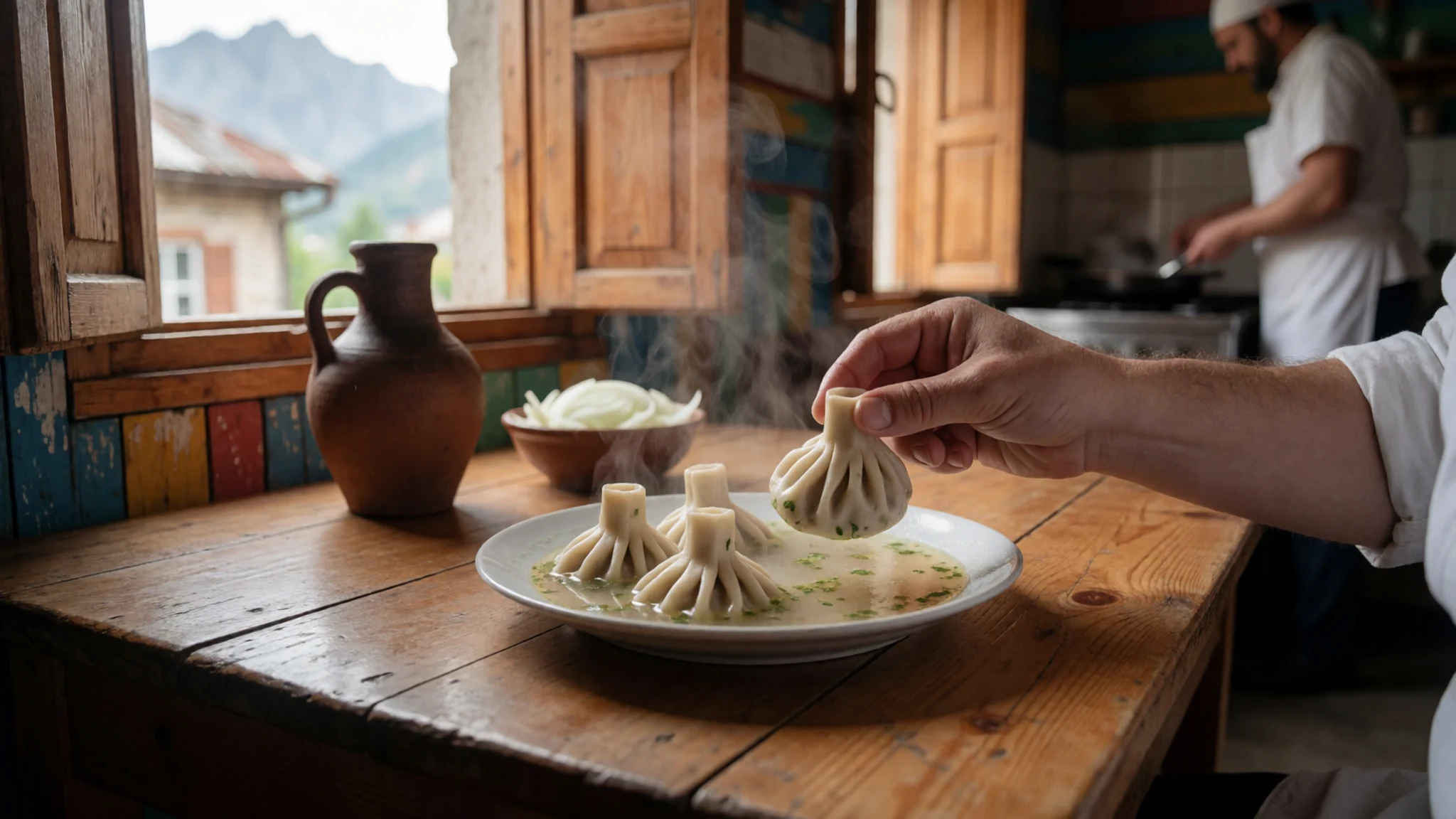
- Khachapuri — Bakeries and casual restaurants in town
Georgian cheese bread comes in regional shapes, from round and flat to the boat-shaped version with a runny egg on top. It is filling, salty and best eaten warm, torn apart and dipped. Share one between two as a first course.
- Lobio — Guesthouse kitchens and small local restaurants
A slow-cooked bean stew seasoned with garlic, coriander and walnuts, often served in a clay pot with cornbread. It is a good option for vegetarians, and warming after a windy morning on the ridge. - Mtsvadi — Grill-focused eateries and roadside barbecues
Skewered pieces of meat grilled over open fire, usually seasoned simply and served with onions and sharp tkemali plum sauce. It is typical of Georgian feasts and fits well with local red or amber wine. - Churchkhela — Roadside stalls and market tables in the valley
A string of walnuts dipped repeatedly in thickened grape juice and dried into a chewy, candle-shaped sweet. It travels well and makes a practical trail snack, though sweetness and texture vary between makers.
Plan it
Best time. June to September, when the track is clear of snow and the days are longest; Kazbek is often hidden by cloud, so allow a spare day, and be prepared for sharp changes in weather at any time of year.
How long. 2–3
Getting there. Fly to Tbilisi, then continue north by road to Stepantsminda by shared minibus or taxi. The last leg is a walk up the track from town or a short ride in a four-wheel-drive taxi to the church.
Budget. low
Tips
- Go at dawn or late afternoon to avoid the tour groups
- Carry layers, a windproof jacket and water, since there is no shop at the church
- Check the weather before committing to the walk, and keep a spare day in case Kazbek is hidden
- Carry some cash for taxis and small guesthouses, and check the official sources before travelling
- Confirm entry rules for your passport before booking, as visa-free access applies to some nationalities, including UK citizens
Etiquette
- Cover shoulders and knees at the church, and women should carry a scarf for the head
- Keep quiet and avoid photographing worshippers, especially during a service
- Accept hospitality graciously and do not argue over who pays
Nearby
Sources
- Wikidata Q1511206 (CC0)
- Wikipedia: Gergeti Trinity Church (CC BY-SA 4.0)
- Wikivoyage: Georgia (country) (CC BY-SA 4.0)
- Photo: Gergeti Trinity Church and Mt. Kazbeg 01 (Braveheart) (CC BY-SA 4.0)
- Photo: Gergeti Trinity Church 09.23 (Supanut Arunoprayote) (CC BY 4.0)
- Photo: Khevi, Georgia — Gergeti Trinity Church (Levan Gokadze) (CC BY-SA 2.0)
- Photo: The Tsminda Sameba church, Kazbegi (3) (Nicolai Bangsgaard) (CC BY 2.5)
- Photo: Kazbeg Panorama (Philipp Weigell) (CC BY 3.0)
- Photo: AVasnetsov Tsminda Sameba (Apollinary Vasnetsov) (Public domain)
- Photo: Church at Kazbek (Roskoschny, 1884) (Public domain)
- Photo: Gadayev, Views of the Caucasus (Fyodor Gadayev) (Public domain)


