Uplistsikhe
Uplistsikhe, Georgia
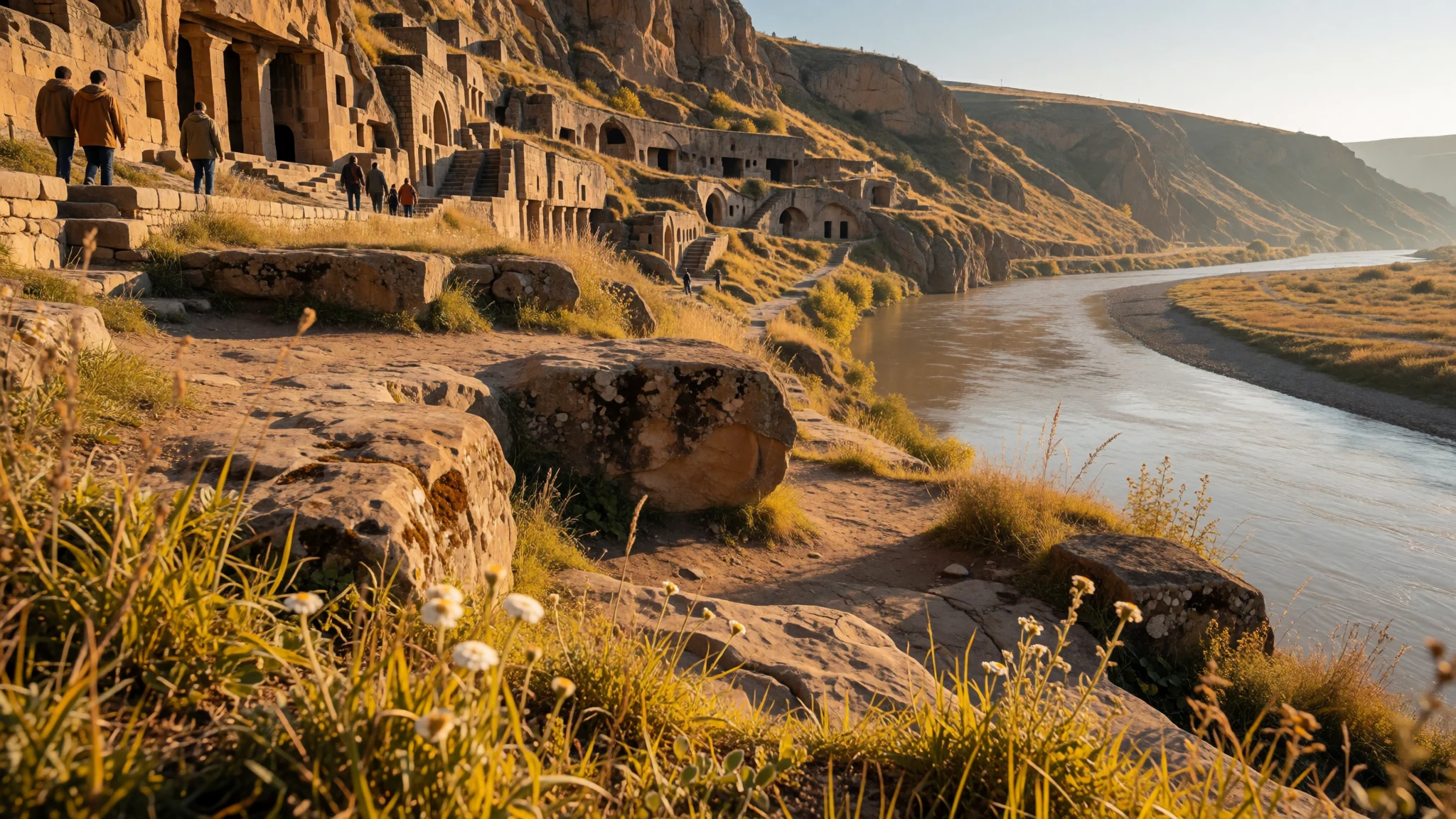
Uplistsikhe offers a rare journey into a multi-layered rock-hewn city where ancient pagan rituals once echoed across dramatic Caucasian river cliffs.
The place
Uplistsikhe stands as an extraordinary rock-hewn settlement carved directly into the precipitous left bank of the Mtkvari River in eastern Georgia. Situated in Shida Kartli, this ancient site rises above the surrounding valley floor, presenting travellers with an intricate labyrinth of chambers, corridors, and stepped terraces hewn straight from soft sandstone. The architecture here tells a complex story of cultural exchange, blending stone-cutting techniques originating from Anatolia and Iran with indigenous Caucasian building traditions. Walking through the lower and upper tiers of Uplistsikhe reveals an urban layout shaped by centuries of human habitation, where secular halls with coffered ceilings sit alongside modest rock-cut dwellings and early places of worship. The geography itself forms the primary defensive layer; the steep river cliffs offer natural protection, while a massive carved rock-cut street system connects the various quarters. Unlike traditional stone-built ruins, the spaces here are subtractive, formed by excavating deep into the geological strata rather than stacking blocks. Visitors wandering these ancient pathways encounter remnants of sophisticated water management systems, grain storage pits, and wine presses carved directly into the bedrock, illustrating how ancient communities adapted to this arid, windswept terrain. The muted grey and ochre tones of the stone shift dramatically under the midday sun, casting deep shadows across the pathways and creating an atmosphere that feels entirely detached from the modern world below.
Its story
Georgian history centers heavily on Uplistsikhe, which experts in excavation classify among the nation's earliest city sites. Situated in the heartland of the ancient kingdom of Kartli, also known as Iberia to classical authors, the site developed into a powerful political and religious hub. Medieval Georgian chroniclers attributed the foundation of Uplistsikhe to the mythical figure of Uplos, linking the settlement directly to the legendary lineage of the nation's earliest patriarchs. Archaeological evidence confirms human presence on the rocky promontory from the late second millennium BCE, with permanent structural development accelerating through the early centuries of the first millennium CE. During the pre-Christian era, the complex served as a major center for pagan worship, featuring grand sacrificial sites and ritual spaces dedicated to regional deities. Following the Christianisation of Kartli, the political gravity of the region shifted toward Mtskheta and Tbilisi, causing Uplistsikhe to cede its primary administrative status, yet the town continued to thrive and adapt. The construction of stone and rock-cut basilicas from the sixth century onward marked a slow integration of Christian architecture into the pagan landscape. During the periods of foreign invasions and the Muslim conquest of Tbilisi, Uplistsikhe experienced a significant military revival, functioning as a vital stronghold for Georgian kings. The destructive Mongol raids eventually brought an end to its continuous habitation, leaving the site largely abandoned save for occasional use as a refuge during times of war.
What to see
- The Hall of Queen Tamar — Upper terrace of the archaeological complex
The Hall of Queen Tamar stands as one of the most architecturally ambitious spaces within Uplistsikhe, featuring a large pillared hall with intricate stone-carved coffered ceilings. Local tradition connects this magnificent rock-hewn chamber to the medieval monarch, though scholars believe it served as a major reception hall or pagan temple before its later adaptations. Visitors can inspect the impressive scale of the chamber and examine the precise geometric patterns carved directly into the solid stone overhead. - The Rock-Cut Basilica — Summit of the central ridge
Perched dramatically on the highest point of the cliff, the Christian basilica represents the complex religious transition of the site from pagan dominance to medieval Christianity. Built partially from stone blocks and partly integrated into the ancient rock formations, this structure offers sweeping views across the Mtkvari River valley. Walking around the exterior reveals weathered medieval stonework and ancient crosses etched into the surrounding cliff faces by pilgrims over the centuries. - The Ancient Theatre — Central platform along the main processional route
The ancient amphitheatre-style structure at Uplistsikhe is a rare survival of secular public architecture from the pre-Christian period in the Caucasus. Characterised by a semi-circular orchestra space and stepped stone seating carved out of the natural rock slope, it hosted public gatherings, dramatic performances, and civic assemblies. Standing in the centre of the stone ring allows travellers to experience the remarkable natural acoustics designed by ancient builders. - The Secret Escape Tunnel — Western slope descending toward the Mtkvari River
A narrow, steep rock-cut trench carved deep into the limestone cliff leads downward from the upper settlement toward the riverbank below. This subterranean passage served as a strategic escape route and a protected water-fetching corridor during times of siege, ensuring the inhabitants could survive prolonged blockades. Walking through this damp, enclosed chute offers a visceral reminder of the defensive engineering required to hold this formidable stronghold against invading armies.
Culture
Uplistsikhe and the surrounding Shida Kartli region are deeply shaped by traditional Georgian values of hospitality, familial heritage, and a rich blending of ancient folklore with Orthodox Christian spirituality. For the local communities living near the ancient rock city, guests are traditionally viewed as gifts from God, leading to a profound culture of warmth and generosity toward travellers. Traditional music, polyphonic singing, and winemaking remain central pillars of daily life, passed down through generations across the valleys. When visiting churches and sacred spaces within archaeological sites like Uplistsikhe, women should carry a scarf to cover their head and wear skirts or trousers that cover their knees, while men must remove hats upon entering.
What to wear
Traditional attire in the Uplistsikhe region historically reflected the rugged requirements of Caucasian life, featuring heavy woolen fabrics, felt hats known as papakhi, and the traditional chokha coat adorned with cartridge holders across the chest. While such garments are now reserved for national holidays, folk dance performances, and weddings, everyday wear in nearby towns leans toward practical, contemporary European styles. For travellers visiting Uplistsikhe, proper preparation is essential due to the exposed, uneven stone terrain. Comfortable walking shoes or sturdy trainers with good grip are necessary for navigating the steep, slick sandstone paths and unpaved cave interiors. Visitors should dress in breathable layers, as the open rock surface offers little shelter from the intense summer sun or chilly winds blowing down from the nearby mountains.
What to eat
- Khachapuri — Local village bakeries and traditional roadside eateries
Khachapuri is Georgia's iconic cheese-filled bread, baked in various regional styles across the country, including the boat-shaped Imeretian and Adjarian versions filled with bubbling melted cheese and butter. You can find freshly baked khachapuri at local bakeries, roadside eateries, and traditional family-run guesthouses throughout Shida Kartli. - Khinkali — Specialised dumpling houses and traditional regional restaurants
Khinkali are large, twisted dumplings stuffed with spiced minced meat and savoury broth, traditionally eaten by biting a small hole to sip the hot juices before consuming the rest. These hearty dumplings are a staple of Georgian cuisine, widely served in specialised dumpling houses and regional restaurants. - Shkmeruli — Traditional village taverns and family-run country restaurants
Shkmeruli is a deeply aromatic and comforting dish featuring roasted chicken simmered in a rich, bubbling garlic and milk or cream sauce. This rustic specialty is best enjoyed hot with plenty of fresh bread to soak up the flavourful sauce at local village restaurants. - Badrijani Nigvzit — Traditional Georgian restaurants and local market food stalls
Badrijani Nigvzit consists of thin slices of fried aubergine rolled up and stuffed with a rich, spiced walnut paste seasoned with garlic, blue fenugreek, and fresh coriander, often garnished with pomegranate seeds. This classic cold starter is found in nearly every traditional Georgian restaurant and market food stall.
Plan it
Best time. April to May and September to October offer the most comfortable weather for exploring the exposed rock terraces without intense summer heat or winter chill.
How long. 1–2
Getting there. Take a minibus from Tbilisi's Didube bus station to the town of Gori, then catch a local taxi or connecting transport for the final 10 km stretch to Uplistsikhe.
Budget. low
Tips
- Wear sturdy walking shoes with reliable grip, as the ancient sandstone surfaces can be very slippery.
- Arrive early in the morning during the summer months to avoid the midday heat and tour bus crowds.
- Carry cash for local minibuses, entry tickets, and small village shops where card payment is unavailable.
- Bring a hat, sunglasses, and plenty of drinking water, as there is minimal shade across the archaeological site.
Etiquette
- Cover your head and shoulders when stepping into any active chapels or sacred structures.
- Ask permission before photographing local residents or artisans in nearby villages.
Nearby
Sources
- Wikidata Q1351318 (CC0)
- Wikipedia (rev 1328859395) (CC BY-SA 4.0)
- Wikivoyage (rev 5291801) (CC BY-SA 4.0)
- Photo photos/01-uplistsikhe41.jpg (CC BY 3.0)
- Photo photos/02-middle-ages-basilica-on-the-top-of-the-cave-uplistsikhe-2023.jpg (CC BY 4.0)
- Photo photos/03-uplistsikhe-cave-city.jpg (CC BY-SA 4.0)
- Photo photos/04-cavesuplistsikhe1.jpg (CC BY-SA 4.0)


