Putuoshan
Putuoshan, People's Republic of China
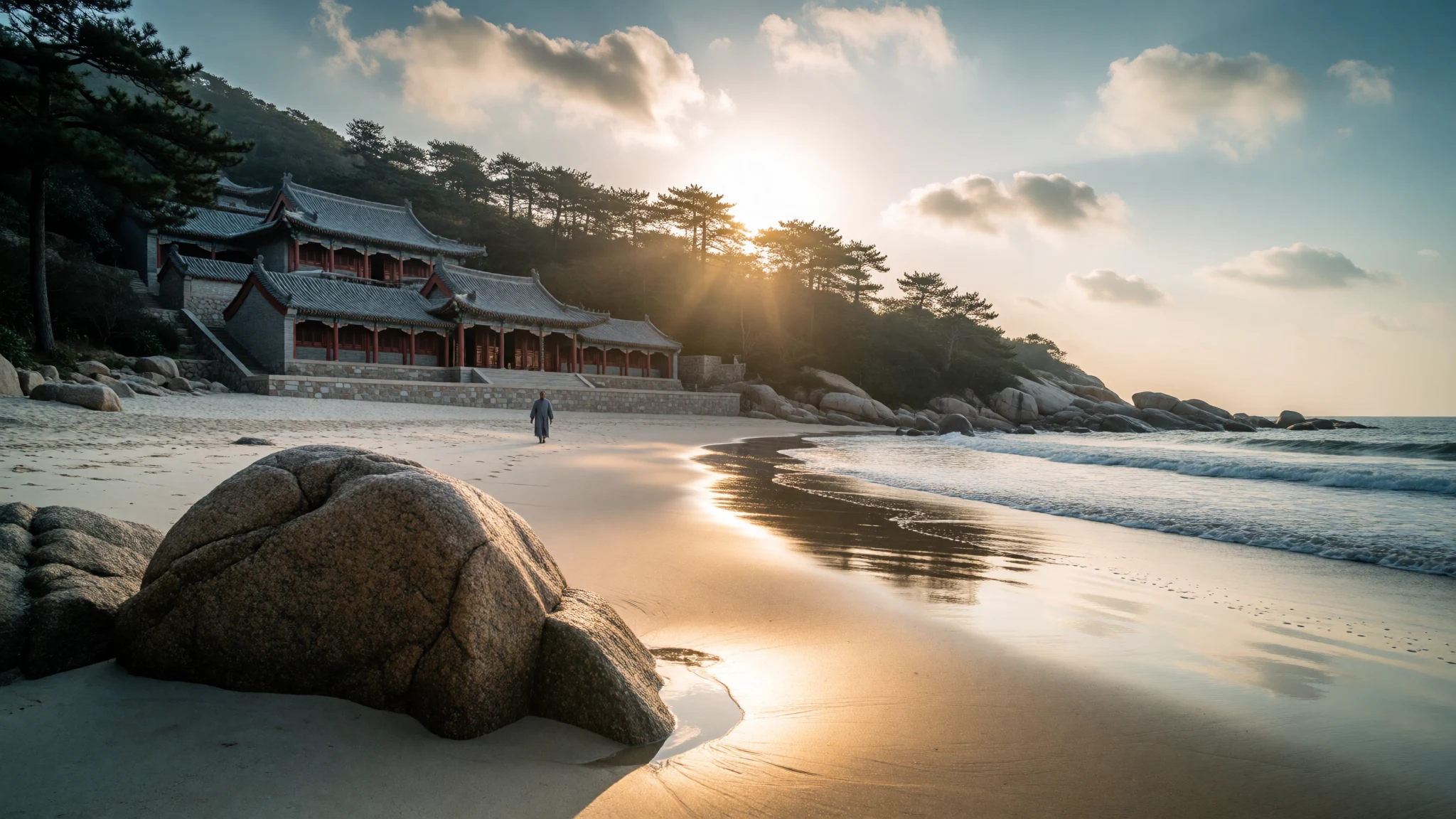
Putuoshan is Chinese Buddhism's island of Guanyin, where pilgrim temples, pine woods and sea beaches sit within walking distance of one another.
The place
Putuoshan is a small forested island in the East China Sea, off the coast of Zhejiang province and a short ferry ride east of Zhoushan island. Its name comes from the Sanskrit Potalaka, the legendary mountain home of Guanyin, the bodhisattva of compassion, often called the Goddess of Mercy in English. It is one of the four sacred mountains of Chinese Buddhism, alongside Wutai, Jiuhua and Emei, and it is the lowest and the easiest to reach, with a high point of 288 metres. Officially it also carries China's top tourist-attraction rating. What it offers is a compact mix of mountain and sea: monasteries tucked into pine and camphor woods, long sandy beaches on the eastern side, ponds and pavilions in front of the main temples, and rocky headlands with lighthouses. Because the island is small and the space for visitors is limited, the busiest temples can feel crowded and far from peaceful, especially around Guanyin's festival days in the second, sixth and ninth lunar months, when pilgrims arrive in their millions. Away from the main axis the mood changes. Many smaller monasteries sit quietly in the woods, and the island feels more relaxed than most famous tourist sites in China. Everything is reached by ferry, and cars are limited, so days here are spent on foot or on short island bus rides. Mist and sea fog are common, and they suit the place.
Its story
Putuoshan has drawn pilgrims for more than a thousand years. After the Tang dynasty the island became the main centre of Guanyin worship in China, and the faithful came across the water to pray to the bodhisattva who protects travellers and sailors. Three great temples came to define it. Puji was founded in the tenth century, Fayu in the late sixteenth century, and Huiji in the late eighteenth. Around them grew dozens of smaller monasteries and hermitages in the woods. The island has also attracted notable travellers. In the early seventeenth century a young man of twenty, Yinyuan Longqi, came here while searching for his father, who had vanished years earlier. He later became a Chan master and is known in Japan as Ingen. During the 1900s, reformer Taixu did a multi-year hermitage retreat on the island. Pilgrimage here has a long-standing rhythm: arrive by boat, burn incense at the main halls, climb to the hilltop temple, then walk the quieter paths. A local saying holds that a pilgrimage to Putuoshan is incomplete without a visit to the small neighbouring island of Luojia Shan, which from certain viewpoints looks like a person lying on their back.
What to see
- Puji Monastery — South end of the island, near the ferry terminal
Puji is the most accessible and best-known monastery on Putuoshan, near the ferry terminal, with restaurants and shops close by. Ponds, bridges and pavilions stand in front of it. Monks hold a public ritual very early each morning, so arrive at first light and check the times locally.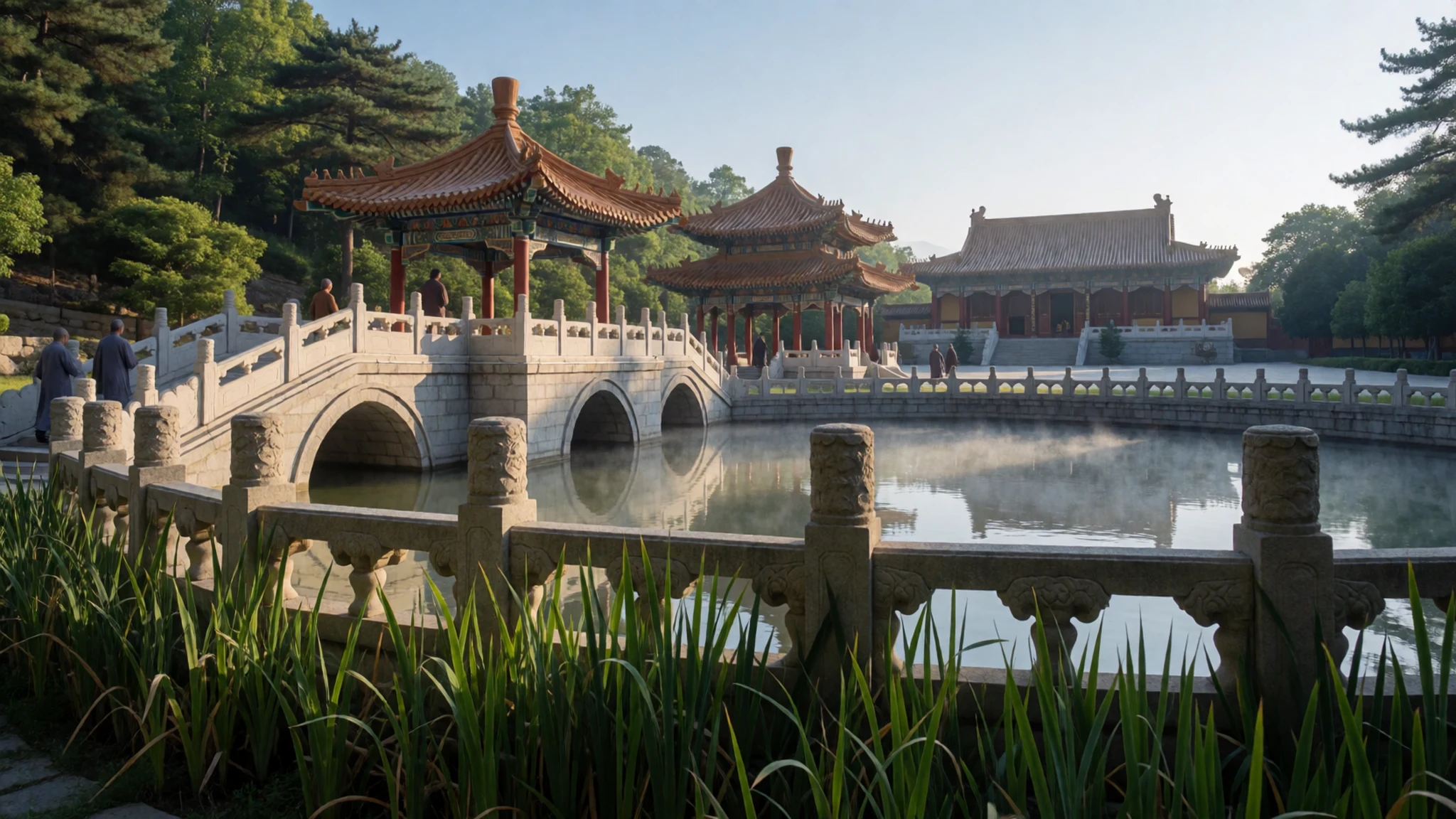
- Fayu Monastery — Foot of Fodingshan, north end of Thousand Step Beach
Fayu lies at the foot of Fodingshan, at the north end of the long sandy beach known as Thousand Step Beach. Its halls climb the hillside in terraces among old trees. It is generally calmer than Puji, and the beach just beyond is good for a sea-breeze walk.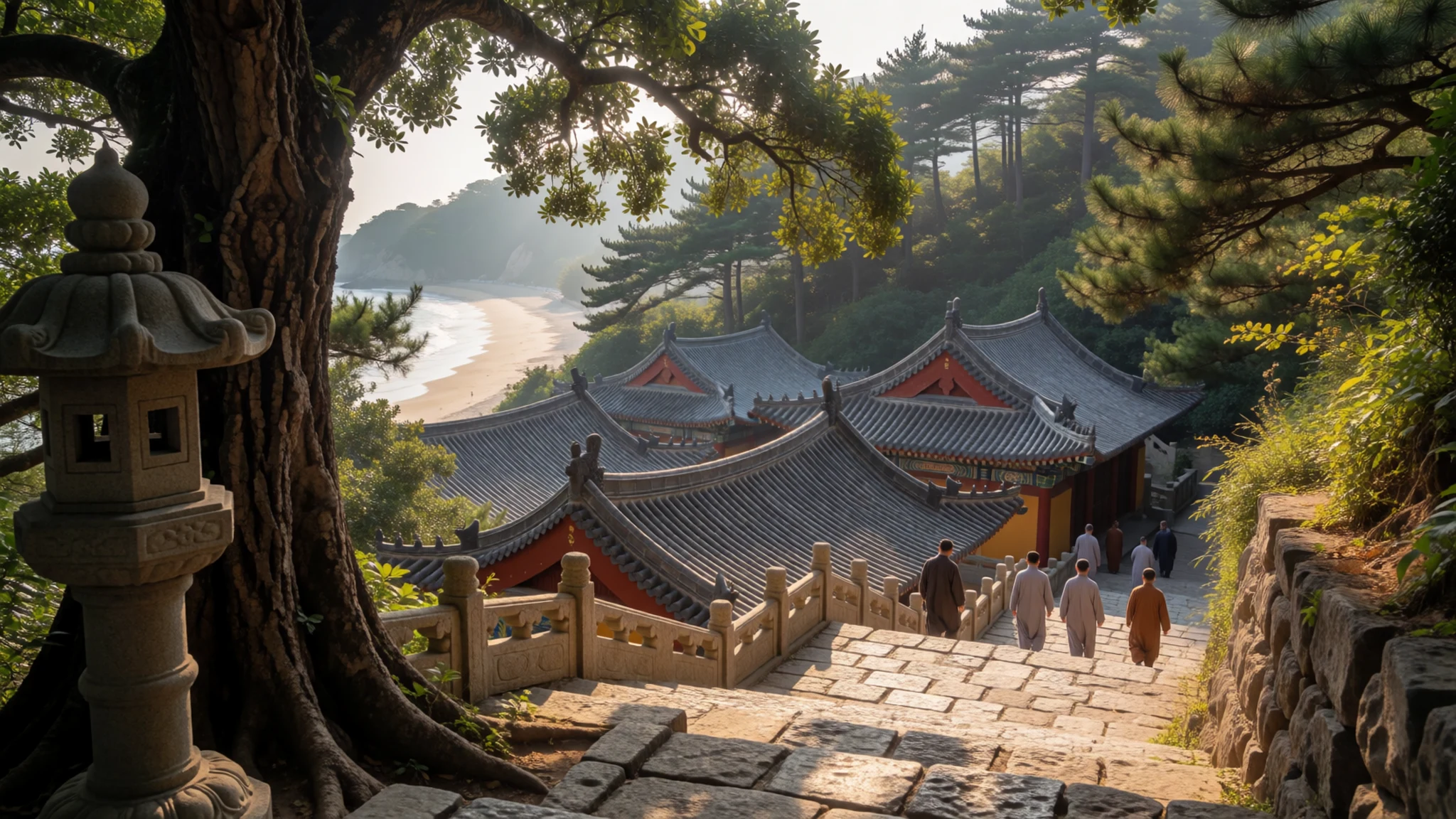
- Huiji Monastery — Hilltop above Fayu Monastery, centre-north of the island
Huiji sits on the island's high ridge among pines and is reached by cable car, island bus, or a long climb on concrete steps from near Fayu. Pilgrims often choose the steps. On clear days the view over the island and out to sea justifies the effort.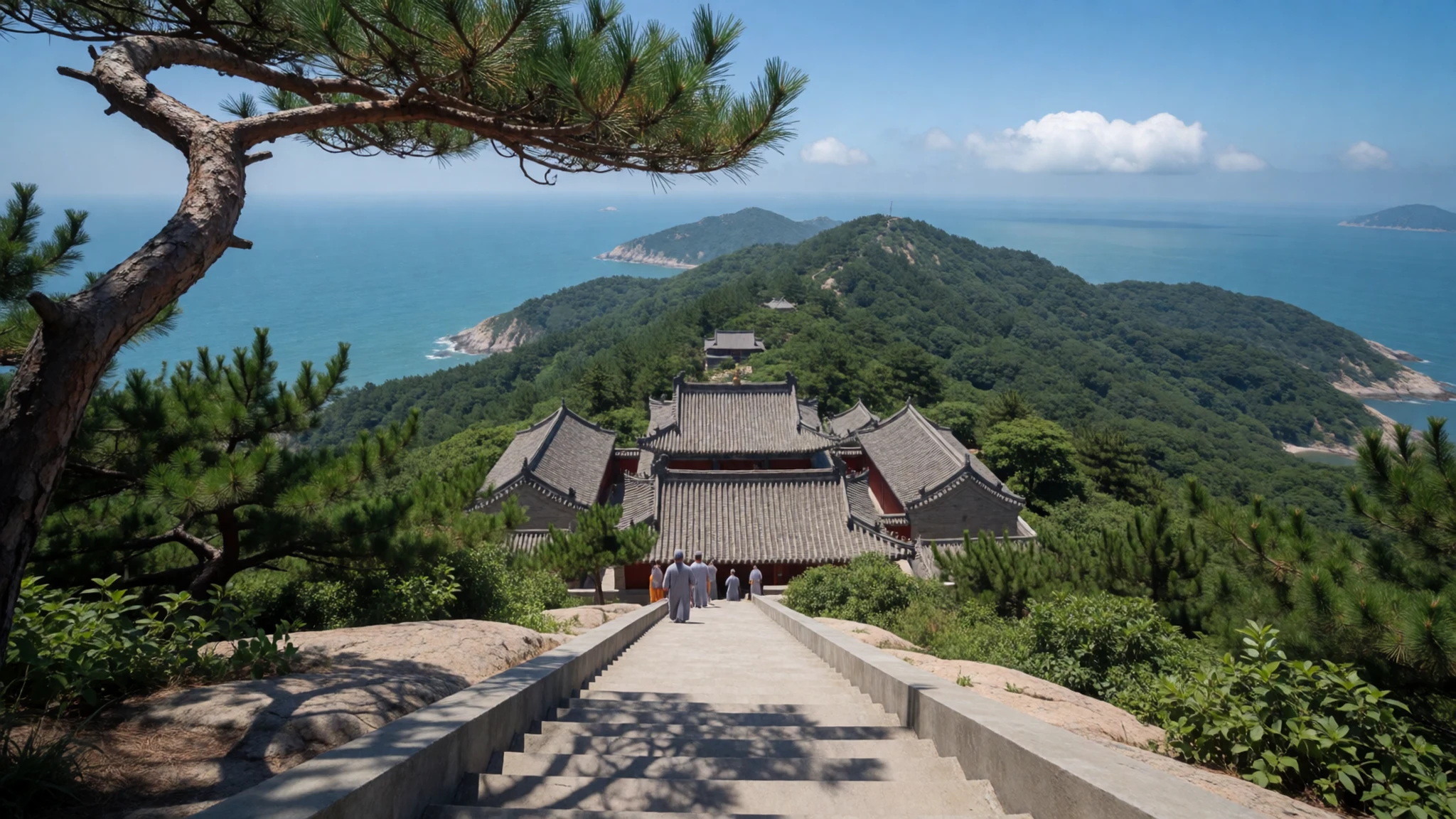
- Miaozhan Pagoda and the eastern monasteries — South-east coast of the island
On the island's south-east side, an intricately carved stone pagoda stands near Yuantong and Dajue monasteries, the latter reached through a yellow-walled corridor. A path continues past them to Luojiashan Lighthouse. This is quieter ground than the western temples and rewards an unhurried walk.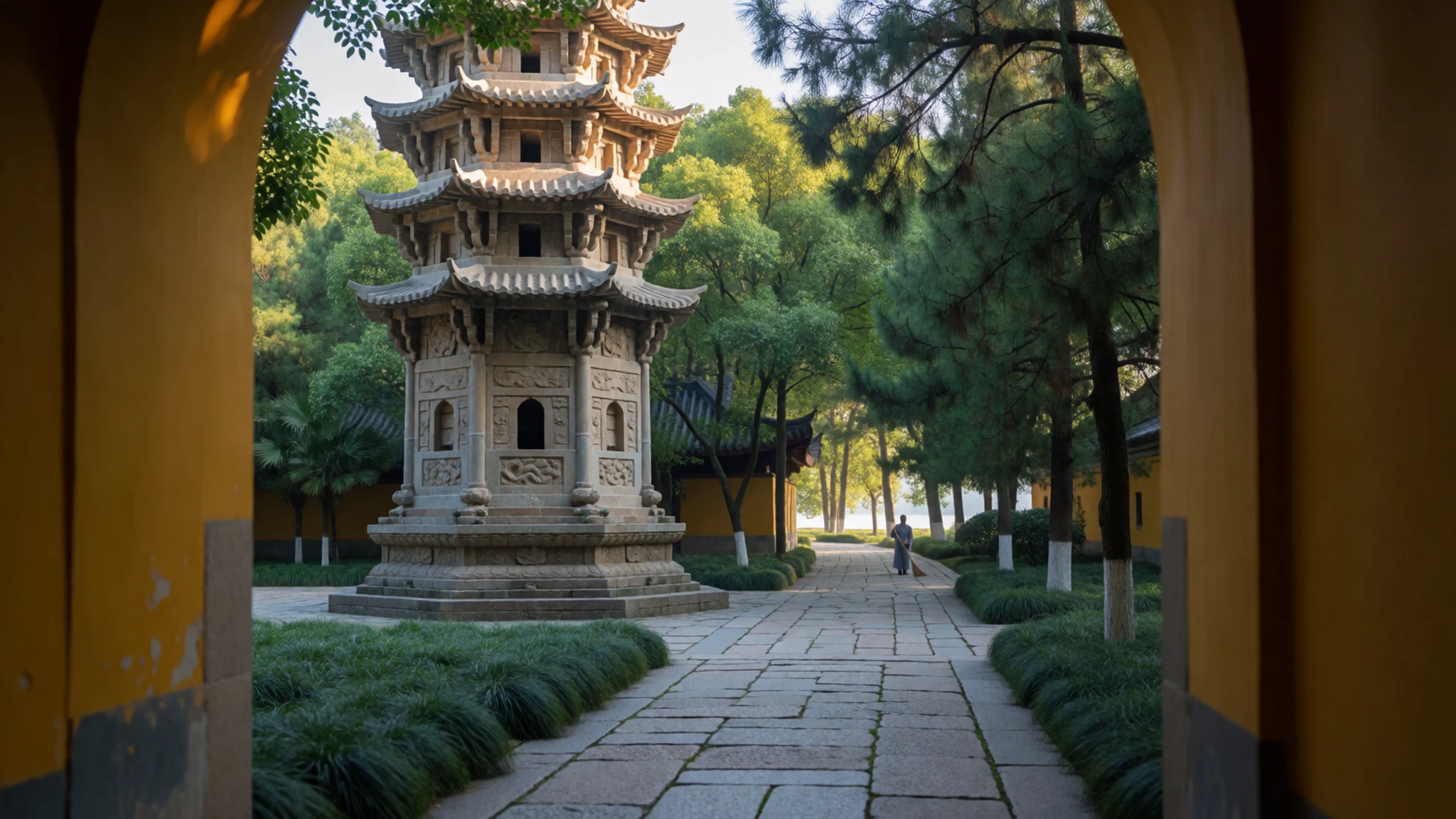
- Fanyin Cave — East coast, short bus ride from Fayu
Fanyin Cave is a sea cave on the east coast, reached by a short bus ride from Fayu Monastery. From there a forest path leads to a quiet spot on the shore. Waves boom in the rock, and the place is associated with Guanyin's appearances in local legend.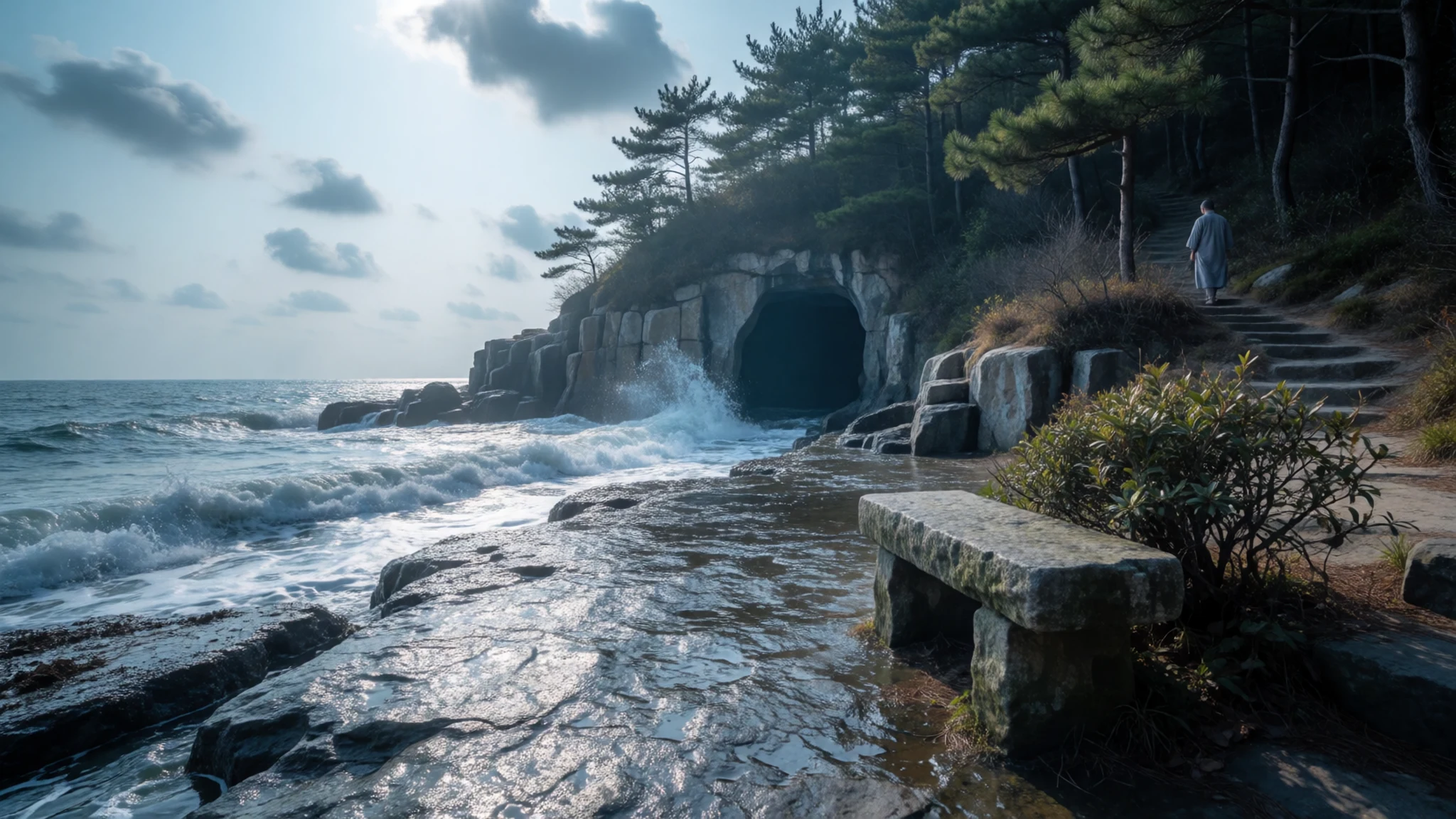
- Luojia Shan — Small island south-east of Putuoshan, by ferry
Luojia Shan is a small island south-east of Putuoshan, visible from the island's temples. A local saying says that the pilgrimage is incomplete without it. A ferry runs from a small port near the main terminal. Check sailing times locally, because services depend on weather and sea conditions.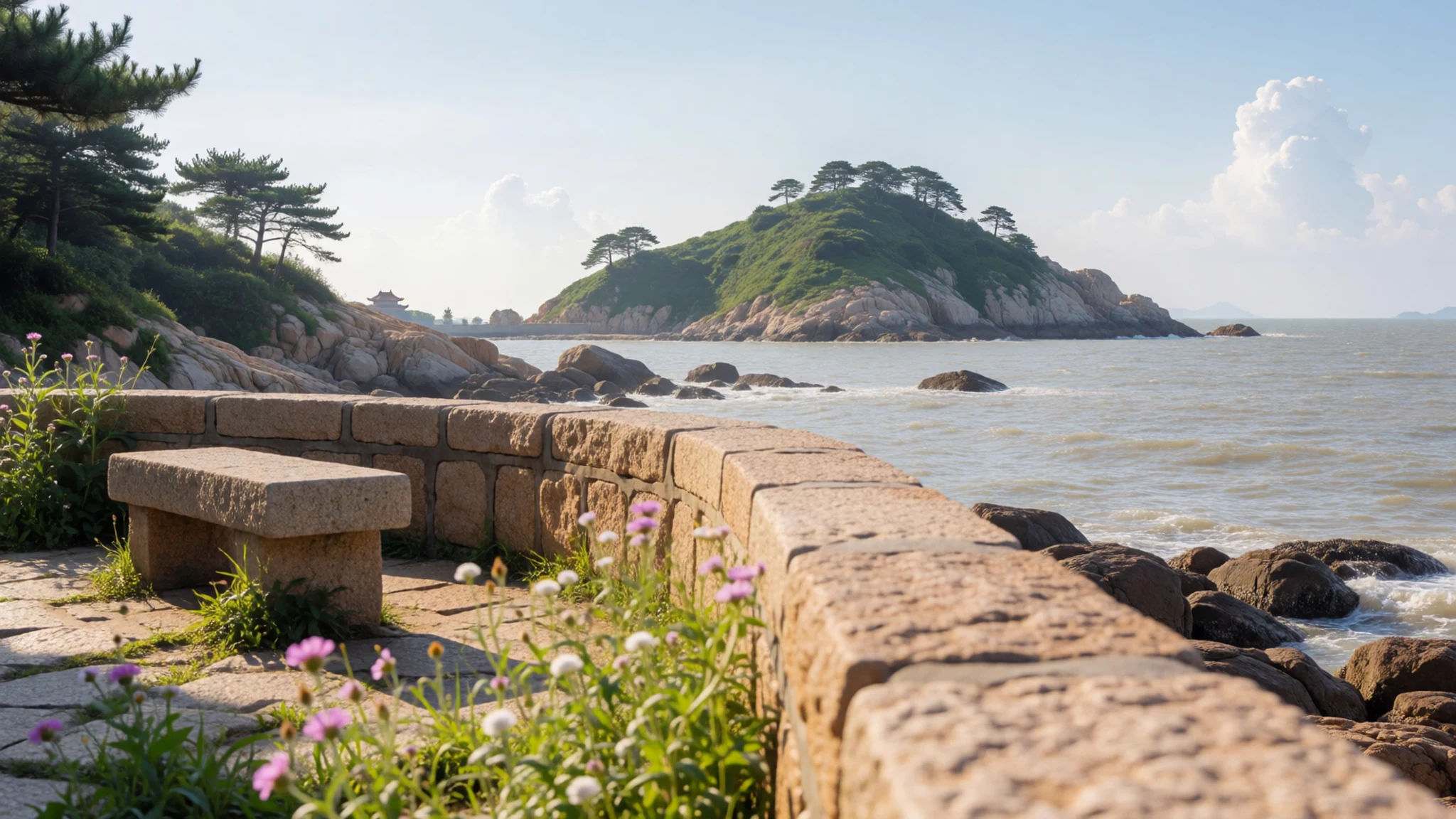
Culture
Putuoshan is a living Buddhist pilgrimage site, not just a scenic island, and the culture here revolves around Guanyin. Devotees come to ask for protection, safe travel and the health of their families, and many are on the island because of a promise made at home. Incense is lit at the main halls, candles are offered, and worshippers bow with palms together, sometimes kneeling on cushions. The festival days for Guanyin's birth, enlightenment and renunciation are especially busy, and the temples then fill with chanting and processions. Monks and nuns keep a daily routine of early prayers, chanting and meals, and the morning ritual at Puji is open to visitors who come to watch quietly. Vegetarian eating is part of the island's character, since temples serve meatless food and many restaurants follow suit. Many people also walk the island's paths as a form of pilgrimage, stopping at small shrines, hermitages and rocks carved with calligraphy. Temples charge for entry and sell incense, so a visit is also a modest contribution to the monasteries' upkeep. Guanyin is greatly loved in Chinese Buddhism as a figure of mercy, and her image appears in many forms, from small altar statues to the large seaside figure that dominates the southern skyline. Visitors who come with patience for crowds, and who go early, will see the island at its most devotional. At temple halls, speak softly, do not step on thresholds, and ask before photographing monks, nuns or worshippers at prayer.
What to wear
Putuoshan's traditional dress is the clothing of Chinese Buddhist monastic life. Monks and nuns wear loose robes of cotton or linen, usually in grey, brown or saffron-yellow, often with a long outer garment worn over a plain jacket and trousers. Devotees on retreat sometimes borrow simple robes or wear plain, modest clothes in muted colours. These robes are worn daily by the monastic community and on ritual occasions by lay worshippers. Everyday wear for islanders and most pilgrims today is practical modern clothing: windproof jackets, trainers or walking shoes, caps and umbrellas. Few people dress up, and dress is mostly about comfort on stairs and hillsides in changeable weather. Visitors should dress for the climate and for the temples. The island has distinct seasons: August is hot and humid, winter is cold, and rain and sea fog can come at any time, so a light waterproof and a warm layer are useful outside high summer. Typhoons can occur from July to September. Shoulders and knees should be covered inside the halls, so pack a light scarf or shirt for temple visits. Footwear matters most, because the paths include long flights of steps and wet stone: choose shoes with good grip and cushioning, ideally ones that slip off easily at hall doors. Sandals suit the beaches but not the climb to Huiji.
What to eat
- Temple vegetarian meals — Monastery refectories and canteens across the island
Meatless set meals served at many monasteries, built around rice, greens, tofu and mushrooms and cooked in the temple tradition. Lunch is the easiest meal to find, and dinner is served early. Eat at monastery refectories and temple canteens.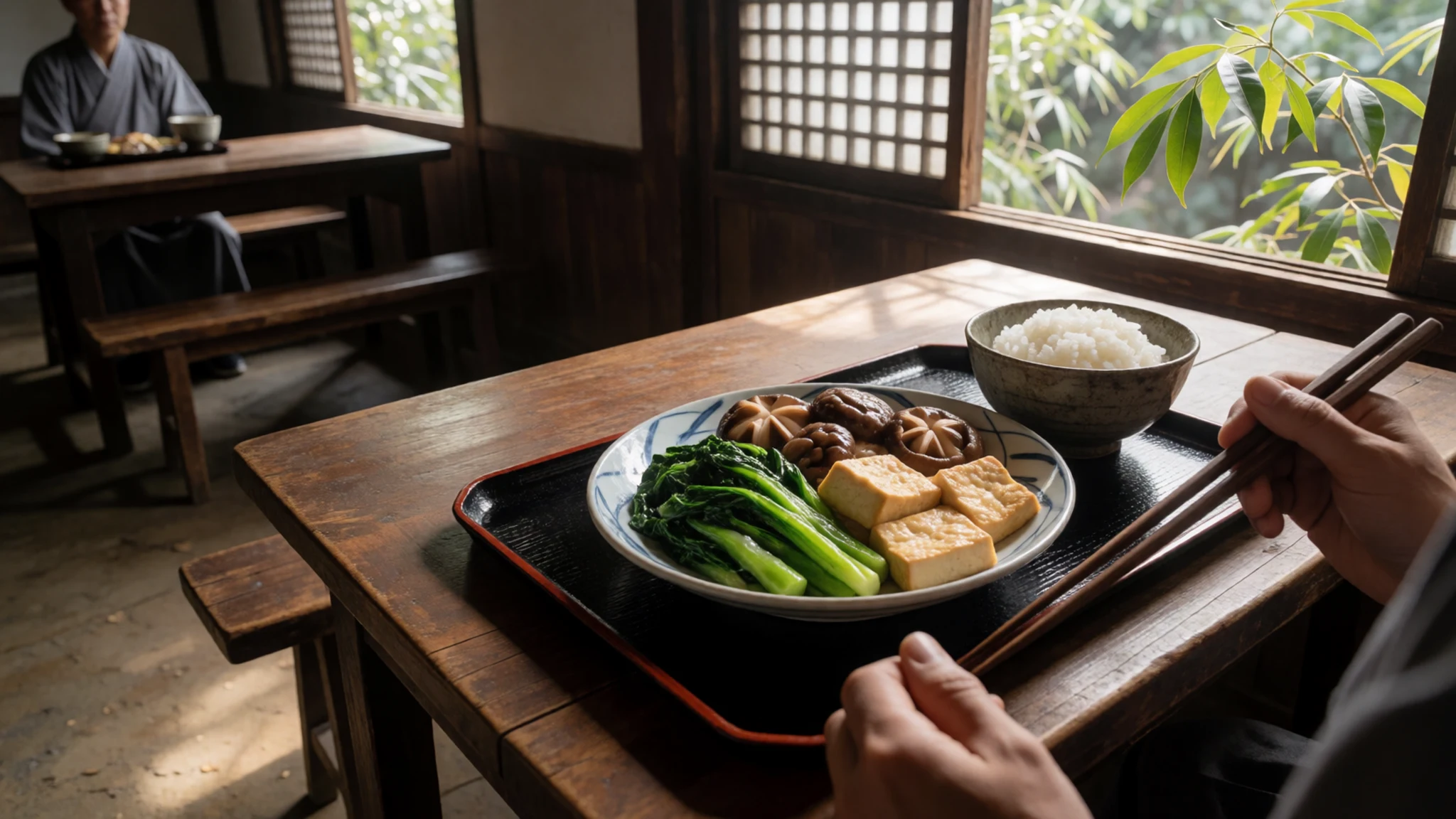
- Vegetarian tofu and mushroom dishes — Eateries around Puji Temple and the ferry end of the island
As a Buddhist island, most ordinary restaurants carry a good range of vegetarian food, including tofu in many forms, stir-fried greens, mushrooms and vegetable noodles. They are inexpensive and a safe choice for vegetarians, who are well served here compared with most of China.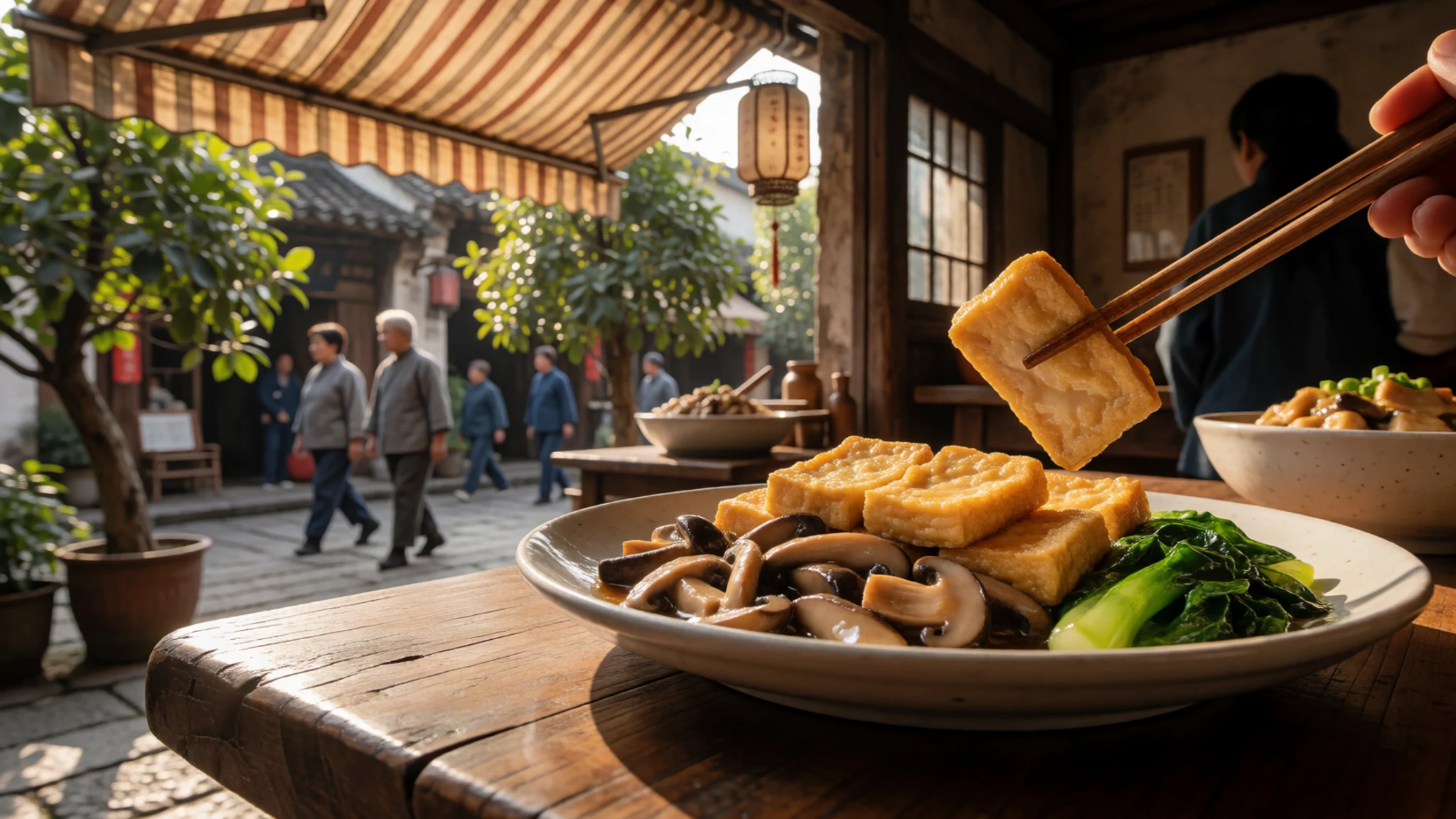
- Fresh seafood — New village south of the ferry terminal
Fish and shellfish are the island's other food pride. Restaurants in the new village south of the ferry terminal show the catch on display and cook it to order. Prices run higher than on the mainland, but the quality is very good. Pointing is usually how orders are made. - Regional Chinese stir-fries — Guesthouse restaurants close to Puji Temple
Guesthouse restaurants near Puji Temple serve standard Chinese dishes such as stir-fried vegetables, soups and rice, and are open to non-residents. They are practical for groups with mixed tastes, and they are among the few places likely to open late. - Early temple breakfast — Temple kitchens, finishing early in the morning
Breakfast is the hardest meal to find on Putuoshan. Temple kitchens may serve simple rice porridge, buns and pickles, but service ends early. Plan to eat soon after the early morning ritual, or carry snacks for the walk.
Plan it
Best time. April–May and October–November are the most comfortable, with mild weather and few typhoon risks. July to September is typhoon season, and August is hot and humid. January is the coldest month. Rain and fog can come at any time, so check the forecast before sailing.
How long. 2
Getting there. The island can only be reached by ferry, arriving at the terminal at the south end. Most visitors travel by bus or train to the ferry port of Zhujiajian (Zhujiamen terminal), with combined bus and ferry tickets sold from Ningbo, Hangzhou and Shanghai. Check ticket and sailing details locally.
Budget. mid
Tips
- Check the weather forecast before travelling, because ferries can be disrupted by fog, wind and typhoons
- Go to Puji and Fayu early in the morning, before the tour groups arrive
- Carry a translation app or phrasebook, since few menus and staff use English
- Eat lunch early at temple canteens, as meal service ends sooner than expected
- Walk away from the main temples to find the quieter monasteries in the woods
Etiquette
- Speak softly in temple halls and do not step on thresholds
- Ask before photographing monks, nuns or people praying
- Do not touch or climb on statues and offerings
Nearby
Sources
- Wikidata Q716232 (CC0)
- Wikipedia: Mount Putuo (rev 1361645014) (CC BY-SA 4.0)
- Wikivoyage: Mount Putuo (rev 5380243) (CC BY-SA 4.0)
- Photo 01: Shizhao, via Wikimedia Commons (CC BY 3.0)
- Photo 02: Don-kun, via Wikimedia Commons (CC BY 3.0)
- Photo 03: John Thomson, via Wikimedia Commons (Public domain)
- Photo 04: J. R. Harding, via Wikimedia Commons (Public domain)
- Photo 05: Ctny, via Wikimedia Commons (CC BY 3.0)
- Photo 06: Berniecourt, via Wikimedia Commons (CC BY-SA 4.0)
- Photo 07: Ctny, via Wikimedia Commons (CC BY 3.0)
- Photo 08: Ctny, via Wikimedia Commons (CC BY 3.0)


