Preah Khan of Kampong Svay
Preah Khan of Kampong Svay, Cambodia
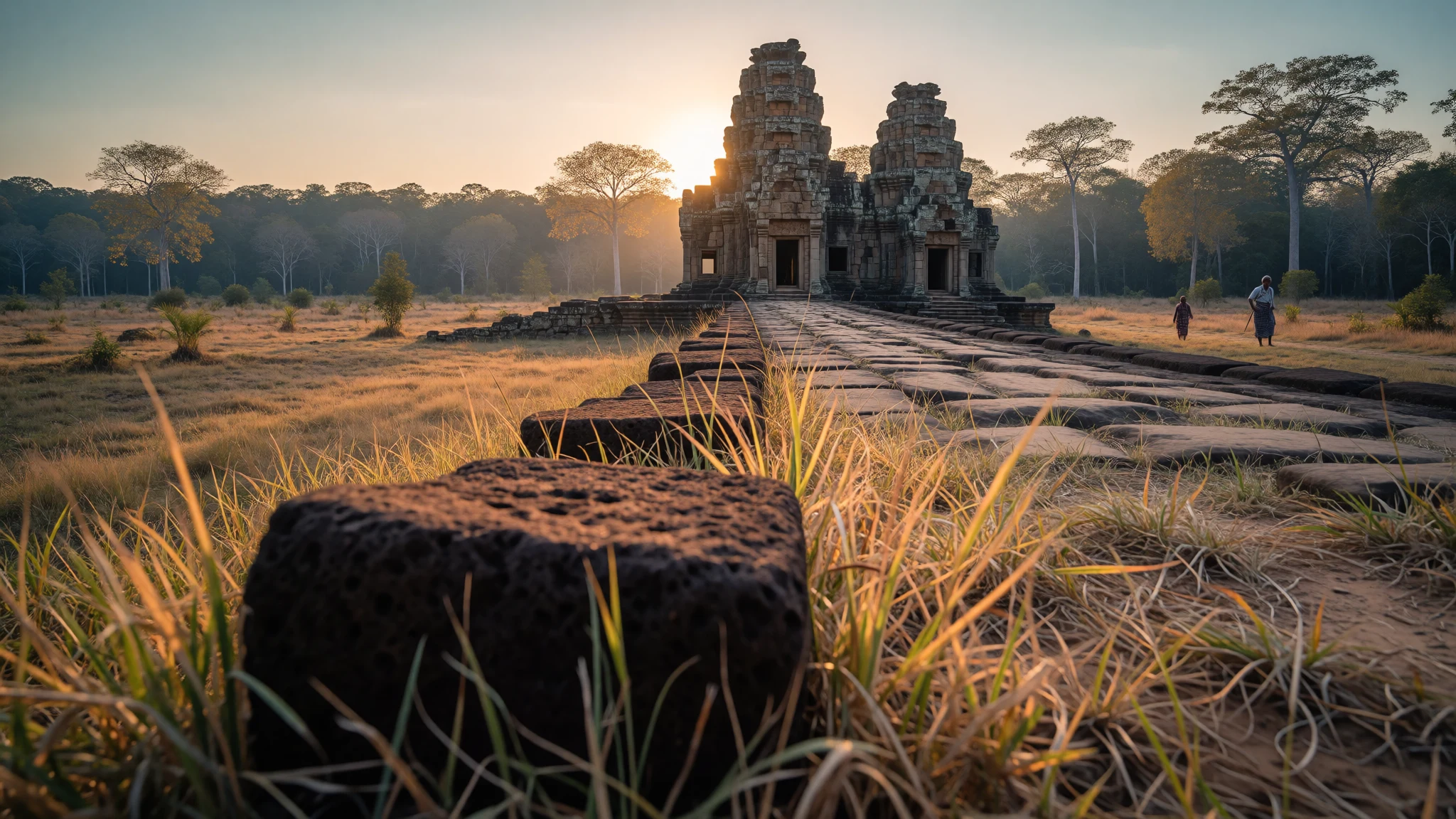
Preah Khan of Kampong Svay is a vast, quiet Khmer ruin far from Angkor's crowds, for travellers who prefer questions to polish.
The place
Preah Khan of Kampong Svay sits in Preah Vihear province, about 100 km east of Angkor, on flat forested country well away from the usual Cambodian circuit. Locals say Prasat Bakan, and it also appears as Bakan Svay Rolay. Wikipedia's account calls it the largest single religious complex of the Angkorian era, with an outer enclosure over 22 km square, though that figure describes the ground the walls once held rather than a compact temple that can be seen in an hour. What survives is scattered: a ruined central sanctuary, stretches of stone walling, causeways, moats and outlying buildings, many half swallowed by trees and scrub. Interpretations vary, and researchers have floated a royal seat, a trading post and a defensive centre as the site's true purpose. Visitors are few. That brings a rare quiet and also real inconvenience: rough roads, little shade in the dry months, few facilities, and signage that cannot be counted on. A local guide, or a driver who knows the route, is close to essential, and a morning is better than an afternoon for walking. The setting matters as much as the stones. Rice fields, villages and woodland press right up to the ruins, so a visit shows an ancient monument sitting inside everyday rural Cambodia rather than behind a ticket gate. Anyone who has already seen the great temples near Siem Reap will find this a different kind of day: less polish, more imagination, and more questions than answers.
Its story
Preah Khan of Kampong Svay has a thin written record, and much of what is said about it is informed argument rather than settled fact. Some French scholars placed its beginnings in the eleventh century, linking it with the king Suryavarman I. Later, it served as a royal residence under Suryavarman II, and Jayavarman VII is said to have used it as a military outpost while the Khmer were fighting the Cham in the late twelfth century. Sediment studies point to a slow decline: upkeep of temples and water works seems to have stopped around the middle of the fourteenth century, and the place was emptied entirely by the fifteenth. That timeline sits within the wider story of Angkorian Cambodia, whose power faded after 1431. The archaeologists Mitch Hendrickson and Damian Evans have weighed several readings of the site, from an independent Khmer polity to a trading outpost or a fortified centre, and none has won out. European attention arrived in 1873, when the explorer Louis Delaporte visited and studied the ruins. With the Cambodian king's agreement he shipped reliefs and sculptures to France. They were shown at the Indochinese Museum in the Trocadéro and in 1927 moved to the Musée Guimet in Paris, where Khmer pieces from this province can still be seen. Cambodia's later history of colonisation, war and the Khmer Rouge years also left remote sites like this one under-studied and little visited.
What to see
- The central sanctuary — Centre of the complex
The ruined heart of Preah Khan of Kampong Svay is a cluster of broken towers and collapsed stonework, with tree roots wedged into the joints. Its scale is modest next to the outer walls, but this is the best place to sense the original plan. Go early for soft light and cooler air.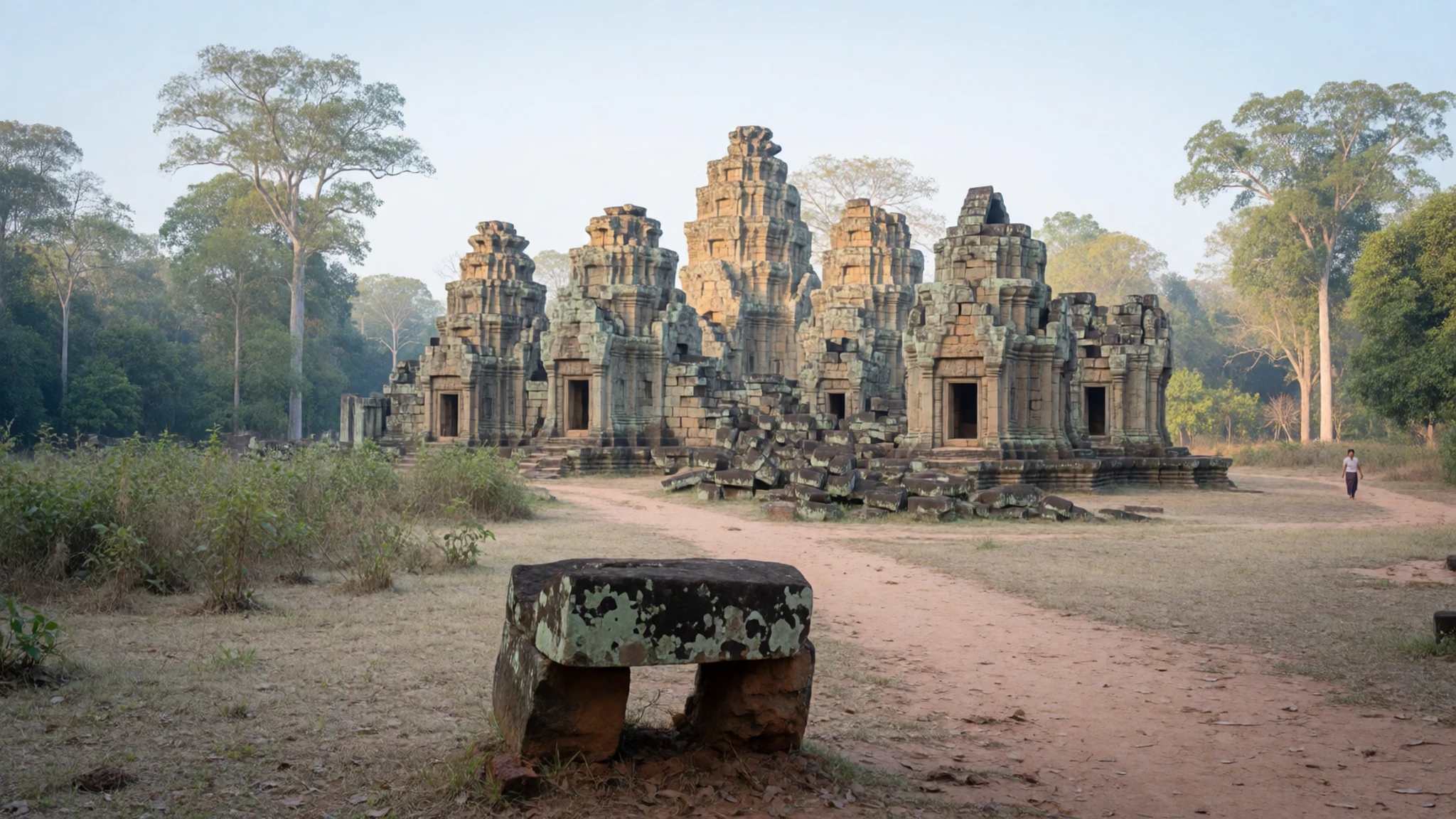
- Carved walls and reliefs — Inner enclosure
Some wall sections still carry carved decoration, including patterned bands and figures weathered smooth by rain and lichen. They reward slow looking rather than quick photographs. Raking morning or late-afternoon light brings out detail that midday sun flattens, so it is worth planning the walk around it.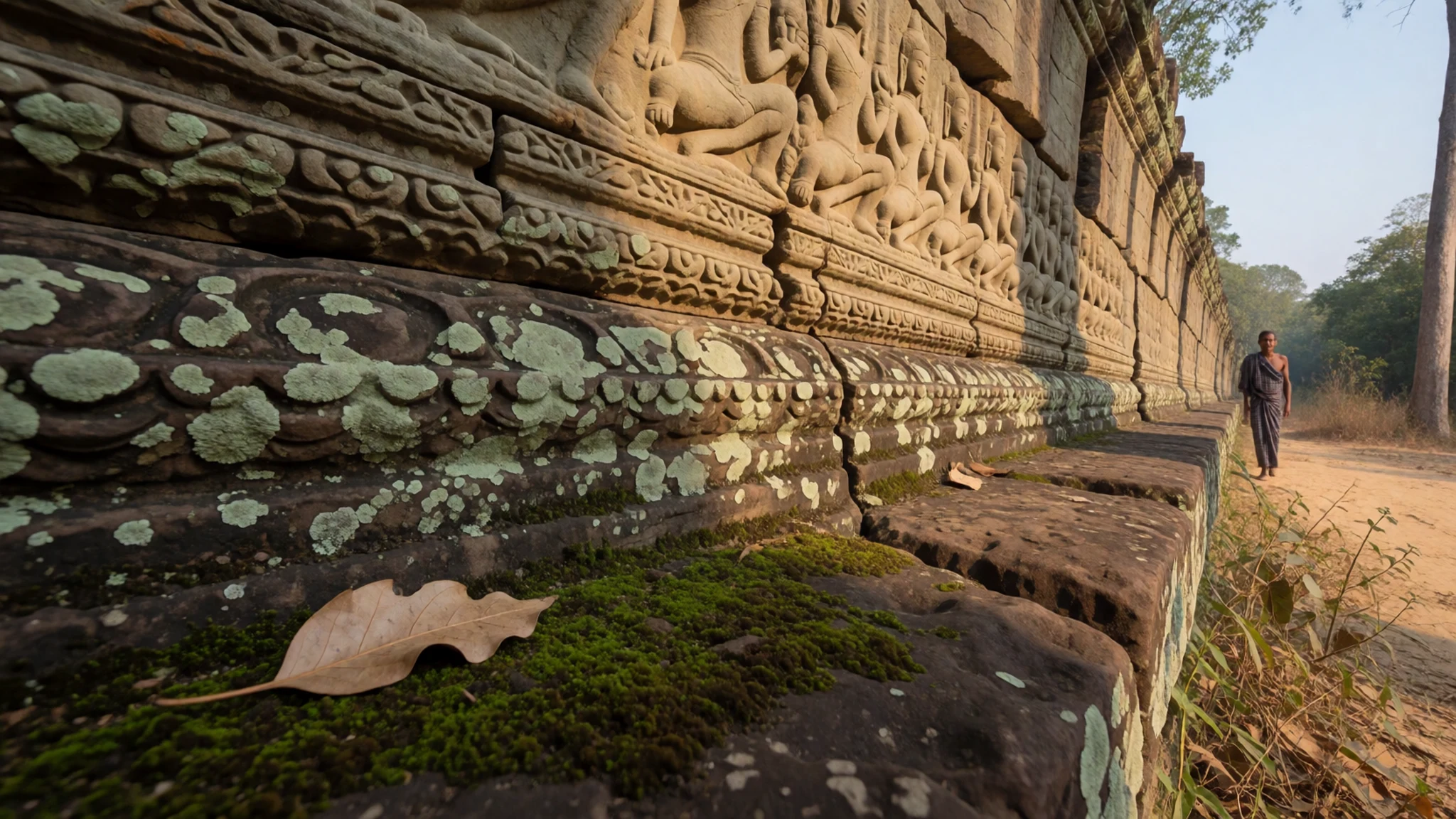
- The second wall — Middle enclosure
Remnants of the second enclosure wall give a feel for how large the complex was meant to be. Long, low lines of stone run into scrub and woodland. Walking a short stretch of it explains why the outer limits are described in kilometres, not metres.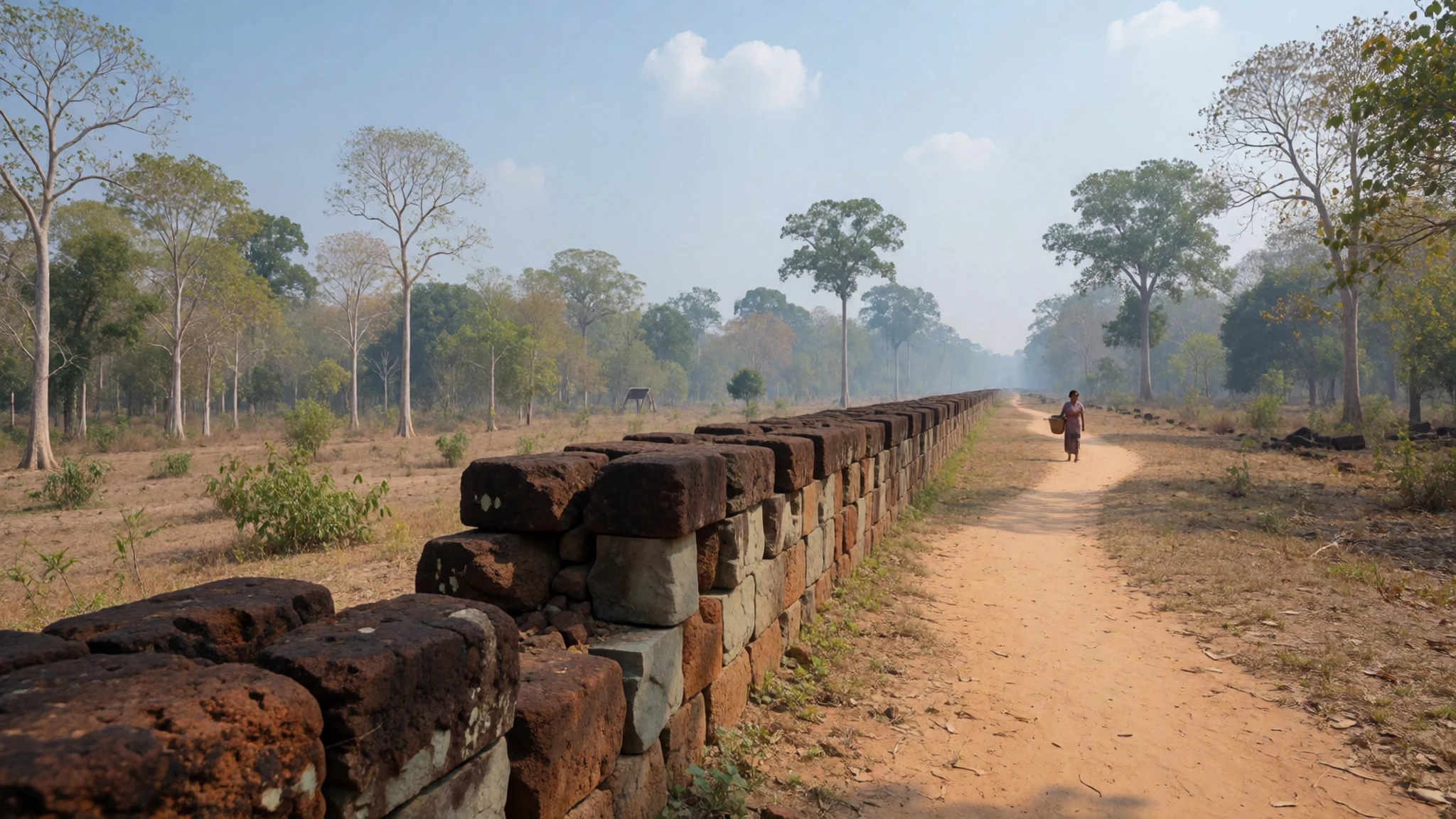
- Outlying buildings — Across the enclosure
Scattered structures stand away from the main sanctuary, and some have no confirmed name or function. One building is simply labelled unidentified in photo archives. They are a fair reminder of how much remains unstudied here, and of how a guide's local knowledge adds more than any signboard.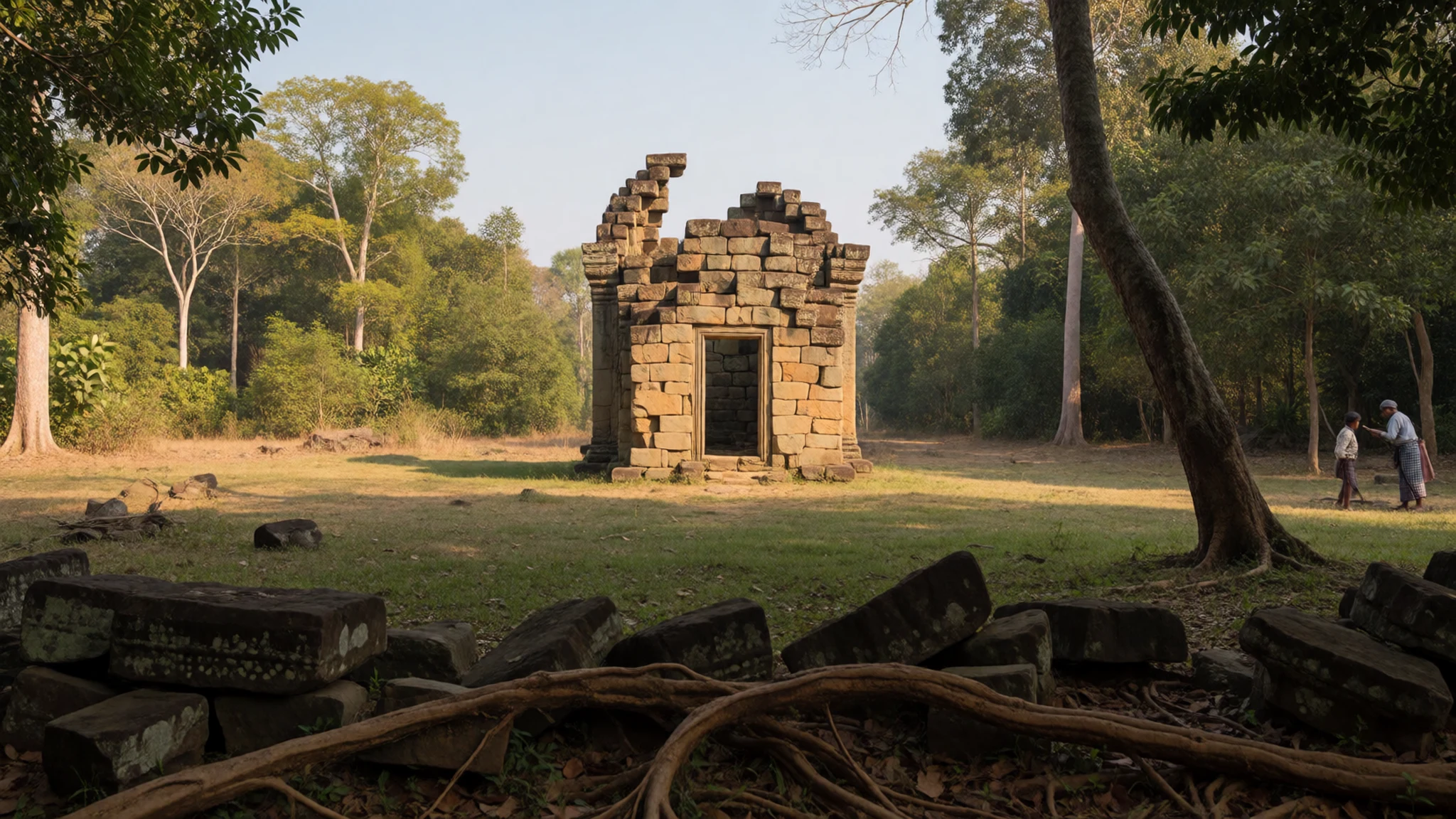
- Sculpture at the Musée Guimet — Paris, France (museum)
Pieces taken from Cambodia in the nineteenth century, including Bayon-style Buddhist figures from Kampong Thom province, are held in the Musée Guimet in Paris. For travellers who also visit Paris, they add context to the empty ruins, showing the kind of sculpture that once filled such temples.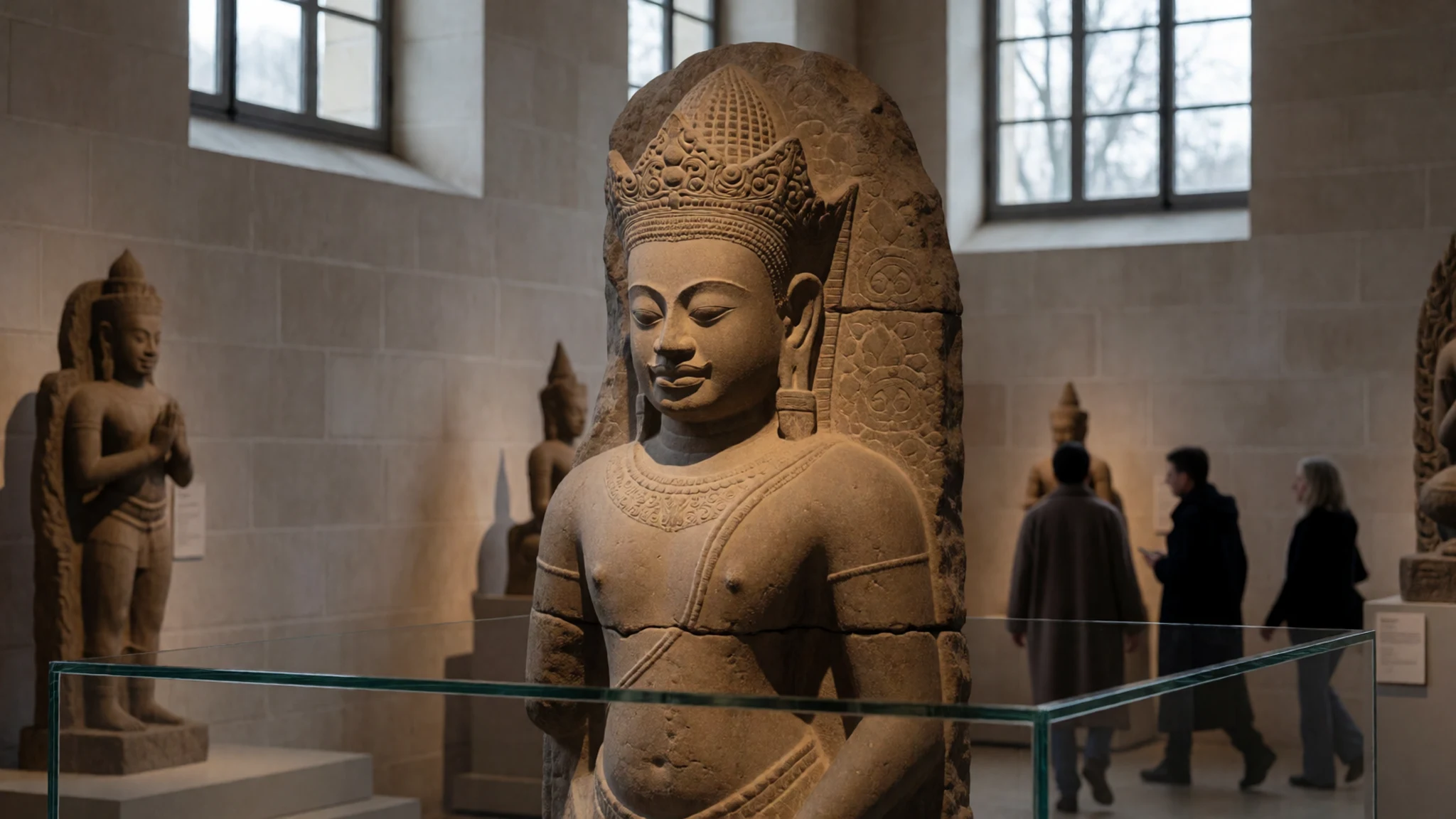
Culture
Preah Khan of Kampong Svay lies in a part of Cambodia where visitors are still unusual, and manners matter more than at the busy Siem Reap sites. Khmer culture is rooted in Theravada Buddhism, with older Hindu and animist threads, and the ruins here belong to the earlier Angkorian world in which Hindu and Mahayana Buddhist ideas shared royal patronage. Villagers nearby use the land for farming and may treat parts of it as sacred. Cambodia has been through colonial rule, civil war and the Khmer Rouge years, and people in rural areas carry that history; it is better to listen than to ask pointed questions. Many in remote areas dislike being photographed, so asking first is a courtesy, and some people in towns will ask for payment. Modest dress is the norm outside the main tourist hubs, and a calm, patient manner goes a long way. Guides and drivers are often the main link between a visitor and the community, so treating them as hosts rather than staff makes the day better for everyone. Greeting with a slight bow and pressed palms is appreciated, and the head is regarded as the highest part of the body, so avoid touching anyone's head. Always ask permission before photographing a person, and cover your shoulders and knees at the site and in the villages around it.
What to wear
Preah Khan of Kampong Svay is a rural site, and clothing around it is practical. The traditional Khmer garment is the sampot, a length of cloth wrapped round the waist and legs, and silk versions woven with patterned techniques are worn for weddings, festivals and temple ceremonies. The krama, a checked cotton scarf, is the everyday classic: it shades the head, wipes sweat, carries a baby or ties up goods. Men may wear a sampot on formal occasions, though trousers and shirts are common. Day to day, people in villages wear light cotton shirts, loose trousers or long skirts, a krama and sturdy sandals, since sun and dust are constant. Women tend to cover up in the daytime, partly for modesty and partly to avoid tanning. Visitors should dress for heat and rough ground rather than for style. Lightweight long trousers or knee-length shorts, a loose shirt covering the shoulders, a wide-brimmed hat and sun cream suit the climate and local norms. Closed shoes or hiking sandals with grip are better than flip-flops for uneven stone and tree roots. In the rainy season a thin waterproof helps, and in the dry season a scarf over the nose helps on dusty tracks. A krama bought locally makes a useful, inexpensive souvenir and works well as sun protection.
What to eat
- Fish amok — Khmer restaurants in Siem Reap and larger provincial towns
A steamed fish curry in a coconut-and-herb paste, often served in a banana-leaf cup. It is mild and fragrant rather than fiery, and is a standard order at Khmer restaurants in Siem Reap and in provincial towns.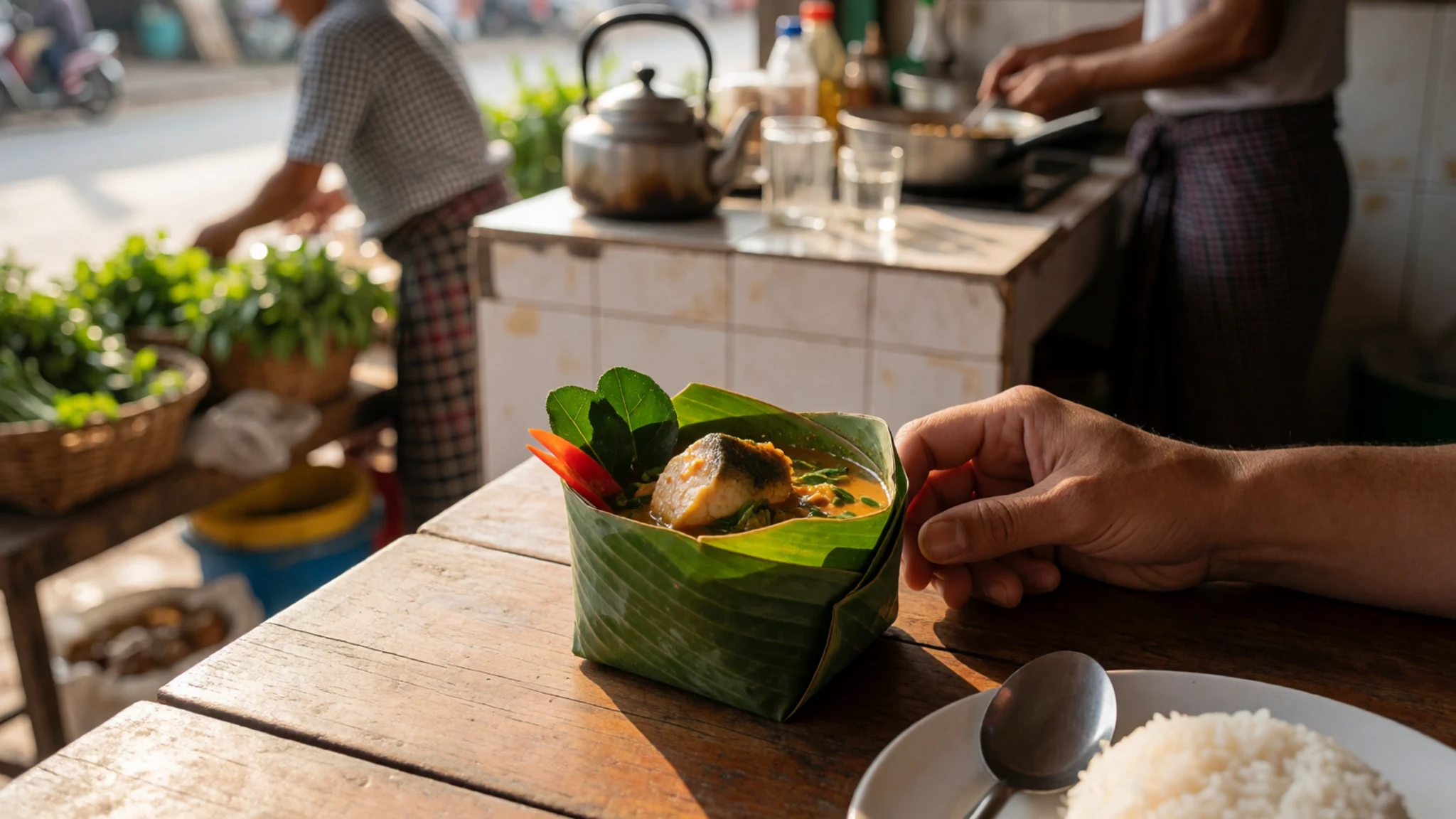
- Num banh chok — Morning stalls in town markets
Fresh rice noodles topped with a green fish-based curry and a pile of raw herbs and vegetables. It is a breakfast dish, sold early from baskets and stalls, so it suits a morning start before a site visit.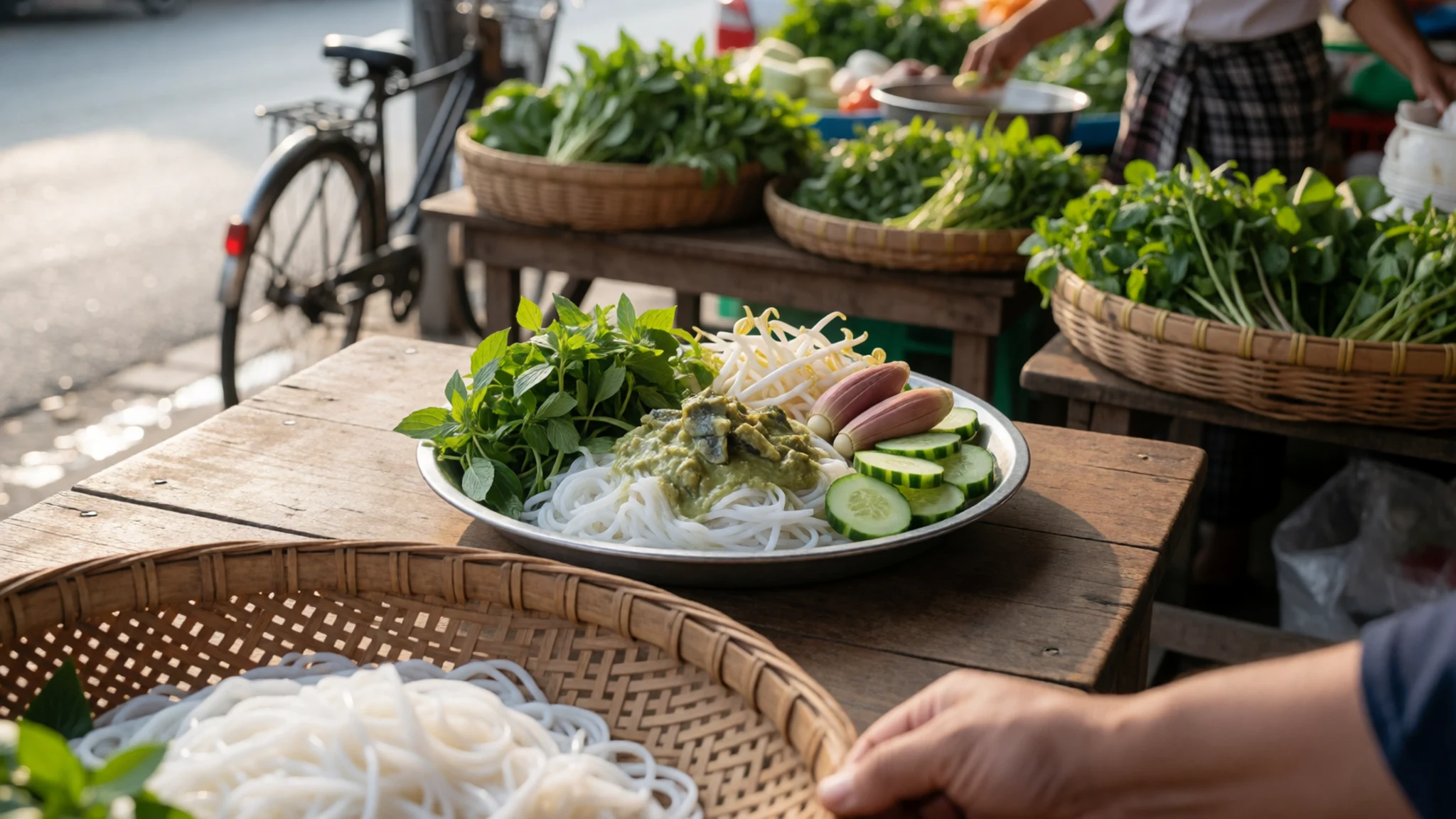
- Lok lak — Eateries in towns and tourist areas
Stir-fried beef in a peppery sauce, served with salad, rice and a dip of lime and black pepper. The pepper rather than chilli is the point, in line with how Khmer cooking leans on pepper and sour notes. - Kuy teav — Roadside noodle shops and market stalls
A clear pork or beef broth with rice noodles, herbs and lime, adjusted at the table with sauces and chilli on the side. It is a filling, cheap meal for a long day on the road. - Prahok — Village kitchens and market food stalls
A fermented fish paste that underpins much Khmer cooking, used in dips, soups and stir-fries. The smell is strong and not every visitor takes to it, but it is central to local flavour, so a small taste is worthwhile.
Plan it
Best time. November to February, when the dry season brings cooler mornings and firmer tracks; March to May turns very hot with little shade at the ruins, and the rains that follow can make remote roads slow or impassable.
How long. 1–2
Getting there. Fly into Siem Reap or Phnom Penh, then travel by road into Preah Vihear province, roughly east of Angkor. The last leg is on rural roads, so hire a driver and guide who know the route and check current conditions before leaving.
Budget. mid
Tips
- Hire a local guide or driver: signage is thin and tracks can be confusing
- Start early to avoid the heat and shoot photographs in soft light
- Carry plenty of water, snacks and cash, as there are few shops or cash machines nearby
- Stay on paths the guide recommends, as rural Cambodia still has hazards left over from past conflict
- Check road and weather conditions before setting out, especially in the rainy season
Etiquette
- Ask before photographing people, especially in villages
- Dress modestly, with shoulders and knees covered
- Do not climb on fragile carved stonework
Nearby
Sources
- Wikidata Q845513 (CC0)
- Wikipedia: Preah Khan Kompong Svay (rev 1365741340) (CC BY-SA 4.0)
- Wikivoyage: Cambodia (rev 5395048) (CC BY-SA 4.0)
- Photo: Remaining parts of the central sanctuary (Saxula) (CC BY 3.0)
- Photo: Wall with carvings (Saxula) (CC BY 3.0)
- Photo: Unidentified building (Saxula) (CC BY 3.0)
- Photo: Remaining parts of the second wall (Saxula) (CC BY 3.0)
- Photo: Map of the temple (Saxula) (CC BY 3.0)
- Photo: Le bodhisattva Lokeshvara (Vassil) (Public domain)
- Photo: Bodhisattva Lokesvara irradiante, Preah Thkoi (unknown author) (CC BY 3.0)
- Photo: Dvarapala da Preah Thkol (sailko) (CC BY 3.0)


