Mount Longhu
Mount Longhu, People's Republic of China
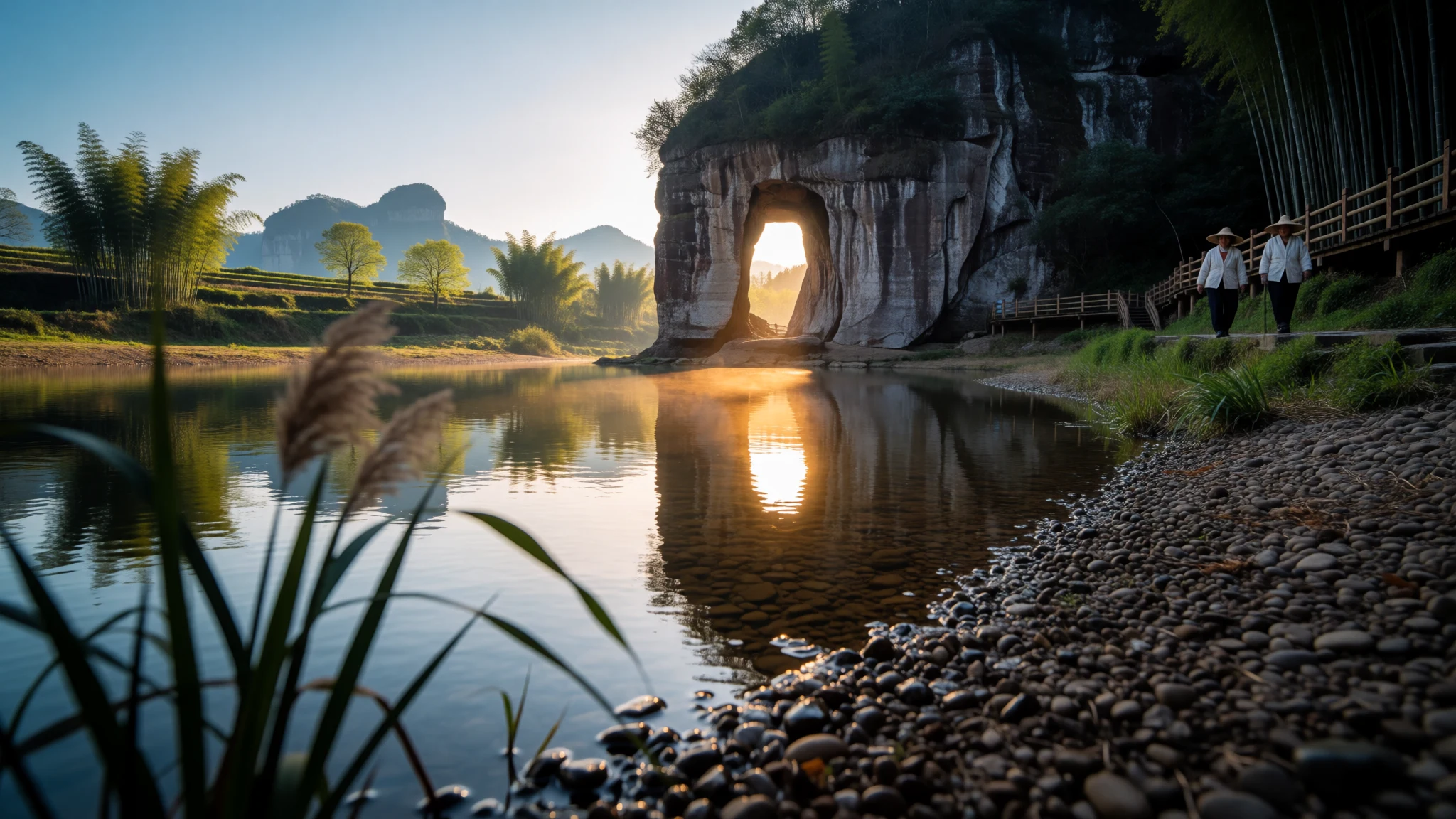
Mount Longhu pairs river-cut rock towers with an early Taoist heartland and ancient cliff burials, all within easy reach of Nanchang.
The place
Mount Longhu, written 龙虎山 and pronounced Lónghǔ Shān, means Dragon Tiger Mountain, and it lies close to the city of Yingtan in Jiangxi province, in south-eastern China. The name promises a single peak, but the reality is a run of rock towers, domes and sheer cliffs standing beside the Tunxi River (泸溪河), with farmland and bamboo in between. Wikidata gives a height of 150 m, which suits a landscape of outcrops rising from a river valley rather than an alpine summit. People come for two reasons that overlap. One is the scenery, best taken from the water or from a boardwalk fixed partway up a cliff. The other is history: this is a cradle of organised Taoism, and the cliffs also hold burial hollows from a much older culture. The park carries a AAAAA tourist rating, so there are ticketed zones, shuttle buses, boat rides and evening performances, and holiday weekends can be crowded. One honest caveat is that nearly every old-looking building has been rebuilt in modern materials, so the temples work better as places in the landscape than as antiques. The area splits roughly in two. The river and cliff core sits around the north entrance and a village of restaurants, while Shangqing, a small town with temple sites, lies further to the south-east. Rooms, meals and transport are easiest to sort out near the north entrance.
Its story
Mount Longhu is where Zhang Daoling, remembered as the founder of the Zhengyi branch of Taoism in the Han dynasty, is said to have settled and practised. Tradition credits him with founding temples here, including one at the Immortal City cliff and the Zhengyi temple, and his descendants inherited the title of Celestial Master. For many centuries that family lived in a compound at Shangqing, the Tianshifu or Mansion of the Celestial Master, which worked as a kind of headquarters for the school. Nearby stood a large temple that opens the classic novel Outlaws of the Marsh (水滸傳), in which a careless official breaks a seal and lets a crowd of demons loose. That scene shows how firmly the mountain sat in the popular imagination. Older than any of this is the cliff-burial tradition of the Guyue people, who set their dead in coffins inside hollows high on the rock faces. How such heavy coffins were hoisted into place is still debated, and a staged show beside the river offers one artistic guess. What visitors see today is mostly rebuilt. The Shangqing temple site is now an archaeological ground with a concrete gate and towers, and the old town is largely new. The authentic layers are the rock, the river, the coffin caves and the stories attached to them.
What to see
- Xianshui Rock — River core, near the burial cliffs
Xianshui Rock is the cliff above the river where ancient coffins still sit in natural hollows high on the face. A small temple is built into the stone, and a path squeezes through a gap in the rock towards the lower end. Early light flatters the cliff, and tour groups thicken later in the morning.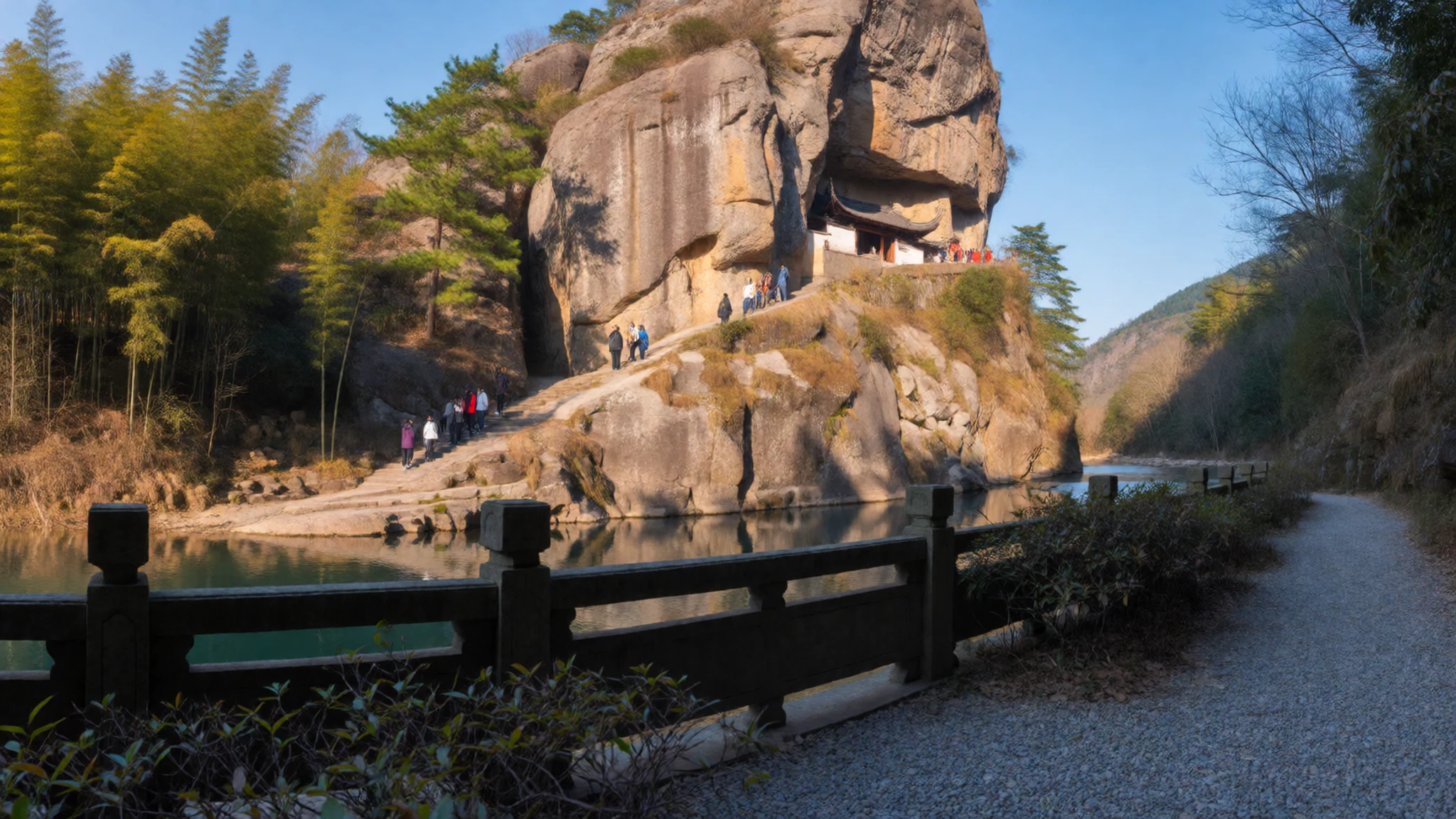
- Elephant Trunk Hill — River core
Elephant Trunk Hill is a rock mass shaped like an elephant dipping its trunk, with a wide gap between trunk and body. A boardwalk fixed to the cliff runs on from here and is the park's main walking route, since few other trails are open for hiking.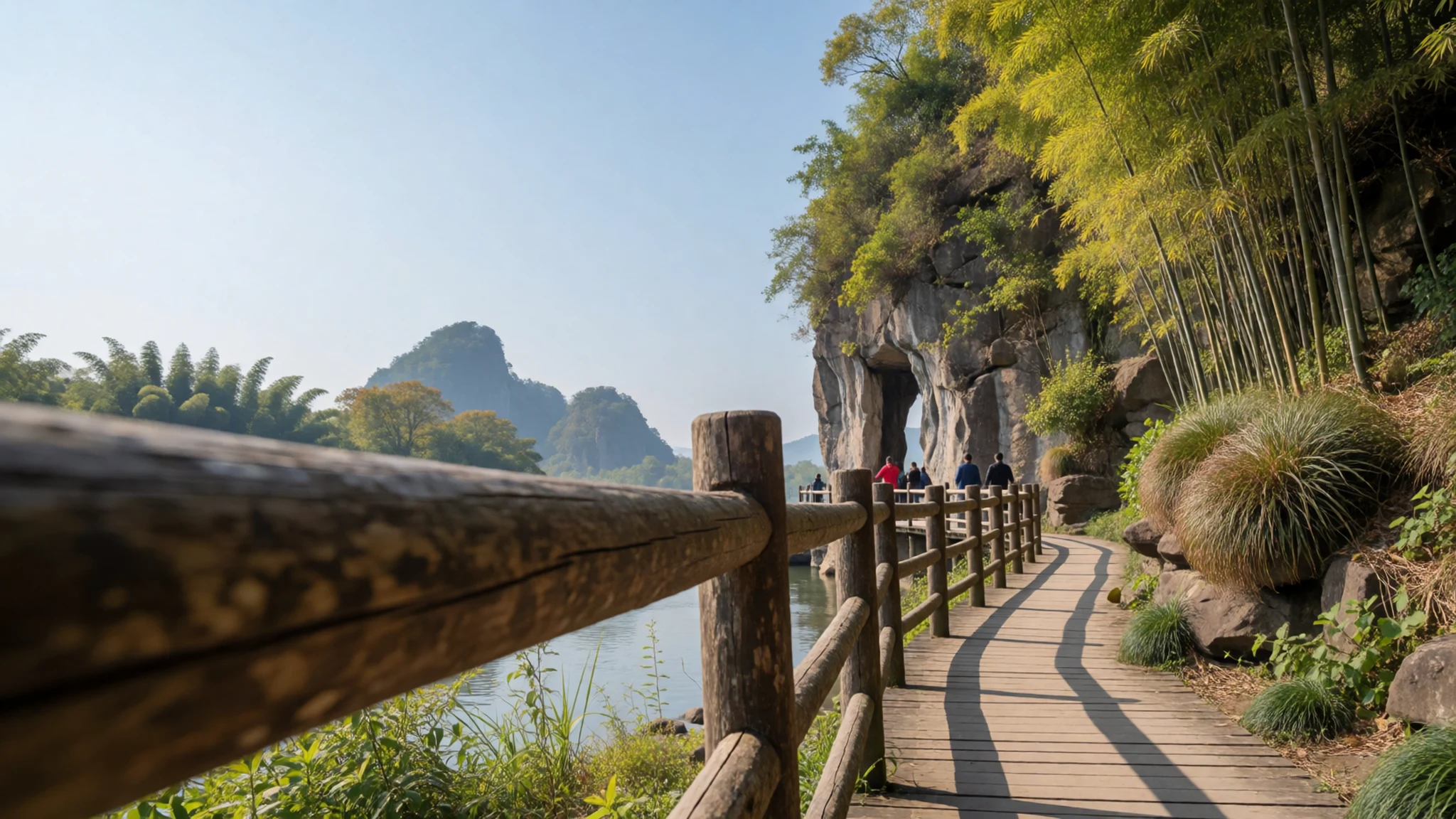
- Zhengyiguan — Between the river core and Shangqing
Zhengyiguan is a rebuilt Taoist temple with a large rock outcrop rising behind it. The view from the front gate is the best part of a visit, along with an old well beside the main hall. Expect modern construction rather than old timber, and treat it as a quiet stop between river sights.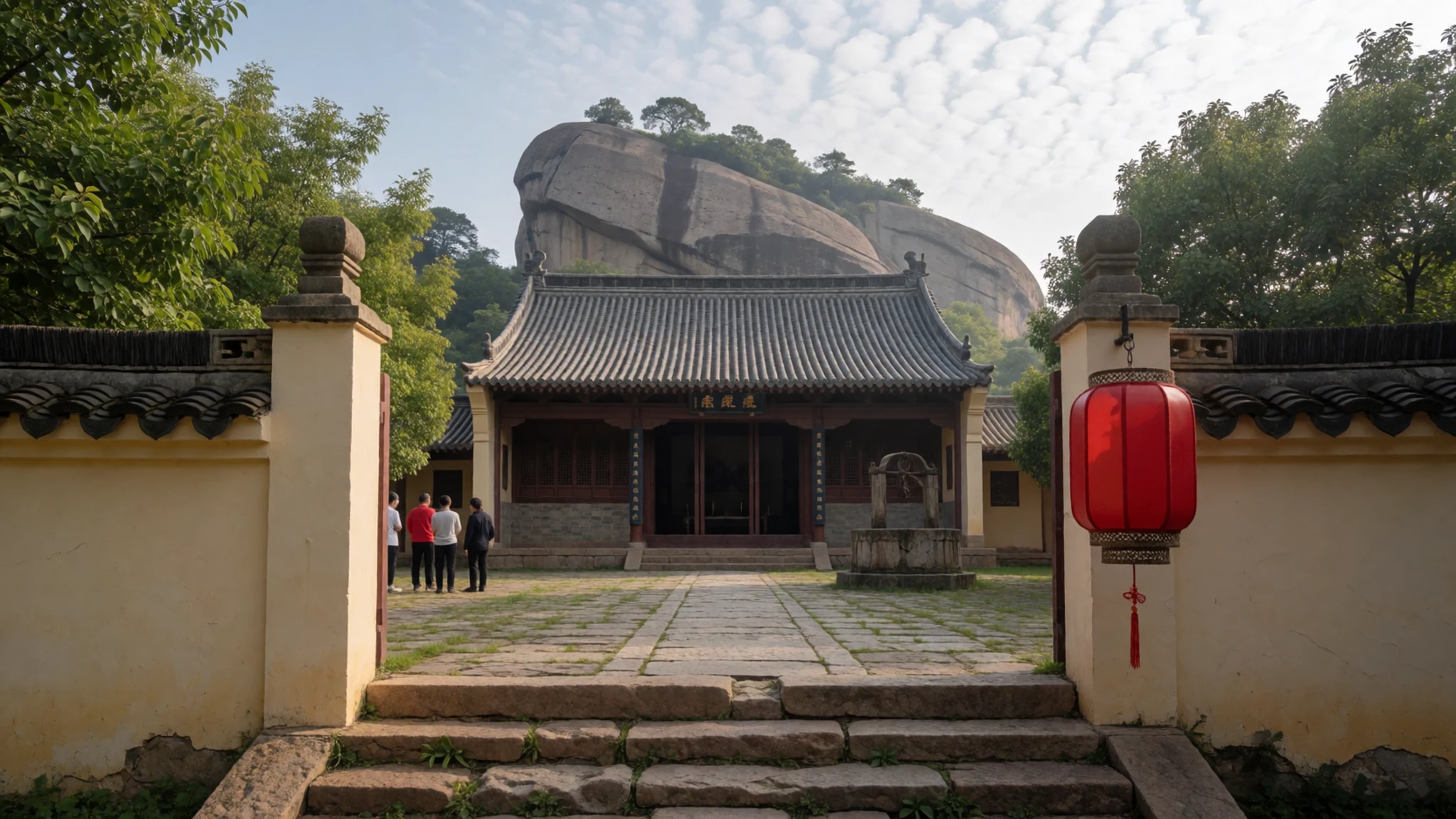
- Shuhan Tianshifu — Shangqing town
Shuhan Tianshifu, the Celestial Master's mansion, stands in Shangqing town and was long the home of Taoist masters. Its gate is the image most visitors photograph. Much of the compound is reconstruction, but it still gives a sense of how a priestly household and a religious school once shared one address.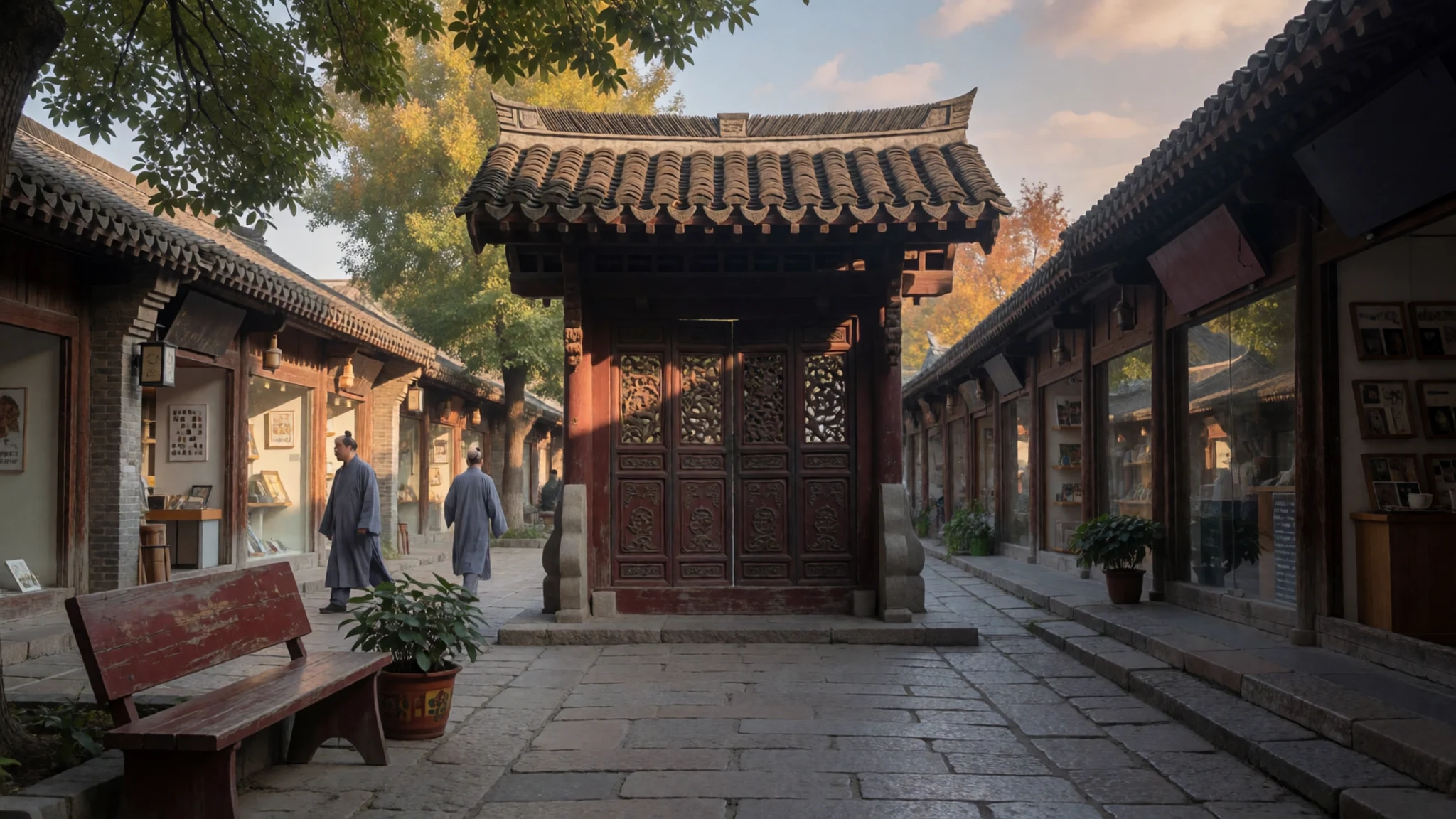
- Rafting on the Tunxi River — South of No Mosquito village to the burial cliffs
Rafting here means a slow ride in a PVC motorboat styled to resemble bamboo. It starts south of No Mosquito village and finishes near the burial cliffs. The river scenery is probably best appreciated from this low angle, with the rock towers rising straight out of the water.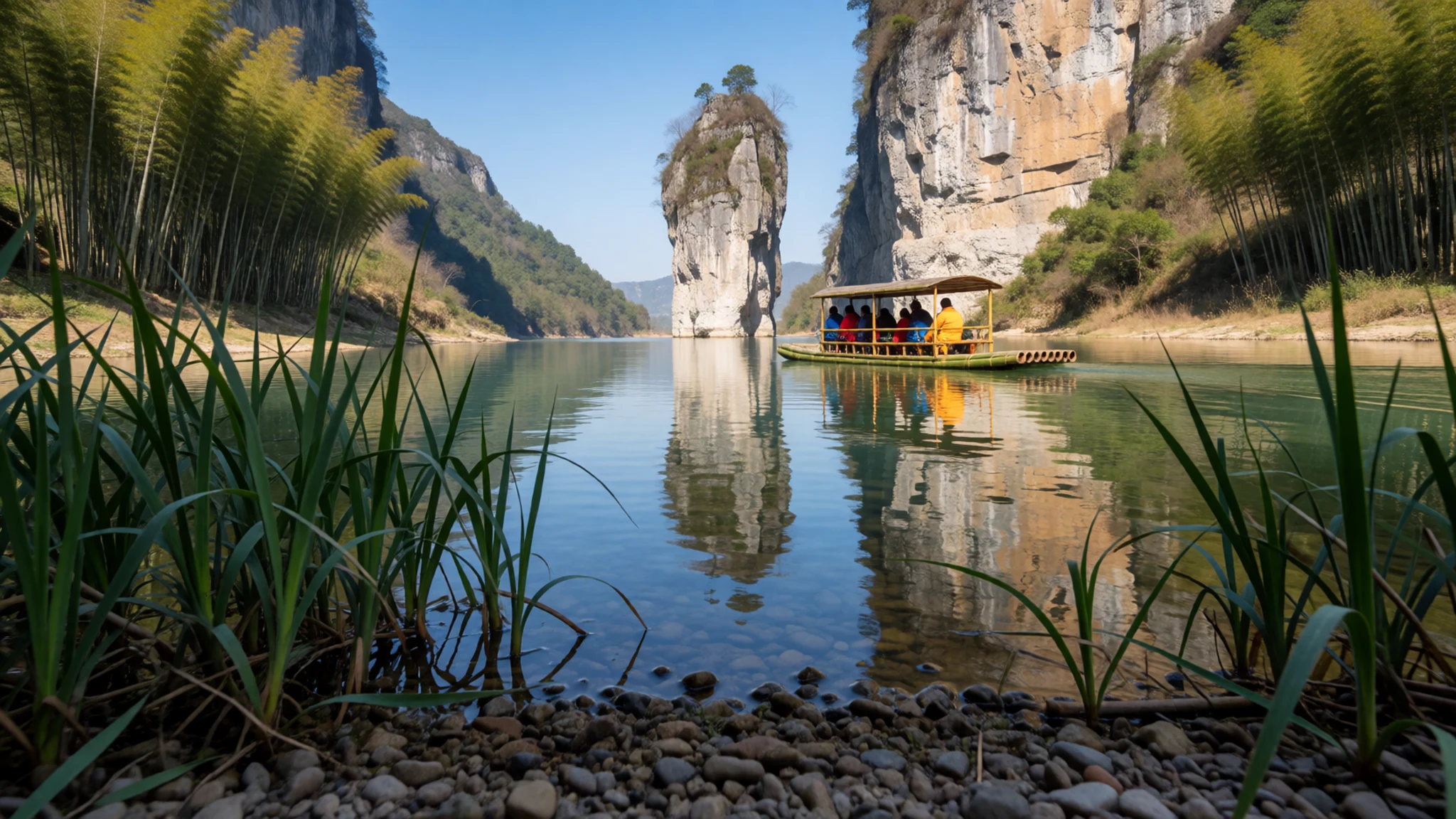
- Dream of Tao — Middle of the park
Dream of Tao is a large outdoor night performance inspired by Taoism, with the cliffs lit up as the backdrop. It is ticketed separately, with shuttle bus access included. It is showy rather than contemplative, and suits those staying overnight. Check the official park site for current schedules.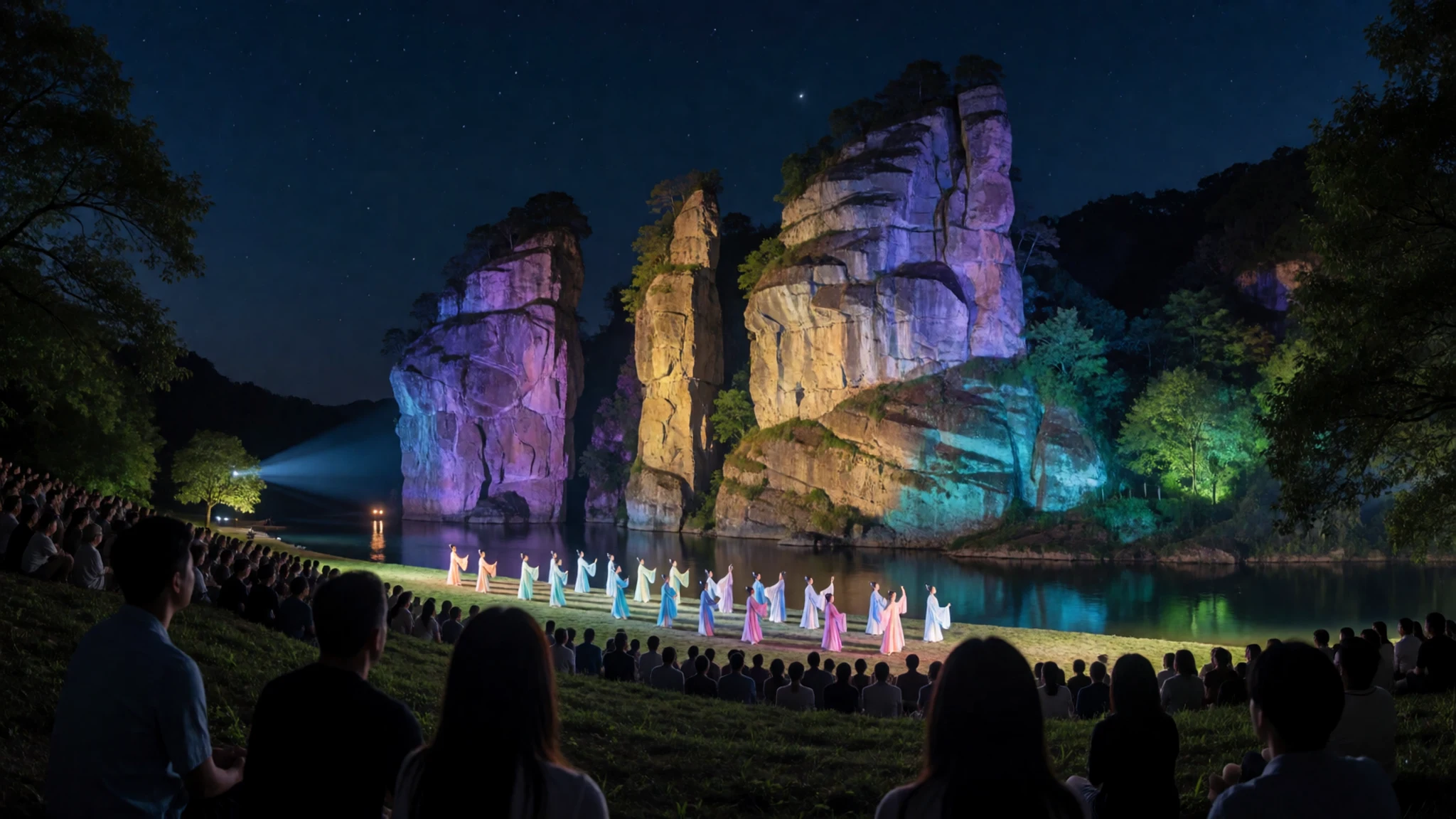
Culture
Mount Longhu is a working centre of Taoism, not only a scenic park. The tradition here is Zhengyi, in which priests can marry, live in ordinary households and perform rituals for communities, which differs from the monastic image many visitors expect. The Celestial Master title passed down a family line, which is why a mansion rather than a monastery sits at the heart of Shangqing. Temple visits involve incense, bows at altars and small offerings placed in donation boxes. Many Chinese visitors arrive as a mix of pilgrim and tourist, and the two blur easily: someone may photograph a gate and then light incense a minute later. Alongside the Taoist layer is the older cliff-burial heritage of the Guyue people, treated with a mixture of scholarly curiosity and showmanship. The coffin-lifting display is a theatrical guess, not a record of how it was done. Village life continues around the park, with river fishing and bamboo among the long-standing local livelihoods. Because so many buildings are reconstructions, the cultural weight lies in the living practice and the stories more than in old fabric. Keep voices low in the halls, step over thresholds rather than on them, and ask before photographing priests or worshippers.
What to wear
Traditional dress at Mount Longhu is tied to the Taoist priesthood. Priests wear long robes, often called daopao, made of cotton or silk in muted colours, with hair gathered in a topknot held by a pin and sometimes a cloth cap. Embroidered ceremonial robes appear for rituals and festival days. Village life in Jiangxi long relied on plain cotton jackets, trousers and straw hats that suited farm and river work. Today most people wear ordinary modern clothes: jeans, T-shirts, quick-dry layers and trainers, often with caps, sun umbrellas and bright rain ponchos. Some visitors hire period costume for photographs in the rebuilt old streets, a tourist habit rather than a local custom. Visitors should dress for humid, hilly subtropical country: light breathable layers, a hat, sun protection and a packable rain jacket in most seasons. Shoes need good grip, because stone steps and boardwalks turn slippery when wet and the walking adds up. Temples do not demand special dress, but covered shoulders and knees are respectful, and a light scarf or shirt is handy for the halls. In winter, bring a warm layer, since damp cold feels sharper than the thermometer suggests.
What to eat
- Shangqing tofu — Restaurants in No Mosquito Village and Shangqing town
Shangqing tofu is the local speciality, made in the area around the temple town. It is usually served braised or stir-fried with local seasoning, and it is worth ordering as a first dish to judge how a kitchen handles simple ingredients.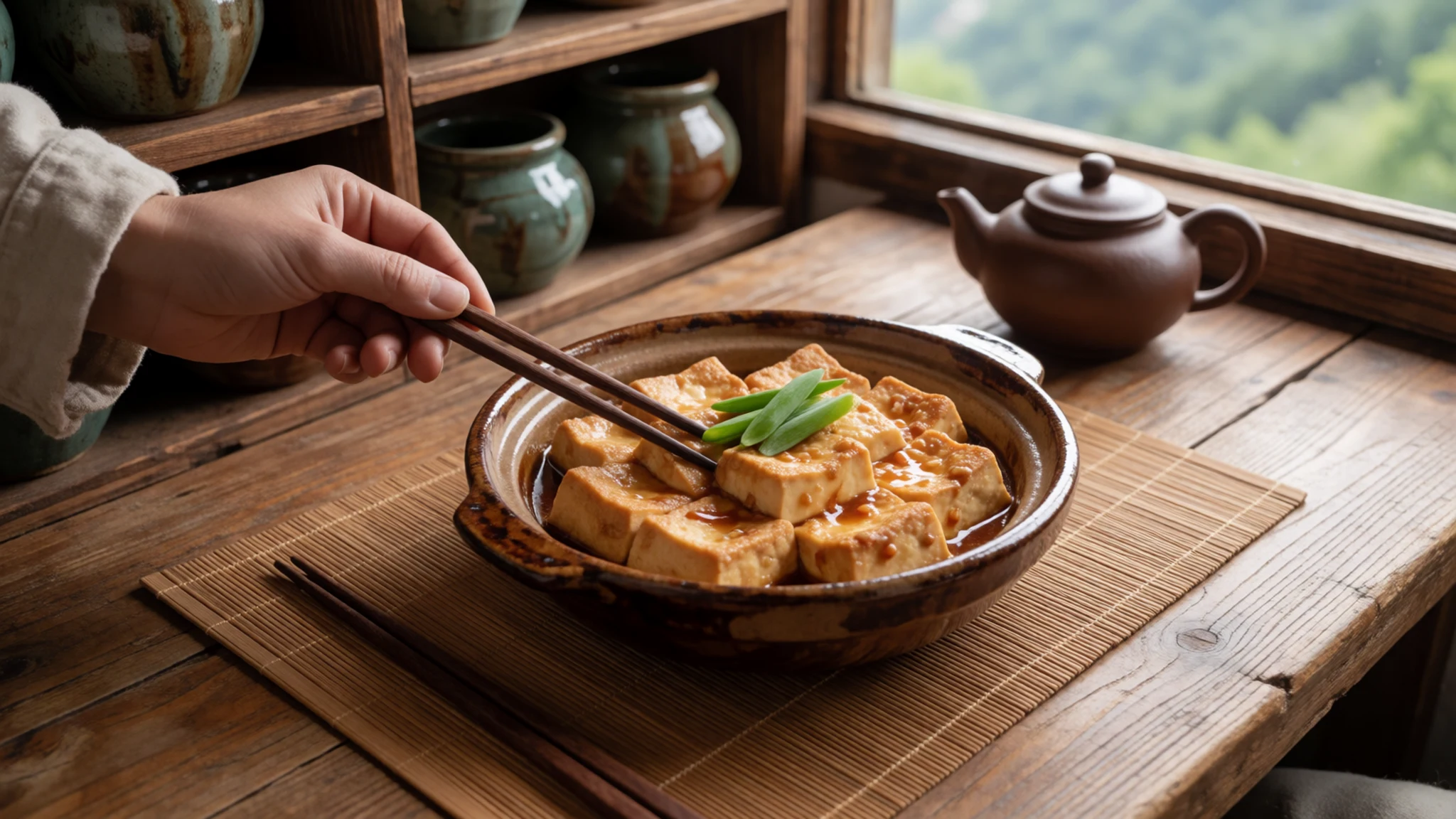
- Small river fish — Village restaurants near the river, especially No Mosquito Village
Small fish from the Tunxi River are cooked whole, typically fried or braised with chilli and ginger. They are eaten bones and all in the manner of a snack-sized dish, so go slowly and ask the kitchen what is in season.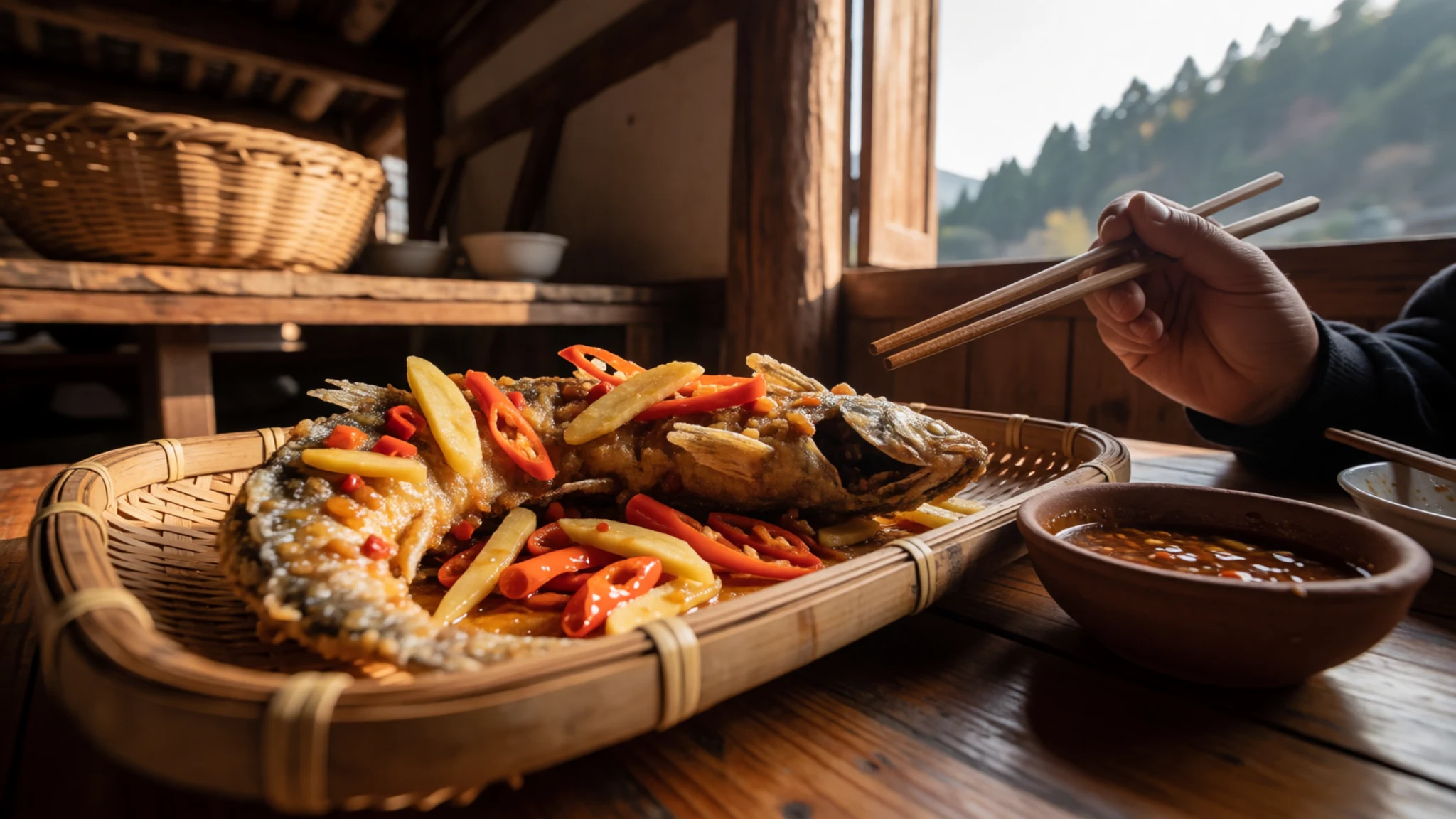
- Jiangxi stir-fried rice noodles — Noodle shops in Yingtan and outside the north entrance
Stir-fried rice noodles (chǎofěn) are a staple across Jiangxi, tossed with vegetables, egg or pork and a good deal of chilli. They make a filling, inexpensive meal before or after a day of walking and rafting. - Seasonal greens and bamboo shoots — Family-run eateries in the villages
Village kitchens stir-fry whatever greens are at their best, often with garlic or chilli, and bamboo shoots appear when the season allows. These plain dishes balance the richer fish and tofu and suit vegetarian eaters. - Village-style home cooking — No Mosquito Village, where many houses are now restaurants
Many houses in No Mosquito Village have become restaurants serving set family-style spreads. Order several shared dishes, point to what neighbouring tables are eating, and eat outside the park gates or in the wider Shangqing area when you want lower bills.
Plan it
Best time. March–April and October–November, when walking, rafting and boardwalks are most comfortable. Summer in Jiangxi tends to be hot, humid and wet, and the main Chinese holidays bring the heaviest crowds.
How long. 1–2
Getting there. Fly to Nanchang, which serves mostly domestic routes, or reach it by high-speed train. Continue to Yingtan by train, then take a local bus or taxi to the park's north entrance. Check current station and bus details before travelling.
Budget. mid
Tips
- Go early on weekdays to beat tour groups, and avoid national holiday weeks if you can
- Check the official park site for ticket zones, shuttle buses and show schedules, as the evening performance is ticketed separately
- Carry some cash and set up mobile payment where possible, since foreign cards are not accepted everywhere
- Eat outside the north entrance or further towards Shangqing, where restaurants cost noticeably less than inside the park
- Bring a rain jacket and shoes with grip, as boardwalks and steps get slippery
Etiquette
- Dress modestly and keep your voice low in temple halls
- Do not photograph priests or worshippers during rituals without asking
- Camping is not allowed in the park, so book a guesthouse near the north entrance or in Yingtan
Nearby
Sources
- Wikidata Q915410 (CC0)
- Wikipedia: Mount Longhu (rev 1385233472) (CC BY-SA 4.0)
- Wikivoyage: Mount Longhu (rev 5239597) (CC BY-SA 4.0)
- Xianshuiyan Cliff Tomb Group, Longhu Mountain, Jiangxi — Zhangzhugang (CC BY-SA 1.0)
- Mount Longhu — 陈昀 (Chen Yun) (CC BY-SA 2.5)
- Tourists at Longhu Shan — Tyler (CC BY 2.5)
- The Tianshifu Gate of the Celestial Master Temple at Mount Longhu — w:User:Zeus1234 (CC BY 3.0)
- Longhu Shan, Jiangxi Province — Tyler (CC BY 2.5)
- Cormorant fishing in the Longhu Mountain — Yumeto (CC BY-SA 4.0)
- Longhu Mountain (084545) — Yumeto (CC BY-SA 4.0)
- Longhu Mountain (085546) — Yumeto (CC BY-SA 4.0)


