Moeraki Boulders
Moeraki Boulders, New Zealand
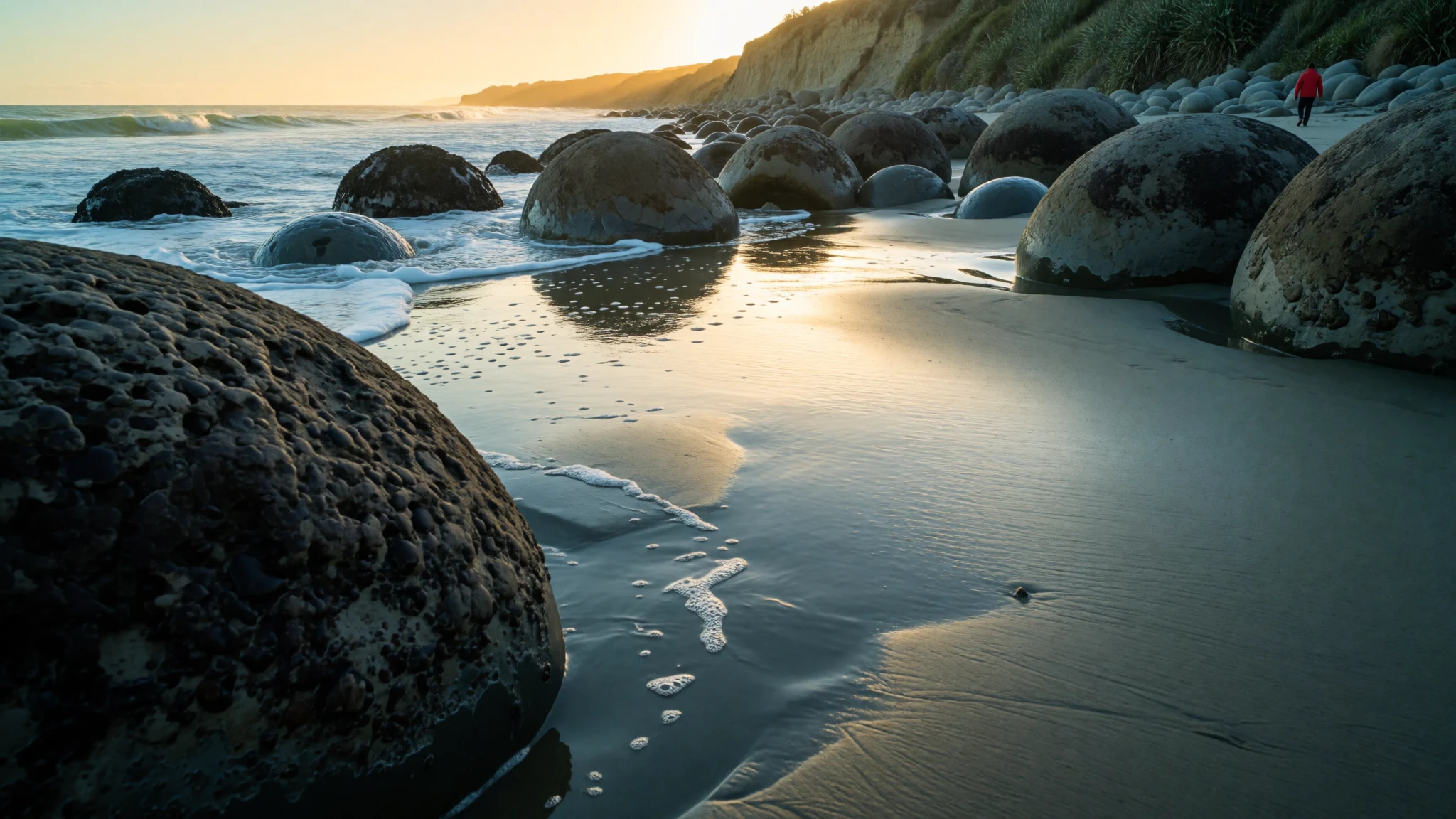
Moeraki Boulders are strangely perfect stone spheres scattered along a wild Otago beach, worth a slow low-tide visit on a coastal drive.
The place
The Moeraki Boulders sit on Koekohe Beach, on the Otago coast of New Zealand's South Island, roughly halfway between the towns of Oamaru and Dunedin. The official name pairs the English label with the Māori Kaihinaki. The stretch of shore is a scientific reserve, so the boulders are protected rather than simply left to the tourist trade.
Each boulder is a grey septarian concretion: a hard lump that formed inside soft mudstone and was later freed when the sea ate away the cliffs around it. Some lie alone in the shallows, while others bunch together in clusters. Waves keep rolling over them, and at high tide many are half hidden.
Size is what catches the eye. The boulders fall into two groups. About a third are modest, around a metre across or less, while the other two thirds are noticeably bigger, reaching about two metres. Most are almost perfectly round, though a few are stretched slightly along the layering of the rock that once held them.
They are not unique. Similar spheres turn up at Hokianga Harbour in the North Island, and flatter, disc-like concretions lie at Shag Point, a short drive south. Even so, Moeraki is the one most people think of, partly because so many sit together on open sand within easy reach of the road.
The village of Moeraki itself is a small fishing settlement a little way along the coast, with a cafe near the beach steps.
Its story
The story of the Moeraki Boulders begins on an ancient seabed. Mud settled there layer by layer, and minerals gathered around a central point inside it, slowly building hard rounded masses. Over a very long time the mud turned into mudstone, and the hard lumps stayed buried in it like stones in a pudding.
Then the land rose and the coast began to wear back. Waves and weather stripped away the softer rock and left the concretions behind, collecting them on the beach where they sit today. The process has not stopped. Some boulders show cracks, and a few have split open to reveal an inner pattern of fine veins, like the cracks in a dried-out riverbed, filled with pale mineral.
Māori tradition tells its own account of the place. One telling links the boulders to the wreck of the canoe Araiteuru, with the rounded stones standing for food baskets and other cargo washed ashore. Local iwi, the Kāi Tahu people, have long ties to this coast, and the Māori name Kaihinaki is still part of the official name.
Visitors have been coming for generations. An old photograph in the Alexander Turnbull Library collection shows a man standing beside the boulders to give them scale, and the habit of posing beside them has not gone away. More recently the beach has become a regular stop on the coast road, which is why the reserve now has a car park, steps and a cafe nearby.
What to see
- Koekohe Beach boulders — Koekohe Beach, Otago coast
The main attraction is the cluster of round boulders lying on the sand and in the shallows. Go near low tide, when more of them are exposed and the wet sand reflects the sky. Some sit alone, and others bunch together, so wander along the beach rather than stopping at the first few.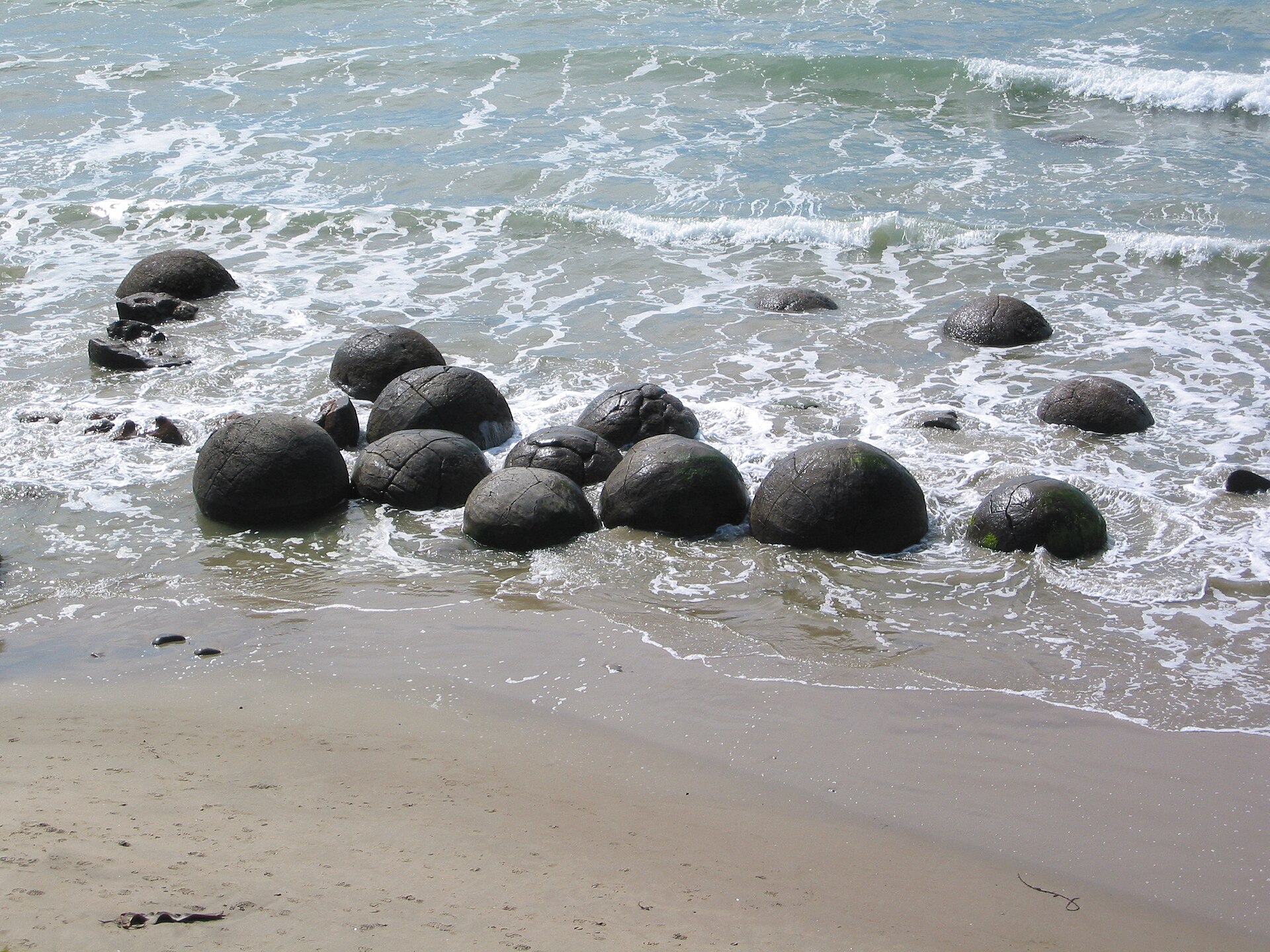
- Sunrise on the beach — Koekohe Beach
Early morning gives the beach its best light, with the boulders silhouetted against a pale sea and very few other people about. Photographers favour sunrise for this reason. Wind and cold off the Pacific can be sharp even in summer, so bring layers and a hot drink.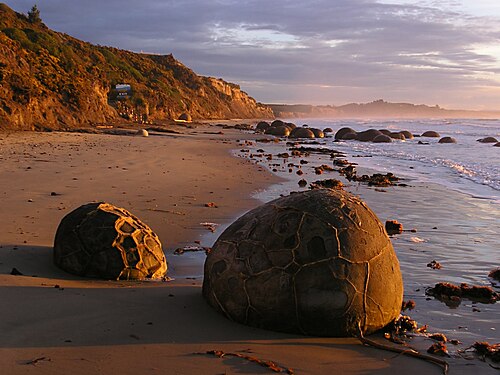
- The split boulders — Along Koekohe Beach
A few boulders have cracked open and show a hollow, veined interior, which makes clear what these objects really are. The pale mineral veins form a web through the grey stone. It is worth looking closely at these, but leave them untouched, as the reserve protects every piece.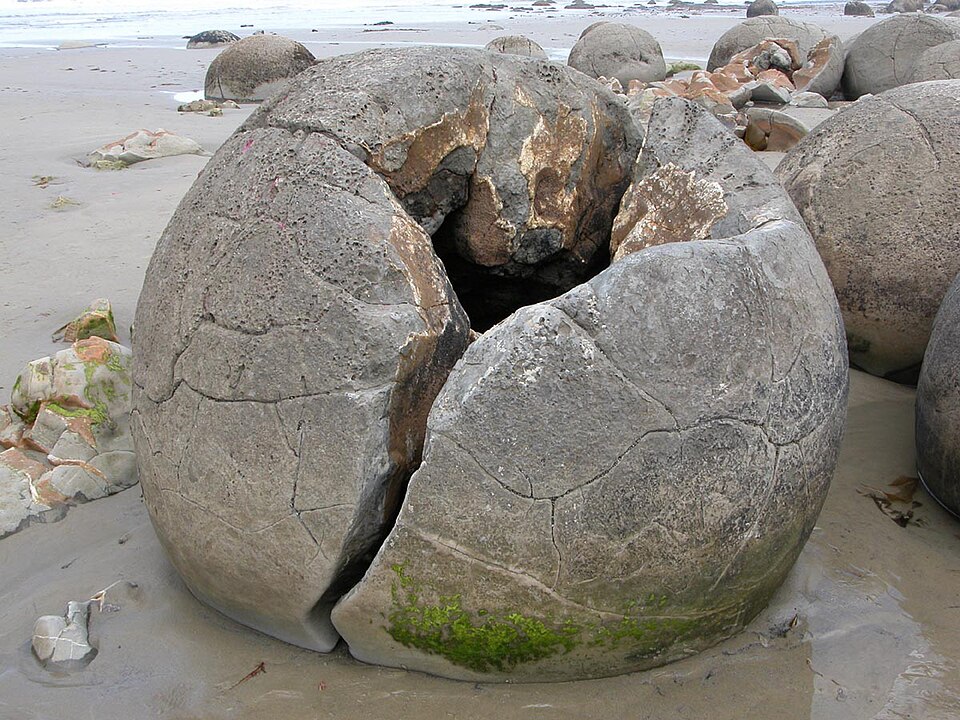
- Moeraki fishing village — Moeraki, a short drive along the coast
The fishing settlement of Moeraki sits on a curve of bay nearby. It is a quiet place of boats, sea air and small buildings, and a pleasant contrast to the open beach. Time here fits well with a visit to the boulders, particularly around a meal. - Katiki boulders at Shag Point — Shag Point, south of Moeraki
Shag Point has boulder-like concretions of its own, some round like cannonballs and some flat or oval. Unlike the Moeraki examples, a few contain the bones of marine reptiles from the age of dinosaurs. It is an easy side trip for anyone curious about the geology.
Culture
Moeraki Boulders sits within the traditional lands of the Kāi Tahu people, and the Māori name Kaihinaki is part of the place's official identity. The stones are a landscape feature first and a visitor attraction second, and local stories about them, including the tale of the wrecked canoe Araiteuru, are part of that heritage.
The beach is also a protected scientific reserve, which sets the tone. This is a place where geology is the point. Visitors come to look at how mud, minerals and sea have shaped the shore, and many stay quietly, watching the waves pass between the spheres. Photography is the main activity, and a polite pace helps everyone get a clear view.
The coast around Moeraki is working country. Fishing boats operate from the village, and the local economy leans on the sea as well as on the road traffic that passes through. Small cafes and shops serve travellers who stop on the way between Oamaru and Dunedin, and a bit of patience goes a long way when the weather turns and everything slows down.
The wider Otago region is also known for pioneer stonework, goldfields and farming heritage, and many small towns along the route keep their old buildings. Anyone driving the long way round will notice this before reaching the beach.
Please do not climb on, sit on or chip pieces from the boulders, since the reserve protects them and the surface is slippery and easily damaged.
What to wear
Traditional Māori dress around Otago includes the korowai, a cloak woven from harakeke (New Zealand flax) and finished with feathers or tassels. Pounamu, or greenstone, is worn as pendants. These garments are usually seen today at ceremonies, graduations and cultural events rather than on the beach, and a korowai is treated with real respect because of its link to ancestry and status.
Everyday dress in this part of New Zealand is practical. People wear layers, wool jumpers, waterproof jackets, jeans and sturdy boots, and the rural Otago look often includes a thick bush shirt or a gumboot-and-fleece combination. Nobody dresses up for the coast, and function wins over fashion almost every time.
Visitors should plan for wind, spray and changeable weather even in summer. Bring a windproof and waterproof outer layer, a warm hat, and sunglasses for the glare off wet sand. Footwear needs grip, as the rocks and the lower beach are slick with seaweed and water. Trainers with a good sole or light walking shoes work well; sandals are a poor idea. Trousers that can handle a splash are better than shorts when the tide is coming in.
There is no dress code at the reserve, and no religious restrictions on clothing. Winter trips need warmer layers, gloves and a thicker coat, since the Otago coast gets cold and some inland roads become icy.
What to eat
- Fish and chips — A coastal fish-and-chip shop along the main highway, such as in Waikouaiti
Fish and chips is the easy local choice, with fresh fish in a light, fluffy batter and chips beside it. Shops along the highway near the coast are reliable for a quick roadside meal, and eating it by the sea is part of the pleasure. - Fresh local seafood — A cafe or restaurant in Moeraki village
The coast here offers good chances to try local seafood, from fish of the day to shellfish, depending on the season. Moeraki village is a fishing community, so menus tend to lean on what the boats have brought in. Ask what is freshest. - Farm cheese — A small cheese factory shop in the region
Small cheese makers in Otago run shops where visitors can taste and buy before choosing. It makes a good picnic item for the beach, paired with bread and fruit. Cheese sampling is also an easy break on the drive. - Cherries and apricots — Roadside fruit stalls in Central Otago, mainly in summer
Central Otago is known for stone fruit, especially cherries and apricots, sold from roadside stalls around the orchards. Smaller stalls tend to be better value than the big ones that cater to coaches. This is a seasonal treat, so check the time of year. - Central Otago pinot noir — A cellar door or wine bar in Central Otago
In Central Otago, pinot noir is the primary grape variety grown, in a region far to the south with a dry continental climate. It is a good match for a meal after a day on the coast. The vineyards are inland, so allow a separate day.
Plan it
Best time. November to March, when the weather is mildest and the long days give plenty of light for a low-tide visit. Winter brings snow in parts of Otago, and inland roads can be icy; the coast itself is windy at any season.
How long. 1–2
Getting there. Fly into Dunedin Airport (DUD), which connects with Brisbane and several New Zealand cities, then hire a car for the coast road towards Oamaru. The beach is reached from a car park and a set of steps. Driving from Christchurch or Timaru is also possible.
Budget. mid
Tips
- Check tide tables and aim for near low tide, when more of the boulders are exposed
- Arrive at sunrise or late afternoon for softer light and fewer people
- Carry chains in winter if heading inland, since alpine roads can ice over
- Roads here are narrow and bendy, so take care when passing
- Bring a windproof layer and sturdy shoes for wet sand and rock
Etiquette
- Do not climb on or take pieces from the boulders
- Keep to marked paths and steps down to the beach
- Respect the Māori name and heritage of the place
Nearby
Sources
- Wikidata Q516651 (CC0)
- Wikipedia: Moeraki Boulders (rev 1354769667) (CC BY-SA 4.0)
- Wikivoyage: Otago (rev 5259450) (CC BY-SA 4.0)
- Photo: Moeraki Boulders, Beast from the Bush (CC BY 3.0)
- Photo: The Moeraki Boulders at sunrise, Karsten Sperling (CC BY-SA 2.0)
- Photo: Moeraki boulder split, William M. Connolley (CC BY 3.0)
- Photo: Moeraki boulders, Albert Percy Godber (Public domain)
- Photo: Moeraki Boulders on Koekohe Bay, W. Bulach (CC BY-SA 4.0)
- Photo: Moeraki Boulders, Region Otago, W. Bulach (CC BY-SA 4.0)
- Photo: Moeraki Boulders Beach, W. Bulach (CC BY-SA 4.0)
- Photo: Moeraki Neuseeland, W. Bulach (CC BY-SA 4.0)


