Lake Towada
Lake Towada, Japan
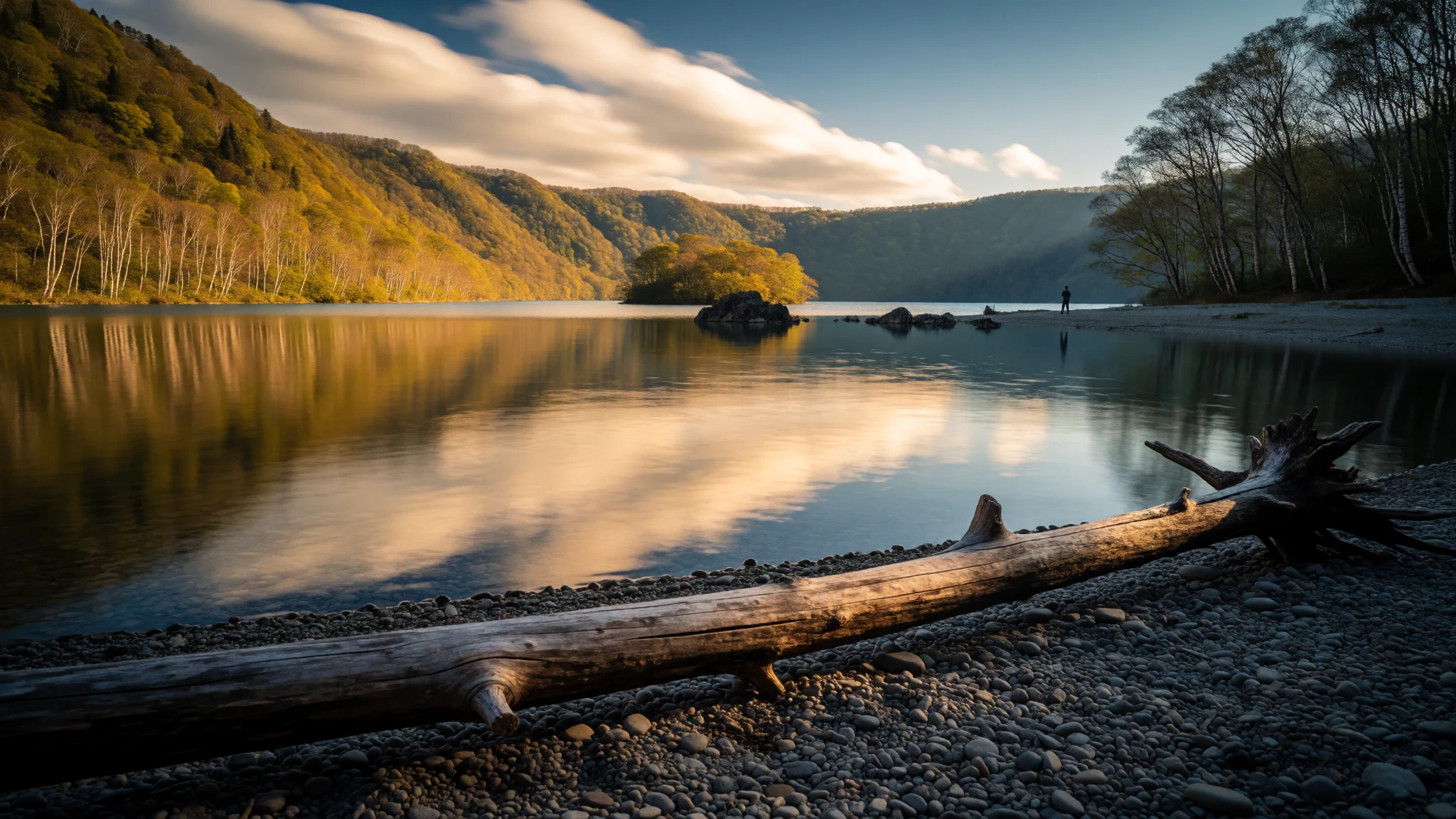
Lake Towada is a deep blue volcanic crater lake in northern Honshū, ringed by beech forest and fed into a gorge made for walking.
The place
Lake Towada sits in the north of Honshū, on the line between Aomori and Akita prefectures, within the northern section of Towada-Hachimantai National Park. It is a crater lake, a caldera filled with water at about 400 m above sea level, and the biggest of its kind on the island. From the air it is almost circular, with a pair of peninsulas reaching in from the southern shore. The water is a deep, clear blue, a colour the sources put down to its great depth. The Oirase River drains it through a wooded gorge that has become a walk in its own right. Forest around the rim is mostly birch and beech, so the shoreline changes character through the year: pale new green in late spring, dark canopy in summer, then a strong run of reds and golds in autumn. Winter brings heavy snow and a much quieter shore. The main base is the small lakeside settlement of Yasumiya on the southern side, where excursion boats come and go and the best-known statue stands. Utarube, further round, is where canoeing and camping happen. Tokyo is about 540 km to the south-west, so Towada is a destination that needs planning rather than a day trip. Aomori and Misawa have the nearest airports, and the lake still feels remote even in the busy weeks of October.
Its story
Lake Towada began as a volcano. The name is believed to come from an Ainu phrase, to watara, meaning rocky lake. The mountain kept erupting well into recorded history, and the last event, in 915 AD, sent pyroclastic flows and mudflows across the surrounding land and spread ash over much of Tōhoku, bringing failed harvests and famine. Legend gives the shore an earlier human story: the general Sakanoue Tamuramaro, campaigning against the Emishi, is said to have founded a small shrine on the Nakayama peninsula in 807 AD. In the medieval centuries the area stayed wild, a place of prayer and training for mountain ascetics called yamabushi, who honoured Suijin, the water deity linked to an azure dragon guarding the lake. Settlement came late. Towards the end of the Edo period the Nambu clan tried to open farmland at Sanbongihara using water from the Oirase River. In 1903 Wainai Sadayuki led the effort to stock the lake with princess trout, and the fish remain part of local life. Tourism grew in the twentieth century: a newspaper poll named the lake among Japan's Eight Scenic Views in 1927, and the national park was created in 1936. In 1953 Kōtarō Takamura's statue of two women was unveiled on the shore, his final work. A wartime army aircraft lost in 1943 was found on the lakebed in 2010.
What to see
- Otome-no-Zo (Maiden Statue), Yasumiya — Yasumiya, southern shore
The two bronze women by Kōtarō Takamura stand at the water's edge in Yasumiya and act as the lake's emblem. Most visitors start here, and excursion boats leave from the same shore. Come early or late in the day for fewer tour groups and softer light on the water.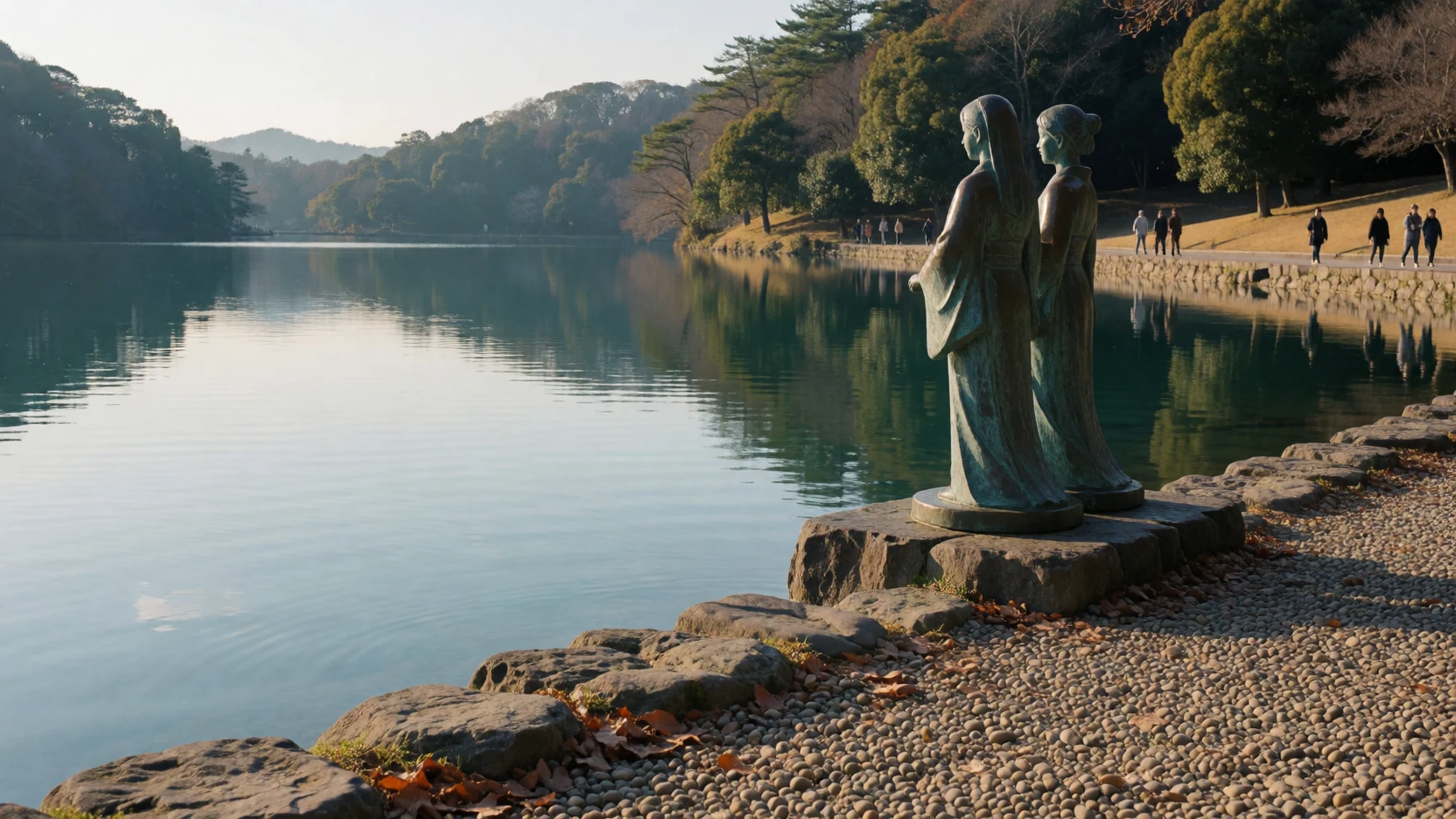
- Excursion boat on the lake — Yasumiya, southern shore
A boat trip is the easiest way to grasp the caldera's shape, with steep wooded slopes, rocky points and small islets passing close by. Sailings run from Yasumiya, and autumn trips pick up the colour on the shoreline. Check the operator's official site for the season's schedule, as winter services differ.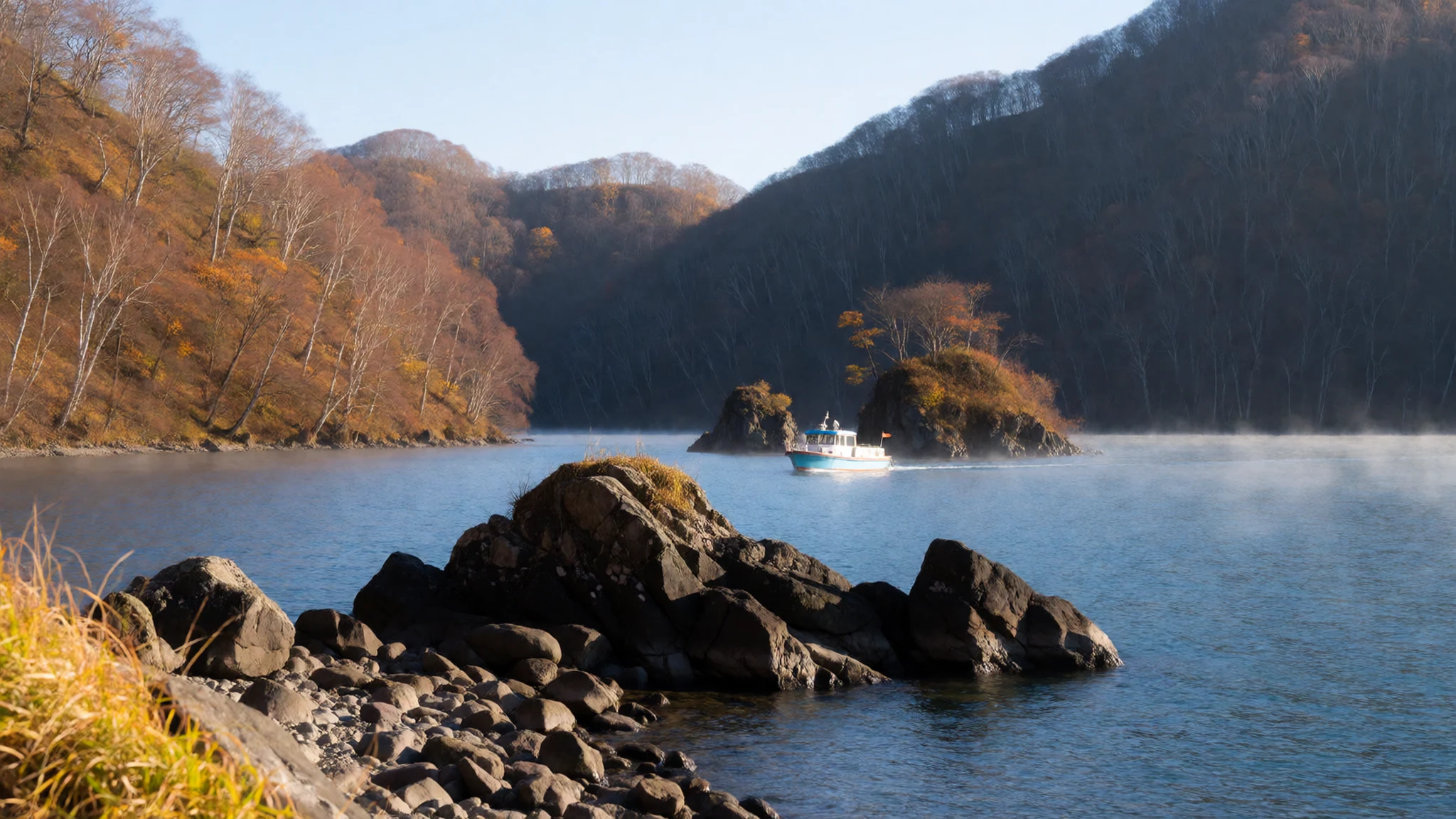
- Mount Ohanabe viewpoint — Northern rim of the lake
From the northern rim, Mount Ohanabe gives a wide view down onto the whole round lake, with the peninsulas pointing in from the far side. It is a clear way to see why geologists call it a caldera. Weather matters here, since cloud can hide everything.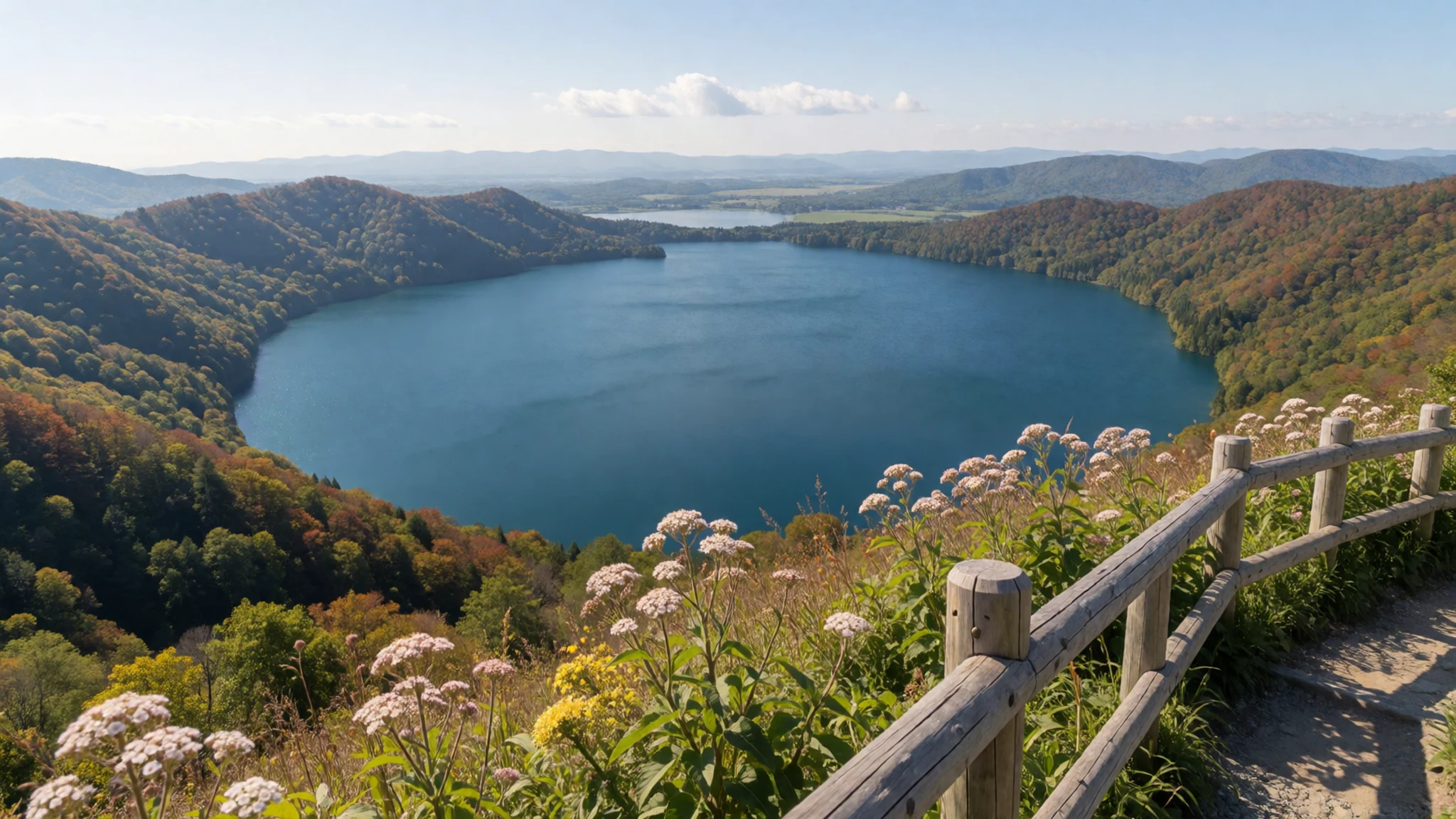
- Oirase Gorge — Outflow of the Oirase River, north-east of the lake
The Oirase River leaves the lake and runs through a forested gorge with mossy rocks and small waterfalls. A walking path follows the water, and the stretch is flat and easy. Autumn is the busiest season, so early starts help. The walk can also be done in one direction using local buses.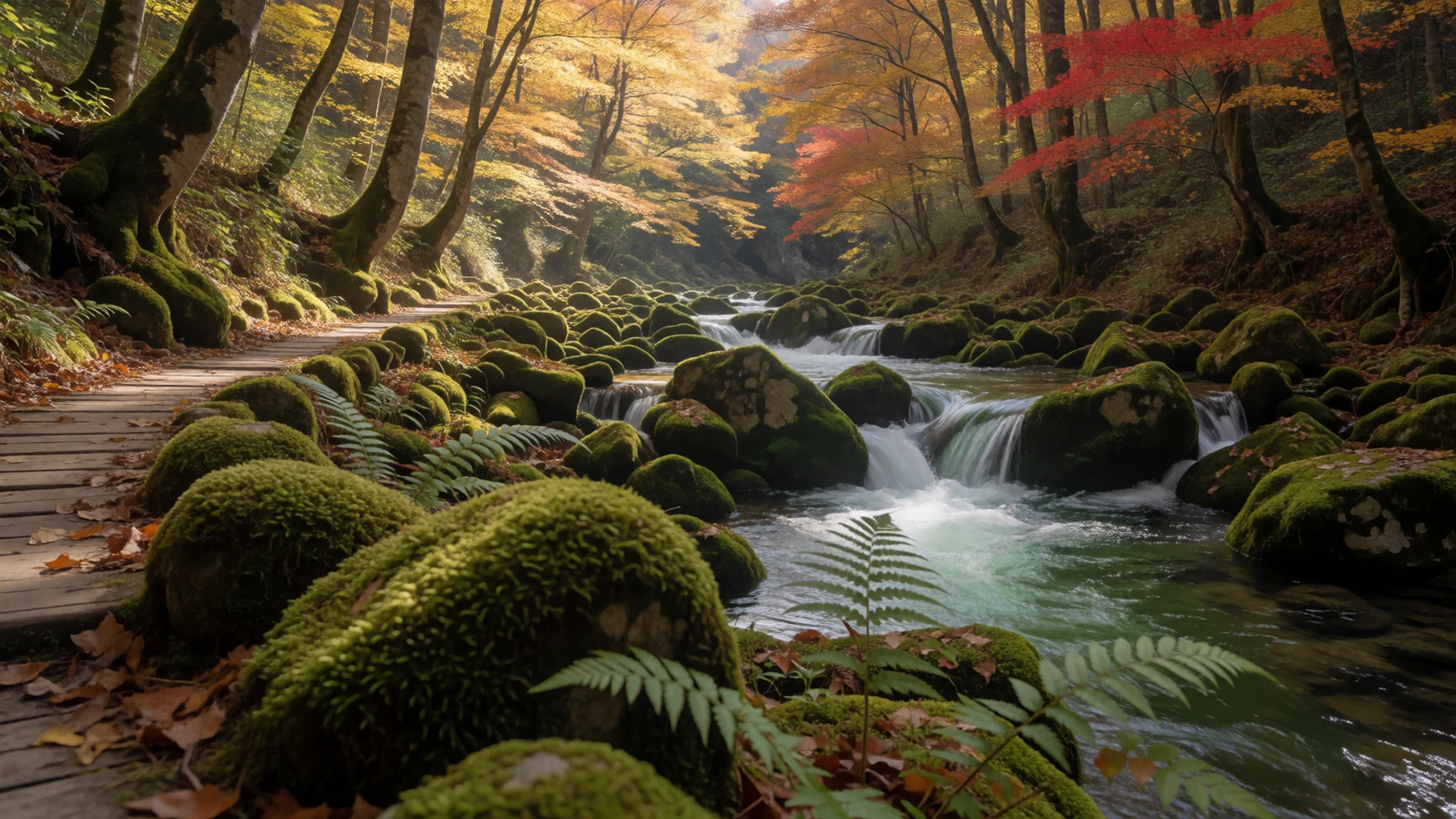
- Towada Shrine, Nakayama peninsula — Nakayama peninsula, southern shore
Towada Shrine stands on the Nakayama peninsula and is tied to the legend of the general Sakanoue Tamuramaro and to the old lake-dragon worship. The setting among trees on the shoreline is as much of the draw as the building. It makes a quiet stop away from the boat landing.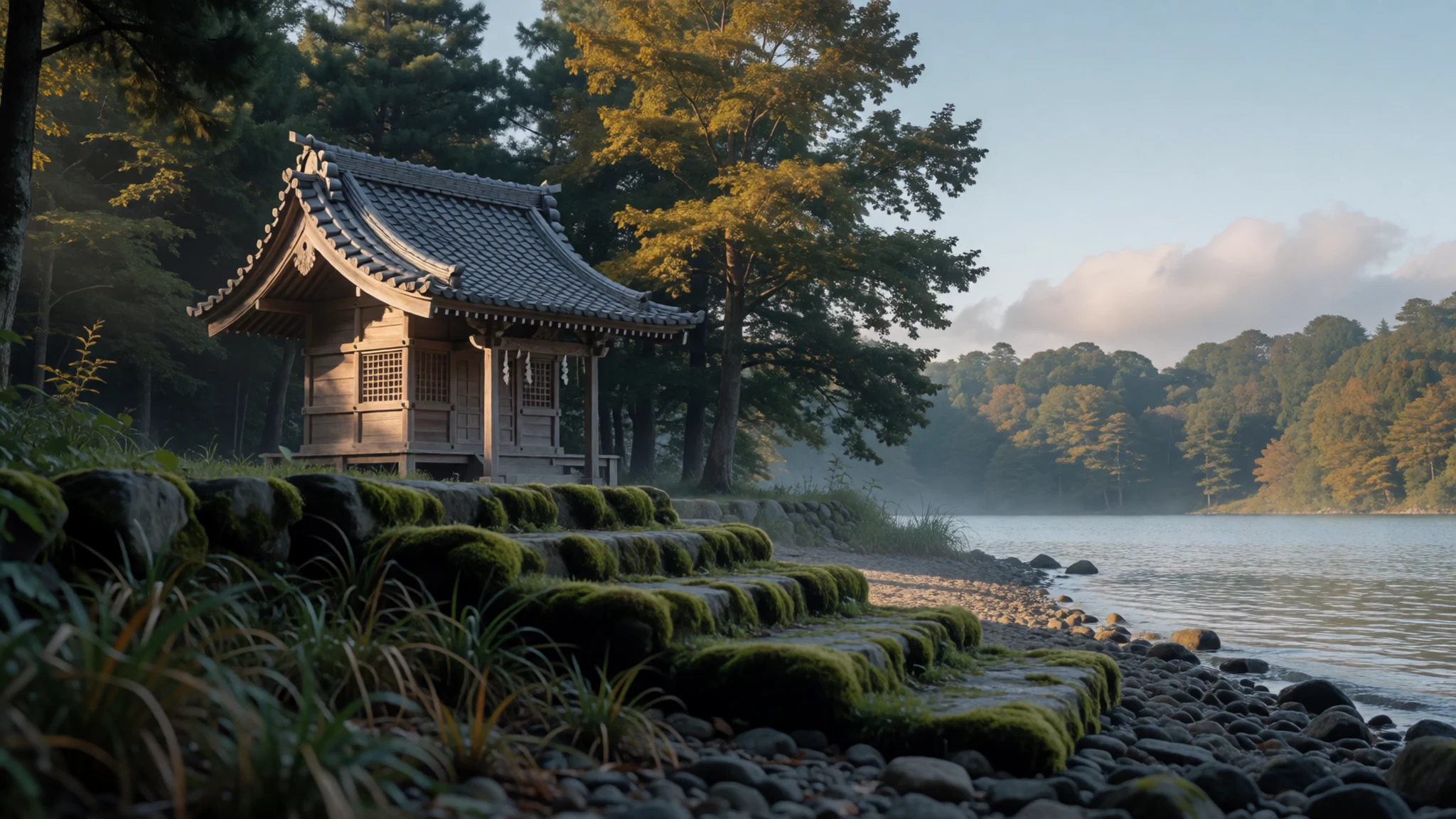
Culture
Lake Towada's culture is shaped by mountain religion and by northern Honshū's farming and festival life. Before the area was a tourist destination it was a place of prayer for yamabushi, mountain ascetics who trained in its forests and honoured Suijin, the water kami, in the form of an azure dragon said to guard the lake. That layered belief survives in the name of the sanctuary on the Nakayama peninsula, Towadasan Seiryū Daigongen, and in the sense that the lake is something to be respected rather than just photographed. The modern symbol is the Maiden Statue, a twentieth-century work that put the lake on the national map. Beyond the shore, Aomori prefecture's festival culture is strong. In August, Aomori city's Nebuta festival brings huge illuminated floats and crowds in costume, and other towns hold their own summer processions with towering lanterns. The Ainu origin of the lake's name is a reminder that the north was home to peoples long before the Japanese state arrived. Local life moves with the seasons: snow shapes winter, apple harvests shape autumn, and village shrines mark the year. At Towada Shrine on the Nakayama peninsula, bow lightly at the gate, keep your voice low, and ask before photographing anyone who is praying.
What to wear
Around Lake Towada, traditional dress comes from the farming and fishing north. Tsugaru in Aomori is known for kogin-zashi, a geometric stitching in white cotton thread on indigo-dyed cloth, historically made to strengthen and insulate work clothes. Indigo cotton and hemp were everyday materials, and the patterns survive today on bags, coasters and festival wear. At August's Nebuta festival, visitors can hire a haneto costume, the dancers' outfit, with a flower-trimmed hat and a bright sash. Day to day, people now dress for the weather: fleeces, waterproof shells, boots and caps in the cool months, and light cotton in summer, much as in the rest of rural Japan. A visitor should dress in layers. Even in summer the lakeside is cooler than the lowlands, mornings on the water can be cold, and autumn evenings turn sharp. Bring a rain jacket in any season, as showers come off the hills quickly. In winter, insulated boots with grip, gloves and a warm hat are essential. Sturdy walking shoes suit the Oirase Gorge path, which is flat but can be slippery with wet leaves. Shrines have no strict dress code, but modest, tidy clothing is appropriate, and mosquito repellent helps on summer forest walks.
What to eat
- Grilled princess trout (himemasu) — Lakeside eateries in Yasumiya
Princess trout were stocked in the lake in the early twentieth century and are now a local speciality. They are usually salt-grilled whole on a skewer, or served as sashimi or in a set meal. Look for them at the small eateries around Yasumiya.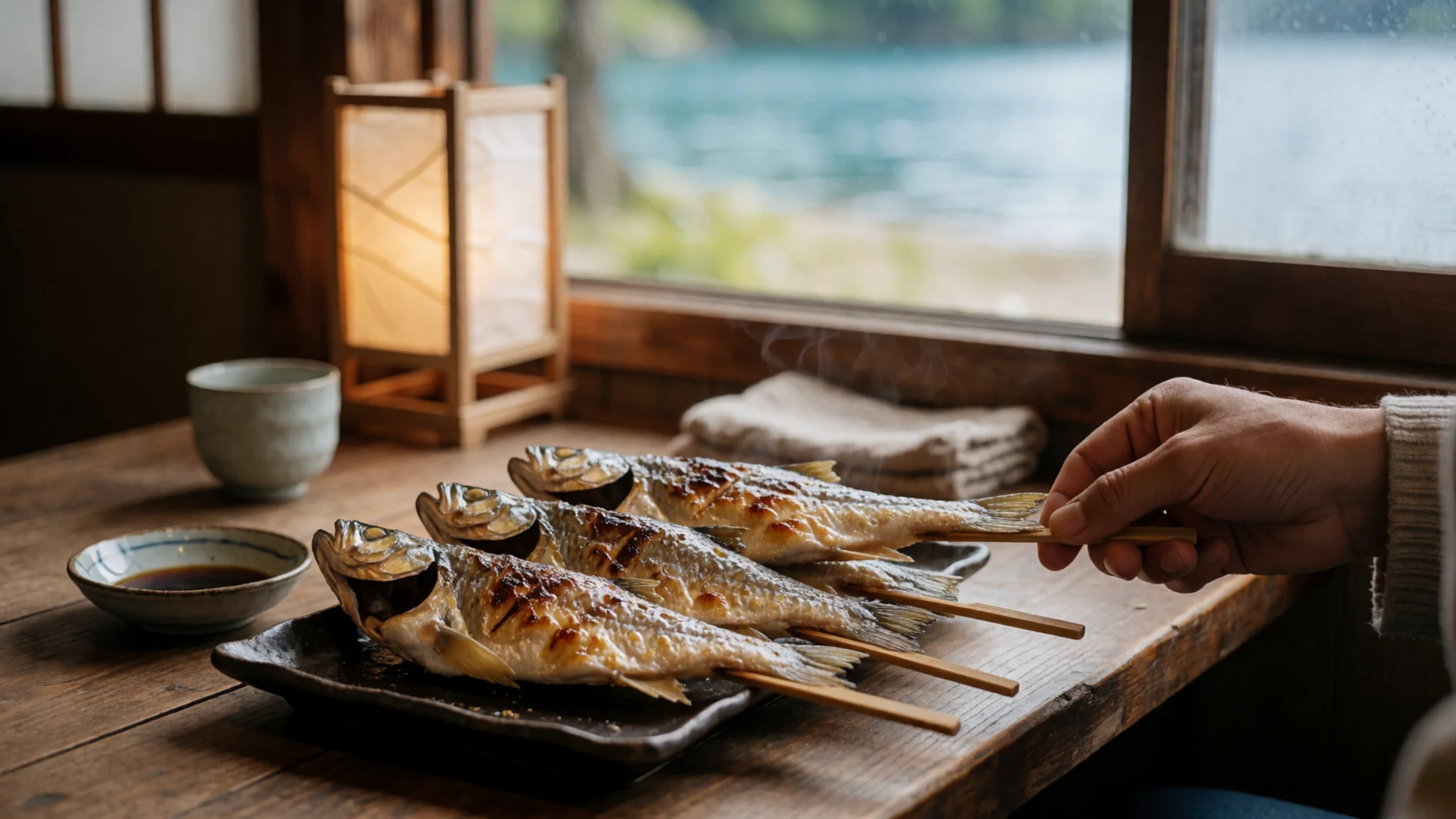
- Aomori scallops — Seafood restaurants and markets in Aomori city and Towada
Aomori is known for its seafood, and scallops are among the most reliable choices, served grilled in the shell, simmered or raw in sushi. They travel well, so they appear on menus around the lake as well as on the coast.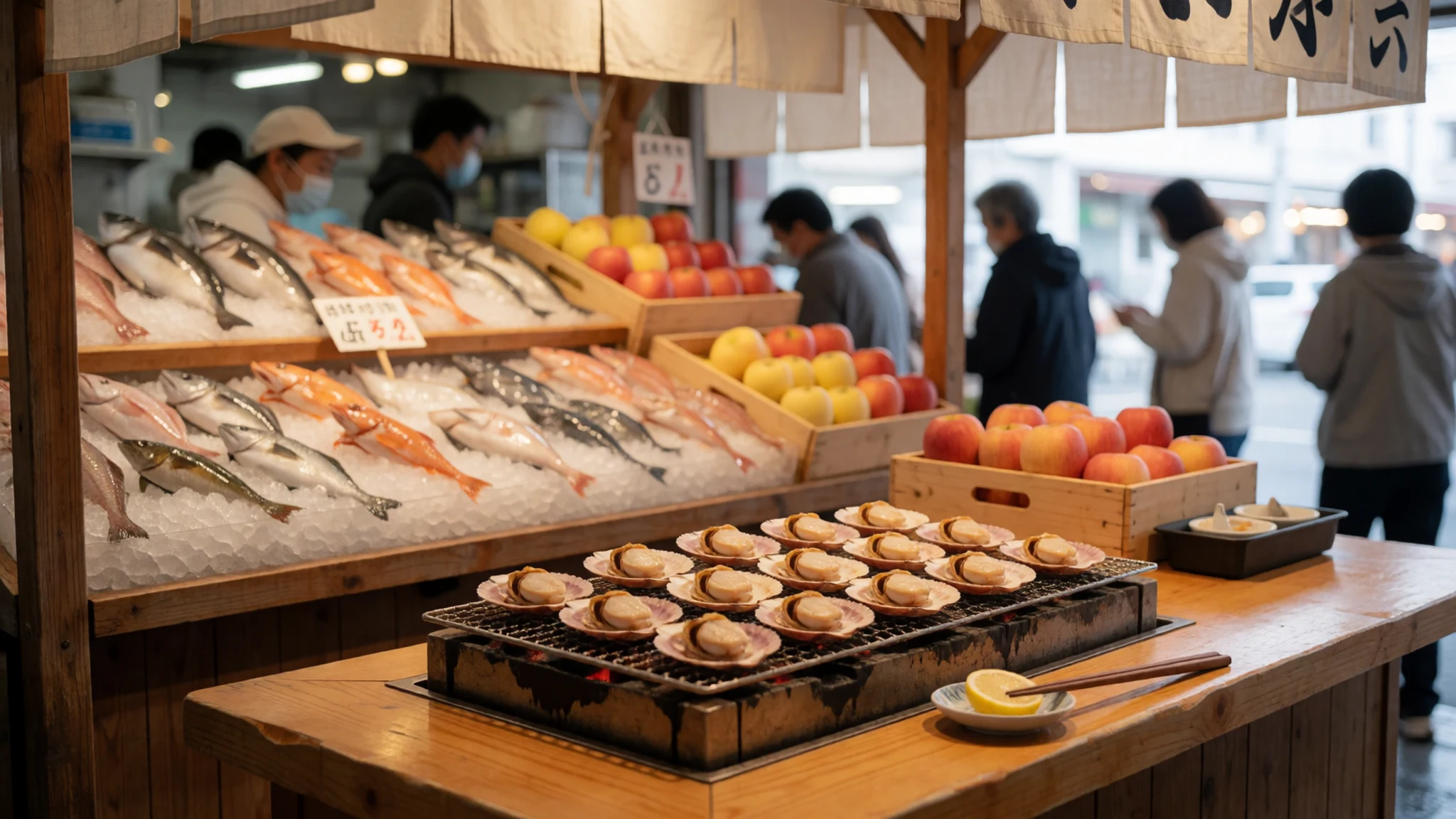
- Apples and apple sweets — Farm stalls, roadside shops and station shops
Aomori is famous for its apples, and autumn brings them in abundance. Fresh fruit, juice, apple pie, dried slices and jams all turn up as snacks and souvenirs, and they suit a lakeside walk when picked up in a roadside shop. - Towada bara-yaki — Casual eateries and food stalls in Towada city
Towada city's local comfort dish is thin-sliced beef cooked on a hot plate with a heap of onion in a sweet-savoury soy sauce. It is hearty, cheap-end food that suits cold days, and is found in casual eateries and festival stalls in the city. - Local sake and beer — Izakaya, sake shops and lakeside eateries
Aomori has its own sake, including Denshu and Momokawa, and neighbouring Akita has Tazawako Beer. A glass with a grilled fish dinner is the natural pairing after a day outdoors. Shops and eateries around the lake usually stock regional bottles.
Plan it
Best time. Late October to early November for the autumn colour on the shoreline and in the Oirase Gorge, though this is also the busiest period; May and June for fresh green and calmer crowds. Winter is cold and snowy, with some services reduced.
How long. 2–3
Getting there. Fly to Aomori or Misawa, both of which have domestic flights from Tokyo, or take the Shinkansen to the northern terminus at Aomori. From the rail or air gateway, local buses or a hire car cover the last leg to Yasumiya; check seasonal bus timetables in advance.
Budget. mid
Tips
- Book rooms early for the autumn colour weeks, as lakeside accommodation is limited
- Start walks and boat trips early to avoid coach-tour crowds
- Carry some cash, since small eateries and shops may not take cards
- Bring layers and rain gear, because weather changes quickly near the water
- Check winter road and bus conditions before travelling, as snow can disrupt access
Etiquette
- Keep to marked paths in the gorge and forest and take rubbish with you
- Keep noise low at shrines and on quiet shorelines
- Ask before photographing people, especially at prayer
Nearby
Sources
- Wikidata Q1196132 (CC0)
- Wikipedia: Lake Towada (rev 1366281436) (CC BY-SA 4.0)
- Wikivoyage: Aomori (prefecture) (rev 5069306) (CC BY-SA 4.0)
- Photo: Lake Towada from Ohanabe (Soica2001) (Public domain)
- Photo: Japan natural location map (Alexrk2) (CC BY 3.0)
- Photo: Towada Caldera 3D (Batholith) (Public domain)
- Photo: Towadako shoreline (Public domain)
- Photo: Lake Towada, Towada7038 (lumoplank) (CC0 1.0)
- Photo: Lake Towada 2005 June 29 (sodai gomi) (CC BY 2.5)
- Photo: Lake Towada, Towada7029 (lumoplank) (CC0 1.0)
- Photo: Lake Towada winter (re-kuma) (CC BY 3.0)


Wildlife
- Princess trout (animal)
The sockeye is a Pacific salmon that turns bright red when it is ready to spawn, a bit like a fish dressed up for a party. Around Lake Towada it is known as the princess trout, first stocked in the lake in 1903 through the efforts of Wainai Sadayuki, and it is still woven into local life. When and where to see it is best asked locally. Watch from a respectful distance, keep voices low, go with a guide if you can, and never feed it.