Lake Tazawa
Lake Tazawa, Japan
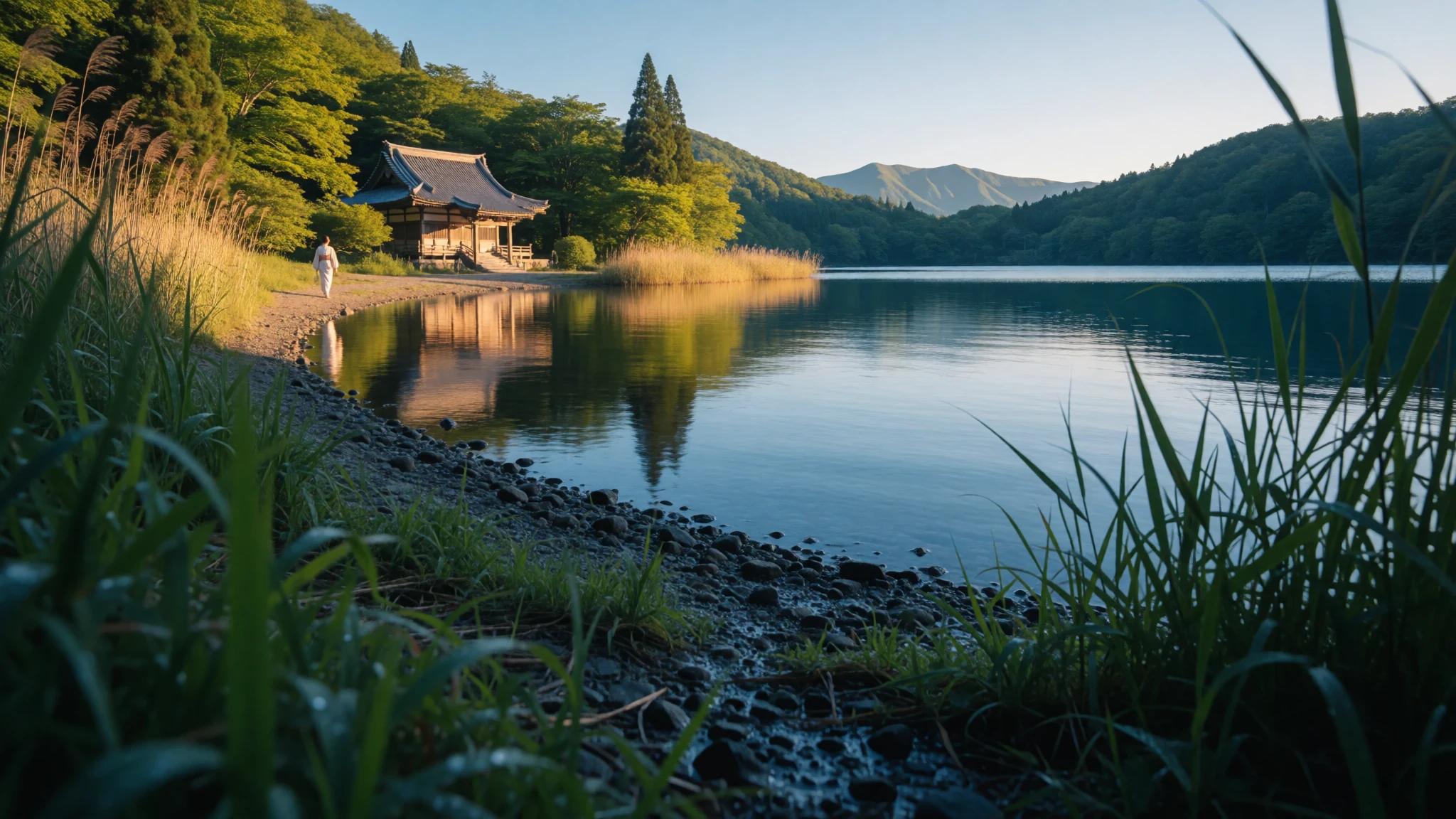
Lake Tazawa is a perfectly round volcanic lake in northern Japan, deep, clear and quiet, with hot springs above and a golden legend on its shore.
The place
Lake Tazawa (田沢湖, Tazawa-ko) fills a near-circular caldera in the city of Semboku, Akita Prefecture, in northern Honshu. The surface sits at 249 metres above sea level, while the water drops to 423 metres, which makes it the deepest lake in Japan according to Wikipedia. That depth and the almost perfect round outline give the lake its character: a deep blue disc ringed by wooded hills, with Mount Akita-Komagatake rising beyond the far shore. Geologists once argued over whether the basin came from a volcanic eruption or a meteorite strike, and surveys of the lakebed, which turned up small volcanic cones, tipped the debate firmly towards a volcano.
The lake is a holiday area rather than a town. Hot spring resorts are scattered through the hills above it, and the biggest ski area in Akita Prefecture looks down on the water, so the place works in snow as well as in summer. Most visitors arrive at Tazawako Station on the Akita Shinkansen and continue by local bus or taxi to the shore. The road around the lake is calm outside holiday weekends, though high summer and the autumn colour bring more people, and winter evenings are very still. Cycling, boat trips and short forest walks fill most days. Services thin out away from the main lakeside cluster, so meals and onward transport are worth sorting out early. The water is cold and clear, and the real pleasure is the scale of it: a lake so deep that its colour shifts with the weather and the hour.
Its story
Lake Tazawa took its present name in the Meiji period, when settlers moved onto the surrounding foothills, but the lake was known long before that to the Ainu people. The name Tazawa is thought to come from the Ainu word Tapukopu, a hill with a raised circular top, which suits a lake that sits inside a round rim.
The older story is about Tatsuko, a young woman of legendary beauty whose origins nobody can pin down. In the telling, she longed to keep her youth and looks for ever, and she was transformed into the goddess of the lake. A bronze statue of her by the sculptor Yasutake Funakoshi stands near the shore with her back to the water, a golden figure that has become the lake's emblem. Wikivoyage places her home in Innai, in present-day Yuzawa, a little way from the water.
The science has its own tale. Because the lake is so deep and so round, people once wondered whether a meteorite had carved it. The depth was first probed by lowering a hemp rope, then a wire rope, and finally by a long survey of the whole lakebed. That survey found a pair of small volcanic cones and thick sediment on the north-west side, which supported the idea of an explosive eruption about 1.4 million years ago. So the lake carries two origin stories side by side: a goddess who chose the water, and a volcano that made the hole.
What to see
- Tatsuko Statue — Western shore of the lake
The golden statue of Tatsuko stands on a rock at the water's edge, facing inland, and is the lake's best-known landmark. It makes a good first stop for the legend. Light is kindest early or late in the day, and tour groups cluster around midday, so a quiet photograph needs patience. - Mount Katamae Forest Park — Hills above the western shore
A nature park with walking trails through woodland, where some of the plants along the paths are edible and labelled for curious walkers. A viewpoint looks out over the whole round lake. Sturdy shoes help on damp ground, and the park is a pleasant way to spend a grey morning. - Lake Tazawa Excursion Ship — Eastern shore, near the main resort cluster
A sightseeing boat gives a slow loop on the water and a sense of how steep the hills are around the rim. It is a relaxed option for anyone tired of walking or cycling. Check the operator's official site for sailing times, because schedules change with the season and weather. - Cycling around the lake — The lakeside road, from the cycle rental near the Kyōei Palace
The road around the shore makes a full lap, rolling up and down rather than lying flat, and takes a few hours at an easy pace with stops. Bicycles can be rented near the eastern shore. Bring water, and start before the afternoon traffic and heat in summer. - Kansa-gū shrine — Lakeside, with Mount Akita-Komagatake in the distance
Kansa-gū is a shrine standing right on the lakeside, and on a clear day the mountain beyond the water gives the scene its backdrop. It is a calm place to pause, ring the bell if others do, and watch the shifting colour of the lake. Mornings tend to be the quietest.
Culture
Lake Tazawa sits in Akita, a northern prefecture where cold winters have shaped a slow, practical and quietly hospitable way of life. The lake's culture is a layered one: Ainu place-names survive in the word Tazawa itself, Shinto shrines stand on the shore, and the Tatsuko legend gives the water a personality that locals still speak of fondly. The golden statue is treated less as an artwork than as a guardian figure, and visitors often leave a respectful moment before it.
Hot spring bathing is the everyday ritual here. The resorts in the hills above the lake use onsen water as a social habit as much as a leisure activity, with guests moving between hot baths, simple meals and early nights. Winter brings skiing and a hush over the lakeside, while summer brings walkers, cyclists and families, so the mood of the place changes with the calendar.
Local people are generally reserved with strangers but helpful when asked, and small gestures such as a bow of thanks or a few words of Japanese are warmly received. Rubbish is usually carried away rather than left in public bins, so a small bag is useful on walks. Shrines are working places of worship rather than museums, so a quiet voice carries well.
At hot spring baths, wash and rinse thoroughly at the washing stations before entering the shared water, and keep your towel out of the bath.
What to wear
Lake Tazawa lies in the Tohoku region, where the traditional dress is the Japanese kimono, usually silk for formal occasions, with the lighter cotton yukata worn in summer and after an onsen bath. Yukata appear at summer festivals and in lakeside inns, often in indigo or bright prints, tied with an obi sash. The Ainu people, whose language gave the lake its name, historically wove garments from elm bark fibre and decorated them with bold patterned embroidery, a tradition now seen mostly in museums and ceremonies.
What people wear now is practical and weather-led. Locals dress in layers, with fleece and waterproof jackets for the cool months and snow boots and thick coats for the long winter, since this is a ski area. In summer, light cotton, sun hats and walking sandals are common around the shore. Kimono are rare in daily life and appear mainly at weddings, festivals and special visits to shrines.
For visitors, comfortable layers matter most, because mornings and evenings by the water can be cool even in summer, and rain arrives without much warning. Bring sturdy walking shoes for forest trails and a warm hat and gloves for winter. Shrines have no strict dress code, but covered shoulders and tidy clothes are respectful. At many onsen, swimwear is not worn, and some baths limit visible tattoos, so check the rules at the door.
What to eat
- Kiritanpo nabe — Farmhouse-style restaurants and izakaya around Semboku
Kiritanpo is Akita's signature winter comfort food: mashed rice pressed onto cedar sticks, grilled until crisp, then simmered in a hotpot with chicken, burdock and mushrooms. Its smoky, chewy texture suits cold lakeside evenings and hearty appetites. - Inaniwa udon — Noodle shops in towns across southern Akita
Inaniwa udon is a flat, hand-stretched wheat noodle from Akita, thinner and smoother than the usual thick udon. It is often served cold with dipping sauce in summer or in a hot broth in winter, and makes a light, easy lunch. - Iburigakko — Station shops, roadside stalls and souvenir counters
Iburigakko is daikon radish smoked over a fire and then pickled, giving a crunchy, smoky and slightly sweet bite. It is traditionally a way of preserving food through the snowy season, and it is easy to buy as a snack or gift. - Tazawako Beer — The brewery and its restaurant, south of the lake
Tazawako Beer is a local craft beer, brewed in the area, and the brewery has a restaurant serving French and Italian-style dishes. It is a good stop for a relaxed meal with a regional drink, and is worth checking in advance for opening times. - Hinai jidori chicken — Local izakaya and grill restaurants
Hinai jidori is a regional chicken breed from Akita, valued for firm, flavourful meat. It appears as grilled skewers, in hotpots and in rice dishes, and it is a good way to taste local produce without ordering anything elaborate.
Plan it
Best time. May–June for fresh greenery and calm weather, and September–October for clearer air and autumn colour. Summer is the busiest and warmest season for lakeside activities, while winter is cold and snowy, suited to skiing and onsen stays.
How long. 2–3
Getting there. The nearest rail stop is Tazawako Station on the Akita Shinkansen; from there, a local bus or taxi runs to the lakeside. Akita Airport is the nearest large airport, with onward travel by rail and road. Check current timetables before travelling.
Budget. mid
Tips
- Check boat, bus and cycle-rental times on official sites before you go, as schedules change with the season
- Start cycling or walking early to avoid afternoon heat and tour-group crowds
- Carry some cash, as smaller eateries, shops and shrines may not take cards
- Bring water and a rain layer, since weather by the lake changes quickly
- Book onsen inns ahead for autumn colour weekends and winter ski season
Etiquette
- Wash and rinse before entering shared onsen baths, and keep towels out of the water
- Take rubbish with you and be quiet at shrines
- Ask before photographing people, especially at festivals and in onsen towns
Nearby
Sources
- Wikidata Q174309 (CC0)
- Wikipedia: Lake Tazawa (rev 1372771488) (CC BY-SA 4.0)
- Wikivoyage: Semboku/Lake Tazawa (rev 5379775) (CC BY-SA 4.0)
- Photo: Lake Tazawa and Kansa-gū (掬茶) (CC BY-SA 4.0)
- Photo: Japan natural location map (Alexrk2) (CC BY 3.0)
- Photo: Tazawako Rose Park Hotel (掬茶) (CC BY 3.0)
- Photo: Tazawako Caldera Relief Map, SRTM-1 (Batholith) (Public domain)
- Photo: A Lakeside Hotel (Ryuetsu Kato) (CC BY 3.0)
- Photo: Akita Prefectural Road 38 at lakeside of Tazawako (掬茶) (CC BY 3.0)
- Photo: Alpa Komakusa (Koichi Shibata) (CC BY 3.0)
- Photo: Crow at the shore of Lake Tazawa (Cheng-en Cheng) (CC BY-SA 2.0)


