Lake Hawea
Lake Hawea, New Zealand
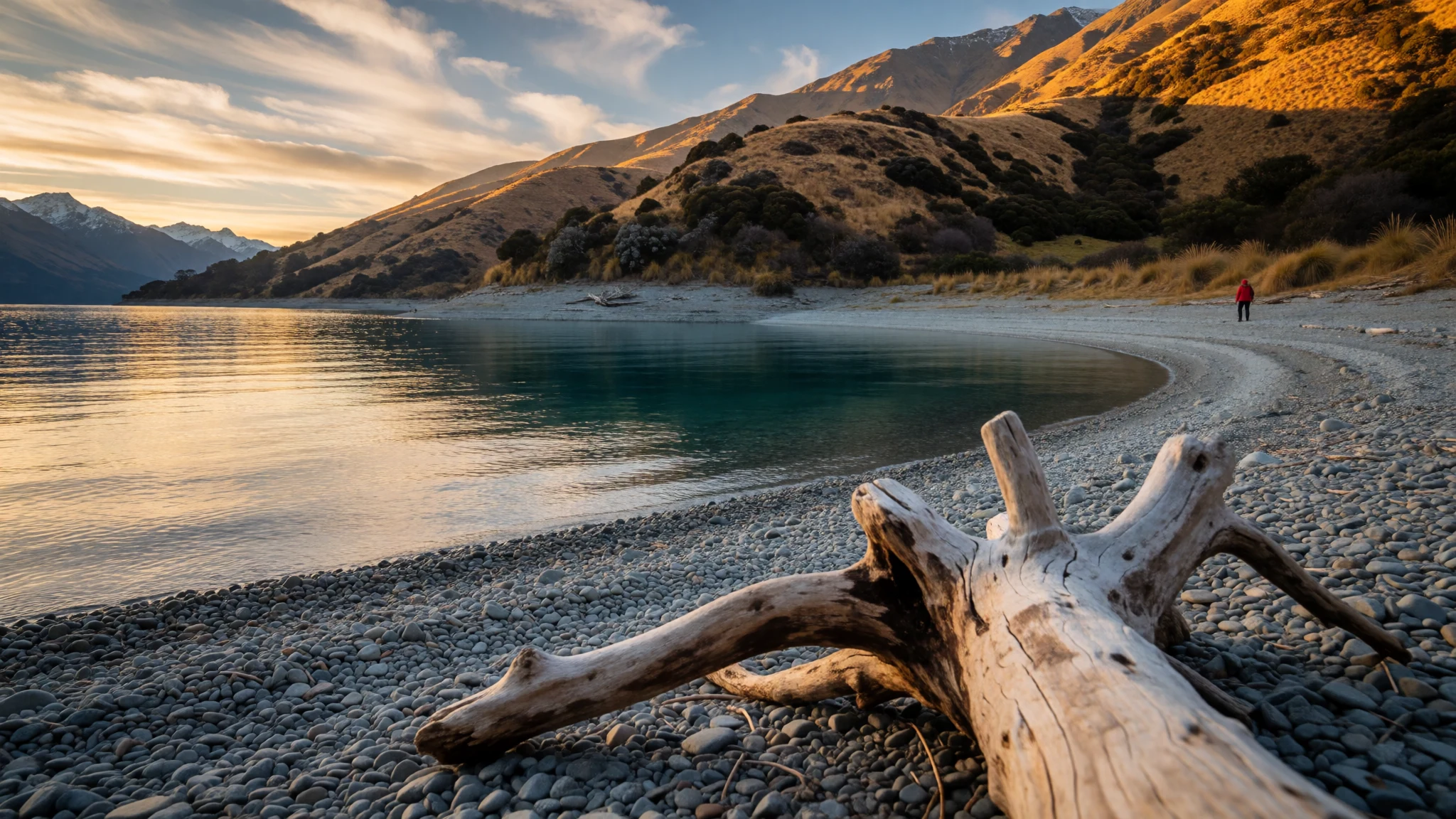
Lake Hāwea is a quiet glacial lake in Otago, where cold water, steep hills and slow summer days sit away from Queenstown's bustle.
The place
Lake Hāwea sits at 348 m above sea level in Otago, on New Zealand's South Island, a long trough of cold water hemmed in by steep, dry-looking hills. It runs about 35 km from north to south, covers roughly 151 square kilometres and drops to 392 m at its deepest, which makes it the country's ninth largest lake. The Hunter River feeds it at the northern end, and the water leaves at the southern end as the Hāwea River, a short stream that soon meets the Clutha / Matau-au near Albert Town. Level ground is scarce here. What little there is gathers around the outflow, and the small town of Lake Hāwea occupies it, strung along the southern shore. Elsewhere the mountains fall almost straight into the water, so the road down the western side is the main way to take in the lake, with signed viewpoints along it. Lake Wānaka lies in a parallel valley about 8 km to the west. At a rocky ridge called The Neck the two lakes come within 1 km of each other, yet they feel quite different, and Hāwea is usually the quieter of the pair. Summer brings families for fishing, boating and swimming, though the water stays properly cold. Winter turns attention to the snowy ranges and the ski fields of the wider district. The town itself is small, so most restaurants, shops and beds are in Wānaka or Queenstown, and Hāwea often works best as a slow half-day or a quiet base rather than a place with a long list of sights.
Its story
Lake Hāwea owes its shape to ice. During the last ice age a glacier carved out the valley, and when the ice retreated it left a terminal moraine, a bank of rock and gravel pushed along by the glacier, across the southern end. That ancient bank, formed about 10,000 years ago, still dams the lake. The name comes from a Māori tribe, the Hāwea, who lived in the area before the Waitaha people. Little of that earlier story is visible from the shore, so local interpretation panels and visitor centres are a better guide than guesswork. The most recent chapter is a human one. In 1958 the lake was deliberately raised by 20 metres to store water for the Roxburgh Dam, further down the Clutha, so that more hydroelectric power could be generated. The shoreline seen today is therefore partly a made one: the water stands higher than it once did, and a stretch of the old edge now lies beneath it. Few visitors would guess this from the calm surface, and the lake has long since settled into its role as a holiday place. It remains a working reservoir as well as a playground, which is why levels can look different from one season to the next. That tension between scenery and utility is part of what makes Hāwea interesting, and the landscape tells it quietly.
What to see
- Lake Hāwea town and Esplanade Reserve — Southern shore
The small town of Lake Hāwea occupies the flat southern shore, and the Esplanade Reserve beside the water is the easiest place to settle in. Grass, shingle and a long open view north up the lake make it a good spot for a picnic, a summer swim or a quiet walk at dusk.
- The western lakeside road — West shore
The road along the western side of Lake Hāwea gives the widest views of the whole lake, with the mountains stacked up behind. Use the signed viewpoints rather than stopping on a bend, since the road is winding and narrow in places. Early morning and late afternoon light suit photographs best.
- The Neck — Between Hāwea and Wānaka
The Neck is the rocky ridge where Lake Hāwea and Lake Wānaka come within about 1 km of each other. The main road crosses it, so it is an easy stop for looking both ways and seeing how two parallel glacial valleys sit side by side, one lake on either hand. - Hunter River valley — Head of the lake
At the northern end of Lake Hāwea, the Hunter River flows in through a wide valley. This is the wilder end, away from the town, and it suits walkers who want more space. Check current track conditions and access with the local Department of Conservation office before setting out. - Mt Aspiring National Park — Near Wānaka
Mt Aspiring National Park lies near Wānaka, the neighbouring town to Lake Hāwea, and is a popular excursion for mountain scenery and tramping. It sits well beyond Hāwea's own shores, so it suits a full day with an early start. Check weather and track conditions first, as alpine conditions change quickly.
Culture
Lake Hāwea carries the name of a Māori tribe, the Hāwea, who lived in the area before the Waitaha people, and the macron over the first 'a' is part of the proper spelling. Beyond the name, the day-to-day culture is that of a South Island lake community: outdoorsy, practical and unhurried. Many visitors are New Zealanders on holiday, so life follows the seasons, with boats, anglers and swimmers busy in summer and the town far quieter once the weather turns cold. Fishing is part of local life, and anyone planning to cast a line should check current licence and catch rules with the local Fish & Game office rather than assume. Water is treated with respect here, since the lake is deep and cold and the weather can change quickly. The lake's hydroelectric past also shapes how people talk about it: the level was raised in 1958 to feed power generation, so conversations about water, flow and conservation come up readily. Visitors who show real interest in the landscape, rather than only photographing it, tend to get friendly answers. Take all rubbish away with you, keep to marked tracks and ask before camping anywhere that is not a designated site.
What to wear
Lake Hāwea has no costume of its own, but the Māori heritage of the region carries a rich textile tradition. The best known traditional garment is the korowai, a cloak woven from harakeke (New Zealand flax) fibre, often finished with feathers or woollen tassels, and worn today at ceremonies, graduations and important gatherings. Pounamu (greenstone) pendants, including the hei-tiki, are worn as heirlooms and gifts rather than as casual jewellery. Around the lake, people dress for the weather and the outdoors. Merino base layers, fleeces, down or synthetic jackets, shorts in summer, jeans and sturdy boots are common, and a rain shell is rarely far away. Nothing is formal; even restaurants in Wānaka and Queenstown are relaxed. A visitor should pack in layers, since mornings and evenings are cool even in summer and mountain weather turns quickly. A sun hat, sunglasses and high-factor sunscreen matter, as ultraviolet levels in New Zealand can be high. Waterproofs are wise in every season, with warm gloves and a hat for winter. Walking shoes or boots with good grip suit shingle shores and tracks, while sandals are fine at the water's edge. No special dress is needed for local sights, though anyone invited onto a marae should follow the hosts' lead, usually removing shoes at the door.
What to eat
- Central Otago cherries and apricots — Roadside stalls around Cromwell
Near Lake Hāwea, summer stone fruit from Central Otago orchards is the easiest local taste in season. Roadside stalls appear on the highways around Cromwell, and it is worth carrying both cash and a card, as stalls differ. - Central Otago pinot noir — Cellar doors in Gibbston Valley and Bannockburn
A red wine grown in the vineyards of the Gibbston Valley and Bannockburn, poured at cellar doors, many of which have their own restaurants. Nominate a driver before tasting, as the roads in the region are winding. - Roast lamb — Pubs and restaurants in Wānaka and Queenstown
A staple of South Island menus, lamb turns up as roast shoulder, racks or slow-cooked dishes. Pubs and restaurants in Wānaka and Queenstown serve it, and it pairs naturally with a glass of local wine after a day outdoors. - Meat pie — Bakeries and cafes in Hāwea and Wānaka
The everyday pie of New Zealand bakeries: pastry filled with minced beef, steak or cheese. Bakeries and cafes in Hāwea town and Wānaka sell them warm, and they make an inexpensive, filling lunch to eat by the water. - Trout — Restaurants in Wānaka, or a lakeside campsite
Lake and river trout, pan-fried or smoked, is tied to the district's fishing culture. Some restaurants in Wānaka serve it, while anglers cook their own catch where the rules allow, so check licence and limits first.
Plan it
Best time. December–March for warm days and the best chance of boating and swimming at Lake Hāwea, though the water stays cold; winter brings snow and skiing in the district, with icy alpine roads, so April–November suits quieter trips with warm layers.
How long. 2–3
Getting there. Fly to Queenstown Airport (ZQN), which has direct services from Sydney, Melbourne, Brisbane, Gold Coast, Auckland, Wellington and Christchurch; the last leg is by hire car or road transfer via Wānaka to the lake's southern shore. Driving from Dunedin, the West Coast, Invercargill or the Mackenzie country is also possible.
Budget. mid
Tips
- Book beds early for December–February and school holidays; many are in Wānaka rather than Hāwea town
- Buy fuel and supplies in Wānaka, as Hāwea itself is small
- In winter check road conditions: the Crown Range between Queenstown and Wānaka often closes, and chains may be needed on alpine and ski-field roads
- Drive slowly on the winding, narrow lakeside roads with blind corners, and stop only at signed viewpoints
- Carry layers, sun protection and drinking water on any walk, as mountain weather changes fast
Etiquette
- Check Fish & Game licence and catch rules before fishing
- Take all rubbish with you and camp only at designated sites
- Ask before entering a marae and follow the hosts' lead on shoes and greetings
Nearby
Sources
- Wikidata Q1440634 (CC0)
- Wikipedia: Lake Hāwea (rev 1366225427) (CC BY-SA 4.0)
- Wikivoyage: Queenstown-Lakes (rev 4997312) (CC BY-SA 4.0)
- Photo: Lake Hawea, New Zealand — Tobias Thierer (Public domain)
- Photo: Lake Hawea 06 — Krzysztof Golik (CC BY-SA 4.0)
- Photo: New Zealand (relief map) — M.Bitton (CC BY-SA 4.0)
- Photo: NZ-SI plain map — Grutness (Public domain)
- Photo: Hawea 27 — Wildman NZ (CC BY-SA 4.0)
- Photo: Lake Hawea panorama — Engmark (CC BY 3.0)
- Photo: Esplanade Reserve panorama, Lake Hāwea (town) — Michal Klajban (CC BY-SA 4.0)
- Photo: Lake Hawea from the South — Aero Icarus (CC BY-SA 2.0)


