Kumarakom
Kumarakom, India
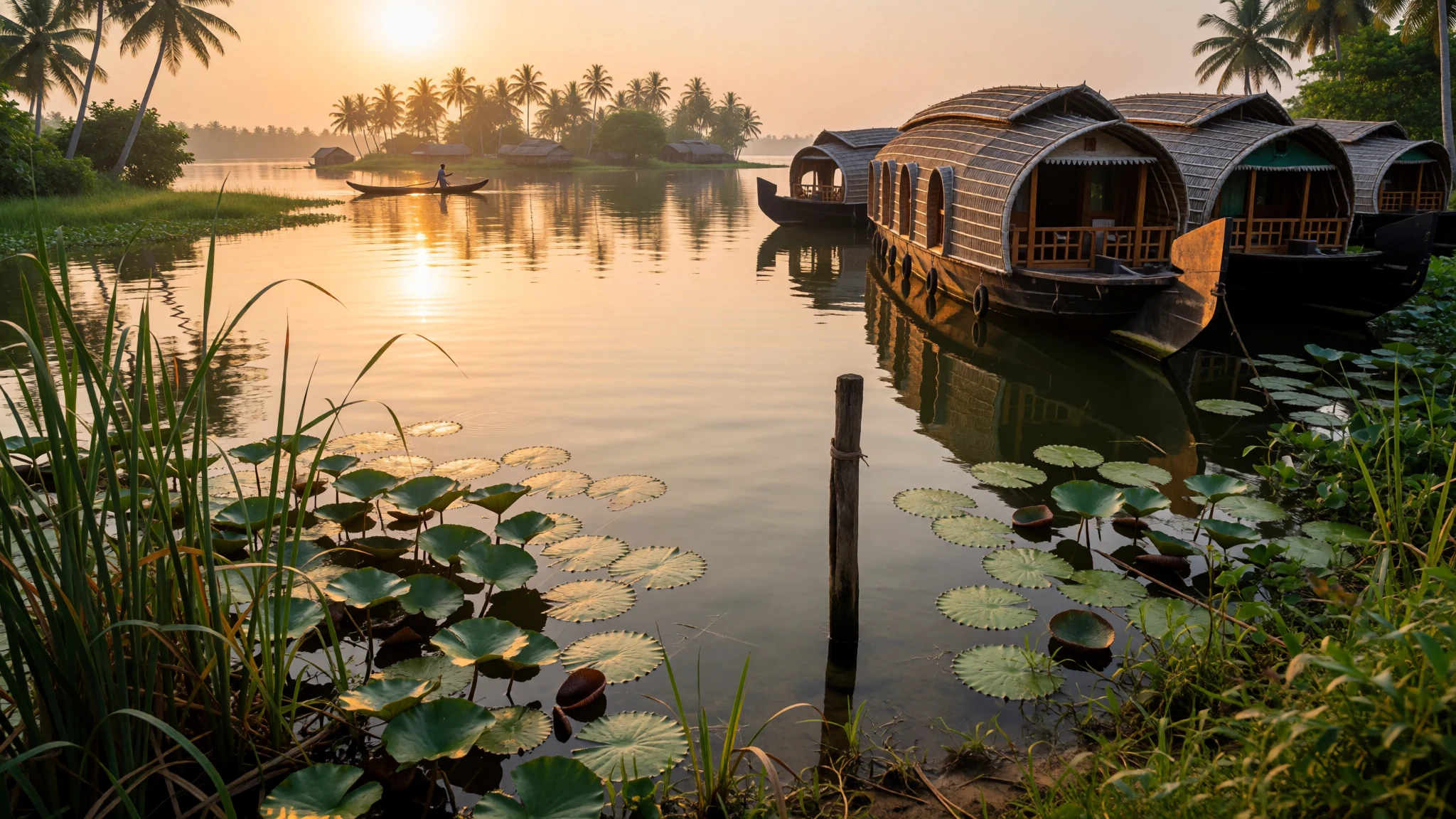
Kumarakom is a quiet cluster of lake-edge villages in Kerala where days pass on slow boats, birdwatching and fish eaten beside the water.
The place
Kumarakom sits on the eastern shore of Vembanad Lake in Kottayam district, Kerala, a short run from the city of Kottayam. It is less a single village than a scatter of low islands, canals and paddy plots held together by water. Part of the ground was won from the lake itself: shallows were embanked and drained, then planted with rice and coconut. That origin shapes the look of the place, with fields sitting close to water level and narrow channels branching off the main lake like veins. Coconut palms crowd the skyline, and in most directions the horizon is a green line with a boat on it.
Life here follows the water. Canoes and ferries carry people to market and school, and the houseboats that drift across the lake are mostly a visitor trade layered over older routines. The open lake is wide enough to feel like a sea on a windy afternoon, while the side channels are calm, shaded and quiet enough to hear a paddle dip.
The climate is tropical and humid, with two monsoons, one from the south-west and one from the north-east. The south-west rains arrive around June, the channels brim over, and the surrounding land fills with dense, saturated green. Kumarakom has drawn press attention for its backwater tourism, including a mention in The New York Times in January 2023, but it remains village-scale, with resorts tucked behind palms rather than towers on the skyline.
Its story
Kumarakom's name comes from its oldest temple. The deity there is Kumaran, and the settlement around his shrine, his akam or home, gradually became Kumarakom. The reclaimed land proved good for rice and coconut, which is why people settled it. It belonged to the Vadakkancore kingdom until 1750, when Marthanda Varma of Travancore took it over. In 1769 the king gave land for the village's first church.
The chapter most often retold begins in 1847, when an English farmer, Alfred George Baker, arrived and began draining and embanking the lake margin for rice fields and gardens. He built a house, later known as Baker House or the History House, and locals took to him warmly, calling him Kari Saipu, probably a shortening of Baker Sahib. The family learned Malayalam and are reported to have worn the mundu, Kerala's white formal wrap. They kept the house through four generations, until 1962.
The house then fell into ruin. The Taj Group eventually took it on, restored it and now runs it as a heritage resort, which is how most visitors meet it today. Kumarakom's later reputation as a backwater getaway grew on top of this older landscape of farms, embankments and family estates, and the farming rhythm is still visible beyond the resort gates.
What to see
- Kumarakom Bird Sanctuary — Vembanad Lake shore, Kumarakom
Also called Vembanad Bird Sanctuary, this protected stretch of lake shore and mangrove-edged waterway is the usual first stop for birdwatchers. Walking paths and small boats give access. Early morning is cooler and livelier. Check locally for opening times and entry arrangements before going. - Bay Island Driftwood Museum — Kumarakom
A small museum of sculpture and furniture shaped from driftwood and root wood, an unusual stop in a place known mostly for water. It suits a short, shaded break from midday heat. Opening times and entry terms change, so check on the spot or with your resort. - A houseboat cruise on Vembanad Lake — Kumarakom Jetty and the lake
The classic way to see Kumarakom is a converted rice barge moving slowly through lake and canal. Quality varies between operators, so research reviews and ask about the cook. Mornings are coolest and clearest. Ask the crew to slow down near narrow channels, where village life is easiest to watch.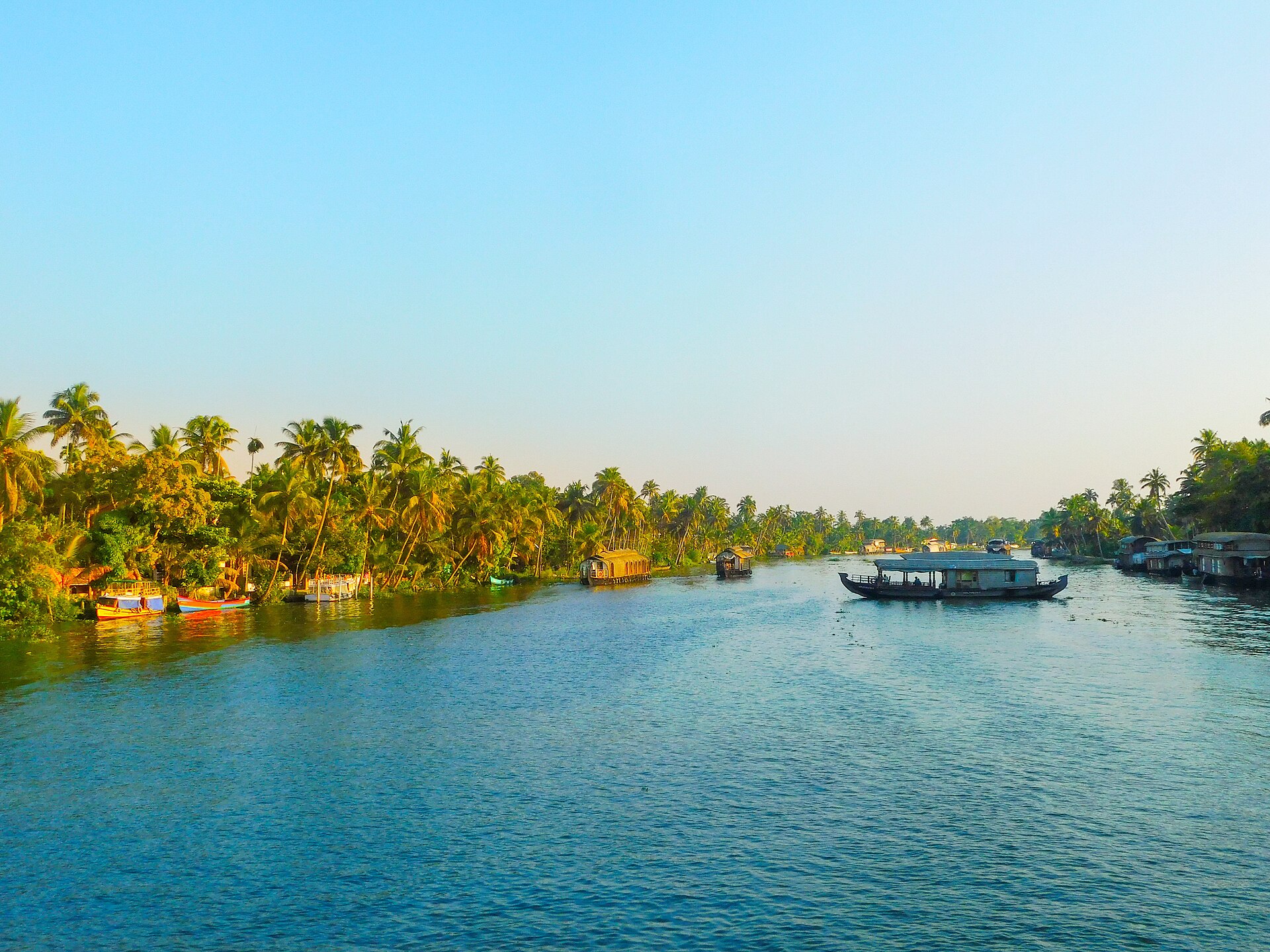
- Kumarakom Market and its canal — Kumarakom Market
The market area gives a look at everyday Kumarakom beyond the resorts: a working canal, shops, small shrines by the road and boats tied up beside the banks. It is best on foot in the morning. Bring small cash for tea, snacks and coconut water.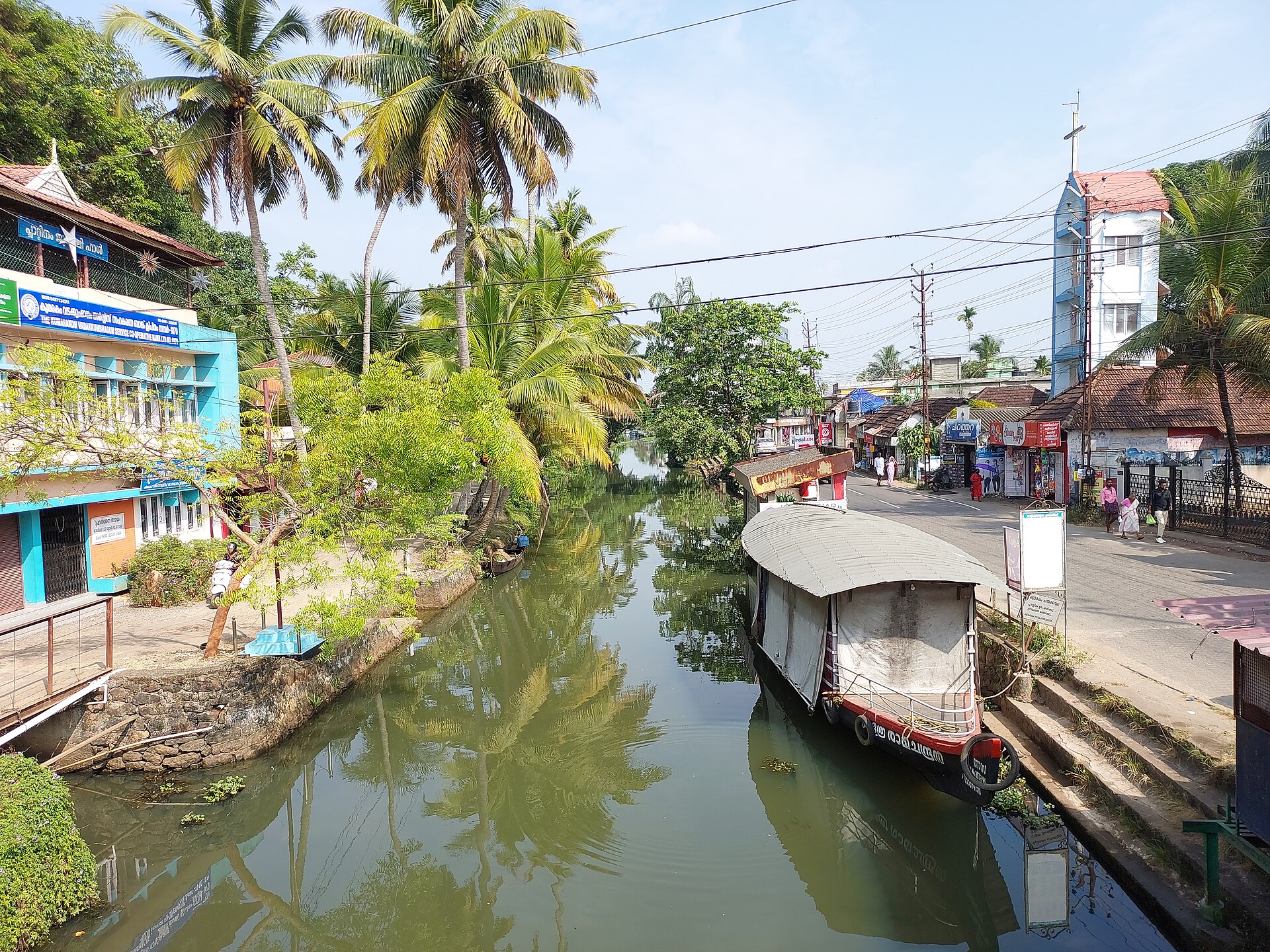
- Cheepunkal backwaters — Near Kumarakom, Kottayam district
Cheepunkal is a quieter stretch of backwater near Kumarakom, with wide views over paddy and open water framed by palms. It suits a slow cycle, a short canoe ride or simply sitting still at the edge. Ask locally for the best approach, as tracks can be narrow and muddy.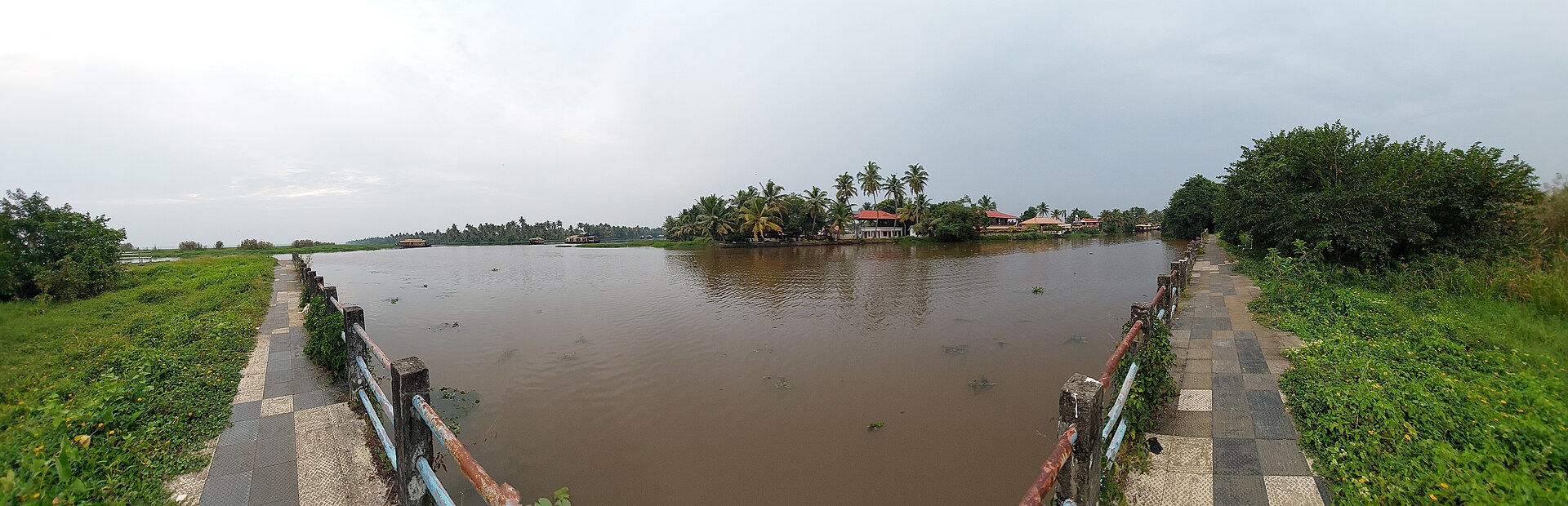
Culture
Kumarakom's culture is Kerala's backwater culture: Malayalam-speaking, built on rice, coconut and fishing, with Hindu, Christian and other communities living side by side. The temple to Kumaran gave the village its name, and Christians have worshipped here since at least 1769, when the first church went up. Small wayside shrines and prayer halls turn up beside canals and near the market, so devotion is part of the everyday landscape rather than something set apart.
Work still follows the water. Families tend paddy and coconut, fish the lake and channels, and pole canoes to shops. Early morning is the busiest and most social hour, with boats loading, tea stalls open and ferries crossing. Evenings are quieter and tend to centre on home and family.
Food is a cultural marker as well. Syrian Christian taste has shaped much of what is cooked in the region, with meat, fish, coconut and spice at the centre of the meal, and toddy shops serve as casual meeting places where spicy fish comes with palm toddy.
A story still told with affection is that of the nineteenth-century English farmer Baker, who learned Malayalam, wore the mundu and was known to neighbours by a nickname.
Remove shoes before entering any temple, church hall or home, and ask before photographing people at work on the canals or in the market.
What to wear
Traditional dress in Kumarakom is Kerala's. Men wear the mundu, a plain white cotton wrap at the waist, often edged with golden silk. Women wear the set-mundu or the kasavu saree, both off-white cotton with a gold-thread border. They appear at weddings, temple festivals, church feast days and above all at Onam. Older men may still wear the mundu daily, folded up to the knee for work, and the Baker family who settled here in the nineteenth century are remembered for wearing it too.
Day to day, people dress for heat and water. Men wear cotton shirts with plain or checked lungis, women wear salwar kameez or simple sarees, and younger people and commuters to Kottayam favour trousers and shirts. Rubber sandals are standard around the canals.
For visitors, loose cotton or linen suits the humidity. Long sleeves help against midday sun on the lake and mosquitoes at dusk, and a hat and sunglasses are useful on a houseboat. In the monsoon months a light waterproof is worth packing. For temples and churches, cover shoulders and knees and wear sandals that slip off easily. Swimwear belongs at resort pools; in villages and the market, shorts are fine but modest dress is appreciated. Shoes with a non-slip sole help on wet jetties and boat decks.
What to eat
- Appam — Village eateries near Kumarakom Market and houseboat breakfasts
A lacy-edged pancake of fermented rice batter and coconut, soft in the middle and slightly sweet. Eaten at breakfast or supper with vegetable stew or a meat curry. A good first order at a simple eatery, and a common houseboat breakfast. - Kappa and fish curry — Toddy shops and roadside eateries
Kappa is cassava, boiled until soft and then mashed or tossed with coconut and spices. It makes a filling plate when paired with a hot red fish curry. This is everyday Kottayam food, found at toddy shops and plain local eateries. - Karimeen pollichathu — Houseboat kitchens, lakeside eateries and toddy shops
Karimeen, the pearl spot, is a freshwater fish marinated in spice paste, wrapped in banana leaf and cooked until the flesh is just set. It is smoky and rich. Ask locally which stretch of the lake supplies the fish, and expect bones. - Toddy-shop fare — Small toddy shops (kallu shappu), including those near R-block
Toddy shops serve spicy fish, meat curries and tapioca beside kallu, fermented palm sap that is alcoholic. A milder sweet, unfermented kallu is called madhura kallu. The menus run bold and chilli-heavy. Ask your boatman to stop at R-block. - Tender coconut — Roadside stalls and jetties
Coconut cut open on the spot, with cool water to drink and a scoop of soft flesh to eat afterwards. It is a cheap, safe way to rehydrate after a morning in humid heat. Look for stalls near the market and jetties.
Plan it
Best time. December to February is the most comfortable stretch for time on the water. The south-west monsoon begins around June and brings heavy rain and flooded channels, and the north-east monsoon can bring showers later in the year. Check the forecast before booking a houseboat in any rainy spell.
How long. 2–3
Getting there. Fly into Cochin International Airport, about 75 km away and around 2 hours by road. By train, the nearest station is Kottayam, 16 km away, with buses and taxis running from Kottayam and Cochin throughout the day. A boat from Muhamma, near Alappuzha, also reaches Kumarakom Jetty.
Budget. mid
Tips
- Research houseboat operators before booking and ask specifically about the cook; reputations vary widely
- Book ahead for holiday weeks, when the best boats fill up
- Go birdwatching or walking in the early morning, before the heat builds
- Carry small cash for tea, tender coconut, market stalls and toddy shops
- Bring mosquito repellent, sun protection and your own water bottle
Etiquette
- Remove shoes before entering temples, church halls and homes
- Ask before photographing people at work on the water or in the market
- Drink alcohol only in toddy shops and licensed places, and keep noise low on the lake
Nearby
Sources
- Wikidata Q3521576 (CC0)
- Wikipedia: Kumarakom (rev 1381116545) (CC BY-SA 4.0)
- Wikivoyage: Kumarakom (rev 5407707) (CC BY-SA 4.0)
- Augustus Binu, A house Boat View from Vembanad Lake (CC BY 3.0)
- Jigyasu, A houseboat in the backwaters of Kumarakom, Kerala (CC BY-SA 4.0)
- നിരക്ഷരൻ, abad hotel - kumarakam - kerala (CC BY 3.0)
- Vis M, Block Level Family Health Centre, Kumarakom (CC BY-SA 4.0)
- Vis M, Canal at Kumarakom Market (CC BY-SA 4.0)
- Vis M, Cheepunkal backwater view (panorama) (CC BY-SA 4.0)
- Vis M, Cheepunkal backwater view (CC BY-SA 4.0)
- Vis M, Wayside Gurumandiram at Kumarakom Market (CC BY-SA 4.0)


Wildlife
- Siberian crane (animal)
Picture a snowy-white crane with black feathers at the tips of its wings, hidden until it takes flight: that is the Siberian crane. It nests in the far Arctic of Russia and migrates for the winter. Kumarakom is a refuge for such travelling birds, and the calm of early morning is the best moment to see one. Watch from afar, stay hushed, follow a guide, and never feed it.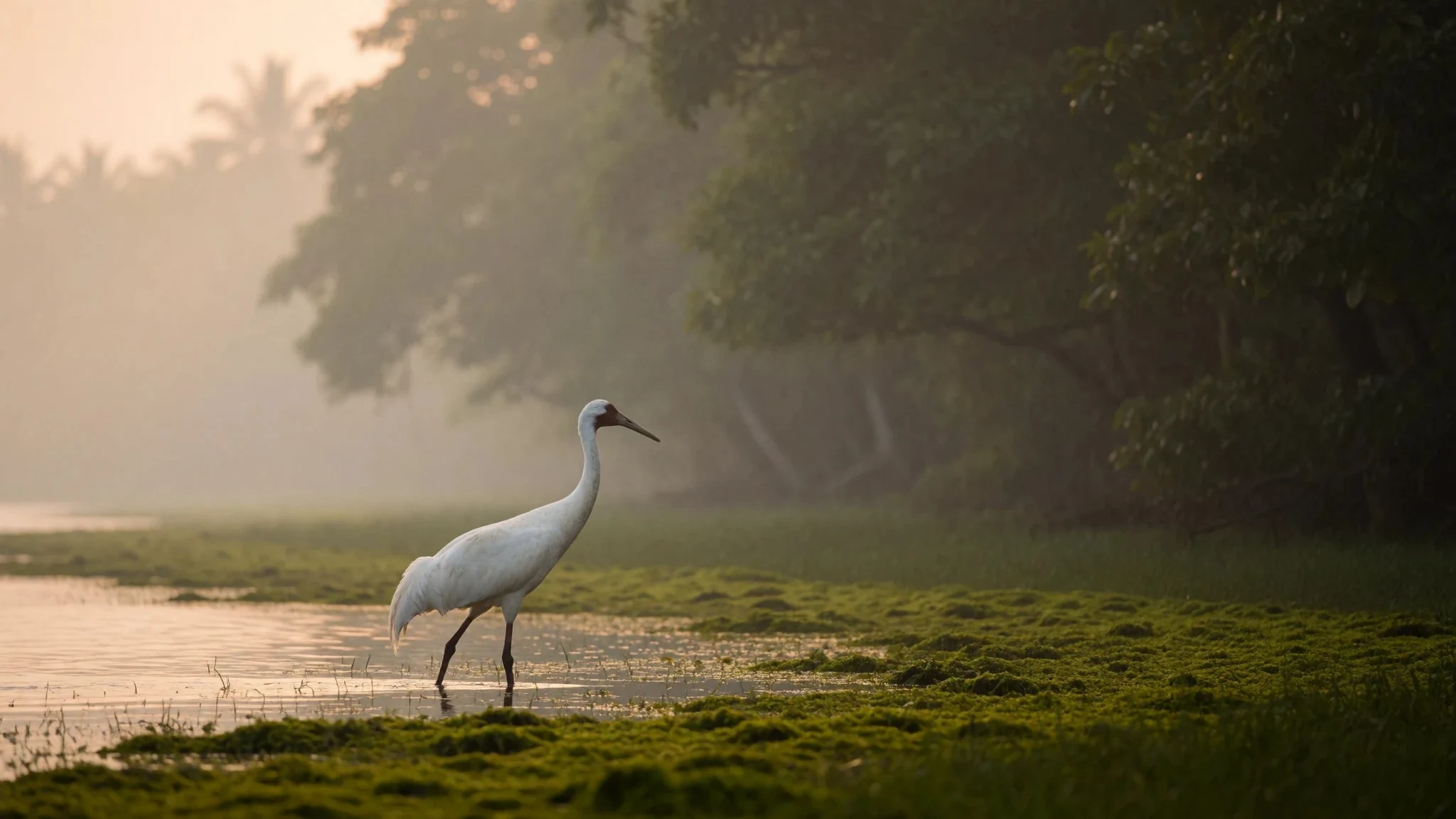
- Siberian crane (bird)
Picture a snowy-white crane with black feathers at the tips of its wings, hidden until it takes flight: that is the Siberian crane. It nests in the far Arctic of Russia and migrates for the winter. Kumarakom is a refuge for such travelling birds, and the calm of early morning is the best moment to see one. Watch from afar, stay hushed, follow a guide, and never feed it. - Egret (animal)
The great egret is a big white wading bird with a long, graceful neck, rather like a swan on stilts. It is found across the warmer parts of the world and raises its young in tree colonies near water. Kumarakom shelters egrets among its many waterbirds, and early morning is the finest time to watch quietly. Keep your distance, move gently, let a guide lead, and never feed them. - Egrets (bird)
The great egret is a big white wading bird with a long, graceful neck, rather like a swan on stilts. It is found across the warmer parts of the world and raises its young in tree colonies near water. Kumarakom shelters egrets among its many waterbirds, and early morning is the finest time to watch quietly. Keep your distance, move gently, let a guide lead, and never feed them.