Kintai Bridge
Kintai Bridge, Japan
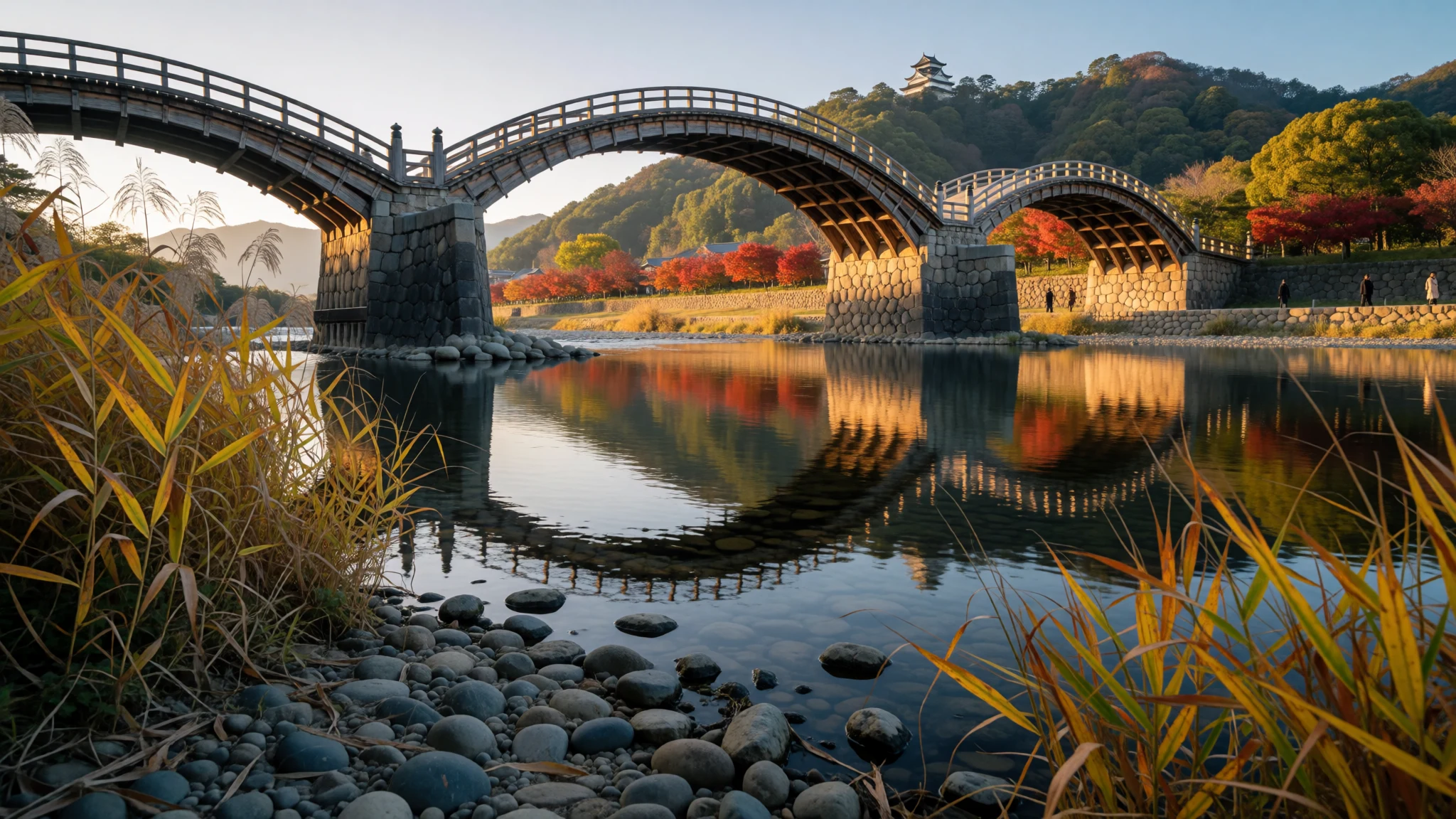
Kintai Bridge is a graceful wooden arch bridge in Iwakuni, rebuilt again and again over a river that keeps trying to take it.
The place
Kintai Bridge (錦帯橋, Kintai-kyō) crosses the Nishiki River in Iwakuni, in Yamaguchi Prefecture at the western end of Japan's main island, Honshu. It is a timber footbridge of five arches, first built in 1673. Behind it rises Mount Yokoyama, with a reconstructed castle on the summit, and the bridge, the hillside and the old samurai quarter on the near bank together make up Kikko Park. Iwakuni is a small, quiet city, and most travellers see it as a day trip from Hiroshima, where accommodation is more plentiful. The bridge is the reason to come, and its setting is part of the pleasure: the arches reflect in the water, the hill stays green for much of the year, and the walk across gives shifting views of the river and the castle above. Spring and autumn bring the crowds, when cherry blossom and maple colour fill the park, and the bridge can be busy by mid-morning. Summer is hot and humid, though the park has sprinklers for cooling off. Iwakuni also hosts a military air station, which has shaped the town since the twentieth century, and aircraft noise is an occasional complaint among residents. The town's history begins with a feudal clan sent to the far west after backing the losing side in a war, which explains the castle and the samurai houses. Most sights lie within an easy walk of the bridge, so a half day covers the core, and a full day allows the park, a museum and a proper meal.
Its story
Kintai Bridge has a history written largely by the floods of the Nishiki River. The Kikkawa family, lords of Iwakuni, tried a series of wooden bridges after their castle was finished, and one flood after another carried them off. The bridge of 1673 was ordered by the third lord, Kikkawa Hiroyoshi, and was meant to end that cycle by standing on new stone piers. It did not: a flood destroyed it the following year. The builders then redesigned the piers to be stronger, and the domain introduced a special tax to pay for upkeep. Upkeep meant planned rebuilding rather than hoping the timber would last, with the three middle spans renewed more often than the two that meet the banks. That routine kept the bridge standing for nearly three centuries, until a typhoon flood in 1950 washed it away. It was already weak, because maintenance had lapsed during the war years. A reconstruction close to the original design followed in 1953. The bridge was declared a national treasure in 1922, and in the early 2000s all five girders were restored for the first time in decades. Anyone crossing today is walking on a structure that is constantly renewed: the shape is old, but the timber is not. That is the point of the design, and it reflects a Japanese habit of treating rebuilding as a way of preserving rather than a break with the past. Only samurai were once allowed to cross; now anyone with an admission ticket can.
What to see
- Kintai Bridge — Over the Nishiki River, Iwakuni
The bridge itself is a timber footbridge of five arches over the Nishiki River. Crossing takes only a few minutes, though most people pause at the crown of each arch for the view. The steps are steep and the planks can be slippery after rain. Admission is charged, so check the official site, http://kintaikyo.iwakuni-city.net/, for current details.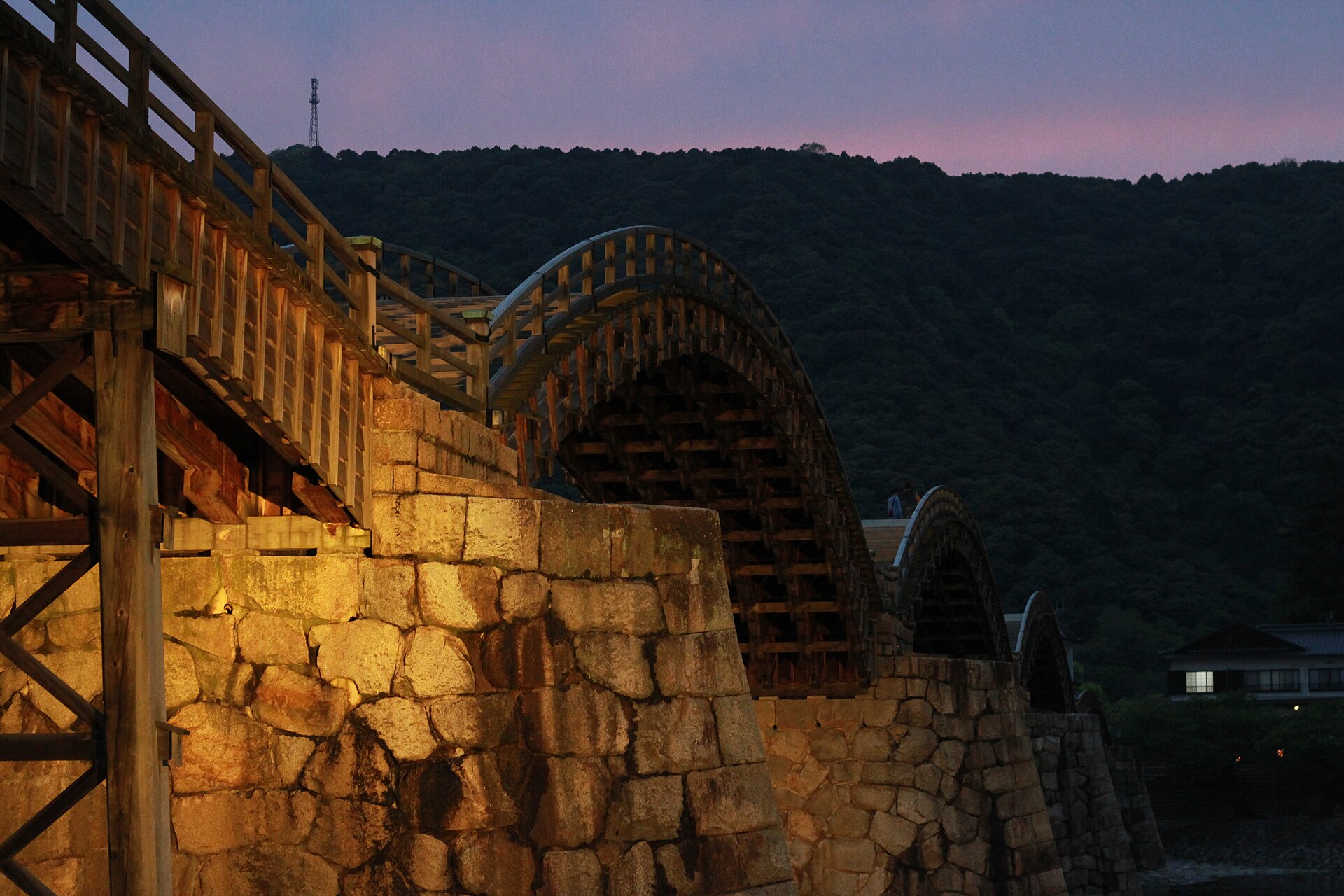
- Kikko Park — West bank of the river, below Mount Yokoyama
Kikko Park, on the far bank, is where the bridge, the castle hill and the old samurai quarter meet. It has flower gardens, lawns and sprinklers that children use on hot days. Cherry blossom in April draws the biggest crowds, so go early or accept company. Autumn maples are quieter but just as pleasing. - Iwakuni Castle — Summit of Mount Yokoyama
Iwakuni Castle sits on the summit of Mount Yokoyama above the bridge. The original was pulled down by imperial order soon after it was built, and the present keep is a modern reconstruction, so the interest lies in the view over the river and the town rather than in old fabric. Check the official site for how to reach the top. - Nagaya Gate and Mekata Residence — Southern end of Kikko Park
Nagaya Gate and the Mekata Residence stand at the edge of the park, once homes of the Kikkawa family's senior retainers. The gate is the more dramatic to look at. Both are private residences today, so they are for admiring from the lane, not for entering. Nearby, the Kikkawa Museum shows weapons and belongings of the ruling family. - White Snake Museum — Eastern Iwakuni
The White Snake Museum lies a short way out from the bridge, to the east of the city, and is devoted to the white snakes native to the Iwakuni area. Locals regard them as messengers of Benten, the goddess of wealth, so a sighting is thought lucky. It suits a rainy hour or a family with children, and is worth a short bus or taxi ride.
Culture
Kintai Bridge belongs to a town shaped by samurai rule. Iwakuni's lords, the Kikkawa, were sent to the far west of Honshu after backing the losing side in a civil war, and they governed for generations from the hill above the river, with loyal retainers living below. The streets near the park still carry that character, with tiled gateways and large private houses. Present-day customs are gentler. Hanami, the picnic under cherry blossom, fills Kikko Park in April, with families spreading sheets beneath the trees, and in autumn the same crowds turn to the maples. Summer evenings on the river have traditionally brought cormorant fishing for ayu, the sweet fish, so check locally whether it is running during a visit. The town also keeps a folk belief in white snakes as lucky messengers of Benten, goddess of wealth, and snake motifs turn up on souvenirs. Iwakuni is home to a military air station, and local feelings about it are mixed, mainly because of noise, so it is best not to raise the subject casually with residents. The mood in the park is quiet and local, with elderly walkers, school groups and photographers sharing the bridge. Treat the Nagaya Gate and the Mekata Residence as private homes and do not enter them, and keep moving on the arches so that others can pass behind you.
What to wear
Kintai Bridge sits in a region where traditional dress now appears mainly at festivals and for photographs. The kimono is a wrapped, T-shaped robe, made of silk for formal wear and of cotton or linen for summer, closed with an obi sash. The yukata, an unlined cotton version, is worn in the warm months for fireworks, river festivals and evenings at hot-spring inns. Samurai households once wore hakama, pleated divided trousers, over their kimono, and these survive today at ceremonies and in martial arts. On an ordinary day in Iwakuni, people dress as in other Japanese towns: neat, practical and modest rather than showy, with light layers in spring and autumn and cool cotton in summer. Visitors need little beyond comfortable clothing. Flat, grippy shoes matter most, since the bridge's arches are stepped and the planks turn slick in rain. In summer, a hat, sunscreen and a water bottle are sensible, as the heat and humidity are strong; in spring and autumn, a light jacket and a small umbrella cover most weather. Shoulders and knees do not need covering in the park, but a tidy look is appropriate for any shrine or museum. Shoes are sometimes taken off indoors, so socks without holes are a courtesy.
What to eat
- Iwakuni sushi — Traditional restaurants near Kikko Park and in the town centre
Iwakuni sushi is pressed in a large square wooden mould rather than rolled, then cut into blocks, with layers of fish, vegetables and seasonings. Chrysanthemum is one of the local touches. Look for it in traditional restaurants near the park and in the town centre, often sold as a set for sharing. - Ayu (sweet fish) — Riverside restaurants near the bridge
Ayu is a slender freshwater fish prized in summer for its delicate, faintly sweet flesh, and it is usually grilled whole with salt. The Nishiki River is known for it. Restaurants beside the river near the park serve it, some in old buildings with a naval past. - Soft-serve ice cream — The small ice-cream courtyard in the town
Iwakuni has a wide reputation for ice cream, with a courtyard of shops selling soft-serve in dozens of unusual flavours, garlic among them. It makes a good cooling stop on a hot day, and one of the shops has become a minor television celebrity. - Crepes and desserts — Cafes and bars in the town centre
Crepes and other desserts, found in small cafes and bars in the town away from the bridge, make a sweet stop after walking the park. Menus often carry photographs, which helps when there is no English translation.
Plan it
Best time. Early April for cherry blossom and November for maple colour, when days are mild. Summer is hot and humid, and late summer into autumn can bring typhoons and heavy rain, the kind of weather that has flooded the river before.
How long. 1
Getting there. Hiroshima is the usual gateway, by Shinkansen or via Hiroshima Airport, then a local train to Iwakuni and a short bus or taxi ride to the bridge. Buses also run from Hiroshima's bus terminal, and overnight buses to Hagi from Tokyo, Kyoto and Osaka generally stop at Iwakuni.
Budget. mid
Tips
- Arrive early, before the tour groups, especially at cherry blossom time.
- Check the official site, http://kintaikyo.iwakuni-city.net/, for admission and opening details before you go.
- Stay in Hiroshima if you want more choice of accommodation, as Iwakuni has only a few options.
- Carry some cash and water, as small eateries may prefer cash and summer heat is draining.
Etiquette
- Keep moving on the arches and step aside to take photographs so others can cross.
- Do not enter the samurai houses beside the park, as they are private homes.
- Take away your rubbish from picnics in Kikko Park, since public bins are few in Japan.
Nearby
Sources
- Wikidata Q1196460 (CC0)
- Wikipedia: Kintai Bridge (rev 1385986794) (CC BY-SA 4.0)
- Wikivoyage: Iwakuni (rev 5430298) (CC BY-SA 4.0)
- Photo 01: Iwakuni, Yamaguchi (Sailko) (CC BY 3.0)
- Photo 02: Iwakuni, Yamaguchi (Sailko) (CC BY 3.0)
- Photo 03: Kintaikyo or Kintai Bridge, Yamaguchi (Japanexperterna.se) (CC BY 3.0)
- Photo 04: Famous Places in the Sixty-odd Provinces, No. 51 (Utagawa Hiroshige) (Public domain)
- Photo 05: Kintai Bridge in flood, 1946 (Geoff soper) (CC BY-SA 4.0)
- Photo 06: "Use Caution!", Iwakuni (x768) (CC BY-SA 2.0)
- Photo 07: Japanese Travel Poster (Japanese Government Railways) (Public domain)
- Photo 08: Kintai Bridge in Iwakuni (Jakub Hałun) (CC BY-SA 2.0)


Wildlife
- Ayu (animal)
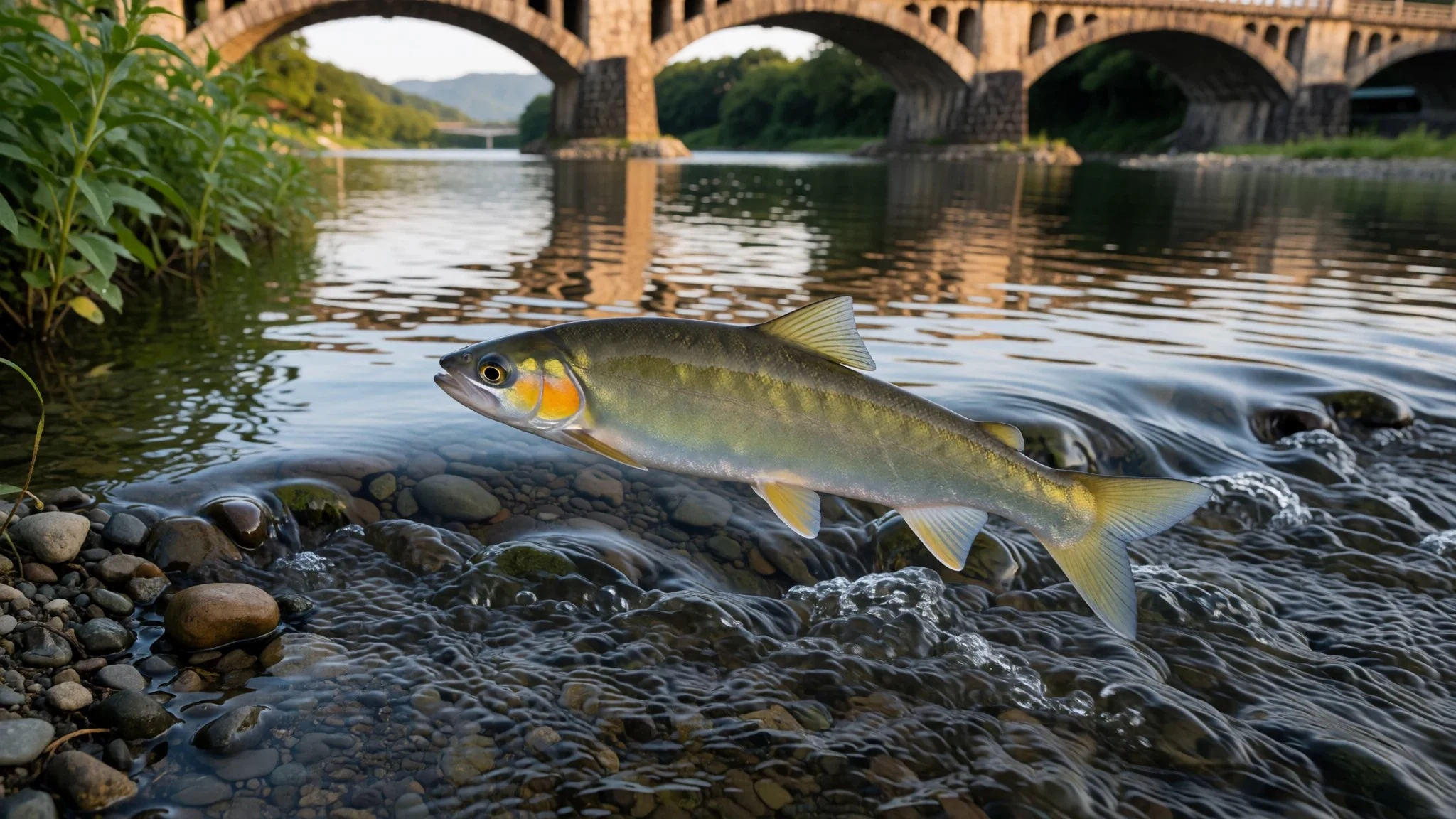
The ayu is a bony fish called the sweetfish, a cousin of the smelts. Remember it as the river fish with a sweet name. On the river at Kintai Bridge, it is traditionally hunted by cormorants on summer evenings, so you may see that old fishing custom rather than the fish itself. Ask locally whether it is running during your visit. Watch quietly from a respectful distance, consider joining a guide, and never feed the fish or birds.