Kanyakumari
Kanyakumari, India
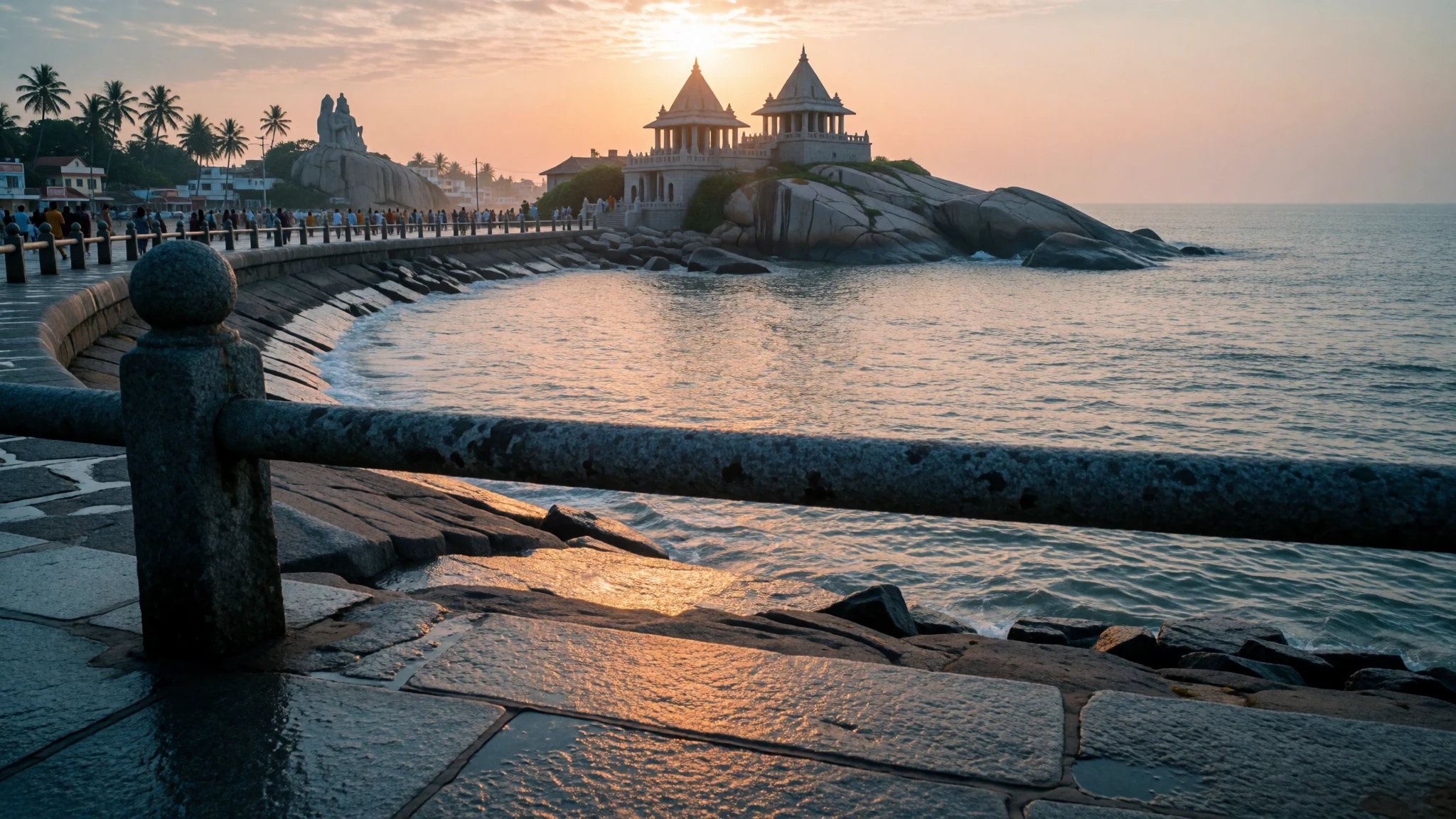
Kanyakumari is the mainland's southern tip, where the Arabian Sea, the Bay of Bengal and the Indian Ocean meet.
The place
Kanyakumari stands at the southern tip of the Indian mainland, in Tamil Nadu, on a rocky point where the Arabian Sea, the Bay of Bengal and the Indian Ocean come together. In Tamil the town is Kanniyakumari (கன்னியாகுமரி), after the goddess honoured in the shore temple as a virgin girl, and older English charts call it Cape Comorin. The streets are those of a small pilgrimage town: the temple enclosure, a bus stand, lodges, tea stalls and a paved seafront where people wait with their faces to the water. What enlarges Kanyakumari is the horizon. On a clear day both sunrise and sunset can be watched from the same rocks, which is why the edge of town fills before dawn and again towards evening. Offshore, dark islets carry the Vivekananda Rock Memorial and a tall figure of the poet Thiruvalluvar, both reached by ferry when the sea allows the boats to run. Ashore, the Kumari Amman Temple turns its painted gopuram to the waves, and a memorial linked with Mahatma Gandhi looks over the place where a portion of his ashes was immersed. The shore is busy and often hot. Coach parties from Tamil Nadu and Kerala arrive through the day, shell-sellers and snack vendors work the pavements, and by mid-morning the stone throws heat back at anyone standing on it. Wind off the water is the local relief, salt-heavy and constant. In the monsoon the ferry is often cancelled and the rocks turn slick, and Kanyakumari feels less like a viewpoint and more like the working temple town it still is.
Its story
Kanyakumari takes its name from a goddess, and the story told on this shore is a wedding that never happened. Devi, in the form of a young virgin, was to marry Shiva at this cape. A demon remembered as Banasura could be defeated only by a goddess who had never married, so the divine timetable was quietly spoiled: Shiva was delayed on the road, the chosen hour passed, and the marriage was abandoned. She stayed at the tip of the land, still a kanya, and the temple above the waves is understood as the place of that unfinished rite and of the power she kept. Wedding food that was never served is the local explanation for the multi-coloured sand and pebbles along the beach — grains, turmeric and coloured rice left behind as stone. Pilgrims still come to wet their feet where the waters meet, to see the goddess, and to treat the cape as a threshold rather than a resort. A later chapter belongs to Swami Vivekananda, who sat in meditation on the offshore rock before he travelled to speak at the Parliament of the World's Religions. The memorial on that rock marks the meditation, not a battle. Beside it, the figure of Thiruvalluvar honours the Tamil poet of the Tirukkural, a book of short moral couplets that Tamil households still quote. In the modern national story the cape also became a place of farewell, when a portion of Mahatma Gandhi's ashes was brought here to be given to the sea, which is why a memorial stands on the shore looking south. Kanyakumari's story is layered: a goddess who did not marry, a monk who sat with the ocean, a poet set in stone, and a political farewell.
What to see
- Kumari Amman Temple — temple precinct on the seafront
Kanyakumari's Kumari Amman Temple stands at the water's edge and is the town's ritual centre. The goddess is worshipped as a virgin girl, and the gopuram carries the bright painted bands of a Tamil shrine. Pilgrims queue for darshan, festival mornings are crowded, and shoes come off at the entrance. The forecourt faces the sea, so the stop is a temple visit with the cape in view.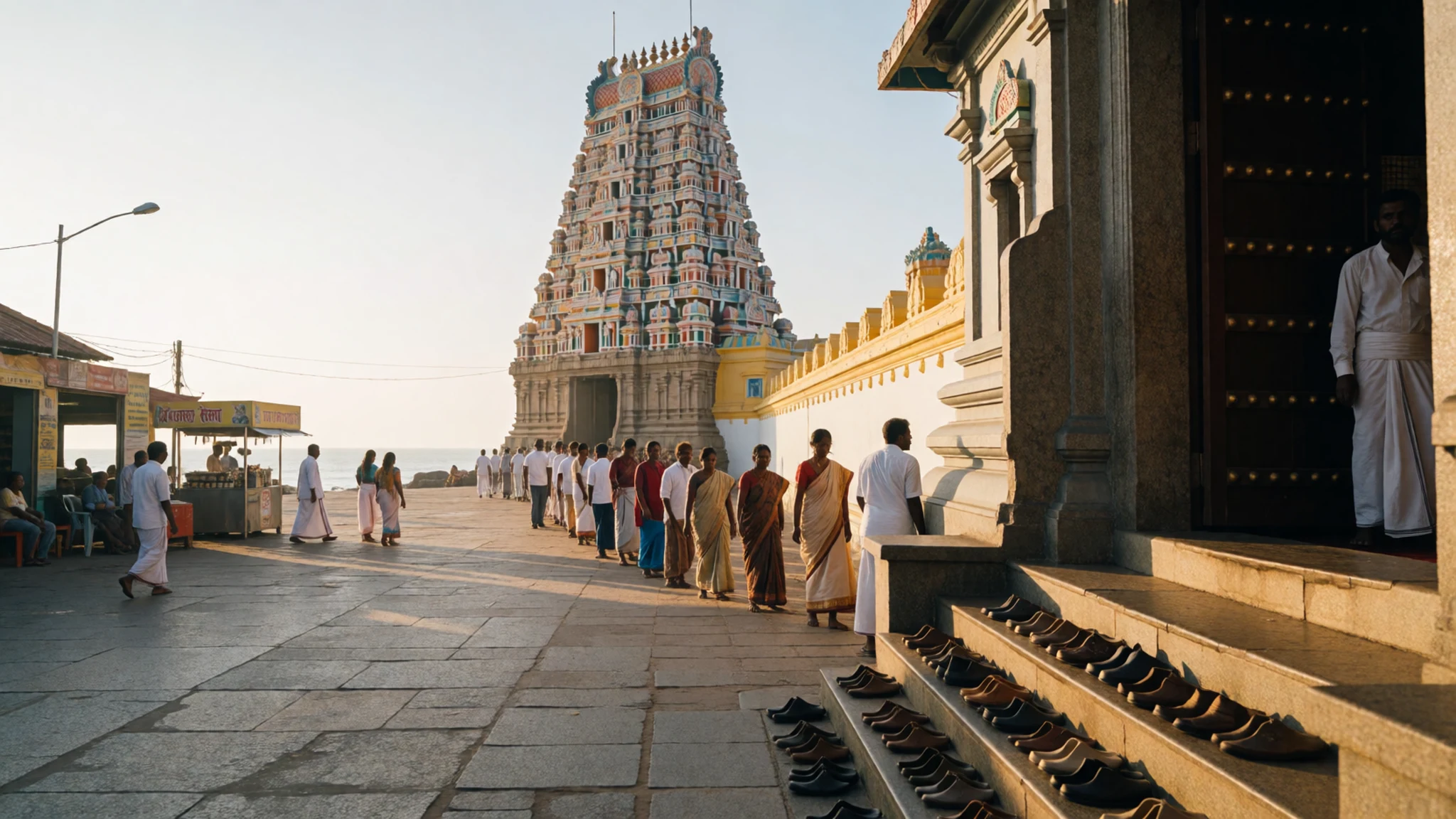
- Vivekananda Rock Memorial — offshore islet
The Vivekananda Rock Memorial at Kanyakumari stands on a dark islet a short boat ride off the cape, where Swami Vivekananda meditated before speaking at the Parliament of the World's Religions. A ferry from the mainland jetty is how visitors cross, and it is cancelled when the sea is rough. The halls are plain and windy, made for looking at the meeting waters, and the return queue often builds.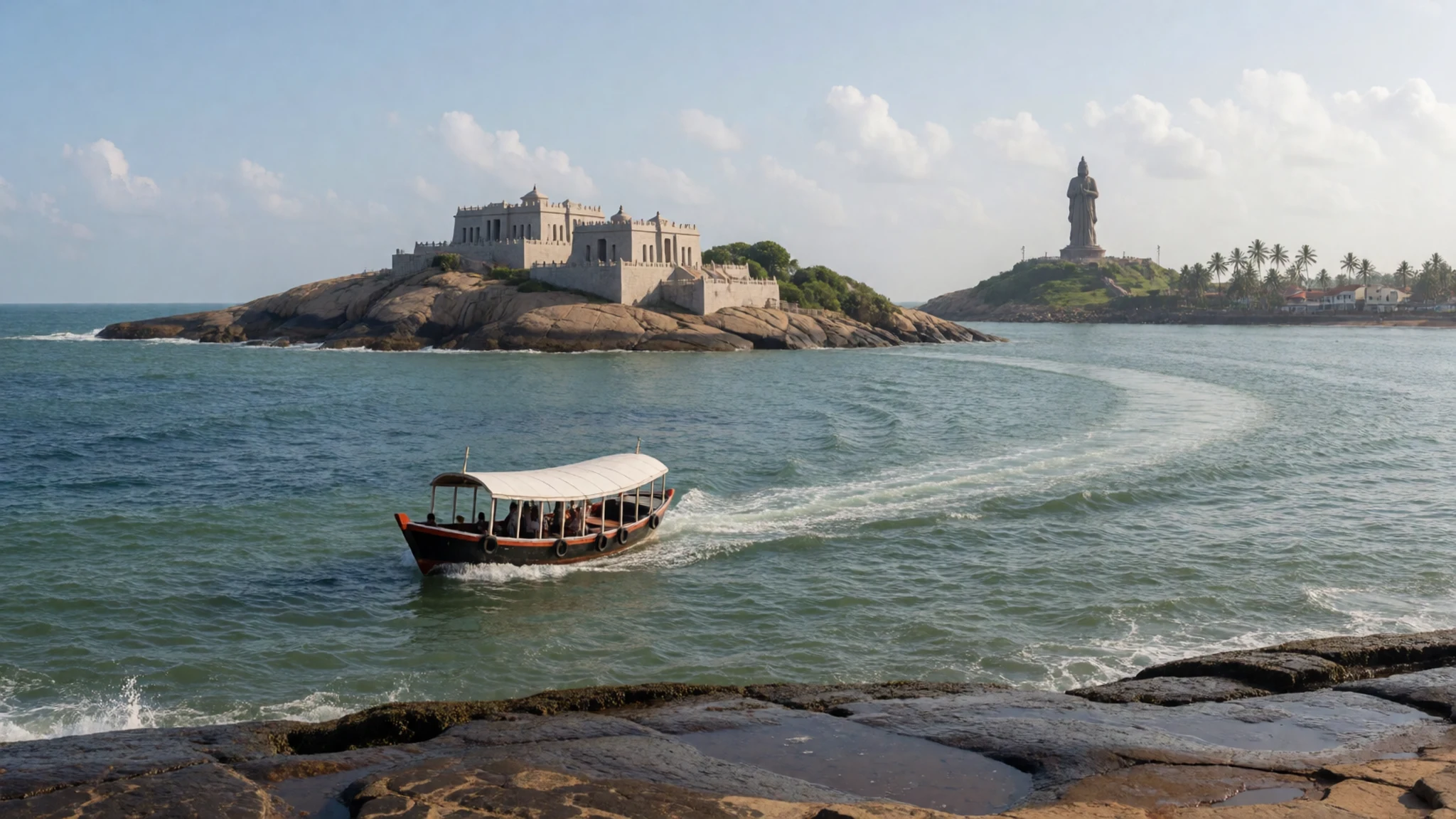
- Thiruvalluvar Statue — offshore islet beside the memorial
The Thiruvalluvar statue at Kanyakumari stands on its own islet beside the Vivekananda rock, a tall figure of the Tamil poet who composed the Tirukkural. It is seen from the memorial, from the ferry and from the seafront, and it reads as a companion to the temple rather than a separate excursion. Boats land when the sea allows; in rough weather the statue is only a silhouette against the sky.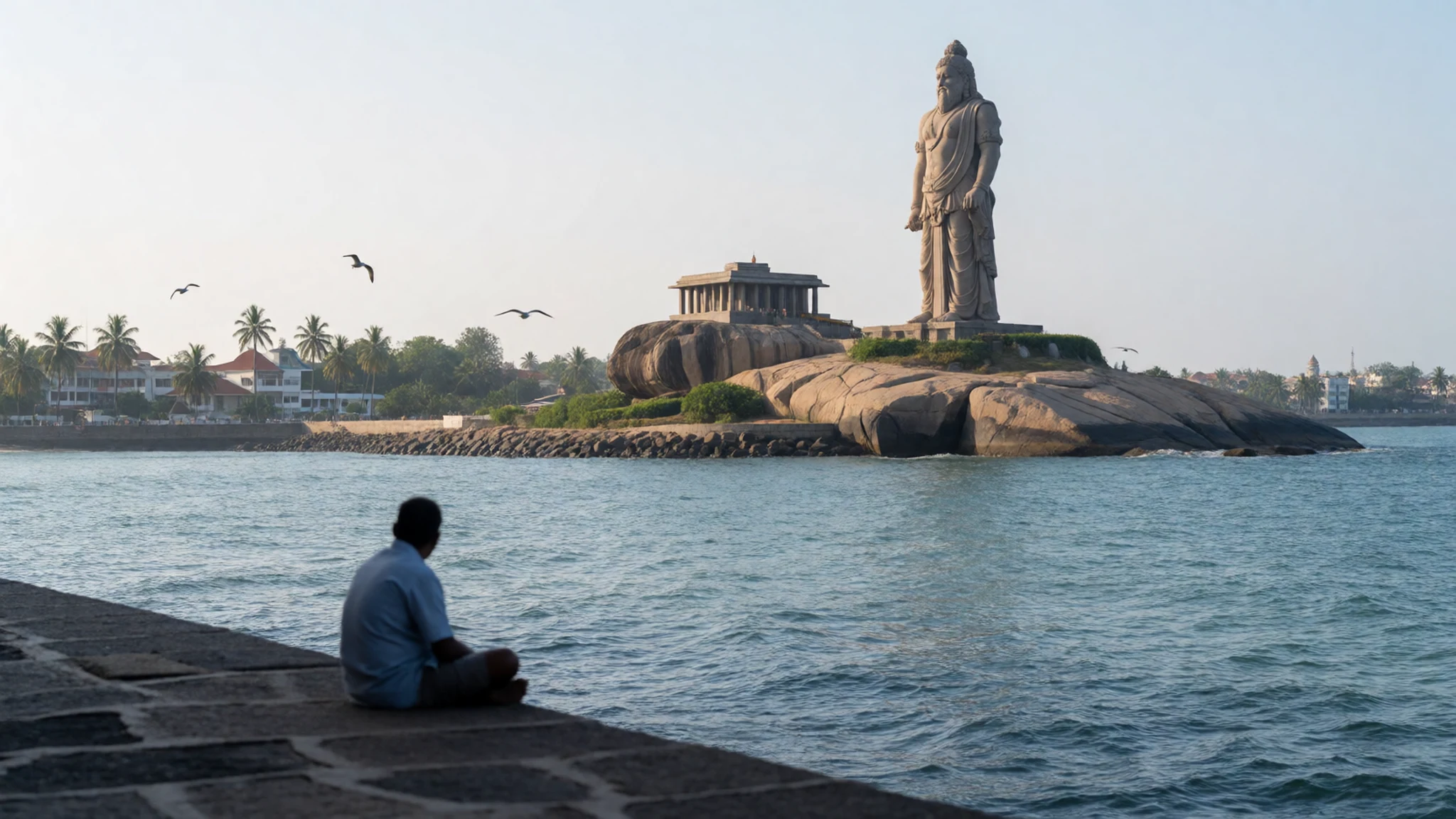
- Gandhi Mandapam — paved seafront
The Gandhi Mandapam at Kanyakumari is the shore memorial marking the place associated with the immersion of a portion of Mahatma Gandhi's ashes. It sits on the paved front, a quiet structure compared with the temple queues and the ferry jetty, and it faces the open water. People step in for a short unhurried pause, often on the way to sunrise or after the boats.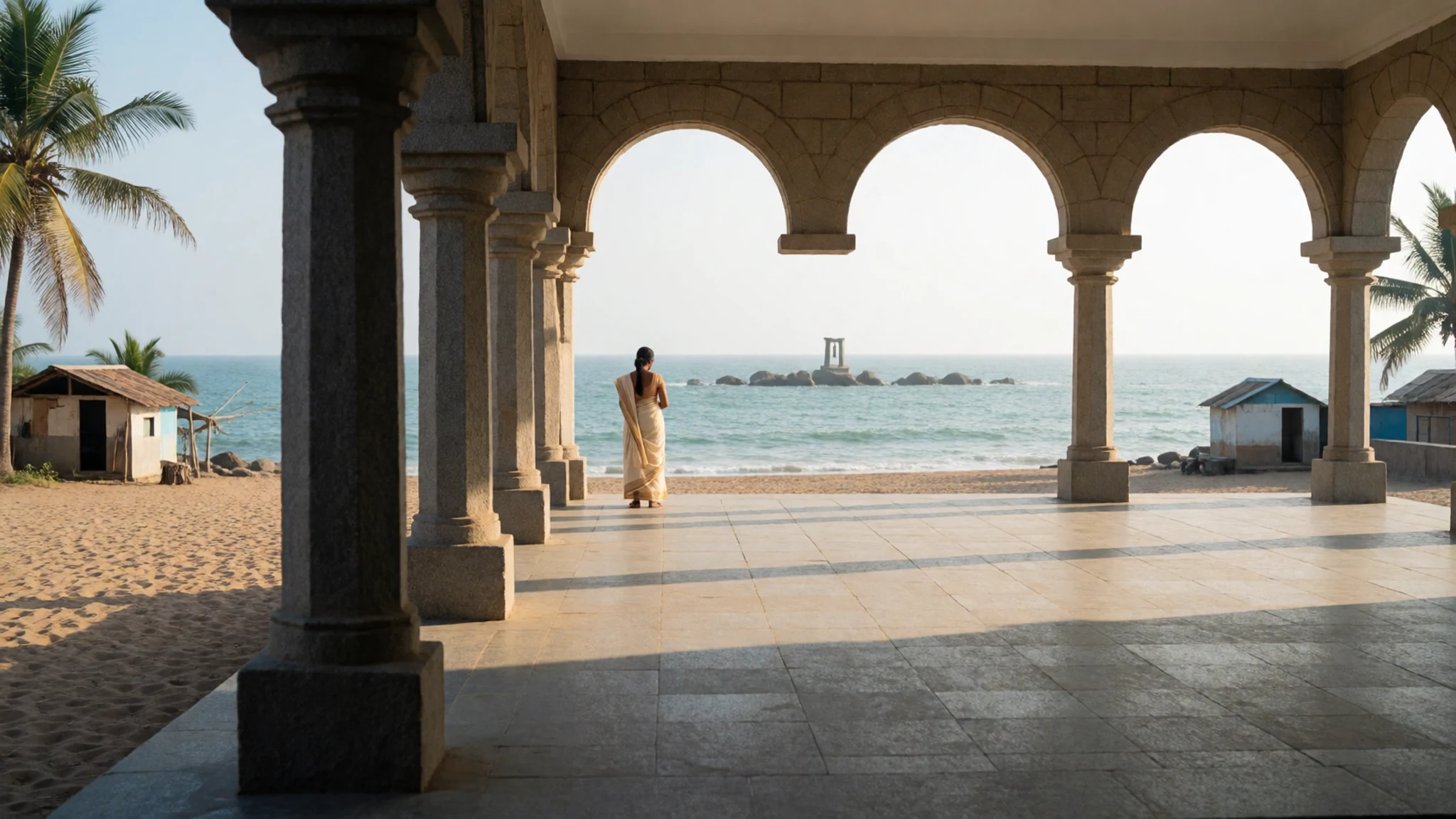
- Seafront confluence — seafront confluence
The seafront at Kanyakumari is where people come to watch the sun rise and, later the same day, set, with the memorial rocks standing in the water. Under that ritual is the confluence of the Arabian Sea, the Bay of Bengal and the Indian Ocean. The paving fills before dawn and again towards sunset, and cloud in the monsoon often hides the horizon.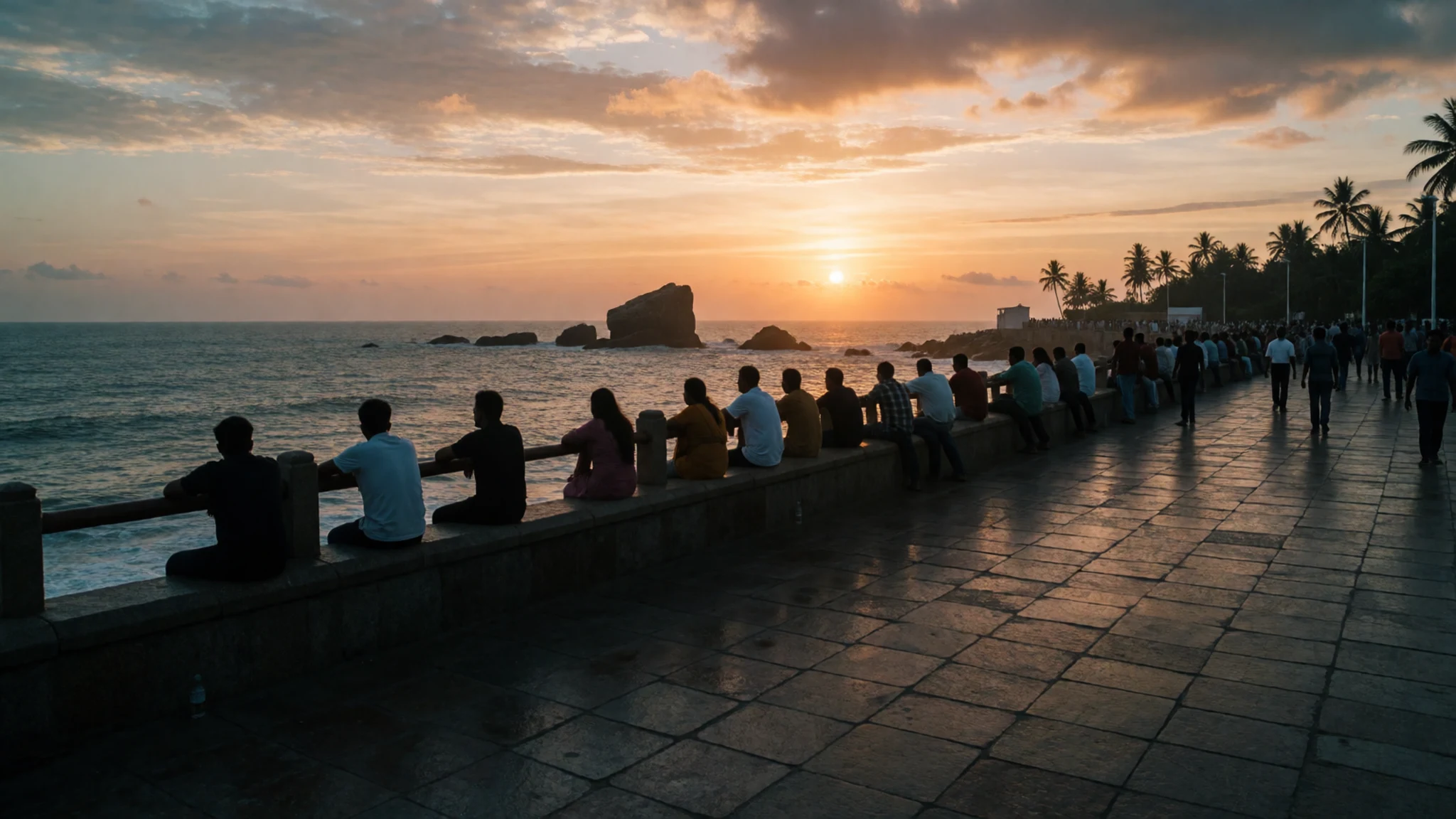
Culture
Kanyakumari's culture is a pilgrimage culture that also receives sightseers, even on days when the coaches outnumber the worshippers. The goddess at the shore temple is the town's reason for existing, and a visit still moves in a ritual order: wet the feet in the sea, queue for darshan, and stand for a while looking south. Tamil is the language of the temple and the buses, but Malayalam is heard all day because the Kerala border is close and many visitors come from Thiruvananthapuram and the southern districts. Festival mornings, especially Navaratri and the full-moon days associated with the goddess, thicken the queues and fill the forecourt with families in silk and fresh flowers. The offshore memorials have added a national and a literary layer — Vivekananda's meditation, Thiruvalluvar's couplets — so the waterfront now holds devotion, Tamil pride and a modern tourist pause in the same short walk. Food stalls, shell sellers and lodge touts are part of that mix, and it is fair to expect noise, heat and a little hustle rather than a silent shrine town. Remove your shoes before entering the Kumari Amman Temple, men with a bare torso, and do not photograph people at prayer or the inner shrine.
What to wear
Kanyakumari dresses at a border. The traditional clothes of this Tamil coast carry a strong Travancore inheritance, because the district once belonged to that princely state: women wear the sari, often a Kerala kasavu sari with a cream body and a gold border, or a set-mundu of white cotton with a coloured edge, and men wear the mundu or the Tamil veshti, a cotton waist-cloth, with a shirt. Silk comes out for Navaratri and weddings; ordinary days are cotton, which survives the sweat and the salt wind. Temple mornings still show that older palette — white, gold, jasmine in the hair — while the bus stand shows what people wear now: synthetic saris, salwar kameez, collared shirts, trousers, and, among younger residents and students, T-shirts and jeans. Visitors do well in light, covering cotton. Men are expected to enter the Kumari Amman Temple with a bare torso, and footwear has to come off and go back on, so sandals beat boots. The seafront has almost no shade, so a hat, sunglasses and a scarf against glare earn their place, and a light rain layer is the right addition in the monsoon, when the rocks are wet and the wind cuts across the point. Bright formal wear is for festivals; for an ordinary day at Kanyakumari, breathable cloth and easy shoes matter more than costume.
What to eat
- Idli, dosa and sambar — vegetarian eateries on the temple streets and by the bus stand
Kanyakumari starts the day the Tamil way, with idli and crisp dosa, sambar and coconut chutney, at vegetarian eateries around the temple streets and the bus stand. It is a light, quick breakfast before a walk to the seafront, and filter coffee is the usual close.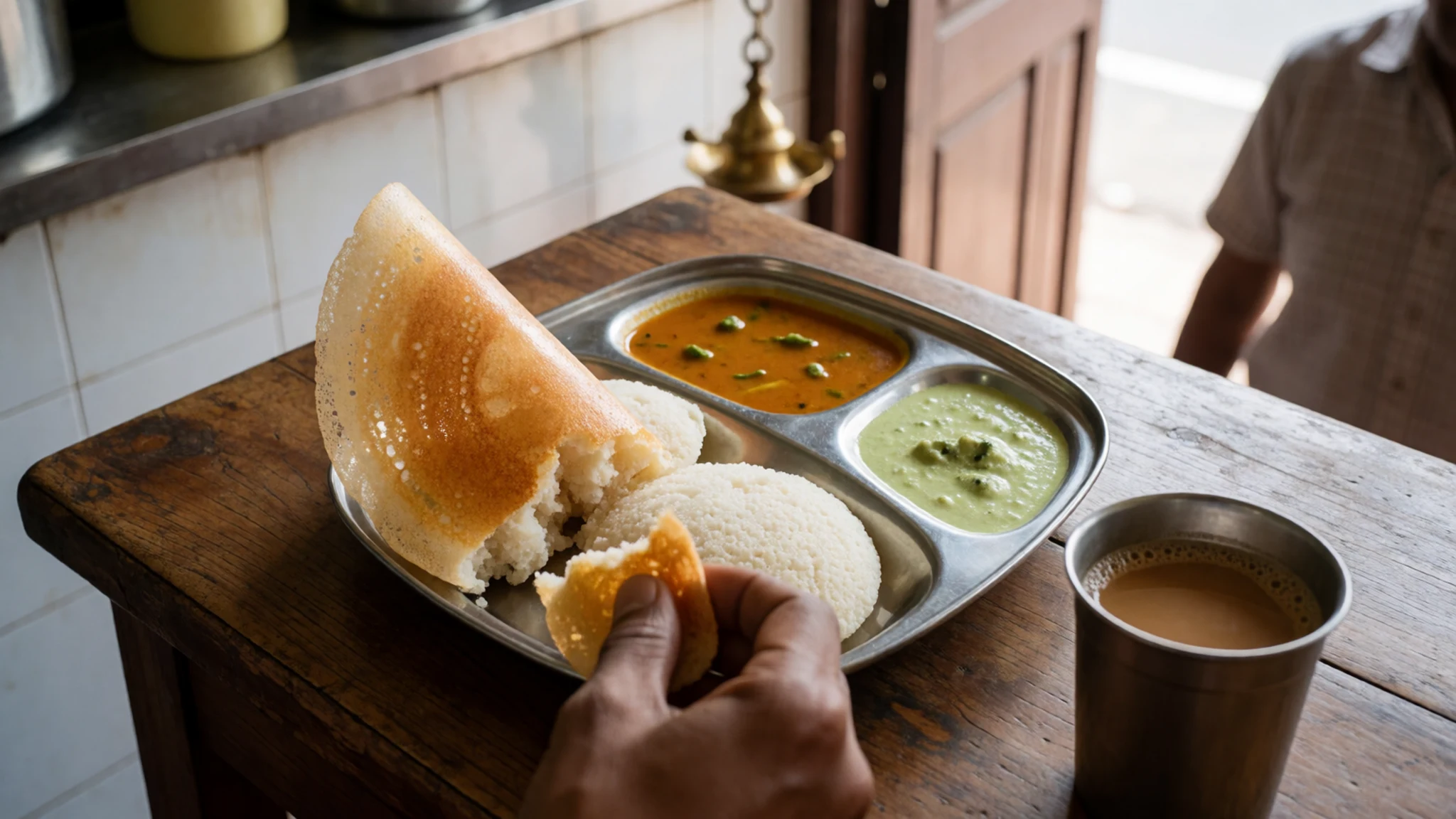
- Fish curry with rice or parotta — small coastal eateries near the harbour lanes
Fish curry with rice, or with flaky parotta, is the coastal meal Kanyakumari shares with southern Kerala. The gravy is hot, sour and coconut-rich, and the fish is whatever the boats brought in. Small eateries near the harbour lanes serve it; the vegetarian rooms do not.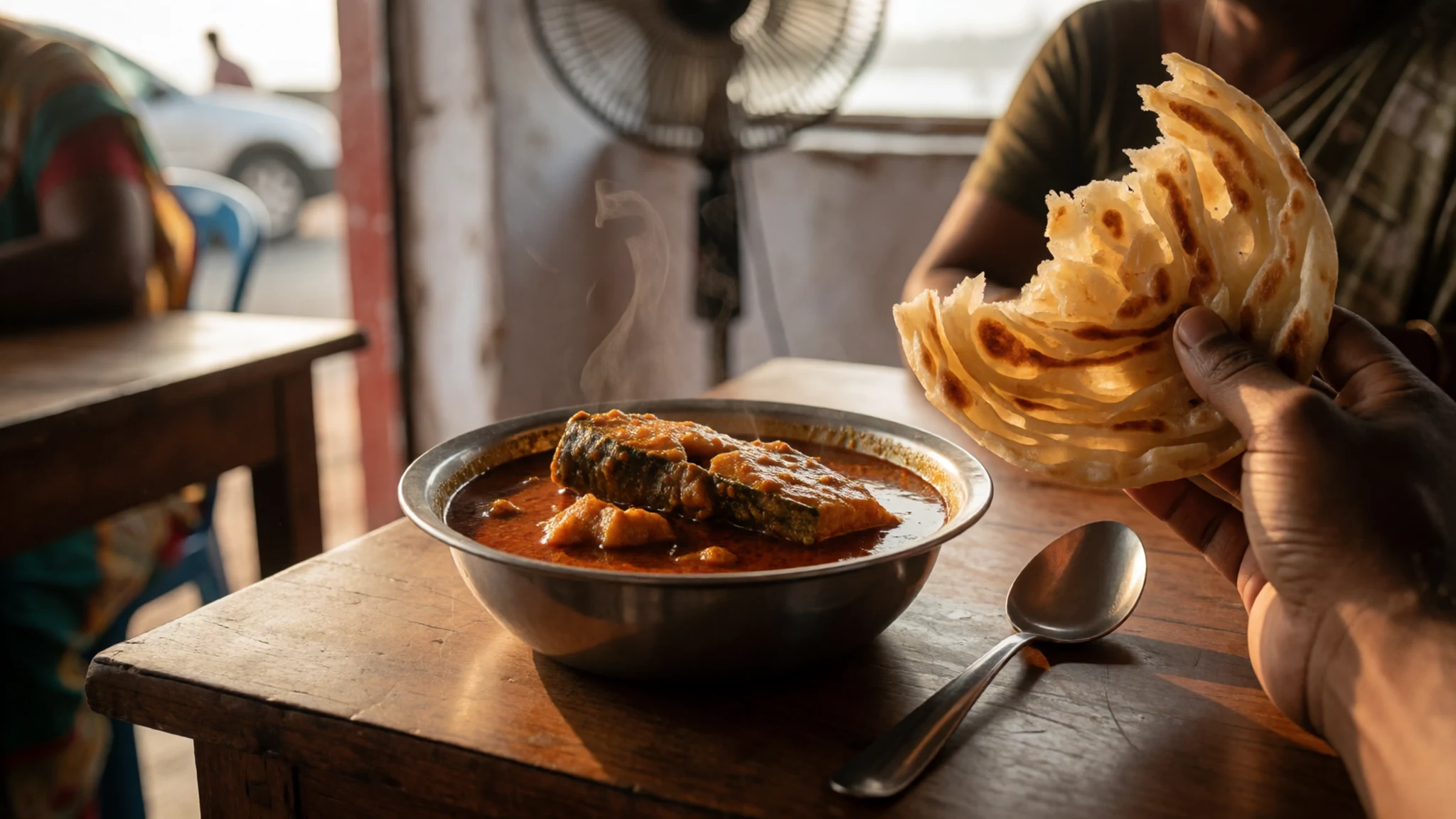
- Appam and stew — eateries serving both Tamil tiffin and Kerala plates
Appam and stew is the other Kanyakumari breakfast, a soft rice pancake with a pale coconut stew of vegetables, sometimes with an egg. It belongs to the Kerala half of the town's cooking and turns up in eateries that serve both Tamil tiffin and Malabar plates. - Kappa and meen — casual Kerala-coastal eateries near the bus stand
Kappa and meen — boiled tapioca with spiced fish — is a border dish Kanyakumari eats because Kerala is next door. The tapioca is plain and filling, the fish fiery, and the plate is a worker's lunch as much as a traveller's. - Nendran banana chips and tender coconut — snack stalls along the seafront
Nendran banana chips, fried from the thick Kerala cooking banana, are the snack Kanyakumari's seafront stalls press on everyone walking to the sunrise point. They are salty, crisp and easy to carry onto the rocks. A tender coconut from the same stall is the drink that matches the heat.
Plan it
Best time. January and February are the kinder months at Kanyakumari: the driest air, a better chance the ferry runs, and a clearer sunrise, though December and January draw the heaviest crowds; May is the hottest, and October and November the wettest. Late spring is hot and glaring. From the southwest monsoon into early autumn the wind rises, rain arrives and boats are often cancelled. The Chithirai full moon draws extra crowds for a paired view of sun and moon, in already strong heat.
How long. 2–3
Getting there. The nearest major airport to Kanyakumari is Thiruvananthapuram, then a road journey on through Nagercoil. The town is also a railway terminus, so trains arrive in Kanyakumari itself and the last leg is a short local ride from the station to the seafront.
Budget. low
Tips
- Be at the seafront before dawn if sunrise is the point of the visit; the paving fills quickly.
- Check on the day whether the ferry to the rock memorials is running; rough weather cancels it.
- Carry cash for the ferry and for small stalls. Cards are not reliable everywhere in town.
- There is little shade on the rocks and the seafront. Bring water and a head covering.
- Weekends, Navaratri and full-moon days draw coach crowds. Book a seafront room ahead if the dawn view matters.
Etiquette
- Remove shoes at the Kumari Amman Temple; men are expected to enter with a bare torso.
- Do not photograph worshippers or the inner shrine without a clear yes.
- Follow the ferry crew's instructions; the islets are exposed and the sea can change quickly.
- Give way to pilgrims in the temple queue and keep voices low inside.
Nearby
Sources
- Wikidata (CC0)
- Wikipedia (CC BY-SA 4.0)
- Wikivoyage (CC BY-SA 4.0)