Huashan
Huashan, People's Republic of China
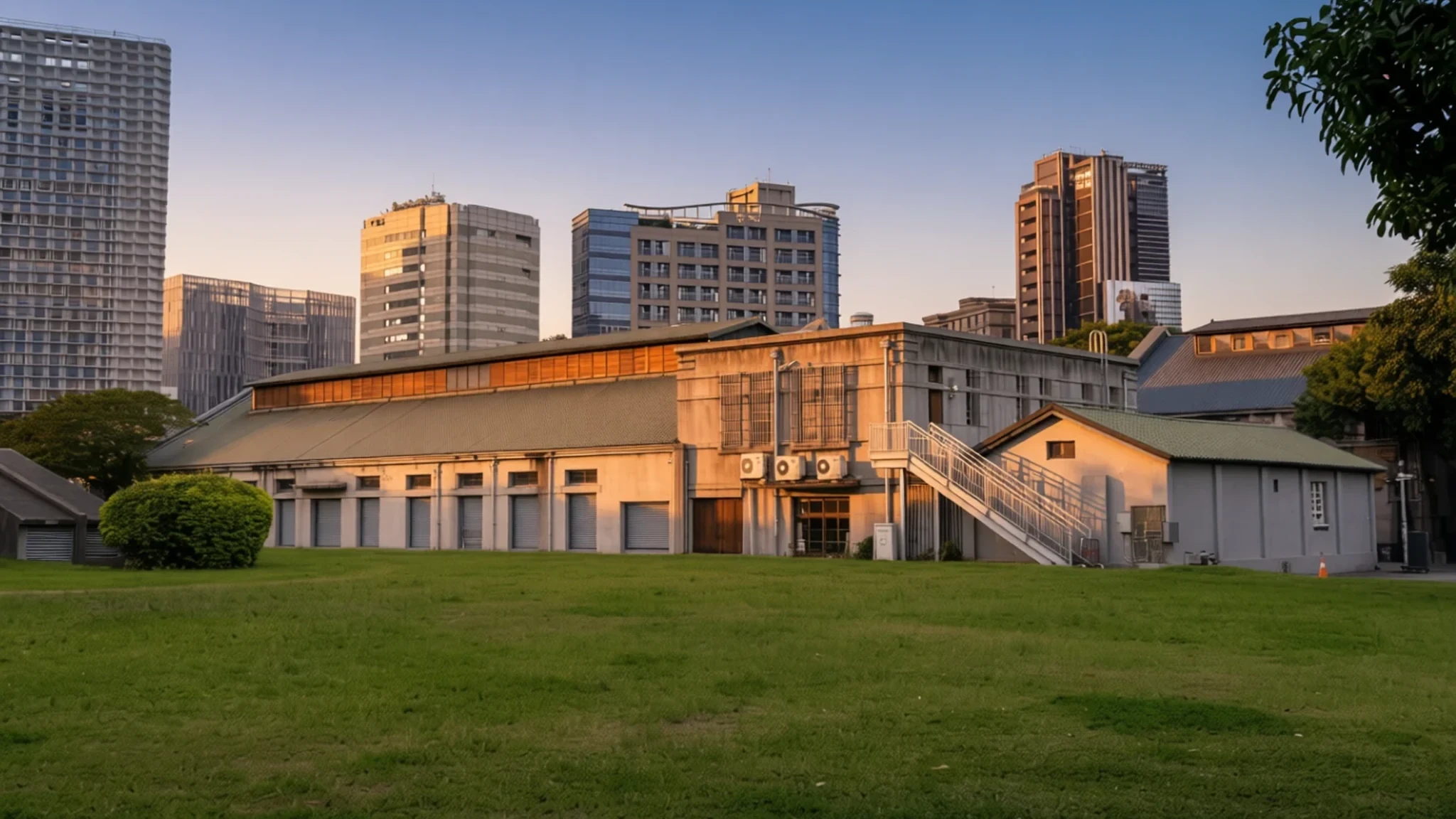
Huashan is a steep Taoist mountain in Shaanxi, walked for granite peaks, cliff paths and clear autumn weather.
The place
Huashan (华山) rises in Shaanxi, south of the Wei River plain, as a granite massif whose ridges end in bare summits rather than a single rounded top. The usual approach begins at the foot in Huayin and follows a long valley before the slope turns into stairs cut into the rock and into paths that lean on iron chain. East, South, West, North and Central peaks form a compact skyline. The West Peak carries a wide summit terrace, the East Peak is where people wait for sunrise, and the South Peak holds a cliffside plank path. Pine and scrub cling to ledges lower down, while the summits are mostly stone, sky and the drop into the plain. From the ridges the Wei valley opens to the north as a flat agricultural floor, and further ranges sit along the southern horizon. Weather decides the day. July is the hottest month and the wettest, June nearly as hot, August and September nearly as wet; November has the most comfortable days, and winter can ice the steps. Cableways shorten the climb toward the North Peak and the West Peak, so the mountain is walked by pilgrims, hikers and visitors who ride part of the way and walk the rest. Lodging sits in the valley and in simple inns near the peaks for people who stay the night. Huashan is both a working Taoist mountain, with temples tucked into saddles and courtyards, and a heavily visited scenic area whose paths are engineered, signed and often crowded. The character of the place is the exposure: a narrow line of stone between a long view and a long drop, reached by stairs that ask for patience and a head for height.
Its story
Huashan stands in Shaanxi as Xiyue, a Taoist mountain whose old name marks it as the sacred peak of the west, looking over the Wei plain. Imperial courts treated mountains of this rank as places where the state met heaven, and offerings were made to the deity of the peak as well as to the wider Taoist pantheon. Hermits and priests settled the ledges, and temples grew up in the saddles between summits, some of them rebuilt many times after fire, war and neglect. A widely told legend links the mountain to a mother goddess shut inside it and to her son, Chenxiang, who splits the rock to free her. The tale is drama rather than doctrine, but it is why Huashan turns up in opera and storytelling far beyond Shaanxi. On the mountain itself the religious life is quieter: incense, courtyard halls, and priests in plain robes keeping a routine of sweeping, chanting and festival days. The modern scenic area laid stairs, chains and cableways over those older paths, turning a hard pilgrimage into a journey that a fit visitor can finish between morning and night, or stretch across a night on the ridge for sunrise. What has not changed is the bargain the mountain offers. People still come to test their nerve on the cliff paths, to stand above the plain at dawn, and to leave a stick of incense in a hall that faces the wind. Huashan remains a sacred mountain that is also a crowded public park, and those uses share the same narrow stone.
What to see
- West Peak — western summit
The West Peak of Huashan is a granite crown above cliffs that fall toward the Wei plain. Stone steps and iron chain lead along the last ridge, and the summit terrace looks across the other peaks and down to the valley haze. A cave opens in the north face below the top, and the path is narrow enough that people move in single file.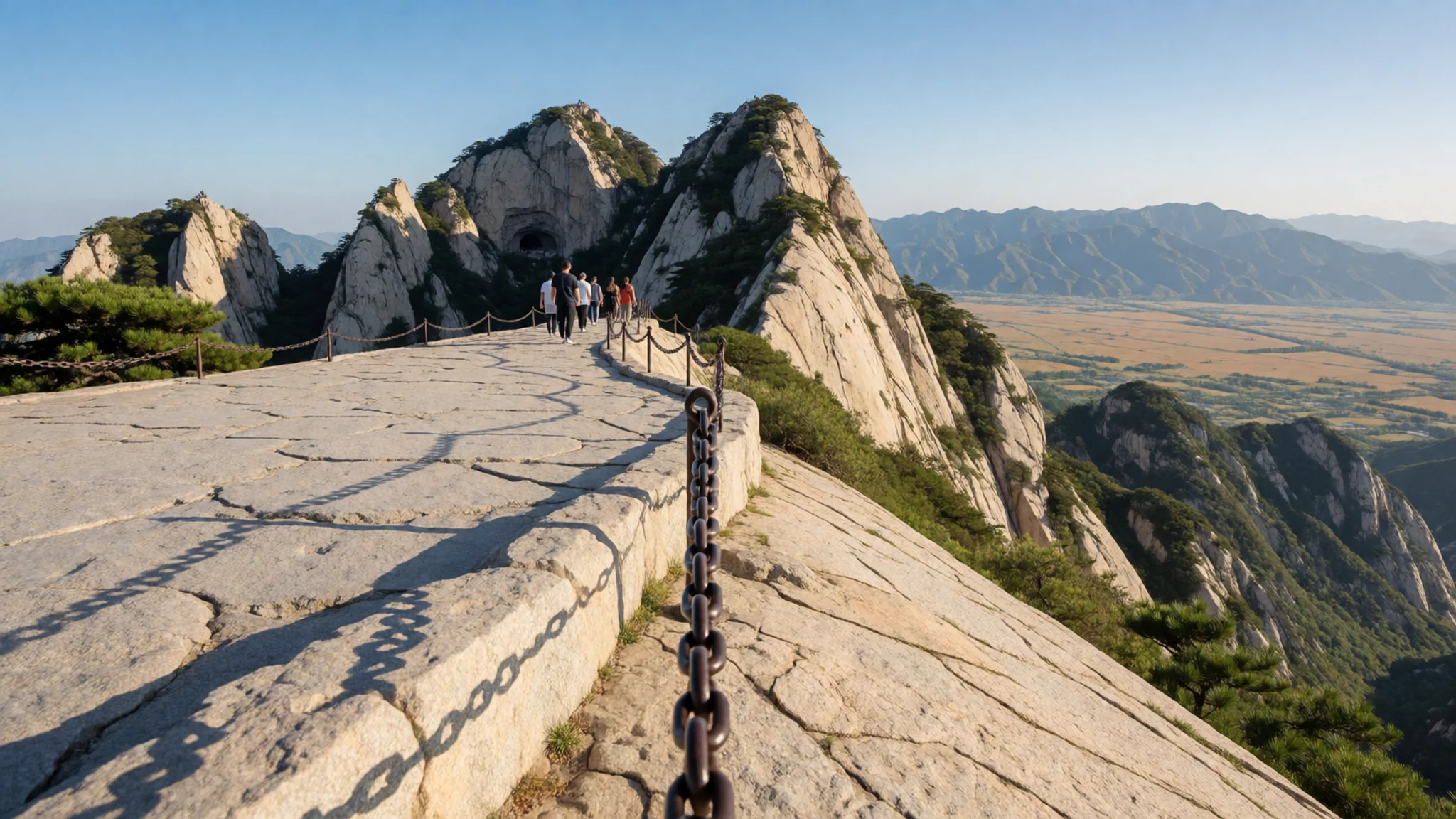
- Qianchi Chuang — north route
Qianchi Chuang is the steep stair on the north route up Huashan, a near-vertical cleft with steps cut into the rock and chains along the sides. The climb sits in a slot of stone, with little to see but the person ahead and the drop beneath. It is the hard gate of the old footpath, often queued, and worth taking slowly without stopping in the narrowest stretch.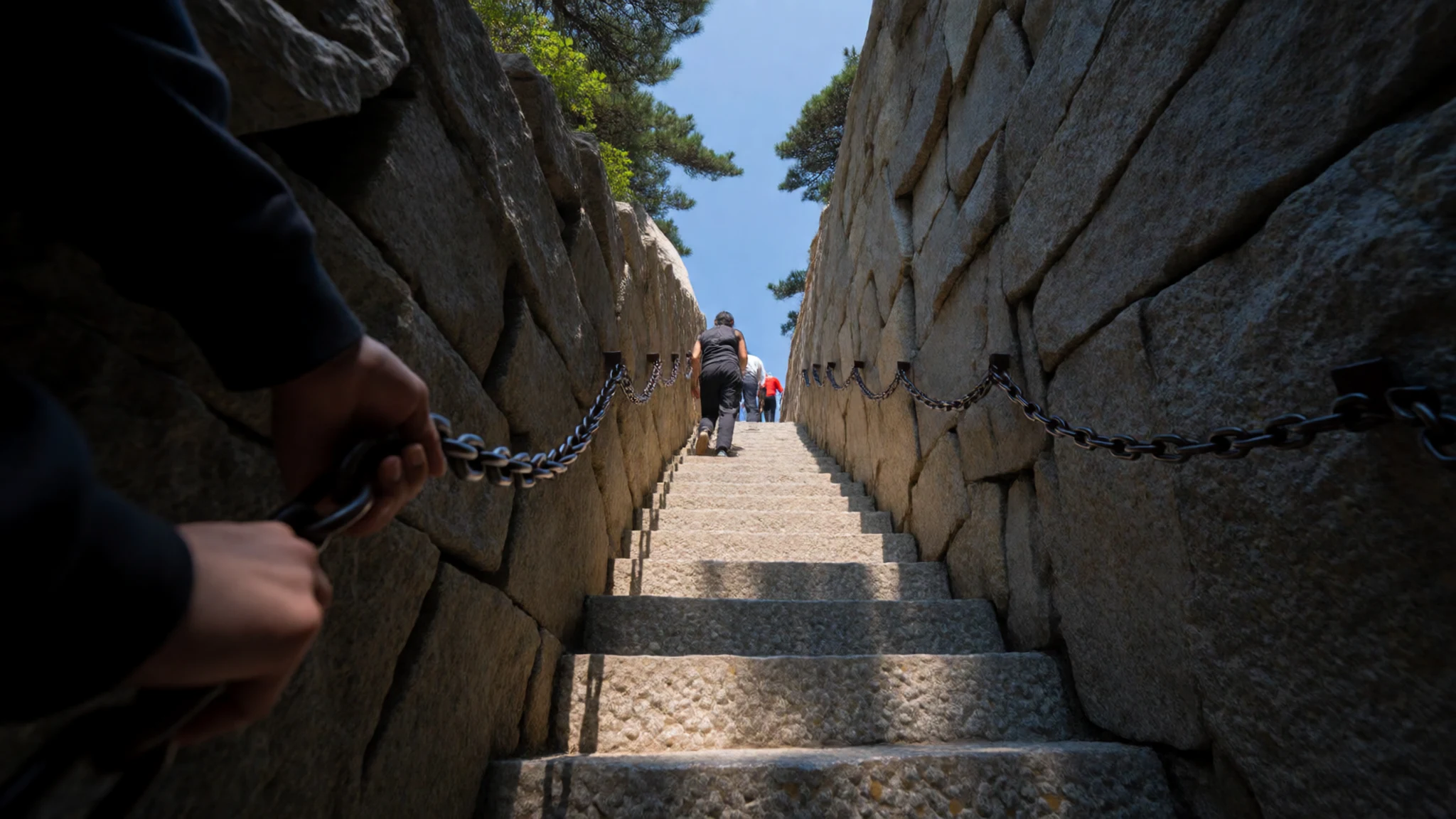
- South Peak — southern summit
The South Peak of Huashan holds a cliff path of planks bolted into the rock face, with chains for the hands and a long drop under the boards. The walk is short and fully exposed, and it returns along the same line, so people meet head-on. The peak itself can be visited without those boards. Wind, rain or ice are reasons to leave the path for another day.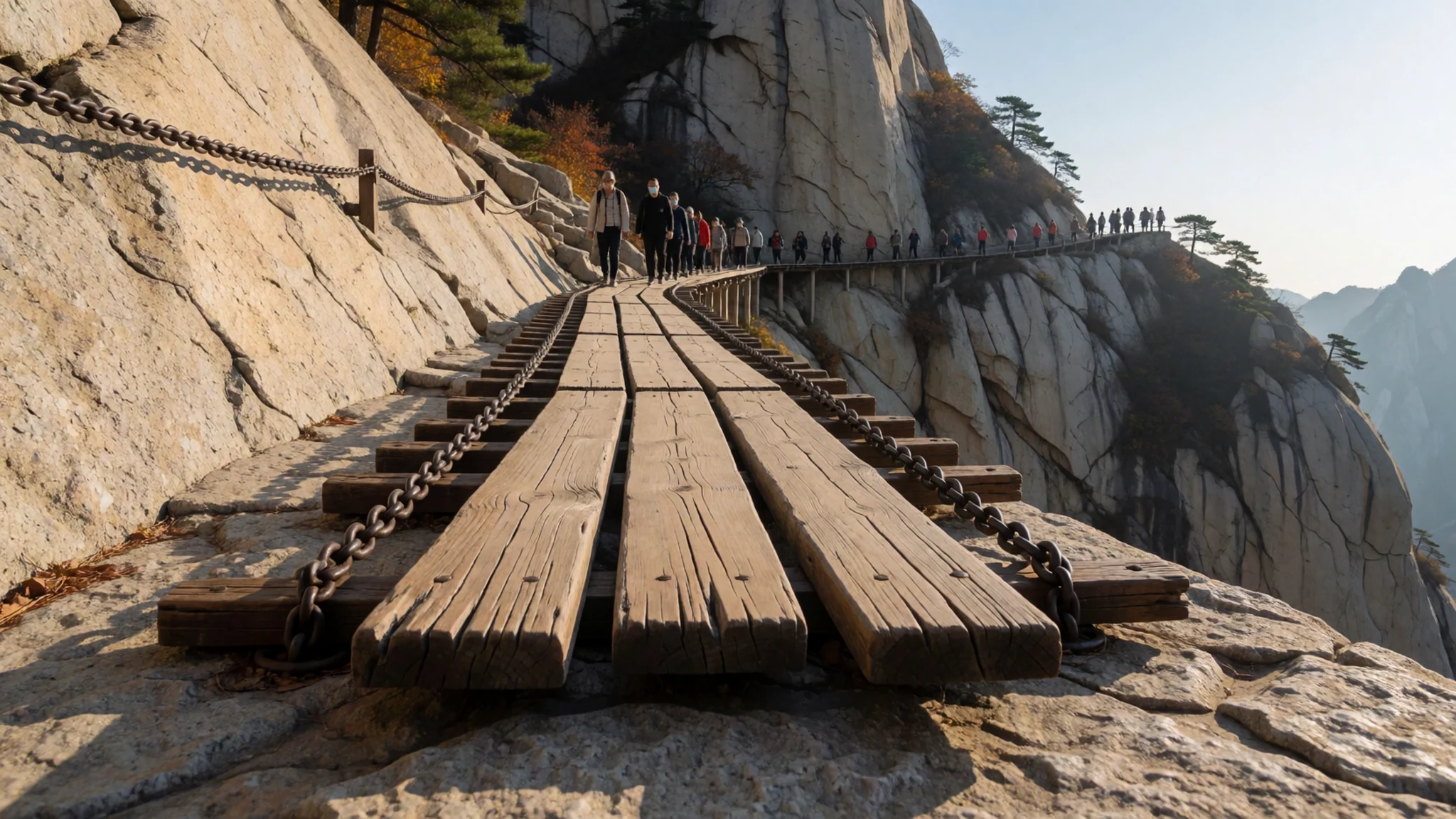
- East Peak — eastern summit
The East Peak of Huashan is the summit where visitors gather before dawn to watch the sun come up over the ridges. The terrace is simple stone, often cold and crowded when the sky is clear. Temples and small inns sit just off the high ground, so many people sleep near the summit and walk over in the dark with a torch.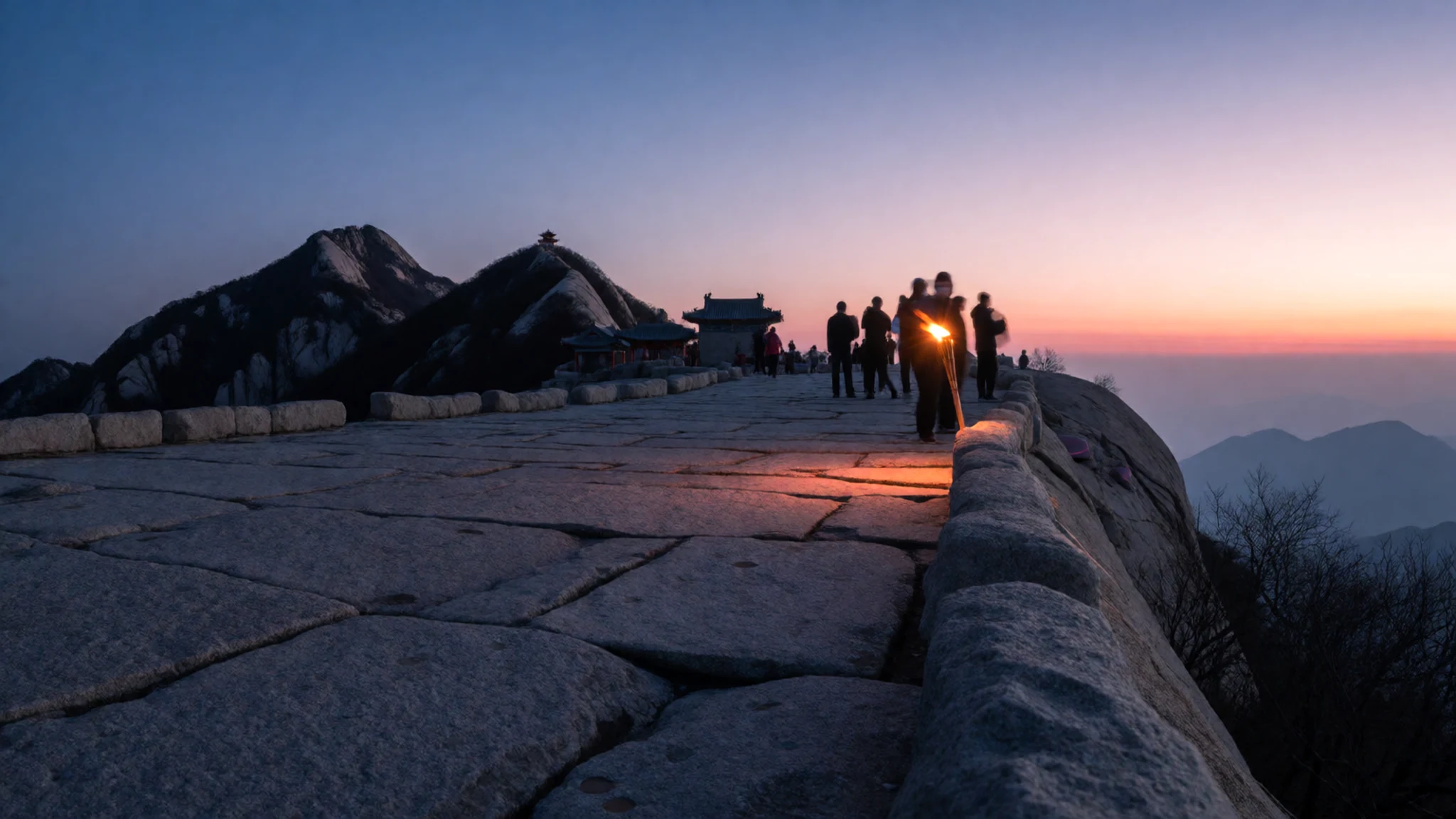
- North Peak — northern summit
The North Peak of Huashan is the first summit many visitors reach, because a cableway arrives on this side of the mountain. It is a rocky platform with views back to the valley and onward to the higher ridges, and it is where the long stair-route and the cableway crowds meet. From here the path continues across the peaks.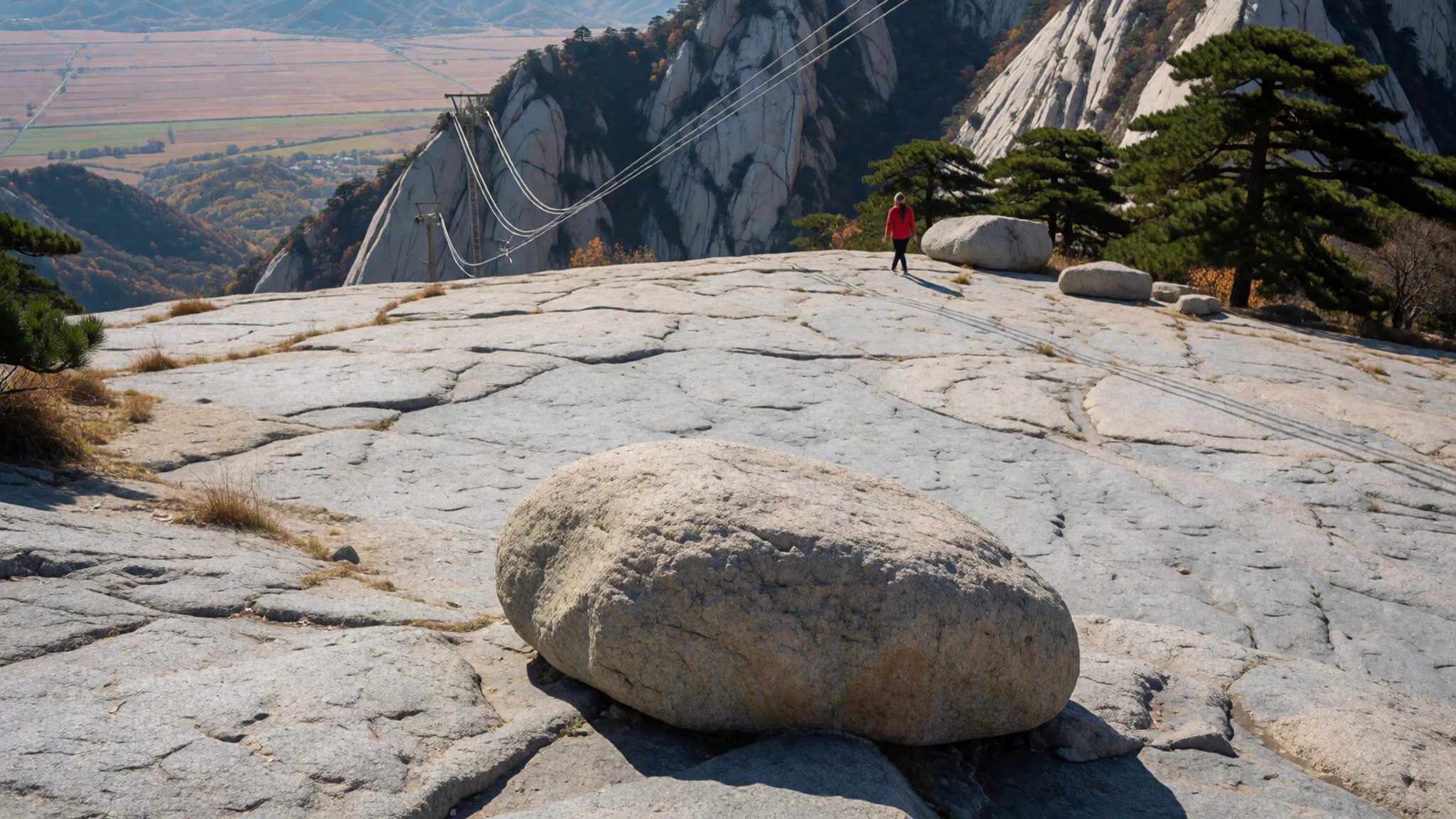
Culture
Huashan is a living Taoist mountain, not only a viewpoint, and the halls on its ridges still keep a daily round of incense, sweeping and quiet recitation. Visitors are welcome in the courtyards, where people bow, light sticks and tie wishes, while priests in dark robes look after the shrines of the mountain deity and of other Taoist figures. Festival days bring more noise, more smoke and more offerings of fruit and paper; ordinary days are simpler, with a few locals and a stream of hikers passing through. The cliff paths have their own custom, half pilgrimage and half nerve: people encourage each other, wait their turn at the chains, and treat the plank walk as a choice rather than a duty. Calligraphy on boards and pillars names the peaks and records old visits, and the sunrise gathering on the East Peak is as much a shared ritual now as any temple service. Photography is constant, which makes courtesy matter. At Huashan, keep to the chained side of a cliff path, speak softly inside temple halls, and ask before you photograph people who are praying.
What to wear
On Huashan the traditional dress still visible is the Taoist robe: a plain, cross-collared garment in cotton or hemp, usually black, indigo or a faded yellow, worn with cloth shoes and the hair pinned up. Priests wear it for ritual and often for ordinary work around the halls; festival days may add a more formal outer robe. Lay pilgrims of earlier generations came in the ordinary clothes of rural Shaanxi — padded cotton jackets, loose trousers and cloth shoes — because the mountain was a walk, not a stage. Today the paths belong to outdoor clothing. Chinese visitors wear lightweight shells, sun sleeves, trainers and, in the cold months, short down jackets; local people in Huayin dress as they do in any Wei-valley town, in contemporary casual clothes, with a heavier coat when the wind comes off the ridges. A visitor should dress for stone stairs and weather that changes with height. Shoes need a firm grip and a sole that can feel the step; smooth fashion soles slip on worn granite and on ice. Layers beat a single heavy coat, because the valley can be warm while the peaks are in cloud and wind. Cover the shoulders and knees if you enter a temple hall, leave long scarves and loose hems off the cliff paths where they catch on chains, and pack a light rain shell and gloves for the ironwork.
What to eat
- Biangbiang noodles — noodle shops in Huayin and the road to the mountain gate
Biangbiang noodles are the wide wheat belts of Shaanxi, boiled and dressed with chili oil, garlic, vinegar and a little meat or egg. The chew is the point. At Huashan, eat them in noodle shops in Huayin and in eateries on the road from the station to the mountain gate.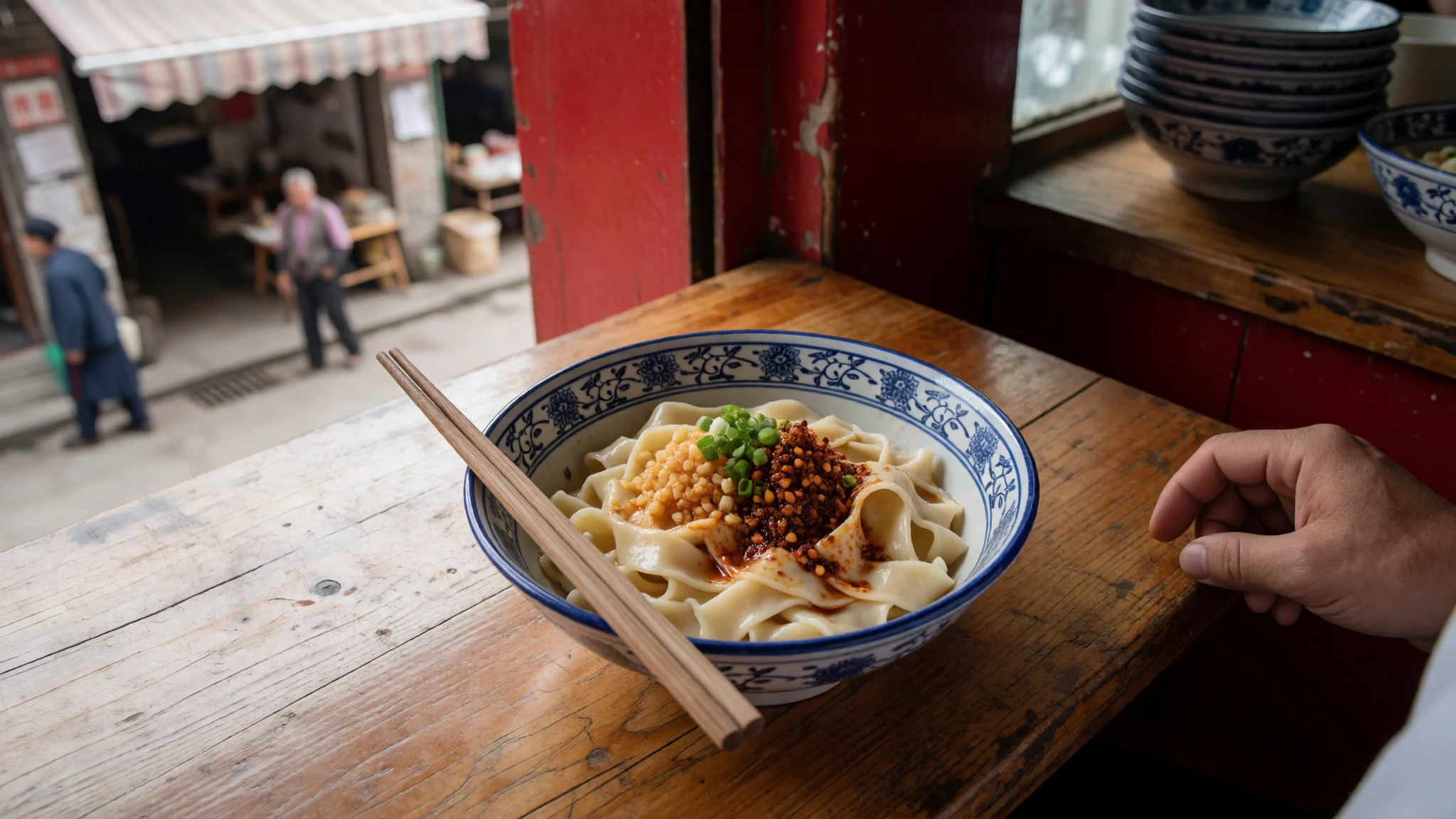
- Roujiamo — stalls in Huayin and by the visitor centre
Roujiamo is braised pork, rich and spiced, packed into a crisp wheat flatbread that cracks at the edges. It travels well in the hand. Around Huashan, stalls in Huayin and near the visitor centre at the foot of the trail sell it before the path leaves the valley.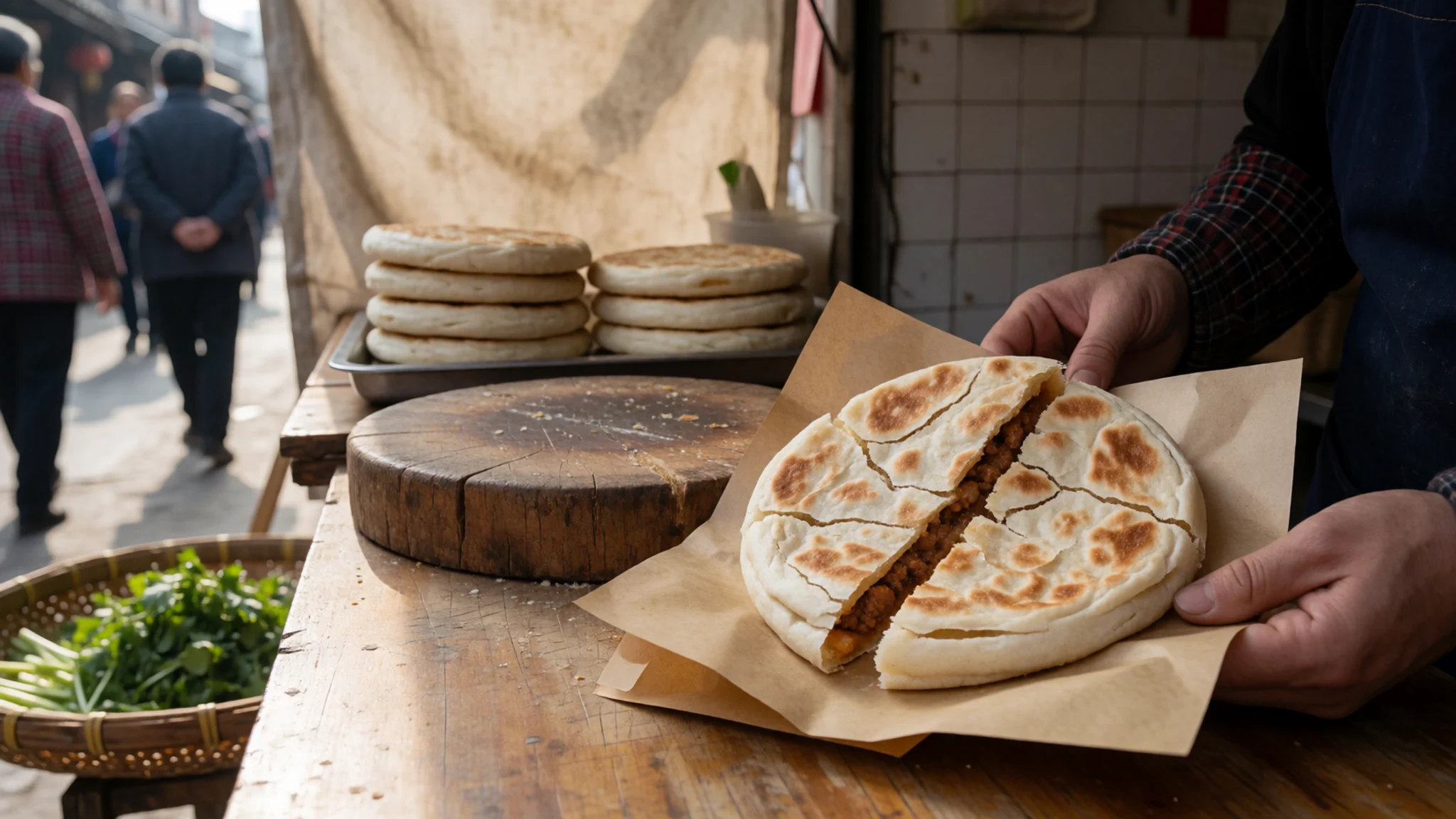
- Liangpi — street stalls in Huayin
Liangpi are cold noodles made from wheat starch, slippery and pale, dressed with chili, vinegar, garlic and cucumber. They suit hot weather and are sold from trays. Around Huashan, street stalls in Huayin, especially near the market streets, serve them when the valley is warm. - Saozi noodles — noodle shops in Huayin
Saozi noodles are thin wheat noodles in a sour-hot broth, topped with minced pork, tofu and wood-ear fungus. The broth should taste of vinegar as much as of chili. At the foot of Huashan, ordinary noodle shops in Huayin serve them through the day, a useful meal before the climb. - Yangrou paomo — lamb-soup eateries in Huayin
Yangrou paomo is a bowl of lamb broth with torn pieces of unleavened wheat bread, plus chili and pickled garlic. The bread should go soft without turning to paste. It belongs to the Wei-valley table more than to the ridge. Around Huashan, eat it at a lamb-soup eatery in Huayin.
Plan it
Best time. November for comfortable days, drier air and autumn colour on the ridges; October for colour too, though wetter and still warm, and March and April for blossom while nights freeze. Summer at Huashan is hot, with sudden storms. Winter can ice the stairs and the cliff paths.
How long. 2–3
Getting there. Fly into Xi'an Xianyang International Airport, then continue by high-speed train or coach to Huashan North station or Huayin. From there a local bus or taxi runs to the visitor centre at the foot of Huashan. Check the official mountain site for cableway status before you set out.
Budget. mid
Tips
- Start the climb early so the steepest stairs are behind you before the paths fill and the afternoon cloud builds.
- Decide at the bottom whether you will use a cableway; walking down is hard on the knees.
- Carry water. Shops run all the way to the top of Huashan, with water and supplies sold on the mountain, and the sun on bare rock is strong.
- Check the forecast and turn back if the steps are icy or a storm is building.
- Keep a little cash for stalls and simple inns; card payment is patchy once you leave Huayin.
Etiquette
- Let people pass on narrow stairs and do not stop on the outside edge of a chained path.
- Speak quietly in temple halls and ask before photographing anyone at prayer.
- Carry rubbish down with you; bins are scarce on the ridges.
Nearby
Sources
- Wikidata Q746614 (CC0)
- Wikipedia: Mount Hua (CC BY-SA 4.0)
- Wikivoyage: Huashan (CC BY-SA 4.0)