Hobbiton
Hobbiton, New Zealand
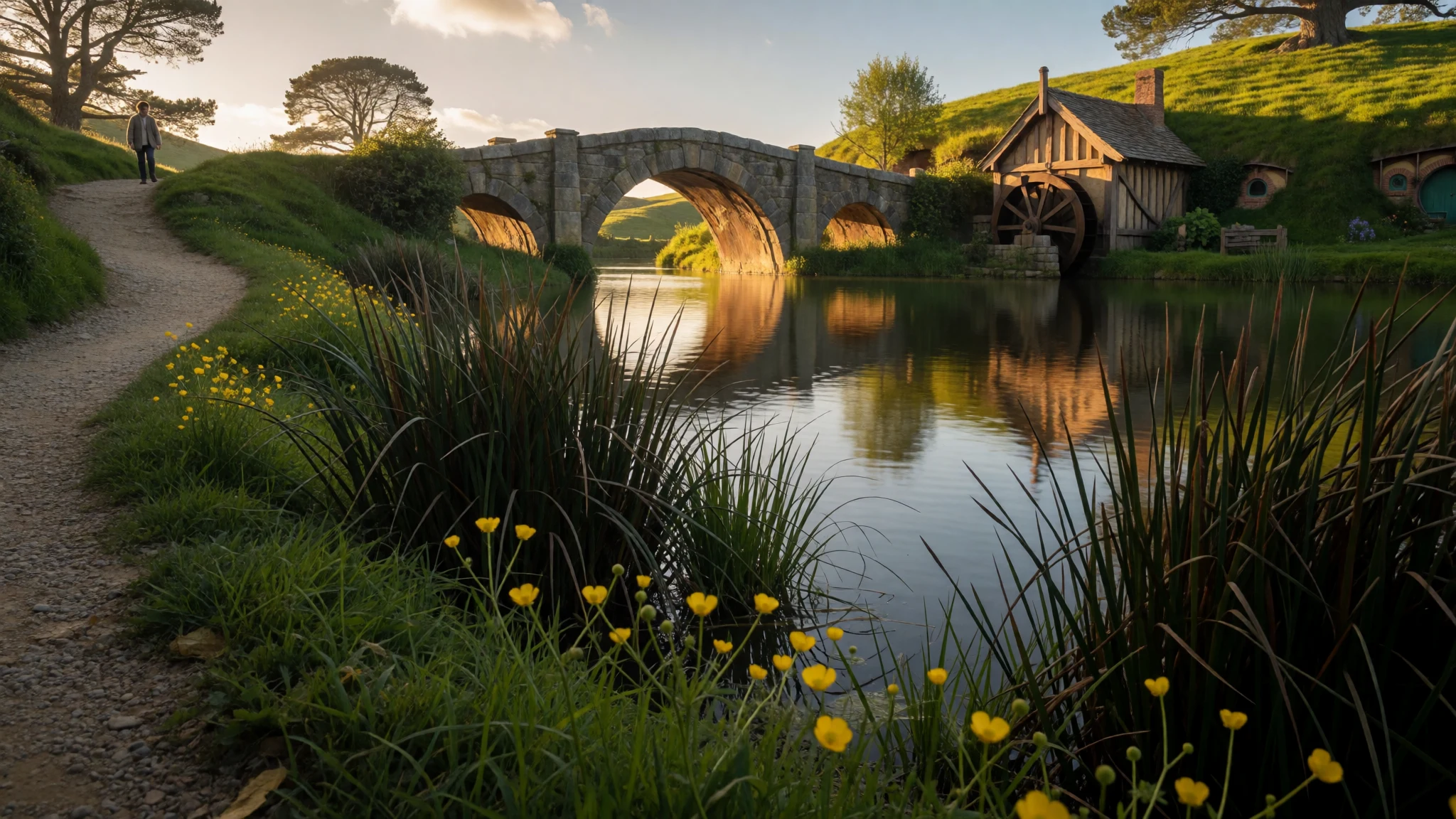
Hobbiton is a film set on a working Waikato farm, where the Shire's round doors, gardens and pub survive as a village you can walk through.
The place
Hobbiton sits on private farmland in Waikato, on New Zealand's North Island, roughly 10 km south-west of the town of Matamata. The country around it is rolling green pasture, mostly dairy and sheep, and the village was built into one of those hillsides. What visitors reach is a settlement of hobbit-holes: round front doors in many colours, vegetable plots, hedges, washing lines and mossy paths, all scaled to look right on camera. Entry is by guided tour on foot. The route winds past dozens of homes before arriving at a lake, a double-arched bridge, a mill and the Green Dragon Inn. The holes are mostly facades, with doors that open onto shallow spaces rather than rooms, so the pleasure lies in the outdoor detail: hand-painted letterboxes, fruit trees, tools left by a gate. Bag End, the Baggins home, crowns the hill above the lake. Beyond the farm, the surrounding region has other draws, including the Waitomo caves, Mt Pirongia, the Coromandel Peninsula and the long Waikato River. Most people come by road from Auckland or Hamilton and treat Hobbiton as a half-day outing or one stop on a longer North Island drive. Because entry is only through tours, the place is organised and fairly busy rather than quiet or wild. The appeal is the setting itself, a pocket of imagined rural England laid over New Zealand farmland. Tickets and tour details are handled through the official site, hobbitontours.com.
Its story
Hobbiton began as a search by a film crew for a Shire. The Lord of the Rings trilogy needed gentle green hills, a lake and a big tree, and this family-run farm offered all three. The director, Peter Jackson, is said to have spotted it from the air while scouting. The first village was put up with temporary materials and largely cleared away once filming ended. When The Hobbit films followed, the set returned, and the village stood in for Tolkien's Hobbiton again, this time rebuilt to last. That decision turned a vanished film location into a permanent attraction. Tolkien himself drew the Shire from the English countryside of his boyhood, with its mills, hedgerows and village pubs. The film-makers translated that landscape into Waikato, and the farm's own sheep, soil and weather became part of the picture. Gardens were planted well before cameras arrived so that they would look lived in, and they have kept growing since. Today the farm still works, and tours pass through a village that is now a Tolkien destination in its own right. For many visitors the film connection is only the starting point, since the place also works as a well-kept garden walk through green farmland.
What to see
- Bag End — Top of the hill, Hobbiton Movie Set
Bag End is the Baggins home at the top of the hill, with a round green door, a tidy front garden and a large tree overhanging it. A sign by the gate warns against entry except on party business. The door is a facade, but the position matters: from up here the whole village and the farmland beyond spread out below.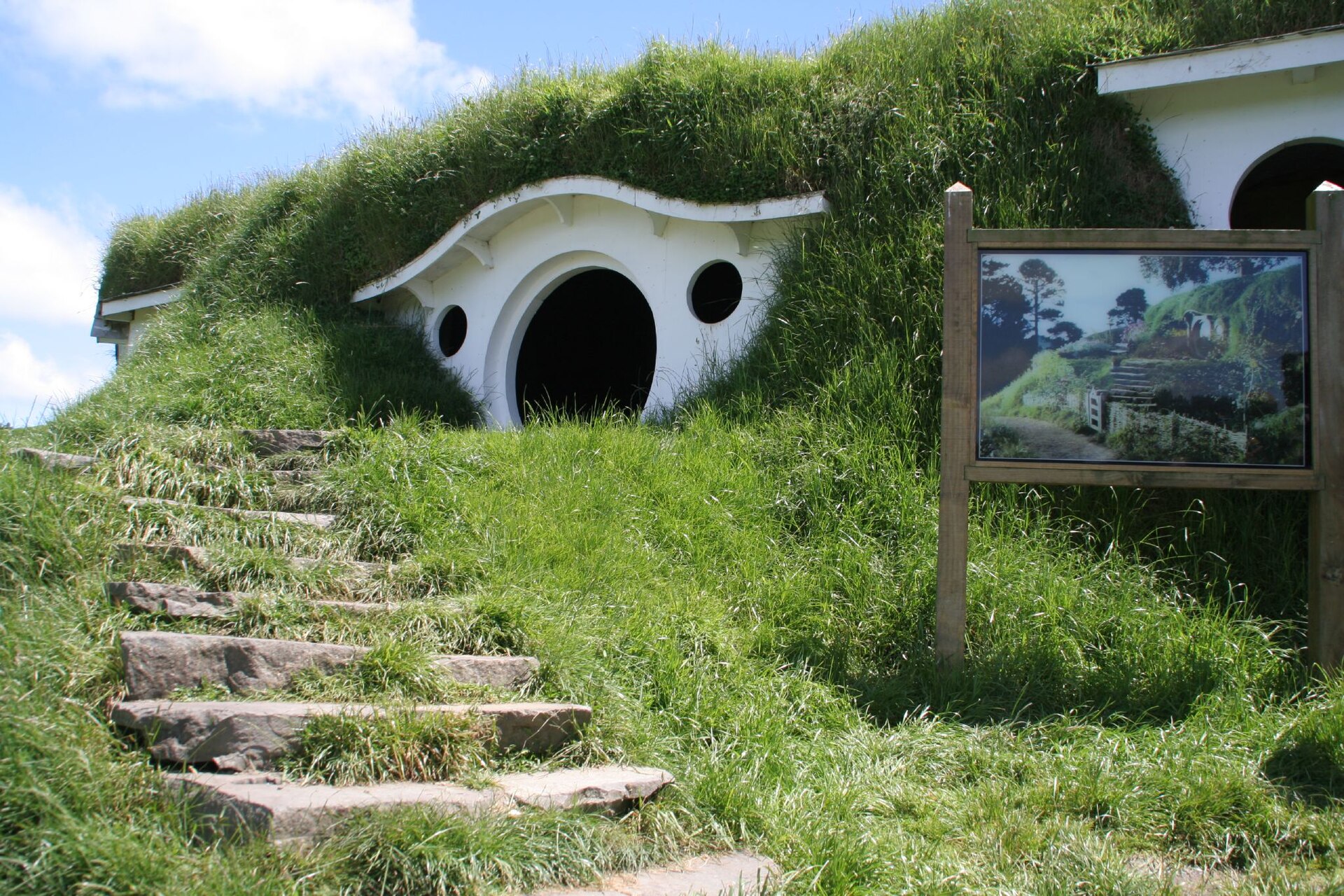
- The hobbit-hole lanes — Village slopes, Hobbiton Movie Set
Paths wind along the hillside past hobbit-holes, each with its own door colour, chimney, garden and small props such as boots, baskets or a hung coat. Guides explain how different holes were built at different scales to make actors look larger or smaller. This is the longest part of the tour and the one for slow looking.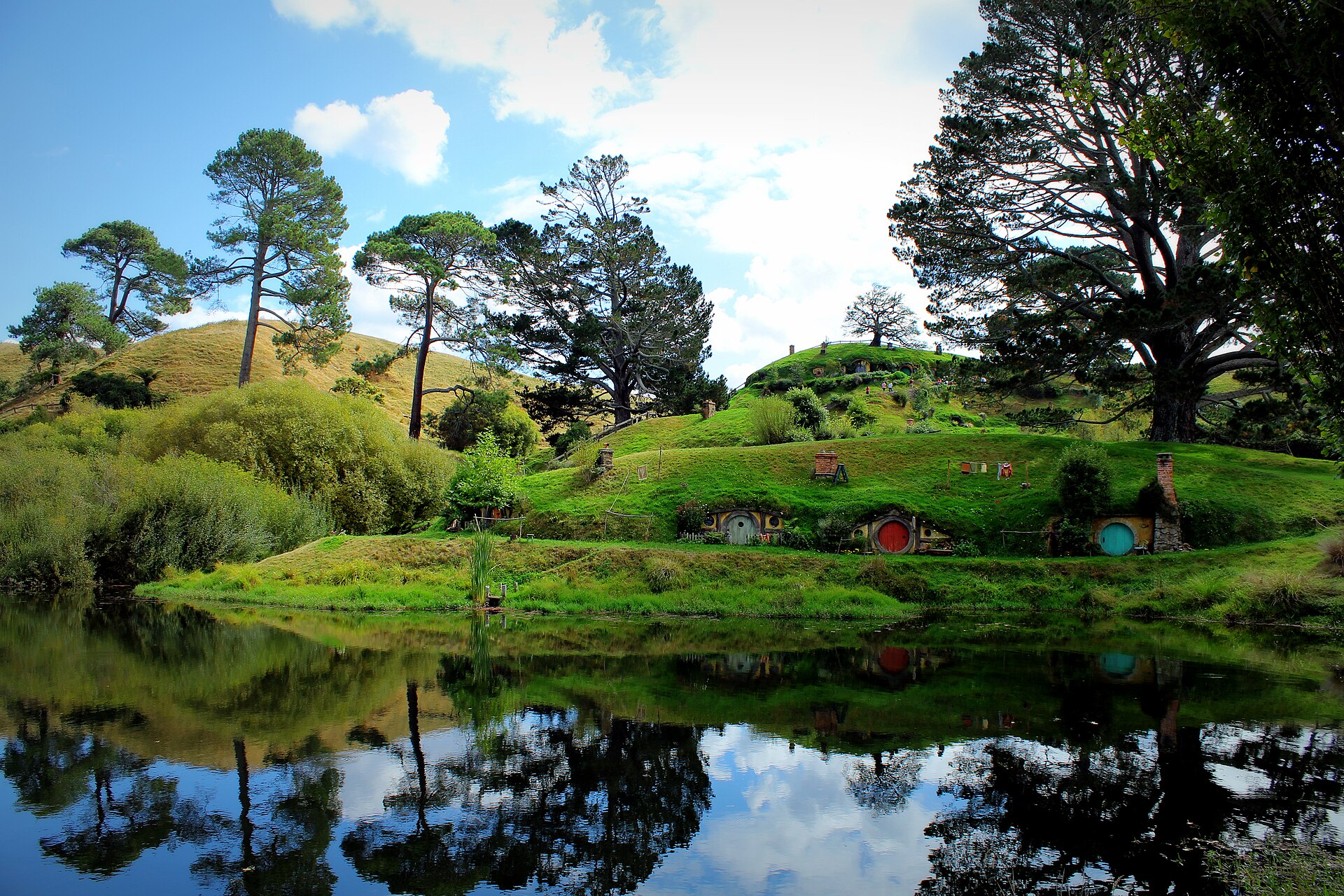
- Lake, mill and double-arched bridge — Lakeside, Hobbiton Movie Set
The lake at the foot of the village is ringed by a mill, a double-arched bridge and a grassy party field. In still weather the hobbit-holes reflect in the water, which is the photograph most visitors take home. Paths here are flatter than on the hill, though they can be damp after rain.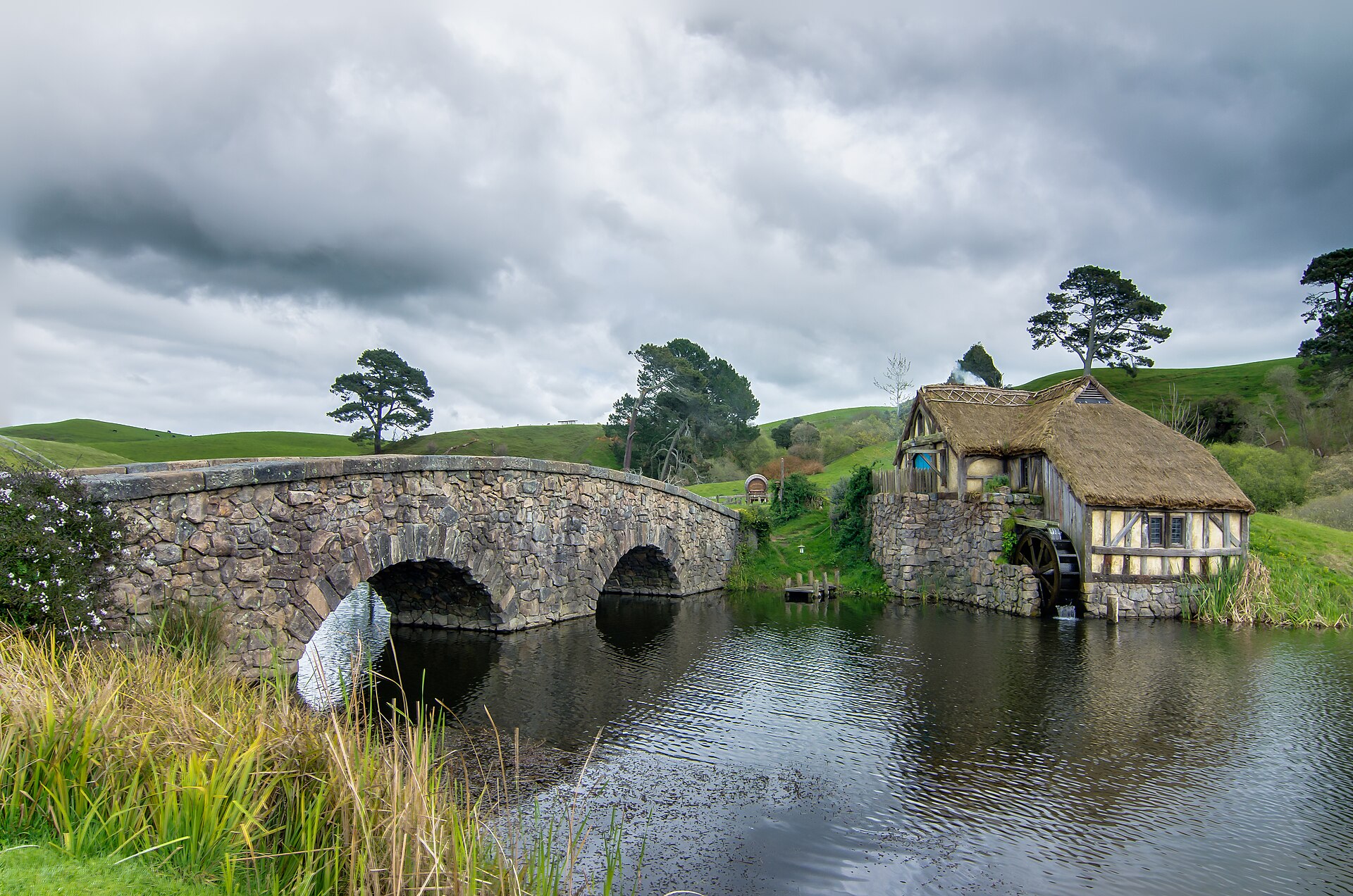
- The Green Dragon Inn — Lakeside, Hobbiton Movie Set
The Green Dragon Inn stands by the water, a low timber-and-thatch pub with a fire, wooden tables and a view of the bridge. The tour ends here. Check the official site for what a ticket includes, as arrangements can differ between tour types.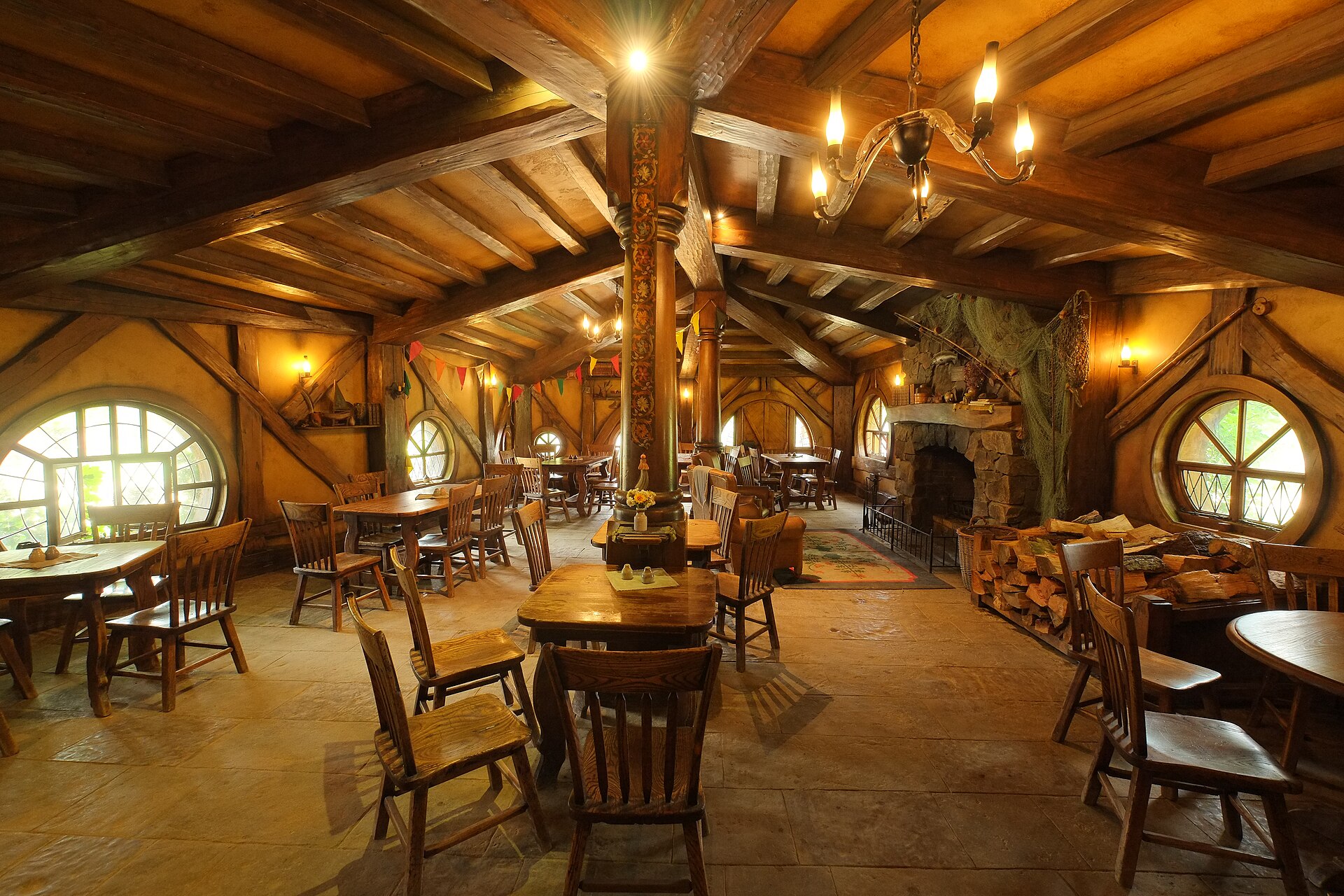
- Ruakuri Cave, Waitomo — Waitomo, Waikato
Ruakuri Cave at Waitomo is the usual add-on for anyone driving through the region. A spiralling walkway leads down through a drum-shaped entrance into the cave, and the descent is an experience in itself. Book it separately from Hobbiton, and check the cave operator's own site for tour times and conditions.
Culture
Hobbiton is a case of one country's farmland standing in for another's imagination. Tolkien wrote the Shire with the English countryside in mind, the film-makers found their version in Waikato, and the set now draws readers and film fans from all over the world. The culture here is layered: the fiction of the hobbits, the working life of a family farm that still shares its land, and the older Māori history of the Waikato, a name tied to the river whose Māori name means flowing water. Guides tend to tell stories about the filming, the craft of the props and the small jokes hidden in the gardens, and visitors often arrive in a mood of affectionate nostalgia for the books. Expect a friendly, informal New Zealand manner: first names, plain talk, easy humour and little ceremony. Fans of the books will find plenty to enjoy, but newcomers are welcome too, since the village works as a garden walk as much as a film location. For wider context, nearby towns such as Matamata have cafés and farm shops that show the agricultural side of the region, and Māori cultural experiences are easiest to find elsewhere in the North Island, with Rotorua the usual choice. Please stay on the marked paths and leave doors, props and garden beds untouched, as the guides ask.
What to wear
Hobbiton has no costume tradition of its own, so its dress comes from two sources: Tolkien's fictional hobbits and the Māori heritage of the wider Waikato. In the story, hobbits wear waistcoats, linen shirts, wool jackets and simple breeches in earthy greens, browns and yellows, mostly homespun, and many go barefoot; the film costumes copied that with hand-dyed, deliberately worn cloth. The older local tradition is Māori: the korowai, a cloak woven from flax fibre and often trimmed with feathers, is worn at weddings, graduations and important ceremonies. Day to day, people around Matamata dress for farm country: wool or merino jumpers, work shirts, shorts in summer, waterproof or oilskin jackets, and gumboots when the paddocks are wet. Visitors need nothing formal. Wear sturdy, closed walking shoes with good grip, since the paths are grass and gravel and can be slippery, and bring layers because Waikato weather can change within an afternoon. Pack a waterproof jacket, a sun hat and sunscreen, as the New Zealand sun is strong even on cooler days. Nothing is expected for modesty beyond ordinary good sense, and there is no religious site on the tour. Dressing as a hobbit is popular with fans, but check the official site for any costume rules first.
What to eat
- Meat pie — Any bakery in Matamata or Cambridge
The New Zealand meat pie, with minced beef or steak in gravy under flaky pastry, is the standard road-trip lunch. It is eaten hot from a paper bag, often on a bench outside, and is a very ordinary and very local way to eat. - Flat white — Town-centre cafés in Matamata and Cambridge
The flat white, an espresso with steamed milk and a thin layer of foam, is the local coffee order and is made carefully even in small farming towns. Many cafés serve it alongside cheese scones or a slice of something sweet. - Waikato cheese and ice cream — Farm shops and roadside stalls around Matamata
Dairying is the main farming industry in this region, so milk turns up as cheese, butter, yoghurt and ice cream. Tasting a local cheddar or a scoop of farm ice cream makes a simple stop between sights. - Roast lamb — Country pubs and restaurants around Matamata
New Zealand lamb is a pub staple, usually roasted and served with potatoes, kumara (sweet potato) and seasonal vegetables. On a cool day it is the comforting choice, and most country pubs have some version of it. - Pavlova — Cafés and bakeries in the Waikato towns
Pavlova, a meringue shell with a soft centre, topped with whipped cream and fresh fruit such as kiwifruit and strawberries, is a national dessert. It is often served at family gatherings and appears on many café and pub menus. - Ale or ginger beer at the Green Dragon — The Green Dragon Inn, Hobbiton Movie Set
The set's own pub serves drinks in the manner of a Shire inn, with beer, cider and non-alcoholic ginger beer. It is a simple pleasure that ends the tour pleasantly. Check the official site for what your ticket covers.
Plan it
Best time. October to April, when the gardens are in leaf and flower and the days are long. Late spring (October–November) is mild and green, summer is warmest and busiest, and winter (June–August) is cooler and wetter, with muddier paths.
How long. 1–2
Getting there. Auckland Airport is the main international gateway, with Hamilton Airport closer for domestic flights. From either, drive to Matamata, the nearest town to the set. Tours begin from the Hobbiton site; check the official site (https://www.hobbitontours.com/) for tour check-in and any transfer options.
Budget. mid
Tips
- Book your tour in advance through the official site, since entry is by guided tour only and popular times can sell out
- Arrive in good time for check-in and expect to spend a few hours on the whole visit
- Carry a waterproof jacket and sunscreen, as weather can change quickly and the route is mostly outdoors
- Bring a card for payments, and check the official site for what your ticket includes before buying extras
- Pair Hobbiton with Waitomo's caves or Rotorua on a longer drive through the North Island
Etiquette
- Stay with your guide and on the marked paths, as the set is a working farm with delicate gardens
- Do not touch, open or climb on doors and props
- Ask before flying a drone and respect other visitors' photographs
Nearby
Sources
- Wikidata Q18924400 (CC0)
- Wikipedia: Hobbiton Movie Set (rev 1379734478) (CC BY-SA 4.0)
- Wikivoyage: Waikato (rev 5259464) (CC BY-SA 4.0)
- Photo: Hobbit holes reflected in water (Jackie.lck) (CC BY 2.5)
- Photo: Waterhouse Lake Front (Harsh.gavhane) (CC BY-SA 4.0)
- Photo: New Zealand relief map (M.Bitton) (CC BY-SA 4.0)
- Photo: North Island plain map (Grutness) (Public domain)
- Photo: Bag End (Rob Chandler) (CC BY-SA 2.0)
- Photo: Baggins residence 'Bag End' with party sign (Pseudopanax) (Public domain)
- Photo: Hobbiton mill and double-arched bridge (Tom Hall) (CC BY 2.5)
- Photo: Inside The Green Dragon inn (Pseudopanax) (Public domain)


