Gunung Gading National Park
Gunung Gading National Park, Malaysia
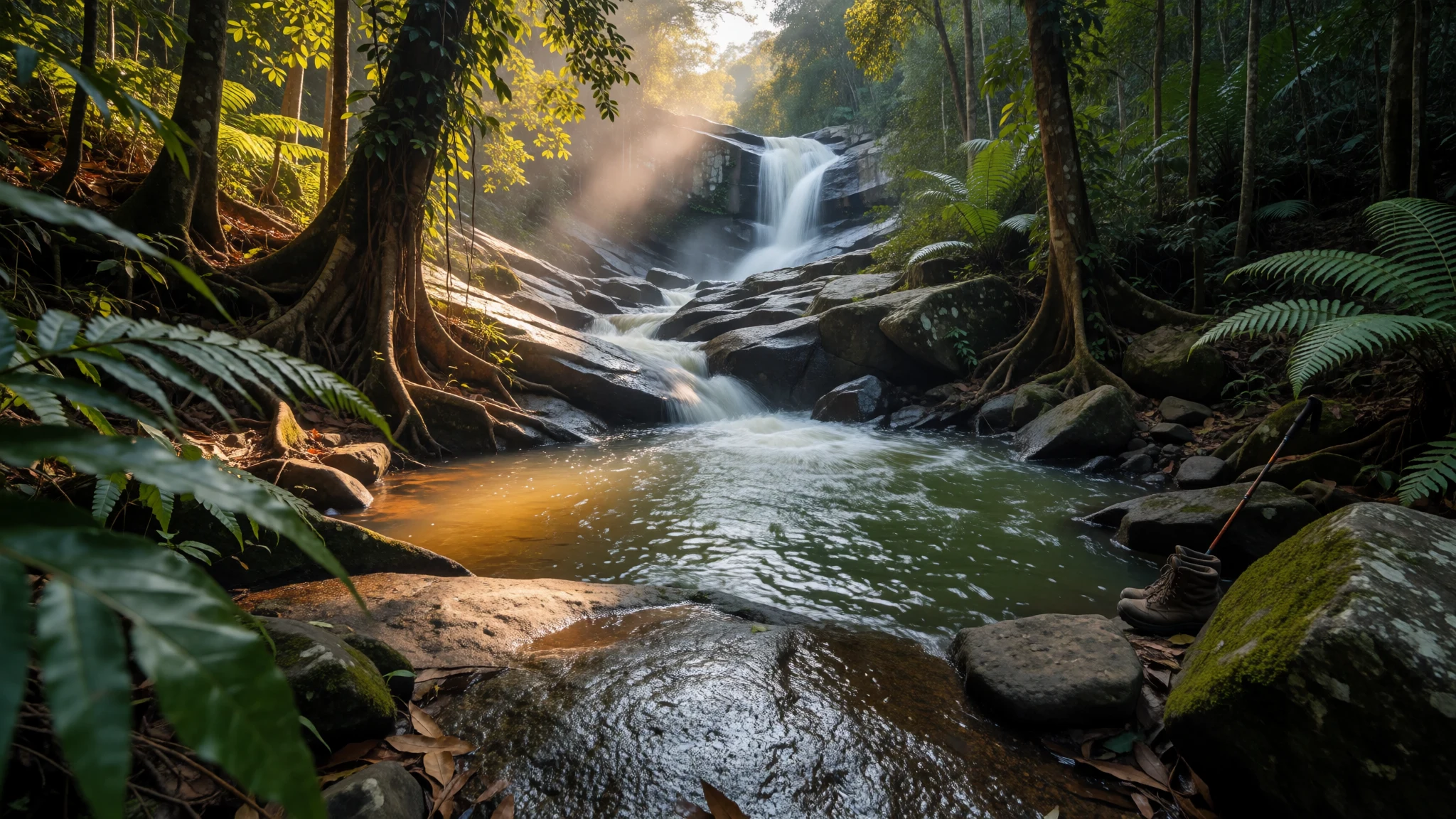
Gunung Gading National Park is a small Bornean rainforest reserve, kept for a giant parasitic flower and a trail of waterfalls.
The place
Gunung Gading National Park sits in the far southwest corner of Sarawak, near the town of Lundu and close to the Indonesian border, about 75 km from Kuching. It covers 41 sq km, small by Bornean standards, and most of that is hill rainforest rising over granite slopes. The trees are mixed dipterocarp forest, a type that once blanketed northwest Borneo and now survives only in scattered fragments. Gading is among the more extensive of those remnants. Two hills shape the landscape, one of them Gunung Gading itself, which has a signed summit trail that takes about six hours return. Other paths follow streams through the forest and end at a chain of cascades, with the Waterfall Trail finishing at the seventh and last. The park feels like a working rainforest rather than a manicured garden. Paths turn muddy after rain, leeches are possible, the air is heavy, and the canopy is loud with insects by mid-morning. Different parts of the park hold different forest communities, because the ground rises and falls within a short distance. Lundu is the practical base for meals and onward transport. Most people come for one flower, but the walks to the water are what fill the rest of the day. The park is compact enough that one early start can take in the exhibits, a bloom if one happens to be open, and at least the lower falls before the afternoon storms arrive.
Its story
Gunung Gading National Park was created in 1983 for a single, specific purpose: to save Rafflesia tuan-mudae and the forest it depends on. The plant has no leaves, stems or roots of its own. It lives inside a host vine and shows itself only when a bud pushes through the bark and opens into a flower that lasts a few days. That makes it hard to protect, since a population can seem absent for months and then appear almost overnight. Establishing a park meant guarding the whole forest, because the flower cannot survive without its host and its habitat. In its early years the park drew mostly Malaysian visitors, with few from abroad. Numbers peaked in 1995, after facilities were built and interest surged among domestic travellers. They fell in the years that followed, then began climbing again as more international visitors found their way to this corner of Sarawak. The visitor centre was designed after a traditional Bidayuh head-house, a gesture to the indigenous communities of the region, and it carries exhibits on Rafflesia and on conservation. The park has therefore worked as both a reserve and a classroom. Its history is a reminder that protecting a species sometimes means protecting something far larger around it: a fragment of lowland and hill forest that once ran unbroken across the northwest of the island.
What to see
- Rafflesia blooms — Near the park headquarters, Lundu
Rafflesia tuan-mudae is the reason the park exists, and it is the only Rafflesia species growing here. Blooms are unpredictable and short-lived, so a visit may or may not coincide with an open flower. Ask at the headquarters for the current bloom locations before setting off, and keep expectations flexible.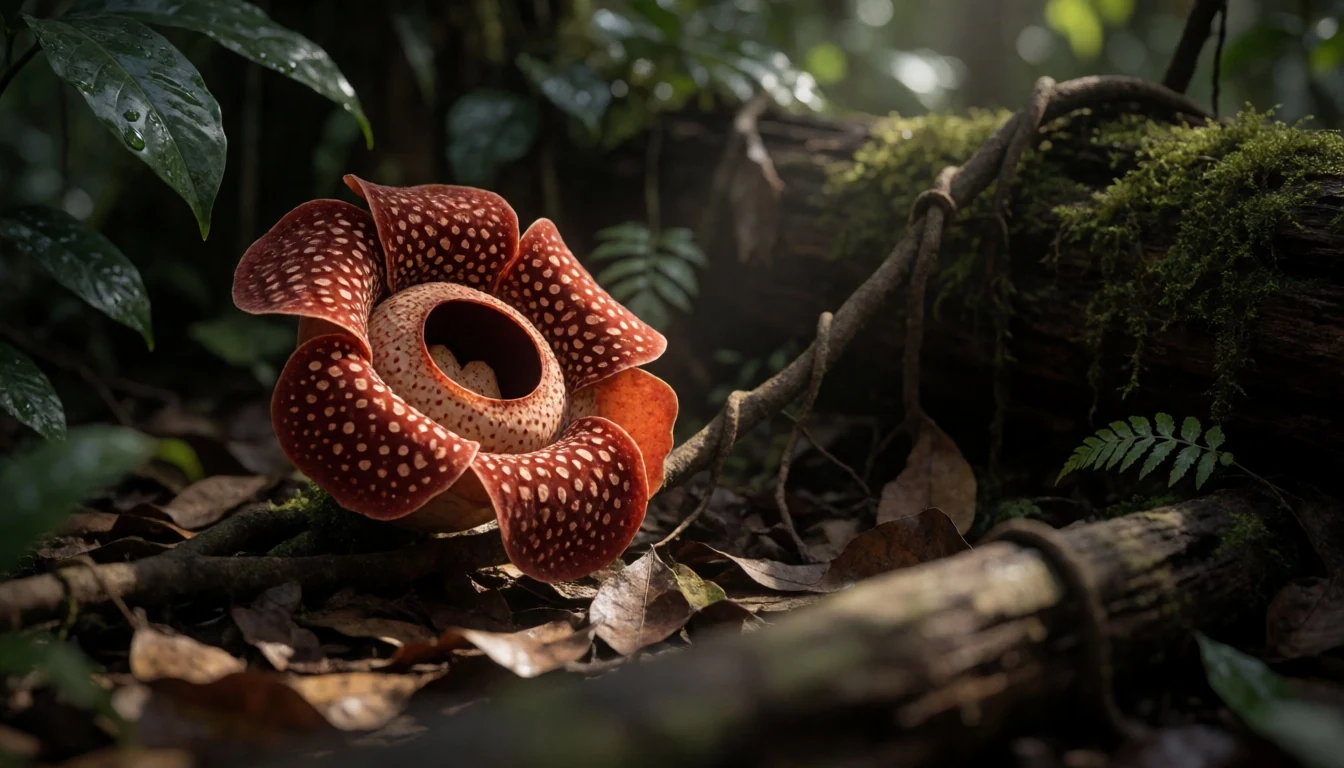
- The Waterfall Trail — Gunung Gading forest, west of Lundu
A stream-side path climbs through forest past a chain of cascades, finishing at the seventh and final fall. Reaching the top takes about an hour and a half of steady walking. Roots and wet rock make footing slippery, but the pools and the cooler air near the water are the reward.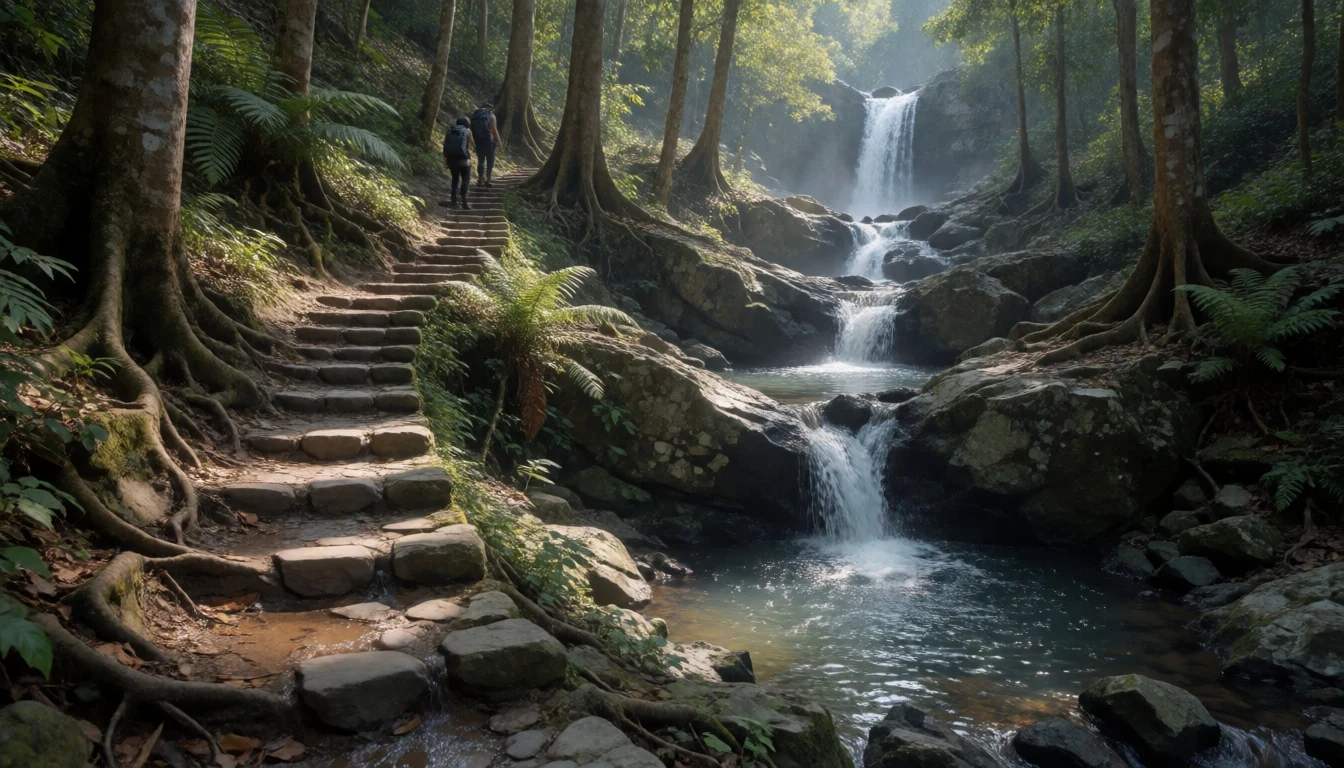
- Lower waterfalls — Start of the Waterfall Trail
The first cascades on the trail suit anyone who wants forest and moving water without a long climb. They are good for a slow hour, watching light fall through the canopy and listening for birds and insects. After heavy rain the flow grows noisy and the rocks turn treacherous, so take care.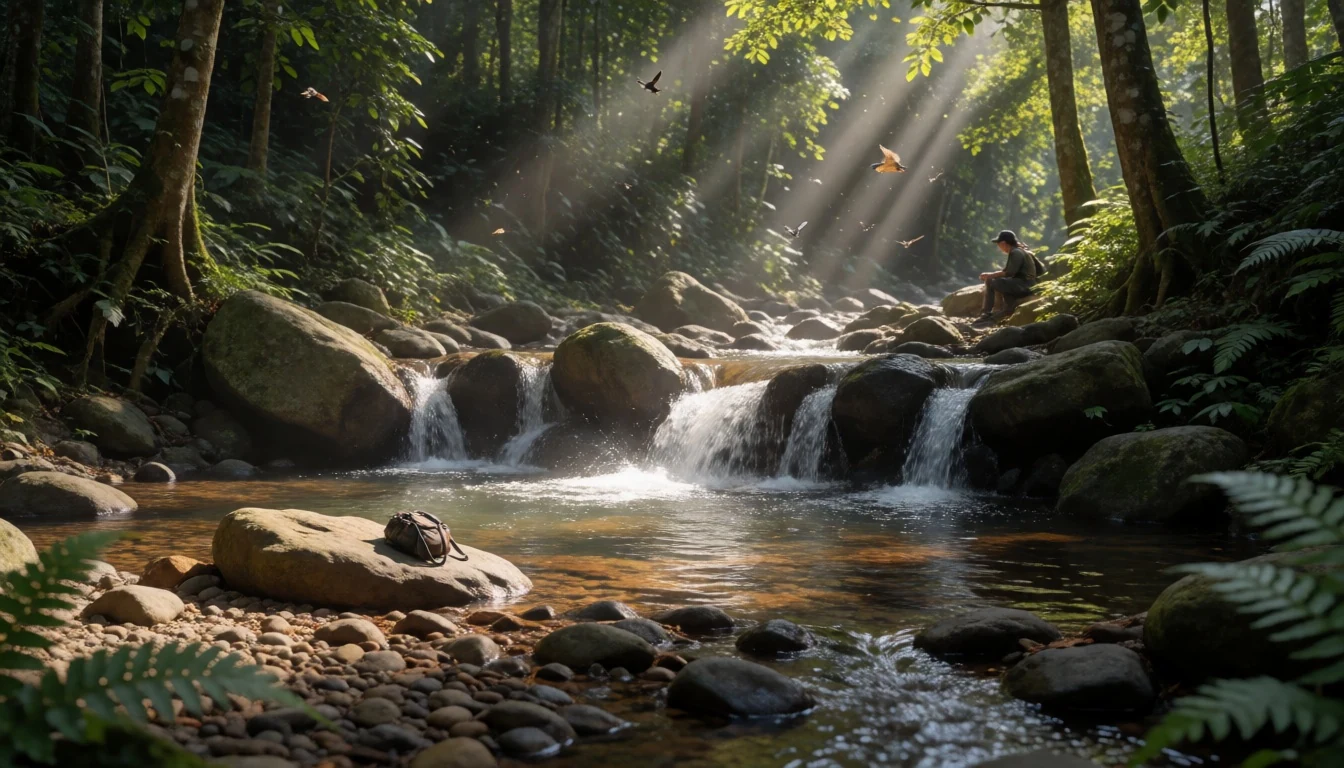
- Gunung Gading summit trail — Gunung Gading, Lundu district
A signed trail leads up Gunung Gading itself and takes about six hours for the return trip. It is a proper hill walk through dipterocarp forest over granite, hot and humid, with little in the way of views for much of the climb. Start early, carry plenty of water, and turn back if storms build.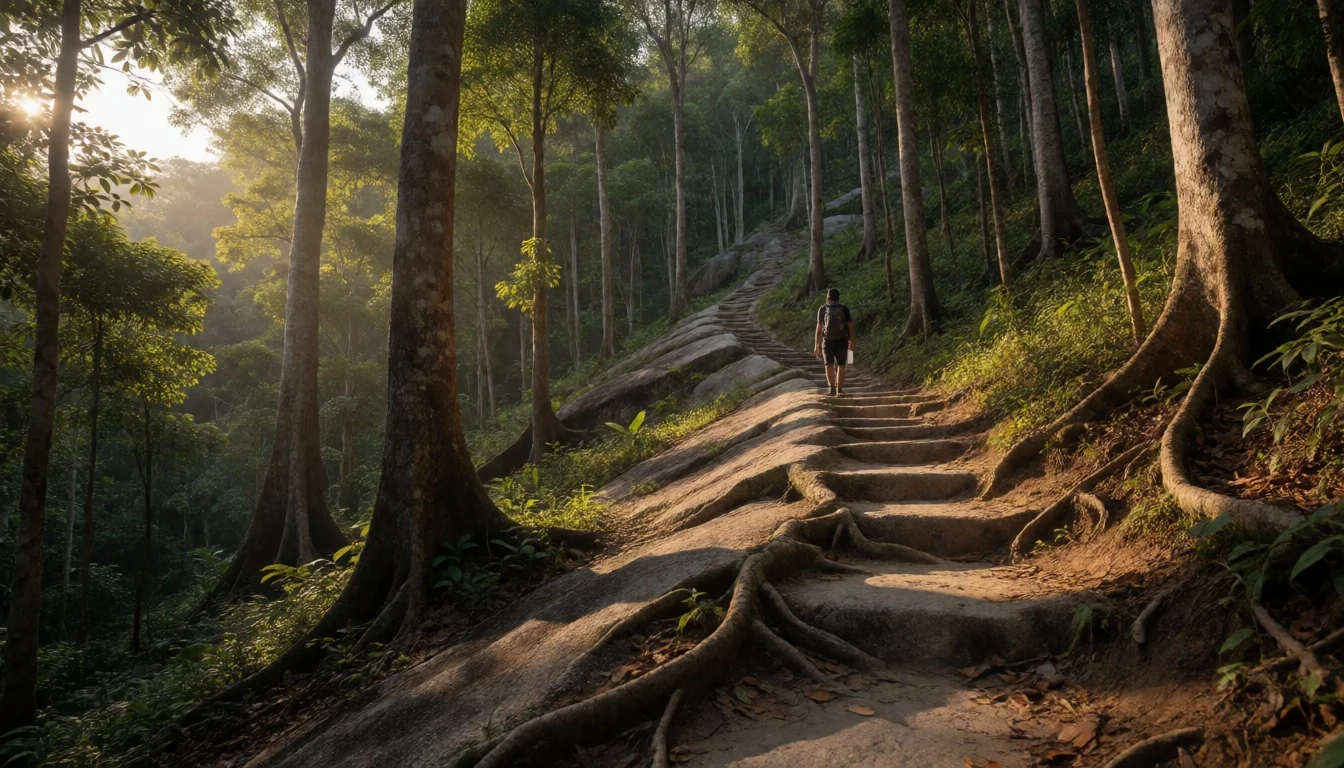
- Visitor centre and baruk — Park headquarters
The headquarters building takes its shape from a Bidayuh head-house, and the exhibits inside explain Rafflesia and the forest that shelters it. Beside it stands a baruk, the round communal house of the Bidayuh. It is a gentle place to start the day, and to finish if rain sets in.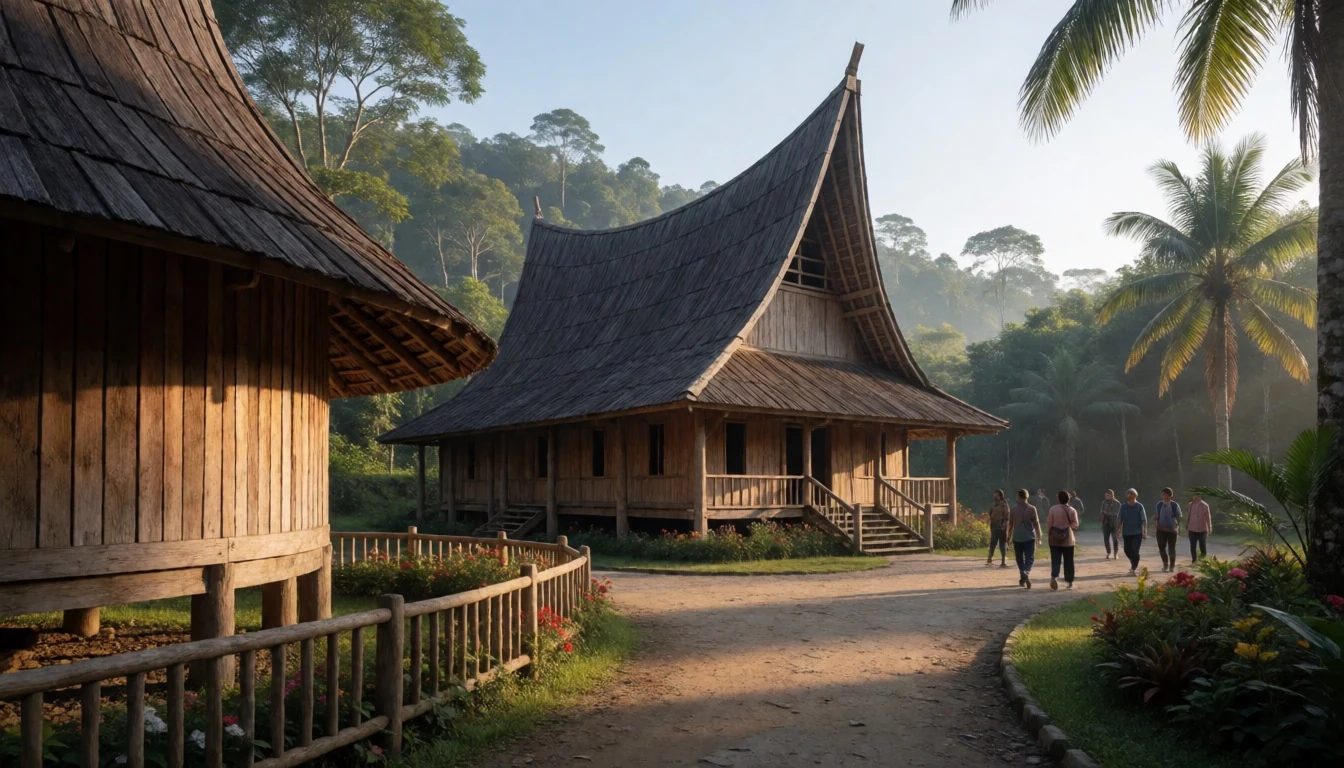
Culture
Gunung Gading National Park lies in country shared by several communities, among them Bidayuh, Iban, Malay and Chinese Malaysians, and the Lundu area carries the strongest Bidayuh identity. The Bidayuh traditionally lived in longhouses and in villages built around a baruk, a raised round house that served as a meeting place and was once used to keep ancestral trophies. The visitor centre at the park borrows that form deliberately, and a baruk stands close to it. Rice farming shaped the calendar here for generations, and the harvest festival Gawai Dayak, held each year at the start of June, is the main moment of celebration, with visits between houses, music, dancing and shared food and drink. Rice wine known as tuak is offered to guests during such occasions, and politeness matters more than quantity. Longhouse stays elsewhere in Sarawak give an insight into community life, and Annah Rais near Kuching is a well-known example of a Bidayuh village. In Lundu itself, daily life is quiet and practical: shopkeepers, farmers, boatmen and park staff, most of whom are glad to talk about the flower and the forest. Rainforest also carries meaning for the communities around it, as a source of food, medicine and building material, so the park is more than scenery. Ask before photographing people or entering a private home or baruk, and if you are offered a drink at a festival, accept a small taste and thank your host rather than refusing outright.
What to wear
Gunung Gading National Park is in Bidayuh country, and traditional dress here has centred on woven cloth, beadwork and ornament, worn mainly at festivals such as Gawai Dayak. Neighbouring Iban communities are known for pua kumbu, a cotton cloth patterned by tie-dyeing the threads before weaving, while Malay families wear batik and songket for weddings and prayers. Bidayuh festival dress typically includes beaded necklaces, decorated headgear and dark, richly trimmed garments, though styles differ from village to village. Everyday clothing in Lundu is far simpler: cotton T-shirts, shorts or lightweight trousers, sarongs at home, and rubber sandals or boots for the farm. Younger people dress much as they would in Kuching, with jeans and branded shirts. Many Muslim women wear a tudung headscarf with a long loose tunic. A visitor should dress for heat, humidity and mud. Quick-drying shirts and light long trousers protect against leeches, scratches and insects, and a light rain jacket is useful in any month. Footwear matters most: shoes with good grip, or sturdy sandals that can get wet, since the waterfall paths are slippery. Cotton socks pulled over trouser hems help keep leeches out. Swimwear is fine at the pools if worn with a cover-up on the way there. In villages, in the town and at a longhouse or baruk, shoulders and knees should be covered, and swimwear belongs strictly at the water.
What to eat
- Manok pansoh — Village-style eateries around Lundu and Kuching
Chicken cooked inside a length of bamboo with lemongrass, ginger and tapioca leaves, an Iban dish that has become a Sarawak favourite. The bamboo seals in the steam, so the meat turns soft and smoky-sweet. It appears at village-style eateries and festival tables.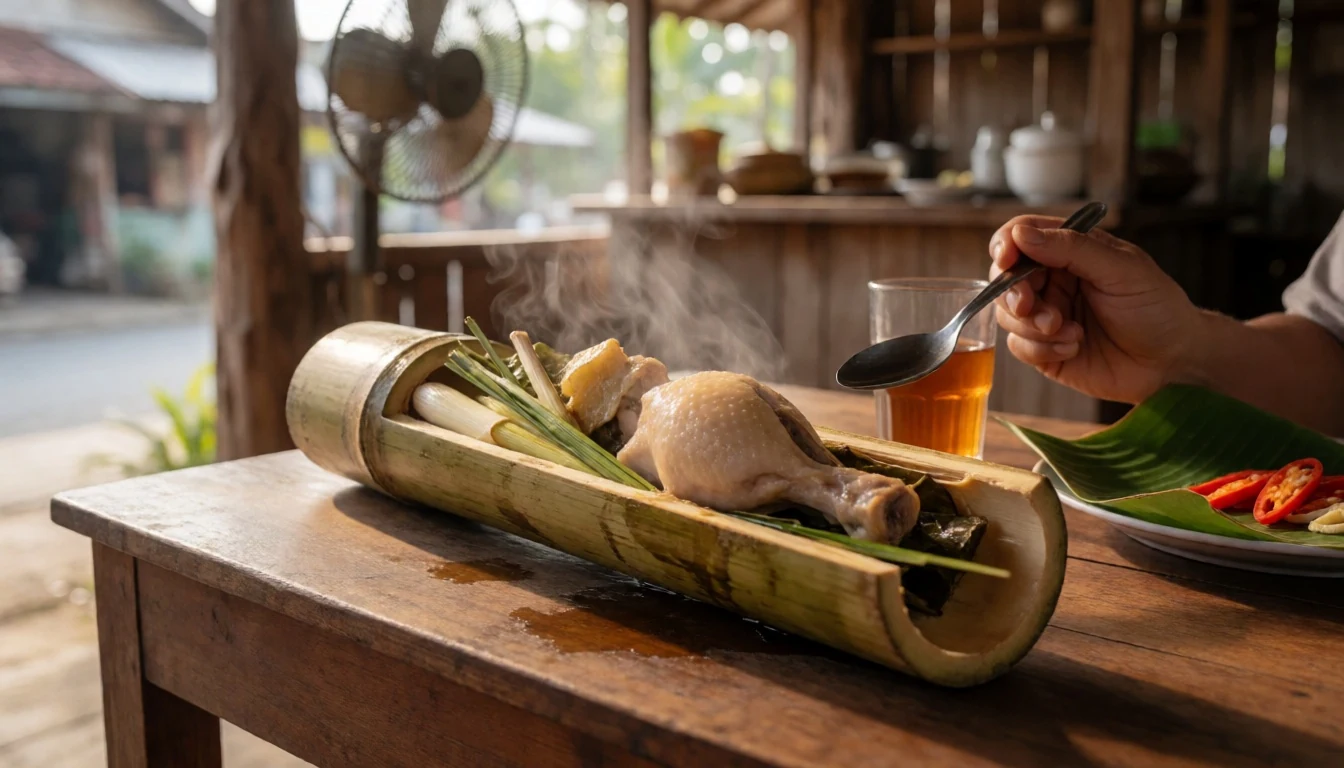
- Midin — Rice-and-dishes stalls and coffee shops in Lundu
A wild jungle fern with curled tips and a crisp, slightly grassy bite, usually stir-fried with garlic or belacan shrimp paste. It is a common side dish across Sarawak and a good way to taste the forest on a plate.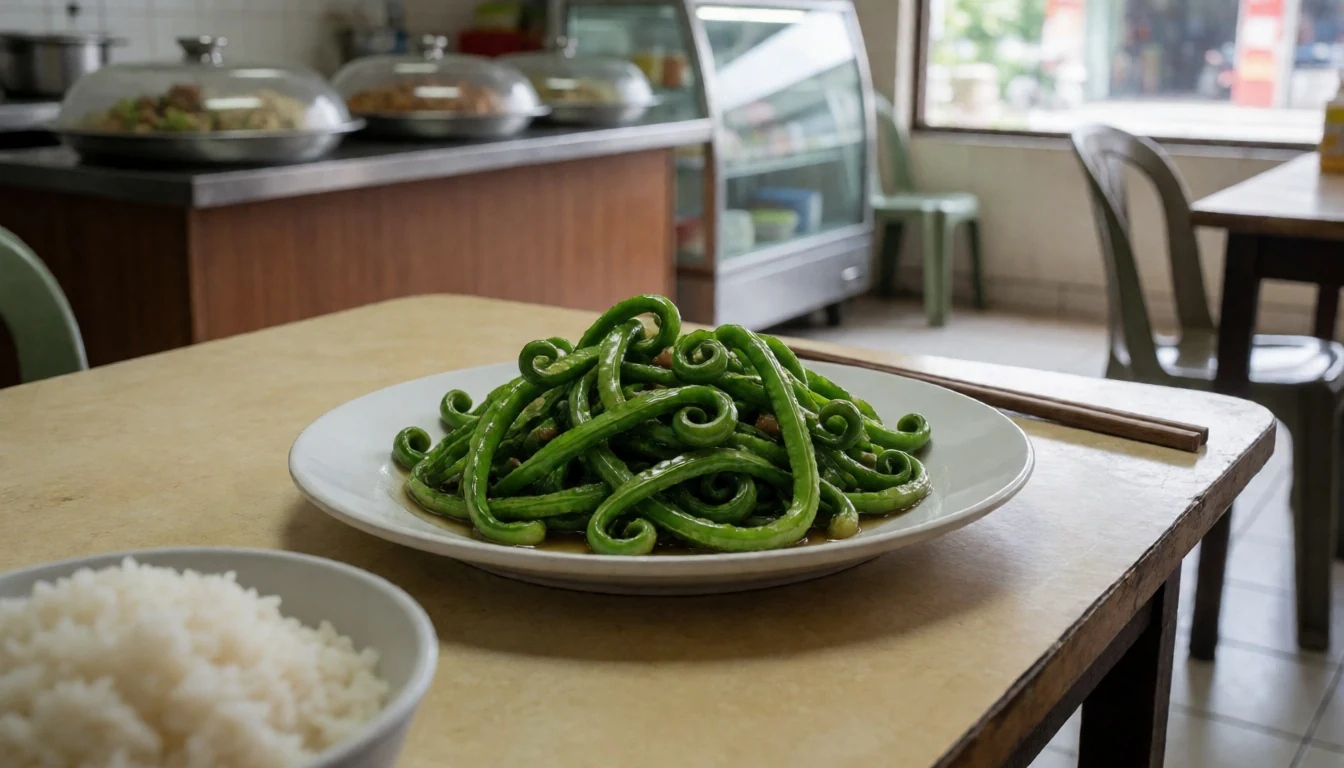
- Sarawak laksa — Morning coffee shops in Lundu and Kuching
A noodle soup built on a spiced paste of sambal belacan, tamarind, lemongrass and galangal, topped with prawns, shredded chicken and omelette strips. Locals eat it at breakfast. It tastes quite different from laksa in peninsular Malaysia or Singapore. - Kolo mee — Hawker stalls and coffee shops in town centres
Springy egg noodles tossed dry with a light sauce, minced pork or chicken, and slices of char siu. It is a simple, cheap Sarawak staple, and a sensible fuel before or after a long walk in the forest. - Tuak — Longhouses during festivals, bottled in supermarkets in Kuching
A home-brewed rice wine made in longhouses, sometimes from sago or other sources of sugar, and offered to guests at festivals. It is mild, sweet and cloudy when homemade, while bottled versions are clearer and sold as souvenirs. Take it slowly.
Plan it
Best time. June to September is generally the drier part of the year in Sarawak, which makes the trails easier and the pools more inviting. The wetter months, roughly November to February, bring heavy rain and slippery paths. Rafflesia can flower at any time, so check bloom news before choosing dates.
How long. 1–2
Getting there. Fly to Kuching International Airport (KCH), the state capital's gateway, which has flights from Kuala Lumpur, Kota Kinabalu, Singapore and Bandar Seri Begawan. Lundu is about 75 km southwest by road, and the park lies just beyond the town. Take a taxi, hire a car or ask about buses; check the current options locally.
Budget. mid
Tips
- Phone the park or check with Sarawak Forestry before you travel to ask whether any Rafflesia is in bloom
- Start walks early, as afternoon storms are common and the heat builds quickly
- Carry cash for Lundu's shops and small eateries, and bring your own drinking water
- Wear trail shoes with good grip, and pack insect repellent and a light rain jacket
- Check opening hours and entry fees on the official park pages, since they can change
Etiquette
- Stay on marked trails and never pick or touch the Rafflesia
- Take all litter out with you and keep noise low so wildlife stays visible
- Ask before photographing people or entering a baruk or private home
Nearby
Sources
- Wikidata Q65071172 (CC0)
- Wikipedia: Gunung Gading National Park (rev 1369276149) (CC BY-SA 4.0)
- Wikivoyage: Sarawak (rev 5314426) (CC BY-SA 4.0)
- Waterfall in Mt Gading NP, Annette Teng (CC BY 3.0)
- Gunung Gading NP, Sarawak, MALAYSIA, Bernard DUPONT (CC BY-SA 2.0)
- Topographic locator map of Borneo, Sadalmelik (CC BY 3.0)
- Baruk next to the headquarters, Cerevisae (CC BY-SA 4.0)
- Gading waterfall No. 7, KelvinToh (CC BY-SA 4.0)
- Gunung Gading National Park headquarters, Cerevisae (CC BY-SA 4.0)
- Rafflesia tuan-mudae, Pavel Kirillov (CC BY-SA 2.0)
- The long-nosed horned frog with three mosquitos, Pavel Kirillov (CC BY-SA 2.0)


