Guinsa
Guinsa, South Korea
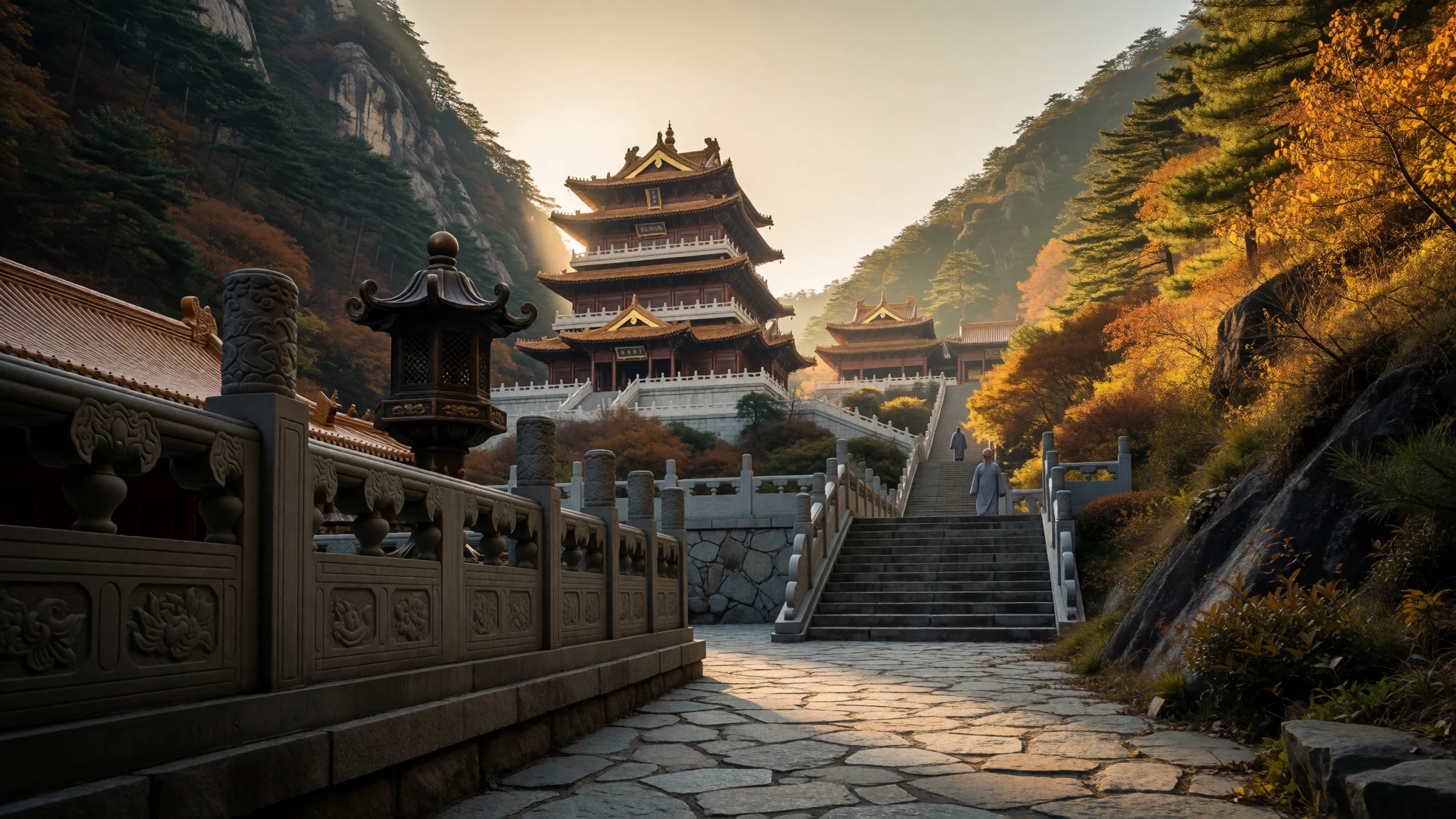
Guinsa is a working Buddhist headquarters of tall, ornate halls stacked up a mountain valley, where visitors can share a free vegetarian meal.
The place
Guinsa sits in a narrow valley of the Sobaek Mountains, near Danyang in Chungcheongbuk-do, South Korea. It is the headquarters of the Cheontae school of Korean Buddhism and the administrative centre for a large network of sub-temples and hermitages belonging to the sect. The name translates roughly as Temple of Salvation and Kindness.
What sets the place apart is its shape. Most Korean temples spread out in low halls of one or two storeys. Here the valley leaves little flat ground, so the builders went upward, and the halls rise several storeys, most of them in concrete with richly painted and gilded decoration. Walking through feels less like a village of pavilions and more like climbing a mountain-side town of stairs, bridges and terraces.
It is also a working community rather than a museum. Monks live and study here in large numbers, and the temple runs its own farm, which supplies much of the food served in the cafeteria. Huge clay pots of kimchi stand in the central courtyard. Pilgrims arrive for retreats and sleep in the dormitories, while day visitors come to climb, look and share a simple meal. Weekends and Buddhist holidays bring the biggest crowds, and the stairs fill with pilgrims. Because the valley is steep and enclosed, the light fades early in the afternoon and the air is cooler than in the towns below.
Its story
Guinsa is young by Korean temple standards, founded in 1945 by the monk Sangwol Wongak (上月圓覺). He read the Lotus Sutra as pointing to this cramped, mountain-ringed valley, and that reading decided where the temple would stand. The first buildings were burned down during the Korean War, and the first rebuilt hall was finished in 1966. Construction has barely paused since, and dozens of structures now fill the slopes, with more still being added.
The teaching behind the temple is far older. The Cheontae school goes back to the Chinese master Zhiyi, who in the late sixth century systematised the Lotus Sutra teaching and founded the school. Korean monks from the Silla kingdom crossed to China to learn it. Yeongwang studied under Zhiyi and later returned to Silla to teach, and in the early eighth century three more Silla monks trained under another Chinese master and carried the doctrine home.
Guinsa is where that lineage was revived in modern Korea. In 1967 the Cheontae school was re-established here and registered with the government as the Cheontae Order, with Sangwol taking the role of its First Patriarch. The five-storey Dharma Law Hall followed, and in 1982 a Buddhist college opened at the Geumgang Institute. The temple is therefore both recent and deeply rooted: concrete halls built within living memory, serving a tradition that has been taught in Korea for many centuries.
What to see
- Bus terminal and the climb — Valley floor
The bus terminal is built in temple style at the bottom of the valley, and it is the best place to get your bearings. From here the road climbs steadily to the temple proper. Take it slowly: the whole complex is a staircase, and the views back down the valley improve with every landing.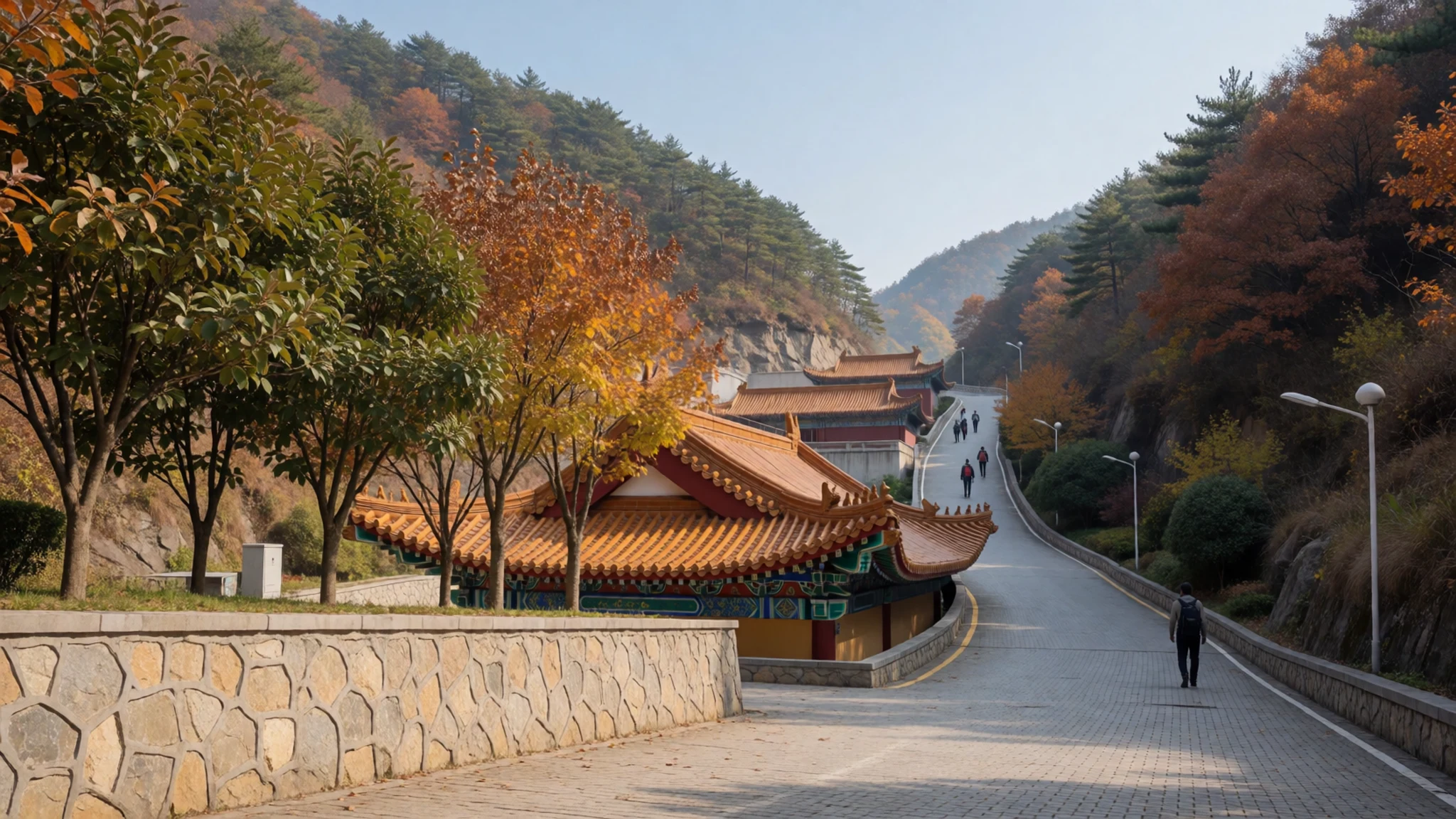
- Four Heavenly Kings Gate — Lower temple
This gate marks the start of the temple itself. The four heavenly kings, the guardian figures of Korean Buddhism, stand inside, and visitors can climb to the upper floor to see the statues. It is a good moment to pause, catch your breath and shift into a quieter pace before the main halls.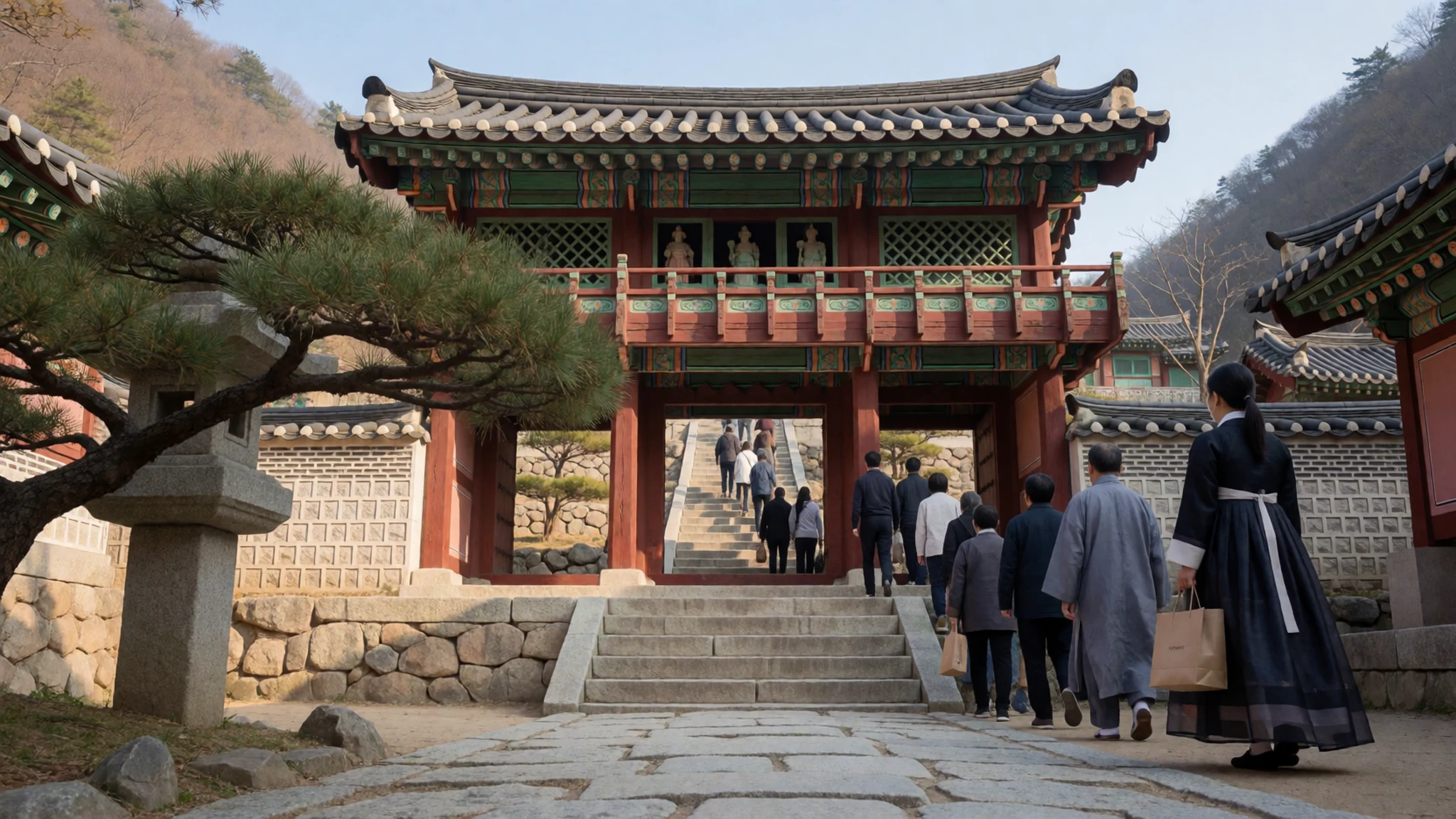
- Five-Storey Dharma Law Hall — Central temple
The main hall of the complex rises through five floors, with maroon glazed roof tiles and heavy decoration outside. The reward for climbing to the top floor is a gilded main altar to the Buddha Shakyamuni, flanked by his attendants. Photography is not allowed inside, so look properly and keep voices low.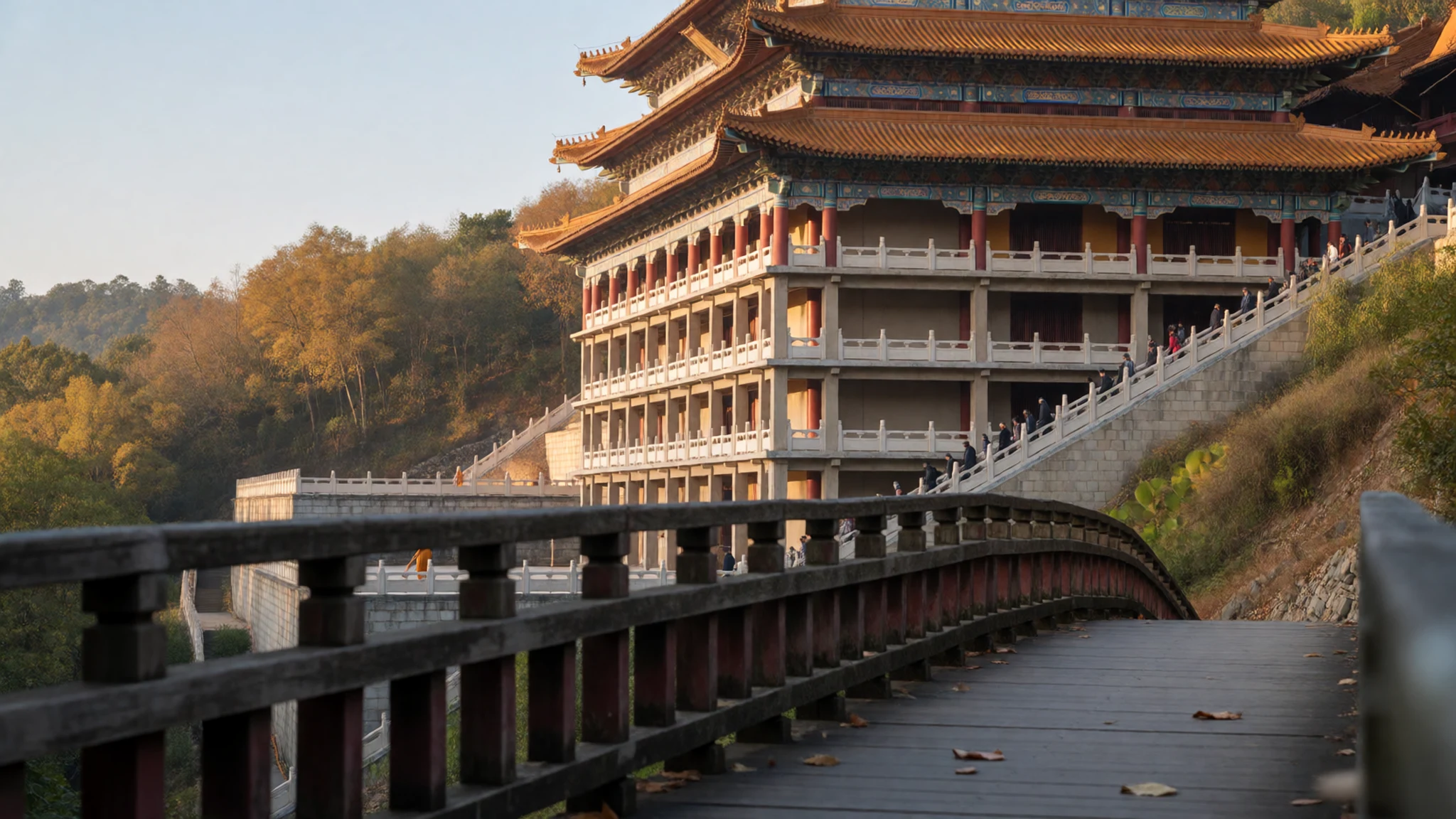
- Central courtyard and kimchi pots — Middle of the complex
Bridges cross over and under one another to reach the central courtyard, where huge clay pots sit on almost every flat surface. These hold the temple's kimchi, which feeds the monks and visitors. The cafeteria hall beside it serves the meals, and a dark passageway nearby leads on to more stairs.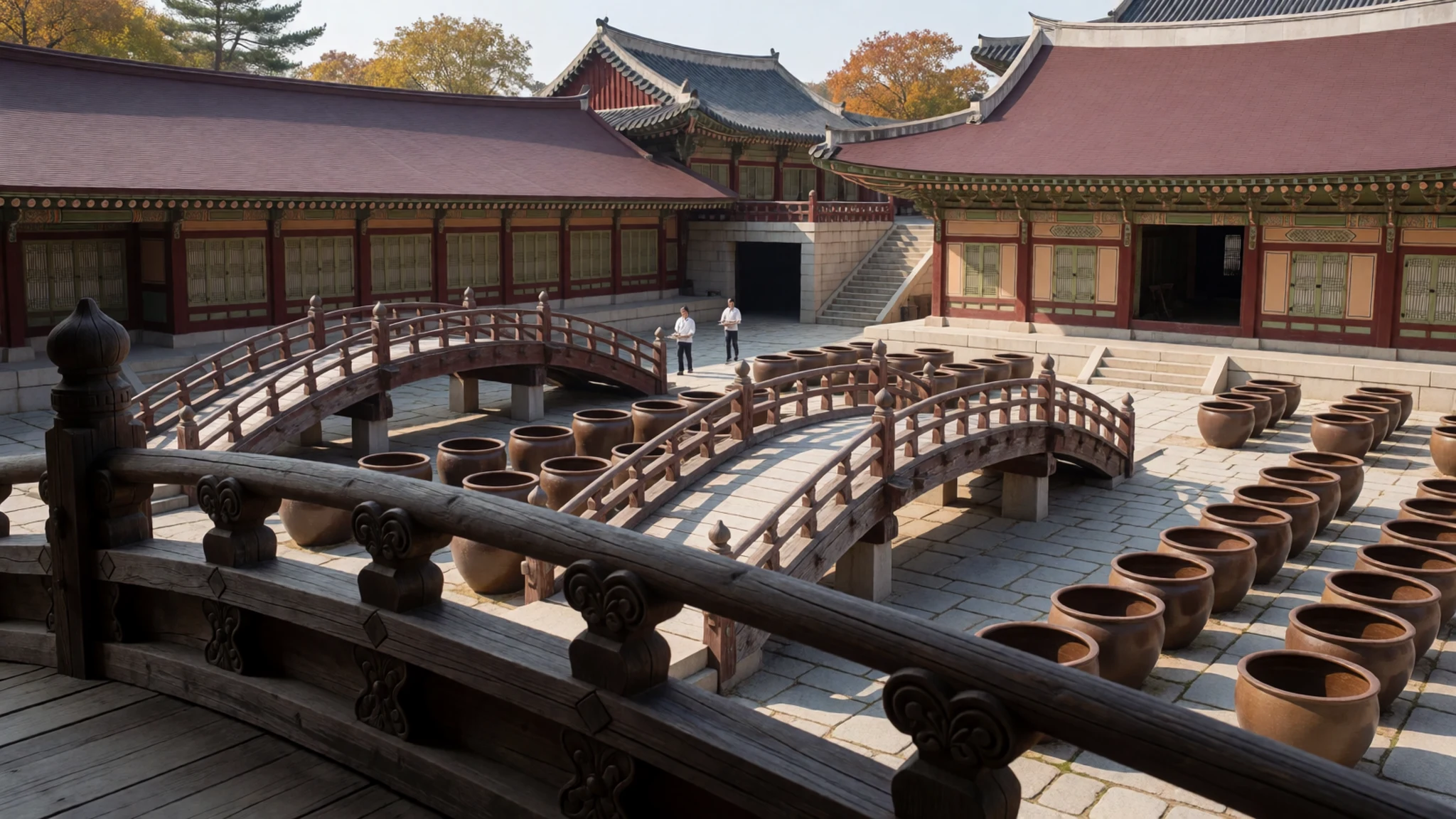
- Great Teacher Hall — Upper temple
The Great Teacher Hall (Daejosajeon) is a shrine to the founder Sangwol Wongak, and a large statue of him stands inside. It sits near the top of the climb, so the walk up passes much of the complex on the way. Devotees often stop here to bow, so wait quietly for a clear view.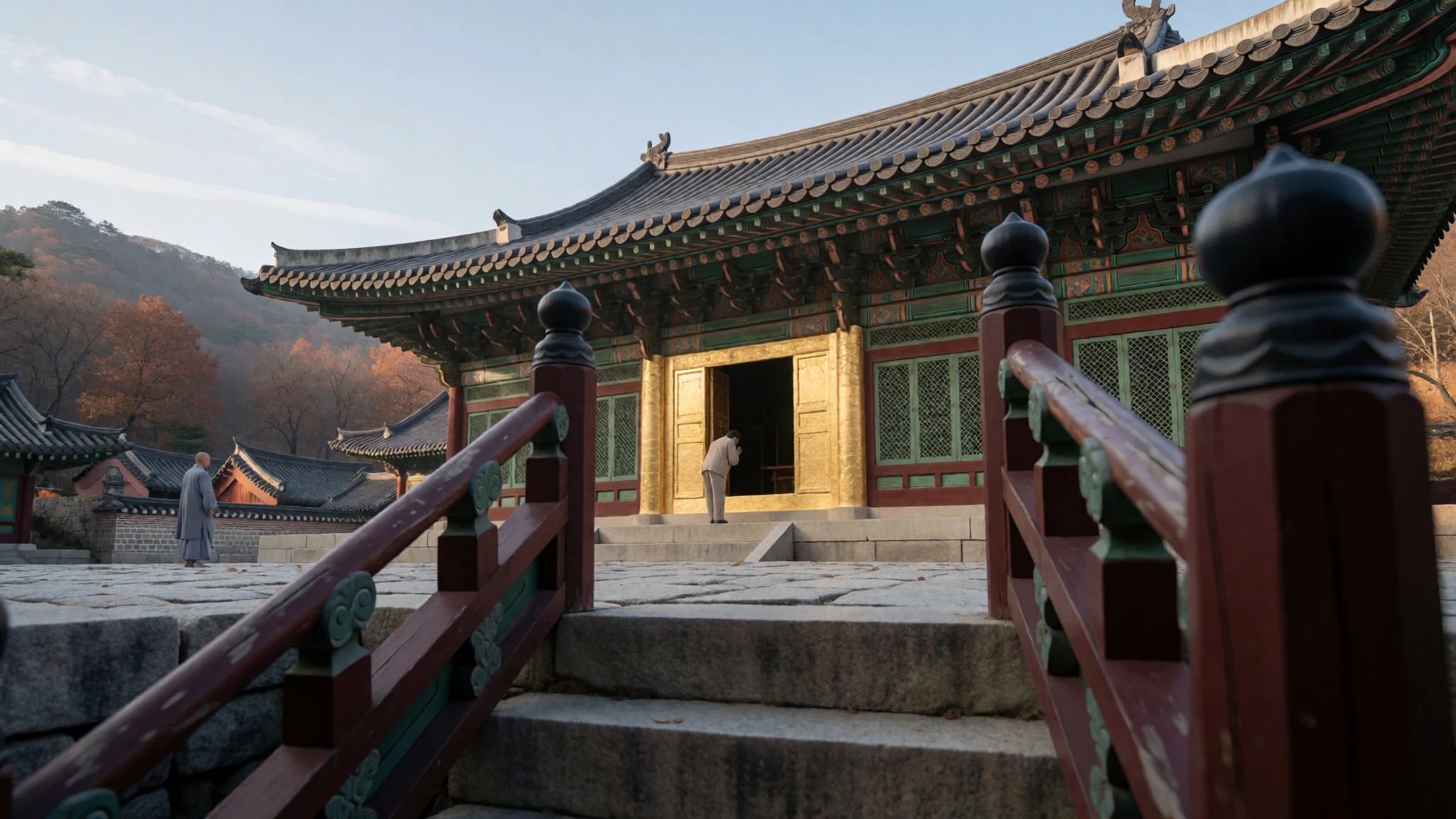
Culture
Guinsa is a living centre of Cheontae Buddhism, and daily life follows a rhythm of study, chanting and communal meals rather than sightseeing. The Cheontae school draws on the Lotus Sutra, and its monks combine scriptural study with meditation, which is why the complex includes a Buddhist college alongside its halls. Pilgrims come in large groups to pray, attend retreats and stay in the dormitories.
Buddhism in Korea is closely tied to food and hospitality. Sharing a meal in the cafeteria is part of the temple experience: the meals are vegetarian, served at fixed times, and offered to anyone regardless of faith. Donations are welcome but not expected, and many visitors leave a small offering at a hall as thanks. The custom at temple meals is to take only what can be finished.
The main halls hold gilded images of the Buddha and his attendants, and statues of the four heavenly kings guard the lower gateway. Visitors will see people bowing deeply, prostrating on cushions and walking slowly around the halls. Quiet matters more than ceremony here. A statue in the Great Teacher Hall honours the founder Sangwol Wongak, and devotees often pause before it.
Remove your shoes before stepping into any hall, keep your voice low, and do not take photographs inside the Law Hall.
What to wear
Guinsa is a Buddhist temple, so the clothes seen here are mostly practical: monks in plain robes, pilgrims in simple layers. Traditional Korean dress is the hanbok, with a short jacket (jeogori) over a full wrapped skirt (chima) for women and loose trousers (baji) for men. It was historically made from silk, ramie and hemp, and today it is worn chiefly at weddings, festivals and family holidays such as Seollal and Chuseok. Monks wear loose grey or brown robes of plain cloth, with an outer layer for ceremonies.
Day to day, most Koreans wear modern clothes, and at Guinsa that means comfortable trousers, fleeces and walking shoes. Pilgrims who stay overnight tend to wear loose, plain clothes that suit sitting on the floor and long periods of chanting.
A visitor should dress modestly: covered shoulders and knees, nothing see-through, and layers that are easy to adjust. The valley is cool in the evenings even in summer and cold in winter, so bring a warm layer. The temple is steep, with long flights of stairs, so wear shoes with good grip that are easy to slip off, and carry clean socks for walking inside the halls.
What to eat
- Temple rice (bap) — The main cafeteria hall
Plain steamed rice is the base of every meal in the temple cafeteria. It is served free at set times to anyone who visits. Expect simple, filling food rather than anything seasoned for flavour, and arrive on time, since the kitchen does not serve outside meal hours.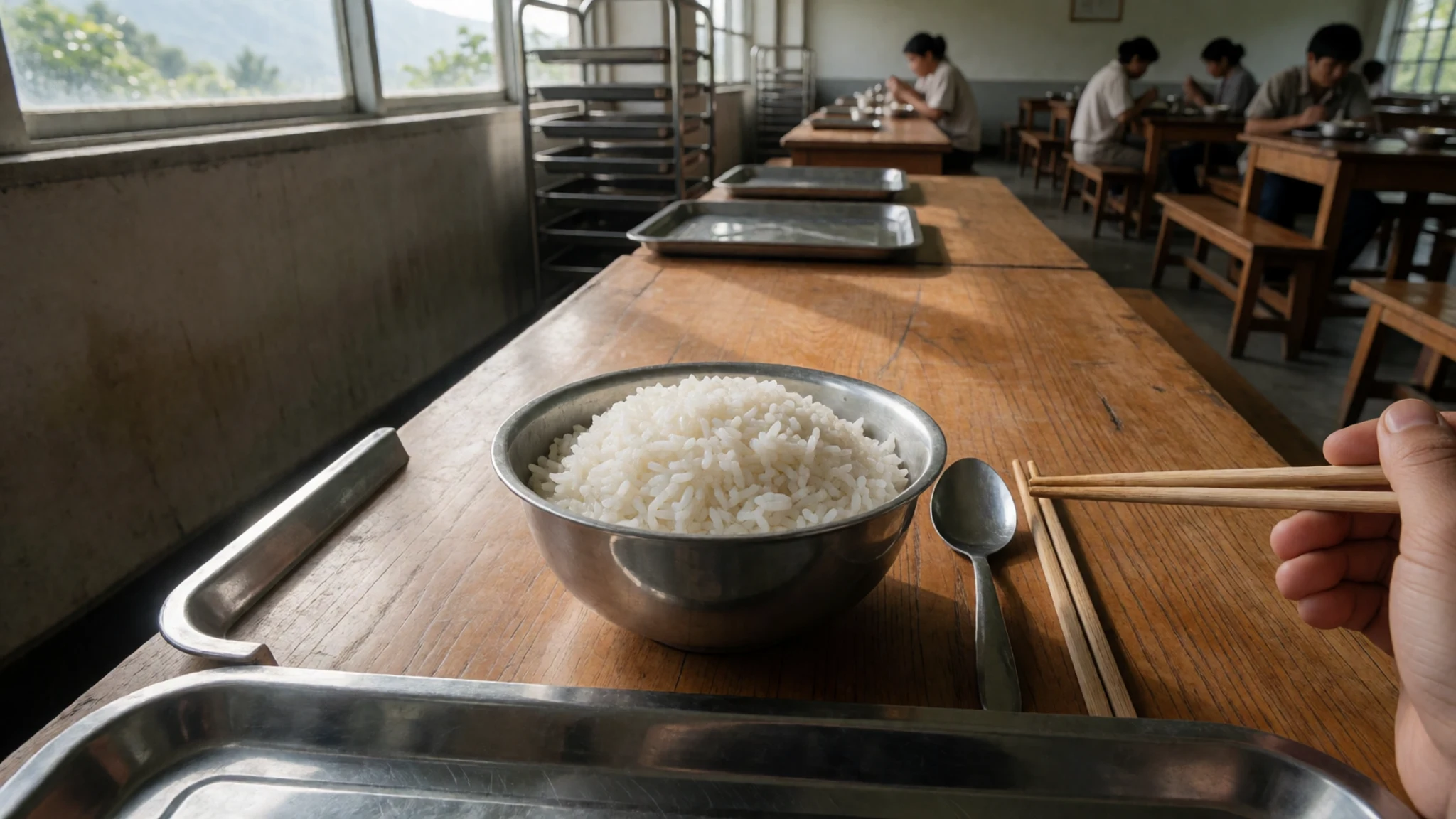
- Temple kimchi — Cafeteria hall, with the clay pots in the central courtyard
The kimchi is stored in the huge clay pots that fill the courtyard, then served at every meal. It is vegetarian, made for a large community, and a good way to taste how the temple feeds itself from its own farm and stores.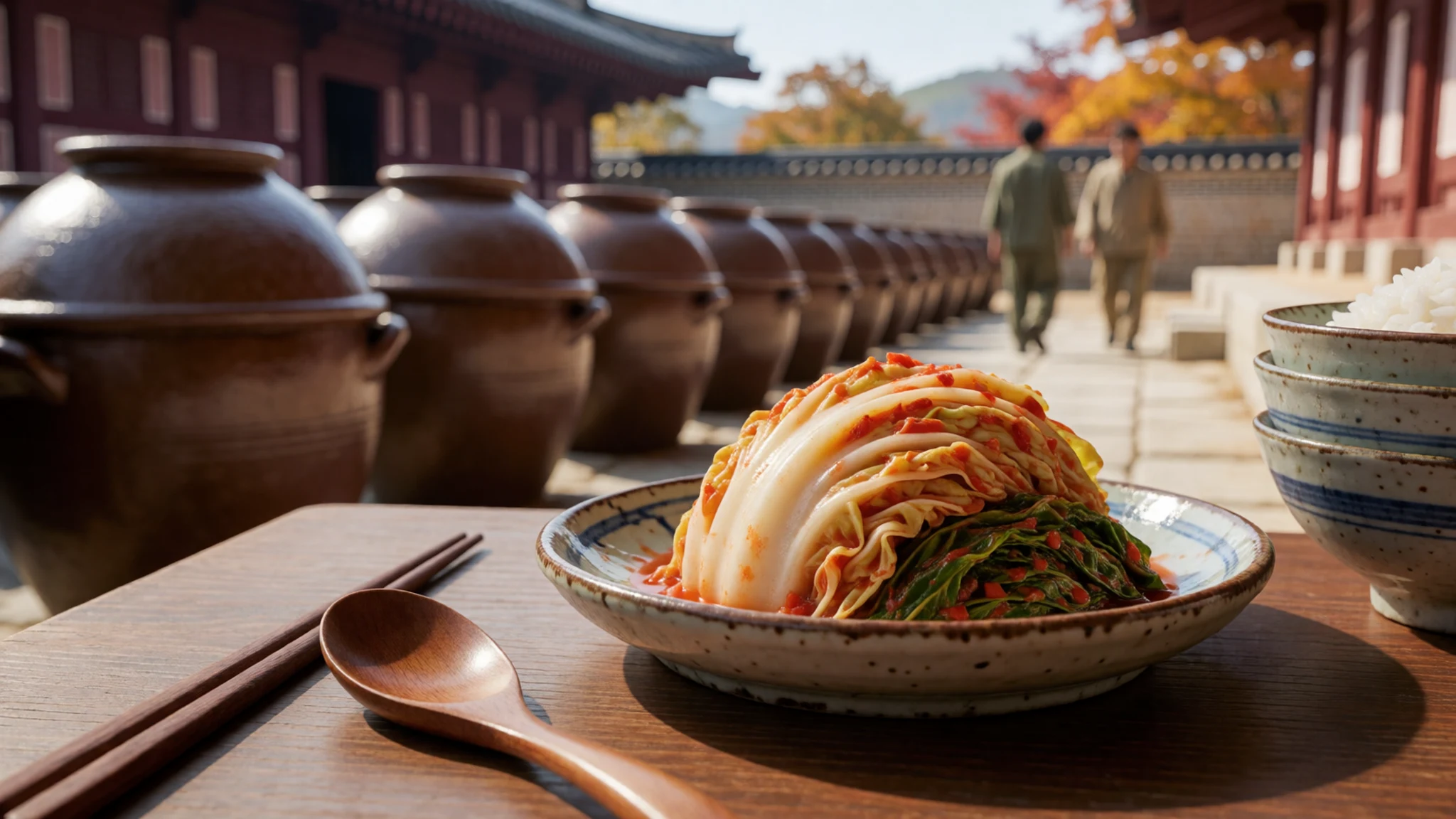
- Vegetable soup (guk) — The main cafeteria hall
A simple, mild vegetable soup completes the three-part temple meal of rice, kimchi and soup. It is warming on cold mornings in the valley. The meal is vegetarian and offered without charge, with donations welcome but not expected. - Instant noodles and snacks — The shop at the bus terminal
Temple meals are plain, so many visitors bring or buy snacks. The shop at the bus terminal sells instant noodles, and vending machines across the site supply tea, coffee, soft drinks and fresh water. It is useful for long days of climbing. - Restaurant meals in the tourist village — Restaurants downhill from the temple and above the bus terminal
For a fuller meal, there is a restaurant on the upper floor of the bus terminal building, and the tourist village downhill has a whole row of eateries. Go there for a choice of dishes beyond the temple's vegetarian set meal.
Plan it
Best time. April–May and October–November, when the mountain air is mild and the Sobaek hills are green or turning to autumn colour. Summers are warm and wet, and winters are cold in the valley, so pack layers whenever you go.
How long. 1–2
Getting there. Guinsa can be reached only by bus or private car. The nearest rail towns are Danyang, a short express bus ride away with hourly departures, and Jecheon, about an hour away. Direct buses run from Seoul's Dong-Seoul terminal via Danyang, with fewer from Busan and Cheongju; check current timetables before travelling.
Budget. low
Tips
- Meals are served only at set times, so plan the day around lunch and bring snacks.
- Weekends and Buddhist holidays are crowded; a weekday morning is quieter.
- Staying overnight in the dormitories means registering at reception first, so ask early and check whether anyone there speaks English.
- Allow plenty of time for the stairs and wear shoes with good grip.
- Fresh water and drinks are available from vending machines across the site.
Etiquette
- Take off your shoes before entering any hall and keep your voice low.
- Do not take photographs inside the Law Hall.
- Take only as much food as you can finish at the cafeteria.
Nearby
Sources
- Wikidata Q5616611 (CC0)
- Wikipedia: Guinsa (rev 1377453096) (CC BY-SA 4.0)
- Wikivoyage: Guinsa (rev 4692333) (CC BY-SA 4.0)
- Steve46814, Guinsa Nestled in the Valley (3027-07) (CC BY 3.0)
- Steve46814, Guinsa Nestled in the Valley (3026-07) (CC BY 3.0)
- Steve46814, Cheontae Sect Logo at Guinsa (CC BY 3.0)
- Steve46814, Great Teacher Hall (Daejosajeon) (CC BY 3.0)
- Steve46814, Guinsa Sawoosil (Dormitory) (CC BY 3.0)
- Steve46814, Guinsa (3005-07) (CC BY 3.0)
- Steve46814, Guinsa Tohang Hall (CC BY 3.0)
- Steve46814, Guinsa Hall with Maroon Glazed Roof Tiles (CC BY 3.0)


