Guilin
Guilin, People's Republic of China
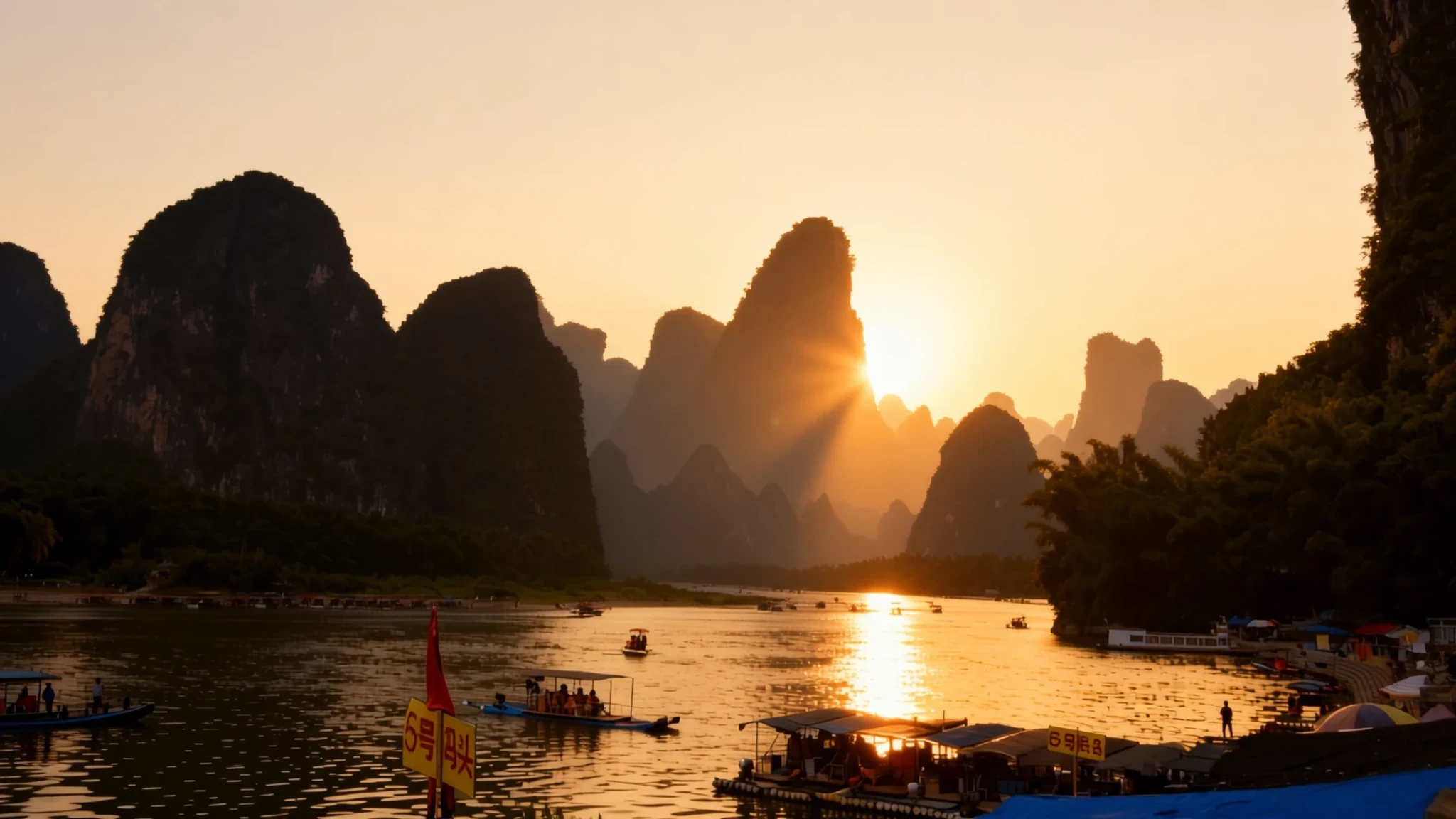
Guilin sets a working river city among steep limestone hills, with caves below and rice terraces in the counties beyond.
The place
Guilin stands in northeastern Guangxi, a riverside city on the Li whose ordinary streets are broken by limestone hills rising straight from flat ground. The centre is compact. Central lakes, older lanes and the willows along the water can be crossed on foot, while the scenery associated with the name starts at the bank and continues downstream, the towers packing closer as the channel bends toward Yangshuo. Elephant Trunk Hill is the outline the city uses to introduce itself: a spur of rock that meets the water like a trunk. From its paths the roofs, the Sun and Moon Pagodas and the next rank of karst sit together. Autumn is sunny, dry and kinder for walking, while spring is overcast and often rainy. Summer is hot, humid and liable to hard rain, and the Li can run high and muddy after storms. Winter is mild set against the north of the country, yet damp, and whole ridges disappear into cloud. Below the streets the stone is hollow. Reed Flute Cave is the cavern most people enter, a run of chambers and a still pool washed in strong colour, with smaller caves scattered through the same karst. Above ground the Li and its branches have been drawn into a circuit of lakes and channels, so a short evening boat is as ordinary as a bus. Guilin is a working prefectural capital, not a preserved district: noodle shops, school runs and new towers share the blocks with older brick. Most people in Guilin are Han, with a large Zhuang community and Yao, Miao and Dong families whose villages sit out in the counties. Zhuang is an official language of Guangxi beside Mandarin.
Its story
Guilin takes its name from the osmanthus trees that flower through the city when the year cools, and the scent still shows up in parks and side lanes in autumn. For a long stretch of imperial rule this was a southern post on the routes between the central plains and the coast: a town to garrison, supply and administer, with the river doing the work of a road and the hills standing in for a wall. The place that makes that past physical is Jingjiang Princes' Palace. A Ming princely household kept court inside these walls, and the compound still reads as a small capital: halls on an axis, a lone peak enclosed with the buildings, gates that face the modern city rather than open country. The ticketed core sits against ordinary streets, so a visit runs from ceremonial stone straight out to a noodle shop. Fame arrived through pictures and poems. Travellers coming south found another isolated peak at every bend of the river, and they set that view into albums and verse until Guilin's scenery became a phrase. Boats and a downstream stop at Yangshuo now turn that subject into a day on the water, while the city remains a prefectural capital of schools, markets and offices. In the counties, Zhuang farmers and Yao and Dong communities toward Longsheng cut rice terraces that follow the slope. Those fields are visited as landscape and are still planted by the families who live above them.
What to see
- Elephant Trunk Hill — Xiangshan, central Guilin
Elephant Trunk Hill is Guilin's riverside landmark, a limestone spur whose arch and descending trunk meet the Li and give the rock its name. Paths around the hill are short, and the reward is the city itself: roofs, lake pagodas and the next rank of karst beyond the water. Midday coach parties crowd the steps, so morning and late afternoon are the calmer hours.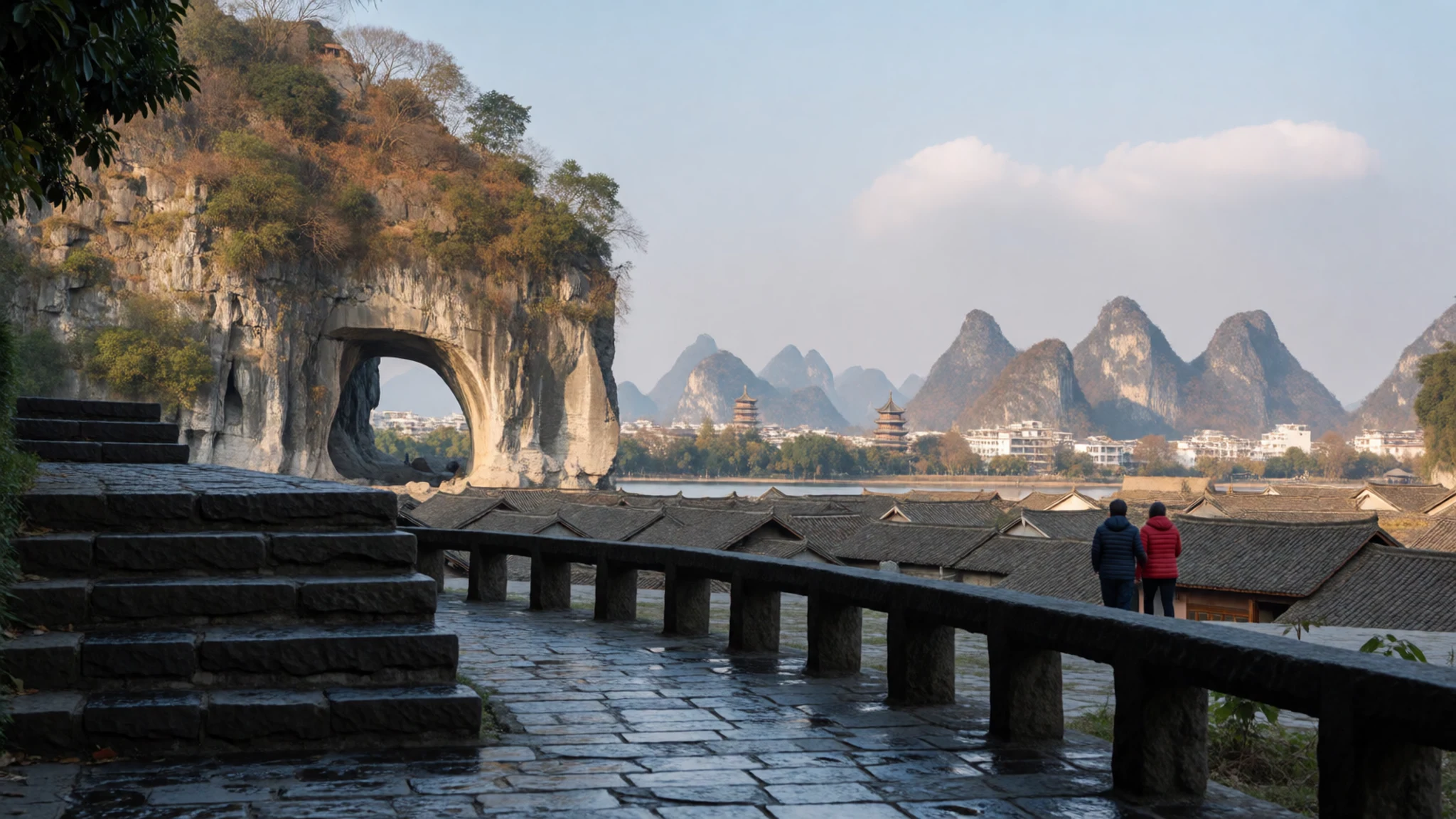
- Li River — Li River, Guilin to Yangshuo
The Li River downstream of Guilin is the passage through this karst that most visitors take, a slow run between towers that stand alone in fields and bamboo. Boats large and small run toward Yangshuo, where the hills tighten and a town replaces the city. Expect a long, quiet middle and a busy start and finish; haze, high water and muddy colour after rain are normal.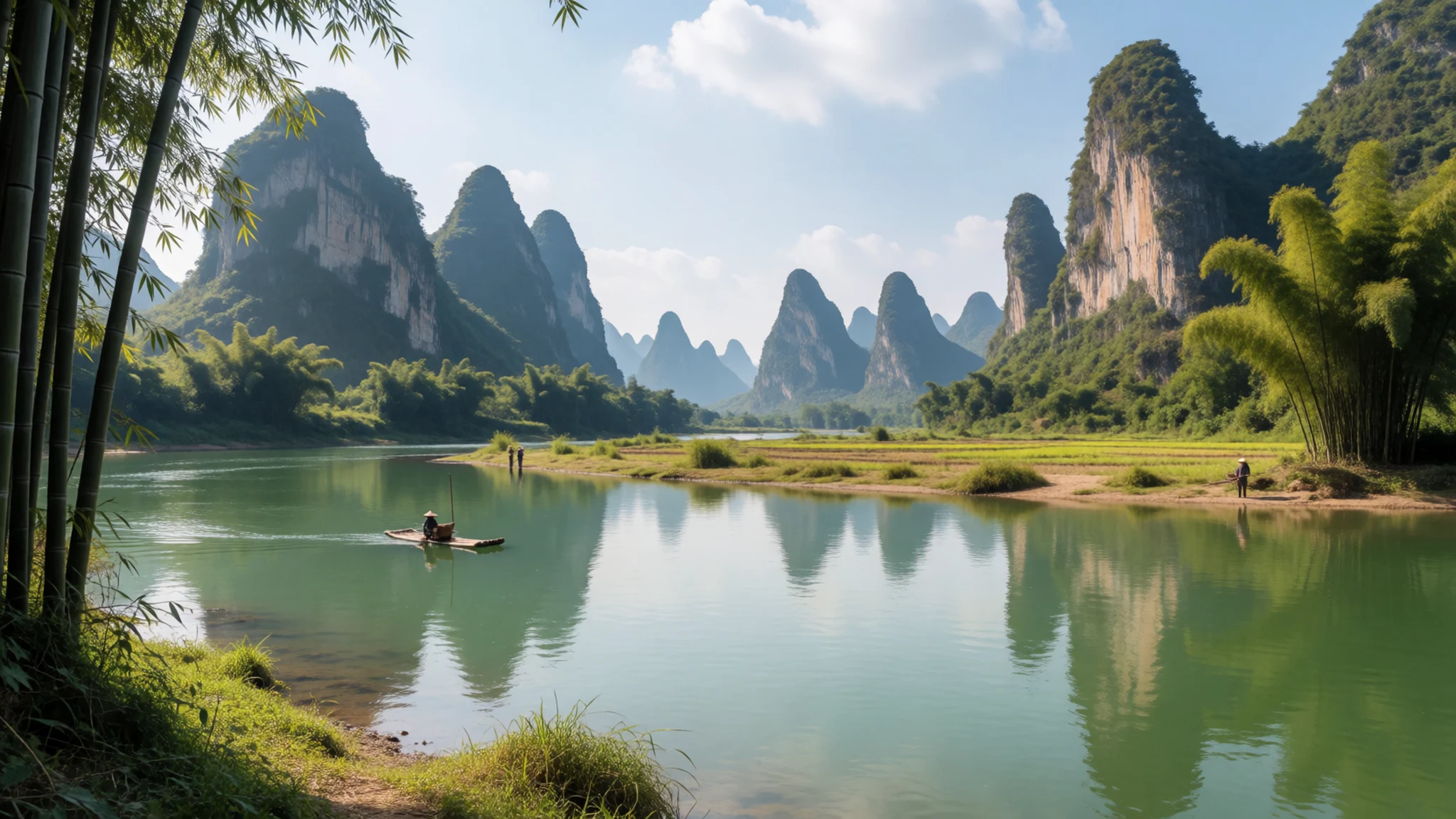
- Reed Flute Cave — northwestern Guilin
Reed Flute Cave is Guilin's show cavern, a lit sequence of chambers in the karst on the northwestern side of the city. A still pool is clear enough that the waterline vanishes. Fixed lights push strong reds, blues and greens, and the paved path turns damp and crowded when tour groups overlap. The same limestone as the outdoor hills appears here. Steps are slippery and the commentary is amplified.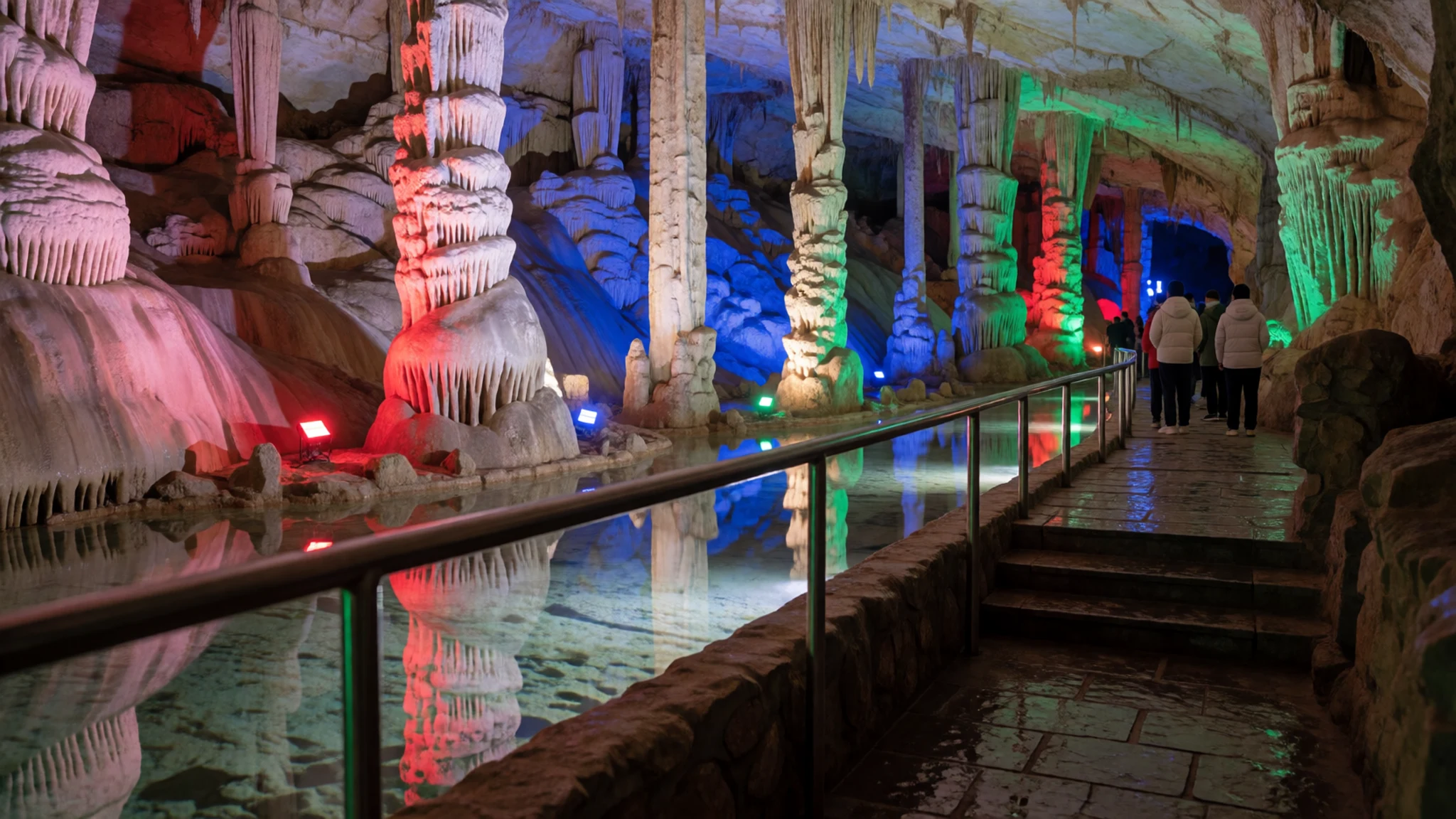
- Sun and Moon Pagodas — Shan Lake, central Guilin
The Sun and Moon Pagodas stand in Guilin's Shan Lake, towers of different height and colour that anchor the evening circuit of lakes and channels. Night is when they earn the walk: the banks are lit, boats move slowly, and the city looks deliberate rather than busy. Holiday evenings fill the paths, but the walk itself is flat and central.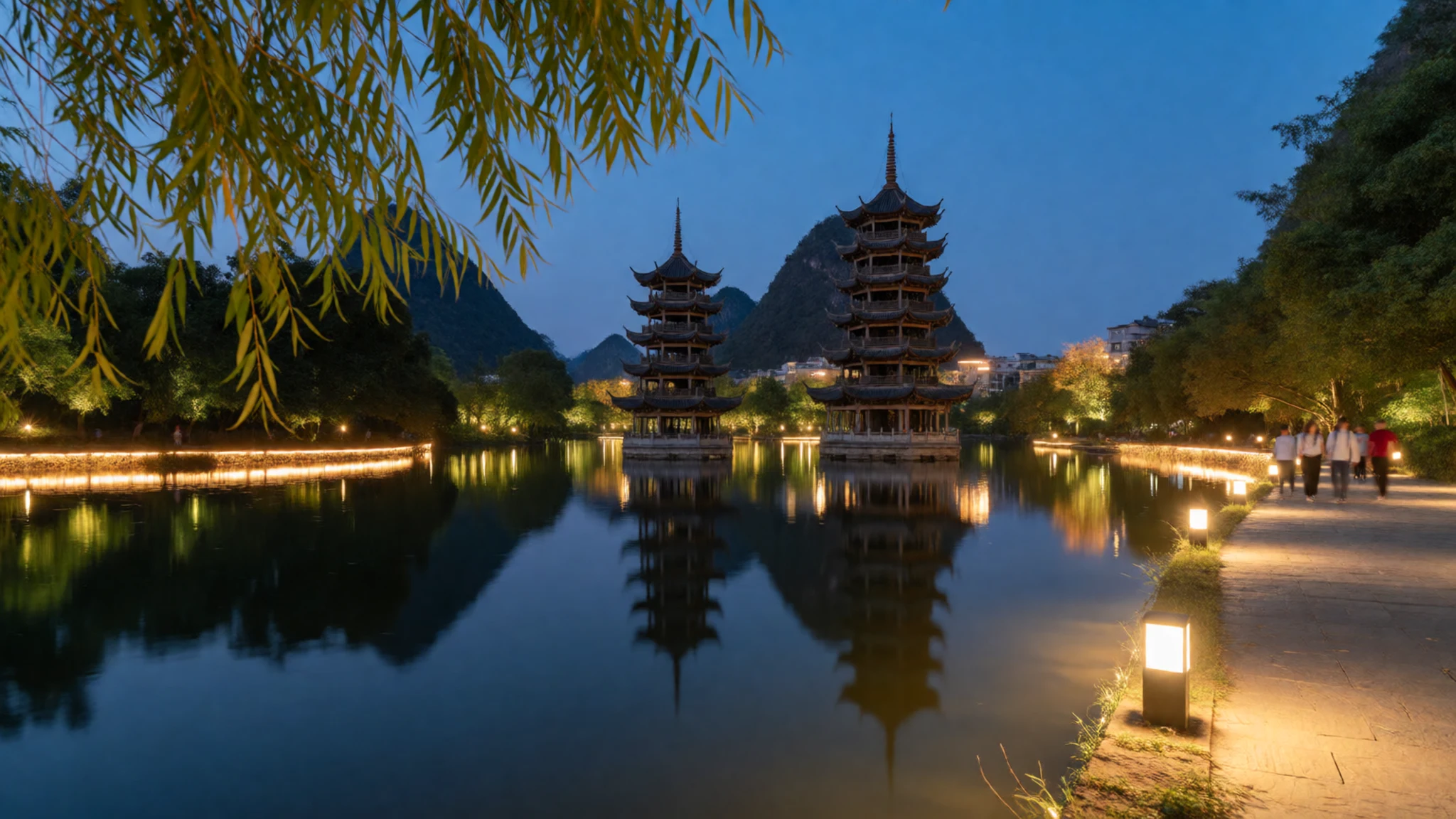
- Jingjiang Princes' Palace — city centre
Jingjiang Princes' Palace is Guilin's surviving princely city, a walled Ming compound with halls on a formal axis and Solitary Beauty Peak rising inside the enclosure. The stone reads as a court in miniature, even though ordinary city streets now press against the walls. What to notice is the plan: gates, terraces and the way the peak was kept as a private mountain.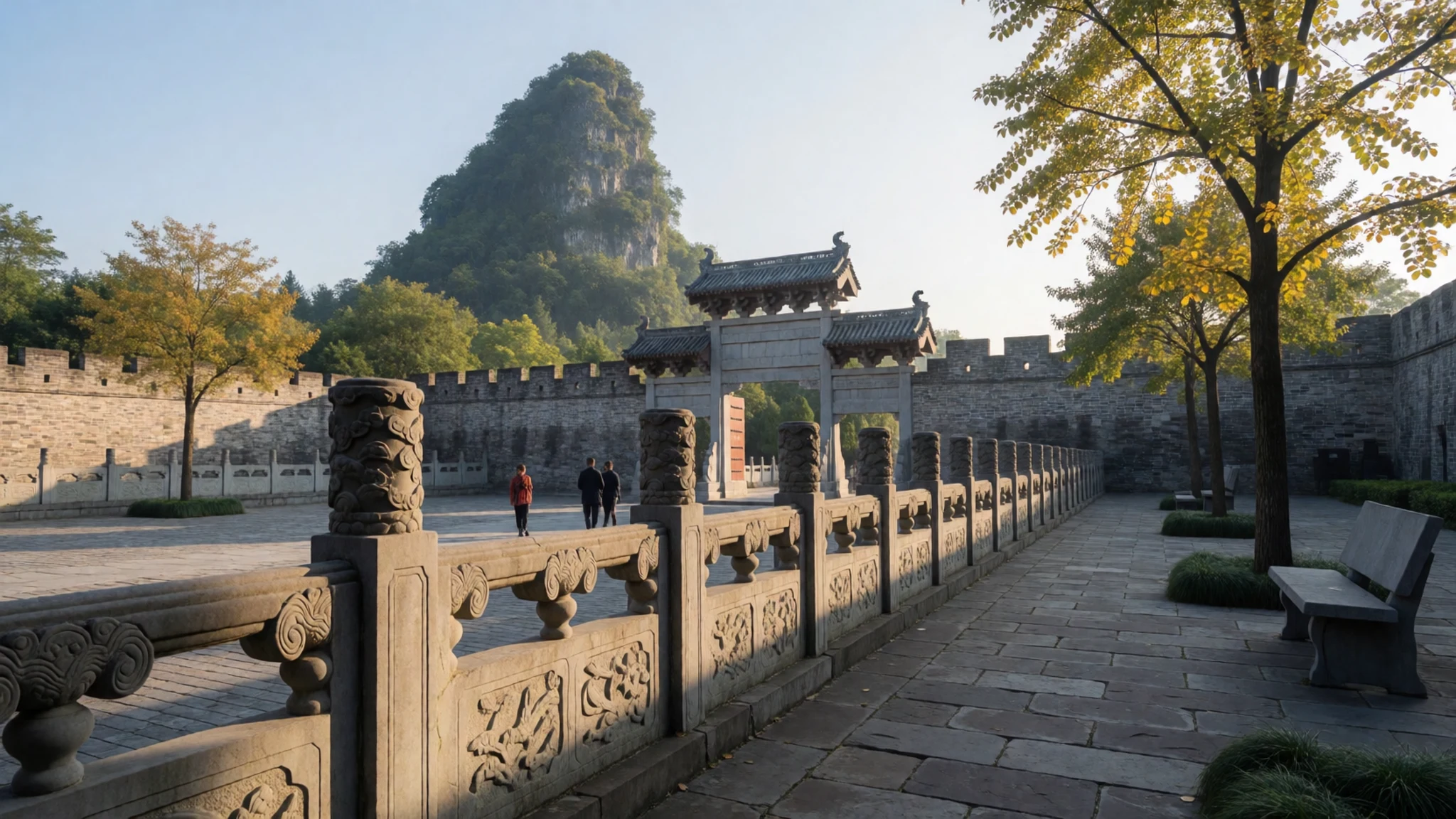
- Longsheng Rice Terraces — Longsheng County
The Longsheng Rice Terraces climb the hills of Longsheng County, north of Guilin, in tight contours that change colour with the farming year: water, green, gold, then bare earth. Zhuang and Yao villages sit above the fields, and the walks are real paths between homes, not a viewing platform alone. Mist is common. The terraces are working land, and the hamlets are places people live.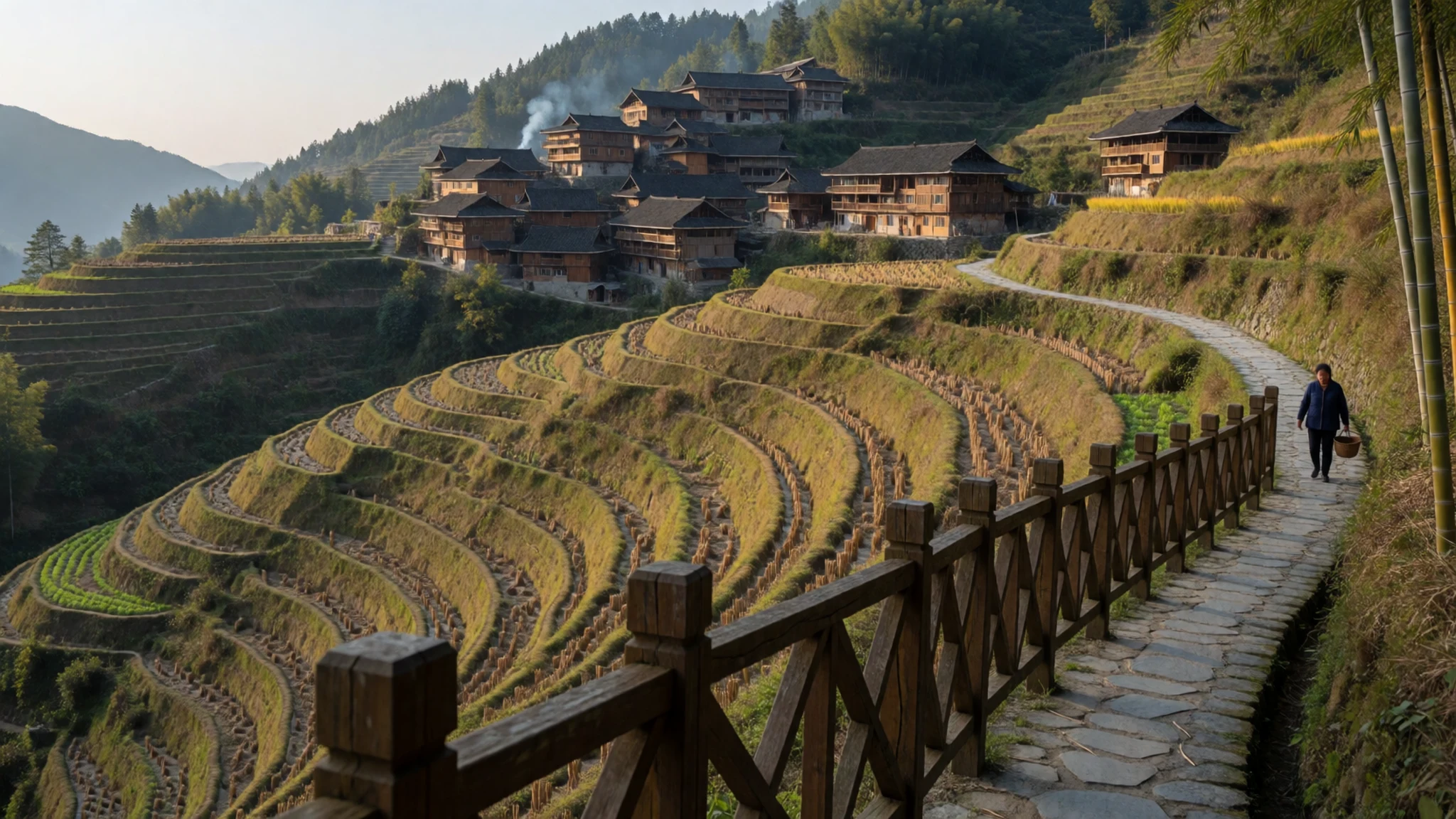
Culture
Guilin's culture is a city culture set inside Guangxi, where Zhuang identity is official and daily, not a performance saved for festivals. Zhuang and Mandarin share public life; songs, bronze-drum traditions and the older calendar of the countryside sit a bus ride away in county towns, while the urban centre runs on the same schools, pop music and night markets as any southern Chinese city. Osmanthus season is the local marker. When the trees flower, bakeries and tea counters push osmanthus cakes and the parks smell like the city's own name. Around Longsheng and in other minority counties the pattern changes. Yao, Miao and Dong communities keep dress, song and hospitality that are distinct from the Zhuang and from the Han city, and Yao is the largest minority. Rice terraces are agricultural knowledge as much as scenery: water is shared down the slope, and the year's look depends on planting, not on a visitor calendar. Festivals in these counties can include group singing and formal hosting of guests. Ask before you photograph people in Guilin, especially in villages and whenever someone is wearing festival or working dress.
What to wear
Guilin dresses in layers of climate and ethnicity, and the city street is not the terrace village. In town the everyday cloth is the same lightweight, practical clothing seen across southern China: breathable shirts, trousers, dresses, sun sleeves and the ubiquitous scooter rain-cape in the wet months. Few people wear full traditional dress to work or to the market. Traditional clothing remains visible, and specific, outside that norm. Zhuang women in the counties and at festivals wear indigo or black jackets and trousers, often with embroidered aprons, woven belts and a headcloth; the cloth is cotton, dyed and sometimes brocaded, and silver jewellery appears for formal occasions rather than for fieldwork. Yao communities around Longsheng are known for heavier silver: headdresses, collars and chest pieces worn with indigo cloth, especially at gatherings and for photographs they have agreed to. These are textiles with a job — sun, rain, identity — not costumes invented for the boat. A visitor's packing follows the weather and the sites. Hot, wet summers call for breathable cloth, a light rain layer and shoes that can cope with damp cave steps and terrace paths. At temple halls and inside the princely palace, covered shoulders and a willingness to remove shoes where slippers are set out are the sensible default. In minority villages, modest everyday clothes draw less attention than costume-like outfits, and flashy festival copies bought in town read as dress-up.
What to eat
- Guilin rice noodles — morning noodle shops and street stalls
Guilin rice noodles, mǐfěn (米粉), are thin rice noodles in a clear pork broth, finished with spring onion, peanuts or soybeans and a spoon of local chilli paste. Horse meat is the older topping; most bowls in town use pork. Morning noodle shops and street stalls serve them all day.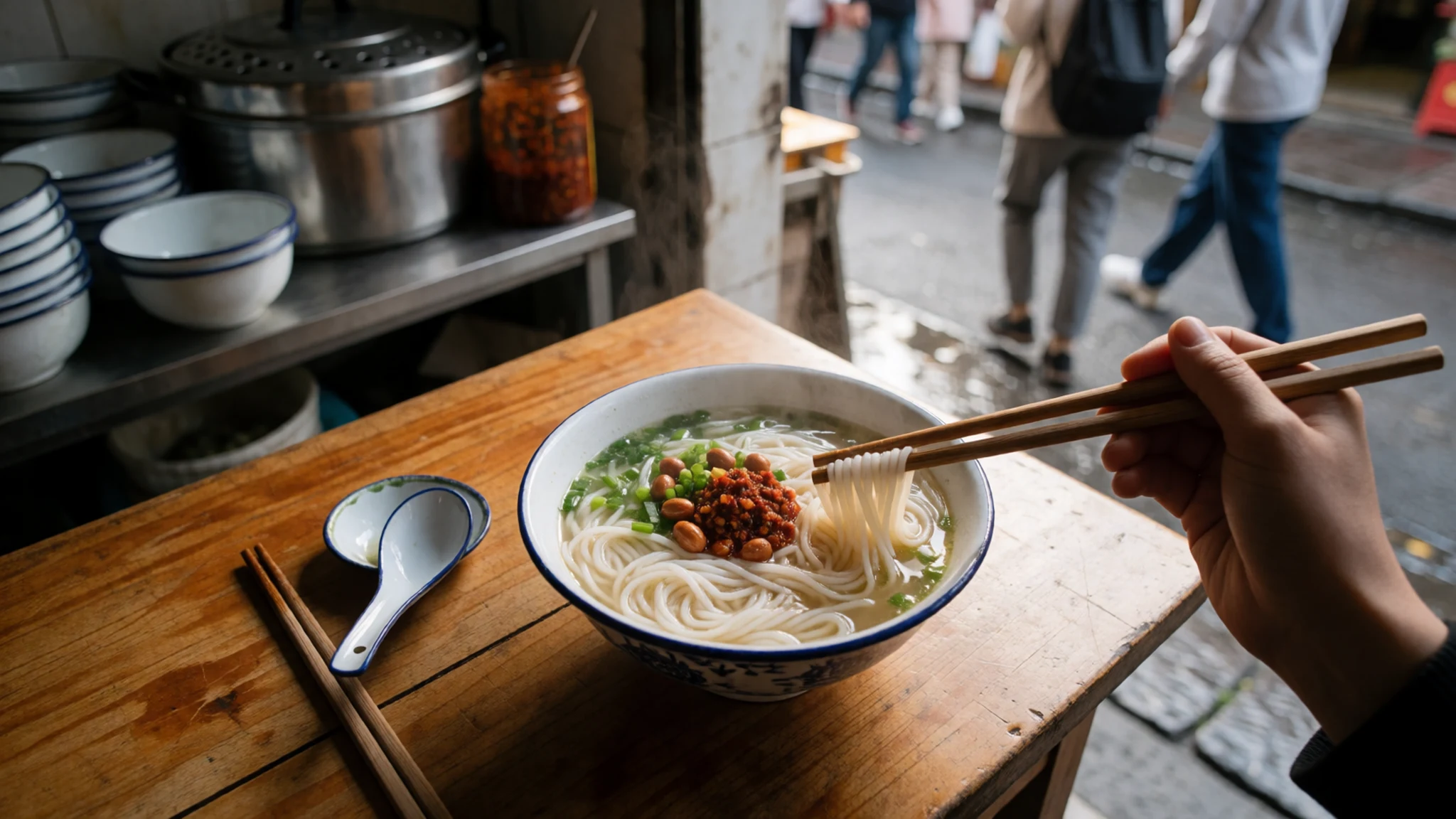
- Beer fish — restaurants along the Li, in Guilin and in Yangshuo
Beer fish is a Guilin favourite: river fish braised with local beer, tomato, garlic, chilli and spring onion until the sauce is thick and slightly sour. Restaurants along the Li and in town cook it as a shared main.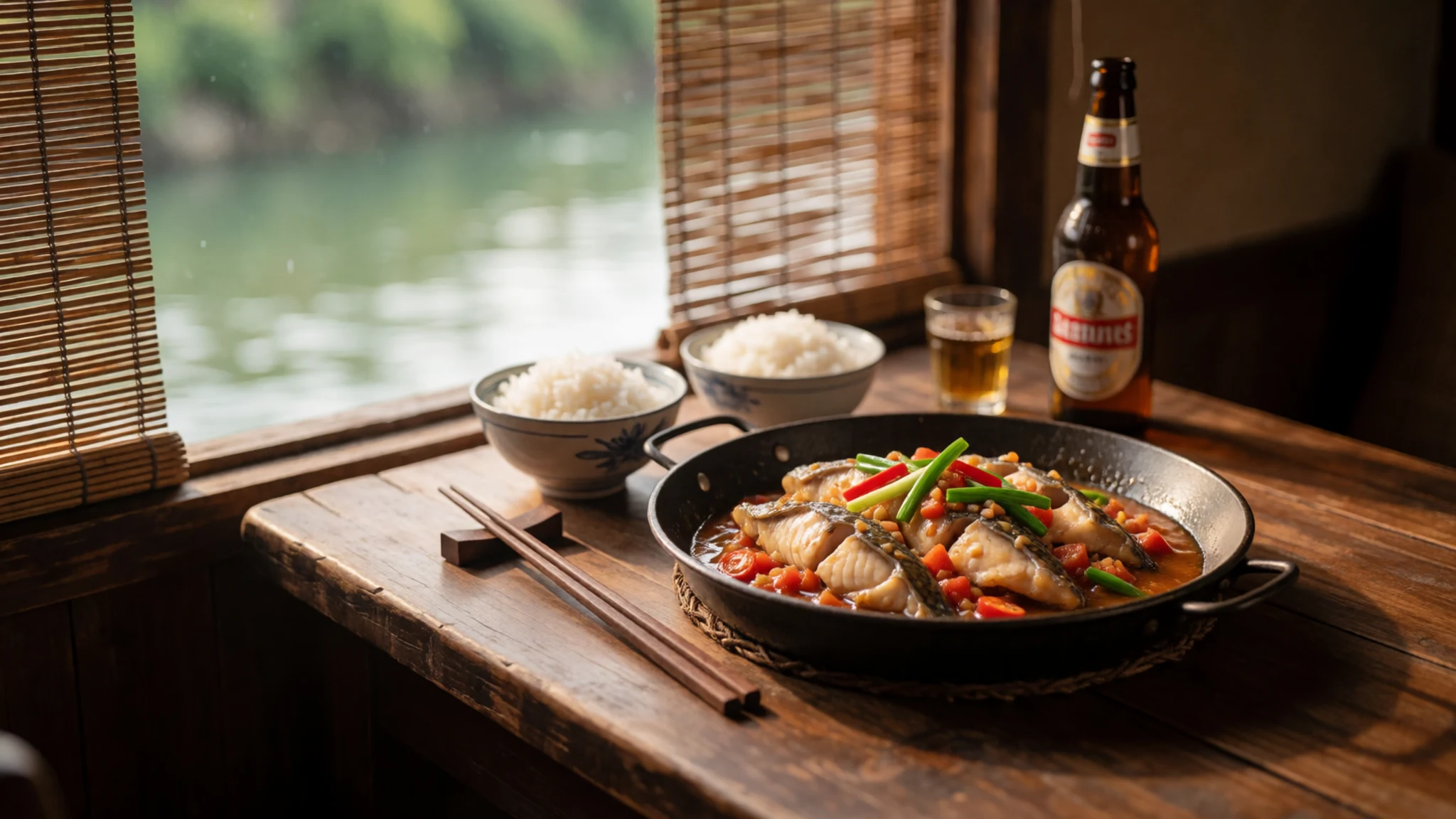
- Stuffed river snails — night markets and street stalls
Stuffed river snails are a Guilin night-market standard: the shell is packed with minced pork, vermicelli and spices, then boiled or simmered and eaten with a toothpick. They are fiddly, garlicky and sold by the plate from stalls rather than as a formal course. - Oil tea — Longsheng villages and county-food shops in the city
Oil tea, yóuchá, is the Zhuang and Yao drink-meal found in Guilin's minority counties and, less often, in city shops that specialise in county cooking. Tea leaves are fried in oil, then simmered and whipped, and served with puffed rice, peanuts and pickled greens. - Water-chestnut cake — pedestrian-street stalls and bakeries
Water-chestnut cake is Guilin's usual sweet: a cool, jelly-like slice made from water-chestnut flour, mildly sweet and often sold from dessert counters and market stalls. Some versions are plain and translucent; others hide red bean or osmanthus. Pedestrian-street stalls and bakeries sell it, especially in osmanthus season.
Plan it
Best time. October is the most comfortable month and November is clearer, while April and May are warm and green in the plum rains. June is the wettest month and, with July and August, the hottest, humid and storm-prone, with a muddier Li; winter is mild but often grey.
How long. 3–4
Getting there. Fly into Guilin Liangjiang International Airport and take a shuttle or taxi into the city. High-speed trains arrive at Guilin North, with a bus or taxi onward; coaches and minibuses run to Yangshuo and Longsheng.
Budget. mid
Tips
- Book the Li River boat, and any Longsheng room, ahead in autumn and on public holidays.
- Begin Elephant Trunk Hill, the princely palace and the cave early; coach groups fill them later in the morning.
- Carry some cash for stalls, temple boxes and village snacks; cards and phone payment handle most city restaurants.
- Pack a light waterproof. Summer rain is sudden, and cave steps and terrace paths are slick.
Etiquette
- Ask before photographing people, above all in Longsheng villages and when someone is in festival dress.
- Stay on marked paths at the rice terraces; the slopes are working fields, not a park lawn.
- Remove shoes where a step and slippers are waiting, and keep voices lower inside temple halls and the cave.
Nearby
Sources
- Wikidata (CC0)
- Wikipedia: Guilin (CC BY-SA 4.0)
- Wikivoyage: Guilin (CC BY-SA 4.0)