Garni
Garni, Armenia
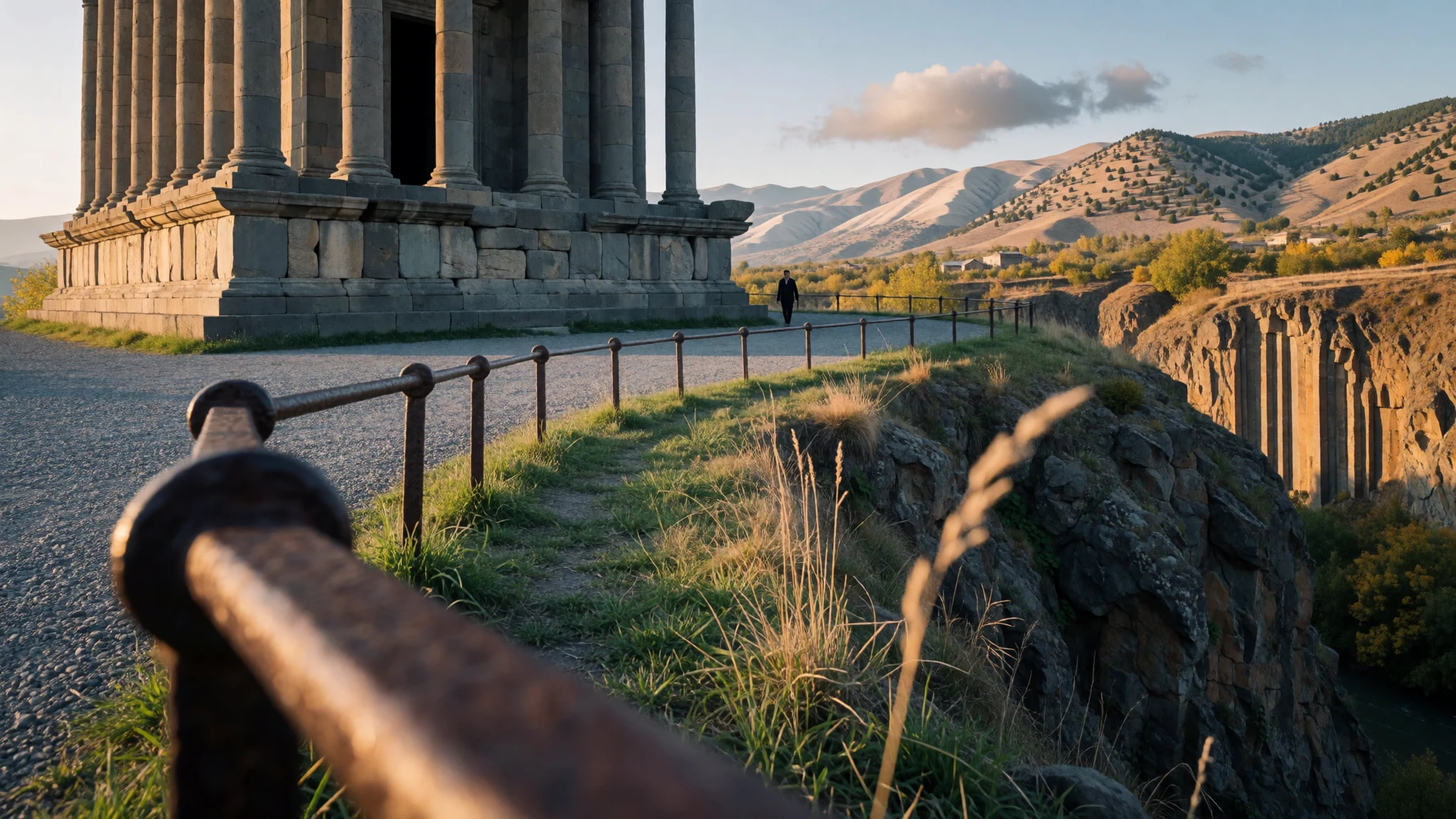
Garni is a Greco-Roman style colonnade on a cliff edge near Yerevan, with a basalt gorge and medieval monasteries in easy reach.
The place
Garni is a village in Armenia's Kotayk Province, about 30 km east of Yerevan, on a triangular spur of rock above the Azat River gorge. The Gegham mountains rise behind it, and the site feels like a balcony: flat ground that ends abruptly in a long drop to the river. The village stands at roughly 1,400 m, high enough that evenings cool quickly even after a hot day in the capital. At the tip of the spur is the Temple of Garni, an Ionic colonnade on a raised platform, built of dark basalt that has weathered to a warm grey. It is the image most Armenians would choose for their pre-Christian past. Around it lie the remains of a fortress: a heavy wall of enormous fitted stones, the footings of a palace, a Roman-style bathhouse with part of a mosaic floor, and a small medieval round church. Outside the fence, the village carries on as normal, with orchards, walled gardens and stalls selling dried fruit and bread. Most visitors come as a half-day trip from Yerevan, often paired with Geghard monastery a short way up the valley. Tour coaches tend to arrive mid-morning, so the platform is busiest then; early or late in the day the stones are quieter and the light on the gorge is better. The temple interior is small, so most of the time here is spent outdoors, walking the edge of the cliff.
Its story
Garni's history begins long before the temple. People settled this defensible bend of the Azat River in the third millennium BC, and a Bronze Age wall of huge stones still marks that early stronghold. In the eighth century BC the Urartian king Argishti I took the place and left a cuneiform inscription calling it Giarniani. Later the Roman writer Tacitus mentioned a fortress called Gorneas in his Annals, which is linked with Garni. The temple is conventionally dated to the first century AD and credited to King Tiridates I, who is named in a Greek inscription found close by. Tradition says it served Mihr, the Armenian form of the sun god Mithra. Some researchers argue instead that it was a second-century tomb, and the question remains open. What is clear is that the building stood for well over a thousand years until an earthquake in 1679 brought it down. Its stones lay scattered across the promontory, which is why so many could later be identified. Interest returned in the nineteenth century, excavations followed in the early and middle twentieth, and between the late 1960s and mid-1970s the temple was rebuilt by anastylosis, a method that puts original pieces back in place and fills gaps sparingly. Today it is also the central shrine of Armenian neopagans, who hold ceremonies here.
What to see
- Temple of Garni — Garni fortress, edge of the village
The Ionic colonnade stands on a stepped platform at the edge of the spur. Walk the full circuit before going near the cella, the inner chamber, because the inscriptions on the stones, from medieval Armenian to Arabic, record centuries of later use. Fallen carved fragments lie beside the platform and show how much was rebuilt.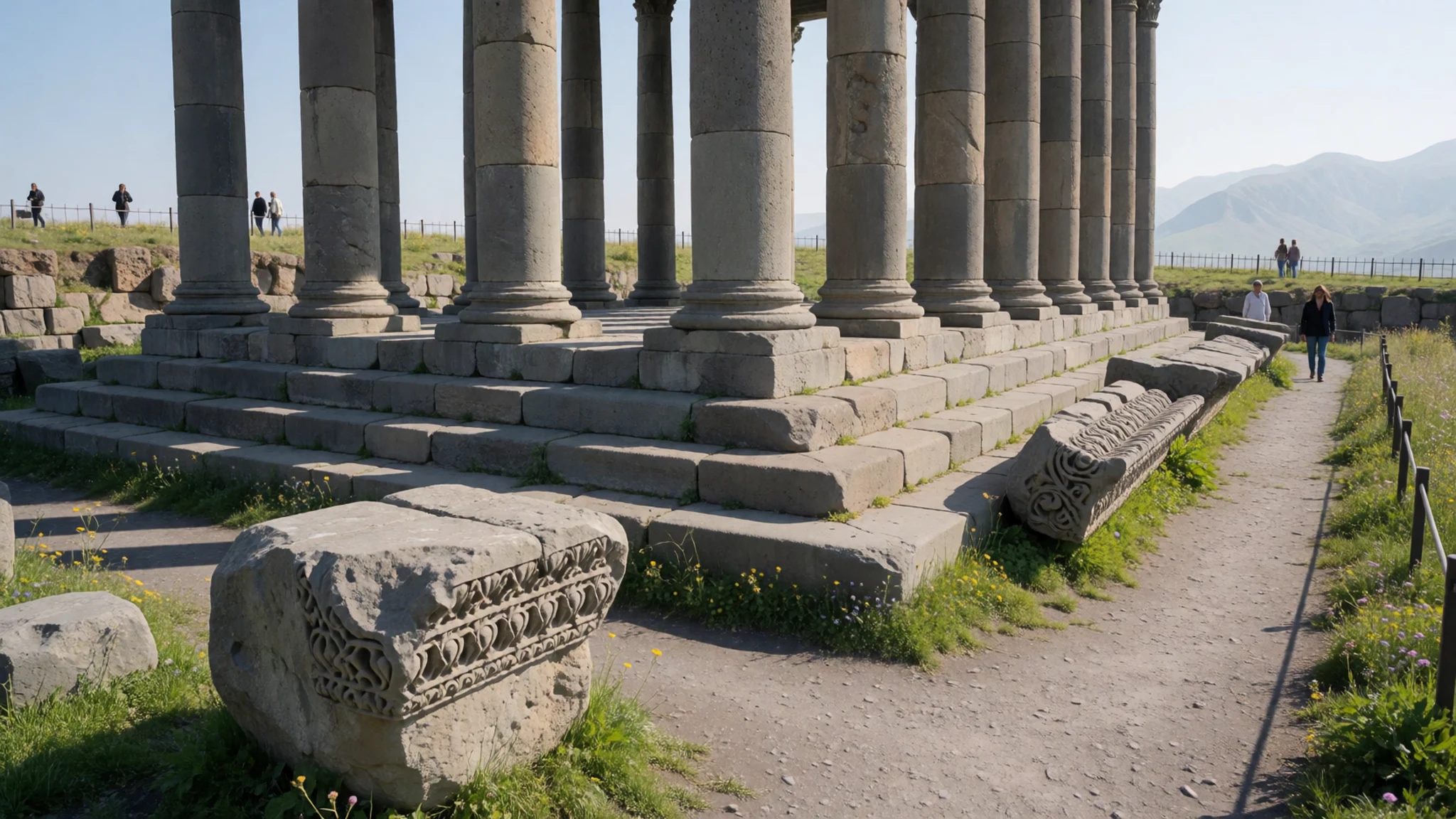
- Roman bathhouse and fortress remains — Garni fortress
Beside the temple, the bathhouse keeps part of a mosaic floor with a Greek inscription, usually under a protective shelter. Close by are the palace foundations, the heavy Bronze Age wall and a small medieval round church. A short wander here fills in the story that the temple alone cannot tell.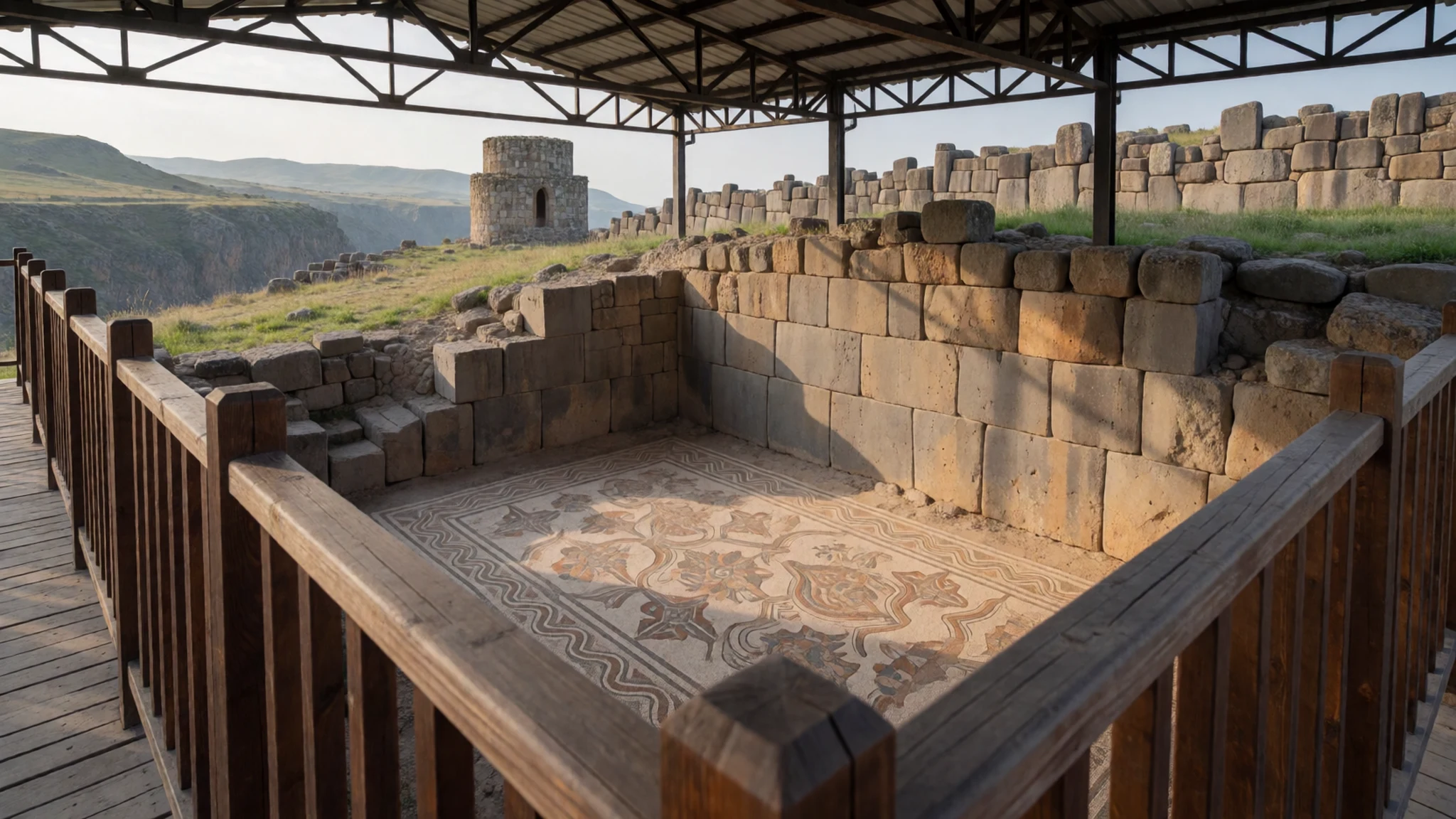
- Garni Gorge, the Symphony of the Stones — Below the temple, Azat River gorge
Below the temple, the Azat has cut a gorge lined with vertical basalt columns packed together like organ pipes, hence the local name Symphony of the Stones. A path leads down from the village. The climb back is steep and hot in summer, so carry water and wear proper shoes.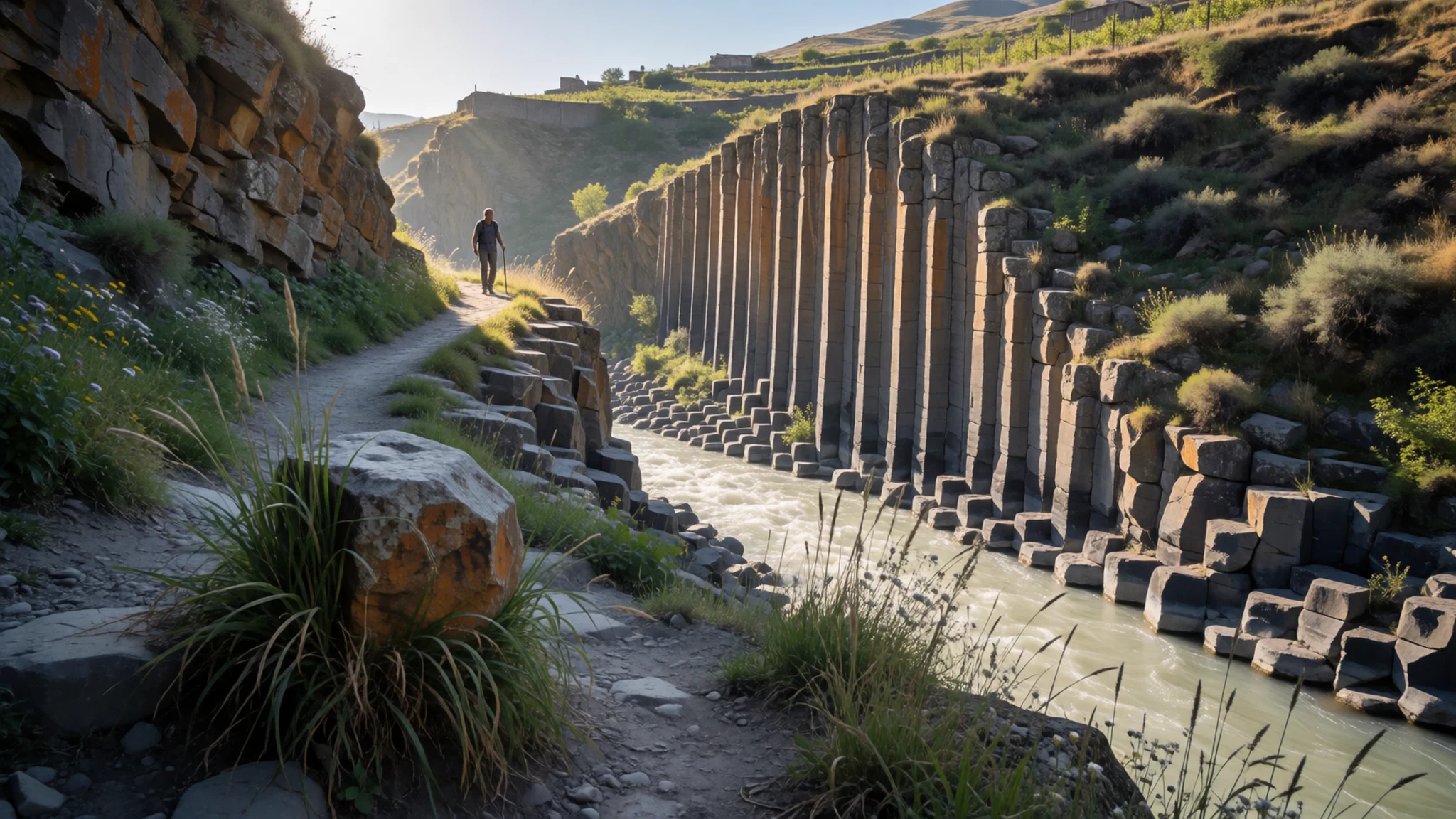
- Mashtots Hayrapet Church — Garni village
A small twelfth-century basilica in dark grey stone with red tufa decoration and finely carved details. It is quiet compared with the temple, and a good stop for anyone curious about the medieval layer of Garni's story. It is an active place of worship, so dress accordingly.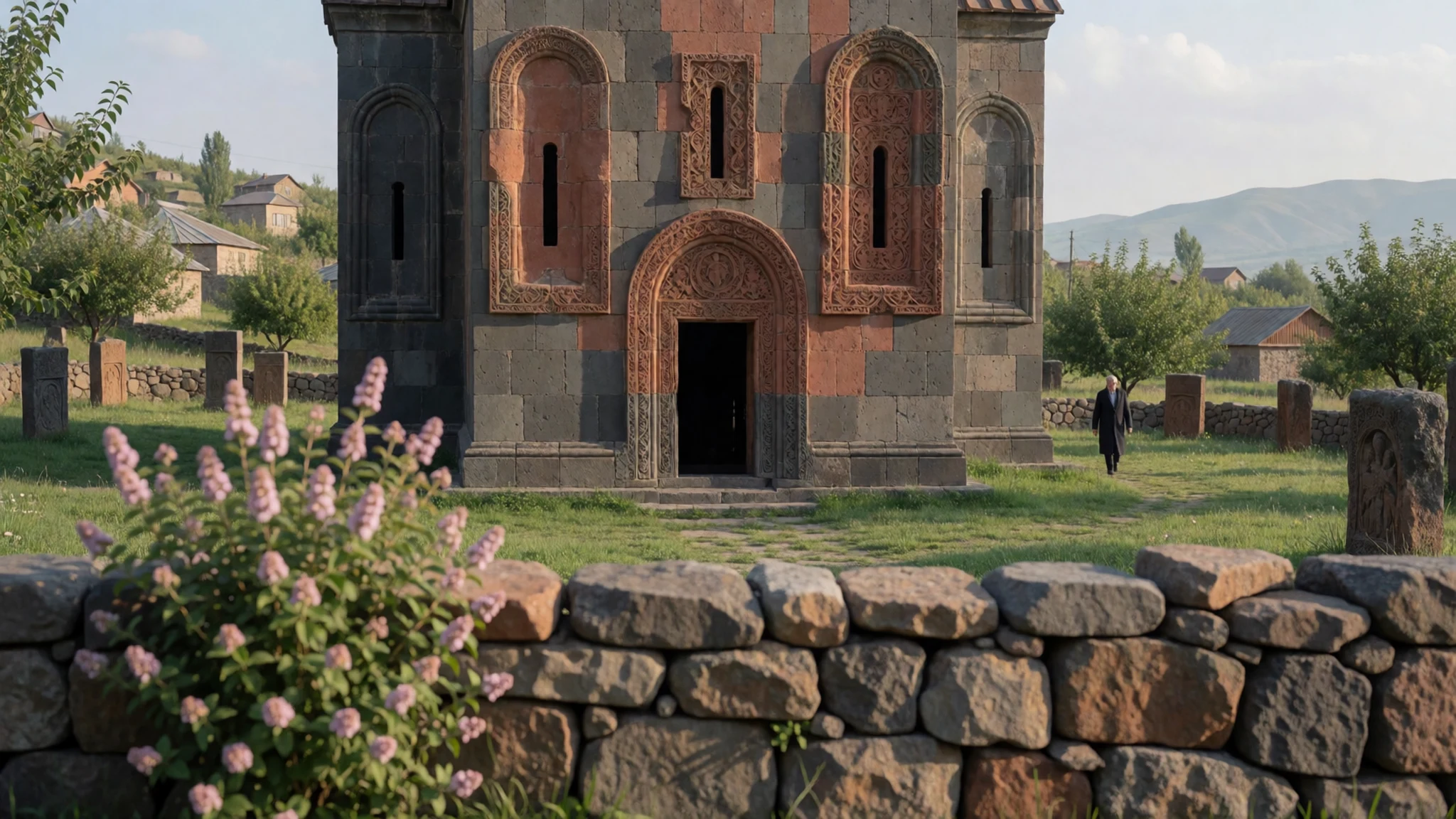
- Geghard Monastery — Upper Azat valley, near Goght
A short drive up the valley, Geghard is a medieval monastery partly carved out of the cliff, with chambers and passages cut into the rock. It sits in a dramatic canyon. Many visitors do Geghard first and then work back to Garni, which tends to avoid the busiest coach hours.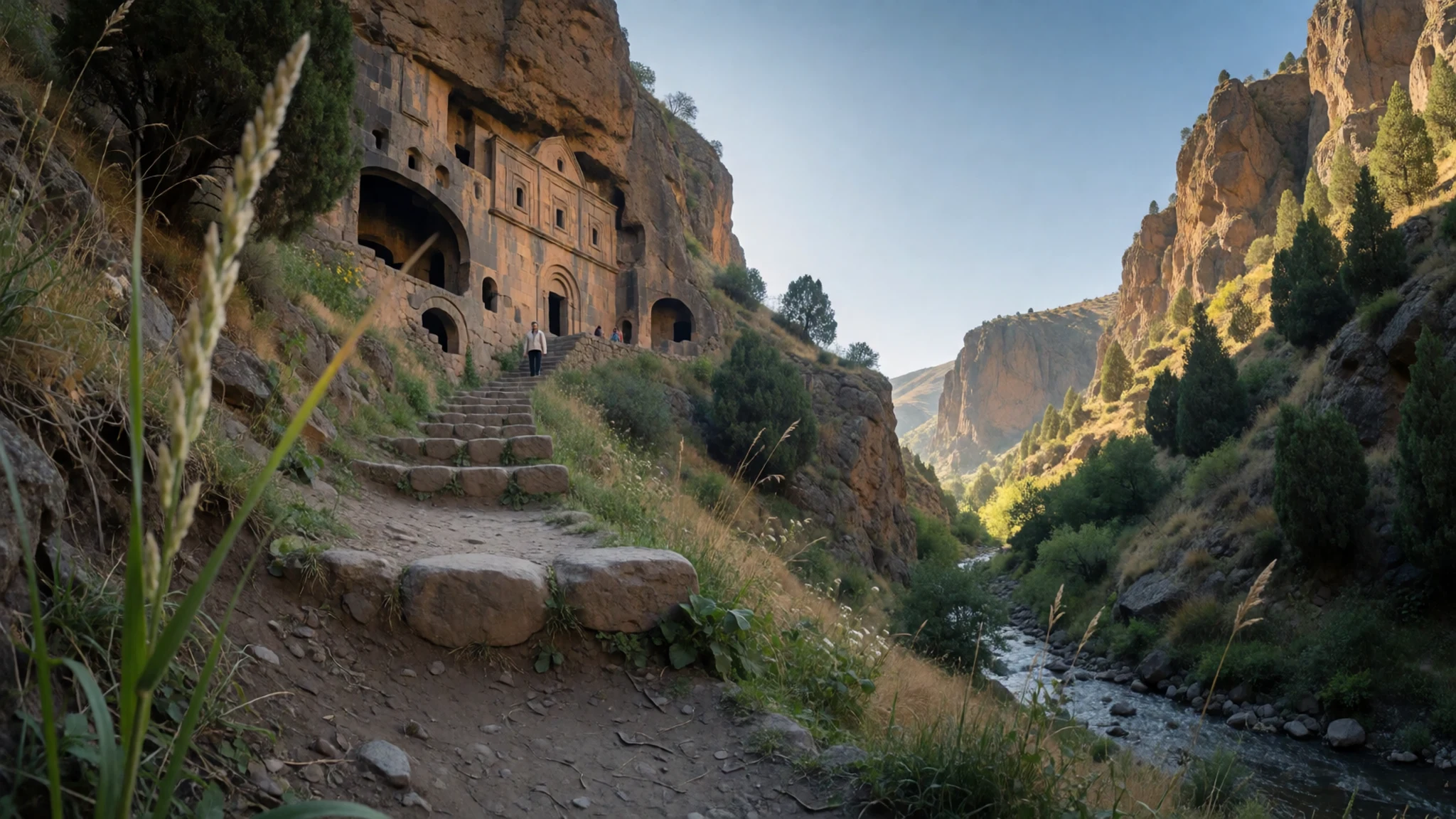
- Havuts Tar Monastery — Footbridge trailhead, east of Garni village
A medieval footbridge over the Azat River marks the start of a trail to this walled monastery on the hillside. It is a longer outing, a few hours with the return, and is best in spring or autumn when the climb is not too hot. Expect few other people.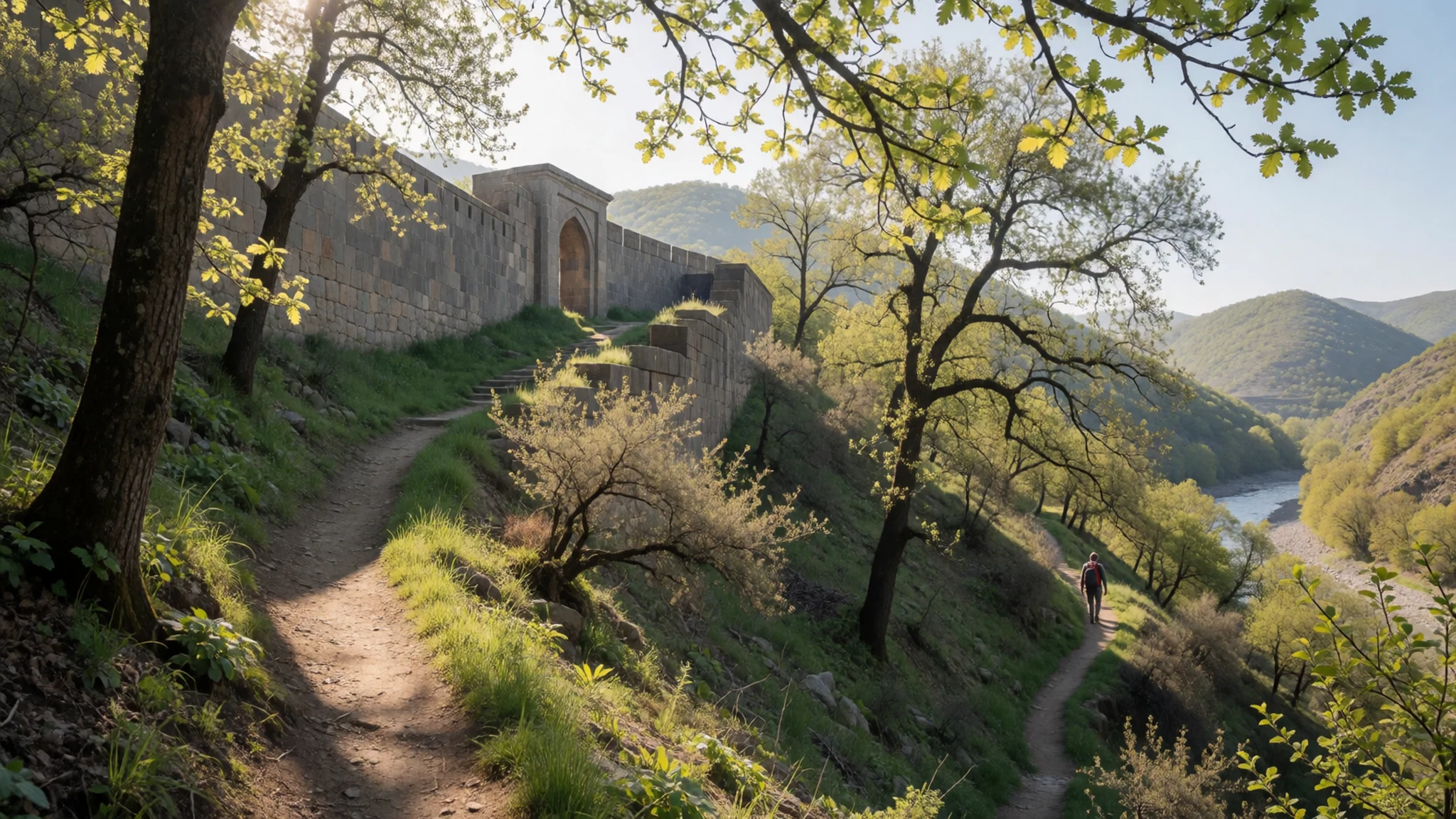
Culture
Garni is a village where the ancient and the lived-in sit side by side. The temple is treated as a national emblem rather than a ruin: its colonnade appears on Armenian souvenirs, books and logos, and school groups come to learn about the pre-Christian kingdom. For followers of Armenian neopaganism it is also a working sacred site, with ceremonies linked to Mihr and the sun. Most villagers, though, belong to the Armenian Apostolic Church, and the medieval churches and carved cross-stones, called khachkars, around Garni reflect centuries of Christian life layered over older beliefs. Hospitality matters here. Visitors may be offered coffee, fruit or a glass of homemade brandy or wine, and it is polite to accept at least a taste. Toasts at the table are taken seriously and are usually led by one person, so wait for the speaker to finish before drinking. Bread has a special place in daily life, and the tonir ovens in village courtyards turn out lavash that is shared around. Weekends bring Yerevan families out for picnics and barbecues along the gorge, so the village is livelier then, and the viewpoints are more crowded. At the churches around Garni, cover your shoulders and knees, keep your voice low, and ask before photographing worshippers or anyone working at a bread oven.
What to wear
Armenian traditional dress varies by region, and the Ararat plain around Garni has its own versions. Women's festival dress is built around the taraz, a long gown in silk, velvet or brocade, with embroidered trim, an apron and a decorated headpiece. Men wore the chokha, a fitted woollen coat with rows of cartridge-holder pockets across the chest, over a shirt and loose trousers. Wool, silk and embroidery were the main materials, and rugs and woven bands carry the same geometric patterns. Today these costumes appear mainly at dance performances, weddings, church festivals and national celebrations. In daily life people around Garni dress as in Yerevan: jeans, shirts, light dresses and jackets, with practical shoes in the village and smarter clothes for evenings out. Older women in the countryside may still wear headscarves and long cardigans. Visitors should dress for sun and uneven stone. In summer, light cotton, a hat and sunglasses help, as the temple platform has little shade. In spring and autumn, bring a jacket, since it cools quickly at 1,400 m. Wear shoes with good grip for steps and loose rock, especially if heading down to the gorge. For churches, covered shoulders and knees are respectful, and a light scarf is handy for women.
What to eat
- Grilled trout — Fish-farm restaurants along the road through the village
Trout from local fish farms, grilled whole and served with a few simple vegetables and lemon. It is the standard lunch in the Azat valley and tastes best fresh from the grill, with bread and a green salad on the side.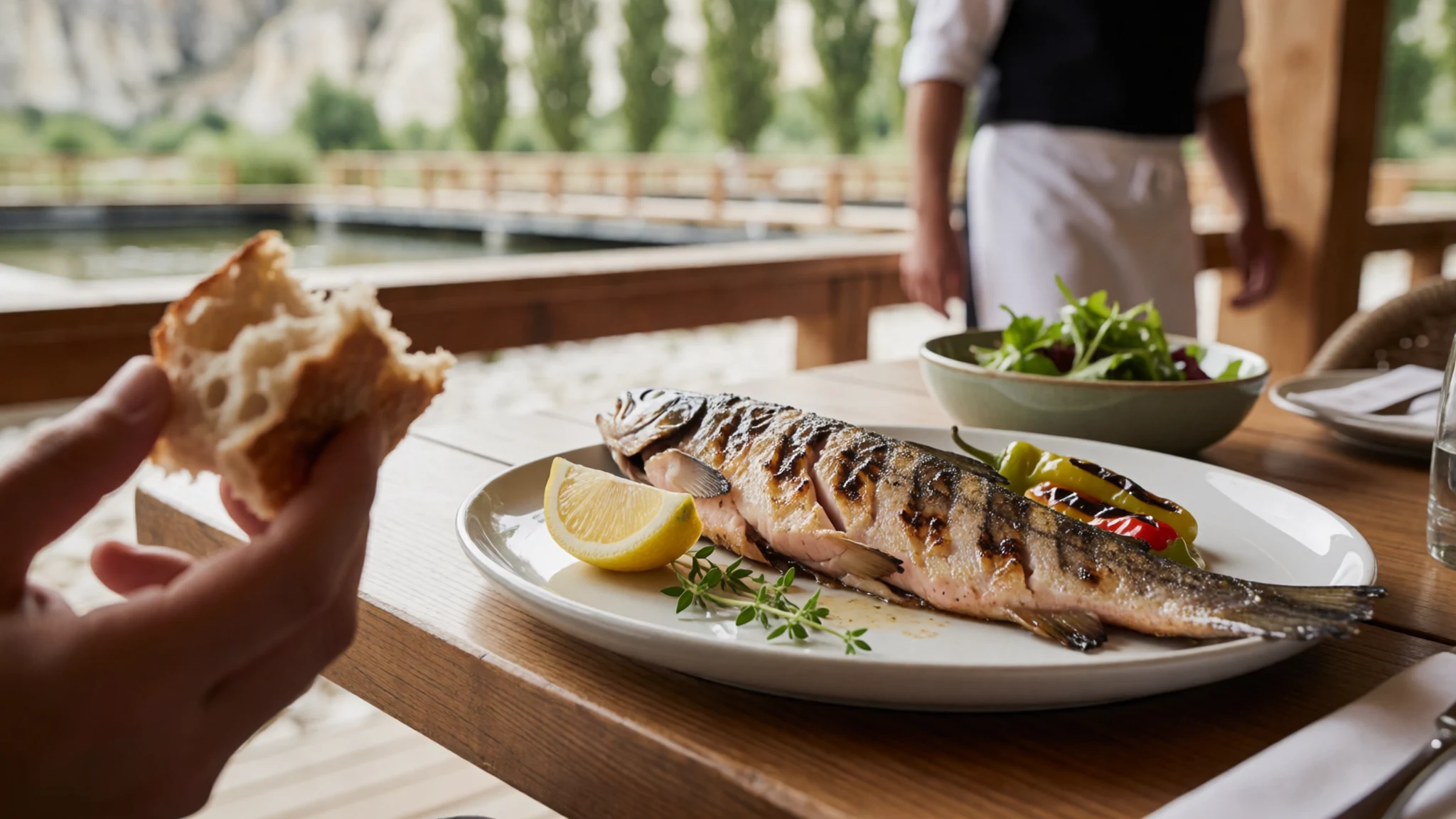
- Khorovats — Terrace restaurants overlooking the gorge
Armenian barbecue: chunks of pork, lamb or chicken grilled over coals on long skewers, with grilled tomatoes, peppers and aubergine. Portions are generous and meant for sharing, and the smoke from the grills drifts across the village on weekends.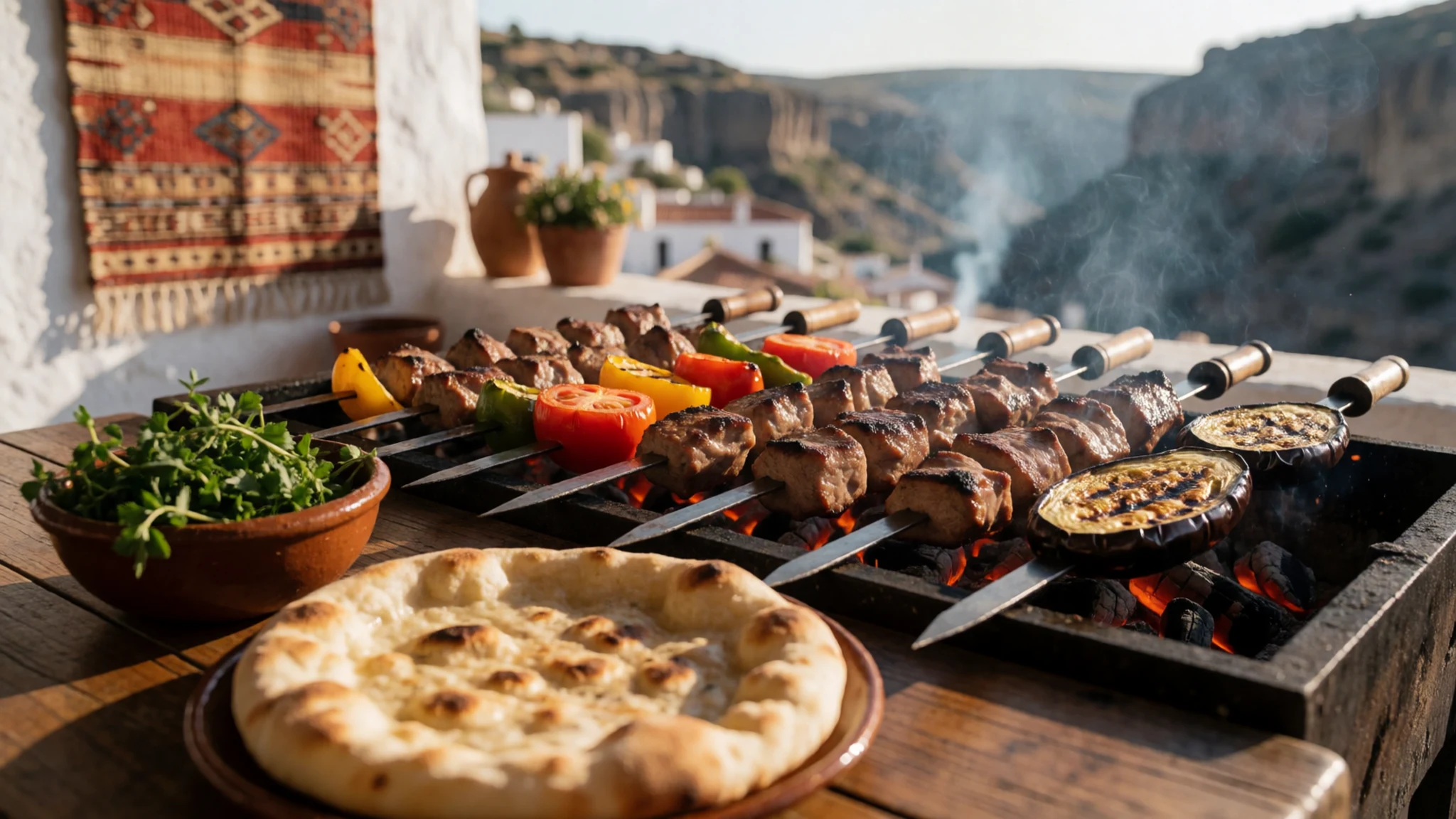
- Lavash — Bread-baking stalls near the temple entrance and village courtyard bakeries
Thin, soft flatbread slapped against the wall of a clay tonir oven and pulled out minutes later. It is used to wrap cheese and herbs, or to scoop up stews. Eaten warm, it is worth stopping for even if lunch is elsewhere. - Tolma — Family-run restaurants and village guest houses
Vine leaves, or sometimes cabbage, wrapped around spiced minced meat and rice, then simmered slowly. Often served with a spoonful of yoghurt. Home cooks in Garni take pride in it, and it is a common starter at family-run restaurants. - Gata — Bakeries and roadside stalls around Garni and the Geghard approach
A sweet, layered bread filled with a buttery sugar-and-flour paste, baked until golden. It keeps well, which makes it a good snack to carry on the walk to the gorge or back to Yerevan, and it goes well with strong coffee.
Plan it
Best time. May–June and September–October, when days are warm and walking is comfortable. July and August are hot and the temple platform has little shade. Winters at this altitude are cold and can bring snow, which makes the gorge path slippery.
How long. 1
Getting there. Fly into Yerevan's Zvartnots International Airport. From Yerevan's Gai bus station, marshrutka minibuses run towards Garni and Geghard about every half hour; ask locally which number to board, as the station is more of a park than a terminal. A taxi from Yerevan is quicker and can be agreed in advance for the return too.
Budget. low
Tips
- Go early or late: tour coaches arrive mid-morning and the platform is busiest then.
- Carry cash in Armenian dram for minibuses, village stalls and small cafés, and check locally for current entry fees and opening times.
- Visit Geghard first and work back to Garni, or the reverse, so the two sights share one transport arrangement.
- Bring water, a hat and good shoes; the gorge path is steep and shade is limited.
Etiquette
- Cover shoulders and knees and speak quietly in churches and monasteries.
- Ask before photographing people, especially worshippers and bread bakers.
- Do not climb on fallen stones or the temple platform walls.
Nearby
Sources
- Wikidata Q684072 (CC0)
- Wikipedia, Garni Temple (rev 1384850704) (CC BY-SA 4.0)
- Wikivoyage, Garni (rev 5402633) (CC BY-SA 4.0)
- Katsiaryna Naliuka, Ancient temple in Garni (CC BY-SA 4.0)
- Yerevantsi, Temple of Garni (2021 drone) (CC BY-SA 4.0)
- Yerevantsi, Garni aerial (CC BY-SA 4.0)
- Yerevantsi, Greek inscription of Tiridates I, Garni (CC BY-SA 4.0)
- Gnvard, Garni Temple 02 (CC BY 3.0)
- Yerevantsi, Garni baptistery inscription (CC BY-SA 4.0)
- Yerevantsi, Garni Arabic inscriptions (CC BY-SA 4.0)
- Yerevantsi, Garni Khoshak Zakarian inscription (CC BY-SA 4.0)


