Geghard
Geghard, Armenia
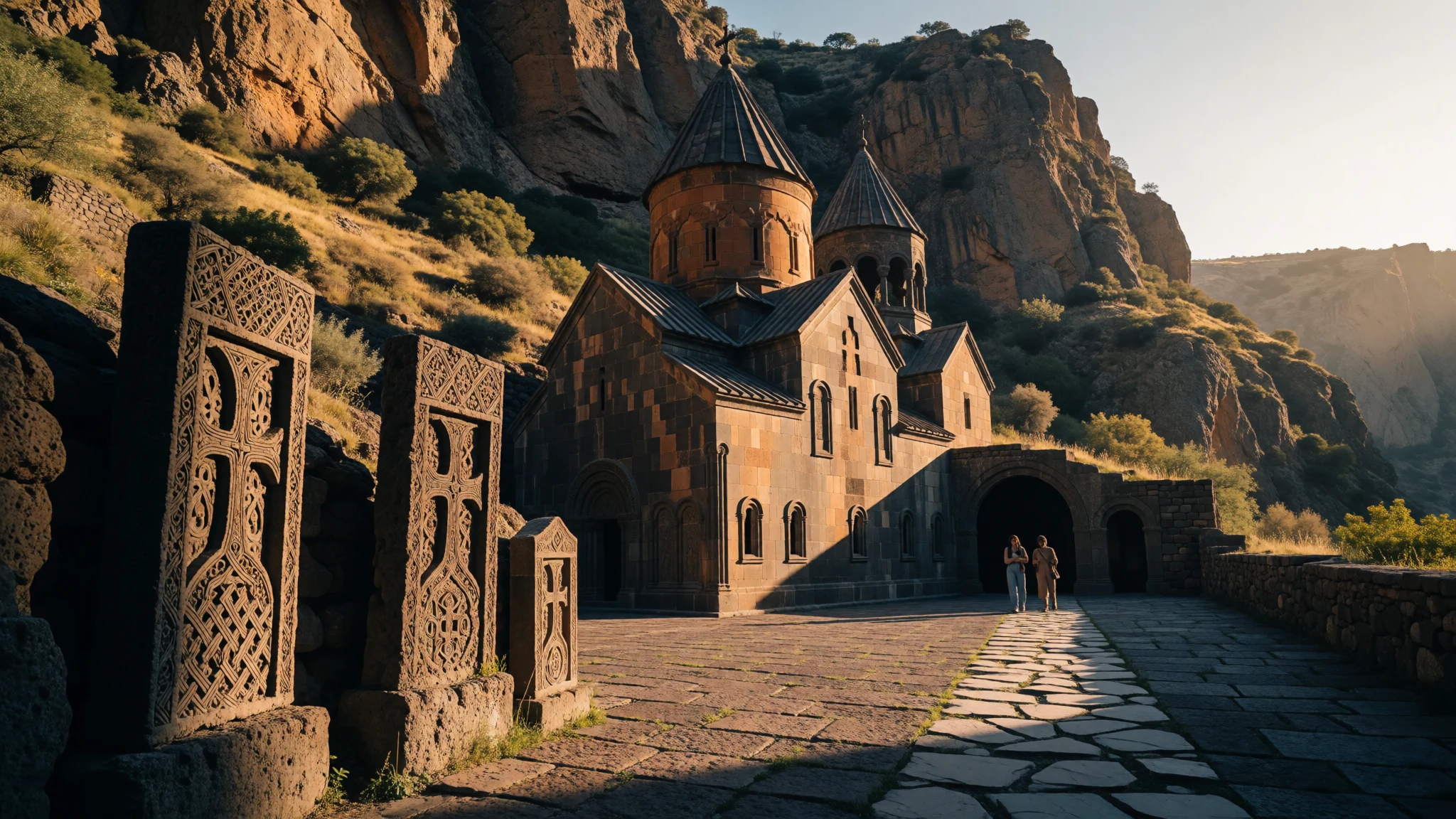
Geghard is a monastery in Armenia where churches are cut into a cliff face above a gorge, around a spring sacred long before Christianity.
The place
Geghard is a monastery in Armenia's Kotayk province, east of Yerevan, pressed against the cliffs of the Azat River gorge. What sets it apart from most monasteries is that the mountain is part of the building. Some of its churches are carved entirely out of the rock, a few are barely more than caves, and others are built structures with walled courtyards and chambers that run deep into the cliff behind. Between them stand many khachkars, the carved cross-stones Armenians have raised for centuries, some set into walls and some free-standing in the open.
The name carries two stories. Geghard (Գեղարդ) means 'spear', and the fuller Geghardavank means the Monastery of the Spear. It refers to a relic said to be the lance that wounded Christ, brought to Armenia by the apostle Jude, known locally as Thaddeus. The spear is no longer here; it is displayed in the treasury at Echmiadzin. The older name, Ayrivank (Այրիվանք), means the Monastery of the Cave, and points to what came first: a spring rising inside a cave.
The mood changes with the hour. Early in the day the dark chambers are quiet, with candle smoke and the sound of dripping water. By late morning, tour groups from Yerevan fill the courtyard and the narrow doorways become bottlenecks. The setting is the other draw. The gorge walls rise close on every side and make the stone buildings look small. Garni, with its Roman-style temple, lies a short drive downriver, and the two are commonly combined into a single day trip from the capital.
Its story
Geghard's story begins with water. A spring welled up inside a cave that people held sacred before Armenia became Christian, and tradition says Gregory the Illuminator founded a monastery there in the 4th century. It was called Ayrivank, the Monastery of the Cave. Chroniclers from several later centuries describe more than chapels: living quarters and service buildings made it a well-equipped community. None of those early structures survives.
Raiders and earthquakes ended that first monastery. Arab forces destroyed it in the 9th century. In 923 a governor acting for the caliph in Armenia plundered its valuables, manuscripts among them, and burned the buildings. Tremors added further damage over the years, so the site was repeatedly rebuilt or abandoned to ruin.
What visitors see today is mainly a thirteenth-century rebuilding. Inscriptions go back to the 1160s, but the main church dates to 1215. It was raised under the patronage of the brothers Zakare and Ivane, Zakarid generals serving Queen Tamar of Georgia, who had taken back most of Armenia from the Turks. The money and confidence behind the church came from that period of recovery, and the rock-cut rooms around it grew into the complex's most unusual feature.
The spear relic gave the monastery its newer name, though the sources used here do not say when the name took hold. The relic itself now lives at Echmiadzin, yet the title Monastery of the Spear stuck, and it is the name on road signs and tickets today.
What to see
- Katoghike, the main church — Geghard monastery, Kotayk
Katoghike is the main church of Geghard and the building the date 1215 belongs to. Its stonework is plain on the outside and tight inside, with the cliff close behind. Go in early if possible, because the interior is small and fills quickly once a group arrives.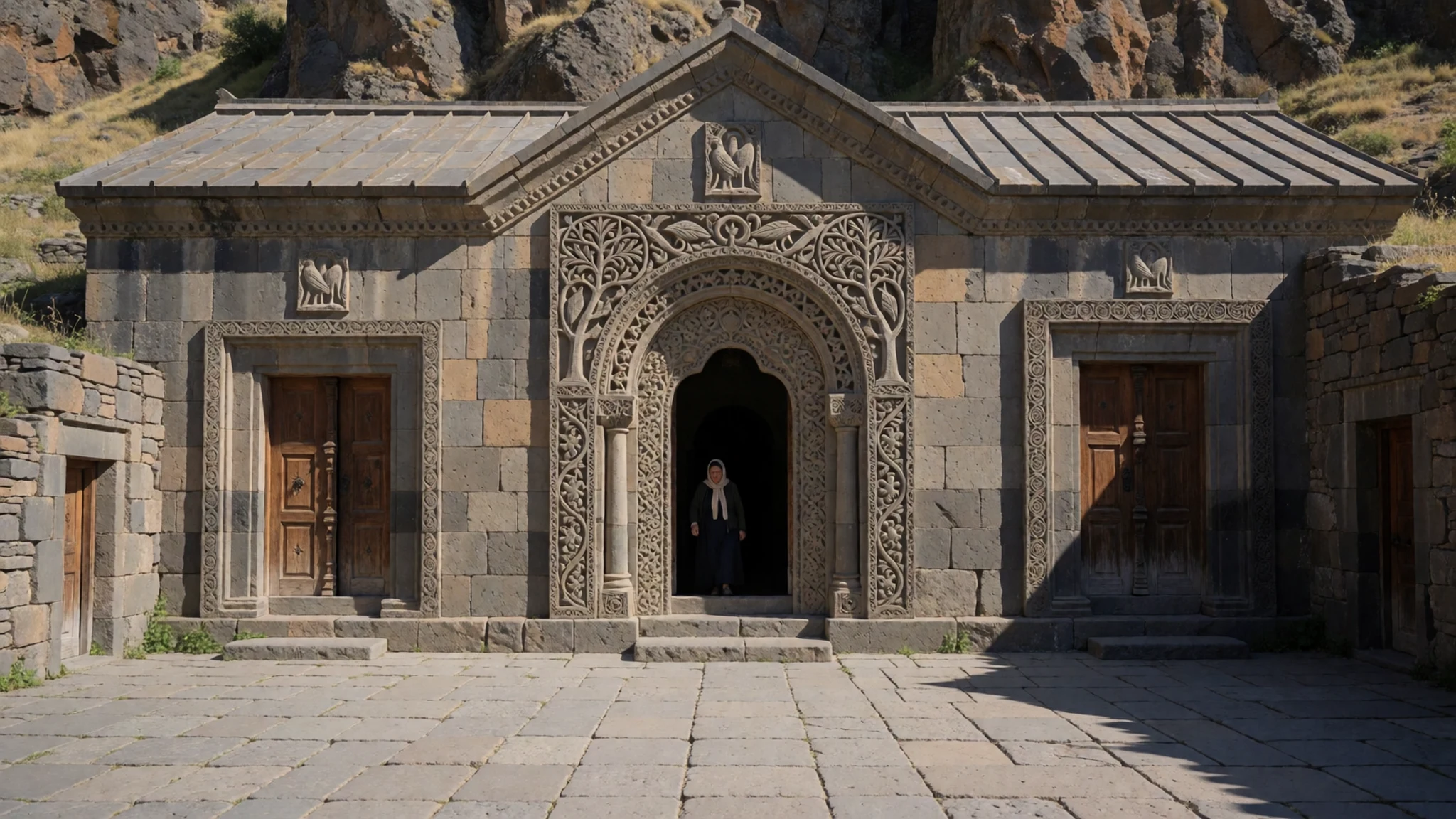
- The gavit — Geghard monastery, Kotayk
The gavit is the vaulted entrance hall attached to the main church, a typical Armenian arrangement where gatherings and burials once took place. At Geghard it is dim and echoing, with carved stone detail that rewards a slow look. Daylight comes only through a small opening, so allow time for eyes to adjust.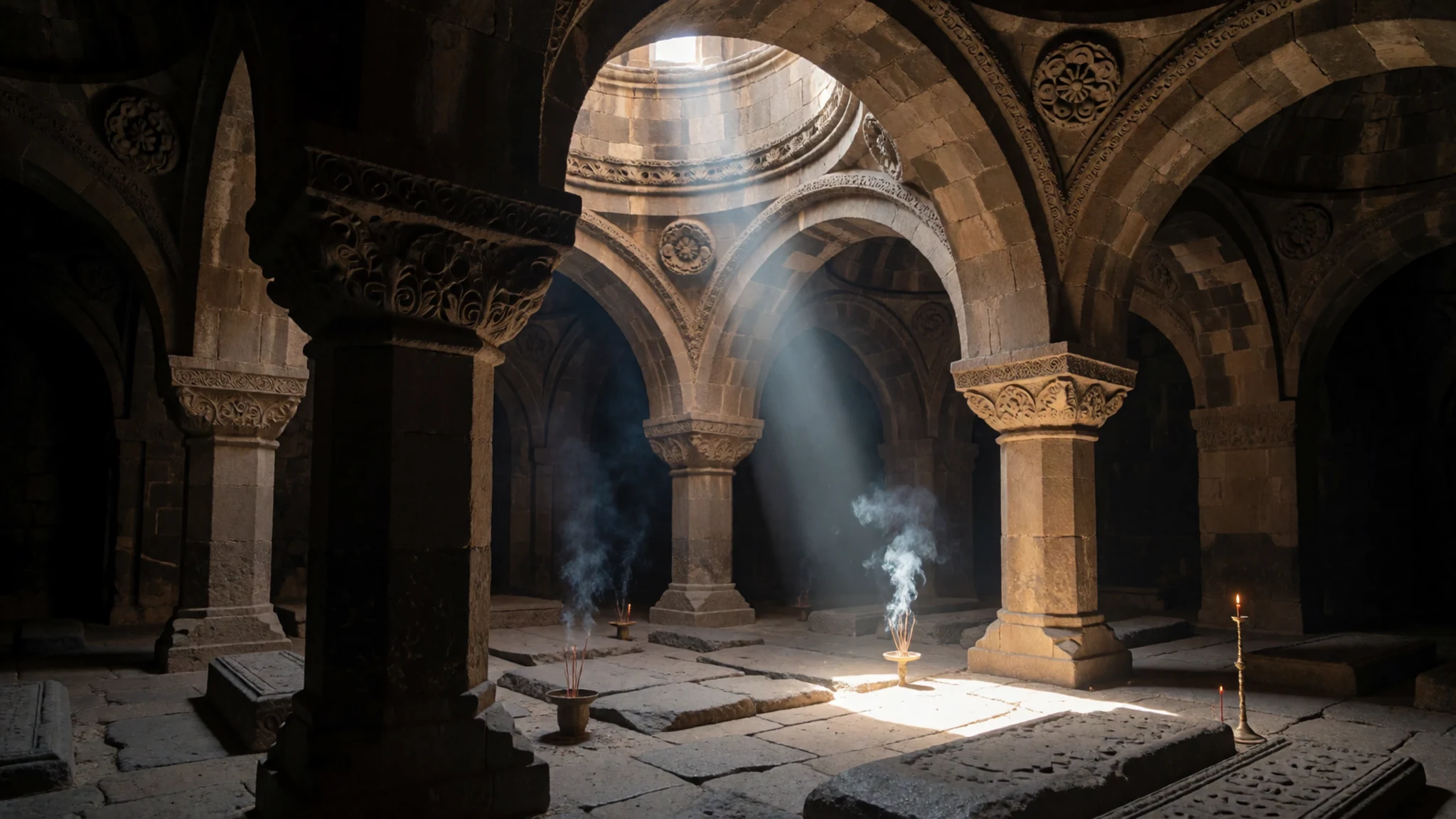
- The rock-cut chapels — Geghard monastery, Kotayk
Beyond the built church, passages lead into chapels hollowed straight from the cliff. One interior carries the crest of the Proshyan family, a reminder that noble houses paid for much of the work. The floors are uneven and sometimes damp, and acoustics here are remarkable when a choir or visitor sings quietly.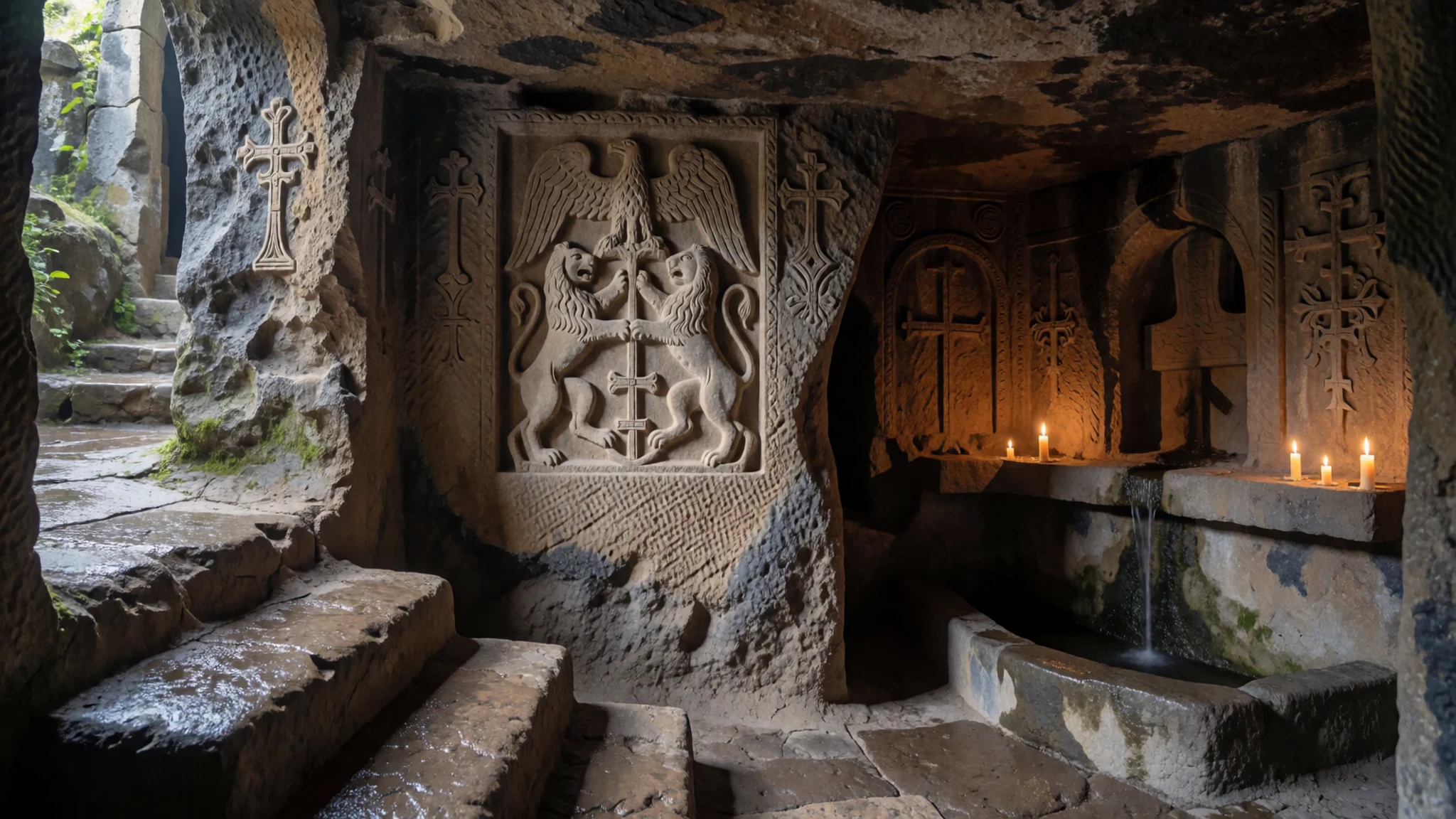
- Khachkars and the cliff walls — Geghard monastery, Kotayk
Carved cross-stones stand in the courtyard and are set into rock faces around the complex. Each has its own interlace pattern, and many are weathered soft by centuries of rain. Spend time at the outer edge of the site, where the gorge walls loom above and the scale of the setting becomes clear.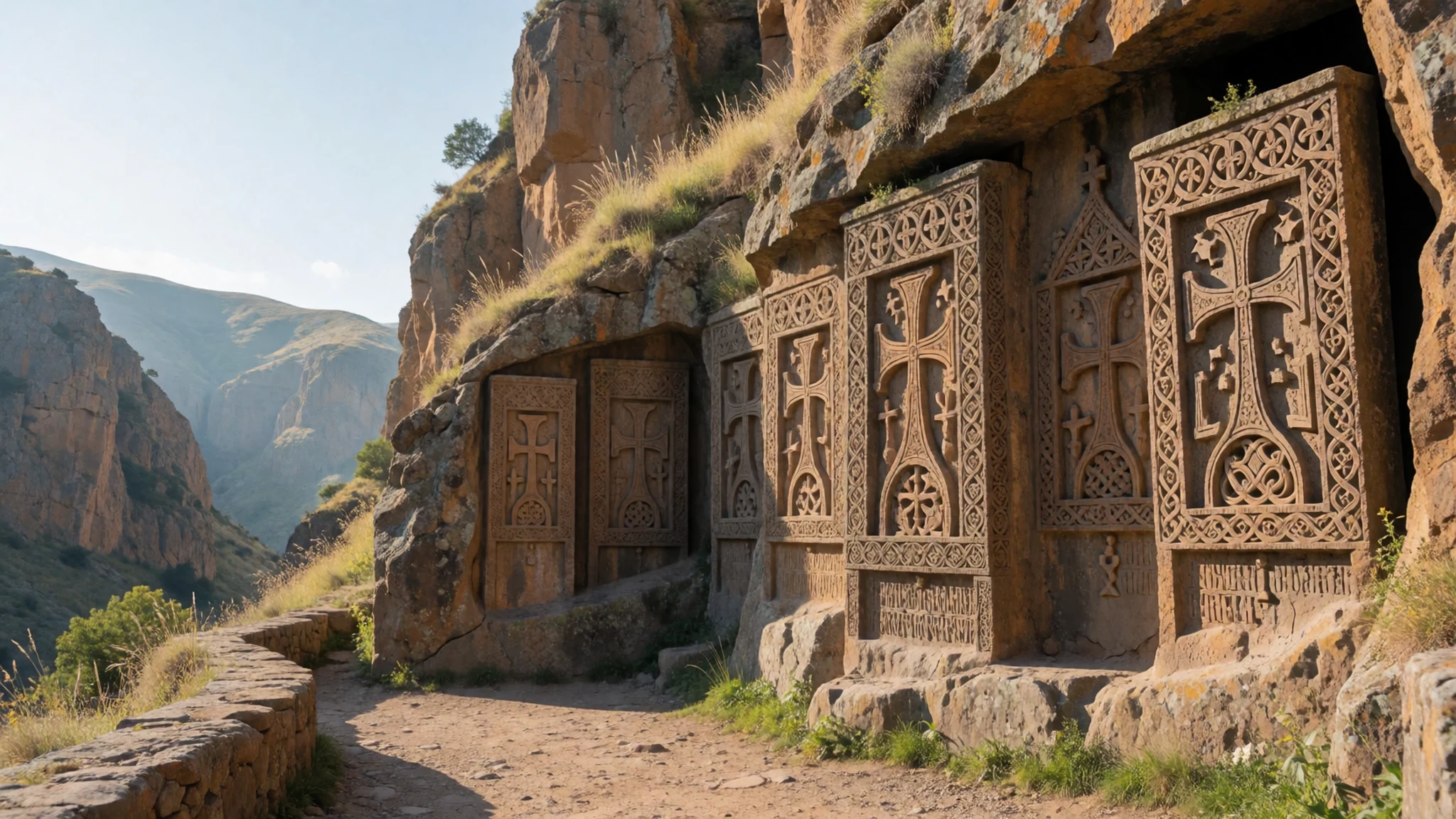
- Garni Temple — Garni, Kotayk
Garni is a short drive downriver and a natural second stop. Its Roman-style temple stands on a promontory above the Azat gorge, a pagan-era building in a country mostly known for churches. The contrast with Geghard's cave-like interiors makes the pairing worth the extra hour.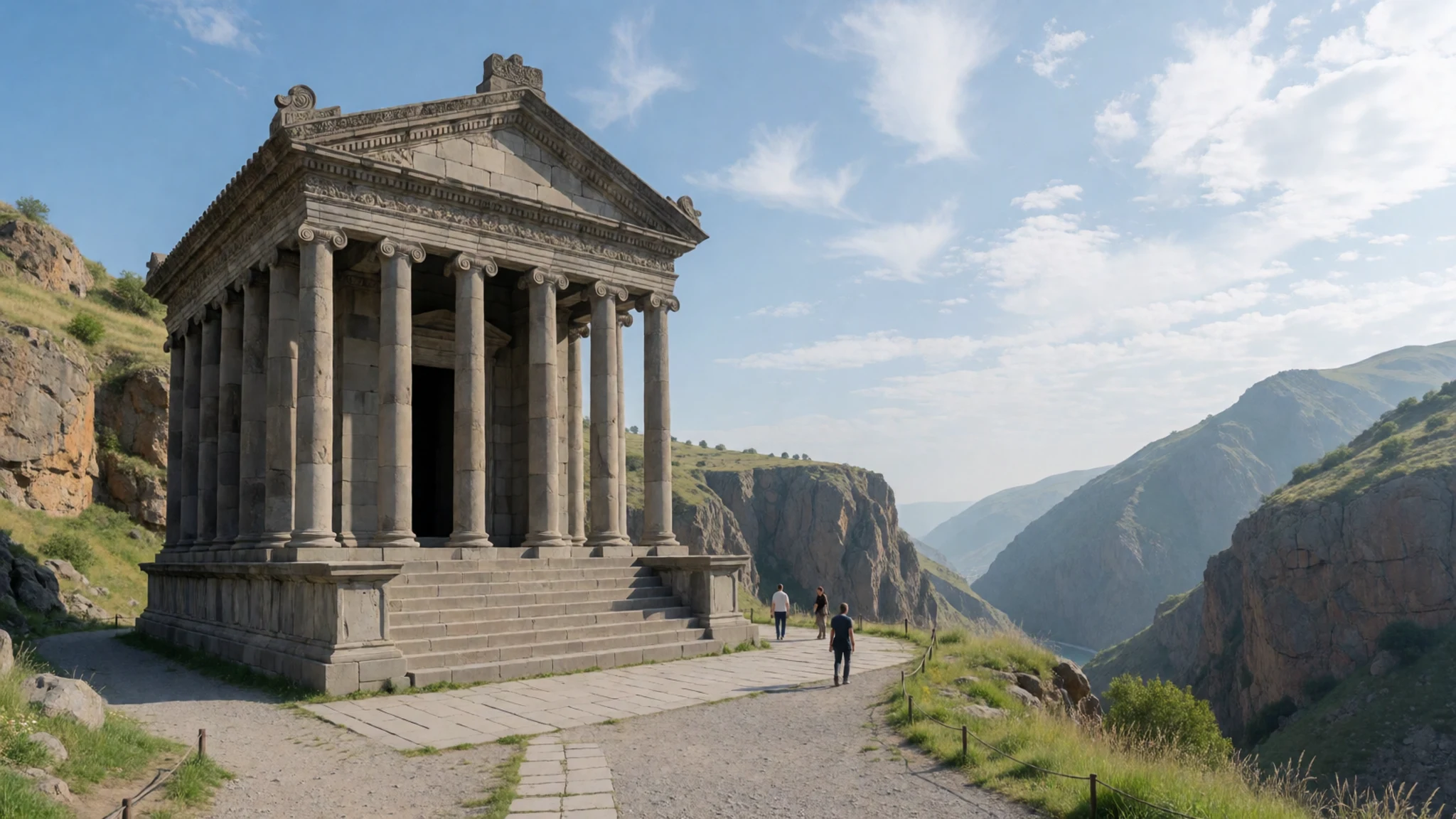
Culture
Geghard belongs to a country where the church remains part of daily identity. Armenians are described by travellers as traditional in manners and deeply religious, and a monastery like this is treated as a living place of faith rather than a museum. It is common to see people lighting candles in the dark chambers, pausing at the khachkars, or collecting water linked to the old sacred spring.
Khachkars are among Armenia's most recognisable art forms. Each is a stone slab carved by hand with a cross rising from patterns of leaves and interlace, and they serve as memorials, thanks offerings and markers of significant places. Geghard has a large number, both free-standing and engraved into walls, so the site doubles as an open gallery of the craft.
Social courtesy tends to be formal. Armenian men often open doors, give up seats and take the initiative to pay the bill for women, and the idea of 'ladies first' is taken seriously. Female travellers need not be alarmed by this, and male visitors will be expected to follow the same habits, even with casual acquaintances. Hospitality is generous, so an invitation to eat or drink is usually sincere.
The monastery sits in a landscape that people also visit for picnics, and the area outside the walls is relaxed. Inside, the tone is quieter and more reverent.
Cover your shoulders and knees, keep your voice low inside the chapels, and ask before photographing anyone who is praying.
What to wear
Geghard is a religious site rather than a fashion destination, but Armenian dress has a long and distinctive tradition. Women's traditional costume centres on a long, fitted dress, often called a taraz, made from silk, velvet or wool and decorated with embroidery, braid or fine needle lace. Men's formal dress included a long wool coat, the chokha, shared with parts of the wider Caucasus. These outfits appear today at weddings, folk dance performances, festivals and church celebrations rather than in daily life.
Everyday clothing in Yerevan and the villages around it is modern and fairly smart. Jeans, shirts, dresses and jackets are normal, and people tend to dress with care for church services and family occasions. Dark colours and neat layers are common, and the style is closer to southern Europe than to the Gulf.
Visitors to Geghard should dress for both the monastery and the gorge. Shoulders and knees should be covered for the chapels, and women may like to carry a light scarf, though it is not always demanded. The stone floors are uneven, worn smooth and sometimes wet near the spring, so shoes with a good grip matter more than style. Sandals with thin soles are a poor choice. The gorge is cooler and shadier than Yerevan, and the dark rock chambers feel cold even on warm days, so a light jacket or cardigan is useful in most seasons. In winter, add proper boots and warm layers.
What to eat
- Khorovats — grill restaurants on the Garni–Geghard road and in Yerevan
Armenian barbecue of pork, lamb, chicken or beef, seasoned with onions and spices and served with grilled tomatoes, aubergine and peppers. It is the standard celebration meal. Look for grill restaurants along the road between Garni and Geghard, or in Yerevan.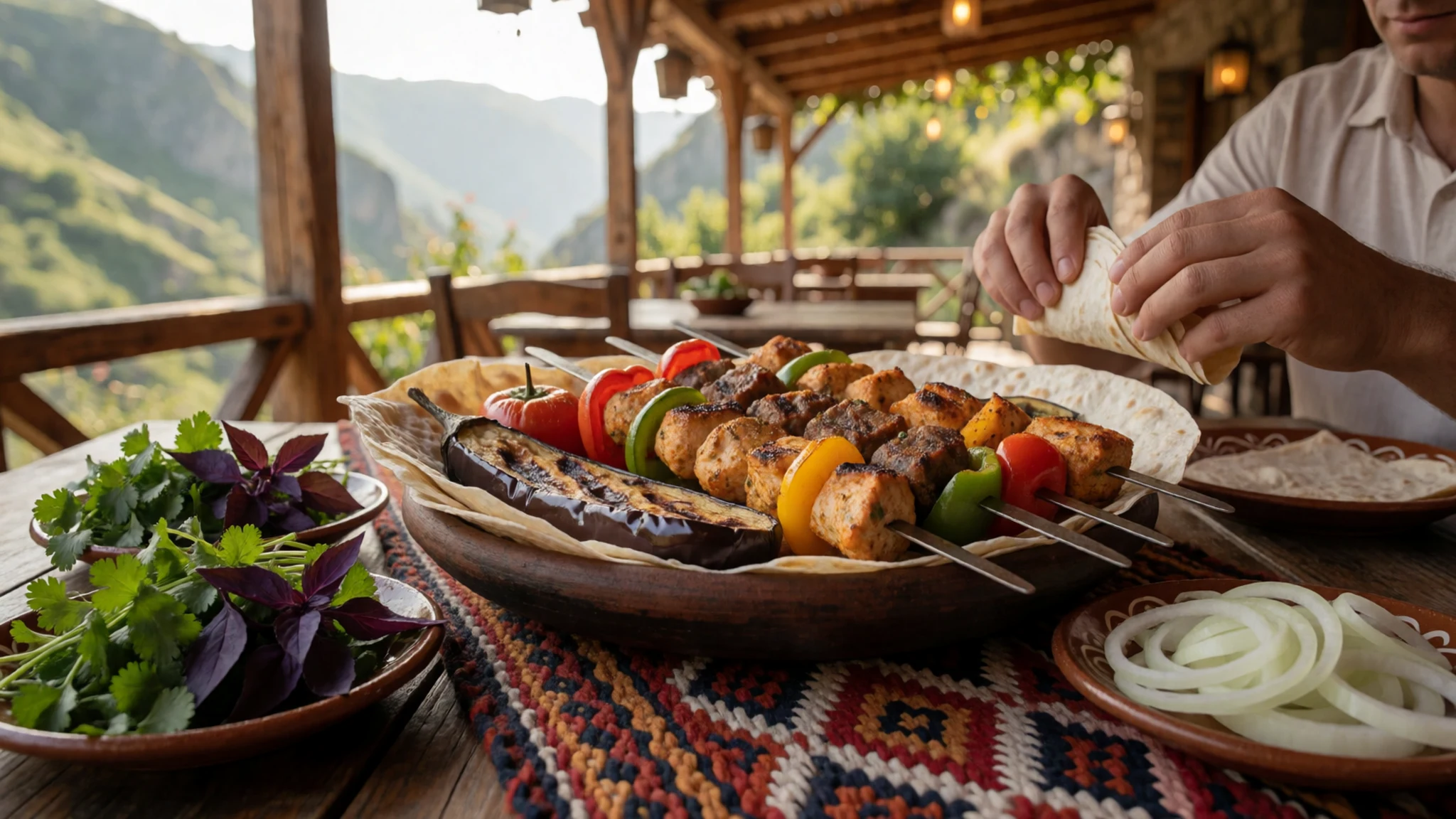
- Kebab — roadside grill houses near Garni
The minced-meat cousin of khorovats, shaped on a skewer and grilled over coals. It is usually the cheaper option and a good lunch after the monastery. Order it with flatbread, raw onion and fresh herbs.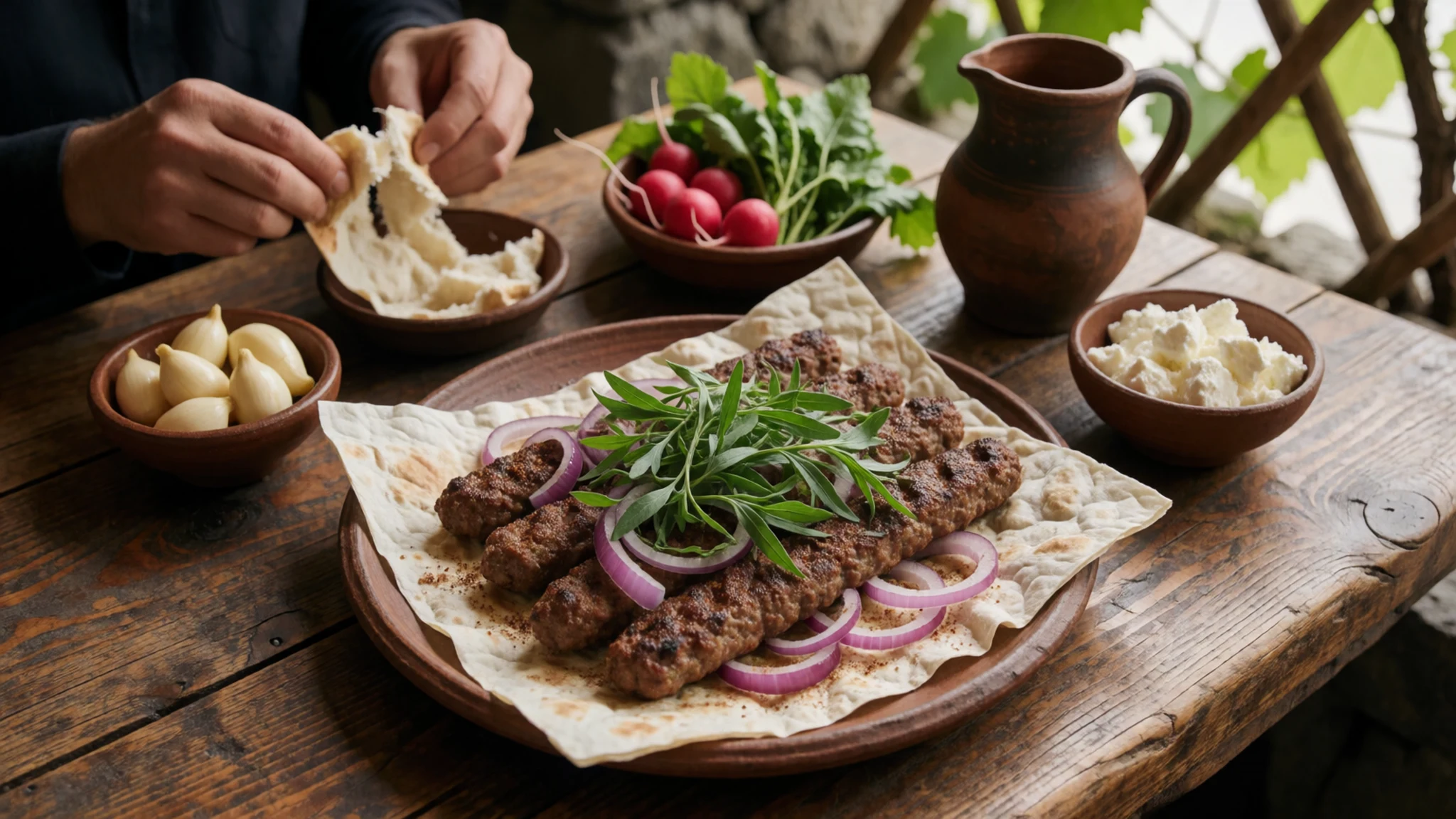
- Harissa — home-style eateries in Kotayk villages and Yerevan, especially around Easter
A thick porridge of slow-cooked chicken or lamb beaten together with coarsely ground wheat until smooth. Armenians traditionally serve it at Easter, and it is regarded as a national dish. It is unrelated to the North African chilli paste of the same name. - Lavash — village bakeries and roadside stalls between Yerevan and Garni
Thin, soft flatbread baked against the wall of a clay oven and eaten with cheese, herbs and meat. Fresh sheets arrive warm and are folded around almost anything. Watching it being slapped onto the oven wall is part of the fun. - Gata — stalls and bakeries near the monastery entrance and in Yerevan
A sweet, flaky round bread or pastry filled with a butter-and-flour crumb, commonly bought as a gift. Different towns have their own versions, and it is a common treat to take home from a day out.
Plan it
Best time. May–June and September–October bring the most comfortable weather for a gorge and monastery day. July and August can be hot in the lowlands, though the shaded gorge is cooler, and winter brings cold and the risk of snow or ice on the approach road.
How long. 1
Getting there. Fly to Yerevan's international airport, then travel east by taxi, organised tour or public transport via the village of Garni; the last stretch is a short road up the Azat River gorge to the monastery car park. Check current bus options locally, as routes change.
Budget. low
Tips
- Go early in the morning, before tour groups arrive from Yerevan.
- Combine Geghard with Garni Temple in one day trip.
- Check the official site or ask locally for opening hours and any entry fees before travelling.
- Carry some cash for roadside stalls and small village eateries.
- Wear shoes with good grip, as stone floors can be uneven and damp.
Etiquette
- Cover shoulders and knees when entering the chapels.
- Keep voices low and ask before photographing people at prayer.
- Do not touch or lean on carved khachkars.
Nearby
Sources
- Wikidata Q499285 (CC0)
- Wikipedia: Geghard (rev 1380715525) (CC BY-SA 4.0)
- Wikivoyage: Armenia (rev 5424247) (CC BY-SA 4.0)
- Photo: Geghard Monastery, Armenia — Diego Delso (CC BY-SA 4.0)
- Photo: Monastère de Kieghart en Arménie — Frédéric Dubois de Montpéreux (Public domain)
- Photo: Geghard — Matthias Süßen (CC BY-SA 4.0)
- Photo: Geghard Monastery, Armenia — Diego Delso (CC BY-SA 4.0)
- Photo: Katoghike Church, Geghard monastery — Anton Skrobotov (CC BY-SA 2.0)
- Photo: Gavit of Geghard (brighter) — AndyHM (CC BY 4.0)
- Photo: Geghard 2018-09-28 — Սարո Հովհաննիսյան (CC BY-SA 4.0)
- Photo: Interior de capilla en la roca, Geghard — AndyHM (CC BY-SA 4.0)


