Everest
Everest, Nepal
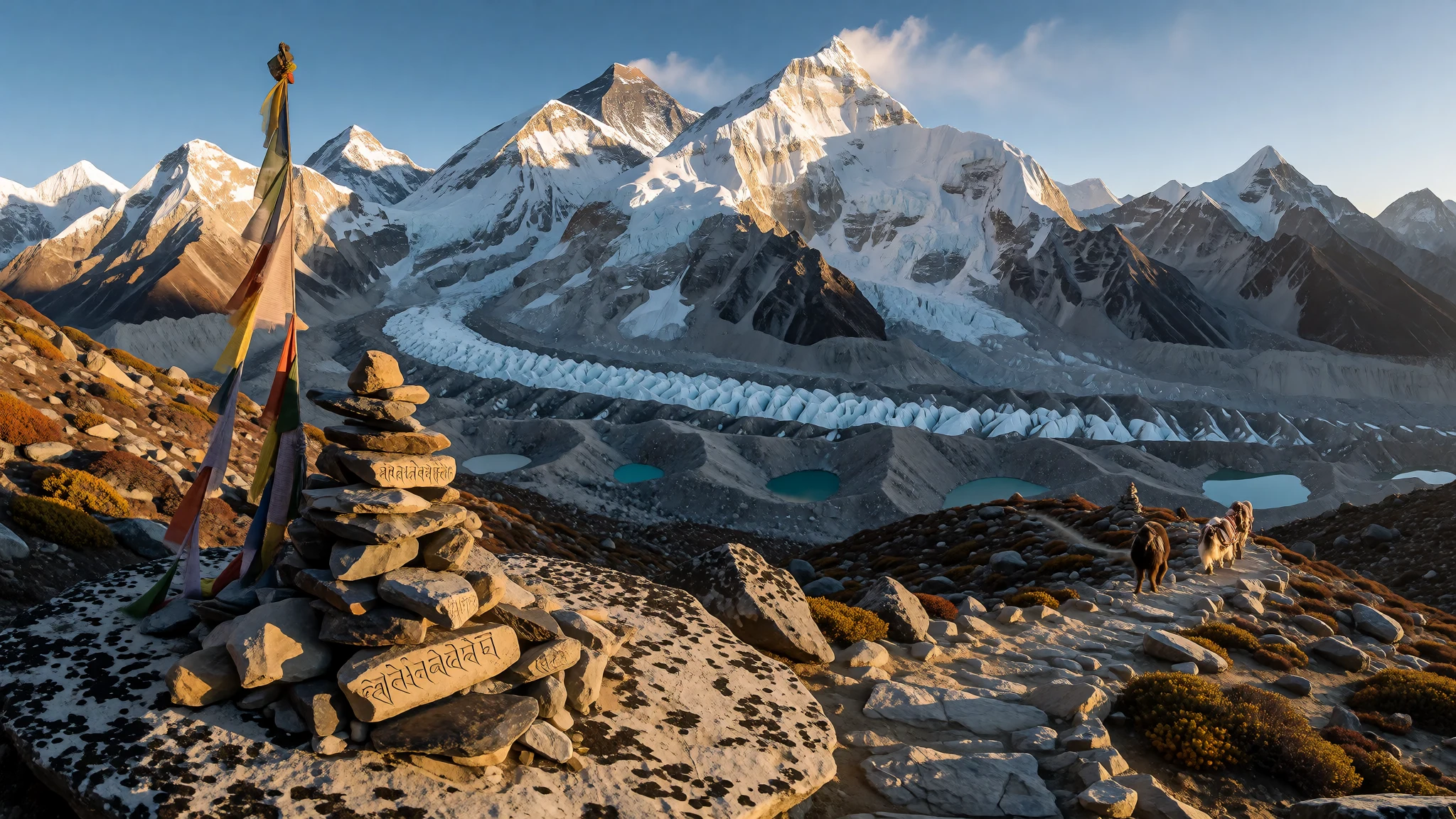
Everest rises at the head of the Khumbu as a rock-and-ice summit that people approach slowly, on foot, through thin cold air.
The place
Everest stands on the China–Nepal border on the high crest of the Mahalangur Himal, the same peak the northward photographs show from the air, from Gokyo Ri and from the Rongbuk side in Tibet. It reads as a dark pyramid of rock striped with snow, set behind Nuptse and beside Lhotse, while Thamserku sits on the morning skyline in front of that wall. From Gokyo Ri the summit looks north across glacier and ridge. From the path towards the Tibetan base of the mountain the north face closes the valley. From the air the whole mass sits in a wider ring of peaks. The mountain remains far from any comfortable standing place, and every closer step is made on foot. On the Nepal side the Khumbu is a working valley. Stone villages, prayer flags, mani walls and teahouses follow the trail, and yak trains share it with people who have come to look. Forest thins to scrub, then to moraine, dust and ice. Cloud often fills the lower valleys by afternoon and may lift or shut the view without warning. Wind on the ridges is ordinary. In the clearer months the viewpoints and the lodges are busy, because many people want the same sight at the same time. Sagarmatha (सगरमाथा), the Nepali name carried on maps of the peak, is how the mountain is known at home: a presence at the end of the path, watched more than it is casually visited. Everest in person is cold, slow and physically hard. The reward is scale, and the occasional quiet hour between weather, not ease or solitude.
Its story
Everest reached distant maps before anyone could visit it. An old engraving published as Gaurisankar shows a southern wall that German captions of that time assigned to this peak, a mix-up the print itself records. Papers of the Royal Geographical Society of London belong to the same era of argument: surveyors on the Indian plains, taking angles, comparing ridges, and trying to decide which summit was which. The mountain already had names at home. Sagarmatha is the Nepali name, the one maps of the peak still print. Tibetans know it as Chomolungma. Climbing came after measuring. Parties approached Everest from the north through Tibet, and from Nepal by the Khumbu. The attempt grew into a chain of camps, porters, ropes and, for many, bottled oxygen. It was not a walk from a roadhead. Sherpa families of the Khumbu carried loads, found routes and did much of the climbing; without that labour, outsiders stayed low. Edmund Hillary and Tenzing Norgay reached the summit and came down, and the route then passed from rumour into a path other people could try. The mountain did not become gentle. The company on it changed. In the clearer seasons Everest is both a trek towards its foot and a guided commercial climb, with crowds on the Nepal approach, full teahouses, and a public argument about waste, risk and fair pay for the people who work the route. Cold, falls, sudden weather and thin air still kill. The story of Everest is that double fact: a name settled after a long confusion, and a ridge that stays dangerous when the trail below it is busy.
What to see
- Summit from the air — Eastern Himalaya, from the air
Everest from a northward airborne view is a dark summit set in a crowd of white ridges, not a lone cone. Rock near the top and the long ridge show why the peak is hard to name until someone who knows the skyline points. Cloud often packs the valleys below, so the flight can be clearer than a walk spent inside that cloud. The look is short.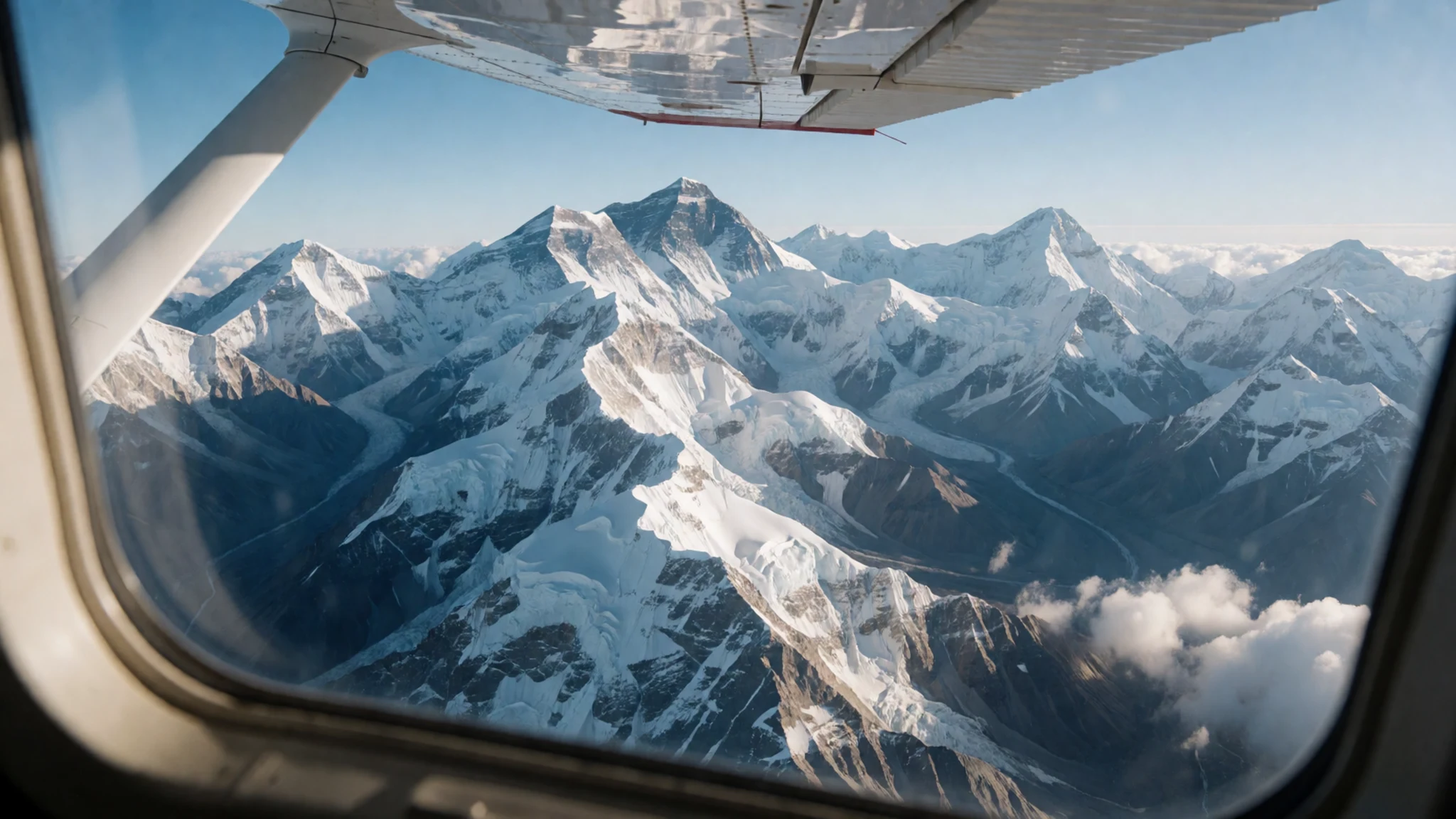
- Gokyo Ri — Gokyo, Khumbu
Everest from Gokyo Ri is a distant pyramid beyond a foreground of lesser snow peaks and the pale bed of the glacier. The walk to this viewpoint starts from the small lakes at Gokyo, on a side valley of the Khumbu rather than the main trail to the base of the mountain. The path is steep, loose and fully in the wind.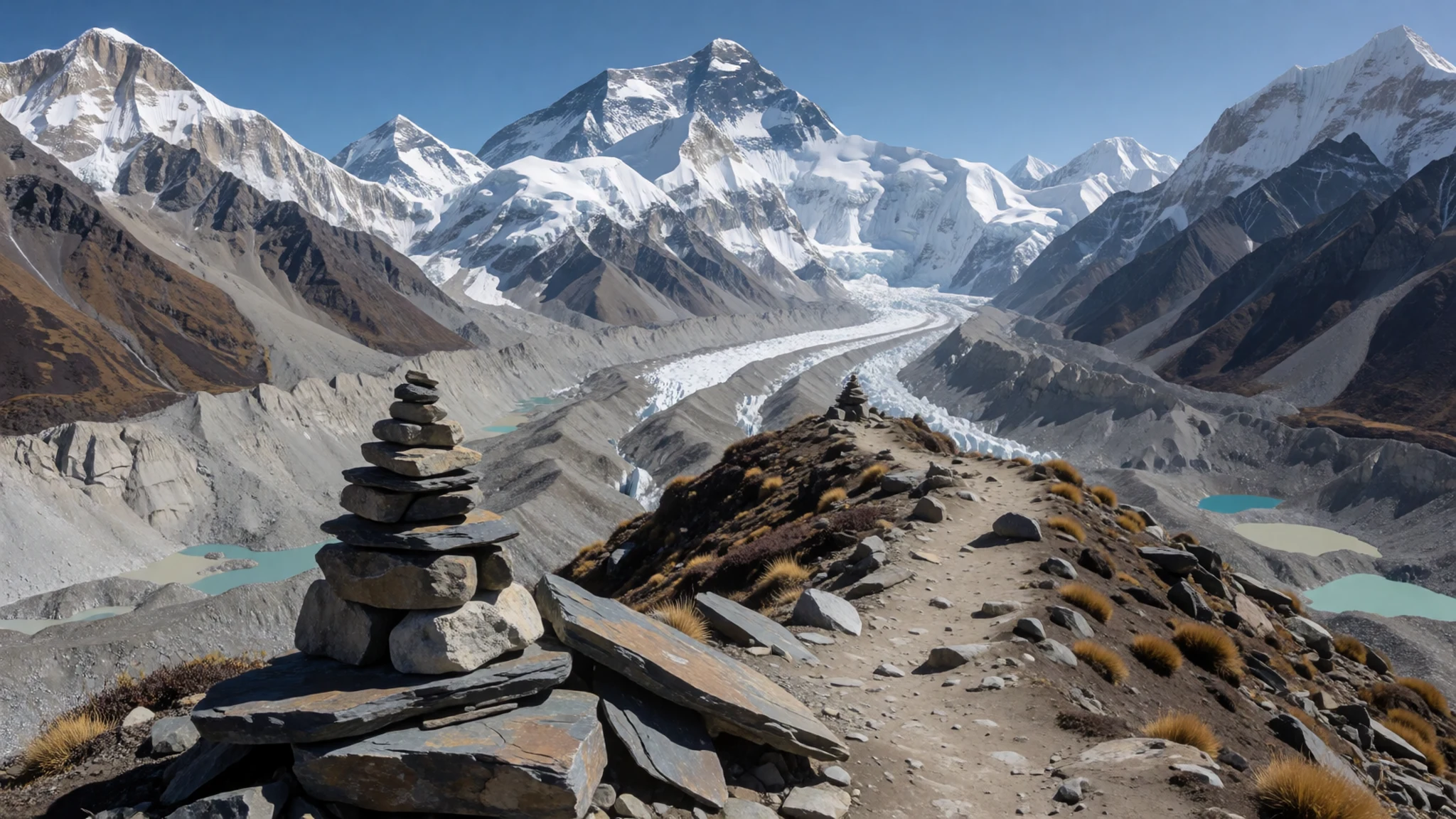
- North face above Rongbuk — Rongbuk valley, Tibet
Everest's north face, seen from the path towards the Tibetan base of the mountain, is a broad wall of rock, snow and ice at the end of the Rongbuk valley. The valley floor is high, dry and stark, with the peak looking closer than it is. This side is a different journey from the Khumbu, reached through Tibet rather than up the Nepal trail.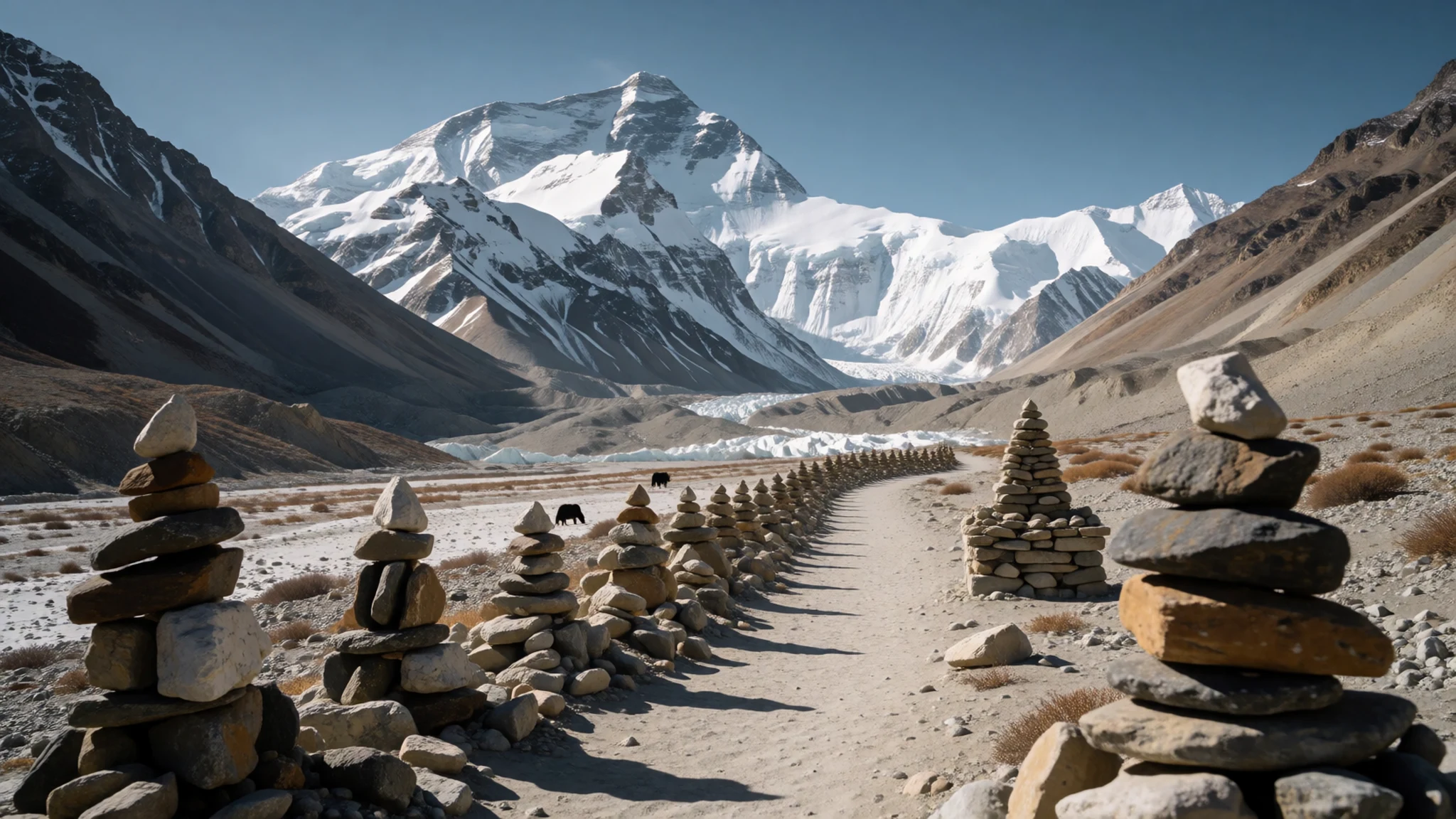
- Dawn skyline — Khumbu, Nepal
Everest at dawn, seen with Nuptse and Lhotse, is a lit edge of snow above shadow, while Thamserku and a neighbouring peak take the same early sun in front. Lodges in the Khumbu look towards this skyline on clear mornings, and the hour before cloud builds is the reliable one. From here the high crest reads as a single wall, which is why watchers disagree about which summit is which.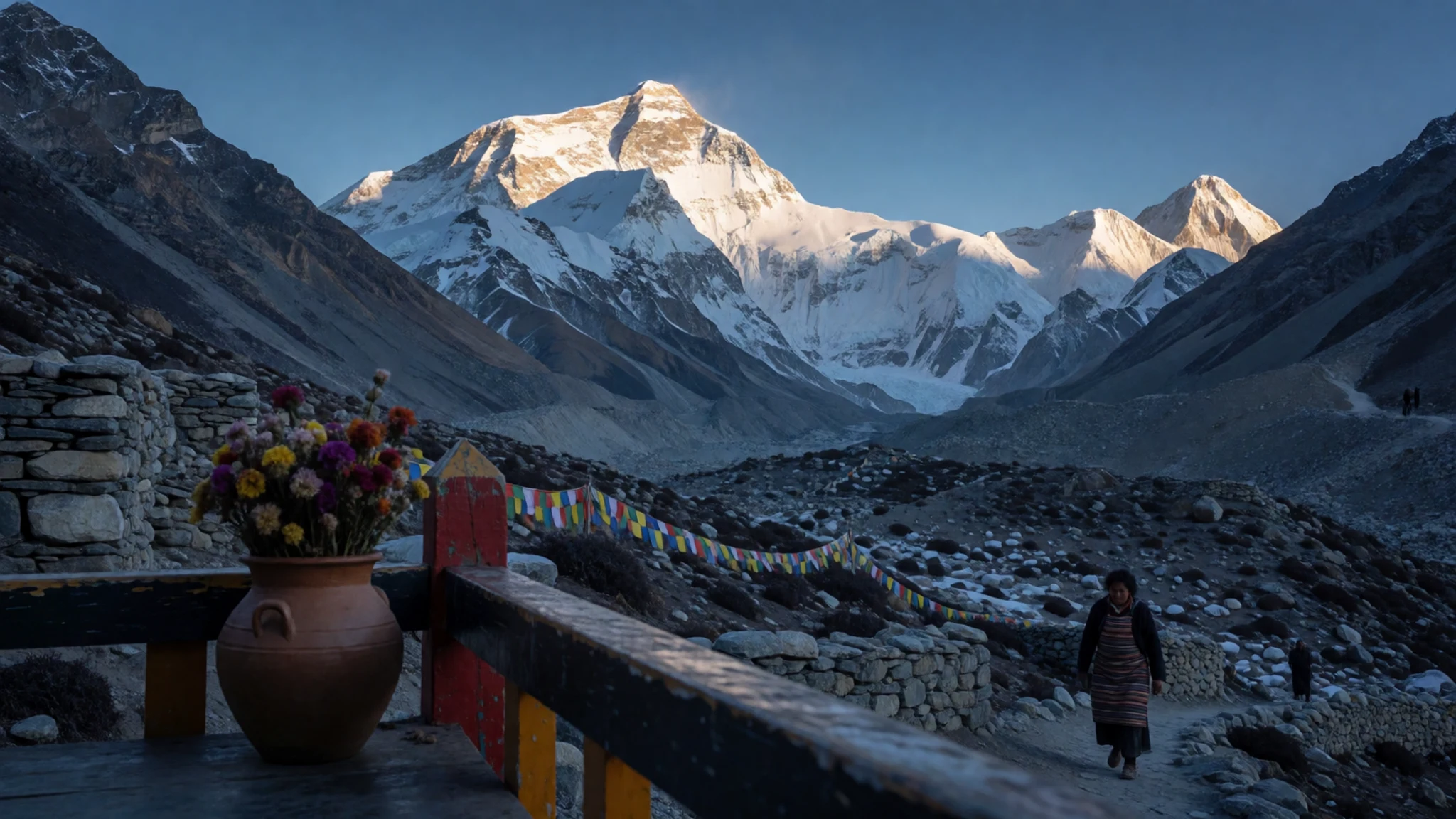
- The Khumbu approach — Khumbu, Nepal
Everest on the walk up the Khumbu rarely shows its full pyramid at first. The summit appears in pieces, over a ridge or beside Nuptse, then disappears as the path drops into a side valley. Prayer flags, mani walls and yak bells occupy the foreground, and the peak is why the path is there at all. The trail is the sight as much as the mountain.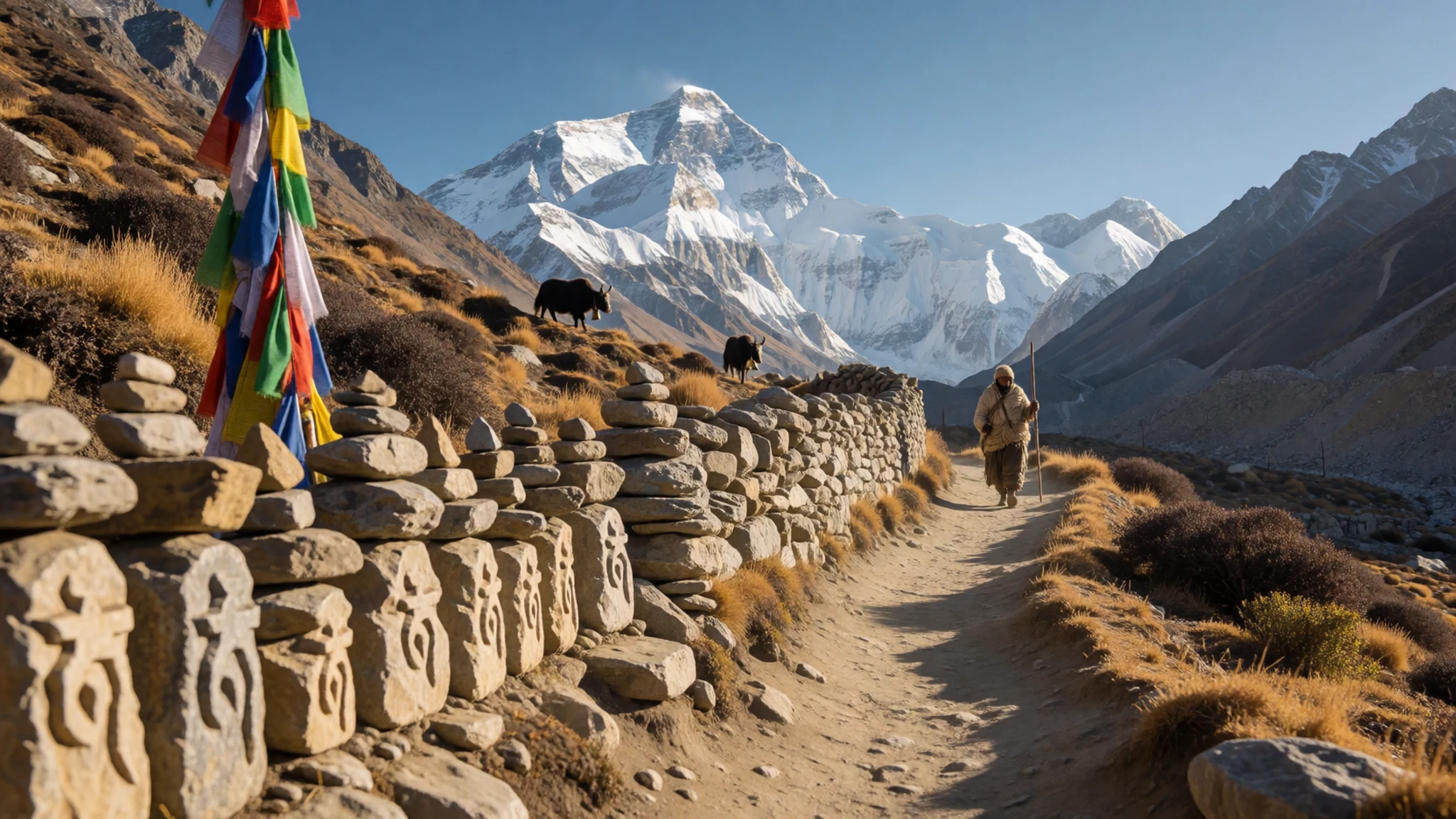
Culture
Everest is a sacred mountain as well as a climbing objective, and the culture around it belongs to the Sherpa people of the Khumbu and to Tibetan Buddhism. Monasteries, above all those in the high villages, hold masked dances and daily ritual; Tengboche is the gompa trekkers pass, though the religious life is older and wider than the trek. Mani walls are carved with prayers and are walked on the left, keeping the stones to one's right. Prayer flags in blue, white, red, green and yellow are strung on roofs, bridges and passes so the wind can carry the texts. A cairn or a flag line is not decoration to rearrange for a photograph. The climbing season has its own rites. Expeditions ask lamas for blessings before going onto the mountain, and Sherpa crews, cooks, porters and guides are the community that makes any ascent possible. Money from trekking has changed the Khumbu: schools, lodges and journeys abroad, and it has also loaded a small valley with visitors who sometimes treat a holy landscape as a gym. Everest's name in Nepal, Sagarmatha, and the Tibetan Chomolungma both frame the peak as a deity's place, not a trophy. Speak quietly inside a gompa, ask before photographing people at prayer, and walk clockwise past mani walls and chortens.
What to wear
Everest's trails show Sherpa clothing made for this climate beside the synthetic kit of visitors. The traditional Sherpa robe is the bakhu, a wrap of thick wool crossed over the chest and tied, worn long by women and hitched at the knee by men when walking or working. Married women wear a striped apron, the pangden, over the robe. The textiles are wool and, where a household keeps animals, yak hair: warm, heavy, and woven or felted for winter. On festival days the same garments appear in cleaner, brighter cloth, with blouses and caps that mark the occasion. Day to day in the Khumbu now, people wear the global mix the trekking economy brought in. Fleece jackets, down coats, jeans, trainers and puffy nylon are as common as the bakhu, and many Sherpa guides climb in the same branded high-altitude suits as their clients. The robe remains for ceremony, for older residents, and for cold mornings around the house. A visitor should dress for wind, strong sun and a day that swings from mild walking to hard frost, in layers that can be put on and taken off: a wicking base, a warm mid-layer, and a windproof shell. Boots ought to be worn in before the trek; new boots shred feet on the moraine. At monasteries, shoulders and knees stay covered, and shoes come off where the doorway asks. Cotton shirts and city trainers belong in Kathmandu, not on the moraine.
What to eat
- Dal bhat — teahouses along the Khumbu trail
Dal bhat is lentil stew with rice and a small pile of vegetables, often with pickle, and it is the meal teahouses on the Everest approach serve from the lower Khumbu upward. A further helping of rice and dal is the ordinary custom.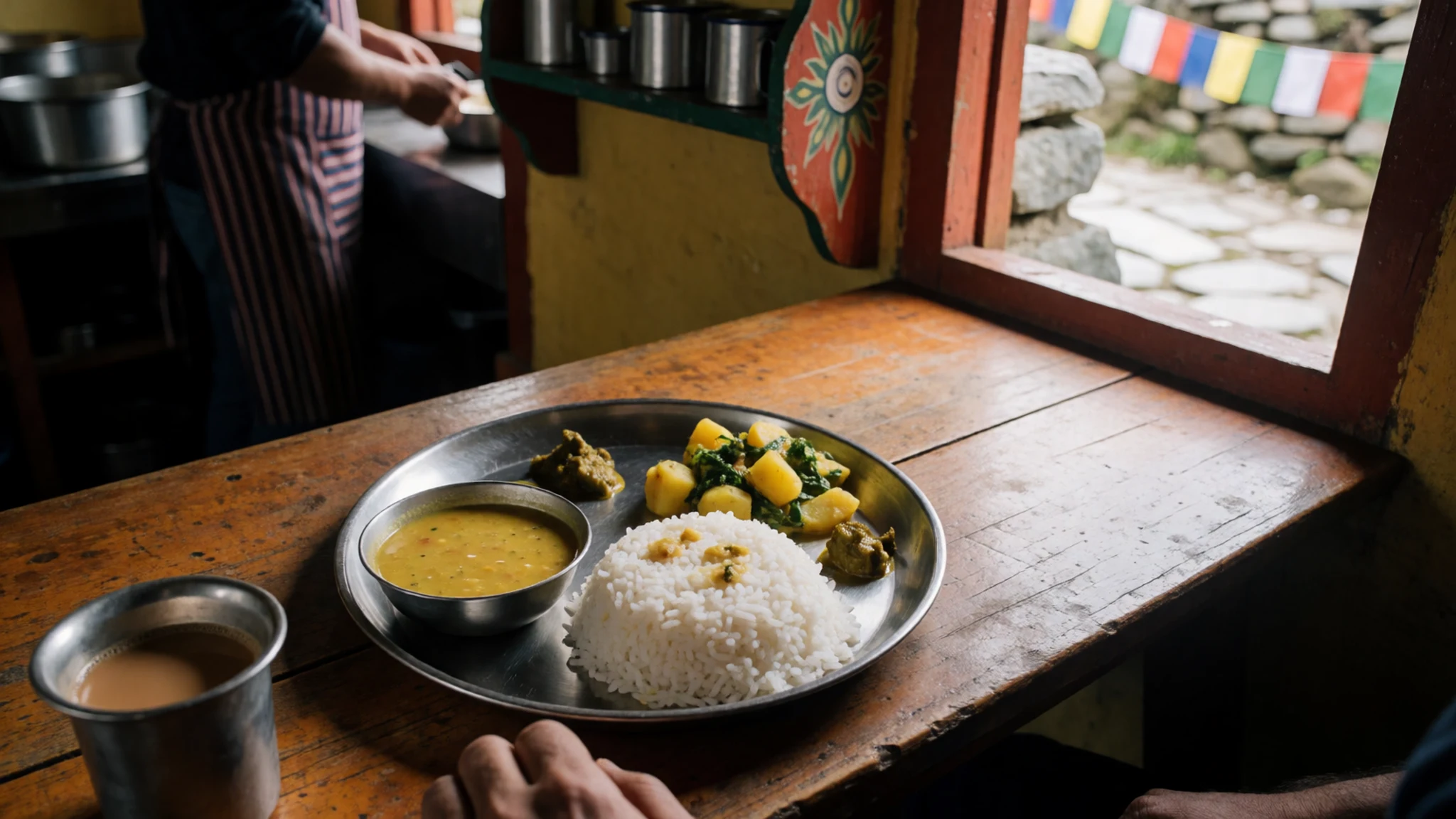
- Shyakpa — village lodges in the Khumbu
Shyakpa is a Sherpa stew of potatoes and vegetables, sometimes with meat when a lodge has some, simmered until the broth goes thick. Along the Everest trail it appears in village kitchens as the alternative to rice. Potatoes grown in the high villages are the heart of it.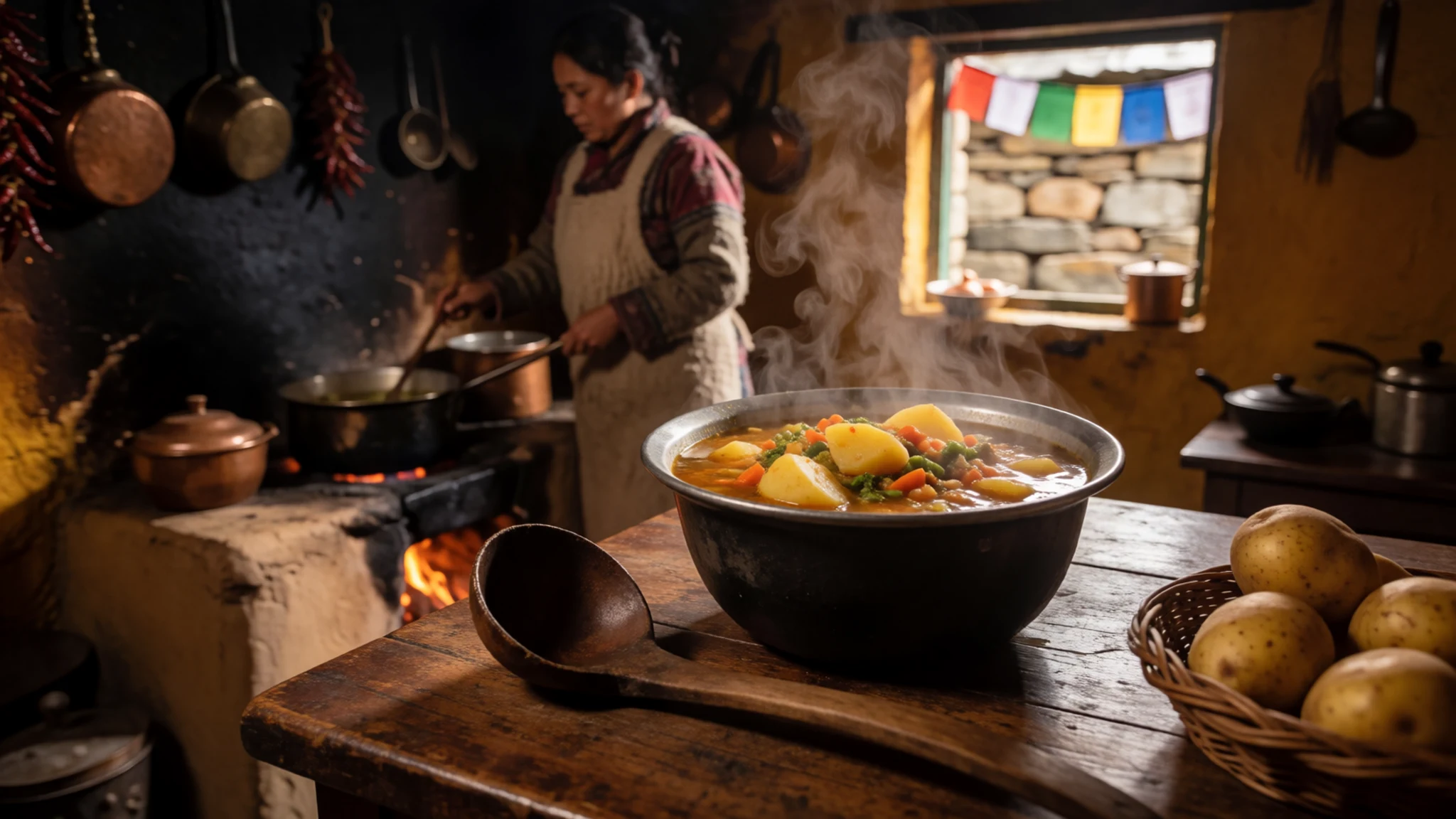
- Momos — teahouses and weekly markets in the lower Khumbu
Momos on the way towards Everest are dumplings of buffalo, yak, chicken or potato, steamed or fried, with a chilli dip that varies from house to house. They are the snack of teahouses in the lower Khumbu and of market days, not a summit food. - Butter tea — Sherpa homes and high teahouses
Butter tea around Everest is salty, not sweet: black tea churned with butter and salt, served in a cup that is refilled as talk continues. Sherpa hosts offer it in homes and in lodges, and refusing a cup is a poor start. The taste is smoky and rich. - Riki kur — high village kitchens in the Khumbu
Riki kur is a potato pancake of the high Khumbu, shredded or mashed potato cooked on a griddle until the edges crisp. Kitchens on the Everest approach serve it at breakfast, often beside a chilli sauce. It is food built on the crop these villages can grow.
Plan it
Best time. Everest is kinder to walkers in spring, before the monsoon, and in autumn after it. Spring draws climbing parties as the days lengthen; July is hottest and wettest, October most comfortable, and September and October nights are milder than April, with November as cold as early spring. Summer brings cloud, rain and leeches lower down. Winter is short-day and deeply cold, and many lodges shut.
How long. For Everest, many days on foot, or a day by air.
Getting there. Kathmandu is the gateway, then a small-aircraft hop to Lukla and a long walk up the Khumbu. There is no road to the Nepal foot of Everest. From the north the last vehicle leg runs through Tibet to the Rongbuk valley, and the rest is on foot.
Budget. high
Tips
- Gain height slowly, and go down if a headache, nausea or confusion starts.
- Keep spare days around the Lukla flight; cloud cancels aircraft.
- Carry cash for the whole walk; lodges do not take a card for granted.
- Begin viewpoint walks early, before cloud fills the valleys.
- Boil or treat drinking water rather than trusting a stream.
- Check current permit rules with the official Nepal tourism office before leaving Kathmandu.
Etiquette
- Keep mani walls and chortens on your right as you pass.
- Ask before photographing people, above all at prayer.
- Take shoes off where a gompa door has a step and shoes waiting.
- Leave drones packed away over villages, flocks and monasteries.
Nearby
Sources
- Wikidata Q513 (CC0)
- Wikipedia (CC BY-SA 4.0)
- Wikivoyage (CC BY-SA 4.0)