Auroville
Auroville, India
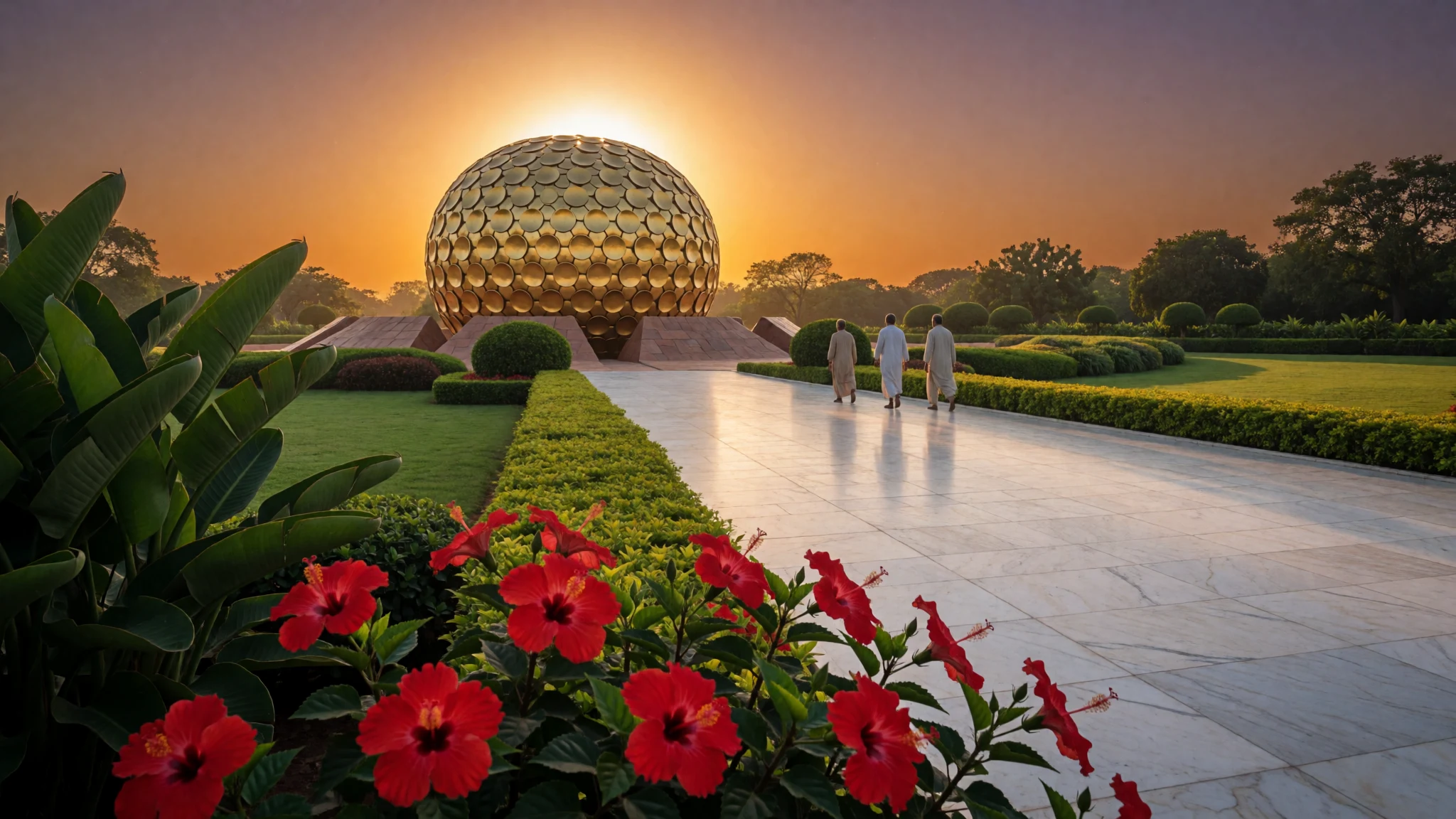
Auroville is a forested experiment in shared living on India's Coromandel coast, where visitors can meditate, volunteer and cycle between farms and workshops.
The place
Auroville is an experimental township on the Coromandel coast of southern India, a short drive north of Pondicherry. Most of it lies in Tamil Nadu's Viluppuram district, with a few parcels across the line in the Union Territory of Puducherry. Wikidata gives it a population of 3,288, and it was founded in 1968. Those numbers explain the feel: this is a scatter of settlements rather than a conventional city. The land is a cluster of properties, roughly 12 km north of Pondicherry, with forest, farms, workshops, schools and homes spread over a low plateau of red earth. The highest point, near the Matrimandir, is only about 32 m above sea level. Roger Anger, a French architect, drew the master plan as a galaxy: four zones, residential, industrial, cultural and international, meant to spiral outwards from the Matrimandir at the centre. Only part of that plan has been built, so in practice the township is a network of lanes, tracks and shaded clearings that are easiest to cover by bicycle or scooter. Residents come from many countries, and about half are Indian. Money works differently here. Residents are given accounts rather than carrying cash, and visitors are asked to open a temporary account with a special card at the Visitors' Centre. The sea is a few kilometres east, and the coast road to Chennai is the main way in. The tone is quiet, green and slightly earnest, closer to a large campus or a collection of villages than to a tourist town, and a visit goes better when it is slow.
Its story
Auroville began as an idea of the Sri Aurobindo Society in Puducherry. In 1964 the society resolved to create a city that would carry out the vision of the philosopher Sri Aurobindo. Mirra Alfassa, known as the Mother, was his spiritual collaborator and the society's president, and she led the project. She saw the township as a laboratory for human unity, open to anyone of goodwill, and in 1965 she issued a public message inviting people to take part. The chosen site was about 20 square kilometres of eroded, treeless plateau a short way inland from the sea. Much of the soil had been washed away, so the first residents spent years planting, building bunds to hold the monsoon rain, and raising the forest that now shades the lanes. The inauguration took place on 28 February 1968, with delegates from 124 nations in attendance. Young people carried soil from their home countries to be placed in an urn at the centre, a gesture meant to show that the town belonged to no single nation. The Mother wrote a four-point charter in French. It says the town belongs to humanity as a whole, that it will be a place of lifelong learning, that it will link past and future, and that it will pursue material and spiritual research toward a lived human unity. Its first decades were not always smooth: disputes over governance and land followed, and the township has since taken its present shape through slow, practical work. The charter still hangs over daily life.
What to see
- Matrimandir — Centre of the township
The Matrimandir is a gold-clad sphere in landscaped gardens, built as a space for silent concentration rather than for any one faith. Inside, a ramp climbs to a white chamber with a large crystal. Entry is tightly managed and bags, phones and cameras stay outside, so ask at the Visitors' Centre for current arrangements. - Tibetan Centre — Near the township centre
This Tibetan-style building sits in green grounds and contains a seat kept for the Dalai Lama. It is a calm stop on a cycle loop between the Matrimandir and the western lanes, and a reminder that Auroville draws on many cultural and spiritual traditions. - Auro Beach — East of the township, off the coast road
The beach is a walk from the bus stop on the East Coast Road and has the open sea air and fishing boats typical of this coast. Litter and pollution are a problem, so it suits a long stroll better than a swim. Check currents locally before going into the water. - Organic farms — Across the township
Farms are a large part of Auroville's identity, growing vegetables and fruit for the community kitchens and shops. Many welcome day volunteers and longer stays, and some run tours. Visitors who want more than sightseeing can arrange a few days of work through the Visitors' Centre. - Kaluveli Bird Sanctuary — North of Auroville
Kaluveli is a Ramsar-listed wetland a drive north of the township, valued for its water birds. Early morning is best, when the light is soft and the heat has not built. Bring binoculars, water and a hat, and expect little shade near the marsh edge.
Culture
Auroville's culture is shaped by a shared purpose more than by one ethnic tradition. The township grew from the teachings of Sri Aurobindo and the Mother, and daily life mixes yoga, arts, craft, research and farm work among people from many countries. Visitors will hear French, Tamil, English and other languages in the same café. The surrounding villages, such as Kottakarai and Alankuppam, are Tamil, and their rhythms of temple festivals, harvest observances such as Pongal in January, and market days sit beside the township's more international routines. Pondicherry's French past adds another layer, visible in bakeries, crêpes and a taste for cafés. Auroville is not a resort and not a religious order: residents are expected to contribute work, money or both, and guests pay a daily contribution towards running costs. Many residents are happy to explain their projects, and volunteering is the usual way to see beyond the main sights. Programmes in yoga, tai-chi and healing therapies are busiest during the visitors' season from December to March. Silence matters at the Matrimandir, where the setting is meant for concentration, and the same spirit of restraint extends to the quiet lanes. Respect for the villages next door also matters, since their residents work here and live here. At the Matrimandir, leave bags, phones and cameras where asked, keep your voice low, and follow the guide's instructions without exception.
What to wear
Auroville has no single costume of its own, so the traditional dress worth knowing is that of Tamil Nadu around it. Women wear the saree in cotton for daily use and in silk for weddings and festivals, with Kanchipuram silk the best-known kind; others wear the salwar kameez. Men wear the veshti, a length of white or cream cotton wrapped at the waist, or the lungi in a checked weave, and both are common in the villages. What people wear in the township now is mostly practical: loose cotton and linen shirts and trousers, handloom kurtas, simple dresses, sandals, and sun hats on scooters and bicycles. Handloom and block-printed fabrics from local boutiques are popular. Visitors should dress for heat and humidity, with average highs above 30 °C, in light, breathable layers that cover shoulders and knees. That also suits nearby villages and temples, where modest dress is the norm. Wear sandals that slip on and off easily, since shoes come off at many doorways, and carry a pair of closed shoes if heading to farms or the bird sanctuary. Bring sunscreen, a hat and a light rain layer for the monsoon months. At the beach, swimwear is fine in the water, but a sarong or shirt over it is wiser on the walk back.
What to eat
- Idli, dosa and South Indian meals — South Indian eateries in Auroville's lanes and in Kottakarai village
Steamed rice cakes, crisp fermented crêpes and rice meals served with sambar and coconut chutney are the local staples. Breakfast is the best time for them, and village eateries often serve them hot and quickly. - Community canteen lunch — The main community canteen near the Matrimandir area
The largest community canteen serves a set vegetarian lunch with rice, dal, vegetables and salad, much of it from Auroville's own farms. It is a plain, sociable meal where residents, volunteers and visitors eat together. - Clay-oven pizza — Pizzerias along the main roads inside the township
Pizza baked in a clay oven is a surprise find here, a legacy of the many European residents. The bases are thin and a little smoky. Some places also serve pasta as a daily special. - Crêpes and fresh fish — French-influenced cafés near the Town Hall and the coast road
French cooking arrives here in the form of buckwheat or wheat crêpes, sweet or savoury, and fish when the catch allows. Menus change by season and day, so check what is on. - Organic baked goods and vegan snacks — Bakery cafés and farm-produce shops near the main junction
Bakery cafés offer breads, cookies, cakes and vegan dishes made with local and organic ingredients, alongside tea, coffee and fresh juice. They are useful for a cycling snack or a quiet morning with a laptop.
Plan it
Best time. January to March, after the north-east monsoon has passed and before the heat builds; December is also lively, since the visitors' season runs from December to March. Rain falls mainly in the south-west monsoon from June to September and the north-east monsoon in November and December, and the dry period lasts about six months. Highs average around 32 °C, so midday is hot even in the best months.
How long. 2–3
Getting there. The nearest airports are Pondicherry, about 11 km away, and Chennai, about 142 km away, so check current flights. From Pondicherry, an auto-rickshaw or taxi covers the 16 km or so up the coast road. By road from Chennai, take the East Coast Road to the Bommayapalayam junction, where rickshaws wait for the last stretch to the Visitors' Centre. Bus timings change, so check the official site at http://www.auroville.org.
Budget. mid
Tips
- Go to the Visitors' Centre first: it handles Matrimandir access, guesthouse listings and the temporary account with a card
- Allow extra days for the Matrimandir, since entry can need a preliminary introduction, and weekends bring queues
- Rent a bicycle or scooter, as distances between sights are too long for comfortable walking
- Start outings early and carry water, because shade is patchy and the sun is strong
- Book guesthouses ahead in the December–March season, or ask at the Visitors' Centre
Etiquette
- Keep quiet at the Matrimandir and leave phones, bags and cameras outside as asked
- Ask before photographing residents or villagers, and respect farm and workshop boundaries
- Dress modestly when visiting nearby villages and temples, and remove shoes at doorways
Nearby
Sources
- Wikidata Q590361 (CC0)
- Wikipedia: Auroville (rev 1382477450) (CC BY-SA 4.0)
- Wikivoyage: Auroville (rev 5394031) (CC BY-SA 4.0)
Wildlife
- Grey heron (animal)
Picture a grey bird on stilts, frozen at the water's edge, waiting for supper to swim past: that is the grey heron. In Auroville, the quiet, sheltered estuary is where the reading suggests watching herons. Some northern herons travel south in autumn, though the notes do not say whether that applies here. Be patient, keep a respectful distance, speak softly, consider a guide, and never offer food. - Grey heron (bird)
Picture a grey bird on stilts, frozen at the water's edge, waiting for supper to swim past: that is the grey heron. In Auroville, the quiet, sheltered estuary is where the reading suggests watching herons. Some northern herons travel south in autumn, though the notes do not say whether that applies here. Be patient, keep a respectful distance, speak softly, consider a guide, and never offer food. - Little egret (bird)
The little egret is a small white heron with a thin black beak and black legs, like a snowy wader wearing dark stockings. Western birds have yellow feet. It hunts small creatures in shallow water and on land. The reading names Auroville's quiet, protected estuary as a place to watch egrets, but gives no season or time of day. Stay at a gentle distance, keep still and quiet, take a guide if possible, and never feed it.