Wudang Mountains
Wudang Mountains, People's Republic of China
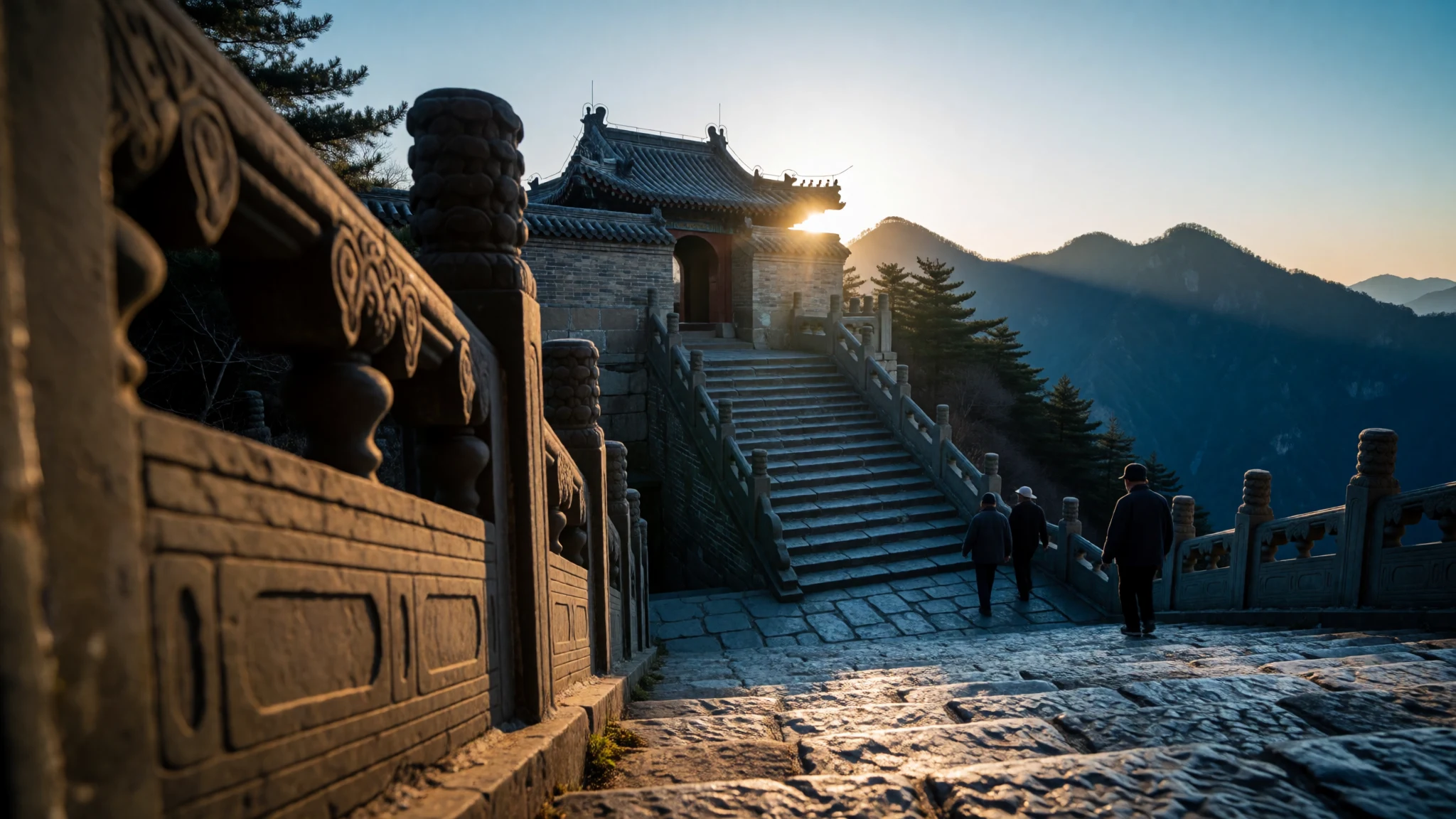
Wudang Mountains offer working Taoist temples, cliff-hung halls and tai chi practice among forested ridges in northwest Hubei.
The place
The Wudang Mountains (武当山, Wǔdāng Shān) rise in the northwest of Hubei province, central China. On maps the name covers two things: a long east–west range running along the southern side of the Han River through several districts of Shiyan, and a smaller cluster of peaks near Danjiangkou that forms the religious heartland. It is that cluster most visitors mean.
The highest peak in the cluster is listed at 1,612 metres on modern maps, though other parts of the wider range climb a little higher. Some geographers treat Wudang as an offshoot of the Daba Mountains, which stretch towards Shaanxi, Chongqing and Sichuan.
What sets the place apart is its character. Wudang is the Taoist answer to Shaolin: where Shaolin belongs to Chan Buddhism, Wudang is tied to Taoism and to the soft, flowing styles of tai chi. The temples are dedicated mainly to Xuantian Shangdi, the Lord of the North, a martial deity also called Zhenwu. It counts among Taoism's four sacred mountains in China and remains a pilgrimage destination, so alongside tour groups there are priests, pilgrims and students of martial arts.
The monasteries were inscribed as a UNESCO World Heritage Site in 1994. Much of the architecture is spread across slopes and ridgelines, with stone stairways, gateways and halls linking one site to the next. Distances are bigger than they look on a map, and the terrain is steep, so the mountain is a place for a full day or more on foot, with cable cars and buses available for the longer stretches. It is also a Chinese AAAAA-rated tourist attraction, which means proper facilities and, in season, proper crowds.
Its story
Wudang has been a Taoist centre for centuries, and its fame rests on two linked things: the temples and the martial tradition of tai chi associated with them. Building began under the Tang dynasty, when Emperor Taizong ordered the first sacred site, the Five Dragons Temple. More halls followed under the Song and Yuan dynasties.
The great expansion came in the Ming era, in the 14th to 17th centuries. The Yongle Emperor said he enjoyed the protection of the god Xuantian Shangdi, and he poured resources into the mountain. At its peak, the Ming-built complex contained nine palaces, nine monasteries, thirty-six nunneries and seventy-two temples. Not everything lasted; timber buildings burn, decay and get rebuilt, and today 53 ancient buildings survive.
The oldest standing structures are the Golden Hall and the Ancient Bronze Shrine, cast in 1307. Other landmarks include Nanyang Palace, begun in 1285, the stone-walled compound at the summit built in 1419, and the Purple Cloud Temple, whose origins lie in 1119. Each was altered over the centuries, so the mountain reads as layers of different periods rather than a single moment.
Loss has been part of the story too. On 19 January 2003 the Yuzhengong Palace, some 600 years old, burned down after a fire started accidentally by an employee of a martial arts school. A gold-plated statue of Zhang Sanfeng, the figure traditionally linked with tai chi, had been moved elsewhere shortly before and was saved. The episode is a reminder that this is a living religious site with schools, residents and daily activity, not a museum.
What to see
- Zixiao (Purple Cloud) Palace — Wudangshan, Danjiangkou
One of the more complete palaces still standing on the mountain, built in the formal imperial style with terraced courtyards. It is recognised as a protected cultural relic and still serves as a working Taoist venue. Allow time to wander its halls slowly; the carved details and roof lines reward patience.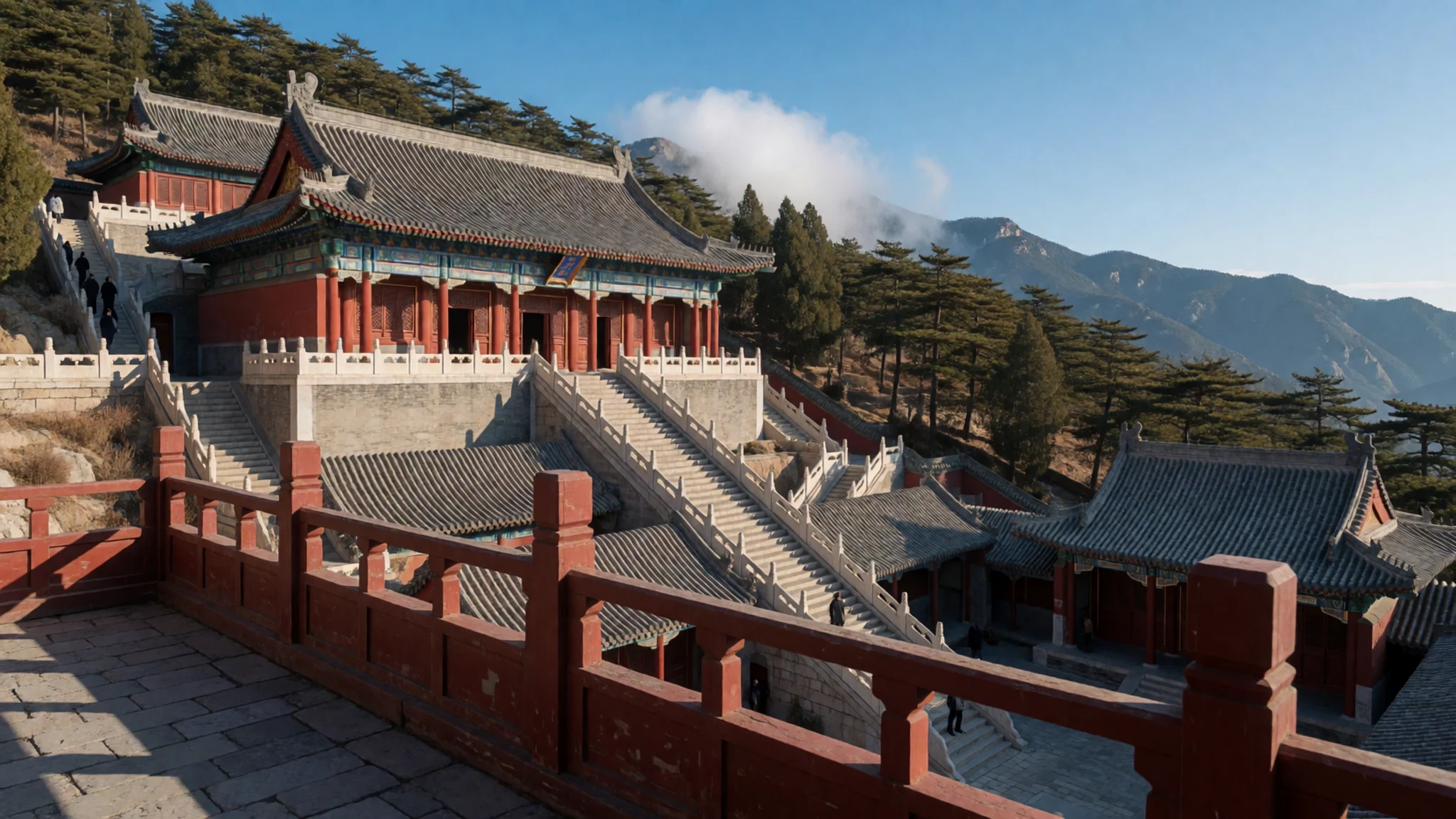
- Nanyan Palace — Wudangshan, Danjiangkou
Said to be where Zhenwu attained enlightenment. Its stone hall, the Tianyi Zhenqing Palace, dates to the Yuan dynasty and is set directly into the cliff face, the most striking of the mountain's 36 rock formations. The setting, with drops on one side, is as memorable as the architecture.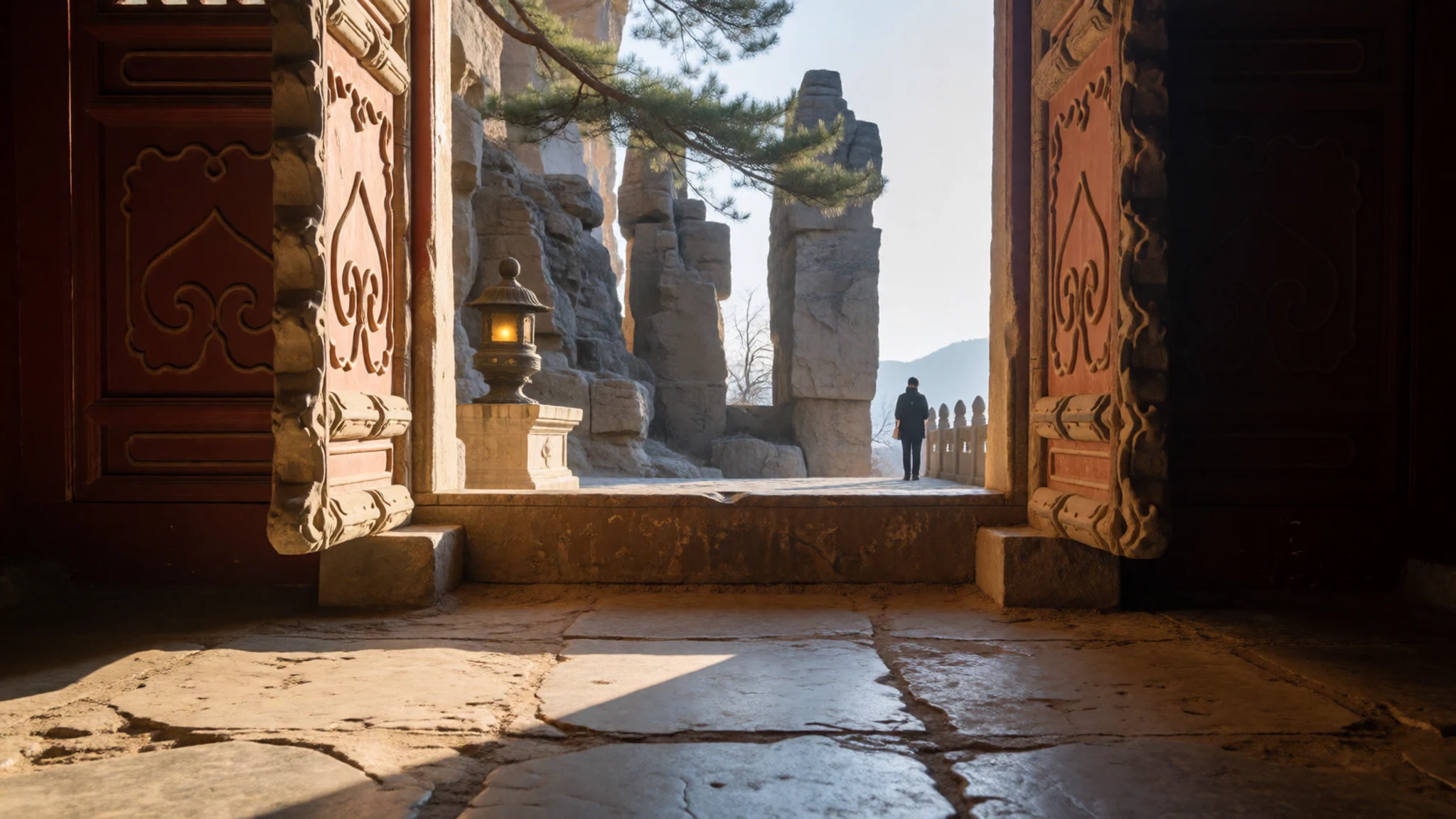
- Golden Hall and the summit — Main summit area
At the top stands the Golden Hall, a gilded bronze building and one of the oldest surviving structures on the mountain. A stone-walled compound surrounds it. Reaching it means a long stair climb or a cable car, and the views over ridges in clear weather justify the effort.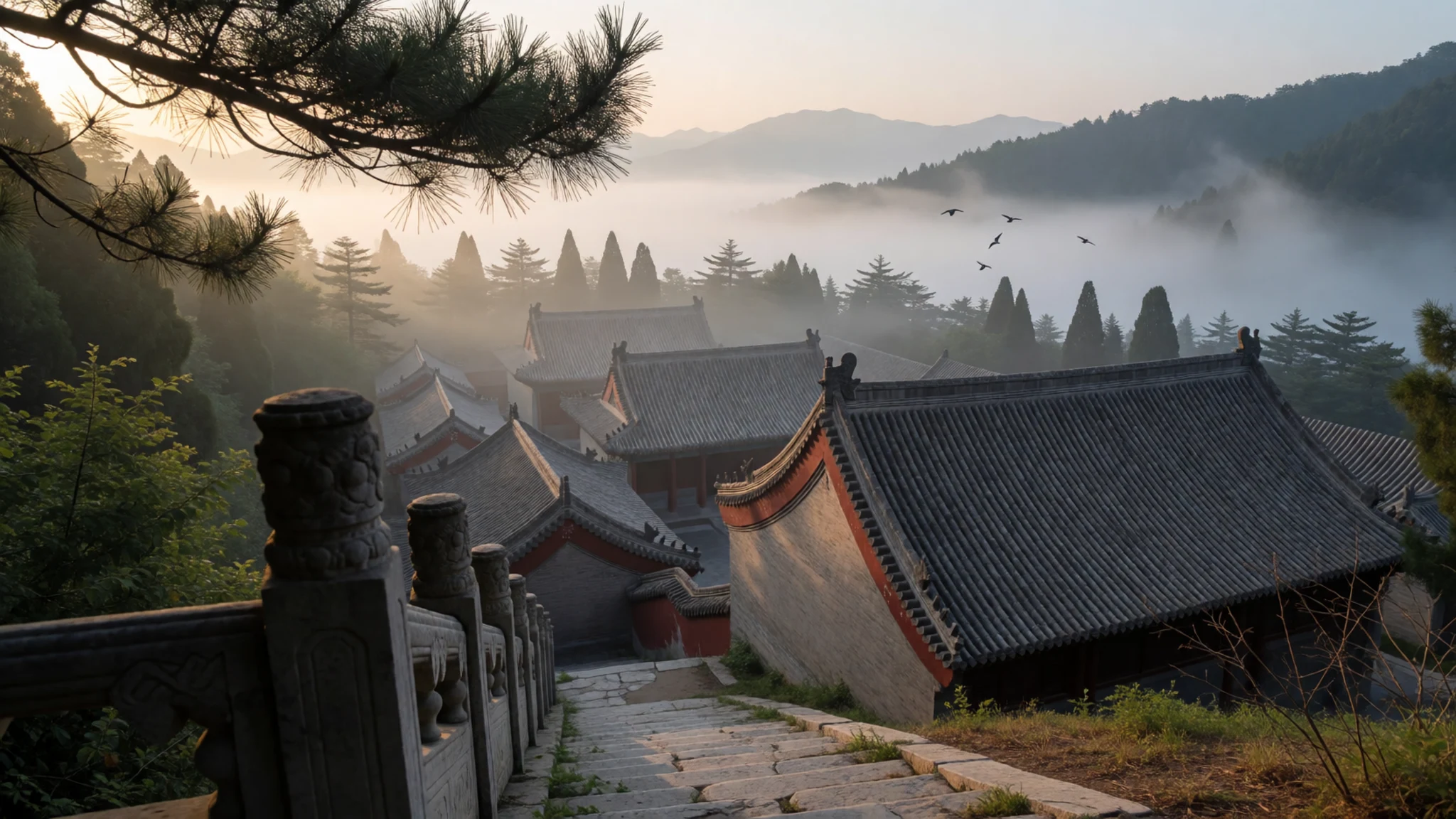
- Xuanwu Gate — Wudangshan
One of the monumental gateways on the mountain, a good place to appreciate how stone, timber and slope are combined. Gates like this mark thresholds between ordinary and sacred ground, and pilgrims traditionally treat them as points to pause before continuing upward.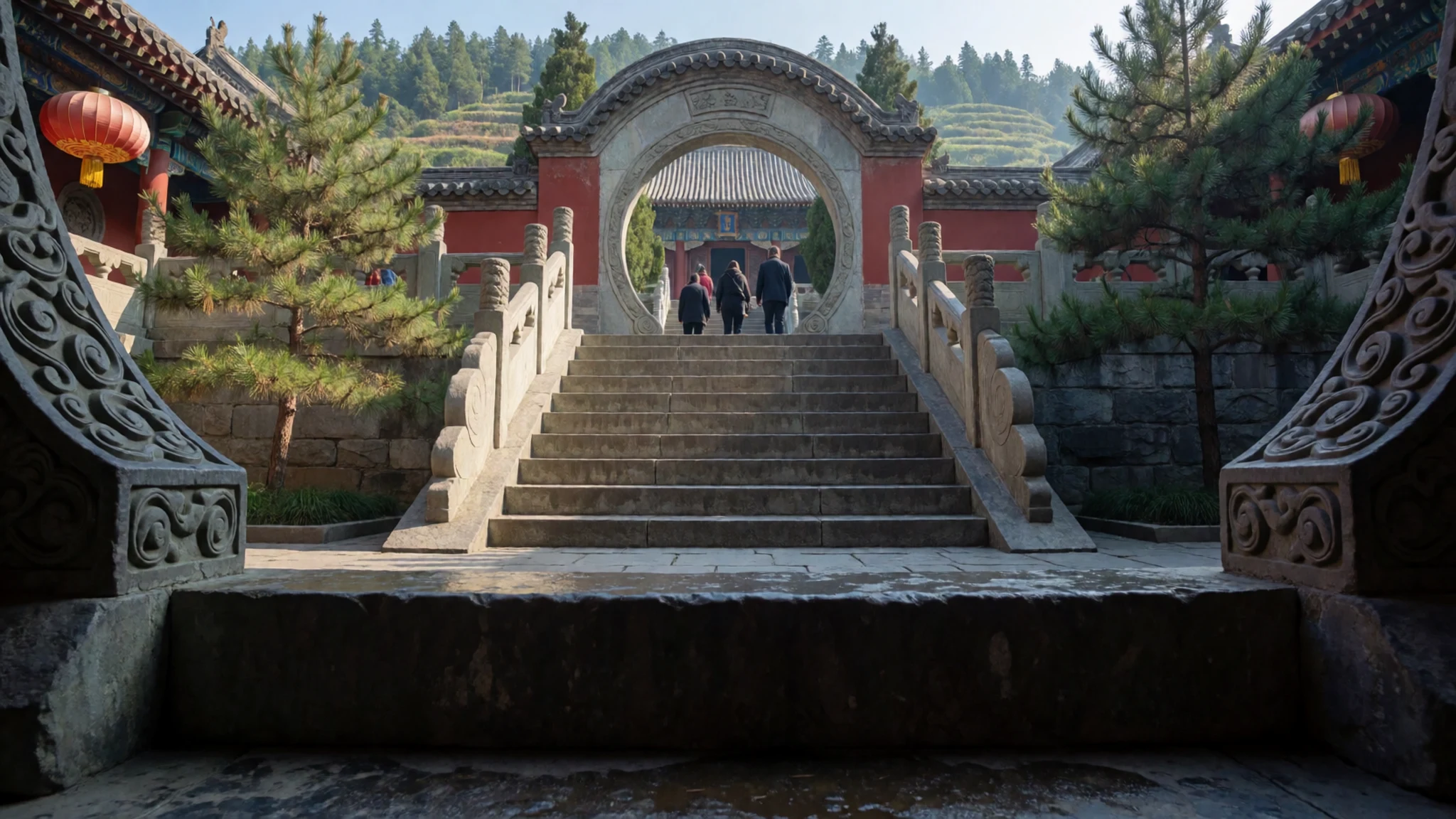
- Qiongtai Middle Temple — Wudangshan
A smaller, quieter temple complex on the slopes, useful for seeing everyday ritual away from the main sites. Incense, tiled courtyards and mountain mist make it atmospheric, and it tends to be less busy than the summit area early in the day.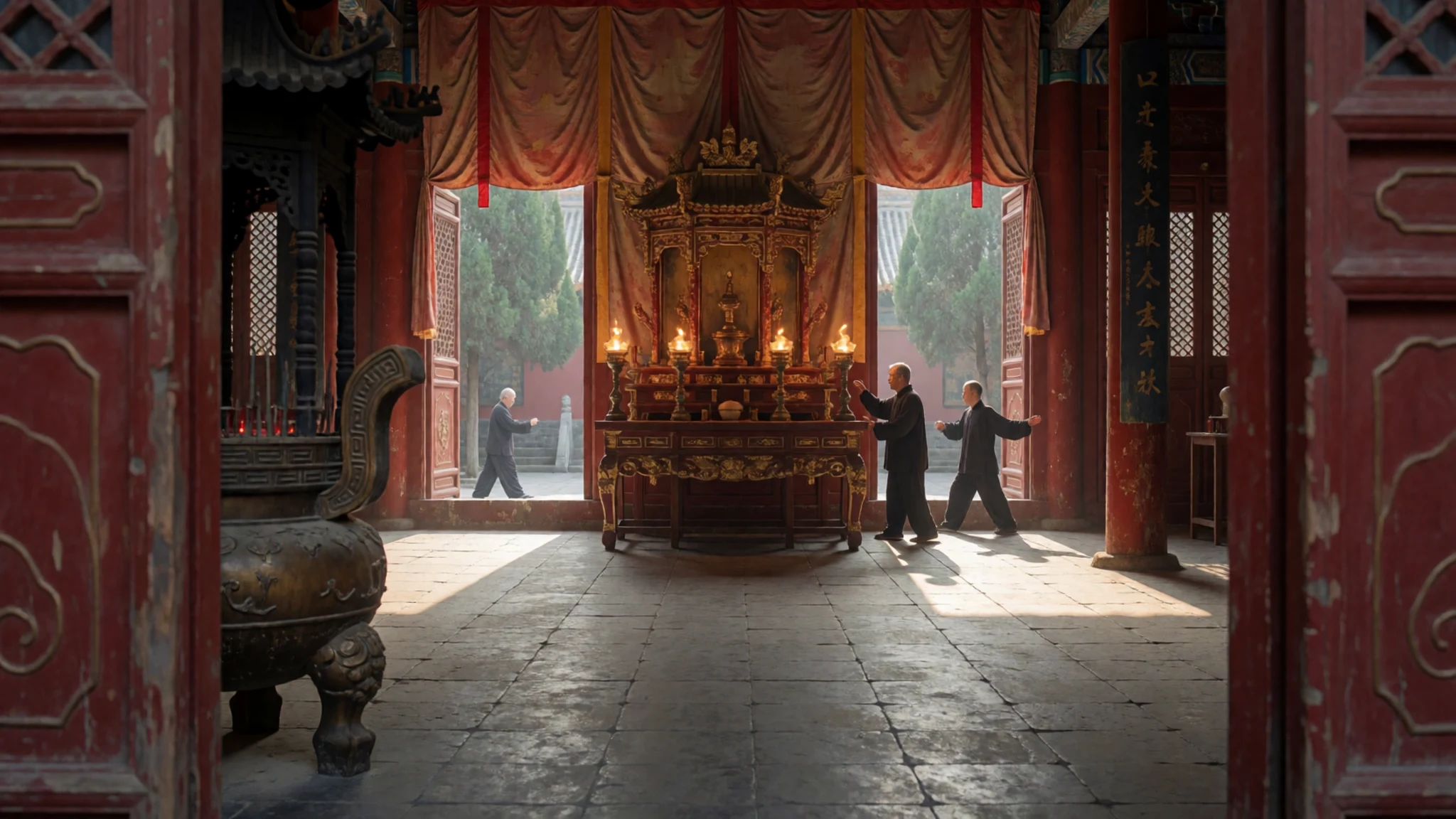
Culture
Wudang Mountains are a living centre of Taoism, not a heritage theme park. Priests and nuns live and work in many of the temples, and ritual continues through the day with chanting, drums and bells. Taoism here is bound up with ideas of balance, nature and cultivating the body and mind, which is why martial arts such as tai chi sit comfortably alongside worship.
The mountain is dedicated mainly to Xuantian Shangdi, the Lord of the North, known also as Zhenwu, a god of war and water who is shown in dark robes with sword in hand. Zhang Sanfeng, a legendary figure credited with creating tai chi, is honoured here too. Visitors will often see martial arts schools training in courtyards and on terraces. Some are devoted students, and demonstrations are put on for tourists, so it is worth distinguishing between a show and a class.
Pilgrims burn incense and bow at altars, and many make the climb to the summit as an act of devotion. Chinese visitors come in holiday periods and at festival times, which makes the temples livelier but also more crowded. Silence is not required everywhere, but a quiet, respectful manner is expected near altars and during rites.
When you enter a working hall, keep your voice low, do not step on thresholds, and ask before photographing priests or worshippers at prayer.
What to wear
Traditional Taoist dress at Wudang is best seen on the priests and students. Priests wear long robes, usually dark blue, black or grey, in cotton or linen, with a hair knot on the crown held by a pin and often a cloth cap. Martial arts students wear loose cotton or silk practice suits in white, black or earth tones, with cloth shoes and sometimes sashes. Ceremonial robes with embroidered patterns appear on festival days.
What most people wear now is simple. Local residents and staff wear ordinary modern clothes: trousers, jackets, fleeces and trainers, with waterproofs in wet weather. Many Chinese visitors dress for hiking, and some wear Taoist-inspired tops or souvenir clothing bought on the mountain.
Visitors should dress for steep, stepped terrain and changeable weather. Sturdy trainers or walking shoes with good grip are essential, since the stone stairs can be slippery when wet. Wear breathable layers and carry a light waterproof, as mist and sudden rain are common. Summers can be hot and humid, while higher up the temperature drops, so a fleece is useful in spring and autumn. For the temples, modest clothing is the safer choice: covered shoulders and knees, nothing that looks like beachwear. Avoid heavy hats inside halls, and bring a small daypack rather than a large rucksack because of the climbing.
What to eat
- Hubei hot-and-dry noodles style dishes — Small noodle shops in the towns at the foot of the mountain
Hubei's regional noodle culture reaches the mountain's towns, with wheat noodles tossed in sesame paste, soy and chilli. Look for small noodle shops near the base villages. They make a cheap, filling breakfast before a long climb.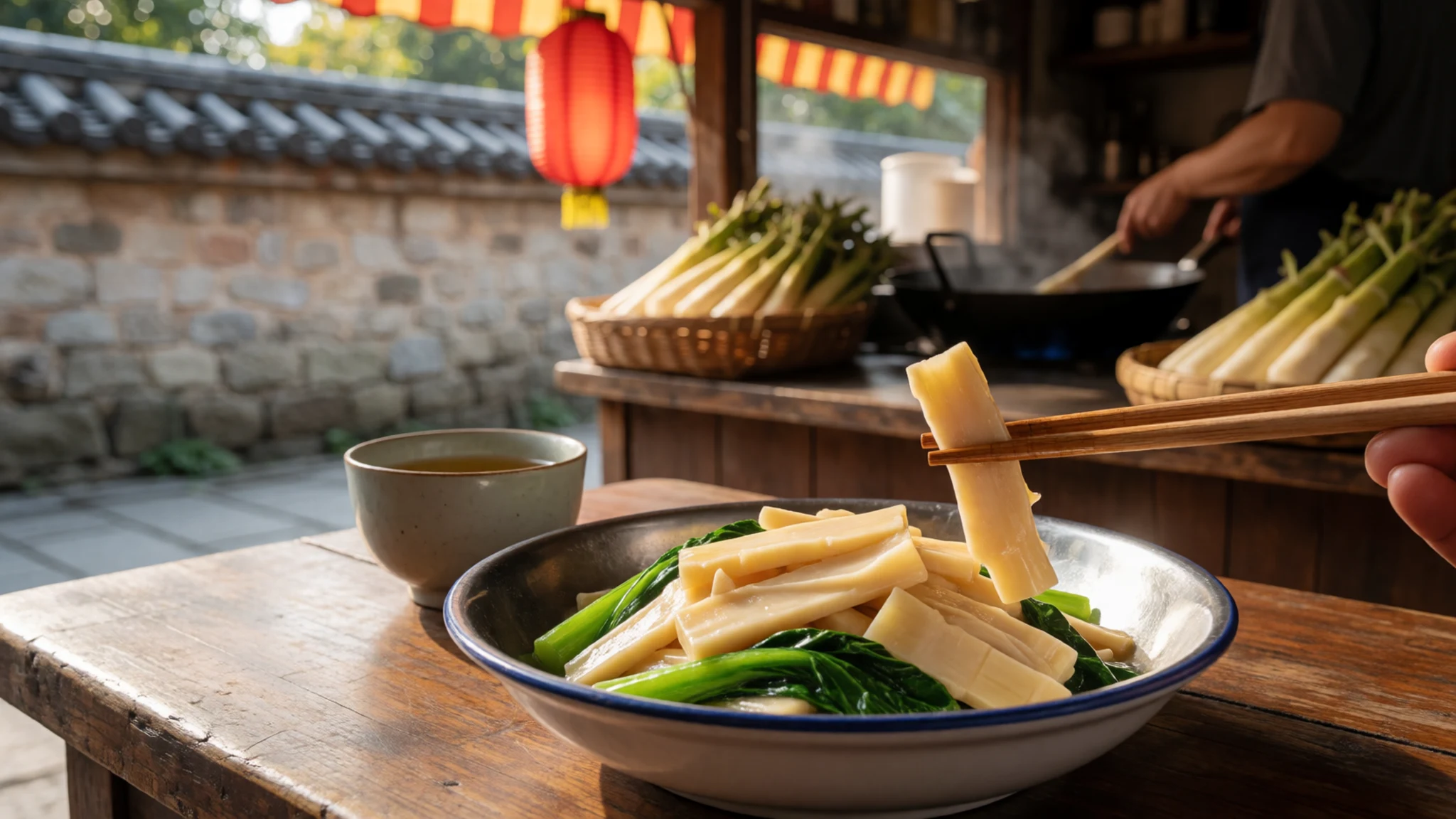
- Vegetarian temple meals — Temple canteens and vegetarian eateries on the mountain
Some temples and nearby eateries serve meat-free dishes with tofu, mushrooms, mountain greens and rice, in keeping with Taoist and Buddhist habits. Meals are plain, fresh and wholesome, and often a calm break between stages of the walk.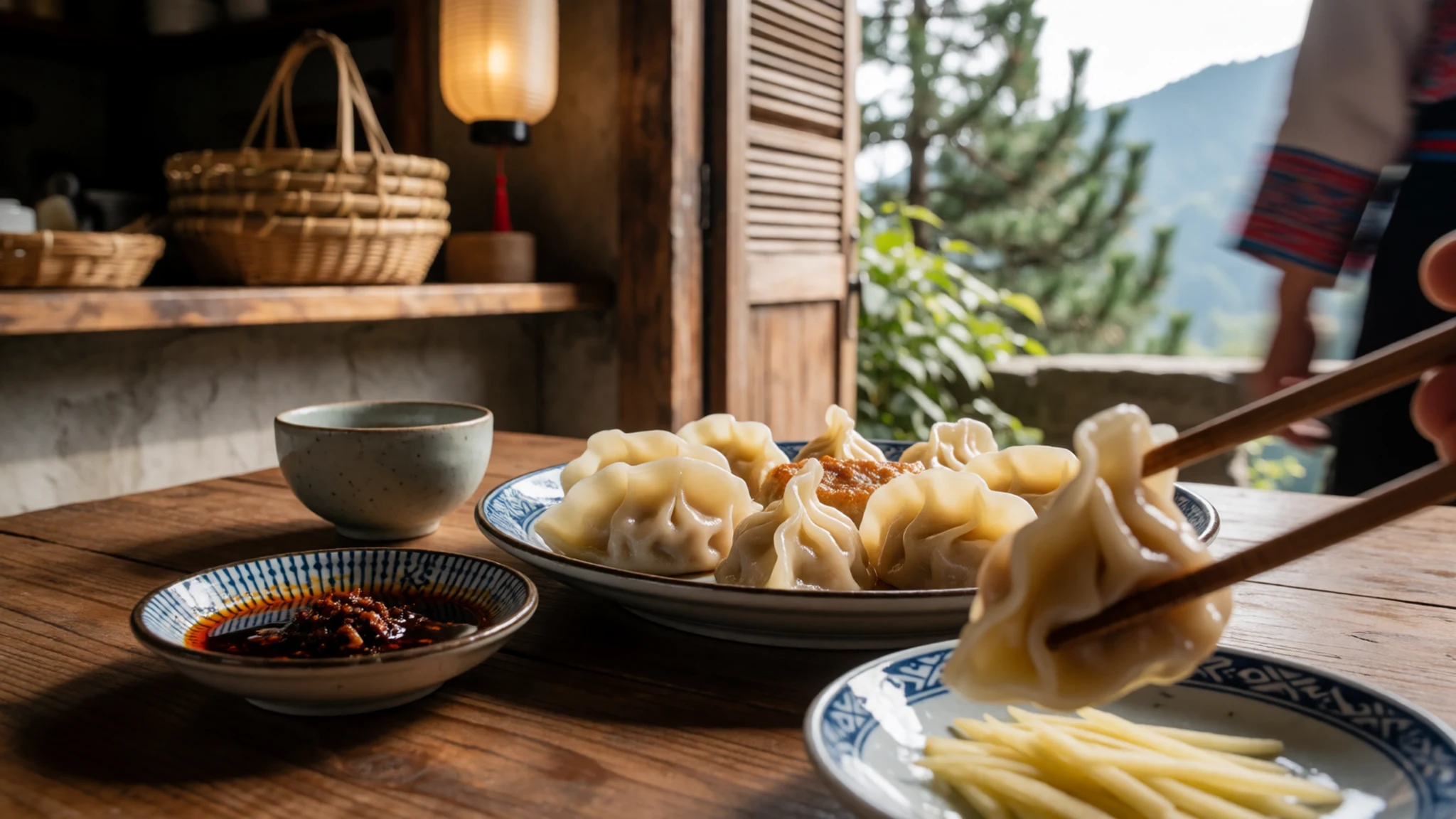
- Wild mountain vegetables — Family-run restaurants in Wudangshan town
Seasonal greens gathered or grown in the hills are stir-fried with garlic or served in soups. Menus change with the time of year, so ask what is fresh. They suit anyone wanting lighter food after hours of climbing stairs. - Mountain tea — Tea houses and rest stops along the main paths
Green tea from the surrounding hills is served in the temples and tea houses, usually in small cups topped up continually. It is a pleasant way to rest at a viewpoint and is closely tied to Taoist ideas of calm and balance. - Steamed buns and stuffed breads — Street stalls near the gates and bus stops
Portable, filling and inexpensive, steamed buns with vegetable, pork or bean-paste fillings are sold at stalls near entrances and along busy routes. They are easy to carry and eat while walking.
Plan it
Best time. April–May and September–October, when temperatures are mild and the hills are green or clear; summer is hot, humid and wet, and winter can be cold and misty at height.
How long. 2–3
Getting there. The nearest practical hubs are Shiyan and Xiangyang, both reached by train from larger Chinese cities, with Wudangshan having its own high-speed rail station. From there, local buses or taxis run to the scenic area gates; check current options before travelling.
Budget. mid
Tips
- Start early; the stairs and summit are quieter before mid-morning
- Check the official scenic area channels for tickets, transport and cable car operation, since details change
- Carry water and snacks, and wear shoes with good grip
- Avoid Chinese public holidays, when crowds are heavy
- Carry some cash as well as a phone payment app, since many rural stalls prefer mobile payment
Etiquette
- Keep your voice low in working temples
- Ask before photographing priests or worshippers
- Do not touch altars or offerings
Nearby
Sources
- Wikidata Q4034 (CC0)
- Wikipedia: Wudang Mountains (rev 1385237506) (CC BY-SA 4.0)
- Wikivoyage: Wudang Mountains (rev 5359132) (CC BY-SA 4.0)
- Photo: Wudangshan 2003 10 (Public domain)
- Photo: Wudang Mountain (xiquinhosilva) (CC BY 2.5)
- Photo: Wudangshan pic 12 (gongfu_king) (CC BY-SA 2.0)
- Photo: Xuanwu Gate (Gisling) (CC BY 3.0)
- Photo: Wudangshan pic 11 (gongfu_king) (CC BY-SA 2.0)
- Photo: Purple Heaven Palace (Gisling) (CC BY 3.0)
- Photo: Qiongtai Middle Temple (Gisling) (CC BY 3.0)
- Photo: Wudangshan pic 8 (gongfu_king) (CC BY-SA 2.0)


