Ulungur Lake
Ulungur Lake, People's Republic of China
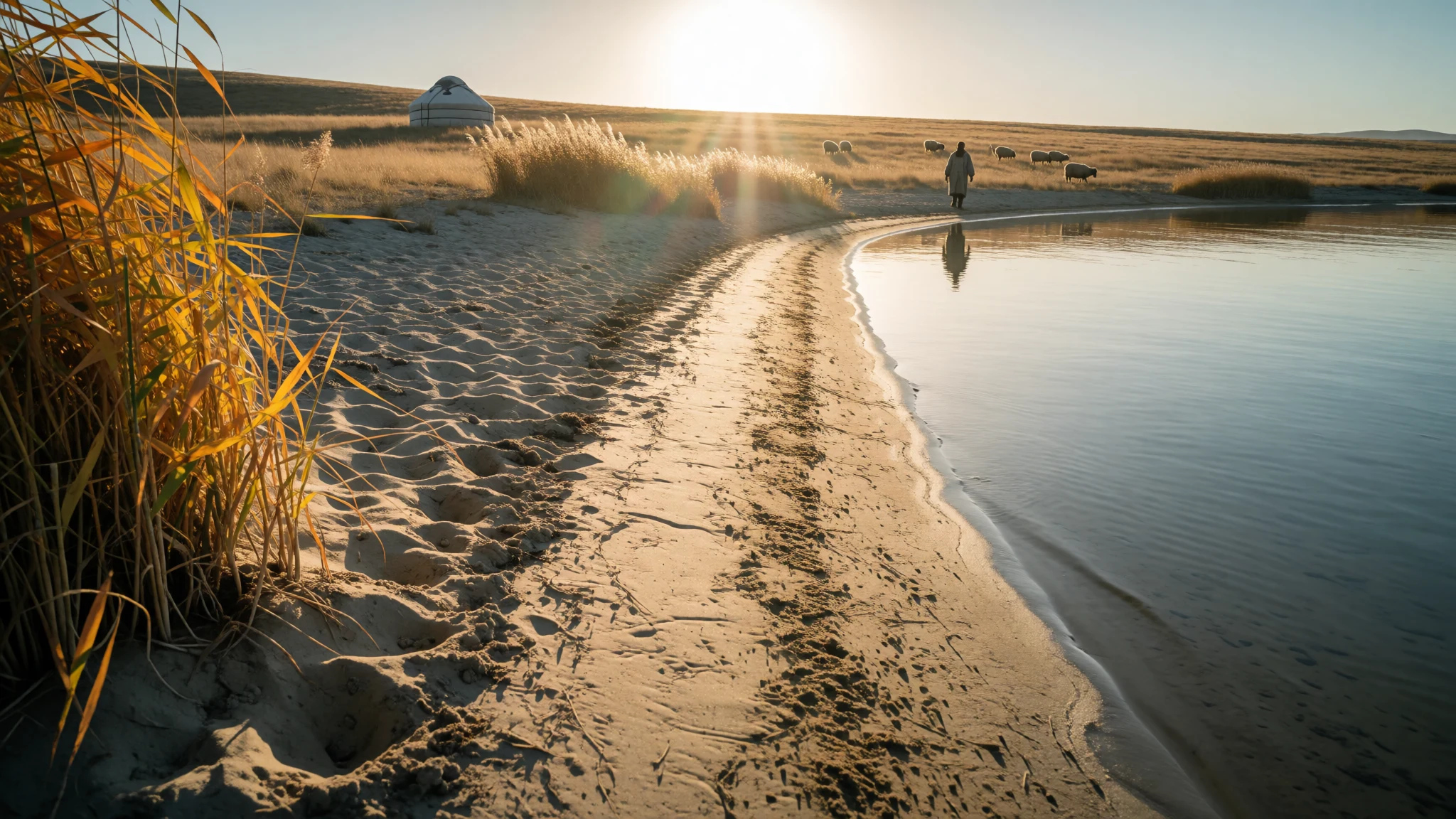
Ulungur Lake is a wide, quiet freshwater expanse in northern Xinjiang, where steppe, sandy shores and Kazakh herding country meet.
The place
Ulungur Lake sits in Fuhai County, in the Altay region of northern Xinjiang, at an elevation of 468 m. It is a freshwater lake with no outlet to the sea, fed mainly by the Ulungur River. That closed basin explains much of its character: whatever flows in can only leave by evaporating into the dry air. The Irtysh River, which does drain towards the Arctic Ocean, runs close by to the north-east, so the watersheds in this corner of China are divided very finely.
The lake is really two. The larger body, called Buluntuo Lake or simply Ulungur proper, is joined by a narrow channel to the smaller Jili Lake (吉力湖). The river now reaches the system mainly through Jili, so reeds, wet margins and birdlife concentrate there, while the main lake opens out into long, flat horizons.
The surroundings are open country rather than alpine drama. Shores are sandy or reedy, the land is dry steppe, and the sky does much of the work. Distances are large and services are thin. Fuhai is the sensible base, and the lake suits walking a shoreline, watching weather cross the water and noticing how few buildings interrupt the view.
Photographs show pale beaches and broad, shallow-looking margins, and a satellite view shows the two lakes as a blue shape against tan ground. Anyone expecting turquoise water and snow peaks, as at better-known lakes, should adjust their expectations. The appeal here is space, quiet and a working landscape of herders and farmland.
Its story
The story of Ulungur Lake is largely a story of water being shared. Because the lake is endorheic, meaning it keeps what arrives and loses it only to evaporation, its level depends on the balance between the Ulungur River's inflow and everything taken from the river before it arrives. Between 1960 and 1987 that balance tipped. The surface fell by 4.2 m as river water was drawn off for irrigation and other needs.
A drop of that size matters more on a broad, shallow lake than on a deep one, because a small change in depth moves the shoreline a long way. Beaches widen, the channel between the two basins narrows, and reed beds that depend on steady water can shift or dry out. The narrow link between the main lake and Jili is exactly the kind of feature that feels such changes first.
The same dry-country logic shows why irrigation along the Ulungur River matters so much. The lake sits at the end of a long chain of users rather than at the start of one. Visitors sometimes read an empty-looking shoreline as untouched wilderness, but it is better understood as a managed and contested water body in a region where rain is scarce.
The brief for this reading gives no present-day water levels, so no current trend is claimed here. Local sources and recent reports are the place to check whether the lake is rising, steady or falling in the year of a visit.
What to see
- The southeastern beach — Southeastern shore
The sandy southeastern shore is where photographs show Ulungur Lake at its most open: a pale beach, a shallow margin and a long flat horizon. It suits slow walking and picnics rather than active water sports, and there is little shade, so a hat and water matter. Ask in Fuhai about the best access point, as tracks vary.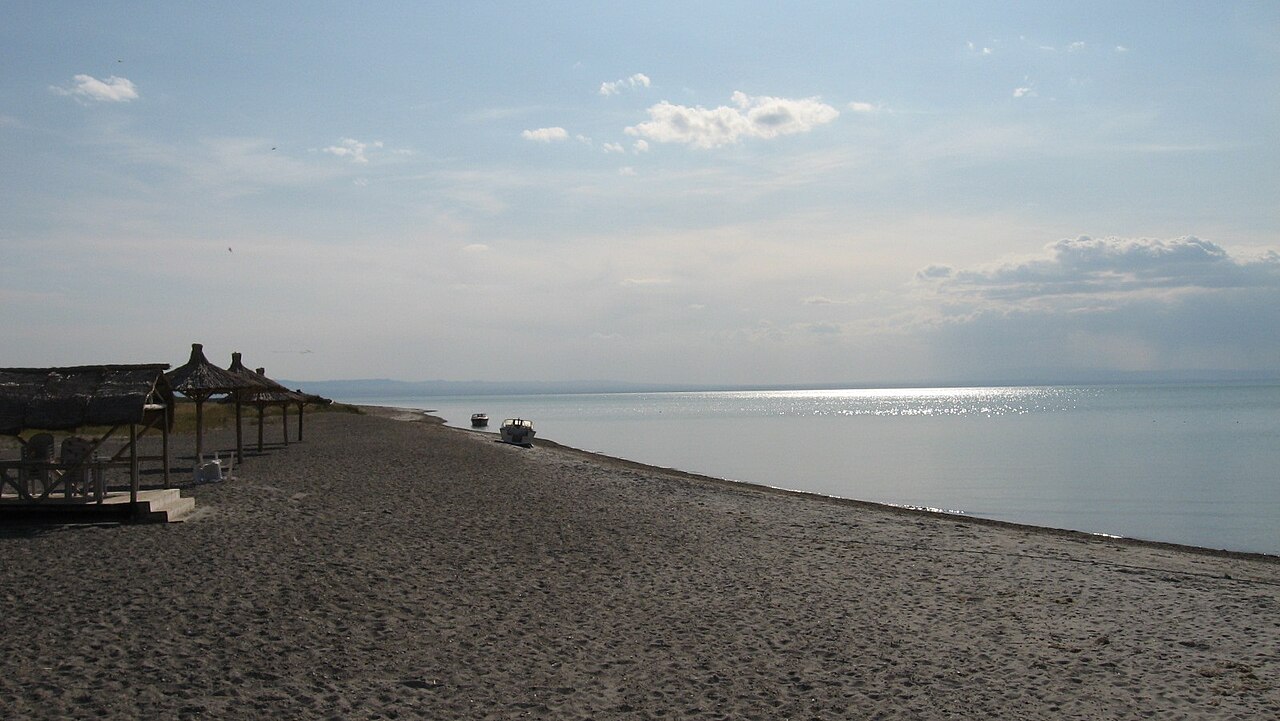
- Jili Lake — South of the main basin
The smaller Jili Lake (吉力湖) lies to the south of the main basin, joined to it by a narrow channel. The Ulungur River now enters here, so reeds, wet edges and birds are likely to gather around it. Go with a local driver, since paths are informal, and keep to firm ground near the water. - Where the Ulungur River enters — Northern edge of Jili Lake
Where the Ulungur River reaches Jili Lake, the landscape shows how a closed basin is fed: a ribbon of water, greener banks, then open flat land. It is a modest place to look at rather than a grand viewpoint, but it explains the whole lake in one glance, especially in the growing season. - Fuhai town and its markets — Fuhai County seat
Fuhai is the county base for the lake and the practical place to find food, transport and local advice. A short walk around its streets and markets gives a feel for everyday life in northern Xinjiang. Opening arrangements change with the season, so confirm anything you plan to rely on once you arrive.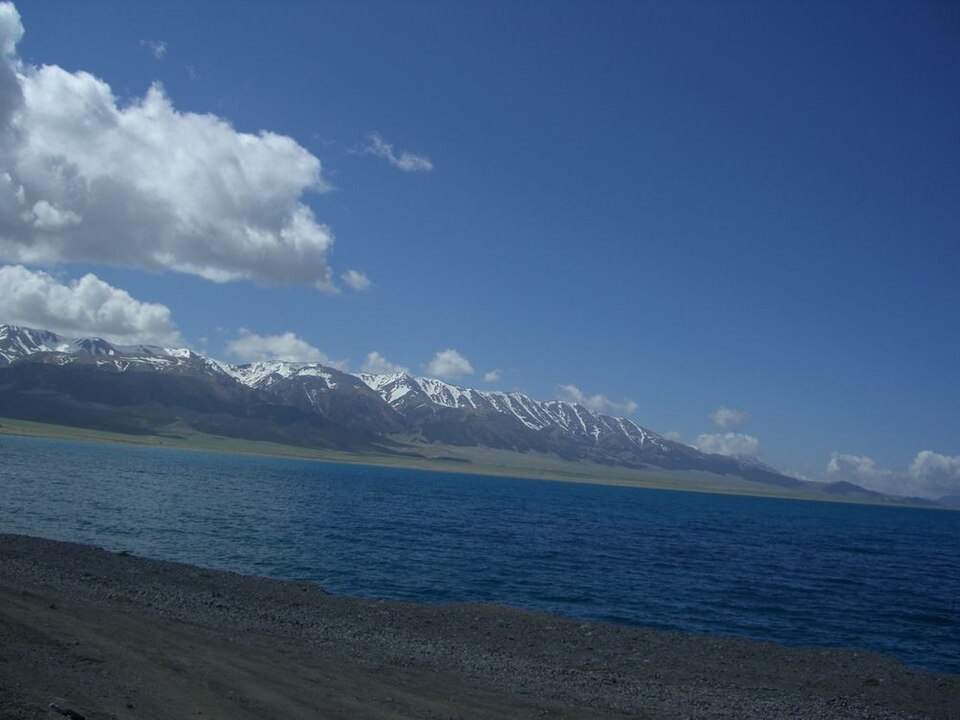
- Grassland between the villages — Countryside around Fuhai
In northern Xinjiang the open country between towns and villages is where Kazakh herders and their yurts are often seen in the warmer months, with flocks moving across the steppe. It is a landscape for watching from the road or on a gentle walk. Eagle hunting is a regional tradition, but sightings are never guaranteed.
Culture
Ulungur Lake lies in northern Xinjiang, a part of China where several peoples share the land. Here many ethnic Kazakhs and Kyrgyz still keep nomadic traditions, and herders and their yurts can often be seen in the open spaces between towns and villages. Herding follows the seasons, with flocks moved to better pasture, so what a visitor sees depends on the month. There is also a custom among Kazakhs and Kyrgyz of hunting with eagles, though meeting it is a matter of luck and timing rather than a scheduled show.
Uyghurs, a Turkic people whose old towns are mostly further south and east, are widely known across China for their dancing, and music and dance feature at festivals and family gatherings. Hospitality runs deep in Central Asian cultures. Tea, bread and meat are offered to guests, and turning down everything outright can feel cold.
Xinjiang is also a sensitive region, with a security presence that has grown since the attacks of the early 2010s. Visitors should expect identity checks and carry a passport, and politics is best left out of conversation with strangers. Photographing police posts or official buildings can cause trouble.
When invited into a yurt or home, take your shoes off if others have, accept what is offered, and ask before photographing people or their animals.
What to wear
Around Ulungur Lake, traditional dress belongs mostly to the Kazakh and Uyghur communities. Kazakh clothing is built for cold open country: felt and wool, fur-trimmed hats, long padded coats and embroidered velvet waistcoats. Brides traditionally wear a tall ornate headdress called a saukele, and such pieces appear at weddings and festivals rather than on ordinary days. Uyghur dress is known for the embroidered skullcap, the doppa, and for bright atlas, a patterned silk with a blurred, painted look, often worn by women on festive occasions.
Day to day, most people in Fuhai wear what is common across China: jeans, trousers, shirts, sportswear and, in the long winters, heavy padded coats. Herders favour practical layers, sturdy boots and hats that cope with wind and sun. Traditional pieces are more likely to be seen on celebration days than at the market.
Visitors should dress for a dry continental climate with strong sun and large swings between day and night. In summer that means light long sleeves, a brimmed hat, sunscreen and sunglasses, plus a warm layer for evenings. Sandy and reedy shores call for closed shoes or trail sandals with grip. In villages and at mosques, covered shoulders and knees are respectful for everyone. In winter, expect serious cold and bring a down jacket, thermals, gloves and insulated boots.
What to eat
- Chuànr (串) lamb skewers — Evening street stalls and grill eateries in Fuhai
Uyghur-style lamb kebabs are the everyday dish of Xinjiang's cooking. Pieces of lamb are threaded on skewers and grilled over a hot fire, often until the edges char. They are usually eaten standing or at simple tables, with naan alongside. - Kǎo bāozi (烤包子) lamb pastry — Bakeries and street stalls near markets
Also called samsa, this is a baked pastry filled with chopped lamb. The crust turns crisp and golden, and the filling stays juicy inside. It makes a cheap, filling snack for a morning by the lake, best eaten while it is still warm. - Náng (馕) flatbread — Street bakers and market stalls in every town
Náng is the flatbread of Xinjiang, sold in many sizes, some plain and some with onion or spring onion baked in. Ask for it warm, because it is far better fresh from the oven, and gesture at the oven if language fails. - Ròunáng (肉馕) meat-filled naan — Bakeries and casual eateries around Fuhai's markets
Ròunáng is naan stuffed with lamb, a heartier version of the plain bread. It works as a full meal, especially on a day of walking. Eat it hot, with tea, and share it if the portion looks too large.
Plan it
Best time. June to September is the practical season, when the shore is open, the grassland is in use and travel is easiest. Winters are long and very cold, so check forecasts and local conditions before any other season.
How long. 2–3
Getting there. Fly to Urumqi, which has direct flights from many Chinese cities and several international ones, then take the direct flight from Urumqi to Altay, or travel overland. The last leg to Fuhai County is by road, so check locally for buses and taxis. Trains on the Lanxin railway also reach Urumqi from major Chinese cities.
Budget. mid
Tips
- Carry your passport at all times, as identity checks are common in Xinjiang
- Bring water, sun protection and a warm layer, since shade is scarce and evenings cool quickly
- Hire a local driver for the lake shores, as tracks are informal and signs are few
- Carry some cash, as small eateries and village shops may not take cards
- Check the Xinjiang and China entry guidance before travelling, as conditions can change
Etiquette
- Take off your shoes when entering a yurt or home if others do
- Ask before photographing people, children or herds, and avoid photographing police posts or official buildings
- Accept food and tea when offered, and keep political talk out of conversation
Nearby
Sources
- Wikidata Q1578612 (CC0)
- Wikipedia: Ulungur Lake (rev 1366777983) (CC BY-SA 4.0)
- Wikivoyage: Xinjiang (rev 5394920) (CC BY-SA 4.0)
- Satellite Image of Lake Ulungur, Xinjiang, China (NASA, via Wikimedia Commons) (Public domain)
- Beach at southeastern shore of Ulungur lake (B_Aichner, via Wikimedia Commons) (CC BY-SA 4.0)
- Fuhai, Altay, Xinjiang, China (rememberfy, via Wikimedia Commons) (CC BY 3.0)
- China Xinjiang Altay Fuhai County (3) (罗布泊, via Wikimedia Commons) (CC BY 3.0)
- China Xinjiang Altay Fuhai County (4) (罗布泊, via Wikimedia Commons) (CC BY 3.0)
- China Xinjiang Altay Fuhai County (5) (罗布泊, via Wikimedia Commons) (CC BY 3.0)
- China Xinjiang Altay Fuhai County (6) (罗布泊, via Wikimedia Commons) (CC BY 3.0)
- China Xinjiang Altay Fuhai County (7) (罗布泊, via Wikimedia Commons) (CC BY 3.0)


