Tucson
Tucson, United States
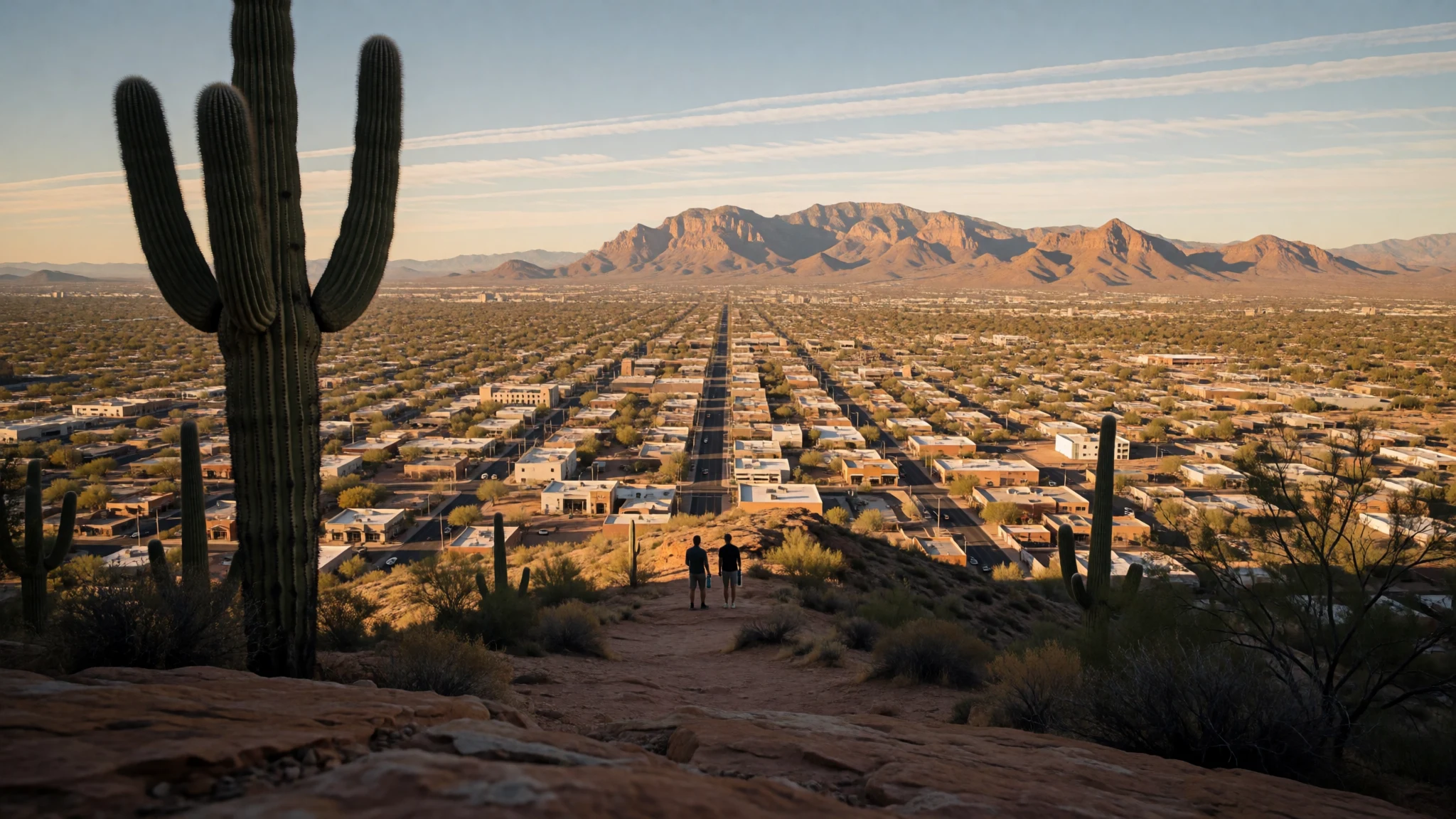
Tucson is a Sonoran Desert city where Spanish, Mexican and Indigenous history, mountain views and some of Arizona's best Mexican food sit within an easy drive.
The place
Tucson sits in the Sonoran Desert of southern Arizona, a city of more than half a million people at about 728 metres above sea level. It is the county seat of Pima County and the state's second city after Phoenix, which lies roughly two hours away by road. The border with Mexico is a short drive south, and that closeness shows in the food, the street names, the adobe walls and the way Spanish and English share signs. The Santa Catalina Mountains rise to the north and give the city its backdrop, while the streets spread across a wide, flat valley below. Downtown is compact enough to wander. The University of Arizona lies to its north-east, older barrios to its south-west, and suburbs such as Oro Valley, Marana and Sahuarita stretch out beyond. The university brings a student rhythm of term-time cafés, bookshops and late-night eateries, while retirees and long-established Mexican American families keep the older neighbourhoods anchored. Tucson feels less polished and less hurried than Phoenix. Locals talk about the light, the summer storms and the saguaro cactus with real affection. Heat shapes every visit: summer afternoons push people indoors, so the good hours are early morning and evening. It rewards several slow days rather than a quick stop at one landmark.
Its story
Tucson has been a settled place for far longer than its Spanish name suggests. People lived along the Santa Cruz River for thousands of years, and excavations beside it have found village remains from well before the Roman era. Early farmers on the floodplain watered fields of maize and beans through hand-dug canals while still foraging in the desert. The Hohokam, who followed, left a web of larger canals and distinctive red-on-brown pottery. In the late seventeenth century the Italian-born Jesuit Eusebio Francisco Kino reached the valley and founded Mission San Xavier del Bac a short way upstream from the site of today's city. The town itself began as a military post: in 1775 Hugo O'Conor authorised the Presidio San Agustín del Tucsón, a fort meant to hold the northern frontier of New Spain. After Mexican independence the settlement passed to the state of Sonora, and the United States took control in the mid-nineteenth century. For a short time during the Civil War it fell under Confederate rule before returning to the Union. Later, soldiers at Fort Lowell took part in the Apache Wars. The twentieth century brought the university, railways and rapid growth, and some old barrio streets were cleared for the convention centre. What remains of the adobe town is small but still readable.
What to see
- Barrio Viejo — South-west of downtown
Barrio Viejo is one of Tucson's older neighbourhoods, close to downtown. Much of it was lost when the convention centre went up, but rows of colourful adobe houses survive, now used as homes, galleries and small shops. It is best covered slowly on foot, ideally in the cooler morning light. - El Tiradito — Barrio Viejo, south-west of downtown
El Tiradito is a small roadside shrine to a sinner, tied to a local legend about a young man whose forbidden affair within his wife's family ended badly. Neighbours and visitors still light candles here and leave wishes. It is quiet, free to see, and a good window into how Tucson folk belief blends Catholic and local traditions. - Sosa-Carrillo-Frémont House Museum — Downtown, beside the convention centre
This historic adobe house is a remnant of the old barrio, now surrounded by the modern convention centre. Built in the 1870s, it shows how thick earthen walls and shaded rooms made desert living bearable before air conditioning. Opening arrangements change, so check the official city site before going. - Fort Lowell Museum — North-east Tucson, Fort Lowell Park area
Fort Lowell was a United States Army post during the Apache Wars. Most of its adobe buildings are now ruins, but the commanding officers' quarters have been rebuilt and house a small museum. The surrounding park is pleasant at the edges of the day, with cottonwood shade and long views to the mountains. - Sentinel Peak — West of downtown, beside the Santa Cruz River
Sentinel Peak is the hill west of downtown from which the classic view of Tucson is taken: the grid of streets, the low towers and the Santa Catalina range beyond. Sunset is the usual hour, when the valley cools and the colours deepen. Bring water and expect other people to have the same idea.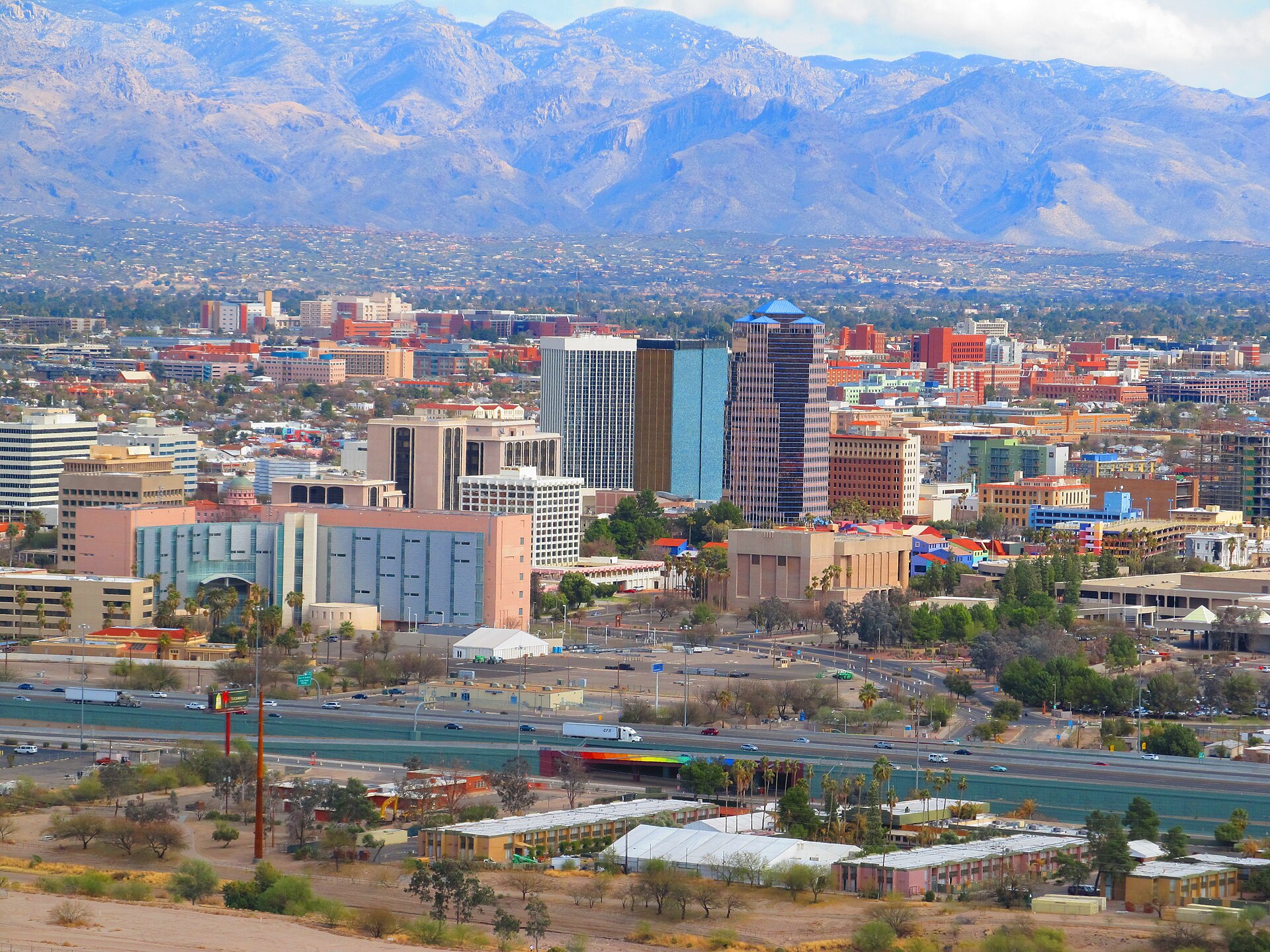
Culture
Tucson's culture is a layered one. The O'odham, whose name for the place is Cuk Ṣon, have lived in this desert far longer than anyone else, and their basketry, foodways and ceremonies remain part of regional life. Spanish colonists and later Mexican families added Catholic feast days, Sonoran cooking and the adobe building tradition. American settlers, railway workers, ranchers and university people have added still more. The result is a city where a mission church, a rodeo, a poetry reading and a taco stand can share one afternoon. The calendar has a few fixed points. Late winter fills the city with gem, mineral, fossil and bead dealers, whose sales spread across many sites for several weeks, with the main show in February. In March the University of Arizona hosts the Tucson Festival of Books, a large free gathering of authors and readers. Between them, smaller fiestas, music nights and neighbourhood markets fill most weekends. Conversation is casual, hospitality is generous, and people are proud of local food and of the desert itself. Visitors will find that locals care about protecting saguaros and other desert plants. Do not touch, climb or take cuttings from cacti, and stay on marked paths when walking in the desert, where plants, wildlife and old Indigenous sites are easily damaged.
What to wear
Tucson has several traditional wardrobes. The Indigenous peoples of the region, including the Tohono O'odham and Yaqui, wear ceremonial dress at feast days, dances and community events, often made of cotton and decorated with ribbon, beadwork or woven details; the O'odham are also known for fine basketry. Mexican heritage brings embroidered blouses, full skirts and charro suits, seen mostly at fiestas, weddings and national celebrations. Everyday dress today is relaxed and practical. Jeans, cotton shirts, sun hats, sandals and trainers are common, with cowboy boots and western shirts still worn without irony. Silver and turquoise jewellery is a local favourite, and university colours show up everywhere in term time. Restaurants and galleries rarely expect more than smart-casual. A visitor should dress for sun first. Light, loose cotton or linen with long sleeves protects better than bare skin in strong sunshine, and a wide-brimmed hat, sunglasses and high-factor sunscreen are sensible all year. Evenings in winter can turn cool, so carry a jacket. Closed shoes with a firm sole are best for desert trails, because of spiny plants and rough ground. At churches and missions, keep shoulders and knees covered out of respect, and remove hats indoors.
What to eat
- Sonoran hot dog — Street carts and taquerías on the south and west sides
A bacon-wrapped hot dog in a soft roll, piled with beans, onion, tomato and sauces. It is the city's signature street snack, and best eaten from the late-night carts and small stands found in the southern and western neighbourhoods. - Birria — Small family-run Mexican eateries on the south side
Slow-cooked goat or beef in a rich chilli broth, served with tortillas, onion, coriander and lime. It is traditional Jalisco food and is made well in modest, family-run Mexican eateries around the south side, where it is a common weekend meal. - Tamales — Neighbourhood markets, bakeries and takeaway counters
Masa parcels steamed in corn husks, with fillings from shredded meat to cheese and green chilli. They are a staple of Mexican households and of the winter holidays, and can be found at neighbourhood bakeries, markets and small takeaway counters. - Tepary beans and desert foods — Farmers' markets and Indigenous food projects
Tepary beans, cholla buds, mesquite flour and prickly pear are traditional desert ingredients, long grown or gathered by the O'odham. Look for them in stews, drinks, syrups and baking at Indigenous food projects, farmers' markets and some local restaurants. - Fresh-bread sandwiches — Bakery-cafés and sandwich shops near the university and in central Tucson
Tucson has a lively sandwich culture, with bakery counters and student-friendly shops building large sandwiches on bread baked the same day. They are filling, good value for lunch and handy to carry on a day trip into the desert.
Plan it
Best time. March–April and October–November, when days are warm and sunny and walking outdoors is comfortable; summer is very hot, with afternoon storms in the monsoon season, and winter nights can be cold.
How long. 2–4
Getting there. Tucson's airport is on the far southern edge of the city, with city buses and taxis for the last leg to downtown and the university. Some visitors fly into Phoenix and either rent a car or take a shuttle for the drive of about two hours. Amtrak's Sunset Limited stops in Tucson three times a week on the New Orleans–Los Angeles route: eastbound trains arrive in the morning and westbound ones in the early evening.
Budget. mid
Tips
- Do outdoor sights early in the morning or at dusk, and carry more water than seems necessary.
- A car makes the desert, missions and foothills far easier; downtown and the university area work on foot or by bus.
- Book rooms well ahead for the late-winter gem shows and for festival weekends in March.
- Carry a card and a little cash for markets, food carts and small museums, and check the official city site at http://www.tucsonaz.gov/ for current opening arrangements.
Etiquette
- Do not touch or pick cacti, and keep to marked desert paths.
- Ask before photographing people at religious events or in private neighbourhoods.
- Dress modestly and speak quietly in churches and at shrines such as El Tiradito.
Nearby
Sources
- Wikidata Q18575 (CC0)
- Wikipedia: Tucson, Arizona (rev 1380925855) (CC BY-SA 4.0)
- Wikivoyage: Tucson (rev 5432583) (CC BY-SA 4.0)
- Photo 01-catalinasandtucsonaz.jpg (Public domain)
- Photo 02-view-of-tucson-from-sentinel-peak-2.jpg (Public domain)
- Photo 03-the-cathedral-of-saint-augustine (Public domain)
- Photo 04-university-of-arizona-may-2019-09-old-main.jpg (CC BY-SA 4.0)
- Photo 05-morecourthouse.jpg (CC BY 3.0)
- Photo 06-usa-edcp-relief-location-map.png (CC BY 3.0)
- Photo 07-tucson-old-edited.jpg (Public domain)
- Photo 08-tucsondowntownview1.jpg (CC BY-SA 4.0)


