Amelia Island
Amelia Island, United States
Amelia Island is a flat, quiet barrier island in north-east Florida, where long beaches, tidal marsh and eight changing flags share one small place.
The place
Amelia Island lies at the top of Florida's Atlantic coast, in Nassau County, roughly 21 km long and no more than about 6 km across. It is the southern end of the Sea Islands, the chain of low islands that runs down from South Carolina, and the northernmost of Florida's Atlantic barrier islands. The land is very flat, with an elevation of about 4 m, so the island is mostly a matter of horizons: a long ocean beach on the east, tidal marsh and winding creeks on the west, and live-oak and pine woodland between them. Three communities share it: Fernandina Beach, Amelia City and American Beach. Fernandina Beach is really two towns that grew together. The older one sits on the Amelia River close to the inlet and still follows a street grid laid out under Spanish rule. The newer one was added a short way to the south later in the nineteenth century and became the bigger of the pair. Administratively the island belongs to the Jacksonville metropolitan area, and that city is the practical gateway. The coast road FL-A1A ends at the island's northern tip, and there is no road across to Georgia, so traffic thins out the further north one goes. A small airfield for general aviation operates on the island, and the Amelia Island Trail links into the East Coast Greenway for walkers and cyclists.
Its story
Amelia Island has carried many names and flags. Its current name honours Amelia, a daughter of Britain's King George II, and eight different flags have flown over it: French, Spanish, British, Patriot, Green Cross, Mexican, Confederate and American. The earliest known residents were Timucua-associated communities who settled around the year 1000 and called the island Napoyca. In 1562 the French Huguenot captain Jean Ribault came ashore, the first European on record to do so, and named it Île de Mai. Three years later the Spanish commander Pedro Menéndez de Avilés destroyed the French base at Fort Caroline on the St. Johns River, and Ribault and many of his people were killed. Spain then held the island for generations. Franciscan friars founded the Santa María de Sena mission in 1573 and called the island Isla de Santa María. Early in the seventeenth century the Mocama people were moved there from their older settlements, and in 1680 the Guale, driven from their mission on the Georgia coast by British raids, arrived too. For a long period the island worked as a mission station and refuge, with several Indigenous communities pressed into one small place. Spain founded the town of Old Fernandina in 1811 as a check on American expansion, then handed Florida to the United States in 1821. That layering shows today mainly in street names and a few preserved sites rather than in grand monuments.
What to see
- Fort Clinch State Park — Northern tip of the island, Fernandina Beach
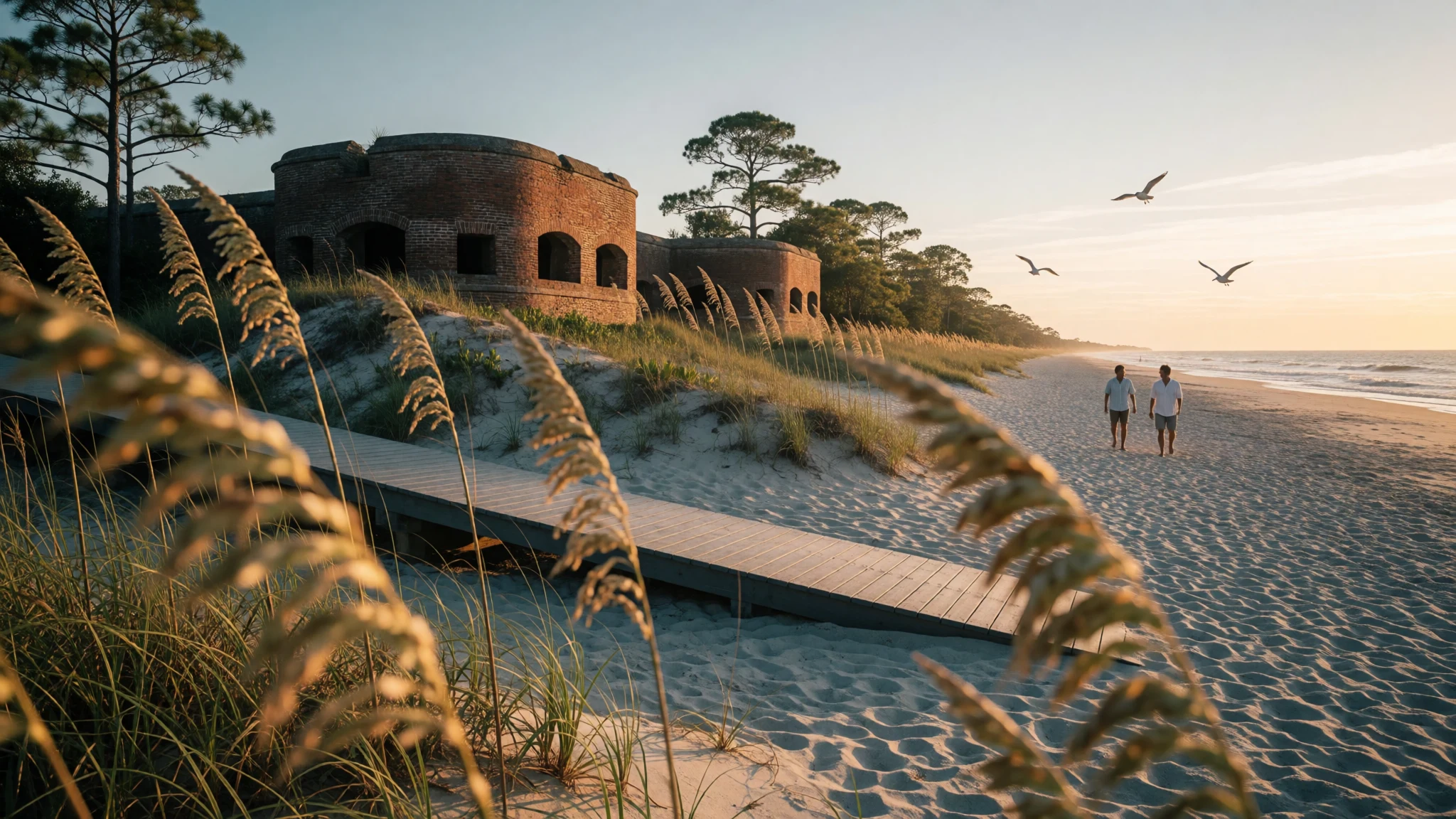
Fort Clinch State Park occupies the island's northern tip and combines a brick fort from the American Civil War era with beach access and camping. The fort draws history-minded visitors, while the surrounding dunes and shore suit a slow walk. Check the Florida State Parks website for opening times and entry charges before setting out. - Amelia Island Museum of History — Old town, Fernandina Beach
The Amelia Island Museum of History in Fernandina Beach is a sensible place to sort out the island's many rulers. Volunteer guides lead tours at set times on opening days, so plan around them and confirm the schedule on the museum's official website. The old Spanish-era streets outside are an easy walk afterwards. - Amelia Island State Park — Southern end of the island
Amelia Island State Park, at the island's southern end, protects beaches, salt marsh and coastal forest in one stretch. Fishing, walking, wildlife watching and horseback riding are all possible here. It is the place to see the marsh landscape that defines the island's western side. Check the state parks website for current conditions.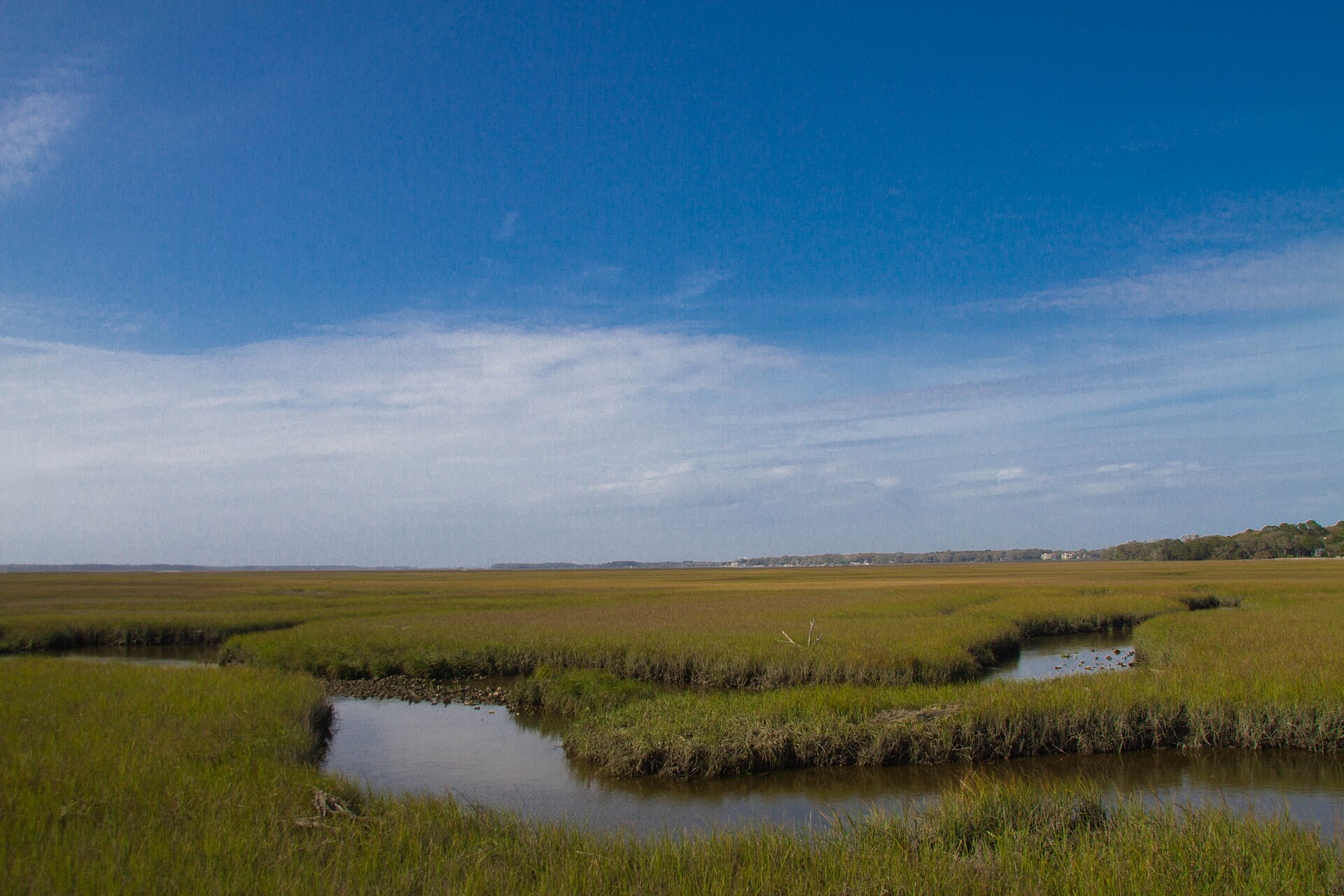
- Old Fernandina waterfront — Amelia River shore, Fernandina Beach
The old town of Fernandina Beach lies on the Amelia River, close to where it reaches the sea. Its streets and their names date from Spanish times, and a morning stroll past the harbour, the older buildings and the small shops gives a feel for the island's working past without needing a ticket. - American Beach — Atlantic shore, central island
American Beach is one of the island's three communities, a seaside settlement with its own story from the segregation era, when it offered Black families a place to enjoy the coast. Visitors can walk the dune-backed beach and ask at local museums or the island's history museum about its background.
Culture
Amelia Island's culture comes from several layers that arrived in turn rather than all at once. Timucua-associated communities lived here first, Spanish Franciscans built a mission, and the Spanish, British, French and Americans all took a turn at running the island. The flags are the local shorthand for this, and residents are quick to count them. The Spanish street grid in the old part of Fernandina Beach is the most visible survivor, while the American Beach community carries a different heritage, as a seaside place that grew up when Black families were shut out of many other beaches. Everyday life today is shaped by the water: fishing, boating, marsh walks and long days on the sand. The pace is slow and polite, in the manner of the American South, and conversations with shopkeepers, museum guides and park staff tend to start with the weather and drift into local history. Guided tours and small museums are the best way to hear the older stories, since many of the sites are modest in scale and need explaining. Festivals and events change from year to year, so check local listings rather than relying on a fixed calendar. Stay on the marked boardwalks and off the dunes, and keep beach lights low at night during turtle nesting season, following any posted signs.
What to wear
Amelia Island has no single traditional costume. The earlier Timucua-associated communities would have worn clothing made from local animal skins and plant fibres, but nothing survives as everyday dress. The settler culture that followed left the lasting style: light cotton and linen suited to a hot, humid climate, with seersucker and straw hats as classic Southern touches. Today people dress casually and for the weather: shorts, linen shirts, sundresses, sandals and sun hats are normal in town, while working boaters and fishers favour practical boots and quick-drying layers. Smart-casual is enough for most restaurants. A visitor should pack for sun, heat and insects: breathable clothing, a wide-brimmed hat, sunglasses and high-factor sun cream. Sandals suit the beach, but closed shoes help on the fort grounds and marsh trails, where the ground can be uneven or muddy and biting insects are common. A light waterproof is wise for sudden showers, and a thin cover-up is useful for shops and restaurants after time on the sand. There are no strict modesty rules, though people usually put on a shirt and shoes away from the beach. Evenings in winter can feel cool near the water, so a light jacket is worth bringing between November and March.
What to eat
- Local shrimp — Seafood restaurants along the Fernandina Beach waterfront
Shrimp is the dish most closely tied to the island's waterfront, served fried, grilled, or in a pot with grits. Look for it at the small seafood restaurants around the Fernandina Beach harbour, where the catch is the point and the setting is relaxed. - Grilled catch of the day — Restaurants in old-town Fernandina Beach
Most island kitchens offer whatever fish came in locally, usually grilled with a simple sauce or served blackened with Southern spices. Ask staff what is fresh, as the fish changes with the season and the day's boats. - Crab cakes — Bistros and restaurants in the old town
Crab cakes, bound lightly and fried until golden, appear on many menus as a starter or main dish. Quality varies, so choose places that make them from lump crab and serve them with a plain lemon or remoulade sauce. - Fried fish with hushpuppies — Casual seafood shacks and beachside restaurants
A basket of battered fish with hushpuppies, the small fried cornmeal balls of the American South, is the casual standard for a lunch near the sea. Expect coleslaw on the side and plenty of tartare sauce. - Steak and seafood plates — Restaurants near the Atlantic beachfront
Beachside restaurants often pair a steak with shrimp or scallops, and the combination suits hungry visitors after a day outdoors. Many have outdoor tables and live music in the evenings, so check the venue's own site for what is on. - Key lime pie — Cafes and restaurants across Fernandina Beach
Key lime pie is the usual Floridian dessert: sharp, creamy and set in a crisp biscuit crust. It turns up in cafes and restaurants across the island, and a slice with coffee is a good way to end a seafood meal.
Plan it
Best time. April–May and October–November, when days are warm rather than oppressive and the beaches are comfortable. Summer is hot, humid and stormy, and the Atlantic hurricane season runs from June to November, so check forecasts if travelling then. Winter is mild but can be cool by the water.
How long. 2–3
Getting there. Fly to Jacksonville International Airport, the nearest large airport, then drive to the island by road; hiring a car is the simplest option. FL-A1A reaches the island from the south, and a road also connects on the western side. There is no direct road north to Georgia.
Budget. mid
Tips
- Book accommodation early for spring weekends and holiday periods, as the island is small and fills quickly
- Hire a car or bring bicycles, since the beaches, fort and old town are spread along a long, narrow island
- Carry sun cream, insect repellent and water, especially for marsh and fort walks
- Check the Florida State Parks website and the museum's own site for opening times and entry charges, as they change
- Arrive at the fort early in the day for quieter walks and cooler temperatures
Etiquette
- Keep to boardwalks and stay off the dunes, which protect the island from erosion
- Keep lights low and do not disturb marked turtle nests on the beach at night
- Ask before photographing people, especially on private property or in residential areas
Nearby
Sources
- Wikidata Q461578 (CC0)
- Wikipedia: Amelia Island (rev 1382319659) (CC BY-SA 4.0)
- Wikivoyage: Amelia Island (rev 5424055) (CC BY-SA 4.0)
- Photo: Amelia Island Marshes, Razvan Orendovici (CC BY 2.5)
- Photo: USA Florida relief location map, Eric Gaba (CC BY 3.0)
- Photo: North Atlantic Ocean relief location map, Uwe Dedering (CC BY 3.0)
- Photo: Río de Santa María e Isla Amalia, Antonio Conesa / Pedro Díaz Berrio (CC BY-SA 4.0)
- Photo: Isla Amelia, Pedro Díaz Berrio and Francisco Cortazar (CC BY-SA 4.0)
- Photo: Recinto de estacas Isla Amelia, Pedro Díaz Berrio and Francisco Cortazar (CC BY-SA 4.0)
- Photo: Batería Isla Amelia, Pedro Díaz Berrio and Francisco Cortazar (CC BY-SA 4.0)
- Photo: Reducto Isla Amelia FL. EEUU, Real Cuerpo de Ingenieros / Pedro Díaz Berrio (CC BY-SA 4.0)


Wildlife
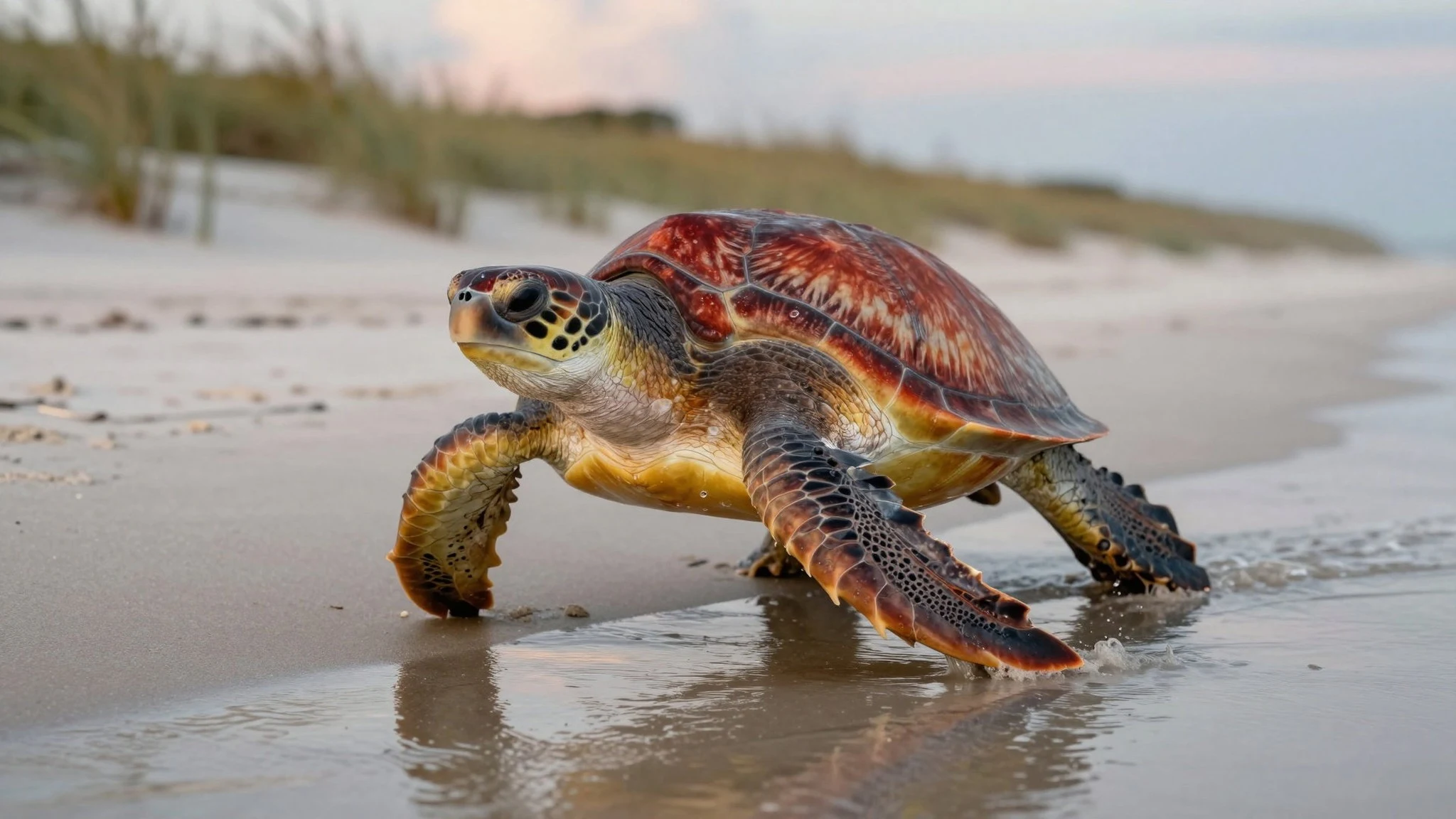
- Loggerhead sea turtle (animal)
The loggerhead is a big sea turtle, a reptile that lives in the sea, with yellow-to-brown skin and a reddish-brown shell, rather like a tortoise with flippers. On Amelia Island, look for it on the beaches during nesting season, when the nights should stay dark. Keep to the marked boardwalks, stay off the dunes, follow any signs, and keep your own lights low after dark. Give it quiet and plenty of space, and never touch or feed it.