Stone Forest
Stone Forest, People's Republic of China
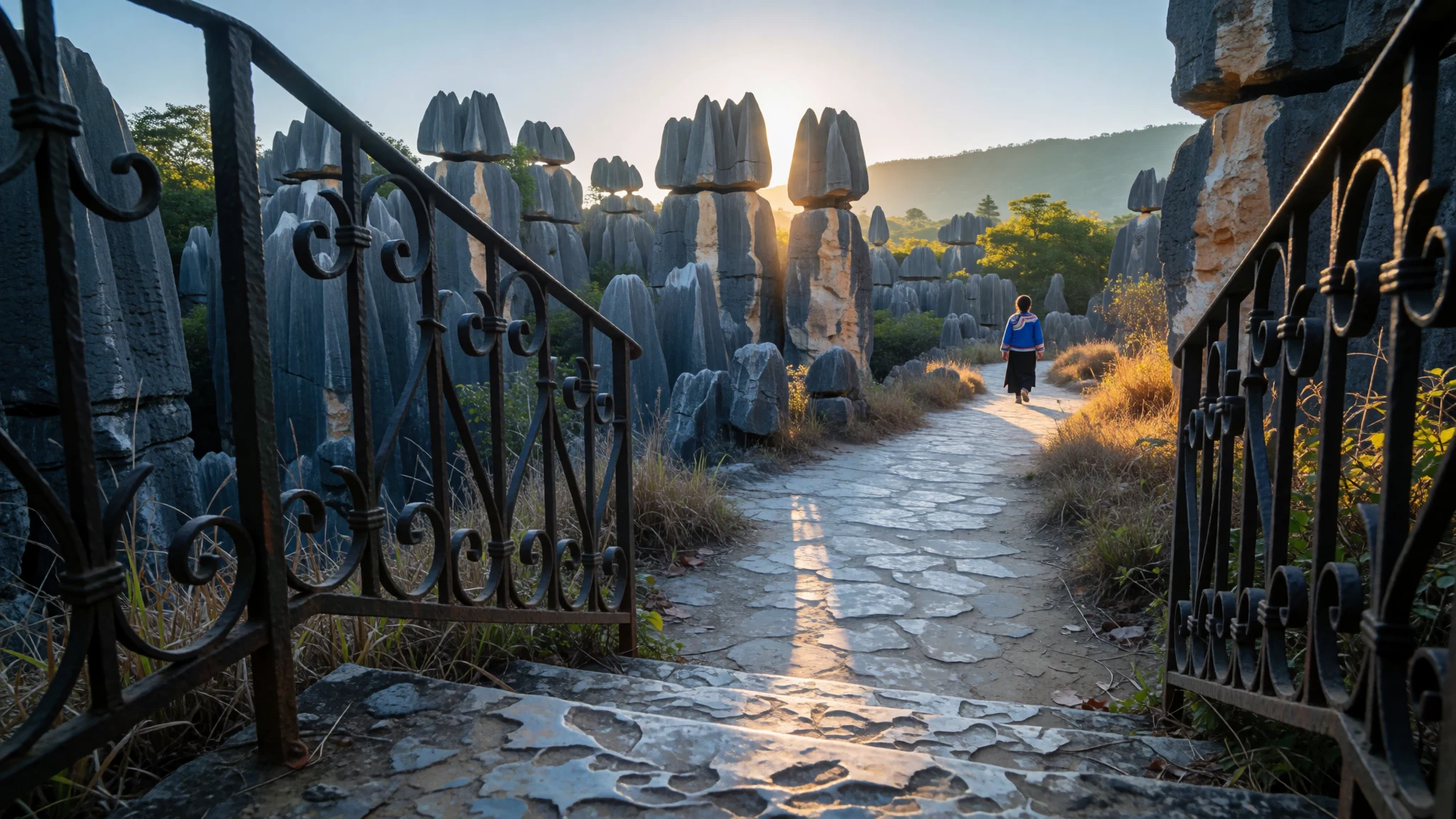
Stone Forest in Yunnan is a maze of grey limestone pillars, shaped over millions of years, with Yi legend woven through the paths.
The place
Stone Forest, or Shilin (石林), stands in Shilin Yi Autonomous County in Yunnan, roughly 90 km east of Kunming, the provincial capital. It is a field of grey limestone pillars, some thin and leaning, some broad as tower blocks, many with the furrowed look of old tree trunks, which explains the name. The formation spreads across a wide area and is divided into sections: the Major Stone Forest, the Minor Stone Forest and, a short way off, the Naigu Stone Forest. Paths, stairways and viewing platforms thread between the rock, and the popular stretches are laid out as loops that squeeze through narrow gaps and open onto small lookouts above the pillars. Two parts of the site, Naigu and Suogeyi Village, have been on the UNESCO World Heritage list since 2007, as part of the South China Karst. The park also carries an AAAAA tourist rating, which tends to mean organised routes, ticket gates and plenty of tour groups. Crowds are heaviest around midday and in national holiday weeks; early mornings and the outer sections feel very different. Kunming and its surroundings have a plateau climate that is mild for much of the year. Summer brings rain, and winter evenings can be chilly. A half day covers the main circuits, and longer is needed if Naigu and the village are included.
Its story
The story of Stone Forest begins in the sea. Around 270 million years ago, in the Permian period, this part of Yunnan lay under shallow water, where limestone built up in layers over older sandstone. Much later the region was pushed upwards, lifting the old sea floor into a plateau. Rainwater, which is slightly acidic, then went to work. It found cracks running through the rock in two main directions, seeped down them and widened them, and over an immense span of time the cracks became deep slots and the blocks between them became pillars. The pattern of those fractures decided how tall the columns grew and which way they face, which is why parts of the forest seem to have a grain. The Major and Minor Stone Forests formed in almost pure limestone, while Naigu, about 9 km to the north-east, formed in rock richer in dolomite. Fossils are rare in the main stone because the rock was heavily altered after it formed, although tiny marine organisms show up under a microscope. Alongside the geology runs a human story. The Yi people of the surrounding county have their own account of the place in the tale of Ashima, and the area is now a protected geopark with World Heritage status for two of its parts.
What to see
- Major Stone Forest — Shilin Yi Autonomous County
The Major Stone Forest is the core of the park and the area most visitors come for. Pillars crowd tightly around paved paths, stairways and several small lookouts, and the best views are from raised platforms where the grey rock spreads out like petrified woodland. Arrive early, before the tour groups, and the narrow lanes between stones feel far less crowded.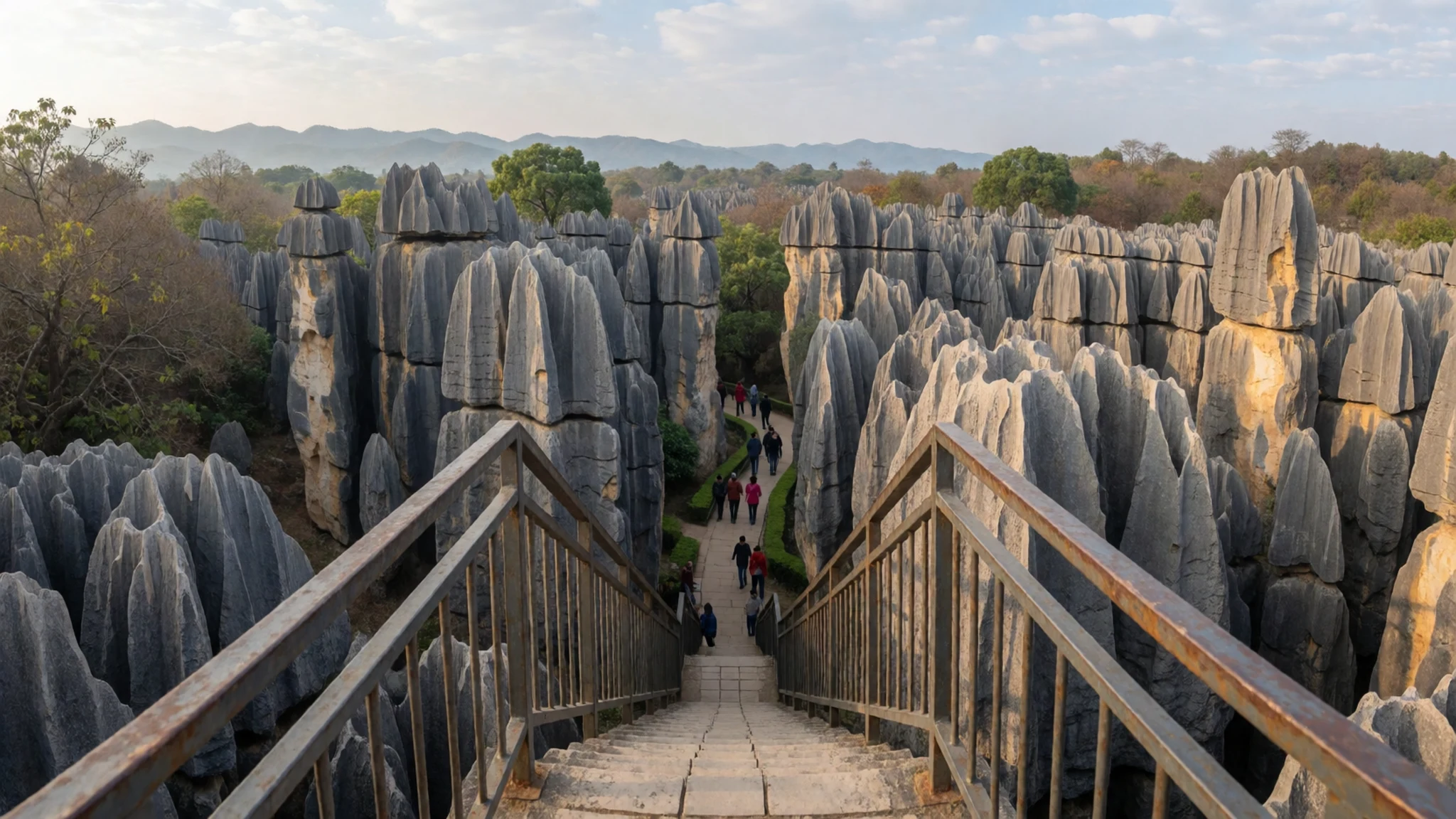
- Minor Stone Forest — Shilin Yi Autonomous County
The Minor Stone Forest sits close to the major section and is gentler in mood. The pillars are shorter and spaced among lawns, trees and water, so the walk feels more like a garden with rock sculptures. It suits a slower circuit after the busy main loop, and the paths are quieter, which makes it easier to look at the rock close up.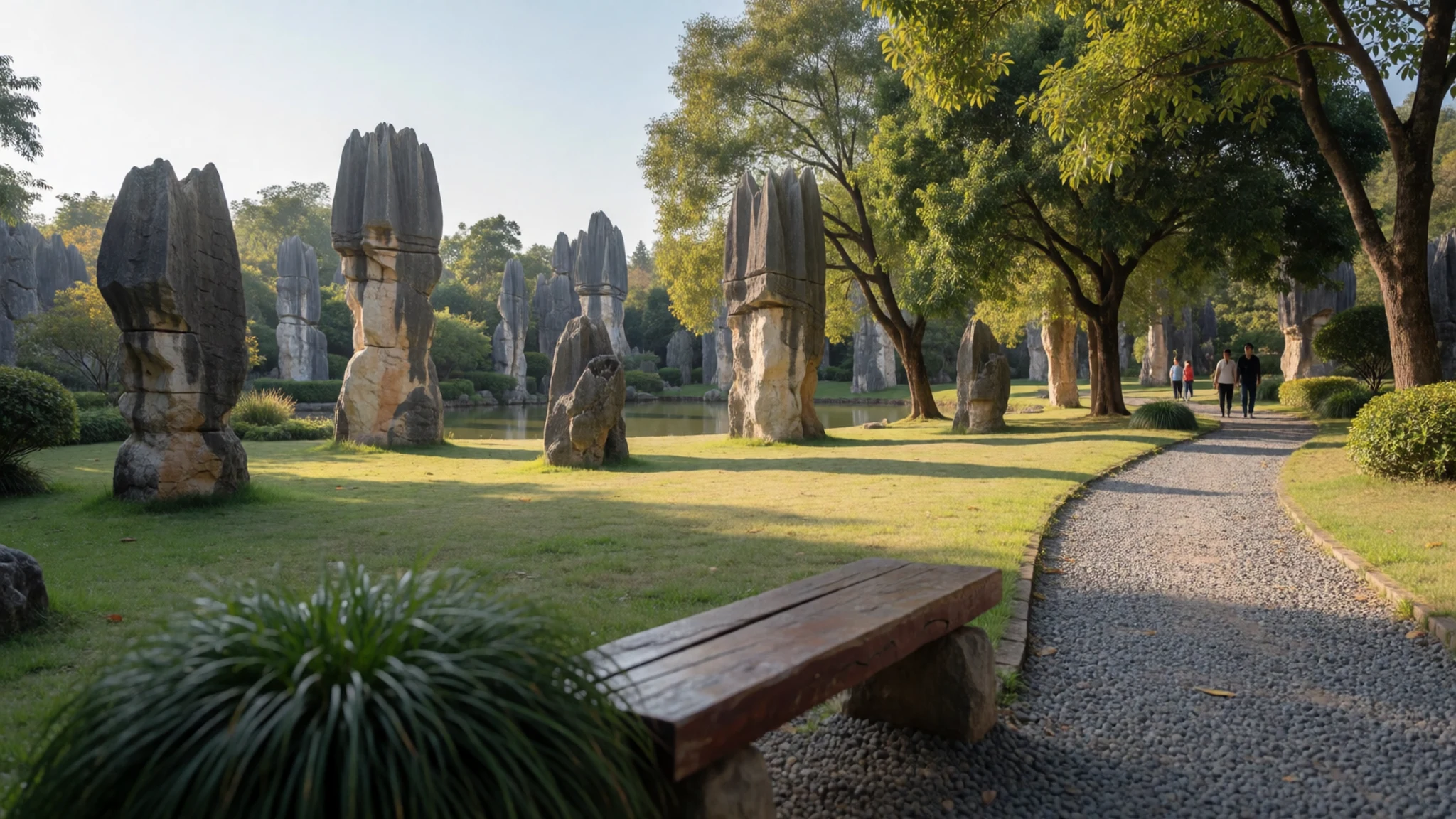
- Naigu Stone Forest — North-east of the main park
Naigu Stone Forest lies about 9 km north-east of the Major Stone Forest and is part of the World Heritage listing. The rock here is dolomite-rich rather than nearly pure limestone, and the setting is more open, with pillars standing in grassy ground. It usually draws smaller crowds, so it suits anyone who wants more space and quiet.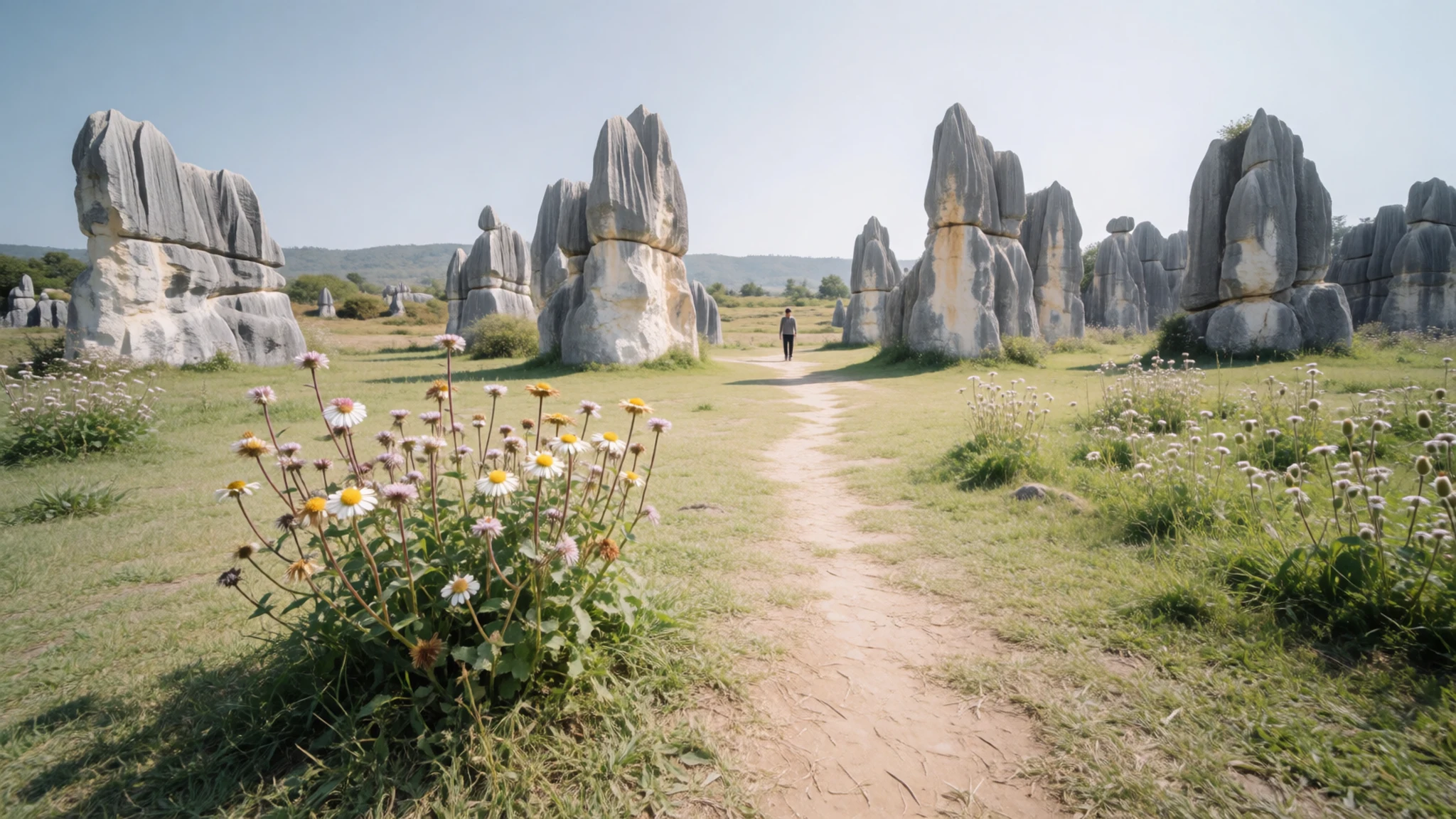
- Ashima Rock — Within the Major Stone Forest
Ashima Rock is the pillar that, in Yi legend, is the girl turned to stone. It is a slender column said to resemble a standing woman, and the viewing spot is often busy with photographers. Even for visitors who find the resemblance a stretch, it is a good way into the story that Yi families tell about this landscape.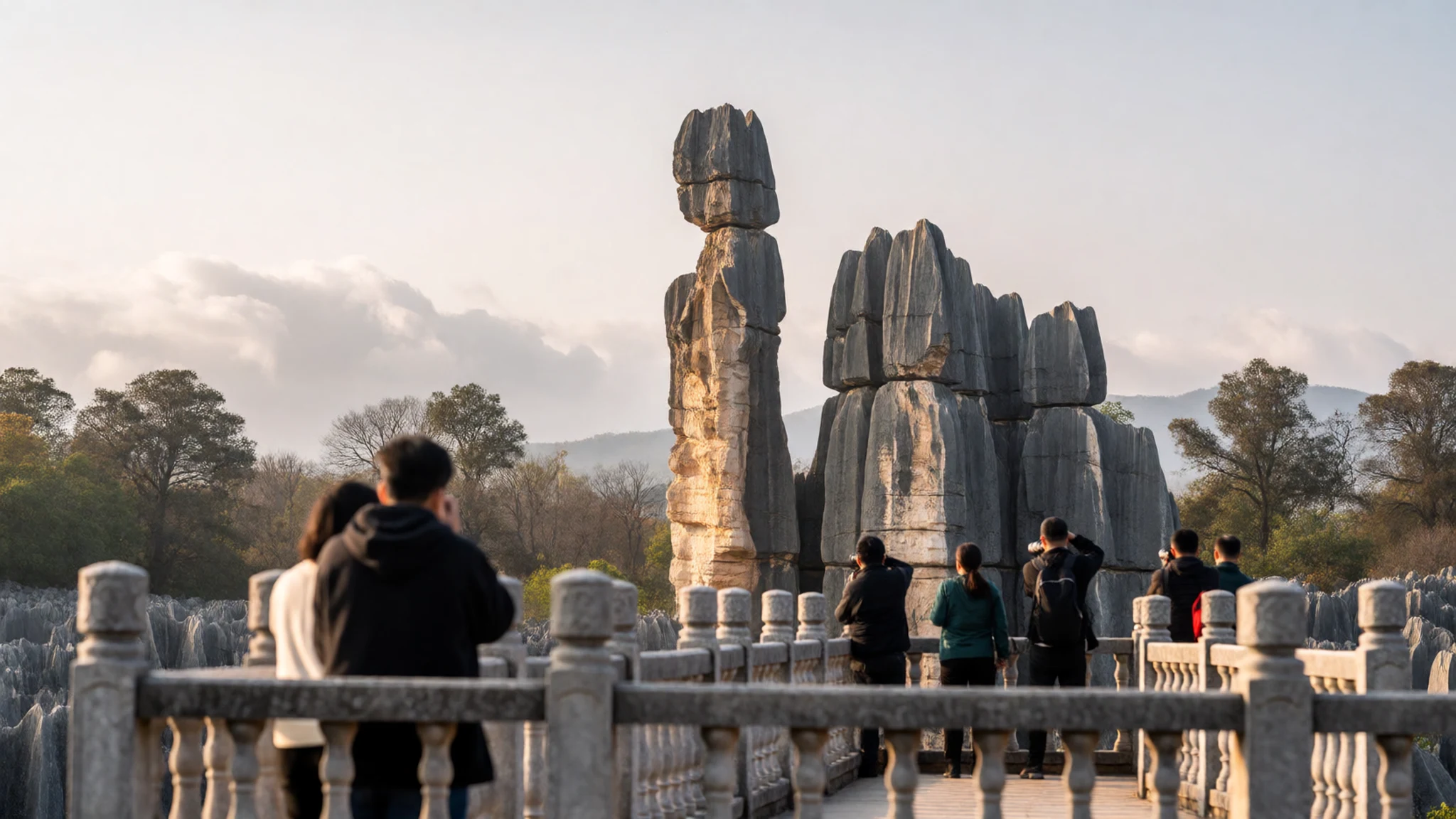
- Suogeyi Village — Near the main park
Suogeyi Village is the second part of the site on the World Heritage list, together with Naigu. It is a small settlement where homes sit among the rocks, giving a more lived-in sense of the landscape than the main park. Visitors should treat it as a village rather than a stage, and ask before photographing residents.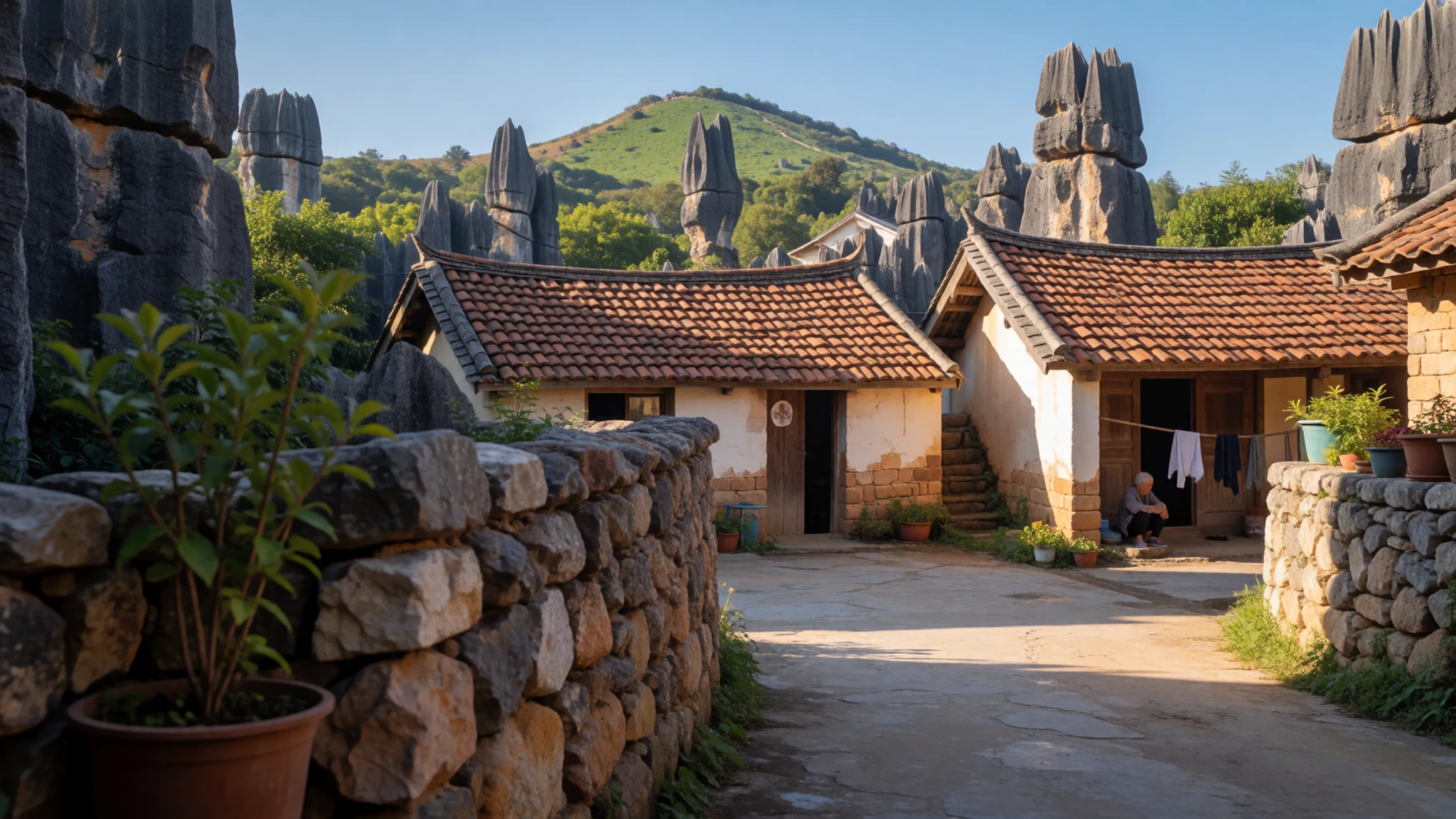
Culture
Stone Forest is as much a Yi place as a geological one. The best-known local story is that of Ashima, a young Yi woman who fell in love but was forbidden to marry the man she chose. In the legend she was turned into stone, and one pillar in the forest still carries her name. The tale is told across the area and gives the rocks a human face, so the walk can feel less like a geology lesson and more like a visit to a character. The other major cultural moment is the Torch Festival, which Yi communities celebrate in the sixth month of the lunar calendar. It brings folk dances, wrestling matches and a lively, outdoor atmosphere. Because the date follows the moon, it moves each year on the Gregorian calendar, so check locally before planning a trip around it. Visitors who arrive during the festival should expect crowds, noise and a very different mood from an ordinary day among the pillars. Outside festival days, the Yi presence is felt in village life around the park, in the names on signs and in the stories that guides tell. Ask before photographing anyone in Yi dress, and keep to the marked paths rather than climbing on the pillars.
What to wear
Around Stone Forest, traditional Yi dress is built on embroidery. Jackets, waistcoats, sashes and headwear are decorated with bright stitched patterns, and cotton and hemp have long been everyday cloth, while heavier wool is worn against cold. Styles differ between Yi communities, so a single description would be too neat. Full traditional outfits appear mainly at festivals such as the Torch Festival, at weddings and in performances. Day to day, people in Shilin and Kunming dress like most of urban China: jeans, trainers, light jackets and fleeces, with a sun hat or umbrella when the weather turns. Some vendors and guides near the park wear embroidered pieces as part of their work, which is worth appreciating without treating it as a costume. A visitor should dress for walking. Wear comfortable shoes with real grip, because limestone steps and paths turn slippery in rain. Bring layers, since mornings and evenings on the plateau can be cool even when midday is warm. Carry a light waterproof from June to August and sun protection in the dry months. There is no strict dress code in the park, but modest clothing is courteous in villages and at festivals.
What to eat
- Crossing-the-bridge rice noodles — Noodle shops in Shilin town and Kunming
A Yunnan classic: a bowl of very hot broth served with raw ingredients and noodles that cook at the table. It is filling after a morning on the paths and is easy to find as a set meal at noodle shops.
- Steamed chicken in an earthenware pot — Local restaurants and eateries in Kunming
Chicken cooked by steam in a special clay pot gives a clear, deeply savoury soup with no added oil. It is a regional favourite, usually ordered to share, and it makes a quiet, restorative dinner.
- Wild mushrooms — Markets and family-run eateries, especially in summer
Yunnan is known for its mushrooms, which appear in stir-fries, soups and hotpots during the rainy months. Menus change with what is in season, so ask what is fresh and be sure the eatery has handled the mushrooms properly. - Fried goat's cheese — Kunming markets and street food stalls
Rubing, a firm, mild goat's cheese, is sliced and fried until golden, then served with a sprinkle of salt or sugar. It is an unusual dairy snack for China and a simple vegetarian option. - Grilled tofu with chilli dip — Street stalls near the park gates and in Kunming night markets
Small cubes of tofu are grilled over charcoal until blistered, then dipped in a salty, spicy seasoning. They are cheap, quick and a good snack to carry between sections of the park.
Plan it
Best time. March–April and October–November, when the weather is mild and the plateau light is clear; June to August is the rainy season, and national holiday weeks bring the biggest crowds.
How long. 1–2
Getting there. Fly to Kunming Changshui International Airport, then continue by road or rail to Shilin, about 90 km east of the city. Check current train and coach options before travelling, and arrange the last leg to the park entrance in Shilin town.
Budget. mid
Tips
- Arrive at opening time to enjoy the narrow lanes before the tour groups
- Book tickets through the official channels and check the park's official site or ticket office for current rules and opening times
- Bring a refillable water bottle, sun protection and a light waterproof
- Carry some cash and a mobile payment option, as small vendors may prefer one or the other
- Allow extra time for Naigu and Suogeyi Village if the main loop leaves you wanting quieter ground
Etiquette
- Stay on the marked paths and do not climb on the pillars
- Ask before photographing local people, especially anyone in Yi dress
- Keep noise down in the village and at festival gatherings
Nearby
Sources
- Wikidata Q2735583 (CC0)
- Wikipedia: Stone Forest (rev 1384596867) (CC BY-SA 4.0)
- Wikivoyage: Stone Forest (CC BY-SA 4.0)
- Shilin, Yunnan, China (24740), xiquinhosilva (CC BY 2.5)
- Shilin-24774, xiquinhosilva (CC BY 2.5)
- Shilin, Yunnan, China (24611), xiquinhosilva (CC BY 2.5)
- Shilin, Yunnan, China (24747), xiquinhosilva (CC BY 2.5)
- Shilin, Yunnan, China (24735), xiquinhosilva (CC BY 2.5)
- Shilin-24629, xiquinhosilva (CC BY 2.5)
- Shilin, Yunnan, China (24619), xiquinhosilva (CC BY 2.5)
- Shilin, Yunnan, China (24812), xiquinhosilva (CC BY 2.5)


