Sayram Lake
Sayram Lake, People's Republic of China
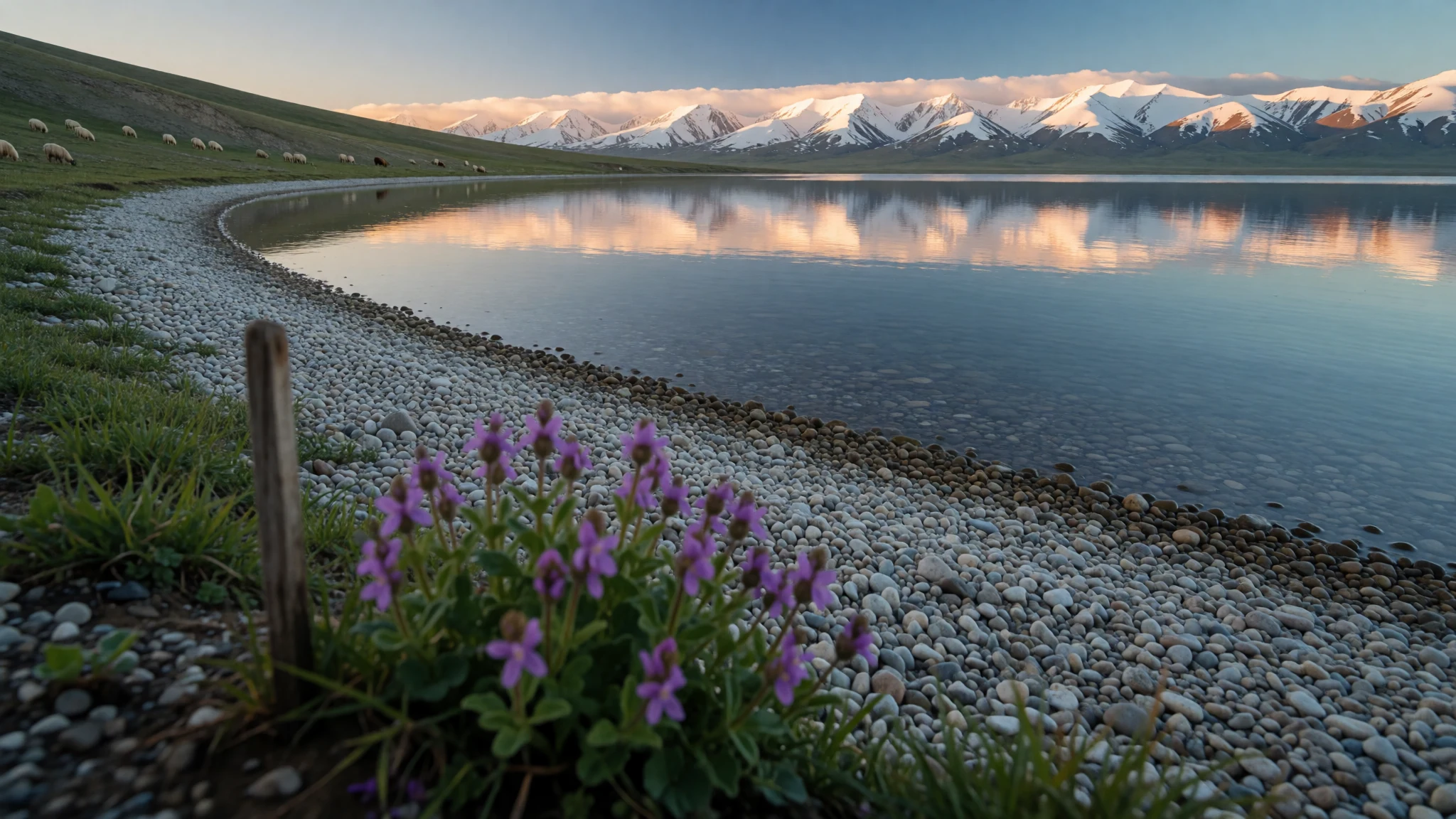
Sayram Lake is a cold, wide, blue mountain lake near the Kazakhstan border, where Kazakh herders graze their flocks in summer.
The place
Sayram Lake sits at 2,070 m in the northern Tianshan, in the Börtala Mongol Autonomous Prefecture of Xinjiang, close enough to the Kazakhstan border that its name is Kazakh, meaning roughly "blessing". It is a freshwater lake with no outlet, fed by glacier melt, snow and rain carried in on the westerlies, and a scatter of springs. Other names exist: Santai Haizi in Chinese, and an older label, the "Clean Sea". The Chinese name is Sàilǐmù hú (赛里木湖).
The setting is open and treeless in the way high pasture often is: a broad blue bowl ringed by grassy slopes, with snowy summits behind. The air is thin and cool even in summer, and the weather can turn within an hour. Kazakh herding families bring sheep and horses up in the warm months, and their tents and flocks are as much a part of the scene as the water.
It is also a major domestic tourist draw, and it holds the top tier of China's scenic-area ratings. A ring road circles the shore, and a large visitor complex of gates, car parks, shops and a restaurant area has been growing near the main entrance. The main viewpoints can be crowded with coach groups in holiday weeks, while a short walk or drive along the shore brings far more space. Summer is the season for a visit; outside it the lake is very cold, and many families have moved down to town.
Its story
Sayram Lake lies on a mountain route used by Silk Road traffic on its northern branch, though the high ground around the water was rarely settled for long. People lived in the valleys to the east instead: Saka horsemen, then Tocharian-speaking groups such as the Jushi and Wusun, later the Göktürks and the Oirat, or Dzungar, Mongols. Each left traces. Around the shore, archaeologists have recorded rock carvings, tombs, the remains of temples, stone cairns called ovoo, inscribed steles and the ruins of relay stations from several different dynasties. The lake was a landmark on a long road more than a place to stay.
Travellers noticed it. The Taoist monk Qiu Chuji, journeying west in the late Southern Song period, wrote of a vast sheet of water ringed with snowy peaks and called it a heavenly pool. The Mongol-era statesman Yelü Chucai also described it, as did Lin Zexu, the Qing official sent to Xinjiang in disgrace after the First Opium War. Their accounts are why the lake had a place in Chinese writing long before it had a ring road.
Local memory has its own version. A Kazakh folktale says a young couple, parted by a demon, threw themselves into a chasm so they could be together, and the tears shed for them filled it to make the lake. The Kazakh name, meaning blessing, sits comfortably beside that tale, and the older Chinese label, the Clean Sea, points to water thought of as pure.
What to see
- The hillside viewpoint — Hillside above the lake
A slope above the shore gives the view most photographs of Sayram Lake are taken from: the whole blue sheet of water, pale grassy hills around it and snow on the far ranges. Go early or late, when the light is low and the tour groups are thin, and carry a windproof layer for the climb.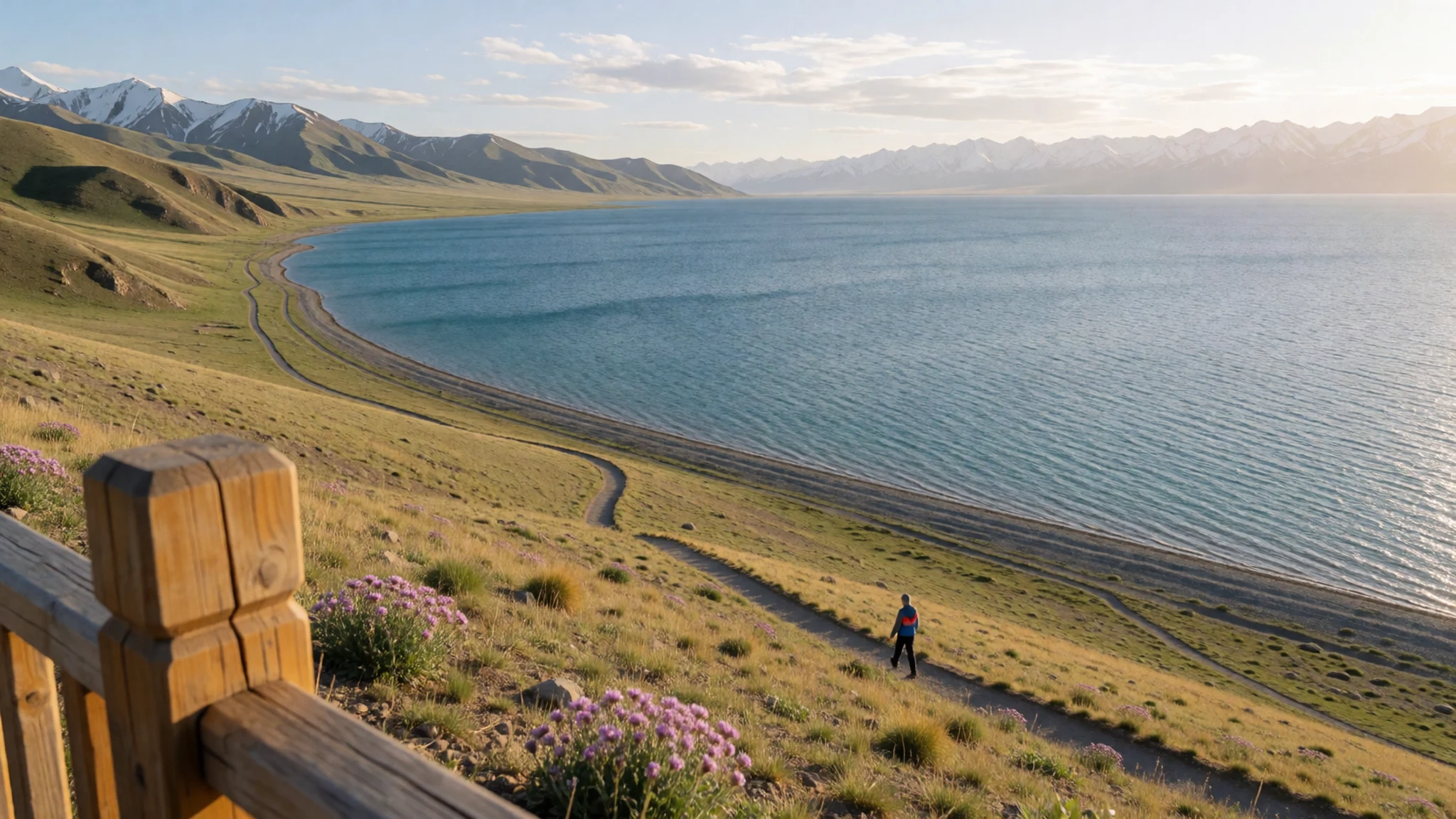
- The island in the water — Open water, central lake
The lake has an island out in the water, which shows up in drone views as a small patch of land in a very large expanse of blue. It is mostly something to look at from the shore rather than a destination; ask at the visitor centre whether any boat trips run and what they cover.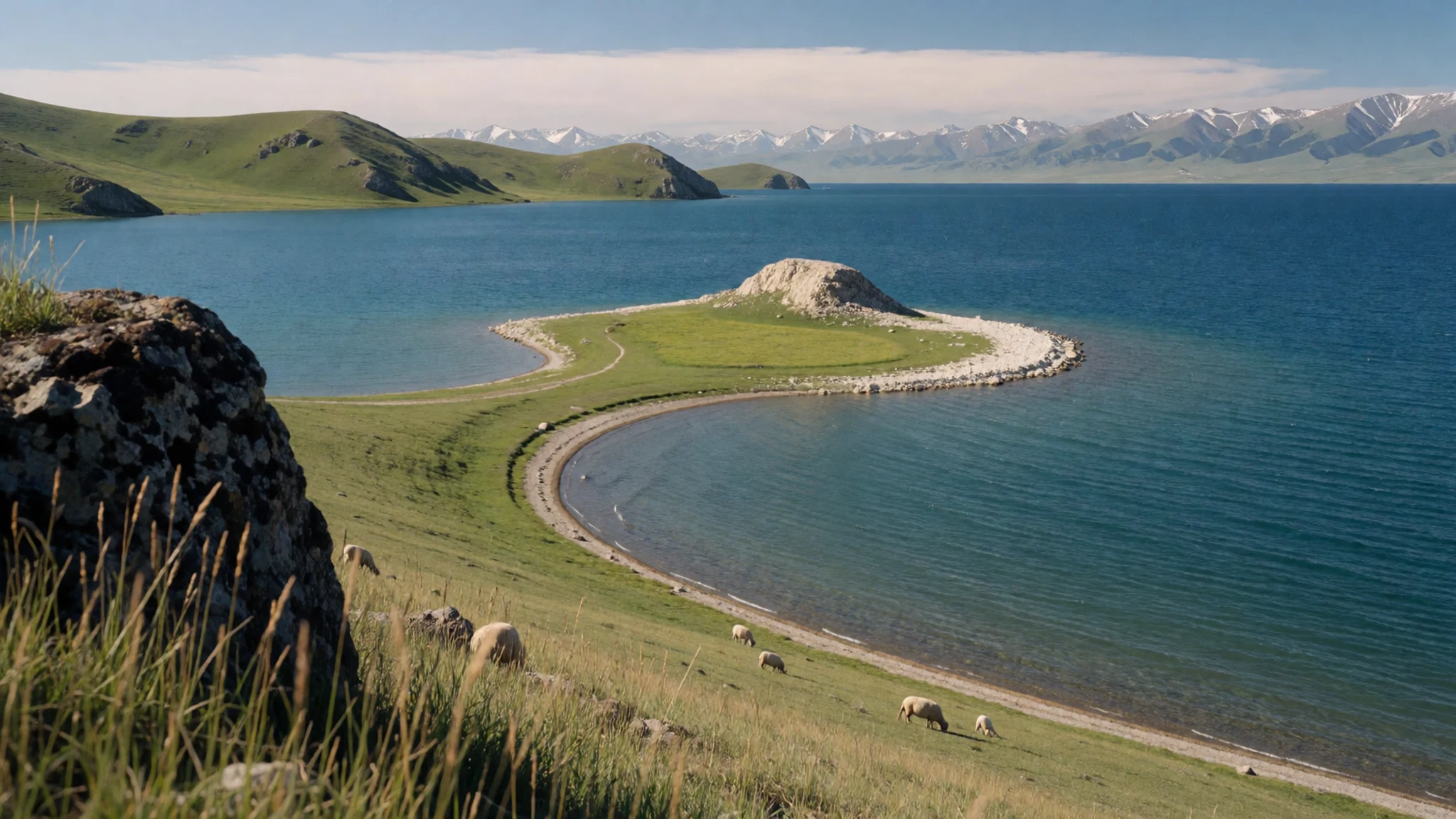
- The shoreline and ring road — Lakeshore road
A ring road circles the lake, so the shore can be covered by car, bike or coach in a day, stopping wherever the view changes. Some stretches have stalls and car parks, others are simply grass, pebbles and wind. An annual cycling race uses the same loop, which tells you the surface is decent.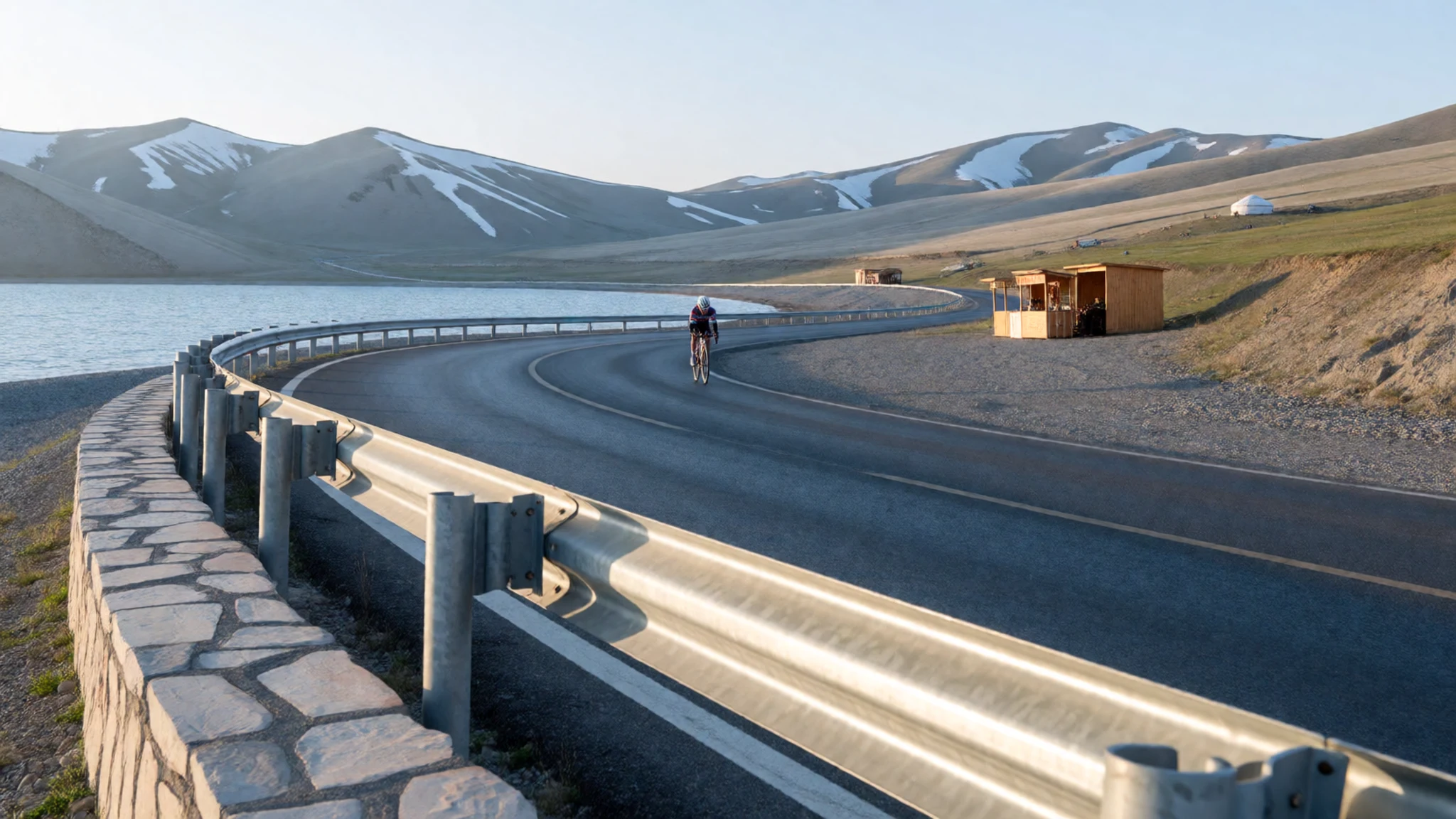
- Kazakh pastures and horse rides — Slopes around the lake
Herding families graze sheep and horses on the slopes around the lake in summer, and some offer horse rides or a seat in their tent. Agree terms before setting off and ask before photographing people. The pastures are best reached by walking a little way from the main car parks, where the coach noise fades.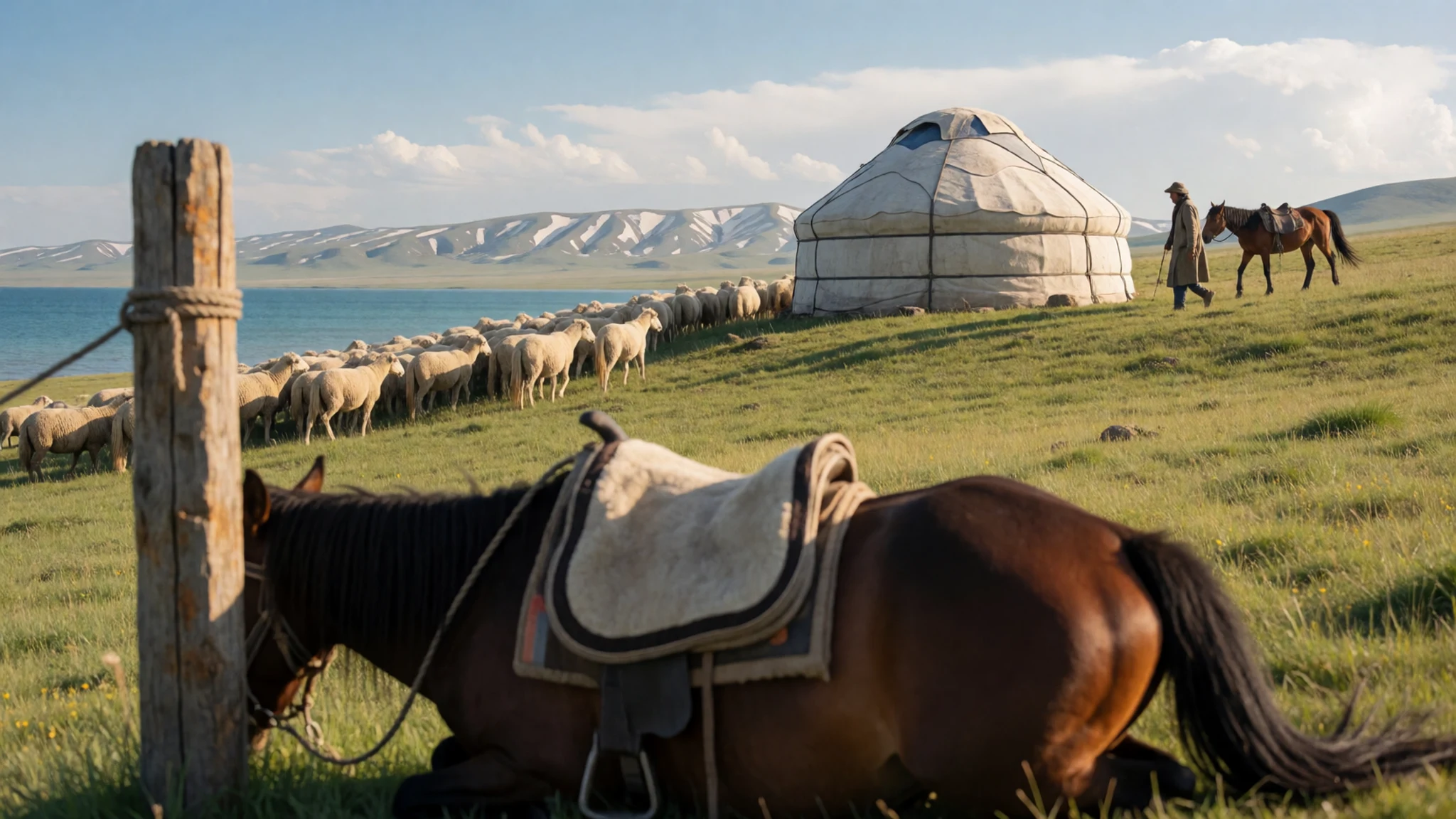
- The visitor area near the entrance — Main entrance area
Near the main entrance the lake shows its tourist side: gates, car parks, a shopping and restaurant complex, and a large visitor centre that was under construction at the time of the brief. It is the practical place to ask about transport, tickets and weather, and to use a toilet before heading round the shore.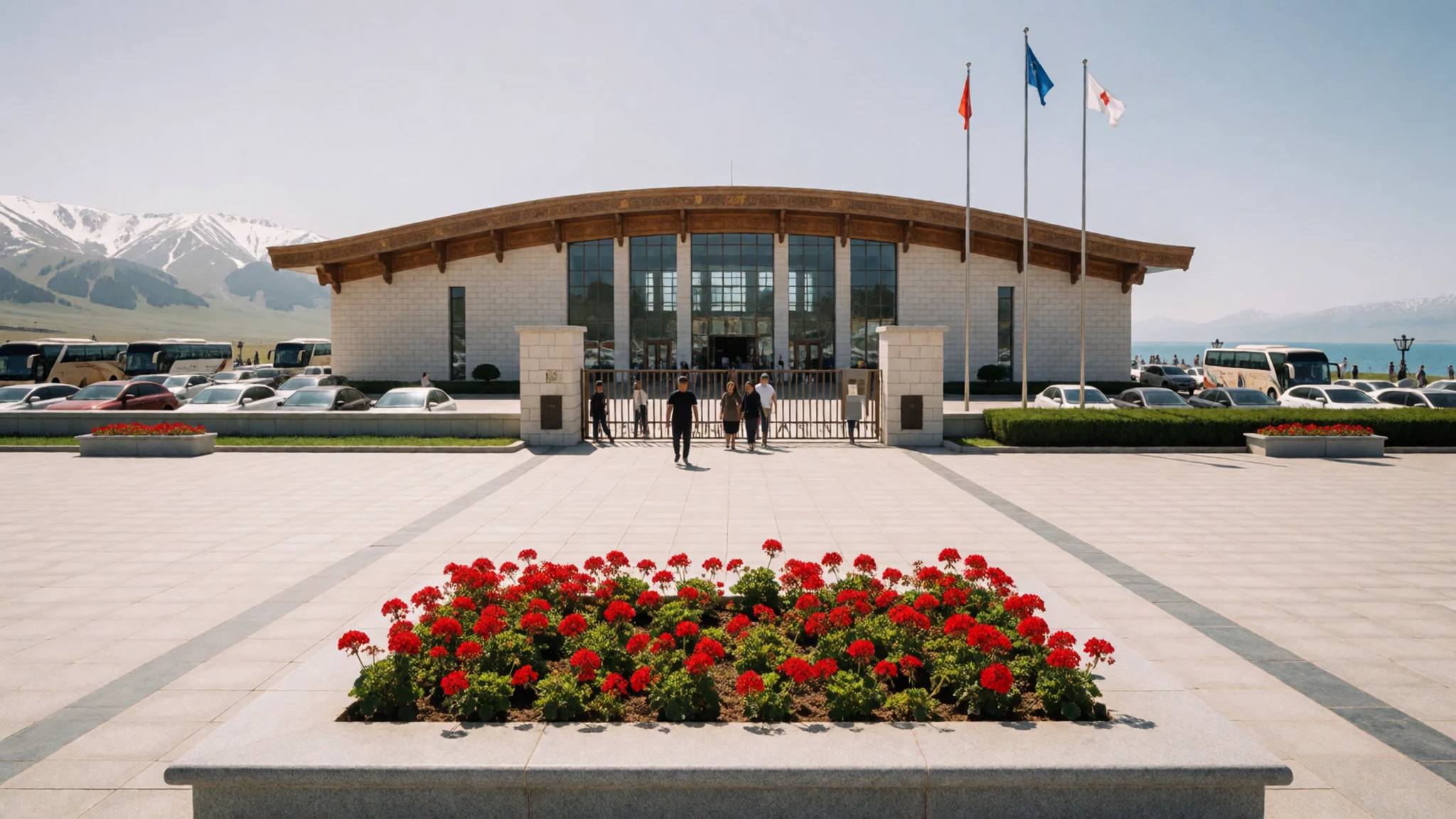
Culture
Sayram Lake is Kazakh country in the everyday sense: the name is Kazakh, and the herding families who spend summer on its slopes follow the hospitality customs of steppe pastoralists. A guest is traditionally offered tea, bread and whatever the household has, and turning everything down can come across as cold. Sharing a little in return, such as fruit or sweets, is the usual way to answer.
Families move with the seasons. In summer they camp by the water, offering horse rides, meals and a bed in a tent; when the cold returns they go down to Yili Town, which is why lodging by the lake gets thin outside the warm months. Most Kazakhs in Xinjiang are Muslim, and that shapes food, dress and the rhythm of the day, while the stone cairns called ovoo, whose ruins turn up in the area's archaeology, belong to older Mongol and Turkic ways of marking high places. The surrounding prefecture is a Mongol autonomous one, and Han Chinese, Uyghur and Kazakh communities all live in the wider region, so signs and shop talk shift between languages within a day's travel.
Tourism is now part of the herders' income, and the lakeside is busiest in national holiday weeks.
Ask before photographing herders, children or the inside of a tent, and take any tea or bread you are offered with your right hand.
What to wear
Around Sayram Lake, traditional dress is Kazakh dress, made for a life on horseback in cold country. Winter coats are sheepskin or fur-lined, men wear a felt hat called a kalpak, and quilted wool or velvet chapan coats close at the waist with a sash. Women's festive outfits use velvet and silk, heavily embroidered and set off with silver jewellery; a bride traditionally wears the tall, ornate saukele headdress, and older married women wrap the head in a white cloth called a kimeshek. Felt, a product of the flocks, runs through everything from boots to rugs. Full costume now appears mostly at weddings, festivals and celebrations.
Day to day, herding families wear what works: padded jackets, fleeces, jeans, sturdy boots, and a cap or headscarf against the wind. Domestic tourists arrive in bright waterproof jackets and trainers.
For a visit, dress for a cold, windy plateau, even in July. Layers work best: a thermal base, a fleece, a windproof and waterproof shell, and a hat and gloves for the evenings. The sun is strong at this height, so sunglasses and sun cream matter. Sturdy trainers or boots suit wet grass and gravel. When visiting a family's tent, cover shoulders and knees, which is the courteous norm in this largely Muslim region.
What to eat
- Baursak — Family tents and roadside stalls around the lake
Baursak are small pieces of dough fried until golden, served with tea and at every celebration. Warm ones from a family tent or a roadside stall are soft and slightly sweet, while cold ones are heavier. They are often eaten with jam or cream.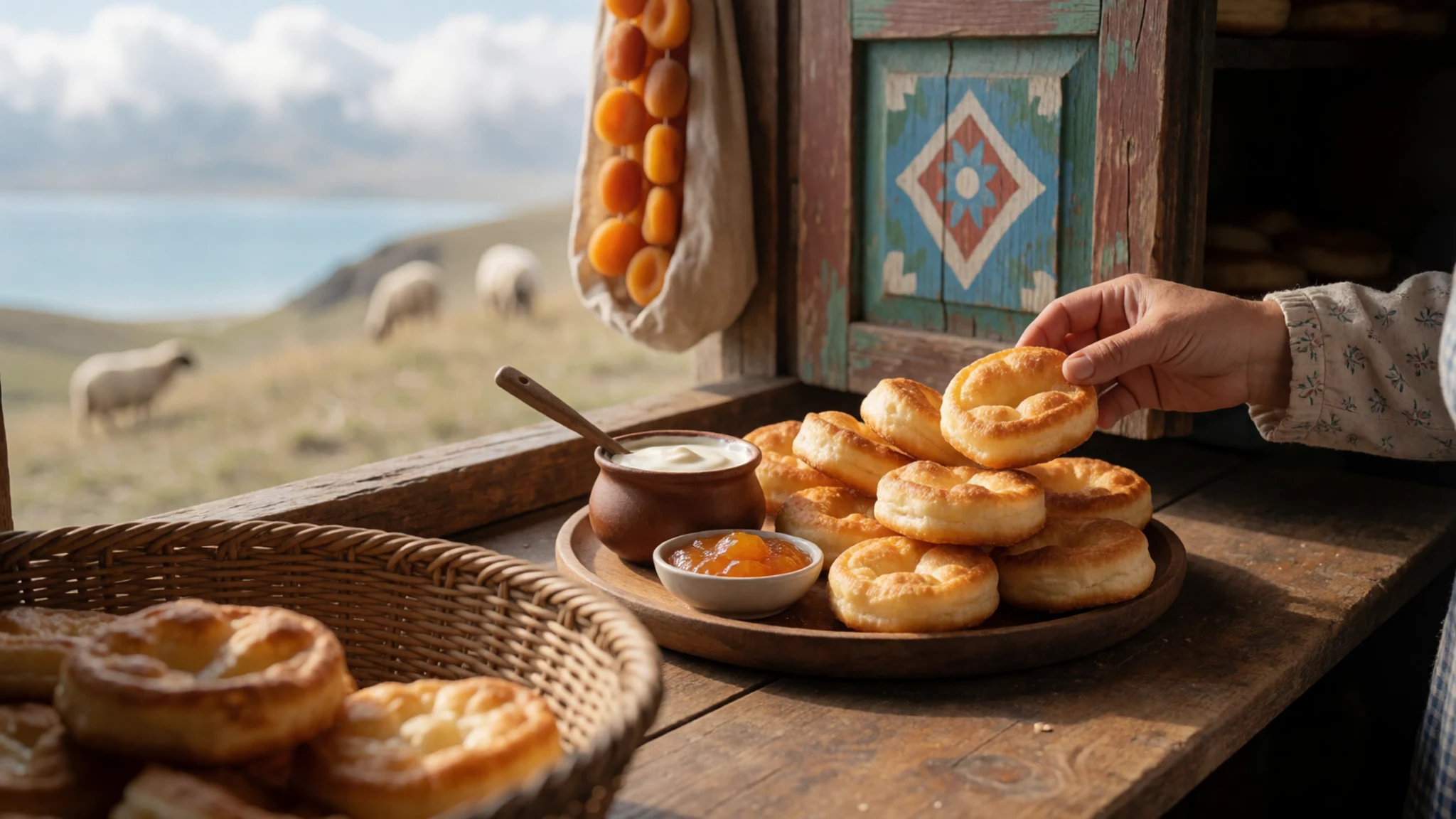
- Beshbarmak — A host family's tent, or a Kazakh eatery in Yili Town
Beshbarmak is boiled mutton or horse meat laid over broad flat noodles with onion and a little broth, traditionally eaten with the hands at feasts. Near the lake it is usually a special order from a host family rather than an everyday dish, so ask a day ahead.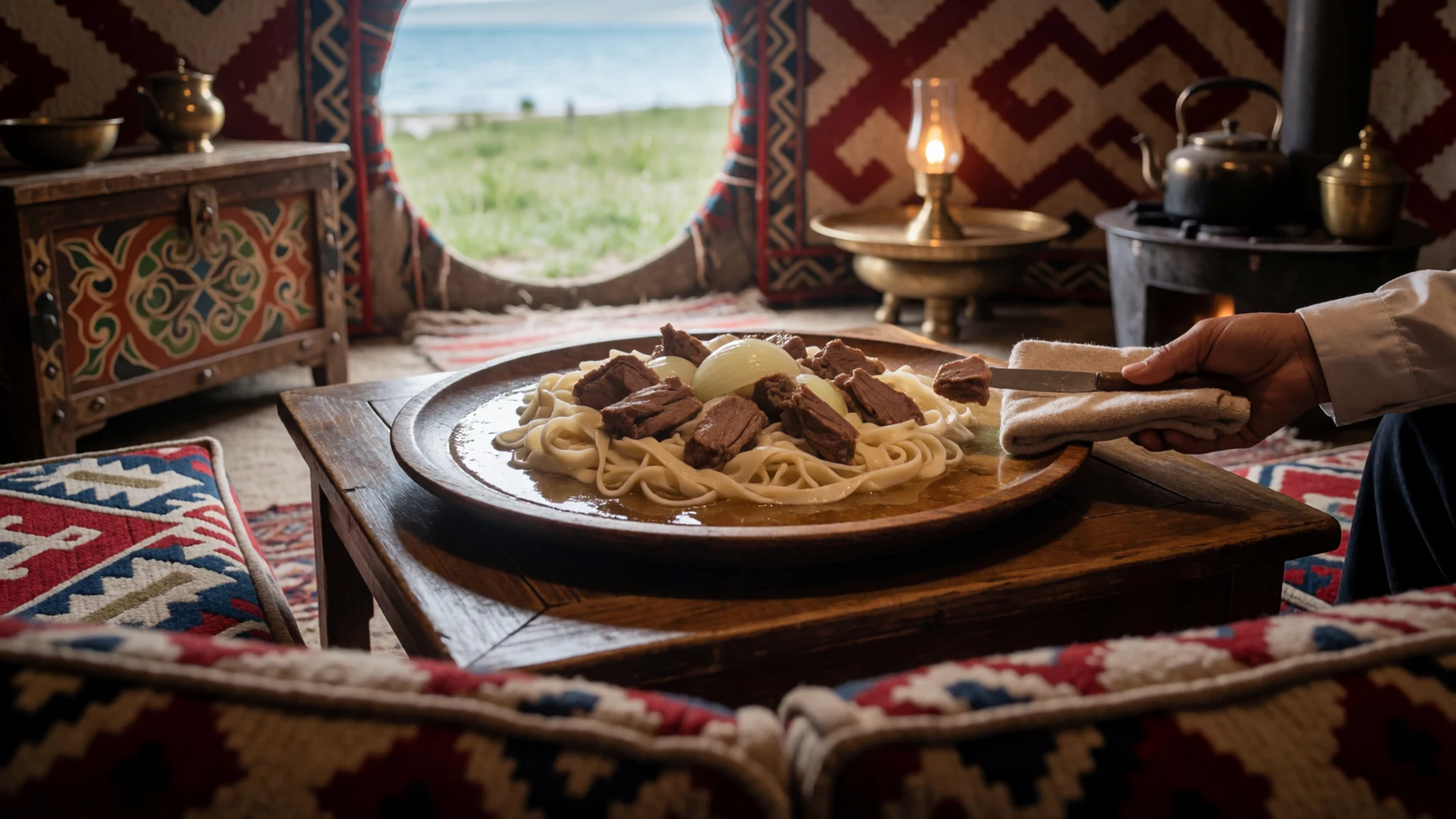
- Kumis — Family tents near the summer pastures
Kumis is fermented mare's milk, lightly fizzy, sour and a little alcoholic, a summer drink of Kazakh herding families. It is an acquired taste, so ask for a small cup first. It is mostly found in summer, in family tents near the grazing areas. - Kurut — Roadside stalls and small markets
Kurut are hard, salty balls of dried curd made from sour milk, kept by herders as a portable snack. They are very sour and need slow sucking or chewing. Look for them in bags at roadside stalls and small markets near the lake. - Lagman — Noodle eateries in the visitor area and in Yili Town
Lagman is hand-pulled noodles in a sauce of stir-fried lamb, peppers and tomato, a staple across Xinjiang. It is the easiest filling meal near the lake, where plain noodle eateries and canteens in the visitor area serve it. Order it with a pot of tea.
Plan it
Best time. June to September, when the days are mildest, herding families are on the slopes and lodging is open. The lake is cold year-round at this altitude, and finding a bed is hard outside those months because many families move down to Yili Town.
How long. 1–2
Getting there. Fly to Urumqi or Yining, then continue by road. The lake lies beside the G30 expressway and the old G312 highway, which link Urumqi with the Khorgos border crossing; from Urumqi it is a long day's drive west, and from Yining about two hours. Check current coach and hire-car options before you go.
Budget. mid
Tips
- Book lakeside lodging well ahead for summer weekends and national holidays, or bring a tent and camp where the park allows
- Bring layers, a hat and sun cream: it is cold and windy at 2,070 m, and the sun is strong
- Carry your passport, as road checks are routine in Xinjiang
- Carry some cash for stalls and family tents, as card payment can be patchy
- Check ticket arrangements and the opening of the visitor centre with the scenic area before travelling
Etiquette
- Ask before photographing herders, children or the inside of a tent
- Accept tea or bread offered by a host, and offer something small in return
- Take all rubbish with you and camp only where it is allowed
Nearby
Sources
- Wikidata Q2410894 (CC0)
- Wikipedia: Sayram Lake (CC BY-SA 4.0)
- Wikivoyage: Sayram Lake (CC BY-SA 4.0)
- DSC_9301 — lwtt93 (CC BY 2.5)
- Panoramic view of Sayram Lake — BitsRot (CC BY 4.0)
- Lake Sayram buildings — User:CatOnMars (CC BY 4.0)
- Lake Sayram, lake and island drone view — User:CatOnMars (CC BY 4.0)
- Lake Sayram, lakeshore drone view — User:CatOnMars (CC BY 4.0)
- Lakeshore of the Sayram Lake — User:CatOnMars (CC BY 4.0)
- Sailboats on the Sayram Lake — User:CatOnMars (CC BY 4.0)
- Scenery in Lake Sayram Scenic Spot — Tomskyhaha (CC BY-SA 4.0)


